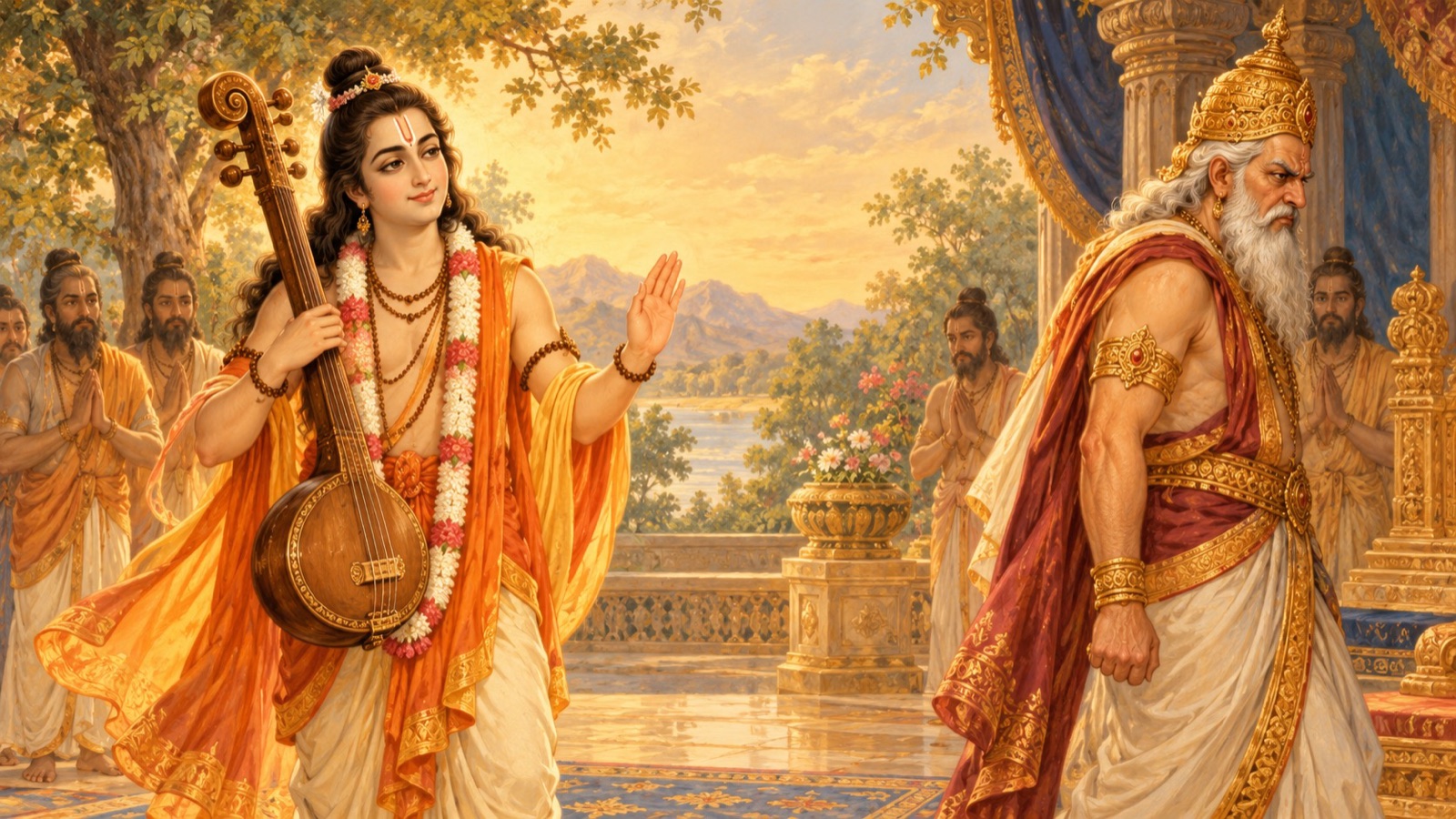
Cursed to wander the worlds without rest, the sage Narada answers not with anger but with a single word — “Very well” — and teaches that to forgive when one could strike back is the mark of a truly holy soul.
Om Namo Bhagavate Vasudevaya.
Om Namo Bhagavate Vasudevaya.
Om Namo Bhagavate Vasudevaya.
Welcome to Srimad Bhagavatam Wisdom, a devotional journey through the sacred histories and teachings of the Srimad Bhagavat Mahapurana. The fifth chapter of the Sixth Canto tells a story at once poignant and profound. Prajapati Daksha, eager to fill the worlds with offspring, fathers first ten thousand sons and then a thousand more, sending each host to perform austerities so that they might beget children. But the wandering sage Narada meets them at a holy lake and, with a handful of riddles, awakens them to the higher purpose of life — and one after another they abandon the path of procreation for the path of liberation, never to return. Twice bereft of his sons, the grieving Daksha turns upon Narada in anger and lays a heavy curse upon him. The chapter’s crown is not the curse, however, but the sage’s response: a serene acceptance that reveals the true stature of a soul devoted to God.
Chapter Information
- Scripture: Śrīmad Bhāgavata Mahāpurāṇa
- Canto: 6 (Book Six)
- Chapter: 5 (Discourse 5)
- Chapter title: Narada Muni Cursed by Prajapati Daksha
- Principal speakers: Sukadeva Gosvami, narrating to King Parikshit; Narada Muni, the Haryasvas, and Prajapati Daksha within the account
- Principal listener: King Parikshit; the sages of Naimisharanya at the outer frame
- Main setting: The bank of the Ganga where Parikshit listens; within the story, the holy lake Narayana-saras, where the river Sindhu meets the sea
- Central subject: The transformation of Daksha’s sons by Narada’s wisdom, their departure for liberation, and Daksha’s curse upon Narada
- Principal verse range: Canto 6, Chapter 5, verses 1–44
- Primary edition: Gita Press Śrīmad Bhāgavata Mahāpurāṇa
The Haryasvas and the Holy Lake
Energized by the Lord’s own creative power, Daksha begot through his wife Panchajani ten thousand sons known as the Haryasvas. Alike in conduct and disposition, and commanded by their father to beget offspring, they journeyed westward to undertake austerities. There they reached Narayana-saras, a vast and holy lake at the place where the river Sindhu meets the sea, resorted to by sages and Siddhas (verses 1-3). Merely by bathing in its sacred waters their minds were cleansed of all impurity, and a natural inclination toward the path of the great renunciants awakened in them — though, bound by their father’s command, they still set themselves to severe penance for the sake of increasing the population (verses 4-5).

Narada’s Riddles and the Awakening
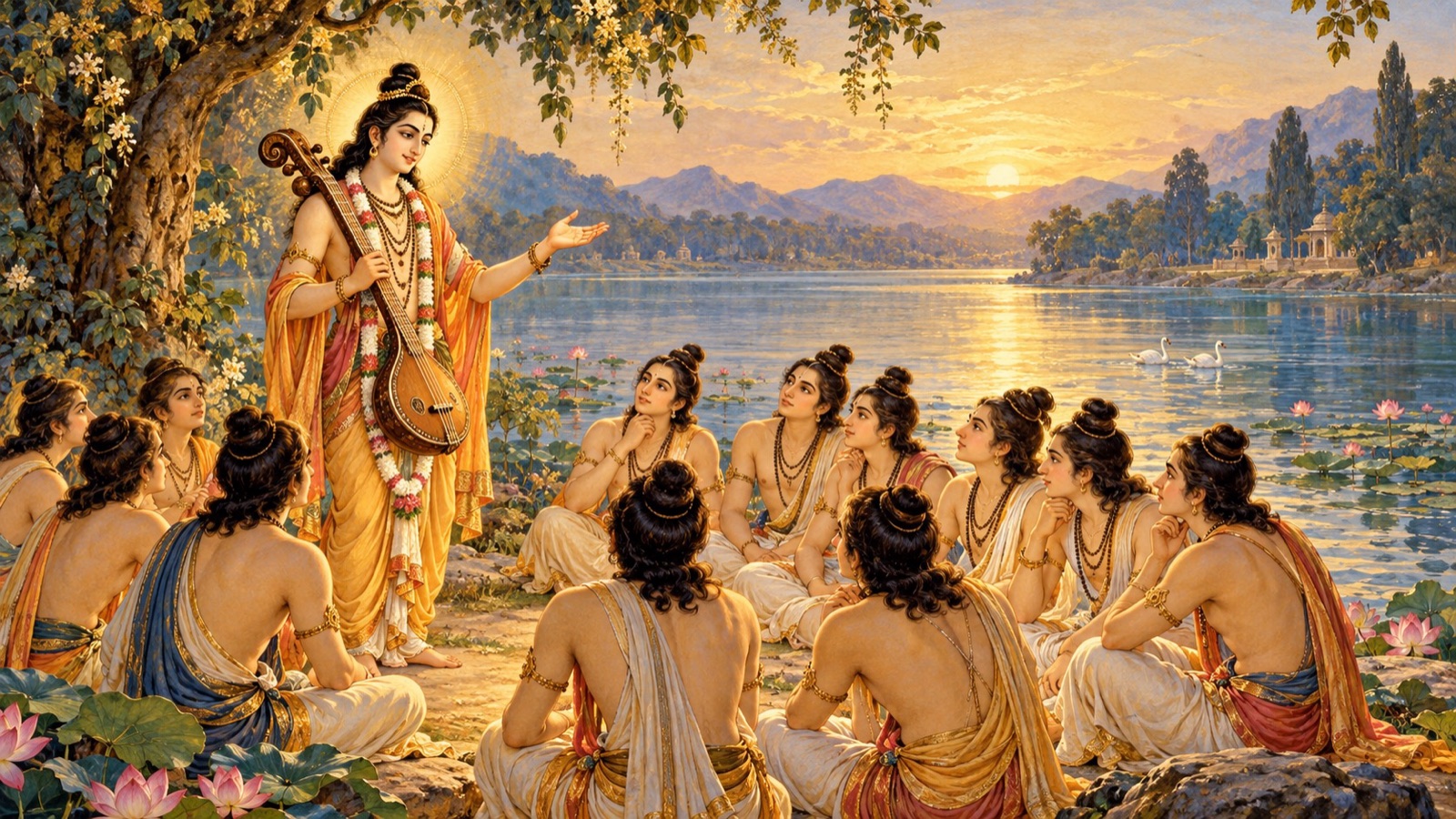
Seeing the Haryasvas intent on multiplying the world’s population, Narada approached and addressed them with a string of enigmas. Without having seen the end of the earth, he asked, how will you truly beget progeny? Though appointed as protectors, alas, you are ignorant! He spoke of a country inhabited by a single person, a hole with no visible outlet, a woman assuming many forms, a man who is the husband of a harlot, a river that runs both ways, a wonderful house built of twenty-five materials, a swan with a strange story to tell, and something exceptionally sharp and revolving — and asked how, without understanding these and their omniscient father’s true command, they could proceed with creation (verses 6-9).
Endowed with quick and clear perception, the Haryasvas pondered his words and unravelled every riddle. The earth was the field of the subtle body, the long-standing fetter of the soul; what is gained by fruitless action without seeing its end? The country’s sole ruler was the Supreme Lord Himself — the witness of the waking, dream, and deep-sleep states, the transcendent fourth, self-supported and beyond all.
एक एवेश्वरस्तुर्यो भगवान् स्वाश्रय: पर: । तमदृष्ट्वाभवं पुंस: किमसत्कर्मभिर्भवेत् ॥ १२ ॥
eka eveśvaras turyo bhagavān svāśrayaḥ paraḥ tam adṛṣṭvābhavaṁ puṁsaḥ kim asat-karmabhir bhavet
Meaning: The Lord alone is the one supreme controller, the transcendent fourth, self-supported and higher than all. Without seeing Him, who is ever free from birth, what can a person gain through fruitless activities? (Canto 6, Chapter 5, verse 12)
So they decoded the rest. The woman of many alluring forms was the wandering intellect coloured by the three modes; her unworthy husband, the soul that identifies with it. The river flowing both ways was Maya, which brings forth creation and dissolution and grows fierce near the very banks of spiritual practice. The wonderful house of twenty-five materials was the body, and its indwelling Purusa the wonderful mirror of all its causes and effects. The swan was the discrimination that separates spirit from matter, as a swan is said to separate milk from water; the sharp, revolving, independent thing was the wheel of Time that devours all creation; and the second father was the scripture, whose precepts turn one away from mere worldly activity. Thus resolved and of one mind, the Haryasvas circled Narada in reverence and took the path of God-realization from which one does not return. His own mind fixed on the lotus feet of Lord Vishnu, the sage went on his way through the spheres (verses 10-22).
The Sabalasvas and the Sacred Mantra
Hearing that his virtuous sons had turned from worldly life at Narada’s word, Daksha was overcome with sorrow — for it is indeed a source of grief to have good children who will not remain. Consoled by Brahma, he begot through Panchajani a thousand more sons, the Sabalasvas, and again enjoined them to beget children (verses 23-24). They too resolved on austerity and repaired to Narayana-saras, where their elder brothers had attained their goal. Their minds cleansed by its waters, they practised great penance, softly uttering the sacred syllable OM. Living for months on water alone and then on air, they worshipped Bhagavan Vishnu with a sacred formula (verses 25-27).
ॐ नमो नारायणाय पुरुषाय महात्मने । विशुद्धसत्त्वधिष्ण्याय महाहंसाय धीमहि ॥ २८ ॥
oṁ namo nārāyaṇāya puruṣāya mahātmane viśuddha-sattva-dhiṣṇyāya mahā-haṁsāya dhīmahi
Meaning: Om. We offer obeisance to Lord Narayana, the Supreme Person, the great Soul, whose abode is pure, unalloyed goodness — upon that great transcendent Swan we meditate. (Canto 6, Chapter 5, verse 28)

Narada approached these princes as well and spoke to them words like those he had given their elder brothers. Discover, he said, the path trodden by the brothers you love so dearly; a brother who knows his duty and follows their exalted path, accompanied by his own virtue, rejoices with the Maruts. Saying this much, the sage — whose very sight never fails to bear fruit — withdrew, and they too followed the path of their brothers, and like the nights that have passed, they have not returned to this day (verses 29-33).
The Grief and Curse of Daksha
Seeing many an evil omen and learning that his sons had again been lost to him through Narada, Daksha was overpowered with grief. When he met the sage, his lips quivering with rage, he reproached him bitterly. Appearing in the garb of a holy man, Daksha said, you have done a cruel disservice to our virtuous youngsters by showing them the path of the mendicant before they had discharged their debts or grown weary of worldly action. You have tarnished the fair name of the Lord, he charged, and yet you move among His attendants; the Lord’s true votaries are ever eager to bless all beings, but you alone have shown enmity to us who were no enemies. A man, Daksha argued, cannot know the bitterness of sense-pleasures without first tasting them, and detachment forced upon another does not take root. We forgave your first offence, he said; but because you have wronged us a second time, breaking the continuity of our race, you shall have no resting place as you wander through the worlds (verses 34-43).
तन्तुकृन्तन यन्नस्त्वमभद्रमचर: पुन: । तस्माल्लोकेषु ते मूढ न भवेद्भ्रमत: पदम् ॥ ४३ ॥
tantu-kṛntana yan nas tvam abhadram acaraḥ punaḥ tasmāl lokeṣu te mūḍha na bhaved bhramataḥ padam
Meaning: O severer of our family line, because you have done us this harm a second time, therefore, O deluded one, you shall find no fixed abode anywhere in the worlds as you wander. (Canto 6, Chapter 5, verse 43)
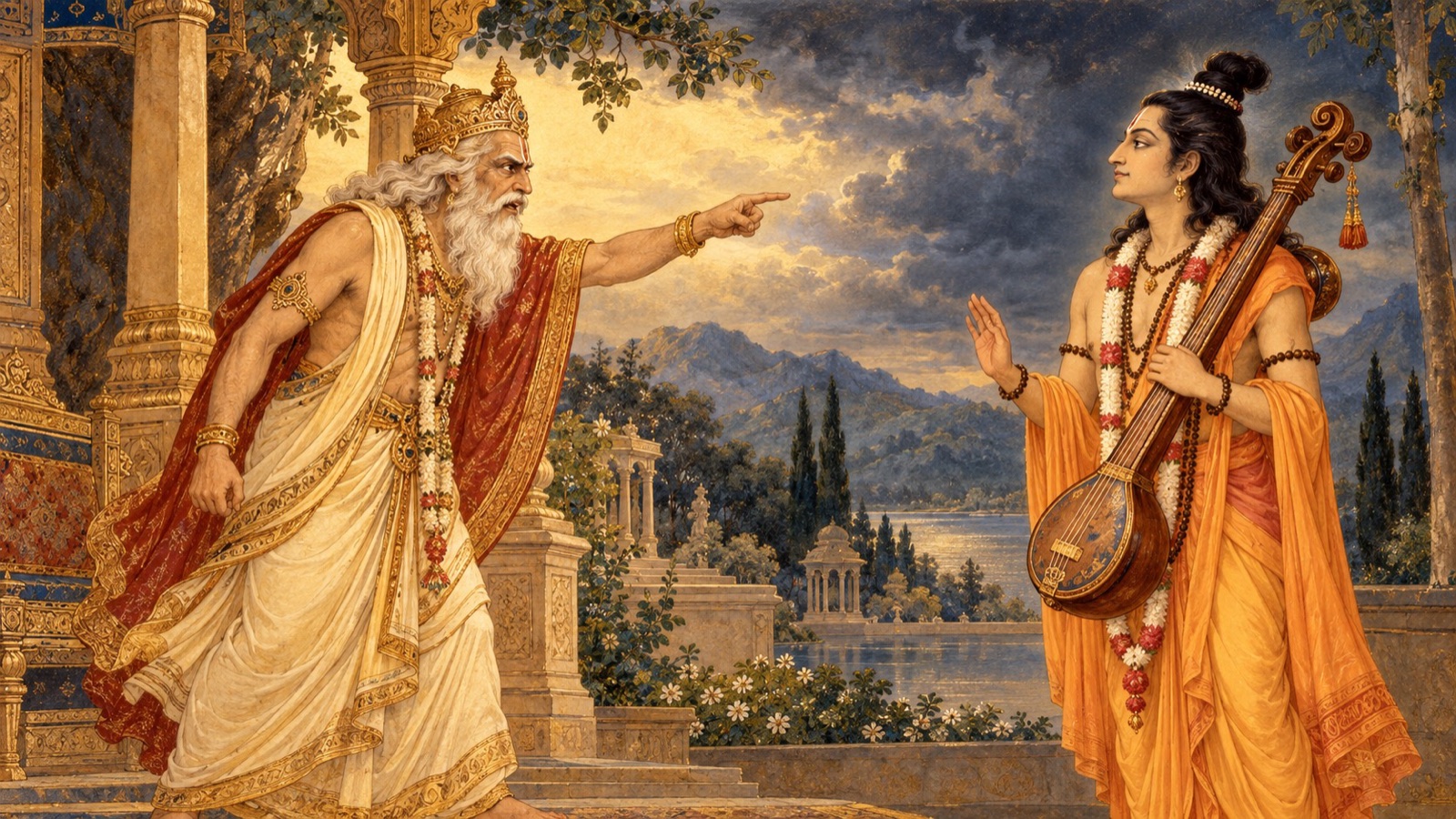
Underneath Daksha’s fury lies an argument that Vaishnava teachers take seriously: his sons, he says, had not yet cleared their debts to the sages, the demigods, and to him — so what right had they to walk away (verses 36-37)? The Bhagavata’s own answer, embedded in Narada’s very conduct, is that such debts are debts of the illusioned self, and a soul who has surrendered completely to the Lord already stands beyond them; the Haryasvas and Sabalasvas were not fleeing an obligation but had reached the one shelter beyond every obligation. Narada does not stop to argue this with Daksha. He simply lives it — accepting the curse in silence rather than defending himself — letting his own uncomplaining tolerance answer a debate no philosophy could settle by words alone (verses 36-44).
The Serenity of a Saint
What follows is the quiet summit of the chapter. Narada, esteemed even by the virtuous, accepted the curse without protest, answering simply, “Very well.” Though fully able to retaliate with a counter-curse, he chose instead to bear the wrong — and it is precisely this forbearance, the Bhagavata tells us, that entitles a soul to be called truly pious.
श्रीशुक उवाच प्रतिजग्राह तद्बाढं नारद: साधुसम्मत: । एतावान्साधुवादो हि तितिक्षेतेश्वर: स्वयम् ॥ ४४ ॥
śrī-śuka uvāca pratijagrāha tad bāḍhaṁ nāradaḥ sādhu-sammataḥ etāvān sādhu-vādo hi titikṣeteśvaraḥ svayam
Meaning: Sukadeva said: Narada, honoured by the saintly, fully accepted the curse, saying, “So be it.” That one who is himself powerful should tolerate the offence of another — this alone is the mark of a genuinely pious soul. (Canto 6, Chapter 5, verse 44)
Principal Teachings of This Chapter
1. A single touch of holiness can turn a whole life around. The mere waters of Narayana-saras and a few words from Narada were enough to awaken the sons of Daksha to the supreme goal, showing how powerfully the company of the holy and holy places act upon a receptive heart (verses 4, 10-21).
2. The riddles of Narada teach discernment. Behind their playful surface lies a complete map of spiritual life — the soul, the modes of nature, Maya, Time, the scripture, and above all the one Supreme Lord who must be known (verses 6-20).
3. The Lord is the one goal worth all endeavour. The Haryasvas conclude that fruitless activity is worthless without first seeing the transcendent Lord, free from birth and self-supported (verse 12).
4. The holy name and form of Narayana are the heart of worship. The Sabalasvas’ meditation on the pure, transcendent Lord through OM and the prayer to Narayana models simple, single-minded devotion (verse 28).
5. Forbearance is the true measure of holiness. Narada, wronged and cursed though blameless, neither retaliates nor complains, teaching that tolerance in one who could strike back is the surest sign of a devotee of God (verse 44).
A Devotional Reflection
This chapter holds two very human sorrows side by side — a father’s grief at losing his children, and a saint’s undeserved punishment — and quietly shows the way through both. Daksha’s pain is real and his anger understandable, yet it drives him to curse the very sage whose touch had lifted his sons to liberation. Narada, who has given the young men the greatest gift imaginable, receives in return only blame; and his answer is a single, unhurried word of acceptance. There is a whole spiritual discipline hidden in that “Very well.” It is easy to be gentle when we are treated gently; the test of our devotion comes when we are wronged, and could answer wrong with wrong, and choose instead to forgive. Narada can afford to be serene because his mind is already fixed on the lotus feet of the Lord; nothing that happens in the wandering worlds can touch the peace he has found there. The curse to roam without rest becomes, for such a soul, only a wider field in which to sing the Lord’s glories. What looks like punishment to the world is, to the devotee, simply more of the pilgrimage he already loves.
A Daily Devotional Practice
Today, take Narada’s “Very well” as your practice. When someone speaks to you unfairly, or blames you for a good you tried to do, resist the first impulse to defend or retaliate. Pause, breathe, and inwardly offer the moment to the Lord, quietly repeating His name. Let the small daily insults you would normally nurse become opportunities to practise the forbearance that the Bhagavata calls the mark of a holy soul. In choosing patience over retaliation even once, you walk, in a small way, the same path as the great sage.
Conclusion
The fifth chapter of the Sixth Canto weaves together the awakening of Daksha’s sons, the power of holy company, and the sublime patience of Narada. Through the sage’s riddles the Haryasvas and Sabalasvas discover that the one Supreme Lord is the goal of all endeavour, and they depart for liberation never to return. Through Daksha’s grief and curse we glimpse the sorrow of attachment; and through Narada’s serene acceptance we learn that true holiness shines brightest not in power but in forbearance. As the Canto moves on to the vast progeny of Daksha’s daughters, we carry with us the sage’s quiet lesson: that a heart anchored in the Lord remains unshaken by every turn of fortune, and answers even a curse with peace.
May the divine wisdom of Srimad Bhagavatam awaken pure devotion within our hearts.
Om Namo Bhagavate Vasudevaya.
Jay Shree Madhav.
References and Attribution
- Primary edition: Gita Press, Śrīmad Bhāgavata Mahāpurāṇa (English, complete), Book Six, Discourse 5.
- Series: Srimad Bhagavatam Wisdom · Biswa Sanatan Dharma Seva Trust.
- Presented following the spiritual guidance and recommendation of Pandit Dr. Shri Kashinath Mishra.
This is an original, faithful retelling in the writer’s own words, with brief quoted verses shown in Devanāgarī and transliteration and their meanings given as summaries. It is not a reproduction of any single publisher’s continuous translation or commentary. No affiliation with or endorsement by any publisher is implied.
Jay Shree Madhav