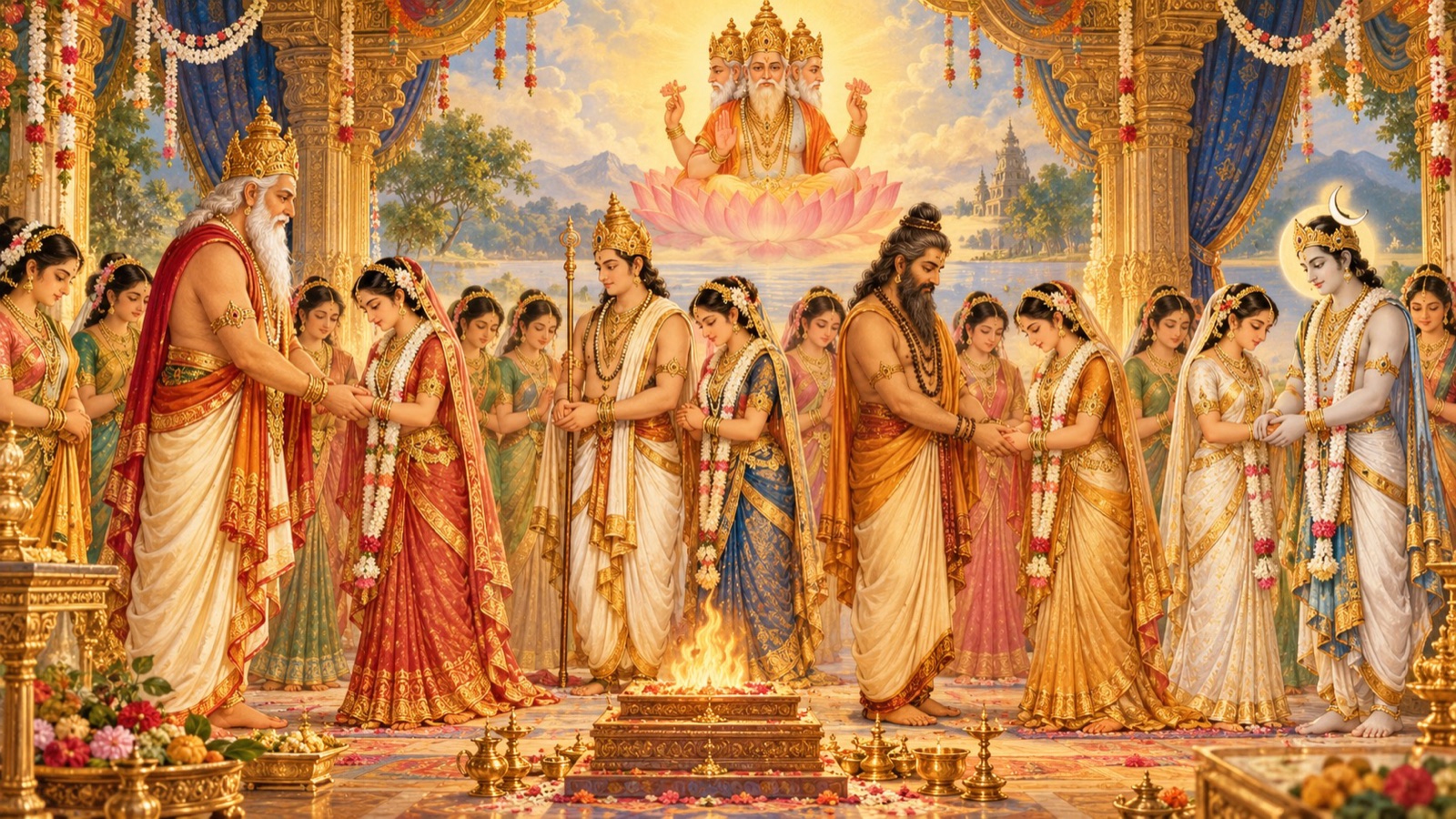
Pacified by Brahma, Prajapati Daksha begets sixty daughters and bestows them in sacred marriage upon Dharma, the sage Kasyapa, and the moon-god — and from these unions the whole living world, from gods and sages to birds, beasts, and the very herbs of the earth, comes into being.
Om Namo Bhagavate Vasudevaya.
Om Namo Bhagavate Vasudevaya.
Om Namo Bhagavate Vasudevaya.
Welcome to Srimad Bhagavatam Wisdom, a devotional journey through the sacred histories and teachings of the Srimad Bhagavat Mahapurana. After the departure of Daksha’s sons for liberation, this sixth chapter of the Sixth Canto turns from renunciation to creation. Consoled by Brahma, Daksha fathers sixty daughters and gives them in marriage to Dharma, to the great sage Kasyapa, to the moon-god, and to other sages; and from their countless offspring the three worlds are filled on every side. Sukadeva Gosvami recites this vast genealogy to King Parikshit — the mothers of the gods and demons, of birds and beasts, of serpents and celestial musicians, of the very herbs and lunar mansions. Yet through this great catalogue of names runs one luminous thread: in the line of Aditi, the Supreme Lord Narayana Himself would appear by a part of His own being, so that even the record of creation becomes a remembrance of God.
Chapter Information
- Scripture: Śrīmad Bhāgavata Mahāpurāṇa
- Canto: 6 (Book Six)
- Chapter: 6 (Discourse 6)
- Chapter title: The Progeny of the Daughters of Daksha
- Principal speaker: Sukadeva Gosvami, narrating to King Parikshit
- Principal listener: King Parikshit; the sages of Naimisharanya at the outer frame
- Main setting: The bank of the Ganga where Parikshit listens, as the sage unfolds the peopling of the worlds
- Central subject: The sixty daughters of Daksha, their marriages, and the vast progeny through whom the three worlds were populated
- Principal verse range: Canto 6, Chapter 6, verses 1–45
- Primary edition: Gita Press Śrīmad Bhāgavata Mahāpurāṇa
The Sixty Daughters of Daksha
Pacified and persuaded by Brahma the self-born, Daksha the son of the Pracetas begot through his wife Asikni sixty daughters, all deeply affectionate toward their father. He gave ten of them to Dharma, the god of piety; thirteen to the sage Kasyapa, son of Marici; twenty-seven to the moon-god; two each to the sages Bhuta, Angira, and Krsasva; and the remaining daughters again to Kasyapa, who is also known as Tarksya. From these daughters, Sukadeva tells Parikshit, and from their children and their children’s children, the three worlds were filled on all sides (verses 1-3).
श्रीशुक उवाच तत: प्राचेतसोऽसिक्न्यामनुनीत: स्वयम्भुवा । षष्टिं सञ्जनयामास दुहितृ: पितृवत्सला: ॥ १ ॥
śrī-śuka uvāca tataḥ prācetaso ’siknyām anunītaḥ svayambhuvā ṣaṣṭiṁ sañjanayām āsa duhitṝḥ pitṛ-vatsalāḥ
Meaning: Sukadeva said: O King, at Brahma’s request Daksha, offspring of the Pracetas, then fathered sixty daughters in the womb of his wife Asikni — every one of them full of tender love for her father. (Canto 6, Chapter 6, verse 1)
Sukadeva does not leave unexplained why Daksha, still smarting from the quarrel with Narada Muni that had cost him his earlier sons, chose this time to raise daughters. A daughter’s affection, unlike a son newly drawn to the wandering life of renunciation, was meant to be given in marriage and carried into households where the sacred order of family life could flourish. The Bhagavata’s own teaching on this point is that a wife who remains chaste and devoted to her husband shares, without any separate striving of her own, in whatever spiritual merit he earns. Read this way, Daksha’s sixty daughters are not merely a fresh beginning after grief: they are a Prajapati’s quiet arrangement for dharma itself to be carried forward through the sanctity of marriage (verse 1).
The Offspring of Dharma’s Wives
The ten wives given to Dharma — among them Bhanu, Lamba, Kakubh, Marutvati, Vasu, Muhurta, and Sankalpa — brought forth a host of divine children who preside over the workings of the cosmos. Of Marutvati was born Jayanta, a part-manifestation of Lord Vasudeva also called Upendra. Of Muhurta came the deities who apportion to living beings the fruits appropriate to each division of time; of Sankalpa came Kama, the god of love; and of Vasu, the eight Vasus, among them Drona, Prana, Dhruva, Agni, and Vibhavasu, each with his own noble progeny — the deities presiding over joy and grief and fear, over cities and towns, over fire and the daytime and the wakefulness of all creatures. Two of these grandsons of Dharma stand out by name: from Agni’s wife Krittika was born six-headed Skanda, later famed as Karttikeya, and from Vastu’s wife Angirasi came Vishvakarma, the celestial architect, whose daughter Akriti became the mother of Manu Cakshusa. And from Dosa’s wife Sarvari came Sisumara, whom the Bhagavata itself names as a partial manifestation of the Supreme Personality of Godhead (verses 4-16). In this the Bhagavata quietly teaches that the ordinary forces that govern our days — time, emotion, thought, the very hours of light — are not blind mechanisms but the offspring of piety, arranged by divine order.
Garuda, the Nagas, and the Mothers of the Species
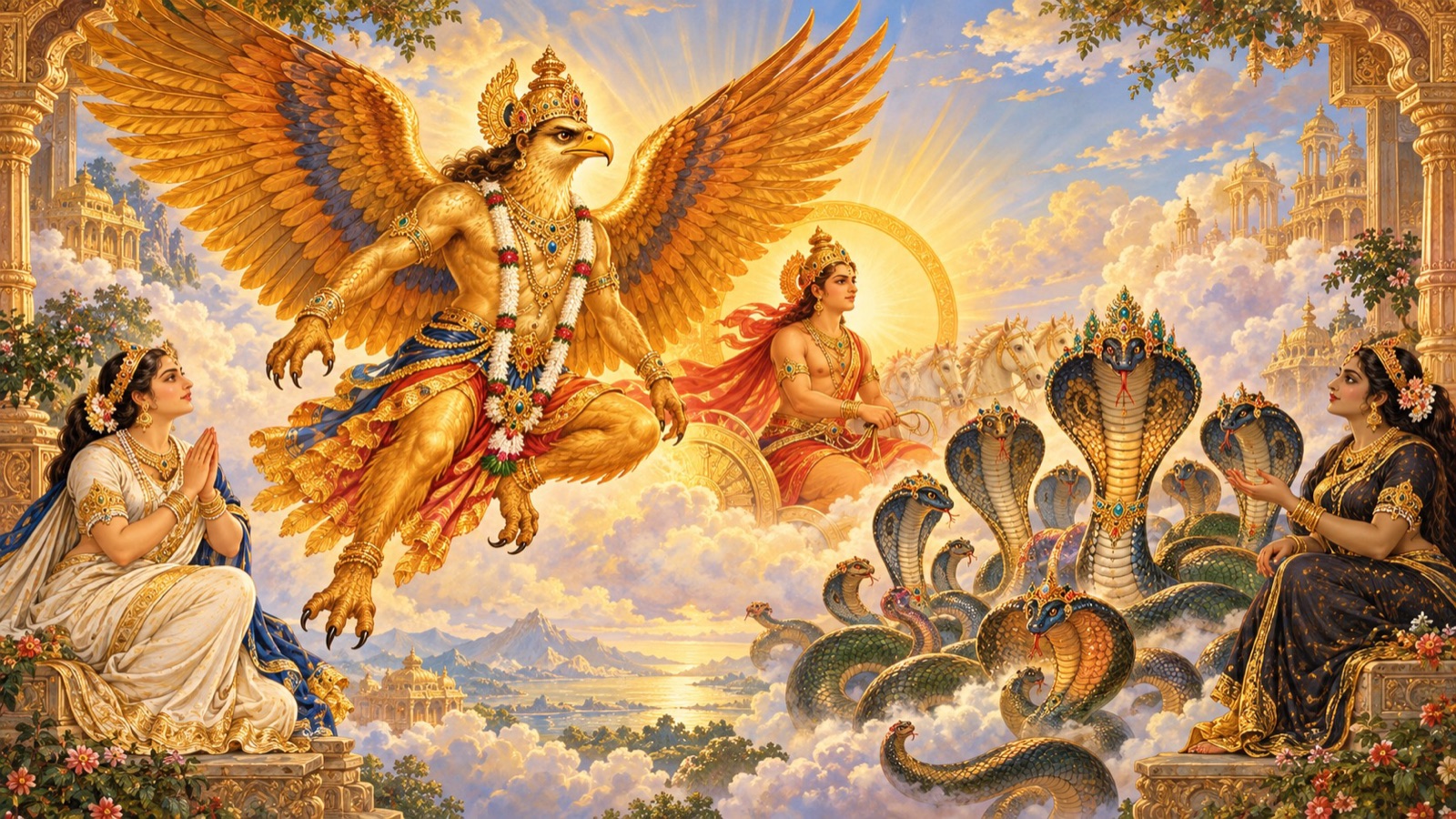
Sarupa, wife of Bhuta, brought forth the Rudras in their countless forms, chief among them Bhava, Ugra, and Ahirbudhnya. The wives of Angira accepted the manes and the Atharva Veda as their sons, and Krsasva, through his two wives Arcis and Dhisana, fathered Dhumaketu and four other sons, among them Vedasira and Devala. Then Sukadeva names the other wives of Kasyapa — Vinata, Kadru, Patangi, and Yamini. Of Patangi were born the birds and of Yamini the moths; Kadru brought forth the many races of Nagas, the serpent-beings; and Vinata bore Aruna, the charioteer of the sun, and mighty Garuda, who carries Bhagavan Vishnu Himself upon his back (verses 17-22).
The Moon-god and the Mothers of Creation
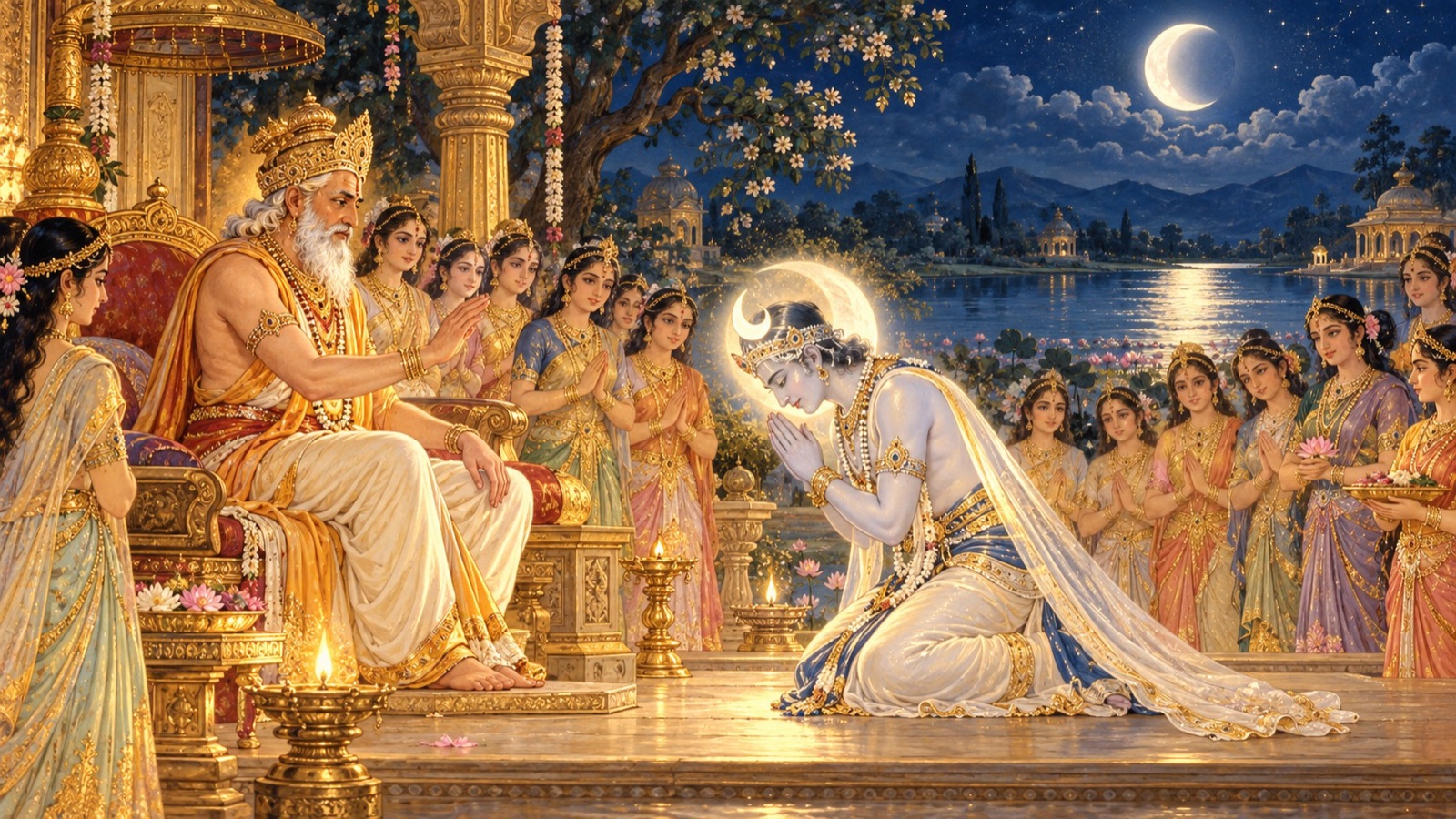
The twenty-seven lunar mansions, Krittika and the rest, are the wives of Soma the moon-god. Stricken with consumption by the curse of Daksha — who was angered by the moon’s excessive fondness for one wife, Rohini, and his neglect of the others — Soma could beget no offspring by any of them. Propitiating Daksha again, the moon-god at last regained the digits of light that wane in the dark fortnight (verse 23). Then Sukadeva names the principal wives of Kasyapa, the mothers of all species of living beings — Aditi, Diti, Danu, Kastha, Arista, Surasa, Ila, Muni, Krodhavasa, Tamra, Surabhi, Sarama, and Timi. Of Timi came the creatures of the water; of Sarama the wild beasts; of Surabhi the cattle; of Tamra the birds of prey; of Krodhavasa the reptiles; of Ila the whole vegetable kingdom; of Surasa the Rakshasas; of Arista the Gandharvas; and of Danu the sixty-one Danavas. Among Danu’s sons was Vaishvanara, whose daughters Puloma and Kalaka were given in marriage to Kasyapa at Brahma’s own request; from them came sixty thousand fierce Danavas, the Paulomas and Kalakeyas — warriors whom Parikshit’s own grandfather Arjuna would one day destroy single-handed in the heavenly planets, to Indra’s great joy. Another of Danu’s line, Vipracitti, begot upon his wife Simhika a hundred and one sons, the eldest of whom was Rahu (verses 23-37).
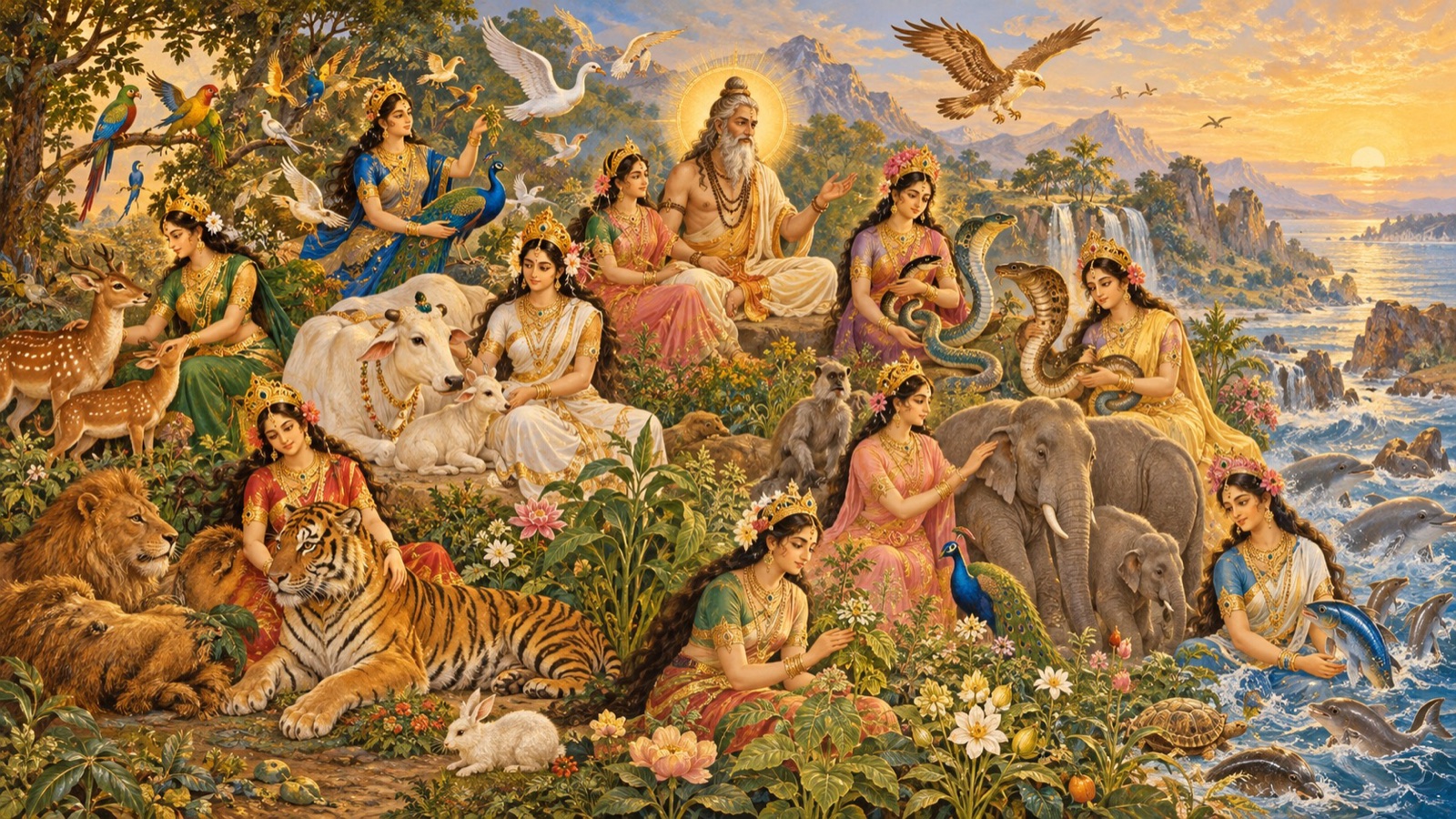
Through this sweeping account the Bhagavata shows that every order of life — those who dwell in the waters and those who fly, the gentle cattle and the fierce beasts, the plants that feed the world and the powers that trouble it — springs from a single web of relationship, all of it born of the daughters of one Prajapati. The whole living world is, in this vision, one vast family under God.
The Dynasty of Aditi and the Descent of Narayana
Now, says the sage, hear in due order the dynasty that proceeded from Aditi — for in this very line the almighty Lord Narayana Himself would appear, manifesting a part of His own being as Urukrama, the Lord of mighty strides, also known as the divine Dwarf. Twelve sons in all were born to Aditi, the sage says, and he recites every one of their names in sequence, ending with that very name (verses 38-39).
अथात: श्रूयतां वंशो योऽदितेरनुपूर्वश: । यत्र नारायणो देव: स्वांशेनावातरद्विभु: ॥ ३८ ॥ विवस्वानर्यमा पूषा त्वष्टाथ सविता भग: । धाता विधाता वरुणो मित्र: शत्रु उरुक्रम: ॥ ३९ ॥
athātaḥ śrūyatāṁ vaṁśo yo ’diter anupūrvaśaḥ yatra nārāyaṇo devaḥ svāṁśenāvātarad vibhuḥ vivasvān aryamā pūṣā tvaṣṭātha savitā bhagaḥ dhātā vidhātā varuṇo mitraḥ śatru urukramaḥ
Meaning: Now hear in order of sequence the dynasty that proceeded from Aditi, in which the almighty Lord Narayana Himself descended by a part of His own being. The sons of Aditi are Vivasvan, Aryama, Pusa, Tvasta, Savita, Bhaga, Dhata, Vidhata, Varuna, Mitra, Shatru, and Urukrama, the Lord of great strides. (Canto 6, Chapter 6, verses 38-39)
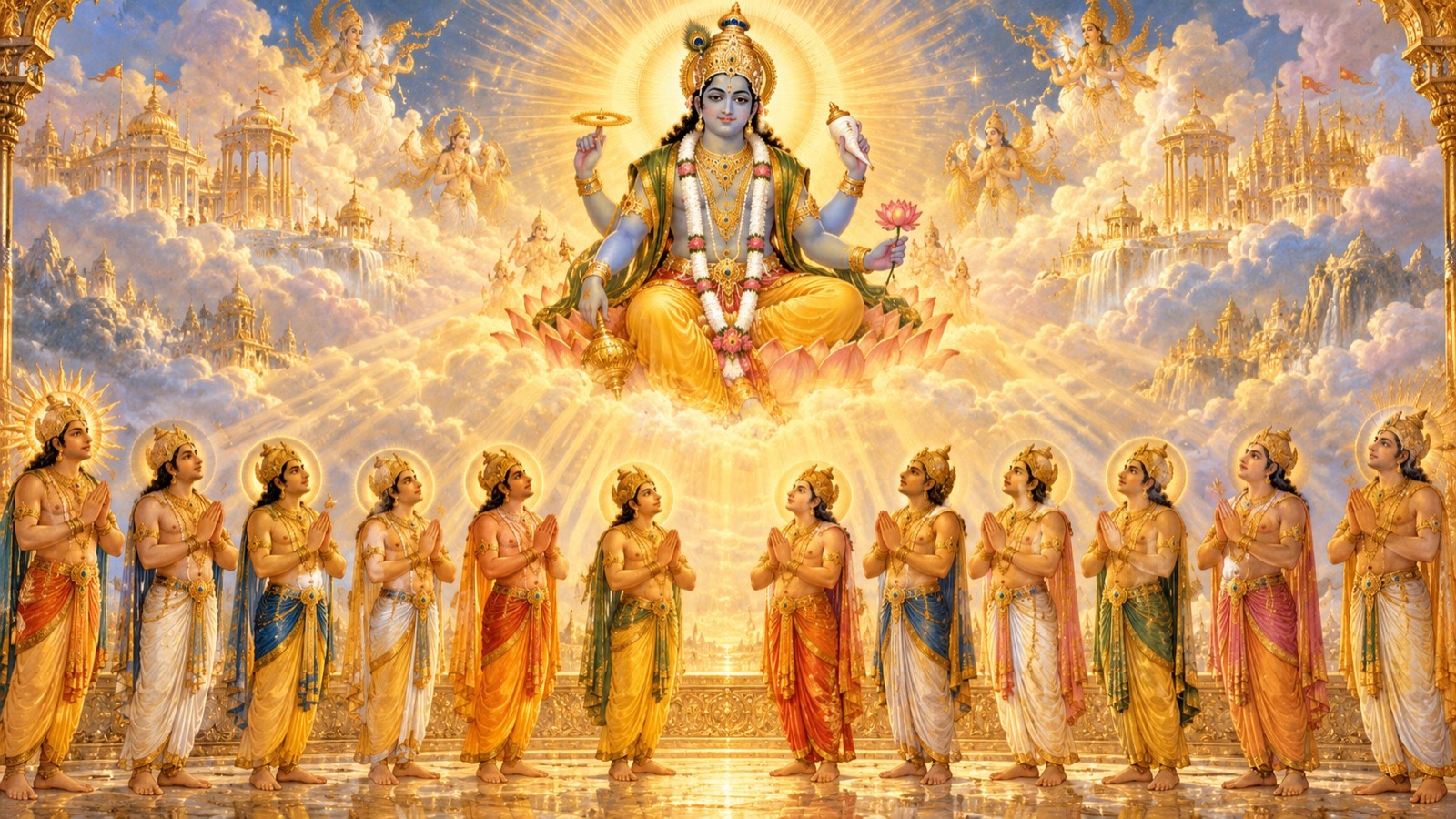
Of Vivasvan, the sun-god, were born Sraddhadeva, who became the Manu of the present age, and the twins Yama and Yami; and, when his wife took the form of a mare on earth, the twin Asvini-kumaras, physicians of the gods. From his shadow-wife Chaya came Sanaiscara, the planet Saturn, and another Manu, Savarni, and the daughter Tapati. So the account moves down the branches of Aditi’s line until it reaches Tvasta, whose wife Racana bore two sons — Sannivesa and the powerful Visvarupa (verses 40-44). And here the genealogy turns toward the drama to come: the hosts of gods, deserted by their own preceptor Brhaspati whom they had insulted, chose Visvarupa for their teacher, even though he was the nephew of their sworn enemies, the sons of Diti (verse 45).
तं वव्रिरे सुरगणा स्वस्रीयं द्विषतामपि । विमतेन परित्यक्ता गुरुणाङ्गिरसेन यत् ॥ ४५ ॥
taṁ vavrire sura-gaṇā svasrīyaṁ dviṣatām api vimatena parityaktā guruṇāṅgirasena yat
Meaning: The hosts of gods chose Visvarupa as their priest, though he was the son of the sister of their enemies, because they had been abandoned by their preceptor Brhaspati, son of Angira, whom they had offended. (Canto 6, Chapter 6, verse 45)
Principal Teachings of This Chapter
1. All creation springs from a single divine order. The daughters of one Prajapati become the mothers of gods and demons, birds and beasts, plants and serpents alike — a vision of the whole living world as one family under God (verses 1-3, 24-28).
2. The forces that govern our lives are sacred, not blind. Time, emotion, thought, love, the hours of light and dark — all are named here as the offspring of Dharma and the ordering of heaven, inviting us to see the cosmos as purposeful (verses 4-16).
3. Offence against a spiritual guide brings loss. The gods, having insulted their preceptor Brhaspati, are left without guidance and forced to a perilous choice — a warning that runs quietly beneath the whole list of names (verse 45).
4. Even a curse and its remedy unfold within divine order. The moon-god’s wasting and partial recovery, granted through the propitiation of Daksha, show that the very rhythm of the waxing and waning moon is woven into the moral order of creation (verse 23).
5. The record of creation is a remembrance of the Lord. Above all names stands the promise that in the line of Aditi, Narayana Himself would descend — so that the genealogy of the worlds becomes, in the end, the lineage of God’s own appearance (verse 38).
6. Marriage in dharma is itself a path, not a lesser one than renunciation. Daksha raises daughters this time so that household life, not the wandering path that claimed his sons, will carry dharma forward — and tradition holds that a wife’s devotion lets her share fully in her husband’s spiritual attainment (verse 1).
A Devotional Reflection
A long list of names can seem, at first, the least devotional part of scripture — a bare register of ancestors and offspring. Yet the Bhagavata frames this chapter with a single sentence of light: “hear the dynasty of Aditi, in which the Lord Himself descended.” Suddenly the whole catalogue is transfigured. Every creature named — the birds born of Patangi, the herbs sprung from Ila, the cattle of Surabhi, the serpents of Kadru — belongs to a creation that God did not merely set in motion from afar but entered in person, taking birth within one of its very lineages. There is comfort in this for us. We too are names in a family line, small links in a great chain of parents and children stretching back beyond memory. The chapter tells us that such a chain is not meaningless: it is the fabric through which the divine chooses to appear. To honour our place in creation, to see even the humblest creatures as kin, and to remember that the Lord Himself was willing to be born among us — this is the quiet devotion hidden in a page of names.
A Daily Devotional Practice
Today, let the vastness of creation turn your heart to gratitude. Take a few moments to look upon the living things around you — a bird, a tree, an animal, another human being — and remember that scripture counts them all as children of the same divine order to which you belong. Silently offer a word of thanks to the Lord who is the source of every species and every life, and who chose to descend among His own creatures. In seeing all beings as kin under God, you practise the humility and reverence that this chapter, beneath its long roll of names, so gently teaches.
Conclusion
The sixth chapter of the Sixth Canto unfolds the great family tree of creation — the sixty daughters of Daksha and the boundless progeny through whom gods and demons, beasts and birds, plants and planets came to fill the worlds. Beneath its sweep of names lies a single message: that all life flows from one divine order, that the powers shaping our days are sacred, and that even offence and curse unfold within the Lord’s design. Above all, the chapter points ahead to grace — for in the very line of Aditi, Narayana Himself would descend among His creatures. As the Canto moves next to the gods’ loss of their preceptor and their fateful choice of Visvarupa, we carry with us the sage’s luminous reminder that the record of creation is, from first to last, a remembrance of God.
May the divine wisdom of Srimad Bhagavatam awaken pure devotion within our hearts.
Om Namo Bhagavate Vasudevaya.
Jay Shree Madhav.
References and Attribution
- Primary edition: Gita Press, Śrīmad Bhāgavata Mahāpurāṇa (English, complete), Book Six, Discourse 6.
- Series: Srimad Bhagavatam Wisdom · Biswa Sanatan Dharma Seva Trust.
- Presented following the spiritual guidance and recommendation of Pandit Dr. Shri Kashinath Mishra.
This is an original, faithful retelling in the writer’s own words, with brief quoted verses shown in Devanāgarī and transliteration and their meanings given as summaries. It is not a reproduction of any single publisher’s continuous translation or commentary. No affiliation with or endorsement by any publisher is implied.
Jay Shree Madhav