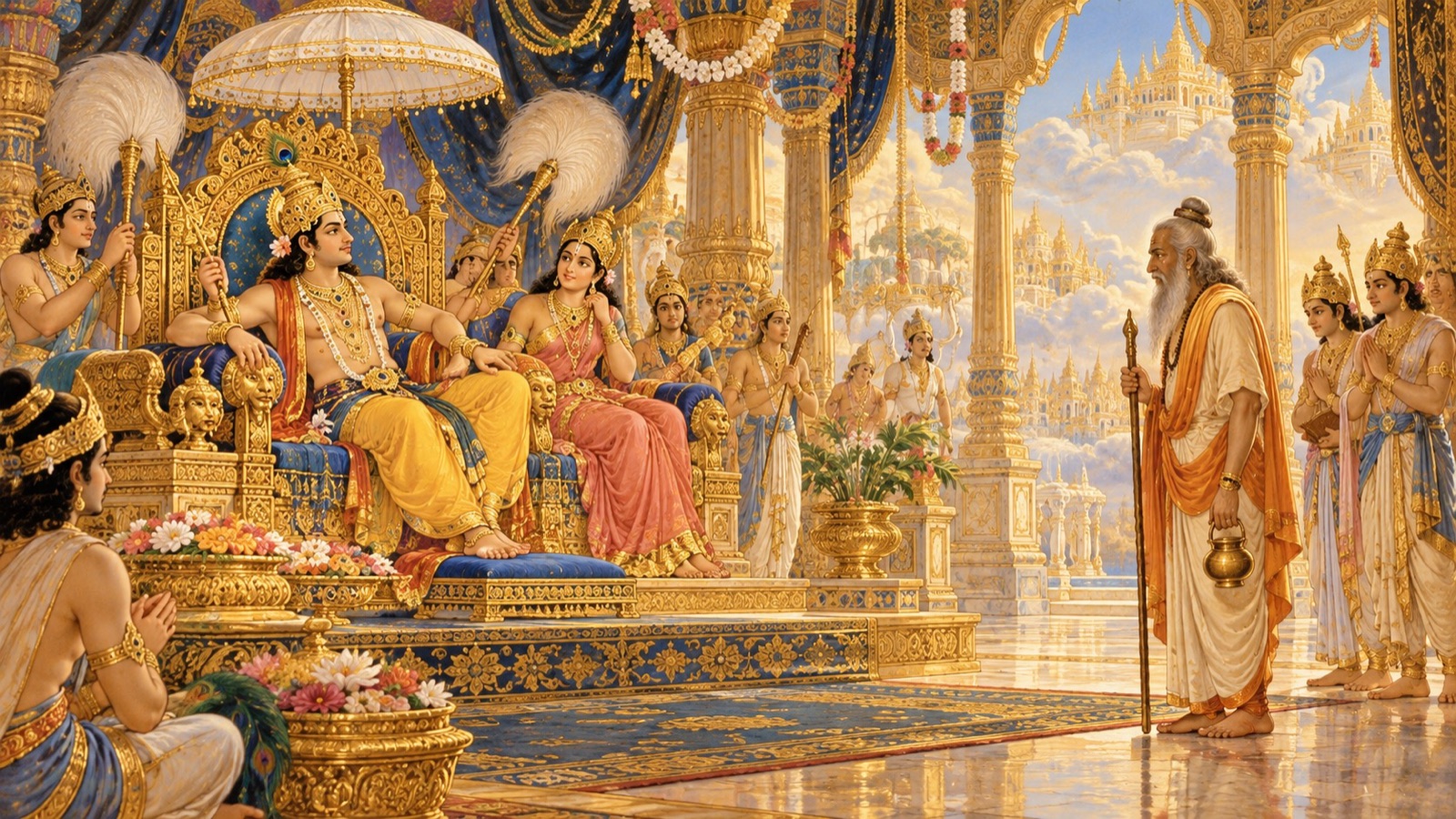
Seated on his glorious throne and drunk with power, Indra fails to rise for his own preceptor Brihaspati — and that single lapse of respect topples the king of heaven, teaching that no wealth or eminence excuses pride toward a spiritual guide.
Om Namo Bhagavate Vasudevaya.
Om Namo Bhagavate Vasudevaya.
Om Namo Bhagavate Vasudevaya.
Welcome to Srimad Bhagavatam Wisdom, a devotional journey through the sacred histories and teachings of the Srimad Bhagavat Mahapurana. The seventh chapter of the Sixth Canto tells how the king of heaven himself fell through a single act of pride. Enthroned in unmatched splendour, Indra failed to rise and honour Brihaspati, the preceptor of the gods; the wise sage silently withdrew, and heaven was left without spiritual guidance. At once the demons, counselled by Sukracarya, fell upon the gods and routed them, and the defeated deities fled to Brahma. Gently rebuked and wisely counselled by the creator, they sought out Visvarupa, the austere son of Tvasta, and with a beautiful teaching on the honour due to elders and teachers they won him as their priest. Through his prayer to Lord Vishnu — the Narayana-kavaca to be given in the next chapter — Visvarupa restored to Indra the fortune he had lost.
Chapter Information
- Scripture: Śrīmad Bhāgavata Mahāpurāṇa
- Canto: 6 (Book Six)
- Chapter: 7 (Discourse 7)
- Chapter title: Indra Offends His Preceptor, Brihaspati
- Principal speaker: Sukadeva Gosvami, narrating to King Parikshit; Brahma, the gods, and Visvarupa within the account
- Principal listener: King Parikshit; the sages of Naimisharanya at the outer frame
- Main setting: The court of Indra in heaven; the abode of Brahma; and the hermitage of Visvarupa
- Central subject: Indra’s offence against his preceptor, the resulting defeat of the gods, and their acceptance of Visvarupa as priest
- Principal verse range: Canto 6, Chapter 7, verses 1–40
- Primary edition: Gita Press Śrīmad Bhāgavata Mahāpurāṇa
The Question of King Parikshit
King Parikshit opens the chapter with a searching question: for what reason were the gods abandoned by their own preceptor? He asks the sage to explain the transgression the disciples committed against their teacher, which brought matters to such a pass (verse 1).
श्रीराजोवाच कस्य हेतो: परित्यक्ता आचार्येणात्मन: सुरा: । एतदाचक्ष्व भगवञ्छिष्याणामक्रमं गुरौ ॥ १ ॥
śrī-rājovāca kasya hetoḥ parityaktā ācāryeṇātmanaḥ surāḥ etad ācakṣva bhagavañ chiṣyāṇām akramaṁ gurau
Meaning: King Parikshit said: For what reason were the gods forsaken by their own preceptor? O holy sage, please explain to me this offence of the disciples against their teacher. (Canto 6, Chapter 7, verse 1)
The Pride of Indra
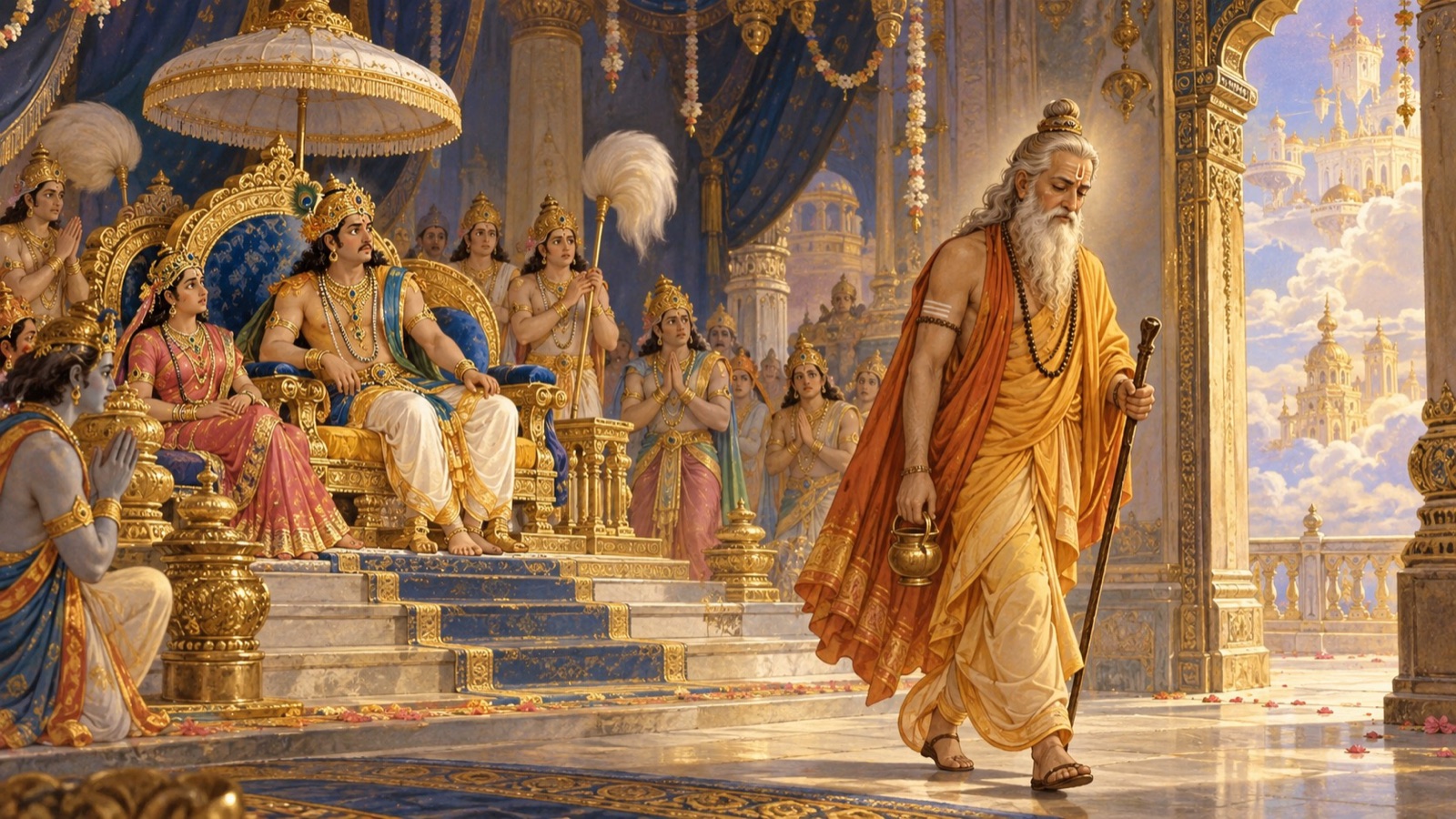
Sukadeva replies that Indra, grown arrogant through the lordship of the worlds, was one day seated upon his throne in full majesty — surrounded by the Maruts, the Vasus, the Rudras, the Adityas, and hosts of celestial beings, waited upon and extolled by Siddhas, Gandharvas, and sages, sheltered by the white royal umbrella and served with chowries, seated beside his queen Saci in dazzling splendour (verses 2-6). Into this court entered Brihaspati, the foremost of sages, the preceptor honoured by gods and demons alike. But Indra, blinded by pride, did not rise, did not offer a seat, did not stir even at seeing the sage present before him. Perceiving the aberration born of pride in power and wealth, the enlightened son of Angira quietly turned and went home, though fully able to correct his erring disciple (verses 7-9).
Remorse, and the Vanished Preceptor
The very moment Brihaspati left, Indra recognized his fault and reproached himself before the whole court. How deplorable, he confessed, that a creature of poor wits, maddened by power, should have slighted his own teacher. What wise person would covet even the fortune of heaven, he lamented, if it drags its holder into egotism (verses 10-12)?
Indra’s grief opened into a wider teaching. Whoever imagines that a king enthroned in his own glory need never rise for another — not even for a brahmana or a fellow sovereign — has missed the deeper law of dharma, for true authority still bows before wisdom and sanctity (verse 13). Such counsel, he saw, is no better than a boat built of stone: the leader who offers it, and all who trust and board it, sink together in the very waters it promised to cross, for what carries a soul to safety is not the throne from which one speaks but the truth of what is spoken (verse 14).
Resolving to touch the sage’s feet with his head and beg forgiveness, Indra set out to propitiate the preceptor of the gods (verse 15). But Brihaspati, knowing Indra’s mind and what lay in store, had already vanished from his home by his yogic power. Search as he might, Indra could find no trace of him, and though surrounded by the gods he found no peace (verses 16-17).
The Defeat of the Gods
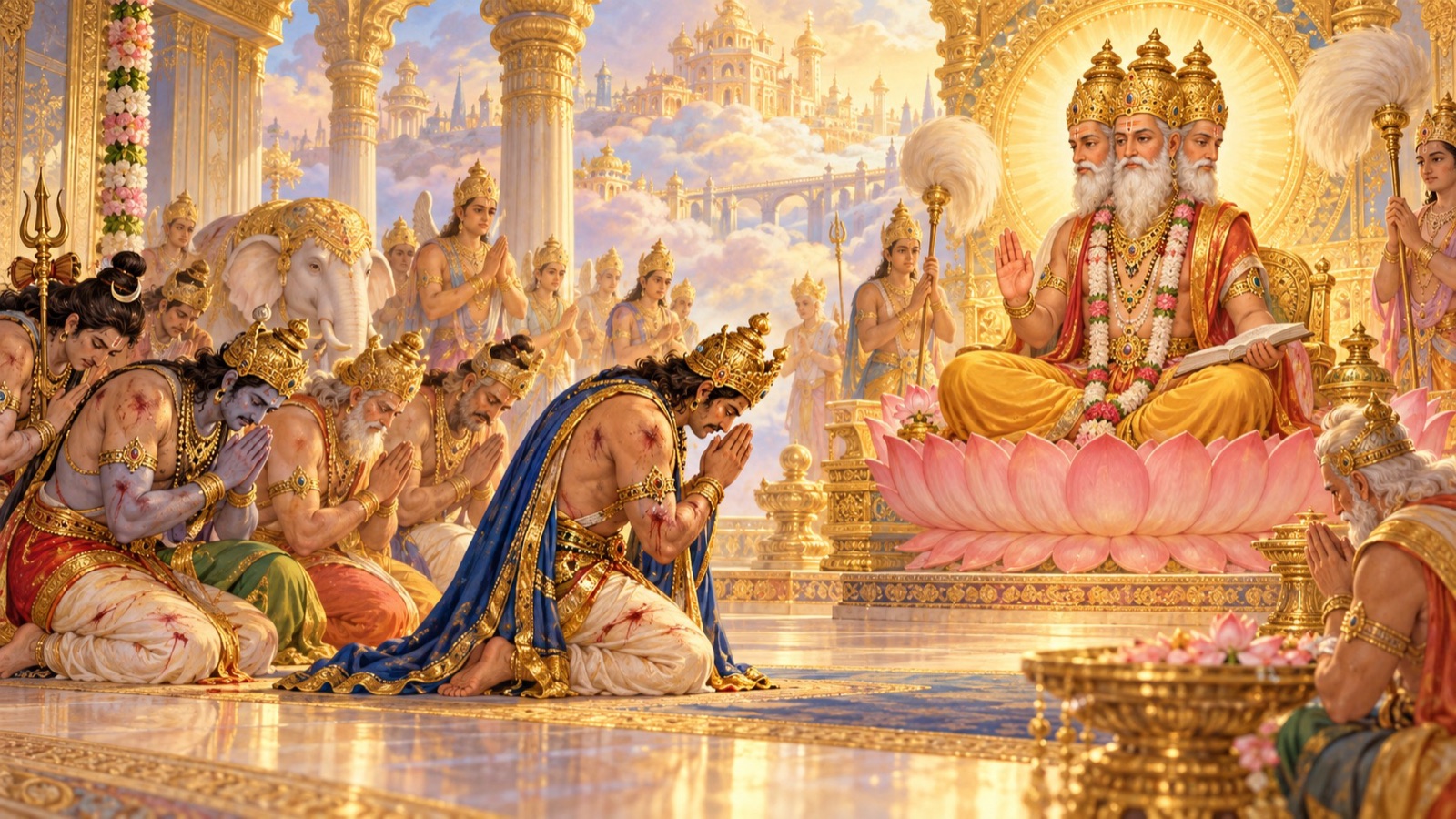
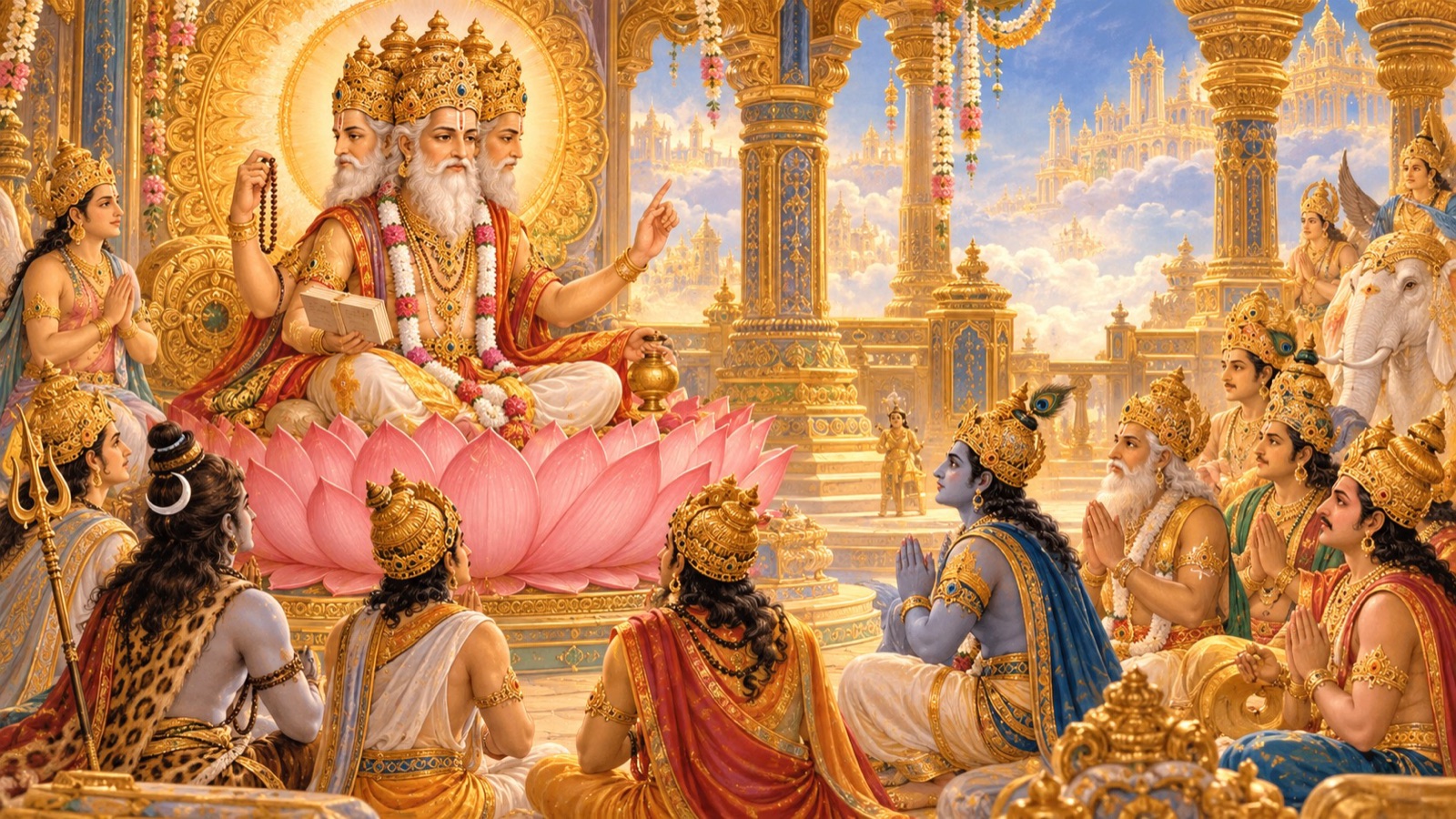
Hearing of Indra’s helplessness, the demons took up arms at the counsel of Sukracarya and marched against the gods. Their limbs pierced by sharp arrows, the gods, led by Indra, were routed, and with heads bowed low in humiliation they approached Brahma for protection (verses 18-19). Seeing them afflicted on every side, the compassionate self-born Brahma spoke to them with comforting words (verse 20).
The Counsel of Brahma
Brahma did not spare them the truth. Your conduct, he said, has been most unwelcome: proud of power, you failed to honour a Brahmana who had disciplined himself and realized Brahma. It was the fruit of that misbehaviour that you, rich and mighty, were defeated by enemies far weaker than yourselves (verses 21-22).
Here Brahma reveals why the encounter went as it did. It was not that the demons had grown mighty by their own strength; time and again the gods had beaten them with ease. Their sudden power, Brahma explained, came only from wholeheartedly propitiating their own preceptor Sukracarya — so completely that they might one day even covet his own abode — just as the gods’ sudden weakness had come only from despising theirs. Strength in this world, Brahma taught, is never self-generated: it flows to whoever honours the brahmana, the cow, and the Supreme Lord, and drains away the instant that honour is withheld, however vast one’s own treasury of opulence may seem (verses 22-24).
Therefore, he directed, resort at once to Visvarupa, the austere and self-controlled son of Tvasta; he will accomplish your true purpose — but only if you can bear with his ways (verse 25).
तद्विश्वरूपं भजताशु विप्रं तपस्विनं त्वाष्ट्रमथात्मवन्तम् । सभाजितोऽर्थान् स विधास्यते वो यदि क्षमिष्यध्वमुतास्य कर्म ॥ २५ ॥
tad viśvarūpaṁ bhajatāśu vipraṁ tapasvinaṁ tvāṣṭram athātmavantam sabhājito ’rthān sa vidhāsyate vo yadi kṣamiṣyadhvam utāsya karma
Meaning: Therefore, at once take shelter of Visvarupa, the son of Tvasta, a Brahmana devoted to austerity and self-control. Honoured by you, he will fulfil your purposes — provided you tolerate his deeds. (Canto 6, Chapter 7, verse 25)
The Gods Approach Visvarupa
Relieved of their anxiety, the gods went to the hermitage of Visvarupa, embraced him as a younger kinsman, and made their appeal. We have come as unexpected guests, they said; be pleased, dear son, to fulfil the wishes of your uncles. Then they spoke a memorable teaching on the sanctity of relationships: service of parents is the highest duty even of those with children, and much more of a celibate; a preceptor is the very form of the Veda, a father the image of Brahma, a brother the image of Indra, a mother a direct incarnation of the Earth; a sister is tenderness embodied, an unexpected visitor virtue itself, a guest the sacred fire, and all living beings the embodiment of the Supreme Self (verses 27-30).
आचार्यो ब्रह्मणो मूर्ति: पिता मूर्ति: प्रजापते: । भ्राता मरुत्पतेर्मूर्तिर्माता साक्षात् क्षितेस्तनु: ॥ २९ ॥ दयाया भगिनी मूर्तिर्धर्मस्यात्मातिथि: स्वयम् । अग्नेरभ्यागतो मूर्ति: सर्वभूतानि चात्मन: ॥ ३० ॥
ācāryo brahmaṇo mūrtiḥ pitā mūrtiḥ prajāpateḥ bhrātā marutpater mūrtir mātā sākṣāt kṣites tanuḥ dayāyā bhaginī mūrtir dharmasyātmātithiḥ svayam agner abhyāgato mūrtiḥ sarva-bhūtāni cātmanaḥ
Meaning: The preceptor is the embodiment of the Veda, the father the embodiment of Brahma, the brother the embodiment of Indra, and the mother the direct form of the Earth. A sister is the embodiment of compassion, an uninvited guest the embodiment of righteousness, a visitor the embodiment of the fire-god, and all living beings the embodiment of the Supreme Self. (Canto 6, Chapter 7, verses 29-30)
Free your parents, they urged, from the affliction of defeat at the hands of their enemies; and we choose you, a Brahmana established in Brahma, as our preceptor, so that through your spiritual glory we may conquer our foes. The wise, they added, do not condemn bowing at the feet of a younger person when it serves a righteous end; mere age, apart from Vedic knowledge, is no true measure of seniority (verses 31-33).
Visvarupa Accepts the Priesthood
Importuned by the gods to become their priest, the great ascetic Visvarupa was pleased and answered gently. Priesthood, he said, has been condemned by the virtuous as diminishing a Brahmana’s spiritual glory; how should one like him, who maintained himself by the pure means of gleaning grain, take up so reproachable an office? Yet he would not decline what his elders earnestly asked; he would accomplish all they sought, he vowed, even at the cost of his life and his own highest interest (verses 34-37).
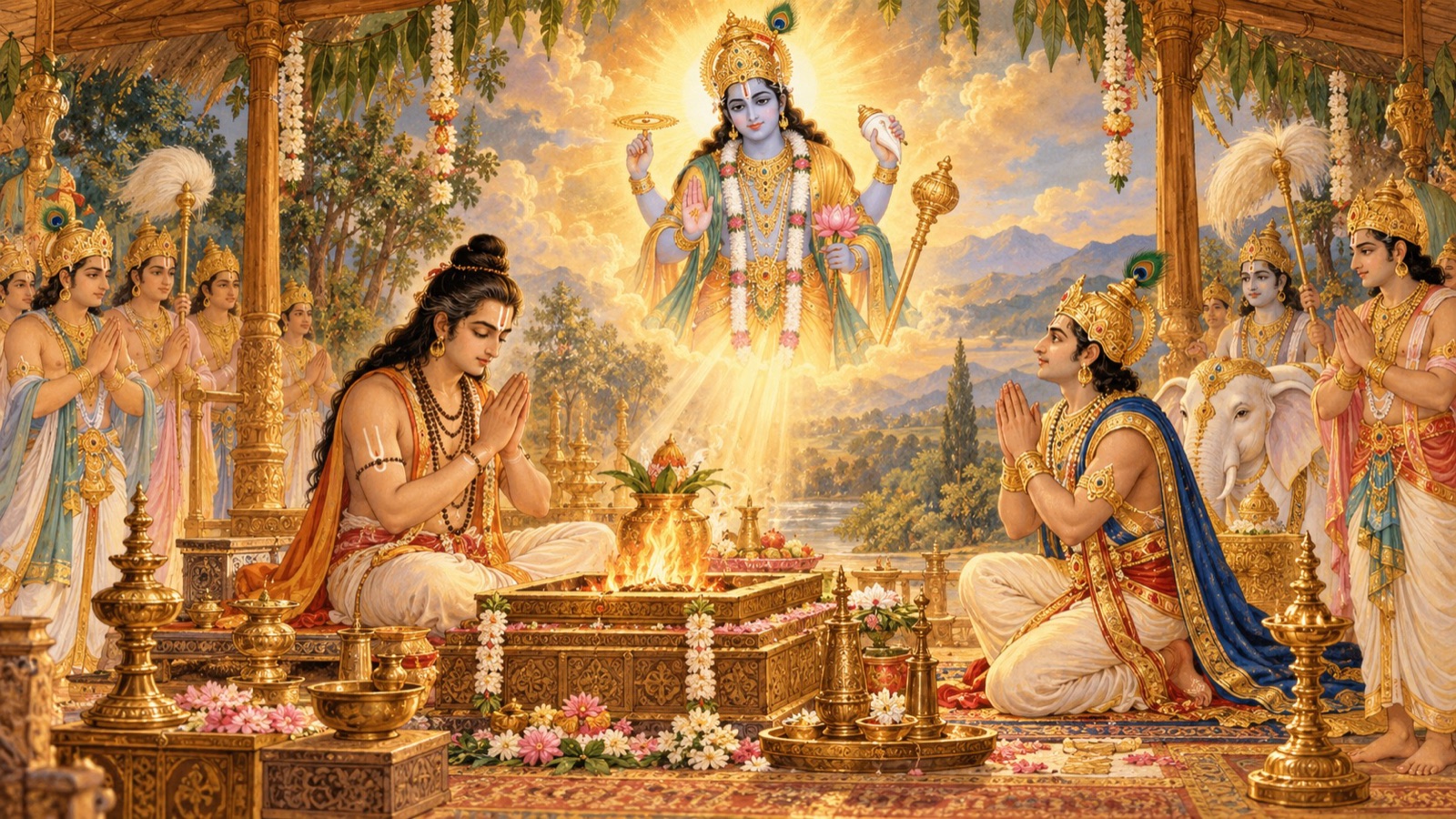
Having promised, Visvarupa discharged the office of priest with supreme diligence. By a prayer addressed to Lord Vishnu — the Narayana-kavaca — he snatched back from the demons the fortune they had won even under Sukracarya’s protection, and restored it to Indra. And the noble-minded sage taught that same protective prayer to Indra, guarded by which the thousand-eyed god was able to conquer the demon hosts (verses 38-40).
यया गुप्त: सहस्राक्षो जिग्येऽसुरचमूर्विभु: । तां प्राह स महेन्द्राय विश्वरूप उदारधी: ॥ ४० ॥
yayā guptaḥ sahasrākṣo jigye ’sura-camūr vibhuḥ tāṁ prāha sa mahendrāya viśvarūpa udāra-dhīḥ
Meaning: Guarded by which prayer the thousand-eyed and mighty Indra conquered the armies of the demons — that very prayer the noble-minded Visvarupa imparted to the great Indra. (Canto 6, Chapter 7, verse 40)
Principal Teachings of This Chapter
1. Pride toward a spiritual guide brings downfall. The king of heaven, at the height of his glory, loses everything through one failure to honour his preceptor — a warning that no eminence excuses disrespect to a teacher (verses 7-9).
2. Remorse is the beginning of recovery. Indra’s immediate, honest self-reproach shows the right response to a fault: not concealment or excuse, but humble acknowledgement and the resolve to make amends (verses 10-12, 15).
3. Every relationship is sacred. The gods’ teaching to Visvarupa reveals the divine presence in preceptor and parent, brother and sister, guest and stranger, and in all living beings — a vision that transforms ordinary duty into worship (verses 29-30).
4. Humility is no disgrace to the wise. Though junior in years, Visvarupa is shown reverence because in Vedic wisdom seniority is measured by knowledge, not age (verse 33); and though priesthood is said to diminish a brahmana’s own spiritual credit, he embraces the office without hesitation for the sake of those who raised him — proof that true greatness bends gladly to a righteous call (verses 35-37).
5. The Lord’s protection is the true armour. Visvarupa’s victory comes not from weapons but from a prayer to Lord Vishnu, pointing ahead to the Narayana-kavaca as the real shield of the devotee (verses 38-40).
A Devotional Reflection
It is startling that the fall of the king of heaven turns not on a great crime but on a small discourtesy — a failure to rise from a throne. Yet the Bhagavata knows how much hides in such moments. Indra did nothing violent; he simply let his eminence persuade him that ordinary respect was beneath him. And in that instant the spiritual guidance that had protected heaven quietly withdrew. How often our own troubles begin the same way — not with dramatic wrongdoing but with a slow forgetting of gratitude toward those who have taught and carried us. What redeems Indra is his swiftness to repent; the same power that made him proud does not stop him from reproaching himself openly before his court. And the remedy the story offers is beautiful: a vision of every person in our lives — teacher, parent, sibling, guest, even the unexpected stranger — as a form of the divine. To live by that vision is to make respect our natural air, so that we never need the hard lesson of losing what we failed to honour. The chapter closes not with revenge but with a prayer, reminding us that our surest protection is never our own power, but the shelter of the Lord.
A Daily Devotional Practice
Today, honour a teacher. Call to mind someone who has guided you — a parent, an elder, a spiritual mentor, a teacher of your childhood — and offer them, inwardly or aloud, a word of sincere gratitude. If you have slighted anyone through pride or forgetfulness, resolve, like Indra, to make it right without delay. As you go through your day, try to see each person you meet — the family member, the colleague, the stranger at your door — as the Bhagavata teaches: a form of the divine deserving of respect. In this simple practice of reverence you build the humility that guards the soul.
Conclusion
The seventh chapter of the Sixth Canto shows how a single lapse of respect can topple even the king of heaven, and how humility and devotion can restore what pride has lost. Indra’s failure to honour Brihaspati leaves the gods defenceless before the demons; but guided by Brahma, and armed with a profound reverence for all sacred relationships, they win the austere Visvarupa as their priest, and through his prayer to Lord Vishnu their fortune is regained. The chapter teaches that no glory excuses arrogance toward a teacher, that remorse and humility open the way back, and that the Lord’s protection is the true armour of the soul. As the Canto turns next to the sacred Narayana-kavaca itself, we carry with us the lesson that reverence, not power, is the safeguard of every life.
May the divine wisdom of Srimad Bhagavatam awaken pure devotion within our hearts.
Om Namo Bhagavate Vasudevaya.
Jay Shree Madhav.
References and Attribution
- Primary edition: Gita Press, Śrīmad Bhāgavata Mahāpurāṇa (English, complete), Book Six, Discourse 7.
- Series: Srimad Bhagavatam Wisdom · Biswa Sanatan Dharma Seva Trust.
- Presented following the spiritual guidance and recommendation of Pandit Dr. Shri Kashinath Mishra.
This is an original, faithful retelling in the writer’s own words, with brief quoted verses shown in Devanāgarī and transliteration and their meanings given as summaries. It is not a reproduction of any single publisher’s continuous translation or commentary. No affiliation with or endorsement by any publisher is implied.
Jay Shree Madhav