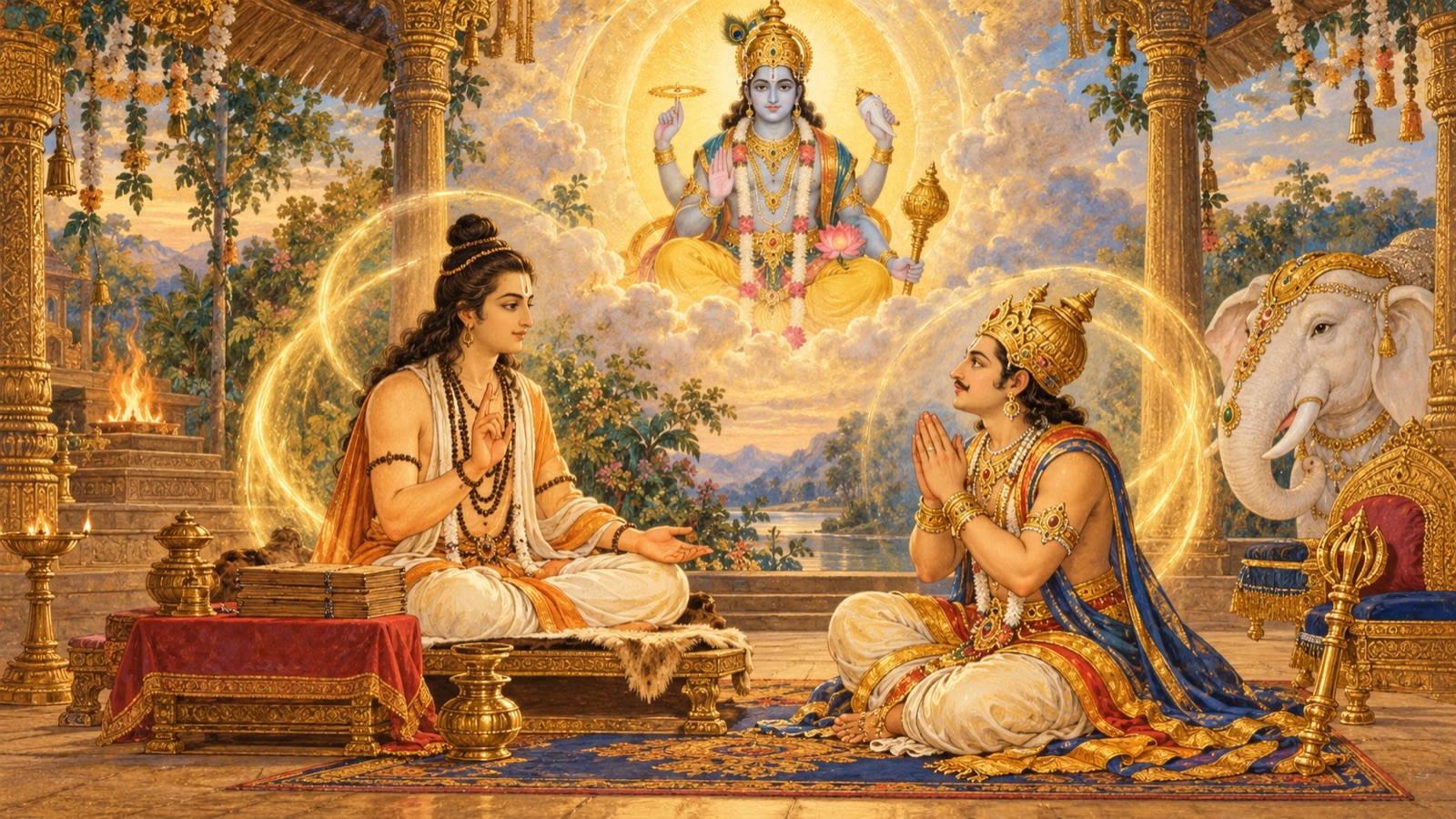
The sage Visvarupa imparts to Indra the Narayana-kavaca — the sacred armour of prayer by which the devotee, calling upon the Lord’s every name, form, and incarnation, is shielded in every place, hour, and danger.
Om Namo Bhagavate Vasudevaya.
Om Namo Bhagavate Vasudevaya.
Om Namo Bhagavate Vasudevaya.
Welcome to Srimad Bhagavatam Wisdom, a devotional journey through the sacred histories and teachings of the Srimad Bhagavat Mahapurana. The eighth chapter of the Sixth Canto is one of the most beloved protective prayers in all of scripture — the Narayana-kavaca, the “armour of Narayana.” Having heard how Indra reconquered heaven, King Parikshit asks to be taught the very prayer that shielded him. In reply, the sage Visvarupa unfolds a complete practice of refuge: the preparation of body and mind, and then a sweeping invocation in which the Lord, in each of His incarnations, is called upon to guard the devotee in water and on land and in the air, through every division of day and night, and against every danger seen and unseen. It is a prayer that rests the whole weight of one’s safety not upon one’s own strength, but upon the names, forms, and weapons of the Supreme Lord.
Chapter Information
- Scripture: Śrīmad Bhāgavata Mahāpurāṇa
- Canto: 6 (Book Six)
- Chapter: 8 (Discourse 8)
- Chapter title: The Narayana-kavaca Shield
- Principal speaker: Visvarupa, teaching Indra; recited by Sukadeva Gosvami to King Parikshit
- Principal listener: Indra within the account; King Parikshit at the frame; the sages of Naimisharanya
- Main setting: The court of heaven, where Visvarupa imparts the sacred prayer to Indra
- Central subject: The Narayana-kavaca — the armour-prayer invoking the protection of Lord Narayana in all His forms
- Principal verse range: Canto 6, Chapter 8, verses 1–42
- Primary edition: Gita Press Śrīmad Bhāgavata Mahāpurāṇa
The Request of King Parikshit
King Parikshit asks the sage to teach him the prayer, imbued with the spirit of Lord Narayana, protected by which the thousand-eyed Indra subdued the enemy’s troops as though in sport and enjoyed the fortune of all three worlds — and how, guarded by that armour, he conquered the foes who came to take his life in battle (verses 1-2).
श्रीराजोवाच यया गुप्त: सहस्राक्ष: सवाहान् रिपुसैनिकान् । क्रीडन्निव विनिर्जित्य त्रिलोक्या बुभुजे श्रियम् ॥ १ ॥ भगवंस्तन्ममाख्याहि वर्म नारायणात्मकम् । यथाततायिन: शत्रून्येन गुप्तोऽजयन्मृधे ॥ २ ॥
śrī-rājovāca yayā guptaḥ sahasrākṣaḥ savāhān ripu-sainikān krīḍann iva vinirjitya tri-lokyā bubhuje śriyam bhagavaṁs tan mamākhyāhi varma nārāyaṇātmakam yathātatāyinaḥ śatrūn yena gupto ’jayan mṛdhe
Meaning: King Parikshit said: Please tell me of that armour, imbued with the spirit of Narayana, protected by which the thousand-eyed Indra, subduing the enemy’s troops and their mounts as though in play, enjoyed the fortune of the three worlds, and by which, protected, he conquered in battle the foes who came to take his life. (Canto 6, Chapter 8, verses 1-2)
The Preparation of the Devotee
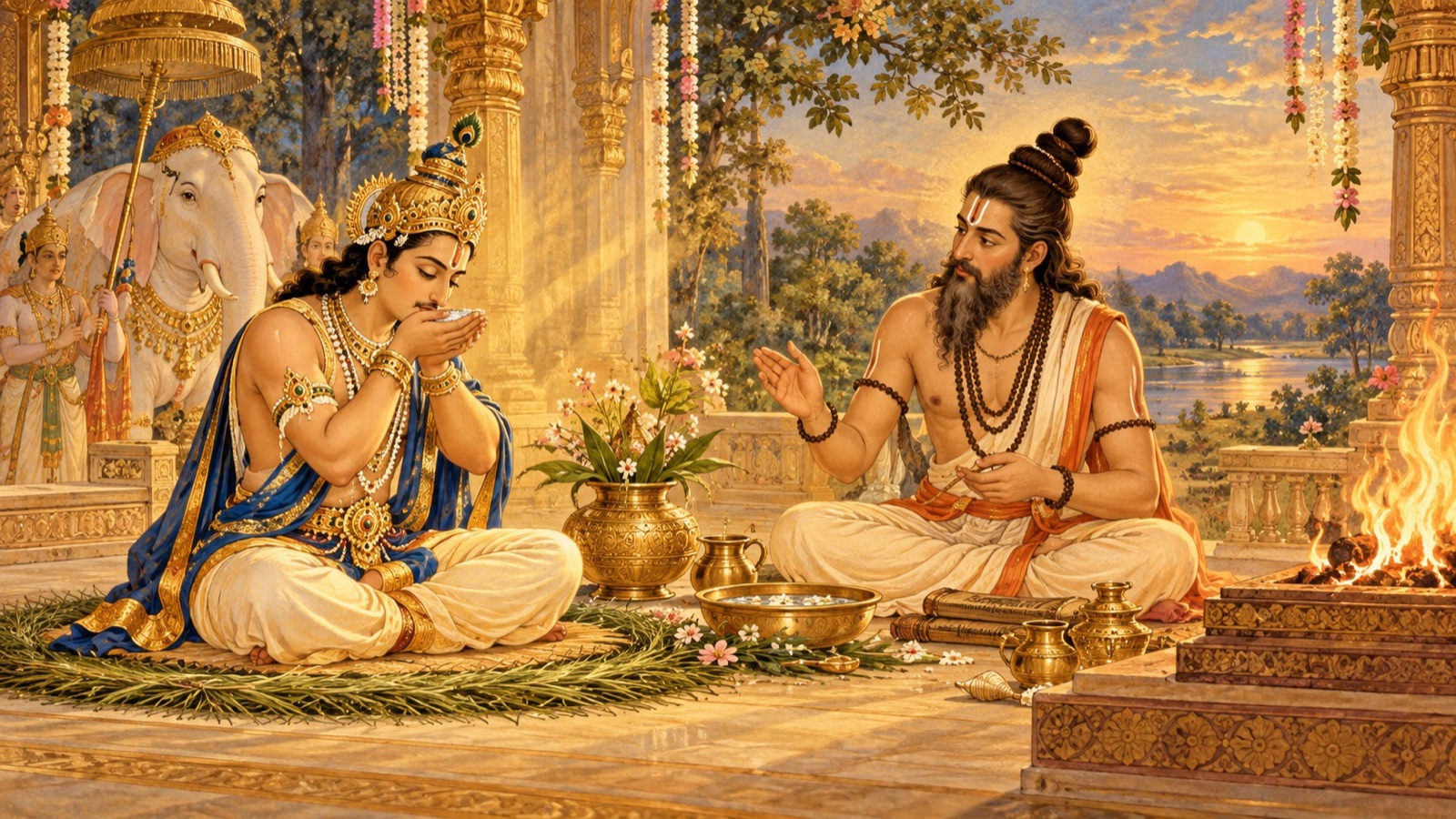
Sukadeva relates that Visvarupa, appointed as priest, taught the Kavaca as requested. The sage begins with the discipline of preparation: in the face of danger, one who has completed his purificatory rites should wash the hands and feet, sip water with the Lord’s names upon the lips, and, wearing a ring of sacred Kusa grass, silently perform the Nyasa — the consecration by which the syllables of the sacred mantras are placed upon the limbs of the body, the twelve-syllable mantra oṁ namo bhagavate vāsudevāya set upon the fingers and joints of the hands, so that the devotee’s very body is made a vessel of the holy Name (verses 3-10). Then, visualizing the Supreme Self endowed in fullest measure with all divine attributes, the worshipper takes up the prayer itself (verse 11). The lesson beneath the ritual is simple and profound: before we ask for protection, we make ourselves ready to receive it, sanctifying body and mind and turning them wholly toward the Lord.
The Eightfold Refuge upon Garuda
With body and mind thus consecrated, the devotee begins the Kavaca itself by fixing the heart upon the Supreme Lord in person, seated upon the back of Garuda, king of birds, His lotus feet resting upon him. In His eight arms the Lord bears eight weapons — the conch, the disc, the shield, the sword, the mace, the arrows, the bow, and the noose — and, complete in the eight mystic perfections, He is entreated to grant protection at all times. Before a single peril is even named, the whole prayer is anchored here: the devotee does not first reach for a weapon of his own, but takes shelter of the all-powerful Wielder of every weapon, resting the weight of his safety upon the Lord Himself (verse 12).
ॐ हरिर्विदध्यान्मम सर्वरक्षां न्यस्ताङ्घ्रिपद्म: पतगेन्द्रपृष्ठे । दरारिचर्मासिगदेषुचाप- पाशान् दधानोऽष्टगुणोऽष्टबाहु: ॥ १२ ॥
om harir vidadhyān mama sarva-rakṣāṁ nyastāṅghri-padmaḥ patagendra-pṛṣṭhe darāri-carmāsi-gadeṣu-cāpa- pāśān dadhāno ’ṣṭa-guno ’ṣṭa-bāhuḥ
Meaning: May Sri Hari, who rests His lotus feet upon the back of Garuda, king of birds, and who holds in His eight arms the conch, disc, shield, sword, mace, arrows, bow, and noose, grant me complete protection; endowed with the eight mystic perfections, may that all-powerful Lord guard me on every side. (Canto 6, Chapter 8, verse 12)
The Lord’s Incarnations as the Devotee’s Guard
Then comes the heart of the prayer: the calling upon the Lord in each of His descents to guard the devotee in every place. May Matsya, the divine Fish, protect me in the waters from all aquatic dangers and the noose of Varuna; may the Lord who appeared as the dwarf Vamana guard me on land, and Trivikrama, who measured the universe, protect me in the air (verse 13). May Nrsimha, slayer of Hiranyakasipu, whose roar resounds through every quarter, protect me in fearful places such as the forest and the battle-front; may the divine Boar, who lifted the earth upon His tusk, guard me from rogues along the road; may Parasurama protect me upon the mountain heights, and may Rama, elder brother of Bharata, together with Lakshmana, protect us in foreign lands (verses 14-15).
जलेषु मां रक्षतु मत्स्यमूर्ति- र्यादोगणेभ्यो वरुणस्य पाशात् । स्थलेषु मायावटुवामनोऽव्यात् त्रिविक्रम: खेऽवतु विश्वरूप: ॥ १३ ॥
jaleṣu māṁ rakṣatu matsya-mūrtir yādo-gaṇebhyo varuṇasya pāśāt sthaleṣu māyāvaṭu-vāmano vyāt trivikramaḥ khe vatu viśvarūpaḥ
Meaning: May the Lord in His form as the Fish protect me in the waters from the creatures of the deep and the noose of Varuna; may the Lord who assumed the form of the dwarf Vamana guard me on land, and may Trivikrama, whose form is the universe itself, protect me in the sky. (Canto 6, Chapter 8, verse 13)
The prayer continues through the Lord’s many forms — Narayana the sage keeping one from false and harmful religion, Nara from pride, Dattatreya from lapses in the practice of yoga, and Kapila from the bondage of fruitive action; Sanatkumara guarding one from lust, Hayagriva from the offence of neglecting obeisance to the Lord, Narada from faults in the worship of the Deity, and Kurma, the divine Tortoise, from falling into the hellish regions; Rsabha from the fear of the pairs of opposites, Dhanvantari from unwholesome food and disease, Yajna from public scandal and harm, and Balarama, as Sesa, from envious serpents; Vedavyasa dispelling the ignorance of one bereft of Vedic knowledge, Buddha guarding against acts opposed to the Veda, and Kalki, the Lord of righteousness, protecting from the impurities of the age of Kali (verses 16-19).

Protection Through Every Hour
The Kavaca then spreads its shelter across the whole round of time. May Kesava guard me in the early morning, Govinda through the following hours, Narayana in the forenoon, and Vishnu bearing the Sudarsana at midday; may Madhusudana protect me in the afternoon and Madhava at dusk; may Hrsikesa guard the first watch of the night and Padmanabha the dead of night; may the Lord who bears the Srivatsa mark protect me after midnight until the sky grows pink, Janardana, sword in hand, through the last watch of the night, and Damodara in the early morning — while Visvesvara, the Lord as the very form of Time, guards the junctions of day and night (verses 20-22). No moment of the day or night, the prayer teaches, is left outside the Lord’s protecting presence.
The Weapons of the Lord
Now the devotee invokes the Lord’s own weapons as living guardians. May the Sudarsana disc, blazing with the fire of universal dissolution, burn away the hostile hosts; may the mace, deadly as a thunderbolt, crush the imps and ogres and evil spirits; may the sword Nandaka and the hundred-mooned shield blind the eyes of the wicked; may the conch, with its terrifying blast, drive away every goblin and evil-eyed spirit (verses 23-26). From every quarter — from comets, from men and reptiles and beasts, from ghosts and even from our own sins — may all fear be destroyed at the mere utterance of the Lord’s names (verses 27-28).

The One Lord Who Is All
Rising above every particular form, the prayer turns first to the Lord’s own associates: may Garuda, the mighty carrier of Vishnu who is himself the personified Vedas, and Visvaksena, the Lord’s foremost attendant, turn away every danger by their very names (verse 29). Then it reaches its truth: it is the Lord alone who constitutes everything with form and without form, and by that very truth may all our troubles end. As the one undifferentiated Lord assumes, by His own creative power, His many potencies and forms and names and weapons, may that same all-pervading Sri Hari protect us by all His manifestations, at every place and time (verses 30-33).
Here the Kavaca opens its deepest secret, and with it the reason such a prayer can shelter us at all. The Lord’s holy names, His transcendental forms, His divine qualities, His carrier, and even the weapons in His hands are not separate things serving Him from without — they are wholly non-different from Him, spiritual in their very substance, each carrying His full power to guard the soul (verses 30-33). To call upon the disc, the conch, or the name of Nrsimha is therefore no superstition and no mere outward rite, but direct contact with the Supreme Person Himself, who dwells in His name as fully as in His form. This is why the devotee who sees this unity within diversity finds the Lord already present everywhere, and why a single sincere utterance of His name places one beneath the same shelter as the whole recited armour.
Finally the devotee calls upon Nrsimha to defend him in all directions and the space between, above and below, within and without — dispelling every fear by His roar and eclipsing all lesser lights by His own effulgence (verse 34).
विदिक्षु दिक्षूर्ध्वमध: समन्ता- दन्तर्बहिर्भगवान्नारसिंह: । प्रहापयँल्लोकभयं स्वनेन स्वतेजसा ग्रस्तसमस्ततेजा: ॥ ३४ ॥
vidikṣu dikṣūrdhvam adhaḥ samantād antar bahir bhagavān nārasiṁhaḥ prahāpayaḻ loka-bhayaṁ svanena sva-tejasā grasta-samasta-tejāḥ
Meaning: May Lord Nrsimha protect me in all directions and the intermediate quarters, above and below, within and without, dispelling all fear by His roar and eclipsing every other radiance by His own effulgence. (Canto 6, Chapter 8, verse 34)
The Power of the Prayer
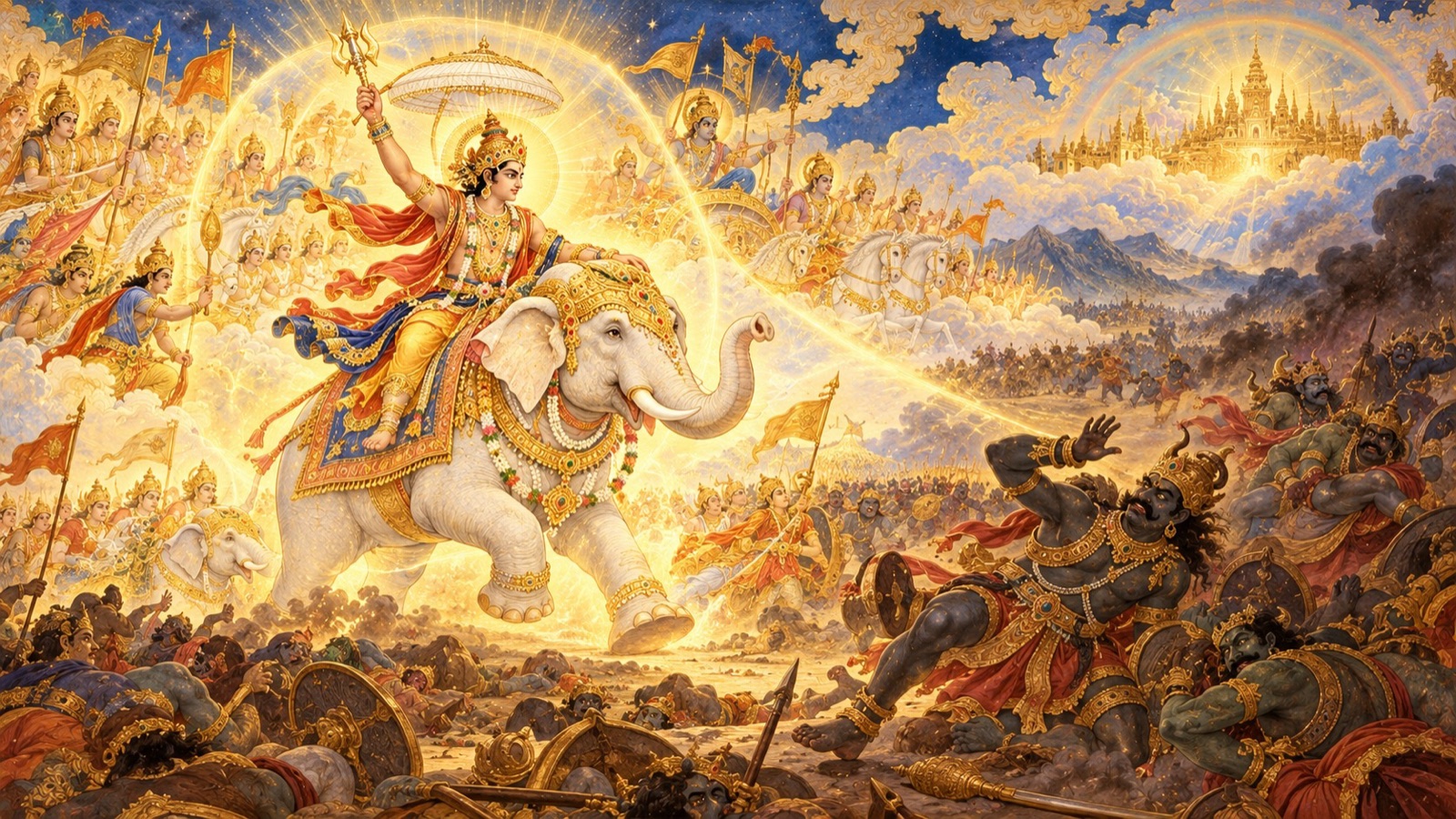
Visvarupa concludes with the fruits of the Kavaca. Whoever the wearer of this armour looks upon or touches is at once freed from all fear; no ruler, robber, evil spirit, or ferocious beast can seize one whose mind is fixed on this sacred prayer (verses 35-37). To show its power he tells of a Brahmana of the line of Kusika, who cast off his body in a desert while absorbed in this prayer; and of Citraratha, chief of the Gandharvas, whose aerial car fell headlong when he flew over the spot, until, on the counsel of the Valakhilya sages, he consigned the Brahmana’s bones to the Sarasvati and departed in wonder at the prayer’s efficacy (verses 38-40). Sukadeva adds that all beings bow to one who hears and meditates upon this prayer at the moment of danger, and that Indra, having learned it from Visvarupa, decisively conquered the demons and enjoyed the sovereignty of the three worlds (verses 41-42).
एतां विद्यामधिगतो विश्वरूपाच्छतक्रतु: । त्रैलोक्यलक्ष्मीं बुभुजे विनिर्जित्य मृधेऽसुरान् ॥ ४२ ॥
etāṁ vidyām adhigato viśvarūpāc chatakratuḥ trailokya-lakṣmīṁ bubhuje vinirjitya mṛdhe ’surān
Meaning: Having obtained this sacred knowledge from Visvarupa, Indra, performer of a hundred sacrifices, conquered the demons in battle and enjoyed the fortune of the three worlds. (Canto 6, Chapter 8, verse 42)
Principal Teachings of This Chapter
1. The Lord’s Name is the true armour. The Kavaca rests one’s safety not on weapons or strength but on the names, forms, and remembrance of the Supreme Lord — the surest shelter of the soul (verses 1-2, 35).
2. Every incarnation is a refuge. In each of His descents — Matsya, Vamana, Nrsimha, Varaha, Rama, Kalki, and more — the Lord meets a particular need and danger, teaching that no situation is beyond His protecting reach (verses 13-19).
3. No hour is outside His care. The prayer covers every division of day and night, reminding the devotee that the Lord’s presence never sleeps and never departs (verses 20-22).
4. Preparation sanctifies prayer. Before invoking protection, the devotee consecrates body and mind, showing that true refuge begins with turning oneself wholly toward God (verses 3-11).
5. All fear ends in the one Lord. Beneath every form and weapon stands the single truth that the Lord alone is all that exists — and resting in that truth, the heart is freed from every fear (verses 31-34).
A Devotional Reflection
The Narayana-kavaca is, at its heart, a lesson in where to place our trust. We spend much of our lives building smaller armours — of wealth, of caution, of influence — and the Bhagavata does not scorn ordinary prudence. But it quietly insists that no earthly shield reaches everywhere: not into the water and the air and the forest, not into every hour of the night, not into the unseen fears that follow us, not into the sins of our own hearts. Only the Lord’s presence covers all of these at once. What moves the devotee is not the promise of magical safety but the vision the prayer opens — a world in which every element, every direction, every moment is already inhabited by God in one form or another, so that there is truly nowhere we can go beyond His care. To recite such a prayer is less to summon protection from outside than to remember a shelter that was always there. And its deepest word is the simplest: that the Lord alone is all that is, and resting in Him, the frightened heart grows still.
A Daily Devotional Practice
Today, make a small armour of remembrance. At the start of your day, pause and call the Lord’s holy name into your heart, entrusting to Him the hours ahead — your going out and coming in, your work and your rest. When a moment of fear or anxiety arises, instead of turning first to worry, quietly repeat the Lord’s name and remember that His presence surrounds you within and without, above and below. You need not recite the whole Kavaca to live its spirit; a single sincere remembrance, offered in trust, places you under the same protecting shelter that guarded Indra in battle.
Conclusion
The eighth chapter of the Sixth Canto gives us the Narayana-kavaca, the armour of the Lord’s own names and forms. Taught by Visvarupa to Indra and recited by Sukadeva to Parikshit, it prepares the devotee in body and mind and then invokes the Lord in each of His incarnations to guard every place, every hour, and every danger, until all fear dissolves in the single truth that the Lord alone is all. Its power is shown in Indra’s decisive victory and in the wonder of the Kusika Brahmana’s bones, and its promise reaches to us: that whoever fixes the mind on this sacred prayer is freed from fear. As the Canto moves next to the great conflict with Vritra, we carry with us the surest lesson of the Kavaca — that our truest protection is never our own strength, but the ever-present shelter of the Lord.
May the divine wisdom of Srimad Bhagavatam awaken pure devotion within our hearts.
Om Namo Bhagavate Vasudevaya.
Jay Shree Madhav.
References and Attribution
- Primary edition: Gita Press, Śrīmad Bhāgavata Mahāpurāṇa (English, complete), Book Six, Discourse 8.
- Series: Srimad Bhagavatam Wisdom · Biswa Sanatan Dharma Seva Trust.
- Presented following the spiritual guidance and recommendation of Pandit Dr. Shri Kashinath Mishra.
This is an original, faithful retelling in the writer’s own words, with brief quoted verses shown in Devanāgarī and transliteration and their meanings given as summaries. It is not a reproduction of any single publisher’s continuous translation or commentary. No affiliation with or endorsement by any publisher is implied.
Jay Shree Madhav