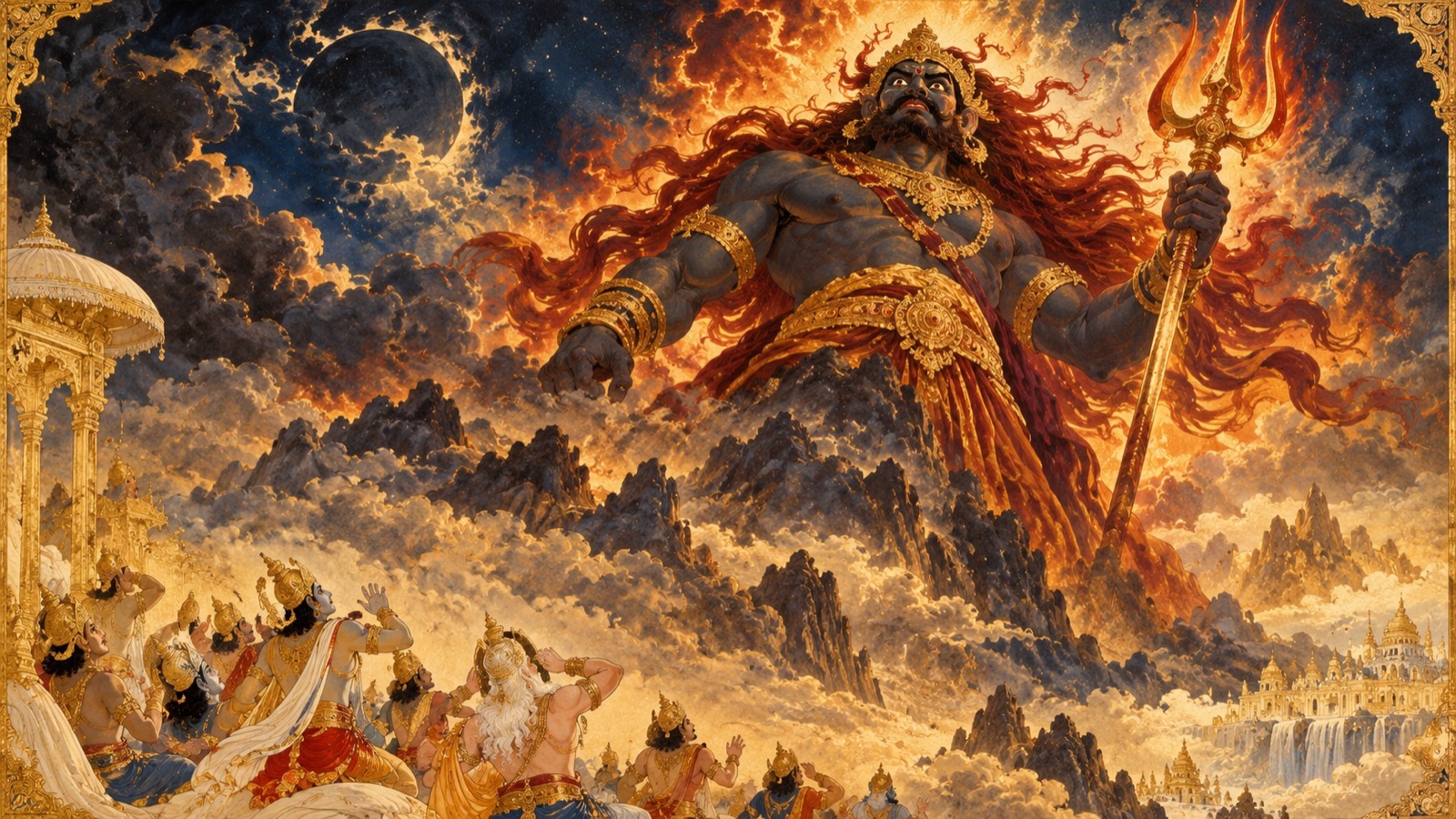
Born of a grieving father’s sacrifice, the colossal demon Vritra rises like the fire of dissolution and swallows the weapons of the gods — until, helpless, the deities turn inward to Lord Narayana, who reveals the one path by which the terror can be overcome.
Om Namo Bhagavate Vasudevaya.
Om Namo Bhagavate Vasudevaya.
Om Namo Bhagavate Vasudevaya.
Welcome to Srimad Bhagavatam Wisdom, a devotional journey through the sacred histories and teachings of the Srimad Bhagavat Mahapurana. The ninth chapter of the Sixth Canto carries the story of Indra into darker country. The very priest who had restored heaven’s fortune, Visvarupa, is discovered secretly favouring the demons, and the fearful Indra beheads him — incurring the grave sin of killing a Brahmana. In retaliation, the grieving Tvasta performs a sacrifice that brings forth Vritra, a demon vast as a mountain and terrible as death, who devours the very weapons of the gods. Powerless before him, the gods at last turn from their own strength to the shelter of Lord Narayana, and offer a prayer of profound surrender. The Lord appears, accepts their praise, and reveals the one means by which Vritra can be slain: the gift of the bones of the sage Dadhici, from which the thunderbolt will be forged.
Chapter Information
- Scripture: Śrīmad Bhāgavata Mahāpurāṇa
- Canto: 6 (Book Six)
- Chapter: 9 (Discourse 9)
- Chapter title: The Appearance of the Demon Vritrasura
- Principal speaker: Sukadeva Gosvami, narrating to King Parikshit; the gods and the Lord within the account
- Principal listener: King Parikshit; the sages of Naimisharanya at the outer frame
- Main setting: The heavens and the sacrificial arena of Tvasta; and the hearts of the gods, where the Lord appears
- Central subject: The slaying of Visvarupa, the birth of Vritra, and the gods’ surrender to Lord Narayana
- Principal verse range: Canto 6, Chapter 9, verses 1–55
- Primary edition: Gita Press Śrīmad Bhāgavata Mahāpurāṇa
The Secret Offence of Visvarupa
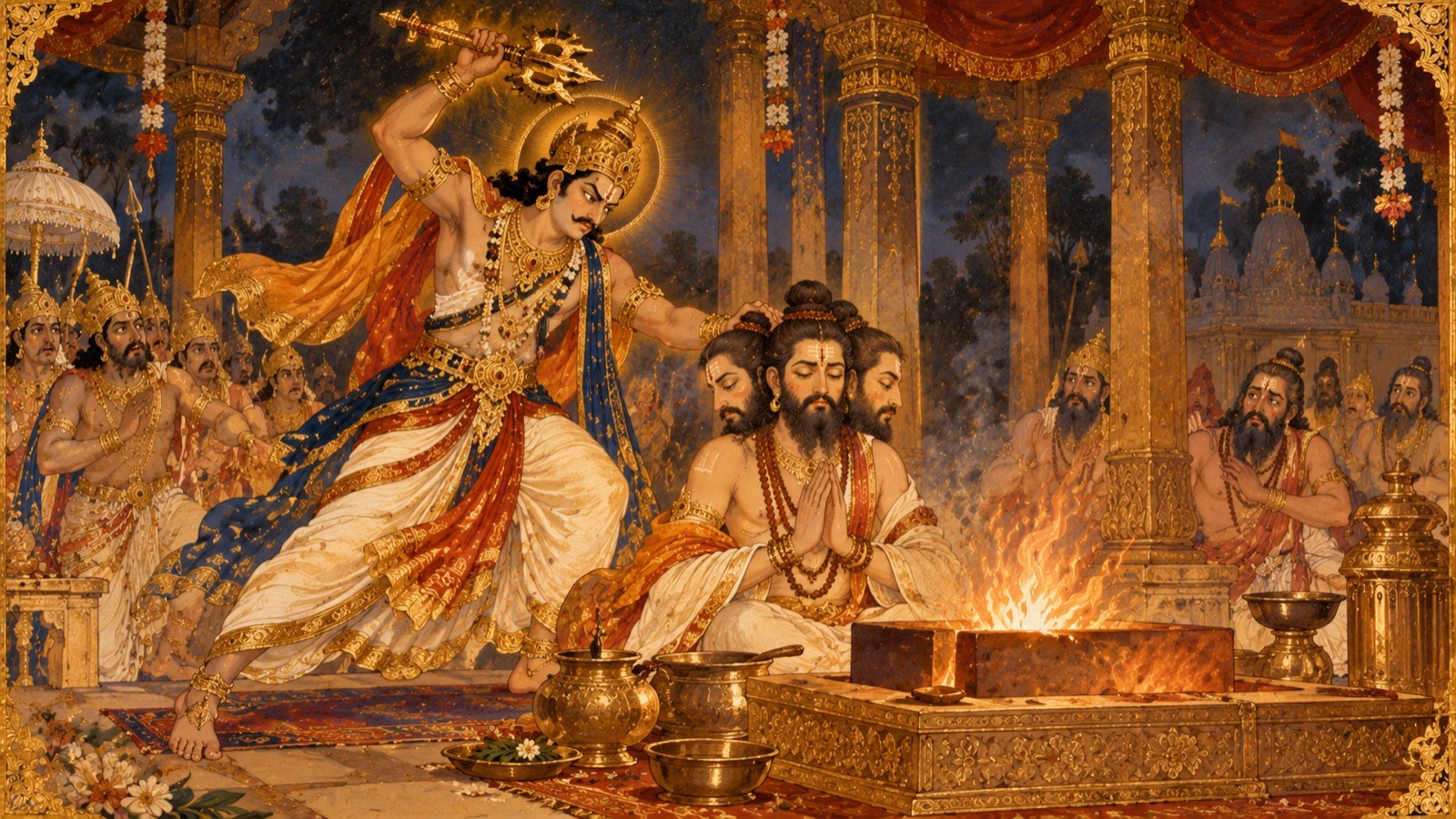
Sukadeva relates that Visvarupa had three heads — one by which he drank the Soma juice, one by which he drank wine, and one by which he ate food. Though he openly offered oblations to the gods, who were his kinsmen on his father’s side, he secretly offered a share to the demons as well, out of the affection his mother bore them (verses 1-3).
श्रीशुक उवाच तस्यासन् विश्वरूपस्य शिरांसि त्रीणि भारत । सोमपीथं सुरापीथमन्नादमिति शुश्रुम ॥ १ ॥
śrī-śuka uvāca tasyāsan viśvarūpasya śirāṁsi trīṇi bhārata soma-pīthaṁ surā-pītham annādam iti śuśruma
Meaning: Sukadeva said: O descendant of Bharata, thus have we heard — with the first of his three heads Visvarupa took Soma, with the second he drank wine, and with the third he ate his food. (Canto 6, Chapter 9, verse 1)
The Slaying of Visvarupa
Learning of this breach of faith — by which the gods were deprived of their rightful share — and fearing that Visvarupa might one day bring about their ruin, the angry Indra swiftly cut off all three of his heads. The head that drank Soma became the francolin, the head that drank wine the sparrow, and the head that ate food the partridge (verses 4-5). Indra, though powerful enough to ward it off, humbly accepted the sin of killing a Brahmana, and after bearing it for a year, divided it into four parts, assigning them to the earth, the waters, the trees, and women — each accepting its share along with a boon, so that visible signs of that sin remain in the world to this day (verses 6-10).
The Birth of Vritra
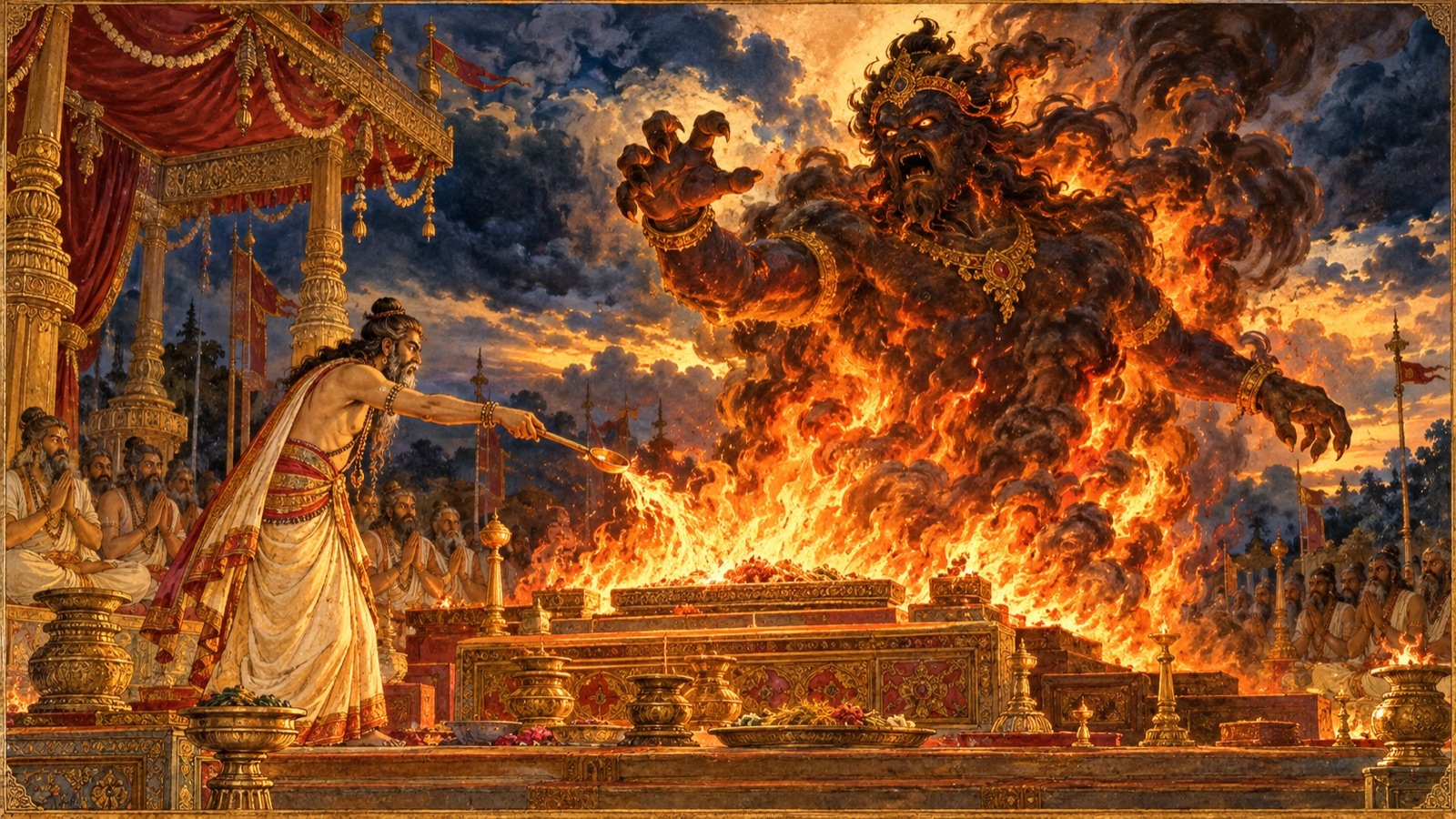
Tvasta, whose son had been slain, poured oblations into the sacred fire to procure a mortal enemy for Indra. In his grief he misspoke the accent of his own mantra, so that what he meant to call forth as “the slayer of Indra” arose instead as “one who is Indra’s enemy” — a small slip that quietly foretells whose hand would finally prevail (verse 11). From the fire rose a demon of terrible aspect, like Death appearing at the time of universal dissolution. Growing day by day to the span of an arrow’s flight on every side, dark as a burnt hill, with beard and hair red as heated copper and eyes fierce as the midday sun, he danced with his blazing trident, roared, and shook the earth, his cavernous mouth seeming to swallow the sky and lick the stars (verses 11-17). Because these worlds were enveloped by that vast darkness born of Tvasta, he was rightly named Vritra, the “enveloper” — most sinful and most terrible (verse 18).
येनावृता इमे लोकास्तपसा त्वाष्ट्रमूर्तिना । स वै वृत्र इति प्रोक्त: पाप: परमदारुण: ॥ १८ ॥
yenāvṛtā ime lokās tapasā tvāṣṭra-mūrtinā sa vai vṛtra iti proktaḥ pāpaḥ parama-dāruṇaḥ
Meaning: Since all these worlds were enveloped by the austerity-born form of Tvasta’s offspring, he was rightly called Vritra, the enveloper — most sinful and exceedingly terrible. (Canto 6, Chapter 9, verse 18)
The Gods Overpowered
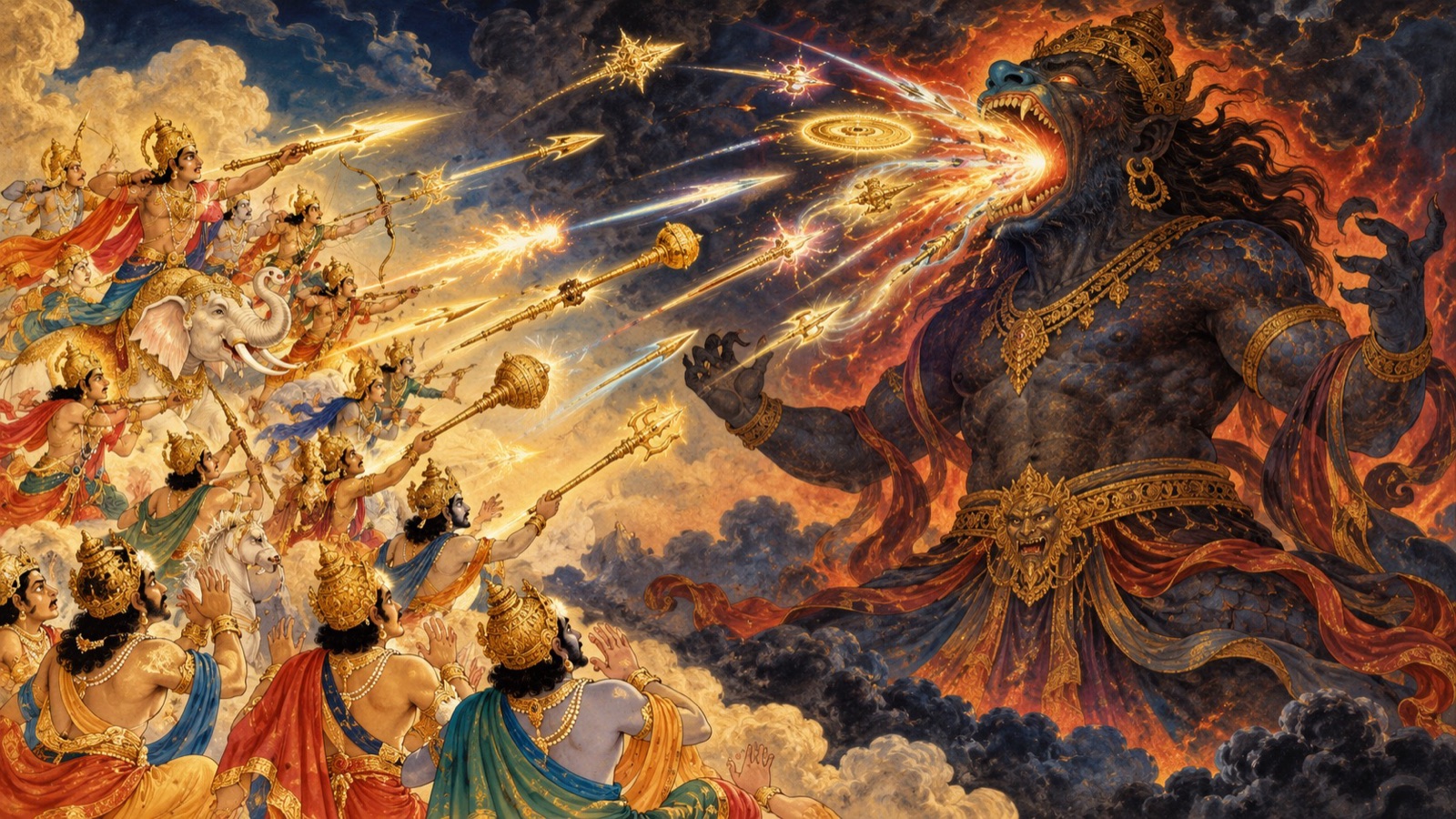
The generals of the gods rushed against Vritra with their hosts of celestial missiles and weapons — but he swallowed them all. Their splendour eclipsed, amazed and dejected, the gods composed themselves and turned inward, approaching Lord Narayana who dwells in the heart (verses 19-20). In a prayer of deep surrender they confessed that even Death fears the Supreme Lord, that anyone who seeks refuge elsewhere is like one trying to cross the ocean by holding a dog’s tail, and that the Lord who saved Satyavrata in the form of the Fish, and Brahma at the dawn of creation, would surely protect His own from the terror of Vritra (verses 21-27).
The Lord Appears
While the gods were praying, the Lord appeared — first within their hearts, and then before them, bearing conch, discus, and mace, waited upon by His sixteen attendants, His eyes like full-blown autumn lotuses. Overwhelmed with joy, the gods fell prostrate upon the ground and then, slowly rising, offered their praises (verses 28-30).
श्रीशुक उवाच इति तेषां महाराज सुराणामुपतिष्ठताम् । प्रतीच्यां दिश्यभूदावि: शङ्खचक्रगदाधर: ॥ २८ ॥
śrī-śuka uvāca iti teṣāṁ mahārāja surāṇām upatiṣṭhatām pratīcyāṁ diśy abhūd āviḥ śaṅkha-cakra-gadā-dharaḥ
Meaning: Sukadeva said: O great king, as the gods were thus offering their prayers, the Lord appeared — first within their hearts, and then, made visible in the western quarter, before their eyes — bearing His conch, discus, and mace. (Canto 6, Chapter 9, verse 28)
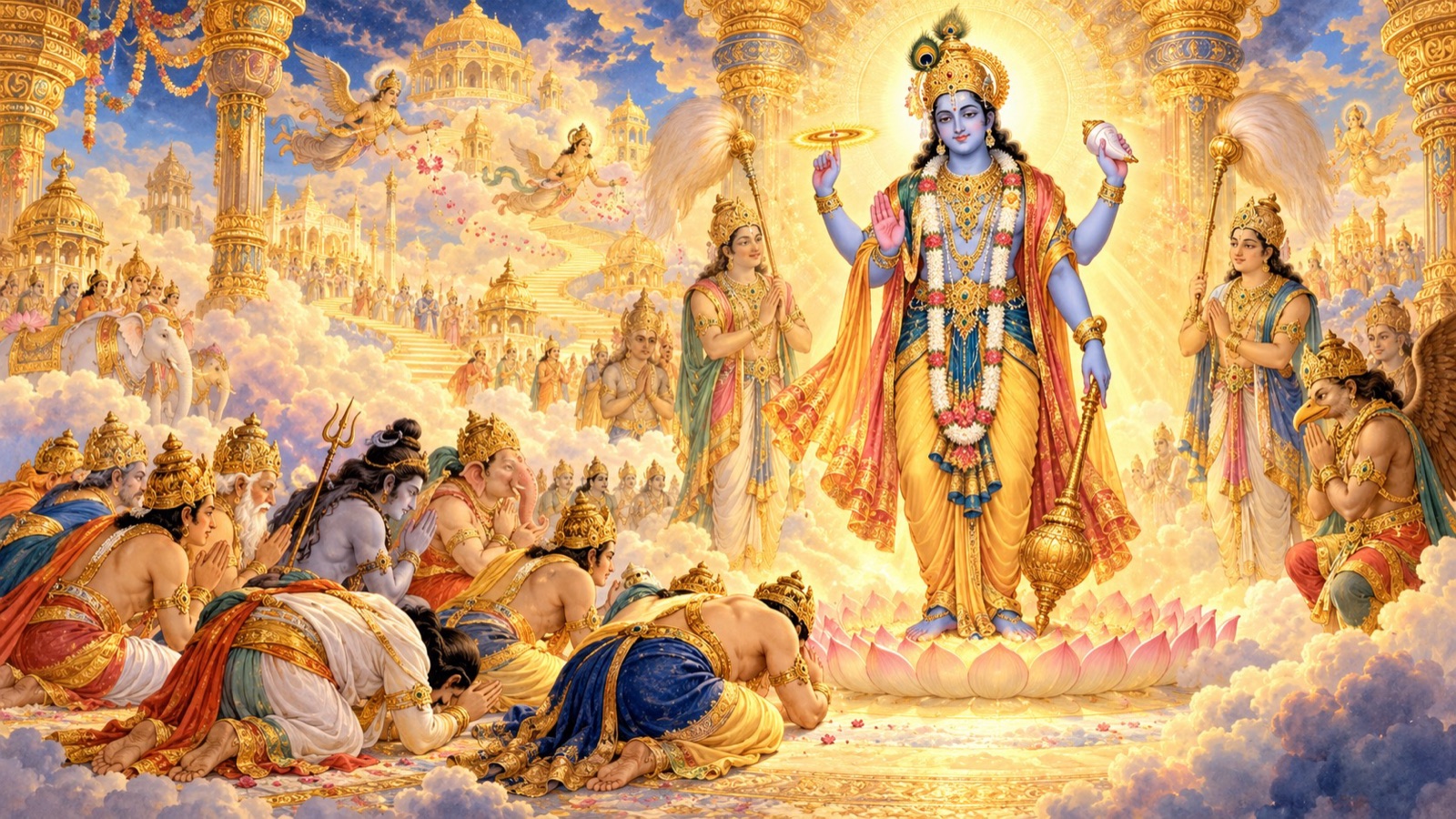
Their prayer rose as a river of praise. They hailed Him as Narayana and Vasudeva, the most ancient Person, whose glory shines through sacrifice and whose discus destroys the enemies of righteousness — the sole shelter of the universe and husband of the goddess of fortune, known only to those perfected renunciants who, through the deepest meditation, throw open the door of the heart long shut by ignorance, and there behold, within their own self, the bliss they had always sought (verses 31-33).
ॐ नमस्तेऽस्तु भगवन्नारायण वासुदेवादिपुरुष महापुरुष महानुभाव परममङ्गल परमकल्याण परमकारुणिक केवल जगदाधार लोकैकनाथ सर्वेश्वर लक्ष्मीनाथ परमहंसपरिव्राजकैः परमेणात्मयोगसमाधिना परिभावितपरिस्फुटपारमहंस्यधर्मेणोद्घाटिततमःकपाट द्वारे चित्तेऽपावृत आत्मलोके स्वयमुपलब्धनिजसुखानुभवो भवान् ॥ ३३ ॥
oṁ namas te ‘stu bhagavan nārāyaṇa vāsudevādi-puruṣa mahā-puruṣa mahānubhāva parama-maṅgala parama-kalyāṇa parama-kāruṇika kevala jagad-ādhāra lokaika-nātha sarveśvara lakṣmī-nātha paramahaṁsa-parivrājakaiḥ parameṇātma-yoga-samādhinā paribhāvita-parisphuṭa-pāramahaṁsya-dharmeṇodghāṭita-tamaḥ-kapāṭa-dvāre citte ‘pāvṛta ātma-loke svayam upalabdha-nija-sukhānubhavo bhavān.
Meaning: Obeisances unto You, O Lord Narayana, Vasudeva, the great and glorious Person, purest good and purest blessing, sole shelter of the universe, lord of all worlds, husband of the goddess of fortune — known only to those great renunciants who, through perfect meditation, throw open the door of the heart shut fast by ignorance, and there find, within their own self, the joy they had always been seeking. (Canto 6, Chapter 9, verse 33)
Yet even at such length, they confessed the praise was hardly needed: how could a spark carry news to the very fire from which it leaps, they asked, when the Lord who dwells within every heart already knows all there is to know (verse 42)? All they truly sought, they said, was shelter beneath His lotus feet, the one shade that quiets every sorrow this world can bring, before they begged Him at last to destroy the demon who had swallowed their strength (verses 43-44). He is, they said in closing, the abode of the universe, the support of all worlds, the beloved home to which every wandering soul returns at the end of its journey (verse 45).
The Command of the Lord
Gratified by their prayer, the Lord replied that He was pleased with the sacred hymn by which they had praised Him — a hymn born of true knowledge, that purifies and awakens whoever offers it (verses 46-47). When He is pleased, He said, what cannot be attained? Yet His true devotee, whose mind is fixed wholly on Him, asks for nothing but the chance to serve (verse 48).
Then came an unexpected turn in the Lord’s own words. Those who count material gain as life’s highest end, He said, are simply misers who do not know the soul’s real need — and whoever grants such a request only humours the miser’s folly (verse 49). A devotee established in genuine knowledge, He continued, never urges a struggling soul toward more of the very engagement that keeps it bound, any more than a wise physician would feed a sick man the food that worsens his illness (verse 50). Gratified as He was, and ready to grant their plea, the Lord could not help but remind the gods, even here, that regained weapons are not the highest gift He has to give.
Then He revealed the remedy: let Indra go to Dadhici, the noblest of seers, whose body has grown mighty through mantra, vow, and austerity, and beg of him his limbs (verse 51).
मघवन् यात भद्रं वो दध्यञ्चमृषिसत्तमम् । विद्याव्रततप:सारं गात्रं याचत मा चिरम् ॥ ५१ ॥
maghavan yāta bhadraṁ vo dadhyañcam ṛṣi-sattamam vidyā-vrata-tapaḥ-sāraṁ gātraṁ yācata mā ciram
Meaning: O Indra, may all be well with you; go to Dadhici, the best of sages, the very essence of knowledge, vow, and austerity, and beg of him his body without delay. (Canto 6, Chapter 9, verse 51)
The Lord explained the sacred lineage of that sage: Dadhici, who had realized Brahma, had imparted transcendent knowledge to the Asvini-kumaras through his horse’s head, and had taught Tvasta the very Narayana-kavaca that had passed to Visvarupa and then to Indra. From the bones of Dadhici’s limbs, offered up in charity, Visvakarma would forge a thunderbolt, and, strengthened by the Lord’s own power, Indra would sever the head of Vritra and regain all his lost glory — for enemies can never destroy those who are sheltered by the Lord (verses 52-55).
Principal Teachings of This Chapter
1. Even a small breach of faith carries great consequence. Visvarupa’s secret partiality sets in motion a chain of sin, grief, and terror, showing how divided loyalties can quietly corrupt even a holy office (verses 3-4).
2. Sin must be owned, not evaded. Indra, though able to ward off the reaction, humbly accepts the sin of his deed and bears its burden — a model of accountability rather than denial (verses 6-10).
3. Anger and retaliation breed new suffering. Tvasta’s grief-fuelled sacrifice produces Vritra; violence answered by violence only enlarges the darkness (verses 11-18).
4. When our own power fails, surrender remains. The gods, stripped of their weapons, turn inward to Lord Narayana — teaching that the end of self-reliance can be the beginning of true refuge (verses 19-27).
5. The Lord’s help often asks a great sacrifice. The remedy for Vritra is not a magic gift but the willing self-offering of a saint, pointing to the truth that deliverance is won through selfless surrender (verses 51-54).
6. True devotion wants nothing in exchange. Even while granting the gods’ plea, the Lord makes clear that a devotee whose heart is fixed on Him desires nothing except the opportunity to serve, and that satisfying a smaller desire, however earnestly prayed for, is itself a kind of folly (verses 48-50).
A Devotional Reflection
This chapter is honest about how trouble grows. It begins with something small — a priest secretly diverting to the demons a share of the offerings that was never rightfully theirs — and it ends with a monster large enough to swallow the sky. In between stand a killing, a grieving father, a vengeful sacrifice, and gods so proud of their weapons that they attack before they pray. The Bhagavata lets us watch the whole sorry sequence, and only when every weapon has been devoured do the gods do the one thing that helps: they turn inward and surrender. It is a familiar shape. So often we exhaust our own strategies — our defences, our counter-attacks, our clever plans — before we finally remember to pray. The mercy of the story is that the Lord does not turn away gods who come to Him late and only after every other resort has failed; He appears the moment they truly turn to Him, first within their hearts and then before their eyes — even as, in the same breath, He gently reminds them that a devotee’s true wealth is not weapons regained but the wish to serve Him for its own sake. And His remedy is quietly beautiful. He does not simply destroy Vritra Himself; He calls forth the sacrifice of a saint, so that even the victory becomes an act of love and self-giving. The chapter teaches us that our darkest troubles are not overcome by greater force, but by surrender to God and the willingness to give ourselves away.
A Daily Devotional Practice
Today, practise turning to God before your own strength runs out. When a difficulty arises — a worry, a conflict, a fear that feels too large — pause before reaching for your usual defences, and first offer the situation to the Lord, quietly placing it in His hands with His name on your lips. Let surrender be your first response, not your last. And take a moment to give thanks for those who have sacrificed for your good — parents, teachers, unseen benefactors — and consider one small way you might give of yourself for another today, in the spirit of the sage who offered his very bones so that others might be saved.
Conclusion
The ninth chapter of the Sixth Canto traces how a hidden fault can swell into overwhelming darkness — from Visvarupa’s secret offering to Indra’s grave sin, from Tvasta’s vengeful sacrifice to the towering terror of Vritra. Yet its true subject is the turning point: the moment the helpless gods abandon reliance on their own weapons and surrender to Lord Narayana, who appears at once to accept their prayer. His remedy — the self-offering of the sage Dadhici, whose bones will become the thunderbolt — reveals that deliverance comes not through force but through sacrifice and grace. As the Canto moves next to the great battle between Indra and Vritra, we carry with us the chapter’s steady lesson: that when every other shelter fails, the surrendered heart finds its refuge in the Lord.
May the divine wisdom of Srimad Bhagavatam awaken pure devotion within our hearts.
Om Namo Bhagavate Vasudevaya.
Jay Shree Madhav.
References and Attribution
- Primary edition: Gita Press, Śrīmad Bhāgavata Mahāpurāṇa (English, complete), Book Six, Discourse 9.
- Series: Srimad Bhagavatam Wisdom · Biswa Sanatan Dharma Seva Trust.
- Presented following the spiritual guidance and recommendation of Pandit Dr. Shri Kashinath Mishra.
This is an original, faithful retelling in the writer’s own words, with brief quoted verses shown in Devanāgarī and transliteration and their meanings given as summaries. It is not a reproduction of any single publisher’s continuous translation or commentary. No affiliation with or endorsement by any publisher is implied.
Jay Shree Madhav