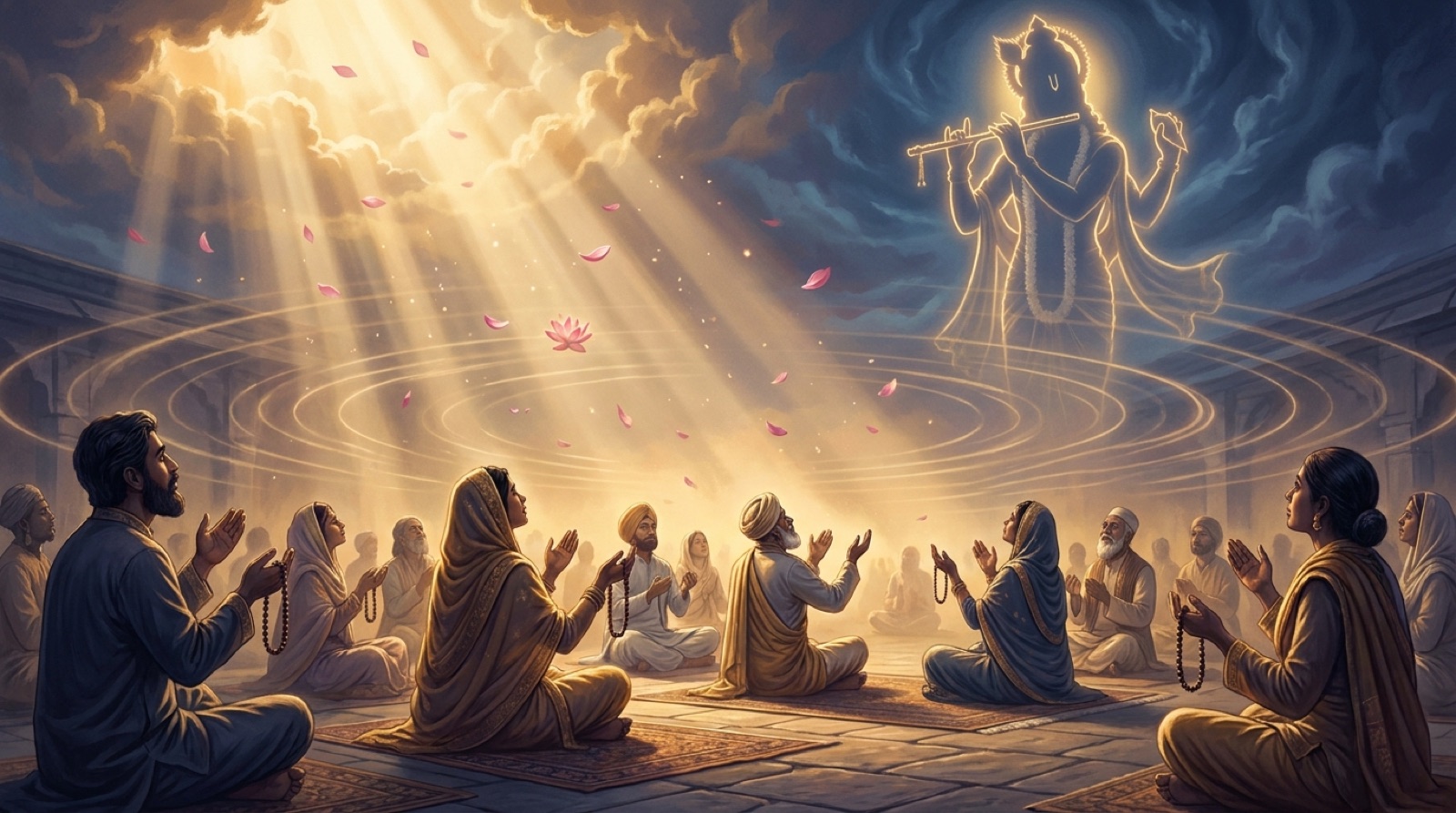
This article first appeared on our earlier website and is restored here from the archives, lightly edited for the new site. Its teaching is more timely now than when it was first published.
One of the most important practices in Sanatana Dharma during Kali Yuga is chanting the name of the Lord — to seek His blessings and attain spiritual liberation. Lord Vishnu is the Supreme Lord, and He has incarnated on earth in various forms to establish Dharma and protect the world; the ten principal incarnations are known as the Dashavatara.
Pandit Dr. Shri Kashinath Mishra has explained that each age has its own name of power: in Satya Yuga it was Bhagwan Maha Vishnu; in Treta Yuga, Bhagwan Shri Narayan and Bhagwan Shri Ram; in Dwapara Yuga, Bhagwan Shri Krishna; in Kali Yuga, Bhagwan Shri Jagannath. But as we now stand in the transition between Kali Yuga and Satya Yuga, the question becomes urgent: which name of the Lord should devotees chant in the present times?
Innumerable sacred names of Lord Vishnu appear in the Mālikā, the Gīta Gōvindam of poet Jayadev, the Srīmad Bhāgavatam Mahapurana and other scriptures. Yet the holiest name for this era is ‘Mādhaba.’
What the name Mādhaba means
‘Mā’ represents Brahma-Swarupa Jagat Mata — the manifestation of the feminine power of the formless Lord. ‘Dhaba’ means Lord (Swami). Together, Mādhaba is the Lord of the universal Mother-power — the name that contains both the Divine Mother and the Divine Lord in a single breath.
The name that was reserved for this age
In Dwapara Yuga, when the Lord bore the name Shri Krishna, Goddess Bhagwati asked Him: "Lord, I christened Your name to be Mādhaba — why did You alter it?" The Lord replied: "I have reserved this name for Kali Yuga, when I will use this mighty name ‘Mādhaba’ for the upliftment and rescue of My devotees. Hence in this age and this incarnation, I bear the name Shri Krishna."
The Mālikā states it directly:
“Mādhabāchārjya sampradāy hōiba, cittā hēba nityānanda”
Source: Bhaviṣya Mālikā
Meaning: The community formed for the re-establishment of Dharma will be known as the Sudharma Maha Maha Sangha — the ‘Mādhaba Āchārya Sampradāya’ — and its devotees will wear the tilak of Lord Sri Chaitanya Dev.
“śēṣa kali līlā bhāba tō āgē, bujhāi kahibi sarba lō,
jāi phula Kalkī rūpa dharibē Mādhaba”
Source: Bhaviṣya Mālikā (Odia)
Meaning: When the Lord incarnates at the end of Kali Yuga, His name at that time will be Mādhaba.
Mahapurush Achyutananda writes further that pastimes akin to those of gōlaka dhāma — the Lord's own abode — will unfold daily in this mortal land, and devotees across the universe will chant "Mādhaba, Mādhaba." People will be astounded, yet unable to recognize the Lord; the devout will proclaim that Mādhaba has come to restore righteousness, and the world will not understand. Not all will recognize Him — this too the Mālikā foretold.
The first name Radha Rani ever spoke to Him
For every devotee of Lord Vishnu — of Vrindavan, of Dwarka, of Badrinath, of Puri — there is one moment that settles the greatness of this name. When Maa Radha Rani first met Shri Krishna, and Lord Brahma and Nanda Baba entrusted Him to her, by which name did she address Him? Chapter 110 of the ‘Krishna Janma Khand’ of the Brahmavaivarta Purana records it:
“mā ca brahma svarūpā jā mūla prakr̥ti īśvarī,
nārāyaṇī tri bikhyātā viṣṇu māyā sanātanī,
māhālakhmī svarūpā ca veda mātā sarasvatī,
rādhā vasuṅdharā gaṅgā, tā saṅga svāmī ca mādhaba”
Source: Brahmavaivarta Purana, Krishna Janma Khand, Ch. 110
Meaning: Upon meeting the Lord for the very first time, Maa Radha Rani addressed Him not as Krishna, but as “Mādhaba, hey Mādhaba.”
The name the Divine Mother herself chose first — hidden through Dwapara Yuga — is effulgent now in this age. Chant the name of Mādhaba, and you shield yourself from the mayhem of Kali and receive the blessings of Lord Vishnu.
In conclusion: chanting the Lord's names is the foremost devotion of Kali Yuga, and different names carry the power of different eras. As per the scriptures, ‘Mādhaba’ is the holiest and most auspicious name to chant in the current era — the heart of the Tri-Sandhya practice, and the name the Mālikā says the whole world will one day be chanting. Begin today.
Companion article: The Sixteen Sacred Names of Lord Vishnu — the Ṣoḍaśanāma Stotram recited in Tri-Sandhya, which ends with the instruction: in ALL activities, remember Mādhava.
Jay Shree Madhaba