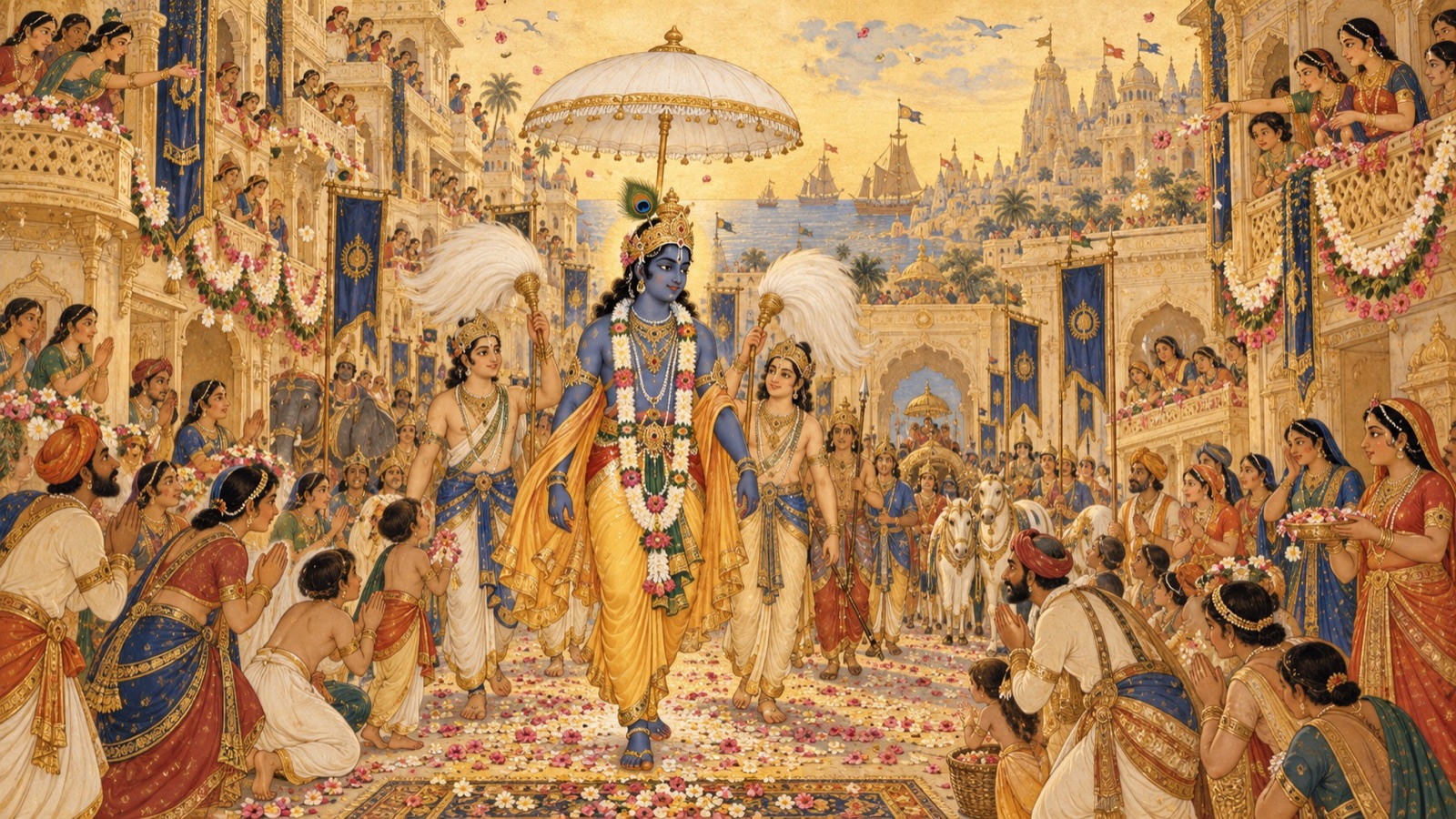
Beneath a white umbrella, showered with flowers, Sri Krishna moves through the rejoicing streets of Dwaraka as its people drink in the sight of their returning Lord.
Om Namo Bhagavate Vasudevaya.
Om Namo Bhagavate Vasudevaya.
Om Namo Bhagavate Vasudevaya.
Welcome to Srimad Bhagavatam Wisdom, a devotional journey through the sacred histories and teachings of the Srimad Bhagavat Mahapurana. The grief of Kurukshetra is behind us. Having consoled the Pandavas and set right the affairs of Hastinapura, Śrī Kṛṣṇa now turns homeward. The eleventh chapter of the First Canto is a chapter of joy — the joy of a whole city that has waited long for its beloved, and pours into the streets when at last His conch is heard. Here we see the tender human face of the Lord’s descent: parents weeping over a returned son, mothers whose breasts flow with milk for love, and a homecoming so radiant that heaven itself seems to grow envious. And through all this delight the sages quietly remind us of the deeper truth — that the One who sports among us so intimately is forever untouched, the changeless Self within all.
Chapter Information
- Scripture: Śrīmad Bhāgavata Mahāpurāṇa
- Canto: 1 (Book One)
- Chapter: 11 (Discourse 11)
- Chapter title: Lord Krishna’s Entrance into Dwaraka
- Principal speaker: the blessed Sūta, Ugraśravā (narrator)
- Principal listener: the sages of Naimisaranya, headed by Śaunaka
- Main setting: the kingdom of Ānarta and the city of Dwārakā
- Central subject: Śrī Kṛṣṇa’s return to Dwārakā, the rapturous welcome of its citizens and kinsmen, His reunion with His mothers and consorts, and His nature as the ever-unattached Lord
- Principal verse range: Canto 1, Chapter 11, verses 1–39
- Primary edition: Gita Press Śrīmad Bhāgavata Mahāpurāṇa
Context from the Previous Chapter
In the tenth discourse, Śrī Kṛṣṇa took leave of the Pāṇḍavas at Hastināpura after the great war. The women of the city climbed to their rooftops to gaze upon Him and sang His praises as He passed, greeting them with smiling looks. King Yudhiṣṭhira, apprehending danger, sent an army to escort Him; but the Lord gently sent the Pāṇḍavas back and set out for His own city with His companions. Passing through many kingdoms — Kuru-Jāṅgala, Pāñcāla, Śūrasena, Brahmāvarta, Kurukṣetra, Matsya and more — and pausing at dusk for His Sandhyā prayers, He drew near at last to Ānarta, His own prosperous land. It is here, at the threshold of home, that the eleventh chapter begins.
The Sounding of the Panchajanya
Reaching His highly prosperous territory of Ānarta, Śrī Kṛṣṇa blew His great conch, the Pāñcajanya, as if to soothe the grief of His people, who had borne the sorrow of His long absence. Blown by the Lord, the conch — its white body flushed red where it touched His rosy lips — shone in His lotus palms like a loudly singing swan resting upon a pair of red lotuses.
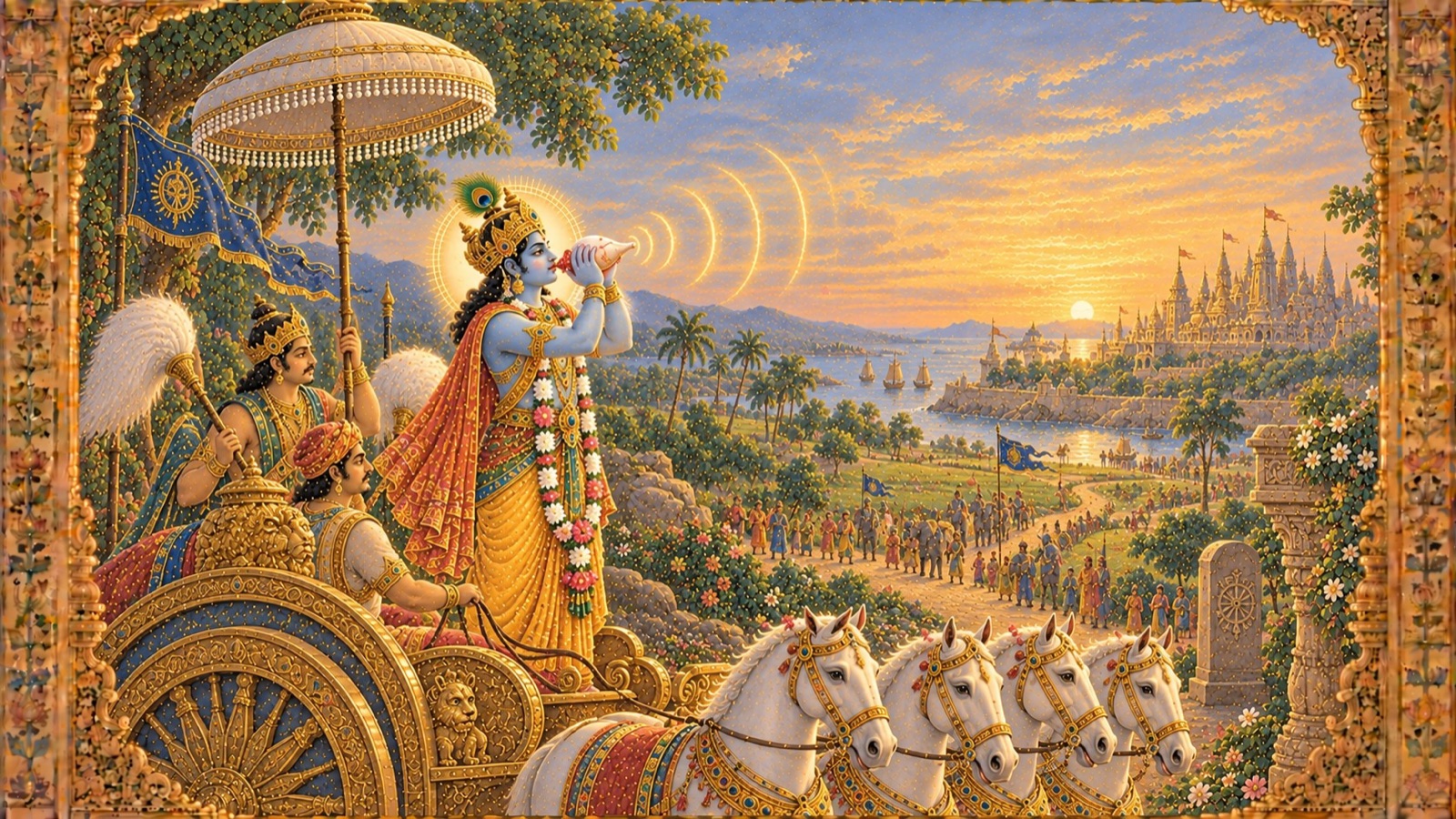
सूत उवाच आनर्तान् स उपव्रज्य स्वृद्धाञ्जनपदान्स्वकान् । दध्मौ दरवरं तेषां विषादं शमयन्निव ॥ १ ॥
sūta uvāca ānartān sa upavrajya svṛddhāñ jana-padān svakān dadhmau daravaraṁ teṣāṁ viṣādaṁ śamayann iva ॥ 1 ॥
Meaning: Sūta said: Reaching His own highly prosperous territories of Ānarta, Śrī Kṛṣṇa sounded His excellent conch, as if to soothe the grief of His people. (Canto 1, Chapter 11, verse 1)
Hearing that familiar blast, which drives away the terror of the world, the entire population of Dwārakā rushed forth to meet Him, longing to behold their lord.
The People Come Forth to Greet Their Lord
They brought their gifts to the Lord — who rejoices in His own Self and is ever complete in His own bliss — even as one might offer lamps to the sun, the very source of all light. Their faces beaming, their voices choked with delight, they spoke to Him as children speak to their father. They bowed before His lotus-feet, adored even by Brahmā, Śiva and Indra, the supreme refuge of those who seek the highest bliss, beyond the reach of Time. “You are our mother,” they said, “our disinterested friend, our lord and father, our true preceptor and supreme Deity; by serving You we have become blessed.”
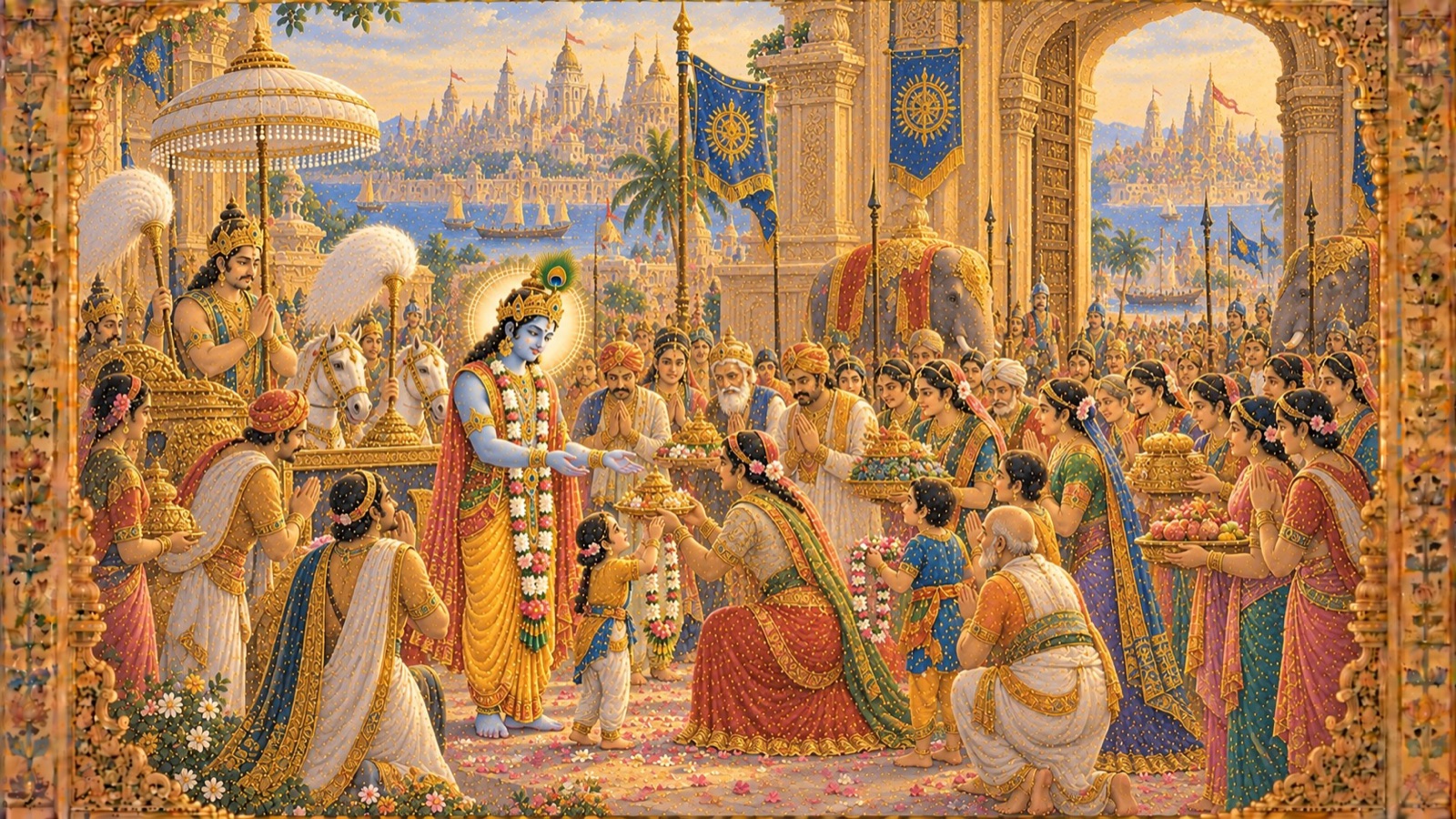
Then they gave voice to the ache of every separation they had endured, in words that any devotee will recognize.
यर्ह्यम्बुजाक्षापससार भो भवान् कुरून् मधून् वाथ सुहृद्दिदृक्षया । तत्राब्दकोटिप्रतिम: क्षणो भवेद् रविं विनाक्ष्णोरिव नस्तवाच्युत ॥ ९ ॥
yarhy ambujākṣāpasasāra bho bhavān kurūn madhūn vātha suhṛd-didṛkṣayā tatrābda-koṭi-pratimaḥ kṣaṇo bhaved raviṁ vinākṣṇor iva nas tavācyuta ॥ 9 ॥
Meaning: O lotus-eyed Lord, whenever You departed for the land of the Kurus or of the Madhus to see Your friends and kinsmen, every passing moment felt to us as long as a myriad years — as an eye feels without the sun, O Acyuta, the infallible one. (Canto 1, Chapter 11, verse 9)
Hearing these loving words, the Lord, who is so fond of His devotees, entered the city, extending His grace to all through His gracious looks.
The City of Dwaraka Adorned
Even as Bhogavatī, the capital of the subterranean regions, is guarded by the serpent Nāgas, so was Dwārakā protected by the mighty branches of the Yādava race — the Madhus, the Bhojas, the Daśārhas, the Arhas, the Kukuras, the Andhakas and the Vṛṣṇis — who were equalled in strength by none. The city was adorned with lotus-lakes surrounded by orchards and gardens rich in the fruits and flowers of every season.
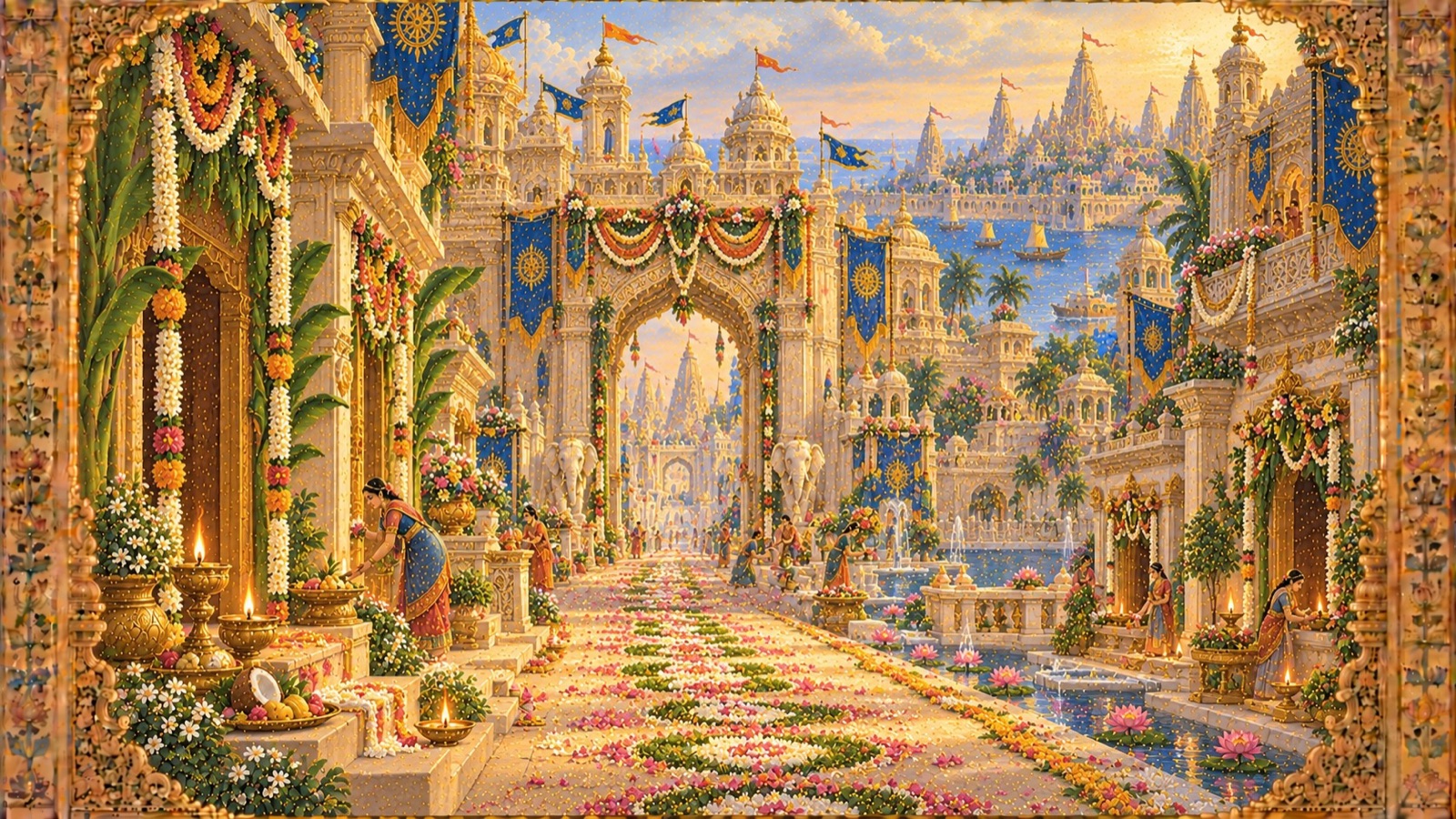
Its gateways, palaces and thoroughfares were hung with festoons in token of festivity, and decorated with flags and banners of every shape, whose fluttering ends broke the sunlight here and there. The highways and market-squares had been swept clean, sprinkled with scented water, and strewn with fruits, flowers, unbroken grains of rice and fresh sprouts. At the door of every house stood the auspicious welcome — curds, whole rice, fruits and sugar-cane, pitchers brimming with water, offerings, incense and lamps.
The Kinsmen and the Citizens Welcome Him
The news of His return lifted His dearest kinsmen from their very beds and seats and meals — the noble Vasudeva, His father; Akrūra; King Ugrasena; the mighty Balarāma, His elder brother; Pradyumna and Cārudeṣṇa; and Sāmba, the son of Jāmbavatī. Overflowing with joy and reverence, they placed a stately elephant at the head of their procession as an auspicious sign, gathered Brāhmaṇas chanting benedictory hymns, took up the emblems of good fortune, mounted their chariots and went forth to meet the Lord amid the blast of conchs and trumpets and the chanting of Vedic hymns.
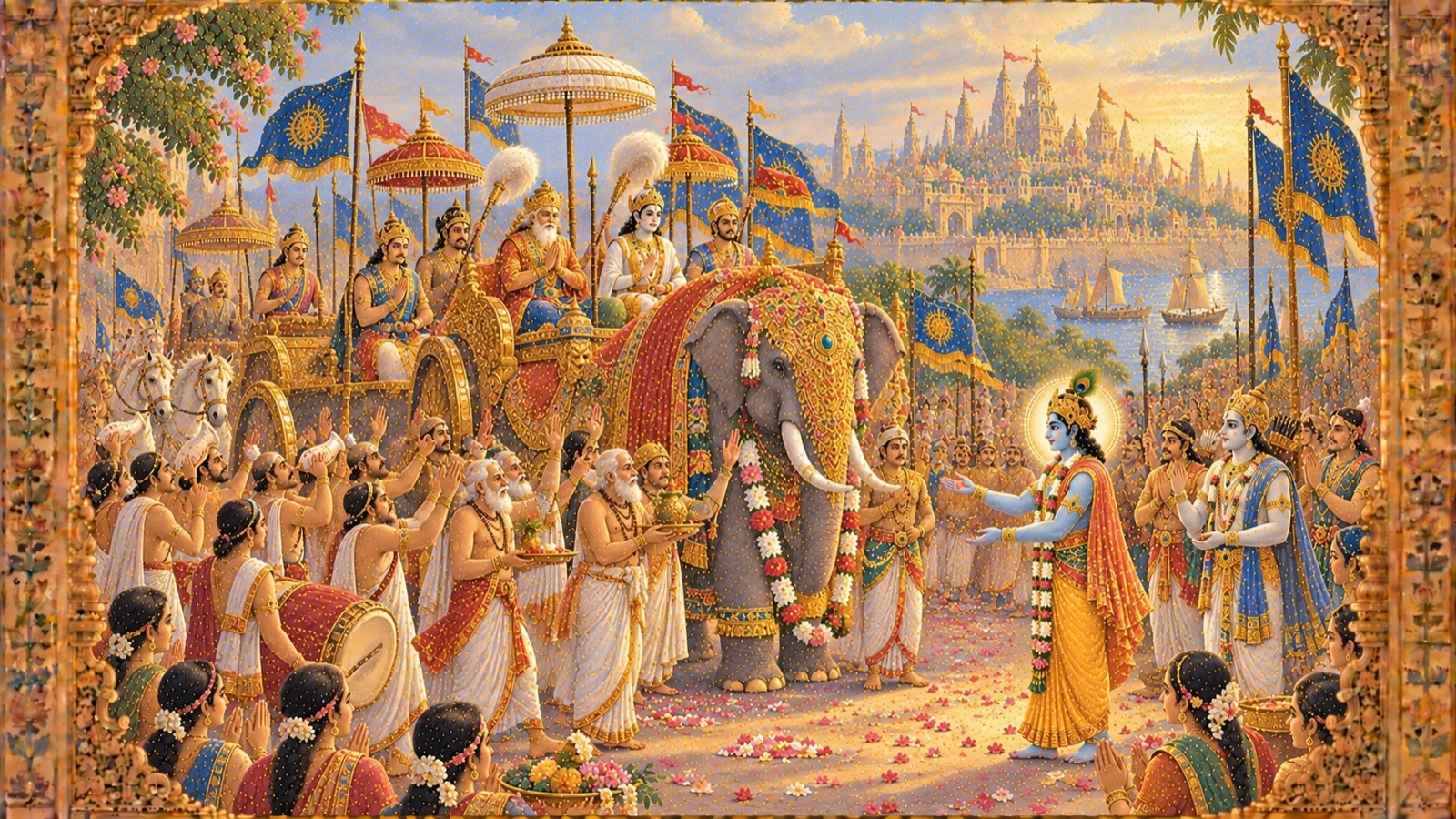
The foremost among the courtesans came out in their hundreds, borne in palanquins, eager for a glimpse of Him; and actors, dancers, singers and bards glorified the wonderful deeds of the Lord of matchless renown. On that occasion the Lord met His kinsmen, His attendants and the citizens each in the fitting manner. He gratified them all, down to the humblest, by bowing His head, greeting them with respectful words, embracing them, pressing their hands, and gladdening them with smiles and affectionate looks and the granting of their heart’s desires. Himself blessed in turn by His elders, by the Brāhmaṇas and their wives and the aged folk, the almighty Lord entered the city.
The Lord Shines Upon the Road
As Śrī Kṛṣṇa passed along the main road, the women of the respectable families of Dwārakā climbed to the tops of their mansions to feast their eyes upon Him. For His bosom is the abode of Śrī, the goddess of fortune; His face, a cup of nectar for the eyes to drink; His arms, the dwelling of the guardians of the worlds; His lotus-feet, the home of His bee-like devotees. Each of His limbs is elegance itself — and so the eyes of the people of Dwārakā knew no satiety, though they beheld Him every day.
सितातपत्रव्यजनैरुपस्कृत: प्रसूनवर्षैरभिवर्षित: पथि । पिशङ्गवासा वनमालया बभौ घनो यथार्कोडुपचापवैद्युतै: ॥ २७ ॥
sitātapatra-vyajanair upaskṛtaḥ prasūna-varṣair abhivarṣitaḥ pathi piśaṅga-vāsā vana-mālayā babhau ghano yathārkoḍupa-cāpa-vaidyutaiḥ ॥ 27 ॥
Meaning: With a white umbrella held above Him and chowries waving on either side, showered with rains of flowers upon the road, clad in yellow robes and wearing His garland of sylvan flowers, the Lord shone like a cloud attended by the sun, a pair of moons, the stars, a rainbow and flashes of lightning. (Canto 1, Chapter 11, verse 27)
Reunion with His Mothers and Consorts
First of all the Lord entered the palace of His parents. There He gladly bowed His head to His seven mothers, Devakī and the others, who clasped Him to their bosoms in return. As they took their son upon their laps, milk flowed of itself from their breasts, and, overwhelmed with joy, they bathed Him in their tears.
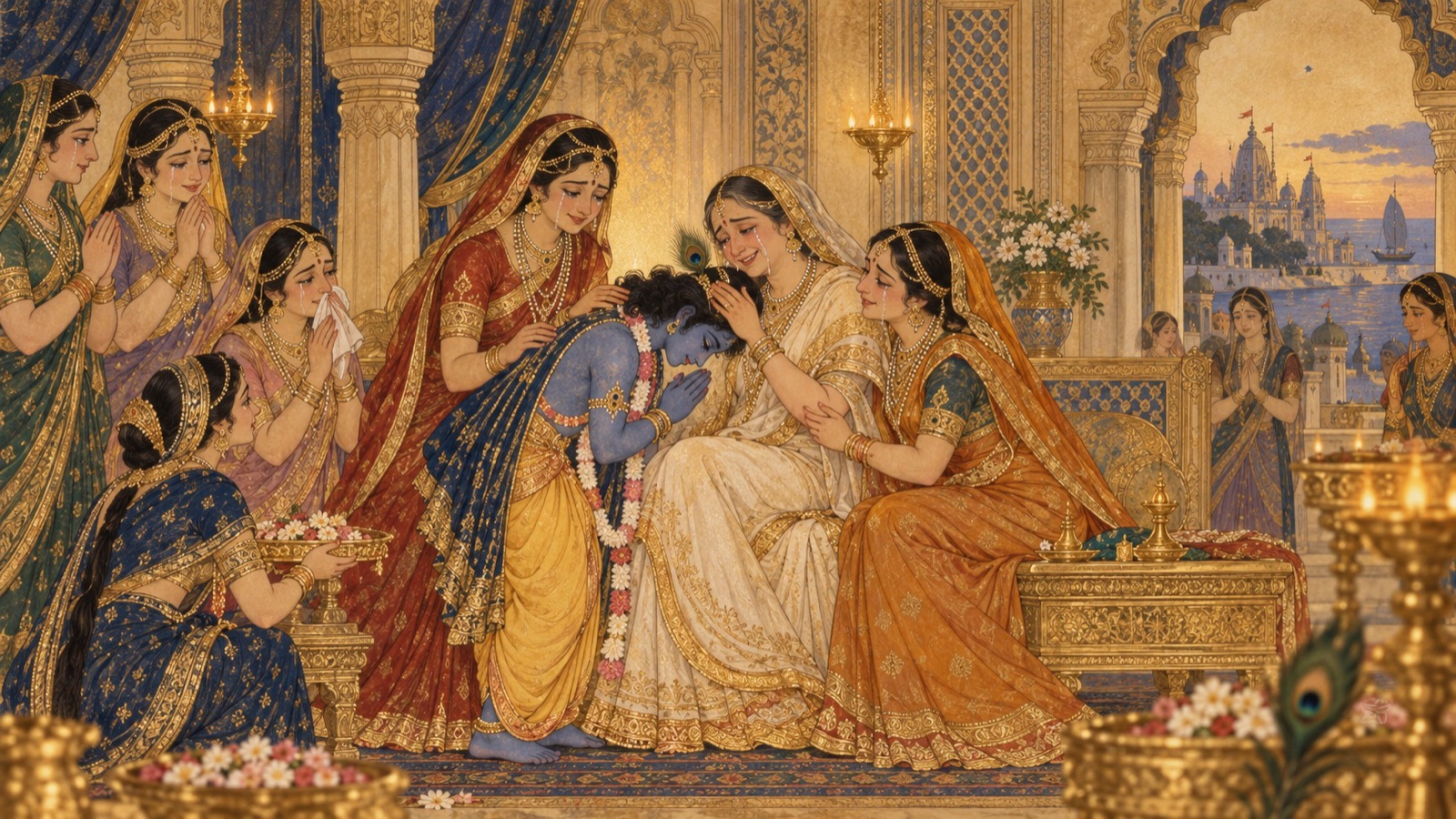
ता: पुत्रमङ्कमारोप्य स्नेहस्नुतपयोधरा: । हर्षविह्वलितात्मान: सिषिचुर्नेत्रजैर्जलै: ॥ २९ ॥
tāḥ putram aṅkam āropya sneha-snuta-payodharāḥ harṣa-vihvalitātmānaḥ siṣicur netrajair jalaiḥ ॥ 29 ॥
Meaning: Taking their son upon their laps, milk flowing from their breasts out of pure affection, and their hearts overwhelmed with joy, His mothers bathed Him with the tears that streamed from their eyes. (Canto 1, Chapter 11, verse 29)
Then He entered His own palace, unrivalled by any other, complete with every desirable thing, which held a separate mansion for each of His consorts, sixteen thousand and more in number. Beholding from afar their lord returned after so long an absence, the ladies were filled with joy; and with bashful faces they rose quickly from their seats, forgetting even the vows of austerity they had kept in His absence. Full of boundless love, they embraced their Lord — first in the mind, then with their eyes, and at last through their children — and the tears they had held back out of modesty now flowed in spite of themselves. Though He was ever at their side, His feet seemed to them fresher in charm at every moment; for what woman could ever forsake those feet, which even the restless goddess of fortune will not abandon?
The Sport of the Unattached Lord
Here the narration turns from the sweetness of the homecoming to its hidden meaning. Just as the wind, rubbing one bamboo against another, kindles a fire that burns the whole thicket, so had Śrī Kṛṣṇa set the burdensome kings of the earth against one another and brought about their mutual destruction in the great war — Himself never taking up a weapon — and, His purpose accomplished, He grew silent. It was this same Lord who, having appeared in the mortal world in His own playful way, sported in the midst of thousands of the most charming women like an ordinary man of the world. Stung by their guileless smiles and bashful glances, even Cupid, the conqueror of all, would faint and let fall his bow; yet these jewels among women could never disturb the serenity of His mind.
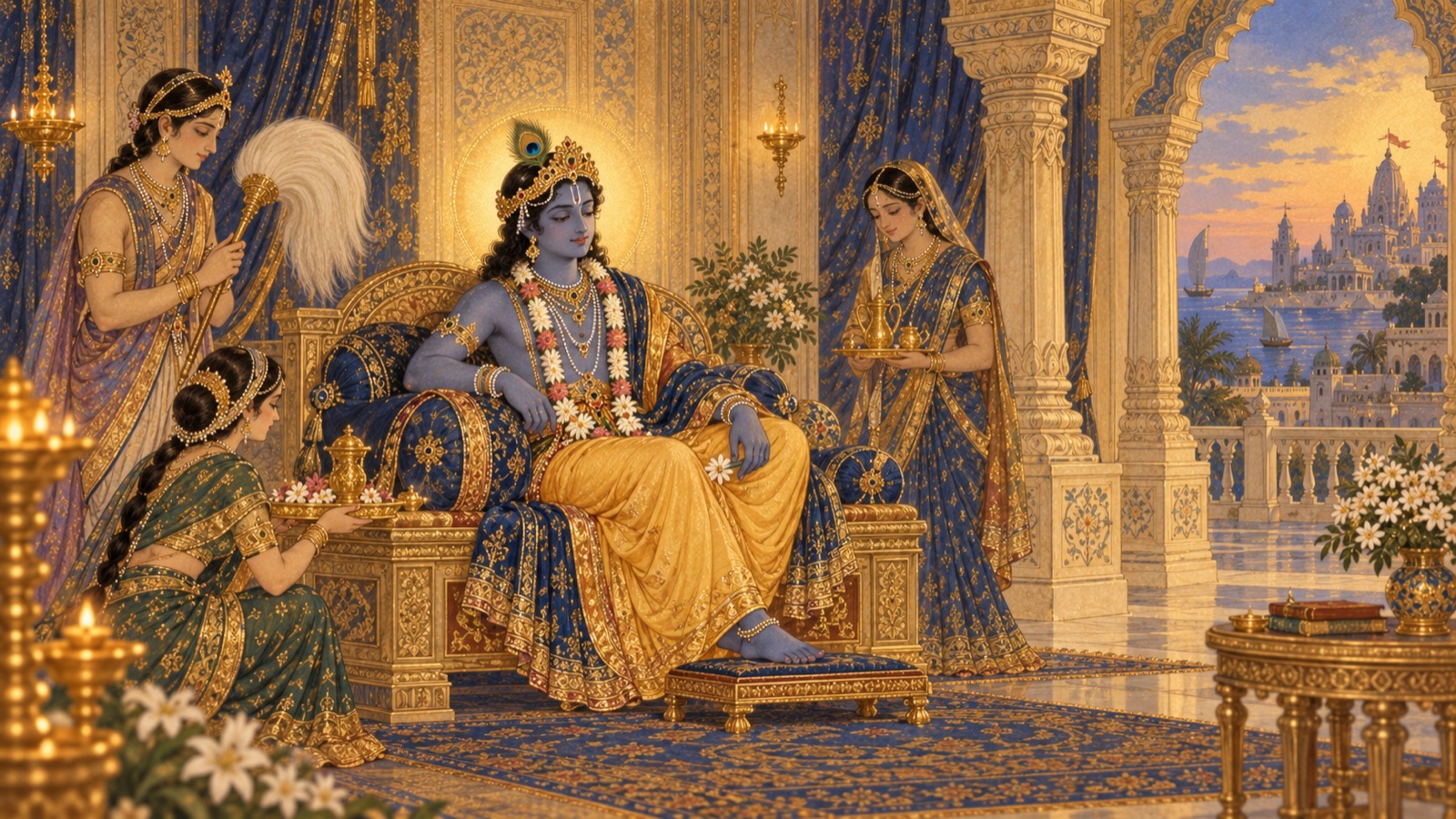
Seeing Him engaged in worldly affairs as they are, ignorant people mistake the utterly unattached Lord for a man full of attachment. But herein lies His true divinity:
एतदीशनमीशस्य प्रकृतिस्थोऽपि तद्गुणै: । न युज्यते सदात्मस्थैर्यथा बुद्धिस्तदाश्रया ॥ ३८ ॥
etad īśanam īśasya prakṛti-stho ’pi tad-guṇaiḥ na yujyate sadātma-sthair yathā buddhis tad-āśrayā ॥ 38 ॥
Meaning: This is the divine mastery of the Lord: though He abides within Nature, He is never bound by its modes — just as the discriminating intellect that has taken refuge in Him remains untainted by the modes of Nature in which it dwells. (Canto 1, Chapter 11, verse 38)
Even His own consorts, unaware of the true extent of His glories, sometimes thought their gentle Lord simply followed their wishes, as an ordinary husband might be led by his wife — just as one who denies God outright fails to recognize Him as the supreme controller of all (verse 39).
Important Verses
The pivotal verse of the chapter reveals how the Lord fulfilled the very purpose of His descent — accomplishing the removal of the earth’s burden without Himself wielding a single weapon:
एवं नृपाणां क्षितिभारजन्मना- मक्षौहिणीभि: परिवृत्ततेजसाम् । विधाय वैरं श्वसनो यथानलं मिथो वधेनोपरतो निरायुध: ॥ ३४ ॥
evaṁ nṛpāṇāṁ kṣiti-bhāra-janmanām akṣauhiṇībhiḥ parivṛtta-tejasām vidhāya vairaṁ śvasano yathānalaṁ mitho vadhenoparato nirāyudhaḥ ॥ 34 ॥
Meaning: Just as the wind sets bamboos ablaze by rubbing them together, so the Lord, taking up no weapon Himself, kindled enmity among the kings who were a burden upon the earth and were girt with mighty armies, and, having brought about their mutual destruction, He became still. (Canto 1, Chapter 11, verse 34)
Principal Teachings
1. The Lord answers the longing of His devotees. Krishna sounds the Pāñcajanya “to soothe the grief” of His people (verse 1), and they rush forth as one. When the heart truly yearns for Him, the very sound of His approach dispels its sorrow.
2. Separation deepens love. The citizens confess that a moment without Him felt like ten million years, like an eye without the sun (verse 9). The pain of separation, borne in devotion, is not the opposite of love but its intensifying fire.
3. Reverence is shown in preparation. Dwārakā is swept, sprinkled, garlanded and lit before the Lord arrives (verses 13–15). Devotion expresses itself outwardly — in the loving readiness with which we prepare a place for the sacred.
4. Greatness stoops to the lowly. The almighty Lord gratifies everyone “down to the humblest” with a bowed head, an embrace and a kind word (verses 22–23). True eminence is known not by pride but by the gentleness it shows to the least.
5. Love returns to its source. Milk flows from the breasts of His aged mothers, and His consorts embrace Him first in mind and then through their children (verses 29, 32). The chapter shows affection at its purest — a whole city’s love converging upon the Lord who is its origin.
6. The Lord is ever unattached. Though He sports like a worldly man, no charm can disturb His serenity; abiding within Nature, He is never bound by its modes (verses 36–38). His intimacy with us never compromises His transcendence — and this is the secret of who He is.
A Devotional Reflection
It is easy to love the Lord who saves us from danger, as He saved the Pāṇḍavas in the chapters just past. This chapter asks something gentler of us: to love the Lord who simply comes home. There are no demons here, no weapons, no miracles of rescue — only a conch on the wind, a swept street, a mother’s tears, a city that cannot bear to look away. And yet the sages, even in the midst of all this sweetness, will not let us forget the deeper truth. The One being embraced on every side, mistaken by His own family for an ordinary man, is the changeless Self of all, untouched by the very affection He so freely receives. There is a lesson here for our own devotion. We may draw as near to Him as Dwārakā did — bring Him our gifts, weep for His absence, prepare our hearts as a city prepares its streets — and still we will never exhaust or diminish Him. He gives Himself wholly to the intimacy of love, and remains wholly free. To love such a Lord is to be, little by little, set free ourselves.
A Daily Devotional Practice
Today, prepare a small welcome for the Lord as Dwārakā prepared its streets. Before your morning prayer, tidy the place where you sit, light a lamp or a stick of incense, and place there something simple and pure — a flower, a fruit, a few grains of rice. Then, as you settle, recall the citizens’ words and make them your own: “Every moment without You feels like an age.” Let that one longing shape a few quiet minutes of remembrance. The outward act is small; it is the readiness of the heart the Lord receives.
Conclusion
So ends the eleventh discourse of the Śrīmad Bhāgavata, which the God-realized call the Paramahaṁsa-Saṁhitā. In this chapter, Srimad Bhagavatam Canto 1 Chapter 11, we have heard the Pāñcajanya sound across the borders of Ānarta and watched all of Dwārakā pour into its streets, bearing gifts and weeping for joy. We have seen the city adorned to welcome its Lord, His kinsmen sally forth in glad procession, and the almighty One gladden every heart down to the humblest as He entered His home. We have shared the tenderness of His reunion — the milk that flowed from His mothers’ breasts, the love of His consorts that returned to Him through their very children. And we have been reminded, at the height of all this sweetness, that He who is embraced on every side is forever the unattached Self, abiding within Nature yet untouched by its modes. Devotion here wears the face of homecoming, and it teaches us how to welcome the Lord into the streets of our own hearts. May we prepare that welcome with love, and never forget, even in our nearness, the boundless One who has drawn so near.
May the divine wisdom of Srimad Bhagavatam awaken pure devotion within our hearts.
Om Namo Bhagavate Vasudevaya.
Jay Shree Madhav.
References and Attribution
Primary edition: Gita Press, Śrīmad Bhāgavata Mahāpurāṇa (English), Book One (Skandha 1), Discourse 11, book pages 41–44.
Srimad Bhagavatam Wisdom · Biswa Sanatan Dharma Seva Trust. Presented following the spiritual guidance and recommendation of Pandit Dr. Shri Kashinath Mishra.
This article is an original, faithful devotional retelling (Copyright MODE B). No publisher translation or purport is reproduced; verse “Meaning” lines are original faithful paraphrase. This article does not imply that any publisher, library, or organization sponsors or endorses it.
Jay Shree Madhav