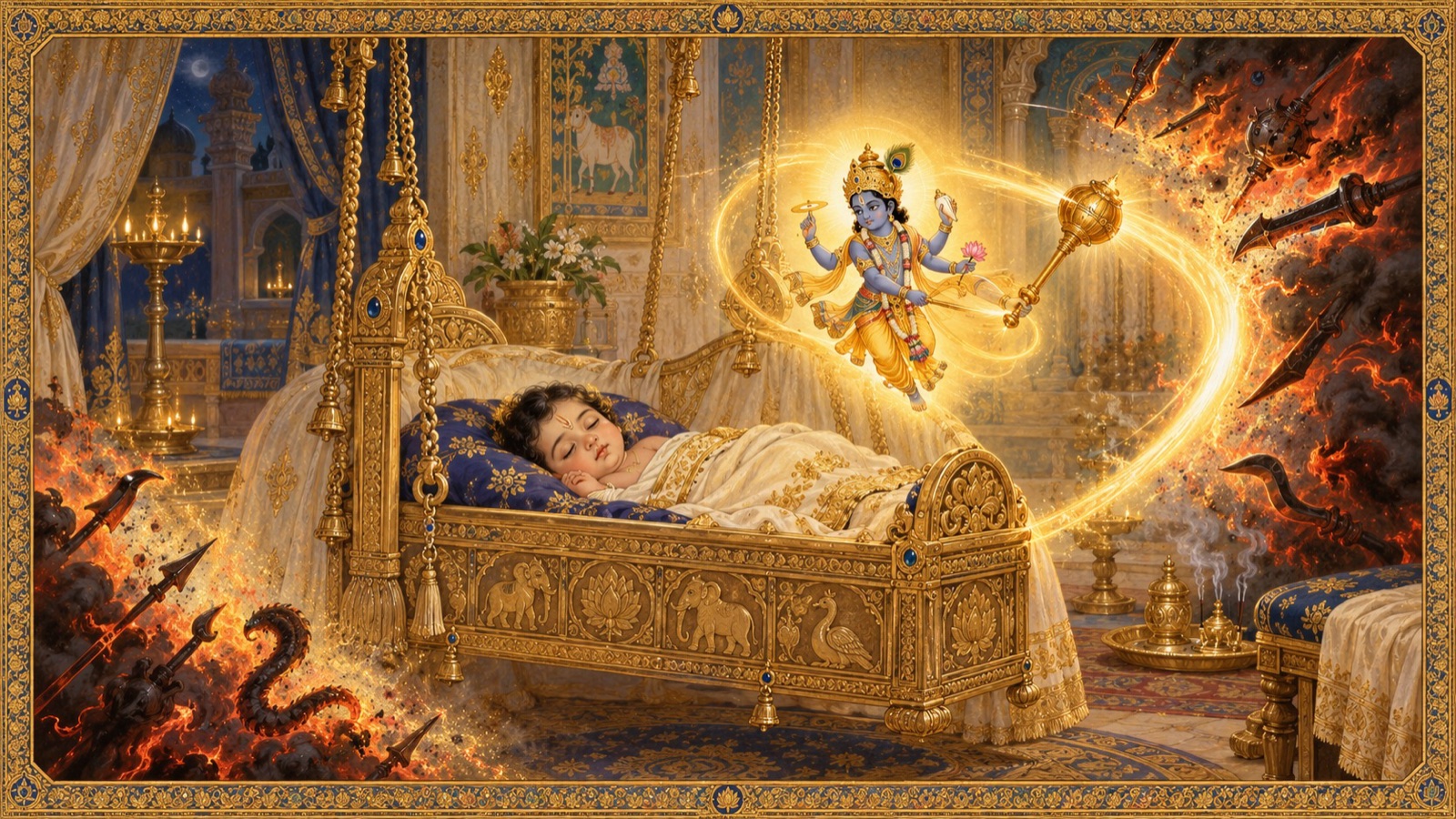
Still in his mother’s womb and scorched by the fire of the Brahmastra, the unborn Parikshit beholds a radiant thumb-sized form of the Lord whirling His mace to quench the flames.
Om Namo Bhagavate Vasudevaya.
Om Namo Bhagavate Vasudevaya.
Om Namo Bhagavate Vasudevaya.
Welcome to Srimad Bhagavatam Wisdom, a devotional journey through the sacred histories and teachings of the Srimad Bhagavat Mahapurana. In the eighth discourse we saw the almighty Lord shield an unborn child from the unfailing weapon of Aśvatthāmā. The twelfth discourse now tells us how that child was born — not merely rescued, but marked from before his birth by a vision of the Lord Himself, and cradled by the blessings of holy sages who foretold a life of matchless virtue. Here is the story of how the last thread of the Kuru line became a great devotee, how he received the two names by which the world would remember him, and how the age of Kali would one day meet its chastiser. It is a chapter of grace, of naming, and of quiet destiny unfolding exactly as the Lord intends.
Chapter Information
- Scripture: Śrīmad Bhāgavata Mahāpurāṇa
- Canto: 1 (Book One)
- Chapter: 12 (Discourse 12)
- Chapter title: The Birth of Emperor Parikshit
- Principal speaker: the blessed Sūta, Ugraśravā (narrator)
- Principal listener: the sages of Naimisaranya, headed by Śaunaka
- Main setting: the kingdom and city of Hastināpura under the reign of King Yudhiṣṭhira
- Central subject: the birth of the child Parīkṣit, his vision of the Lord in the womb, the sages’ blessings and prophecy, his two names, and the horse-sacrifices of Yudhiṣṭhira
- Principal verse range: Canto 1, Chapter 12, verses 1–36
- Primary edition: Gita Press Śrīmad Bhāgavata Mahāpurāṇa
Context from the Previous Chapter
In the eleventh discourse, Śrī Kṛṣṇa returned to His own city of Dwārakā and was received with overflowing joy by its citizens and by His queens. Having comforted the grieving house of Kuru and set Yudhiṣṭhira firmly upon his throne, the Lord resumed His pastimes among the Yādavas. The twelfth discourse now turns back to Hastināpura, where the sages of Naimisaranya, still gathered around the blessed Sūta, ask to hear the story of the child whose life had been saved in the womb.
The Sages Ask About the Child Who Was Saved
Śaunaka, foremost of the assembled sages, opened the chapter with a question born of wonder. He recalled how the embryo in Uttarā’s womb, scorched by the mighty energy of Aśvatthāmā’s Brahmastra, had been restored to life by the Lord Himself. Now the sages longed to hear the whole account of that great soul.
शौनक उवाच अश्वत्थाम्नोपसृष्टेन ब्रह्मशीर्ष्णोरुतेजसा । उत्तराया हतो गर्भ ईशेनाजीवित: पुन: ॥ १ ॥
śaunaka uvāca aśvatthāmnopasṛṣṭena brahma-śīrṣṇoru-tejasā । uttarāyā hato garbha īśenājīvitaḥ punaḥ ॥ 1 ॥
Meaning: Śaunaka said: The embryo in the womb of Uttarā, struck by the terrible energy of the Brahmastra released by Aśvatthāmā, was restored to life once more by the Lord. (Canto 1, Chapter 12, verse 1)
They wished to hear of the birth and the deeds of that noble and highly intelligent soul, of how his death came about, and of the destiny he attained after death — the same great king to whom Śuka would one day impart divine knowledge. If Sūta thought fit, they begged, let him narrate all of it to them, who listened with faith and earnestness.
King Yudhishthira’s Righteous Reign
Sūta then began. Freed from all thirst for enjoyment through his constant service to the lotus-feet of Śrī Kṛṣṇa, the righteous King Yudhiṣṭhira protected his subjects like a father, gratifying them in every way.
सूत उवाच अपीपलद्धर्मराज: पितृवद् रञ्जयन् प्रजा: । नि:स्पृह: सर्वकामेभ्य: कृष्णपादानुसेवया ॥ ४ ॥
sūta uvāca apīpalad dharma-rājaḥ pitṛvad rañjayan prajāḥ । niḥspṛhaḥ sarva-kāmebhyaḥ kṛṣṇa-pādānusevayā ॥ 4 ॥
Meaning: Sūta said: King Yudhiṣṭhira, the very embodiment of righteousness, freed from craving for every kind of enjoyment through his service to the feet of Śrī Kṛṣṇa, maintained and pleased his subjects as a father cares for his children. (Canto 1, Chapter 12, verse 4)
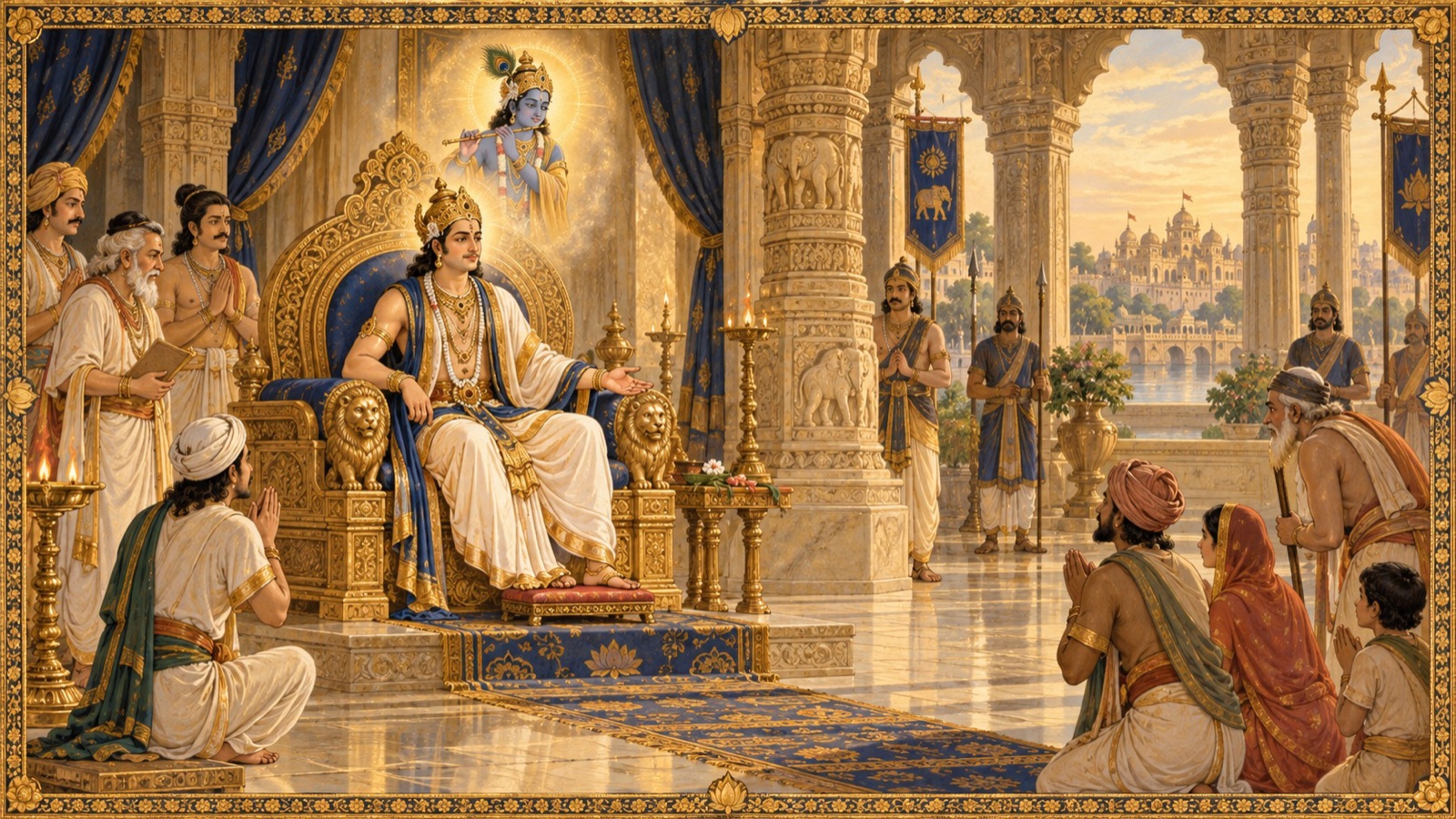
Riches beyond counting were his; he had performed many a sacrifice and earned a place in the highest worlds. His consort, Queen Draupadī, and his brothers were all devoted to him. His sovereignty extended over the whole globe, he ruled Jambūdvīpa, and his fame had reached as far as heaven. Yet all these enjoyments, coveted even by the gods, could bring the king no real delight — for his mind was given wholly to Śrī Kṛṣṇa, the bestower of liberation, just as nothing other than food can satisfy a hungry soul.
किं ते कामा: सुरस्पार्हा मुकुन्दमनसो द्विजा: । अधिजह्रुर्मुदं राज्ञ: क्षुधितस्य यथेतरे ॥ ६ ॥
kiṁ te kāmāḥ sura-spārhā mukunda-manaso dvijāḥ । adhijahrur mudaṁ rājñaḥ kṣudhitasya yathetare ॥ 6 ॥
Meaning: O Brāhmaṇas, could all those enjoyments, coveted even by the gods, bring any joy to the king whose mind was fixed on Mukunda — any more than things other than food can gratify a hungry man? (Canto 1, Chapter 12, verse 6)
The Vision in the Womb
Sūta now told the sages what had happened within the womb during those days of danger. While being scorched by the fire of the Brahmastra, the heroic child in Uttarā’s womb beheld a wondrous, effulgent Being no larger than a thumb.
मातुर्गर्भगतो वीर: स तदा भृगुनन्दन । ददर्श पुरुषं कञ्चिद्दह्यमानोऽस्त्रतेजसा ॥ ७ ॥
mātur garbha-gato vīraḥ sa tadā bhṛgu-nandana । dadarśa puruṣaṁ kañcid dahyamāno ’stra-tejasā ॥ 7 ॥
Meaning: O delight of the Bhṛgus, that heroic child within his mother’s womb, while being scorched by the energy of the weapon, beheld a certain Person drawing near. (Canto 1, Chapter 12, verse 7)
The Being was spotless and most charming to behold, swarthy of hue, clad in yellow robes that shone like lightning, and crowned with a glittering diadem of gold. He had four long and graceful arms, wore pendants of refined gold, and had reddish eyes; in one hand He held a mace that blazed like a firebrand, whirling it round and round as He Himself circled the child. This was none other than Lord Acyuta, the infallible one.
श्रीमद्दीर्घचतुर्बाहुं तप्तकाञ्चनकुण्डलम् । क्षतजाक्षं गदापाणिमात्मन: सर्वतोदिशम् । परिभ्रमन्तमुल्काभां भ्रामयन्तं गदां मुहु: ॥ ९ ॥
śrīmad-dīrgha-catur-bāhuṁ tapta-kāñcana-kuṇḍalam । kṣatajākṣaṁ gadā-pāṇim ātmanaḥ sarvato diśam । paribhramantam ulkābhāṁ bhrāmayantaṁ gadāṁ muhuḥ ॥ 9 ॥
Meaning: He had four long and beautiful arms and earrings of molten gold; His eyes were reddish, and in His hand He held a mace. Blazing like a meteor, He moved about the child on every side, whirling His mace again and again. (Canto 1, Chapter 12, verse 9)
With that mace He was beating away the fire of the Brahmastra, even as the sun disperses the fog. The child in the womb gazed at Him and wondered who this could be. Having quenched the fire, Śrī Hari — infinite by nature, all-pervading, the protector of virtue — vanished then and there, within the womb itself, while the unborn child of ten months looked on.
विधूय तदमेयात्मा भगवान्धर्मगुब् विभु: । मिषतो दशमासस्य तत्रैवान्तर्दधे हरि: ॥ ११ ॥
vidhūya tad ameyātmā bhagavān dharma-gub vibhuḥ । miṣato daśamāsasya tatraivāntardadhe hariḥ ॥ 11 ॥
Meaning: Having driven away that fire, the immeasurable Lord Śrī Hari, the all-pervading guardian of dharma, disappeared then and there within the womb, as the ten-month-old child watched. (Canto 1, Chapter 12, verse 11)
The Birth of the Protector of the Line
In due course, at an hour favourable for the flowering of every noble quality and when the stars in the ascendant were auspicious, the child was born — the one who would carry forward the thread of Pāṇḍu’s line, another Pāṇḍu, it seemed, in bodily strength.
तत: सर्वगुणोदर्के सानुकूलग्रहोदये । जज्ञे वंशधर: पाण्डोर्भूय: पाण्डुरिवौजसा ॥ १२ ॥
tataḥ sarva-guṇodarke sānukūla-grahodaye । jajñe vaṁśa-dharaḥ pāṇḍor bhūyaḥ pāṇḍur ivaujasā ॥ 12 ॥
Meaning: Then, at a moment promising the rise of every good quality and when the planets were favourable, was born the bearer of Pāṇḍu’s dynasty, who in bodily prowess seemed like Pāṇḍu come again. (Canto 1, Chapter 12, verse 12)
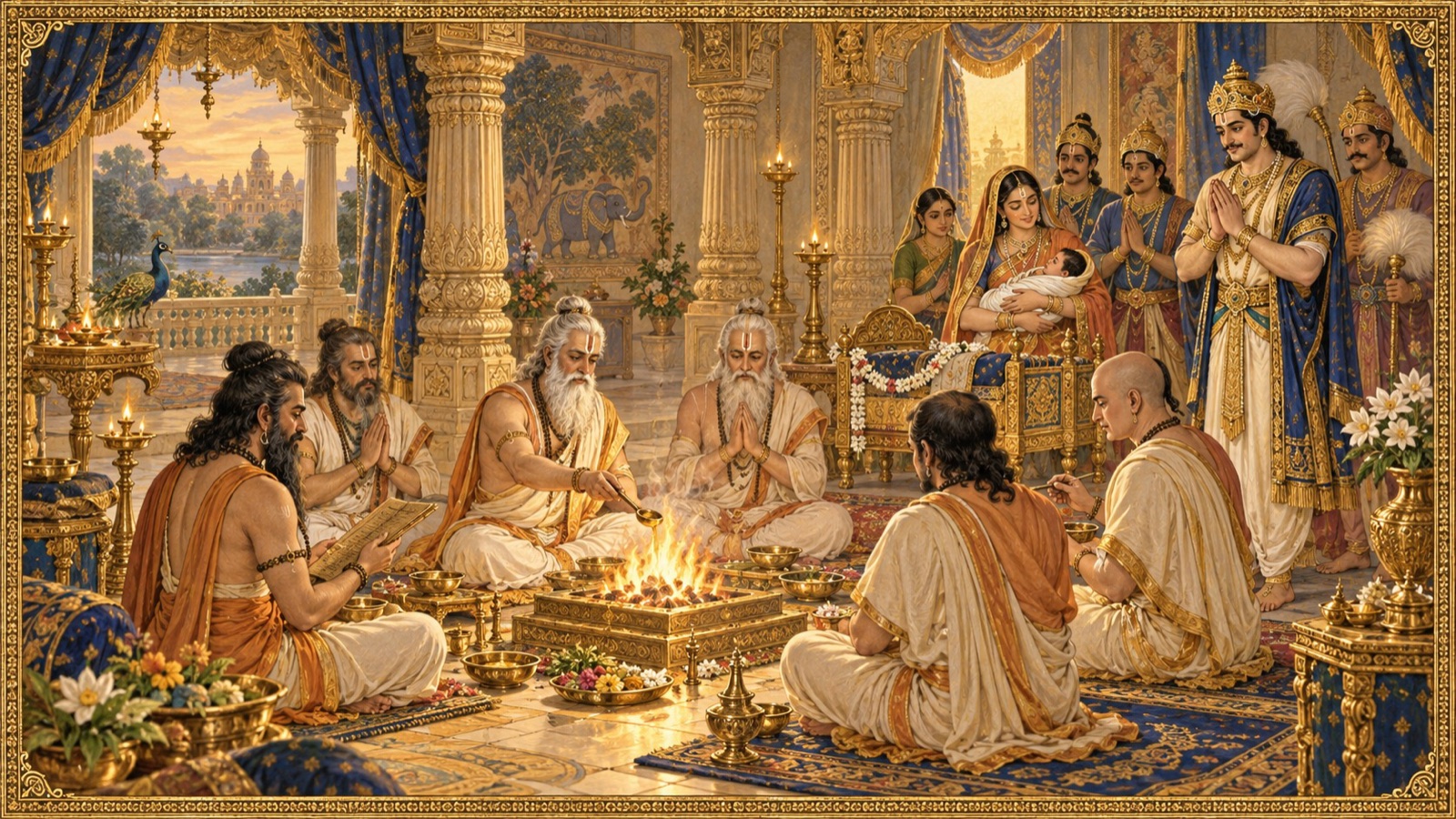
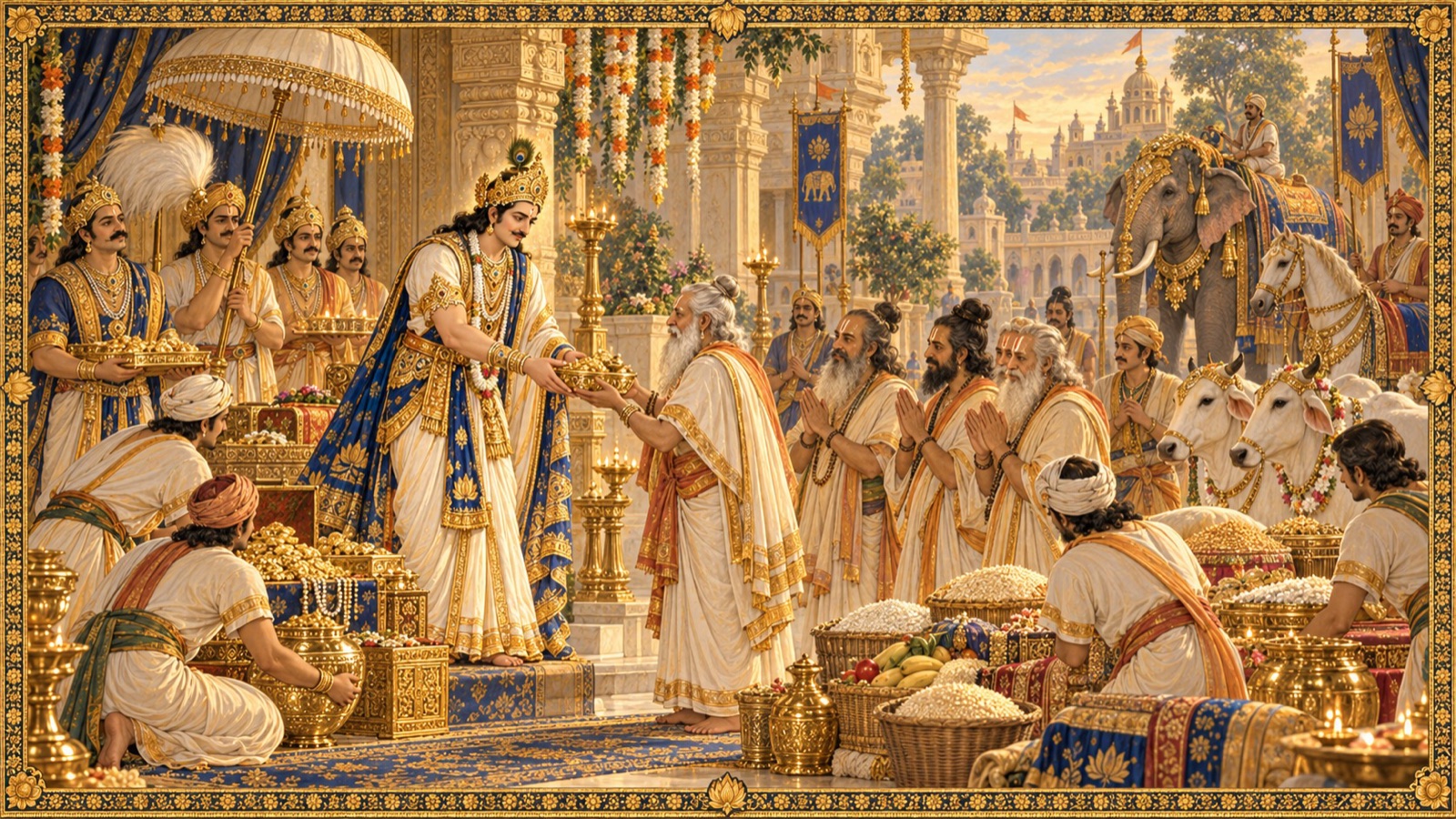
Delighted at heart, the king had auspicious hymns recited and the birth-rites duly performed by holy Brāhmaṇas such as Dhaumya and Kṛpa. Knowing well the right moment for giving gifts, Yudhiṣṭhira bestowed at the sacred hour of the birth — before the navel-string was cut — gold, cows, lands, whole villages, fine elephants and horses, and the best of foodgrains upon the Brāhmaṇas.
The Blessing of the Brahmanas and the Name Vishnurata
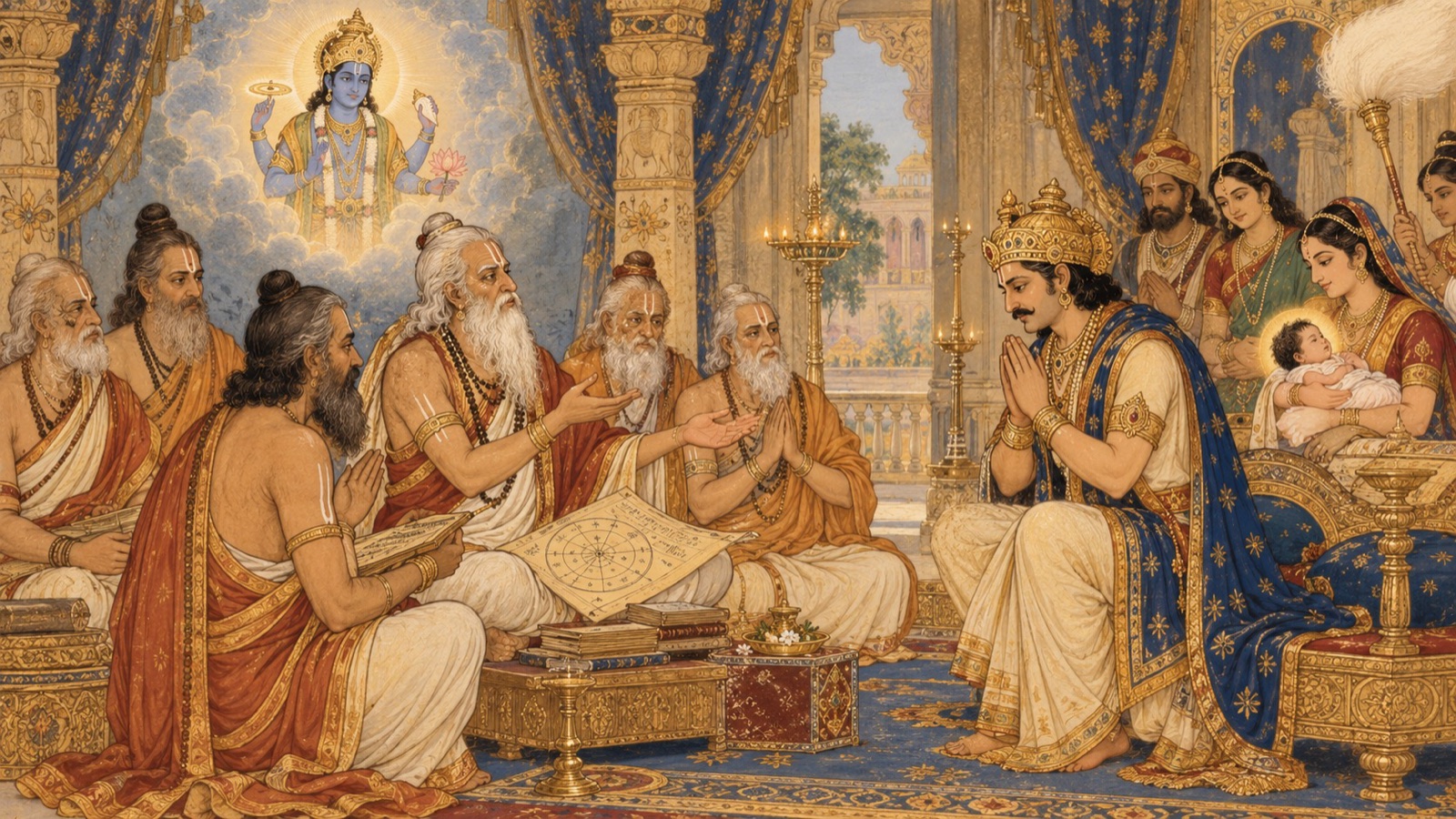
Pleased with the king’s gifts, the Brāhmaṇas addressed the humble Yudhiṣṭhira with words of blessing. They told him that this stainless race of the Purus had all but perished by the unopposable will of Providence — yet the almighty Lord Viṣṇu, in order to shower His grace upon the king, had preserved the line by saving this very child.
तस्मान्नाम्ना विष्णुरात इति लोके भविष्यति । न सन्देहो महाभाग महाभागवतो महान् ॥ १७ ॥
tasmān nāmnā viṣṇu-rāta iti loke bhaviṣyati । na sandeho mahā-bhāga mahā-bhāgavato mahān ॥ 17 ॥
Meaning: Therefore he will be known in the world by the name Viṣṇurāta, “one given by Viṣṇu”; of this there is no doubt, O fortunate king — he will be a great devotee of the Lord and an exalted soul. (Canto 1, Chapter 12, verse 17)
Yudhishthira’s Question and the Prophecy of a Noble Life
The king, ever humble, then asked the assembled sages whether this child would follow in the footsteps of the glorious, high-souled royal sages of his own line.
श्रीराजोवाच अप्येष वंश्यान् राजर्षीन् पुण्यश्लोकान् महात्मन: । अनुवर्तिता स्विद्यशसा साधुवादेन सत्तमा: ॥ १८ ॥
śrī-rājovāca apy eṣa vaṁśyān rājarṣīn puṇya-ślokān mahātmanaḥ । anuvartitā svid yaśasā sādhu-vādena sattamāḥ ॥ 18 ॥
Meaning: The king said: O most virtuous ones, will this child follow the renowned and high-souled royal sages of his dynasty in fame and in the praise of the good? (Canto 1, Chapter 12, verse 18)
In reply, the Brāhmaṇas, learned in the science of the stars, unfolded a radiant prophecy of the child’s future. As a protector of his subjects he would be like Ikṣvāku, the eldest son of Vaivasvata Manu; devoted to the Brāhmaṇas and true to his word like Śrī Rāma, the son of Daśaratha. He would be generous and a sure refuge like Śibi, king of the Uśīnaras, and would spread the fame of his own people like Bharata, the son of Duṣyanta. Among bowmen he would have no equal, unassailable as fire and unconquerable as the ocean; heroic as a lion, worth taking shelter of like the Himalayas, patient as the earth, and forbearing like one’s own parents. In even-mindedness he would resemble Brahmā, in graciousness Lord Śiva, and he would be a shelter for all beings like Viṣṇu Himself. Following the example of Śrī Kṛṣṇa in every noble virtue, he would be as generous as Rantideva and as pious as Yayāti; as firm as Bali and as unflinching in devotion to Kṛṣṇa as Prahlāda. He would perform many horse-sacrifices, wait upon his elders, be the progenitor of a line of royal sages, and a chastiser of those who strayed from the path of virtue. For the sake of the earth and of righteousness, they said, he would even subdue Kali, the spirit of the dark age.
राजर्षीणां जनयिता शास्ता चोत्पथगामिनाम् । निग्रहीता कलेरेष भुवो धर्मस्य कारणात् ॥ २६ ॥
rājarṣīṇāṁ janayitā śāstā cotpatha-gāminām । nigrahītā kaler eṣa bhuvo dharmasya kāraṇāt ॥ 26 ॥
Meaning: He will be the father of royal sages and a chastiser of those who wander from the right path; and for the sake of the earth and of dharma, he will subdue the spirit of Kali. (Canto 1, Chapter 12, verse 26)
Then the Brāhmaṇas foretold the manner of his passing. Hearing of his approaching death at the fangs of Takṣaka, called down by the curse of a Brāhmaṇa’s son, he would give up all attachment and take shelter at the feet of Śrī Hari.
तक्षकादात्मनो मृत्युं द्विजपुत्रोपसर्जितात् । प्रपत्स्यत उपश्रुत्य मुक्तसङ्ग: पदं हरे: ॥ २७ ॥
takṣakād ātmano mṛtyuṁ dvija-putropasarjitāt । prapatsyata upaśrutya mukta-saṅgaḥ padaṁ hareḥ ॥ 27 ॥
Meaning: Hearing that his death would come from Takṣaka, brought about by the curse of a Brāhmaṇa’s son, he will renounce all attachment and take refuge at the feet of the Lord. (Canto 1, Chapter 12, verse 27)
Then, once Śukadeva, the son of Vyāsa, had resolved for him the real nature of the soul, he would relinquish this mortal frame on the bank of the Gaṅgā and pass beyond every fear, wholly free of sorrow.
जिज्ञासितात्मयाथार्थ्यो मुनेर्व्याससुतादसौ । हित्वेदं नृप गङ्गायां यास्यत्यद्धाकुतोभयम् ॥ २८ ॥
jijñāsitātma-yāthārthyo muner vyāsa-sutād asau । hitvedaṁ nṛpa gaṅgāyāṁ yāsyaty addhākutobhayam ॥ 28 ॥
Meaning: Having inquired into the true nature of the Self from the sage Śukadeva, the son of Vyāsa, he will give up this body on the bank of the Gaṅgā, O king, and reach the fearless, sorrowless state. (Canto 1, Chapter 12, verse 28)
Having thus instructed the king about the child’s future, the Brāhmaṇas, masters of astrology, received their honours and returned each to his own home.
Why He Was Called Parikshit
As the boy grew, he came to be renowned in the world by a second name — Parīkṣit, “the examiner.” For he never forgot the wondrous form he had seen while still in the womb, and would go on examining every person he met, searching among all men for that one whom he had once beheld.
स एष लोके विख्यात: परीक्षिदिति यत्प्रभु: । पूर्वं दृष्टमनुध्यायन् परीक्षेत नरेष्विह ॥ ३० ॥
sa eṣa loke vikhyātaḥ parīkṣid iti yat prabhuḥ । pūrvaṁ dṛṣṭam anudhyāyan parīkṣeta nareṣv iha ॥ 30 ॥
Meaning: He became famous in the world as Parīkṣit, because, ever meditating on the One he had seen before, he would examine every person he met among men, seeking Him. (Canto 1, Chapter 12, verse 30)
The royal prince grew swiftly, like the waxing moon, filled fuller day by day by the loving care of his elders, as the moon is filled by its digits.
The Horse-Sacrifices and the Departure of the Lord
Meanwhile, Yudhiṣṭhira wished to perform the horse-sacrifice, that he might be freed of the sin of the slaughter of his kinsmen; yet, having emptied his treasury, he could think of no source of wealth other than taxes and fines. Understanding the king’s intention, his brothers, impelled by Acyuta, brought back abundant riches from the northern quarter.
With that wealth gathered, the son of Dharma, still fearful for the sin of the war, sought to please Śrī Hari by carrying out three horse-sacrifices.
तेन सम्भृतसम्भारो धर्मपुत्रो युधिष्ठिर: । वाजिमेधैस्त्रिभिर्भीतो यज्ञै: समयजद्धरिम् ॥ ३४ ॥
tena sambhṛta-sambhāro dharma-putro yudhiṣṭhiraḥ । vājimedhais tribhir bhīto yajñaiḥ samayajad dharim ॥ 34 ॥
Meaning: With the wealth thus gathered, Yudhiṣṭhira, son of Dharma, still afraid of the sin incurred in battle, propitiated Lord Hari through three horse-sacrifices. (Canto 1, Chapter 12, verse 34)
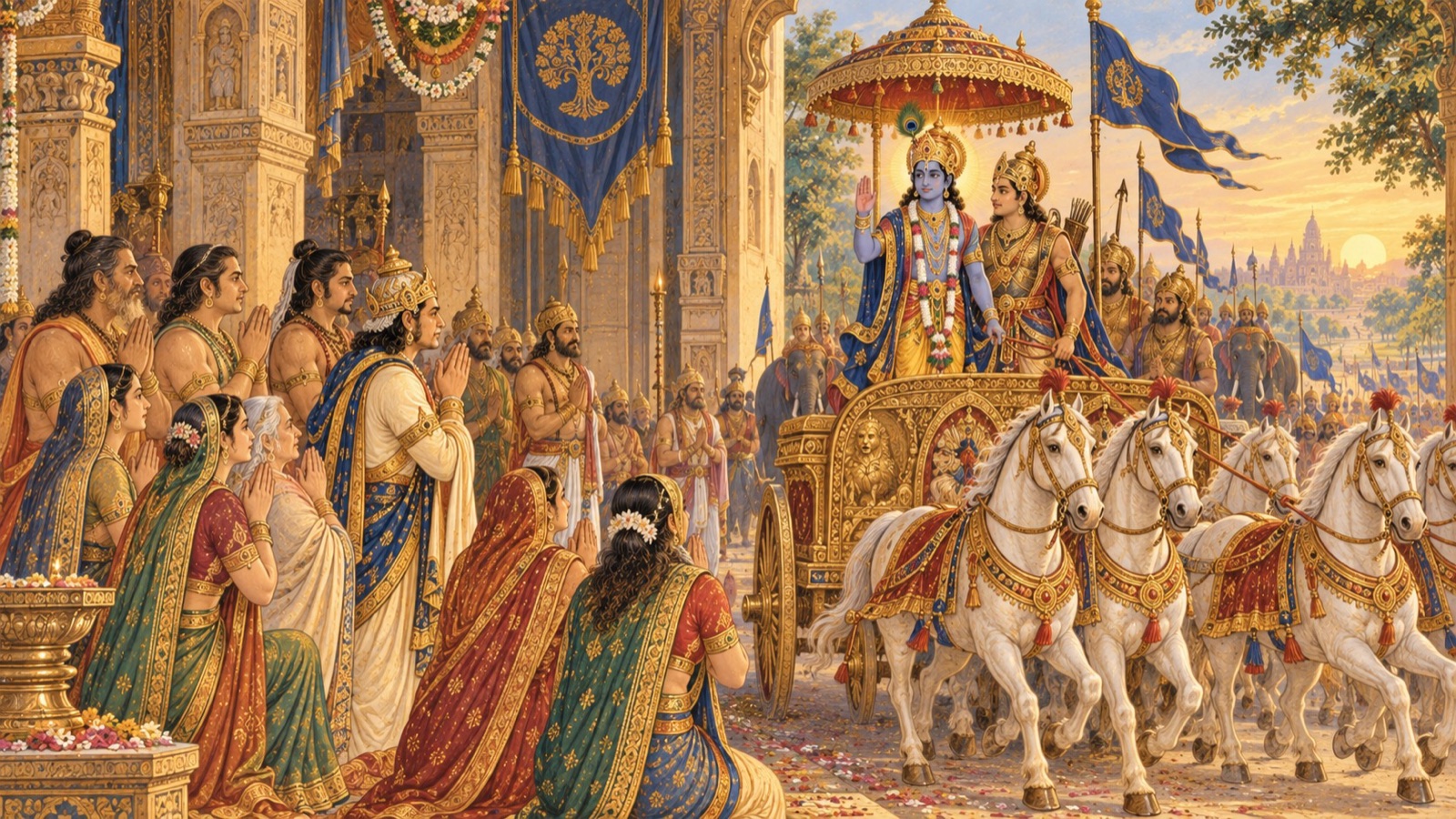
Invited by the king, Lord Śrī Kṛṣṇa oversaw the sacrifices with the help of the Brāhmaṇas and then, for the pleasure of His friends and kinsmen, remained with them for some months. At last, with the leave of the king, his brothers, and Draupadī, He set out once more for Dwārakā, accompanied by Arjuna and surrounded by the chiefs of the Yadus.
ततो राज्ञाभ्यनुज्ञात: कृष्णया सह बन्धुभि: । ययौ द्वारवतीं ब्रह्मन् सार्जुनो यदुभिर्वृत: ॥ ३६ ॥
tato rājñābhyanujñātaḥ kṛṣṇayā saha-bandhubhiḥ । yayau dvāravatīṁ brahman sārjuno yadubhir vṛtaḥ ॥ 36 ॥
Meaning: Then, granted leave by the king, by Draupadī, and by his kinsmen, O Brāhmaṇa, He set out for Dwārakā, accompanied by Arjuna and surrounded by the Yadus. (Canto 1, Chapter 12, verse 36)
Principal Teachings
1. The Lord is seen first by those He saves. Before Parīkṣit drew a single breath, he had already beheld the Lord who protected him (verses 7–11). Grace often precedes our awareness of it; the Lord is present and at work long before we can recognize Him.
2. Worldly abundance cannot satisfy a God-given heart. Yudhiṣṭhira possessed sovereignty, riches, fame, and every enjoyment coveted by the gods, yet none of it delighted him, for his mind rested in Mukunda (verse 6). The soul that has tasted devotion is no longer fed by the world alone.
3. A holy name is a lifelong blessing. The child received two names — Viṣṇurāta, “given by Viṣṇu,” and Parīkṣit, “the examiner” — and each carried a whole destiny within it (verses 17, 30). What we are called, when it is given in devotion, can shape who we become.
4. Devotion turns even a foretold death into liberation. The sages foretold that Parīkṣit would hear of his death and, instead of fleeing it, would renounce attachment and take shelter of the Lord, attaining the fearless state on the bank of the Gaṅgā (verses 27–28). Death faced in devotion becomes the doorway to freedom.
5. The seeking heart searches everywhere for the Lord. Parīkṣit examined every person he met, looking for the One he had glimpsed within the womb (verse 30). True remembrance makes a devotee restless for God in all things and all people.
6. The righteous seek to atone, and the Lord aids them. Still fearful of the sin of the war, Yudhiṣṭhira propitiated Hari through three horse-sacrifices, and Kṛṣṇa Himself came to oversee their completion (verses 34–35). Sincere repentance draws the Lord’s help toward the humble heart.
A Devotional Reflection
There is something deeply moving in the thought that Parīkṣit met the Lord before he met the world. His very first sight, before the light of day, was the whirling, protecting form of Śrī Hari — and that sight became the shape of his whole life. He grew up examining every face he passed, unable to forget the One he had seen. We may feel that we came late to God, that our years without Him were wasted. But this chapter gently suggests otherwise: the Lord is often nearest at our most helpless hour, working unseen within us, planting a memory we spend the rest of our lives trying to recover. To live devotionally is, in a sense, to become like Parīkṣit — to keep looking, in every person and every circumstance, for the beloved form we half-remember, until at last, on some quiet bank of our own Gaṅgā, we find Him fully and are afraid no more.
A Daily Devotional Practice
Today, choose one of the Lord’s holy names — Mukunda, Acyuta, Hari, or the name most dear to you — and let it be the name by which you quietly greet each moment. As Parīkṣit searched every face for the One he had seen, let your heart turn, again and again through the day, toward the Lord hidden within all things. When a difficulty comes, remember that He was present with the unborn child in the fire of the Brahmastra, and speak His name softly. Let the practice be small and steady; that is enough to begin.
Conclusion
So ends the twelfth discourse of the Śrīmad Bhāgavata, which the God-realized call the Paramahaṁsa-Saṁhitā. In this chapter, Srimad Bhagavatam Canto 1 Chapter 12, we have heard how the sages of Naimisaranya asked about the child saved in the womb; how that child beheld the thumb-sized, mace-wielding form of Lord Acyuta quenching the fire of the Brahmastra; and how, at an auspicious hour, he was born to carry forward the line of Pāṇḍu. We have seen King Yudhiṣṭhira, contented only in Kṛṣṇa, welcome the birth with hymns and gifts; we have heard the Brāhmaṇas name him Viṣṇurāta and foretell a life of Rāma-like virtue, ending in liberation on the bank of the Gaṅgā; and we have learned how the world came to call him Parīkṣit, the one who searched every face for the Lord. The chapter closes with the horse-sacrifices of Yudhiṣṭhira and the departure of Śrī Kṛṣṇa for Dwārakā. From before his birth to the hour of his death, the life of Parīkṣit is held within the grace of the Lord — a reminder that our own lives, too, are cradled in that same unfailing love.
May the divine wisdom of Srimad Bhagavatam awaken pure devotion within our hearts.
Om Namo Bhagavate Vasudevaya.
Jay Shree Madhav.
References and Attribution
Primary edition: Gita Press, Śrīmad Bhāgavata Mahāpurāṇa (English), Book One (Skandha 1), Discourse 12, book pages 46–48.
Srimad Bhagavatam Wisdom · Biswa Sanatan Dharma Seva Trust. Presented following the spiritual guidance and recommendation of Pandit Dr. Shri Kashinath Mishra.
This article is an original, faithful devotional retelling (Copyright MODE B). No publisher translation or purport is reproduced; verse “Meaning” lines are original faithful paraphrase. This article does not imply that any publisher, library, or organization sponsors or endorses it.
Jay Shree Madhav