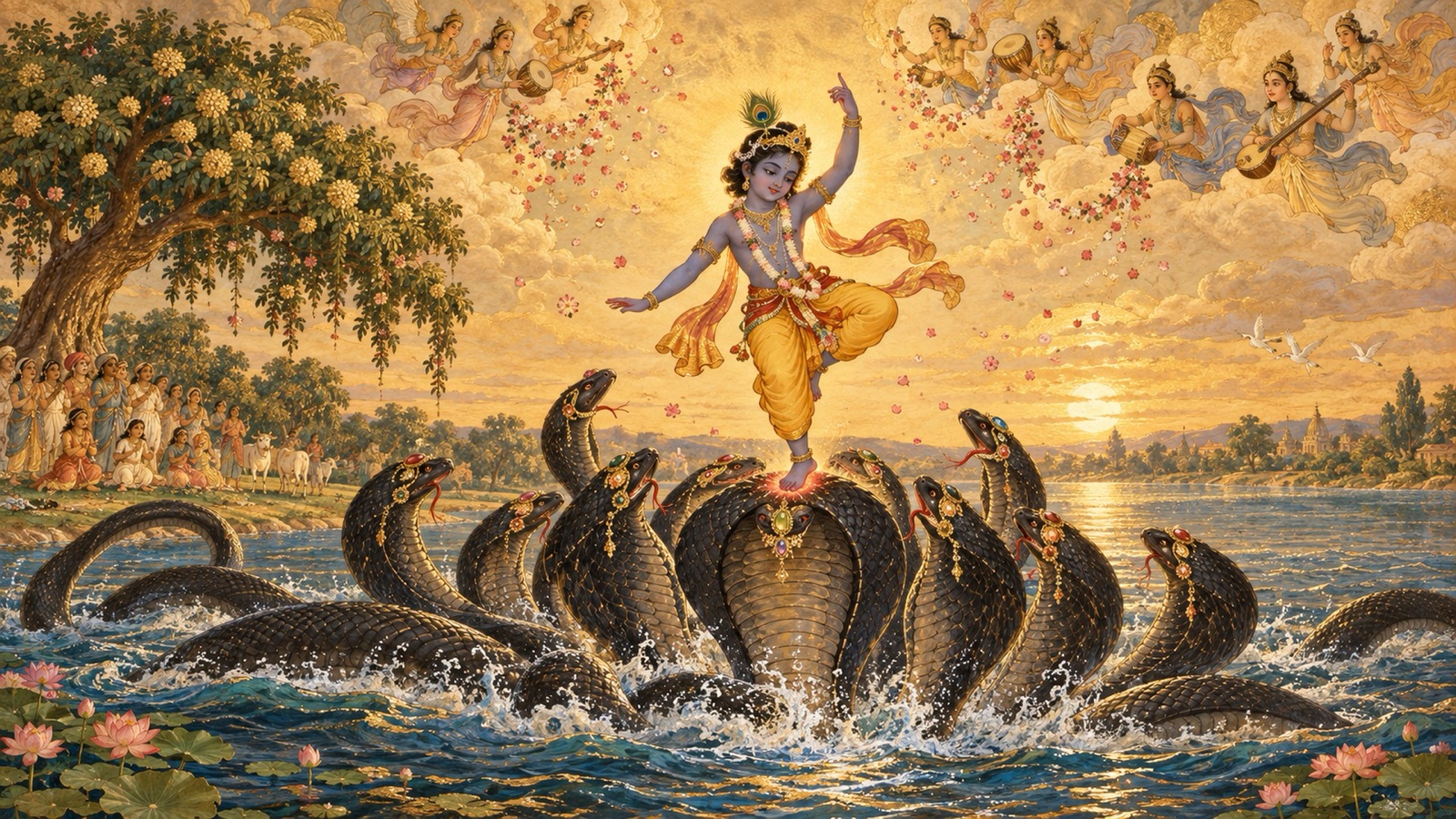
Rising upon the hundred hoods of the serpent Kaliya, His lotus feet reddened by the jewels on its heads, Krishna dances the demon into submission as the celestials rain flowers and sound their drums.
Om Namo Bhagavate Vasudevaya.
Om Namo Bhagavate Vasudevaya.
Om Namo Bhagavate Vasudevaya.
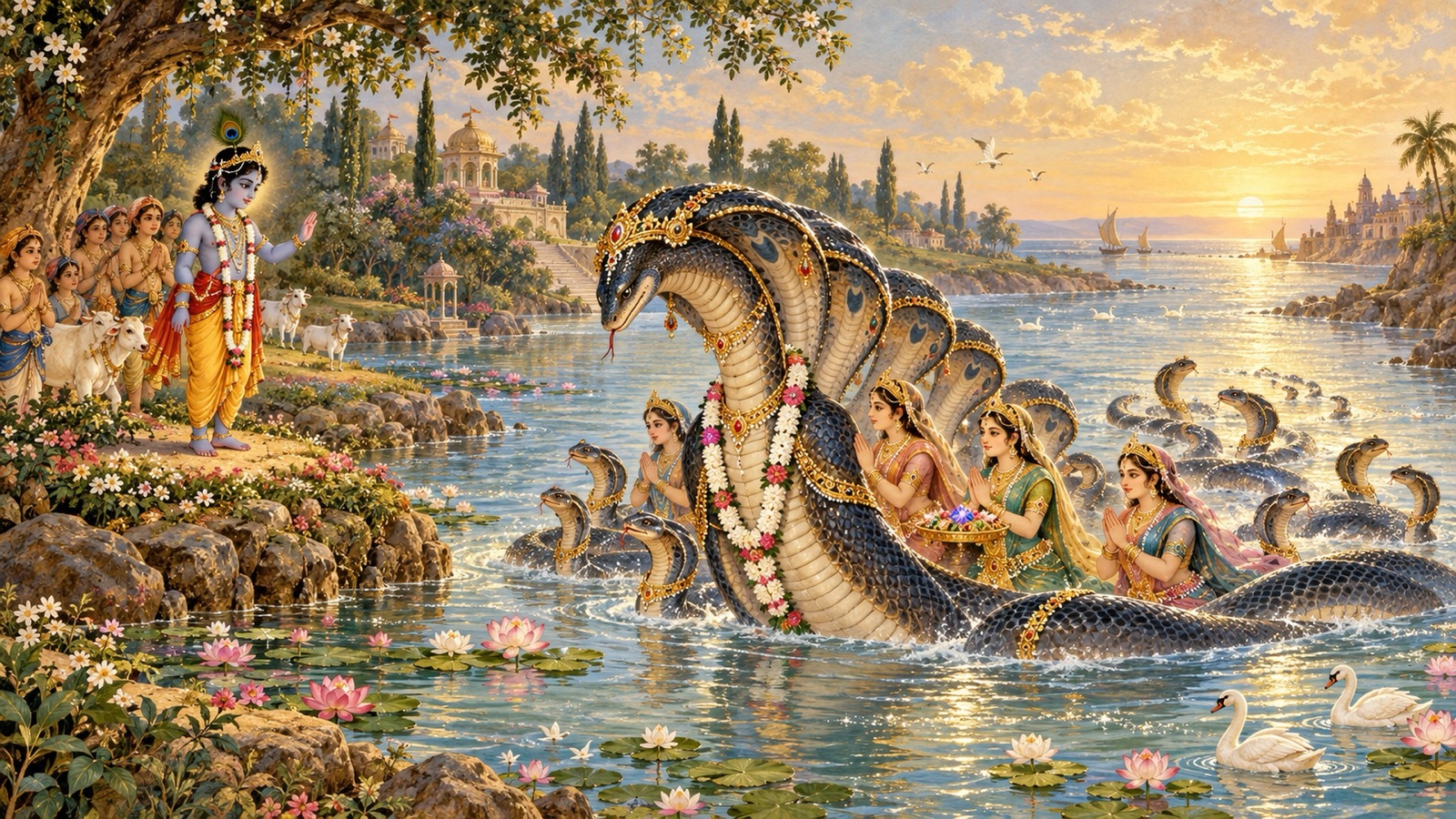
Welcome back to Srimad Bhagavatam Wisdom, our devotional journey through the sacred histories and teachings of the Srimad Bhagavat Mahapurana. This sixteenth chapter of the Tenth Canto tells one of the most celebrated of all Krishna’s pastimes — the subduing of the serpent Kaliya. A deep bend of the Yamuna had been made deadly by the venom of the great black serpent, so that birds fell dead in flight above it. To purify the river, Krishna leaps from a tall kadamba tree into the poisoned lake; the serpent coils about Him, and all of Vraja, rushing to the bank, is plunged into grief. Then the Lord rises, and upon the hundred hoods of Kaliya He dances the serpent into submission. The serpent’s wives offer a beautiful prayer for their husband’s life, Kaliya surrenders, and Krishna spares him, banishing him to the ocean — and at once the Yamuna is made sweet and pure again.
Chapter Information
- Scripture: Śrīmad Bhāgavata Mahāpurāṇa
- Canto: 10 (Book Ten, First Half)
- Chapter: 16 (Discourse 16)
- Chapter title: The Subduing of the Serpent Kaliya
- Principal speaker: Sukadeva Gosvami (narrating to King Parikshit)
- Principal listener: King Parikshit
- Main setting: The lake of Kaliya in the Yamuna river at Vrindavana
- Central subject: The poisoned lake; Krishna’s leap into the water; the grief of Vraja; the dance upon Kaliya’s hoods; the prayers of the serpent’s wives; Kaliya’s surrender and banishment; and the healing of the Yamuna
- Principal verse range: Canto 10, Chapter 16, verses 1–67
- Primary edition: Gita Press Śrīmad Bhāgavata Mahāpurāṇa (Sanskrit-Hindi, Volume 2)
Context From the Previous Chapter
In Chapter 15, Balarama slew the ass-demon Dhenuka in the Talavana, and Krishna revived the cows and boys who had fallen from the poisoned water of the Yamuna — water made deadly by the serpent Kaliya. This chapter tells how Krishna drove that serpent from the river and purified it.
The Poisoned Lake
King Parikshit, longing to hear more, asked how Krishna had subdued the serpent in the deep water where it had dwelt for many ages; for who, he said, could ever be satisfied while drinking the nectar of the Lord’s generous cowherd deeds? Sukadeva answered. Within the Yamuna lay a certain lake of the serpent Kaliya, its waters boiling with the fire of his venom, so that birds flying overhead fell dead into it, and creatures on the banks perished from the poison carried on the spray and the wind.
Krishna Leaps into the Lake
Seeing the river thus ruined by the serpent’s fierce and potent venom, Krishna — who had descended precisely to curb the wicked — resolved to drive him out. Climbing a very tall kadamba tree on the bank, He tightened His belt, slapped His arms in challenge, and leaped into the poisoned water.
तं चण्डवेगविषवीर्यमवेक्ष्य तेन
दुष्टां नदीं च खलसंयमनावतार: ।
कृष्ण: कदम्बमधिरुह्य ततोऽतितुङ्ग-
मास्फोट्य गाढरशनो न्यपतद् विषोदे ॥ ६ ॥
taṁ caṇḍa-vega-viṣa-vīryam avekṣya tena duṣṭāṁ nadīṁ ca khala-saṁyamanāvatāraḥ kṛṣṇaḥ kadambam adhiruhya tato ’ti-tuṅgam āsphoṭya gāḍha-raśano nyapatad viṣode
Meaning: Seeing the river ruined by the serpent of fierce speed and potent venom, Krishna — whose descent is meant for the subduing of the wicked — climbed a very tall kadamba tree, tightened His belt, slapped His arms, and leaped into the poisoned lake. (Canto 10, Chapter 16, verse 6)
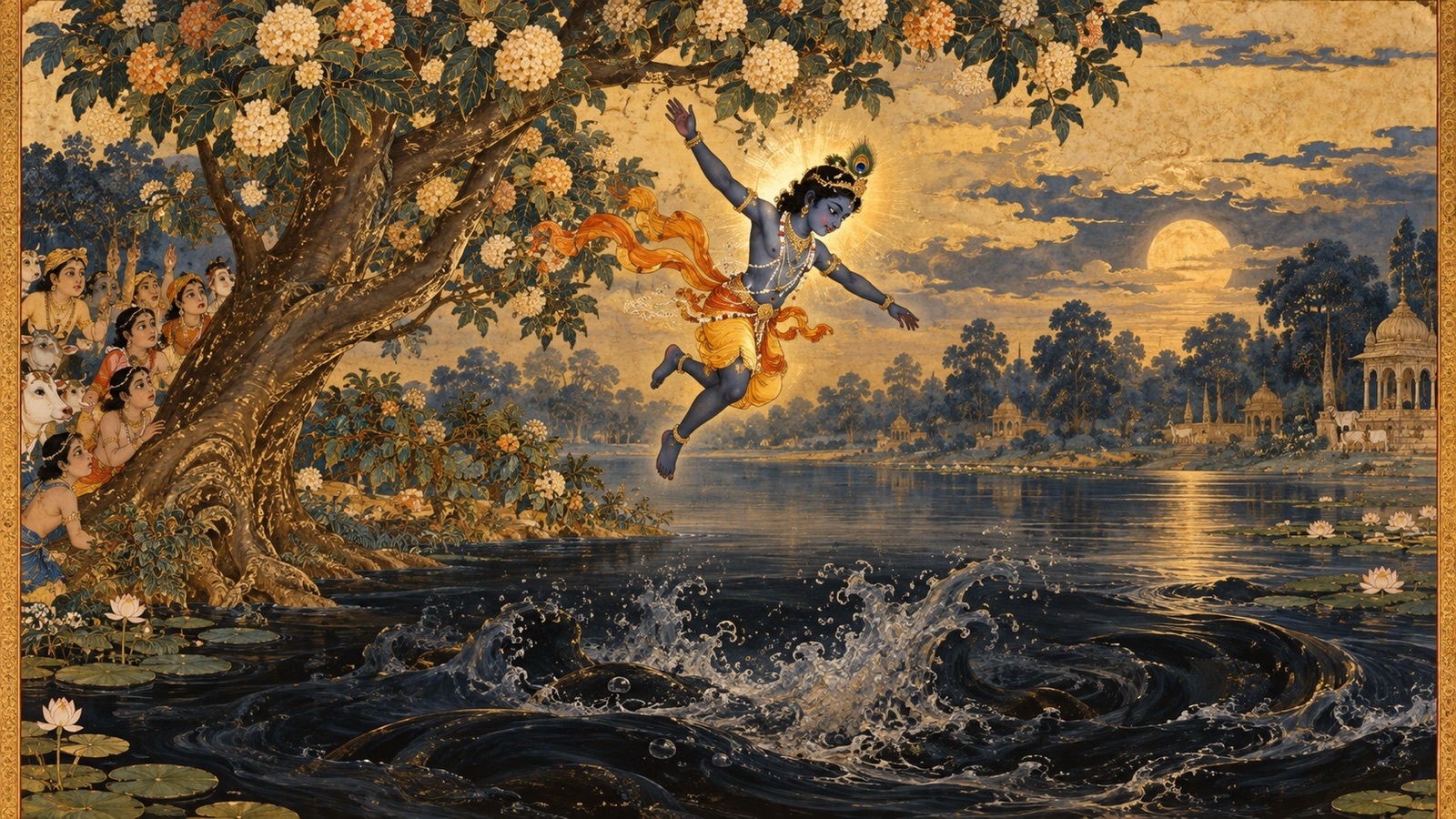
The serpent’s lake, churned by the fall of the Supreme Person, overflowed its banks a hundred bow-lengths, its waves terrible with venom — yet what is such a thing for the Lord of unlimited strength? As Krishna sported in the water, His arms churning it with a sound like a mighty elephant’s, Kaliya heard the invasion of his home, and, unable to bear it, rushed forth. He bit the Lord in His vital parts and wound his coils about Him. Seeing Krishna motionless, enveloped in the serpent’s coils, His dear cowherd friends — who had given Him their very selves, their families, their all — fell down senseless with grief, and the cows and calves stood crying piteously, their eyes fixed on Him.
The Grief of Vraja
Terrible omens broke out in Vraja, and the cowherds, led by Nanda, knowing that Krishna had gone to graze the cows without Balarama, feared the worst and rushed toward the Yamuna, their very lives bound up in Him — the old, the young, the women, all coming out of Gokula, desperate for a sight of Krishna. Balarama, knowing His younger brother’s power, smiled and did not stop them. Following Krishna’s footprints, marked with the divine signs of the lotus, barleycorn, goad, thunderbolt, and flag, they reached the bank and beheld Him held within the serpent’s coils, and the stunned boys and cattle all around; and they were overwhelmed.
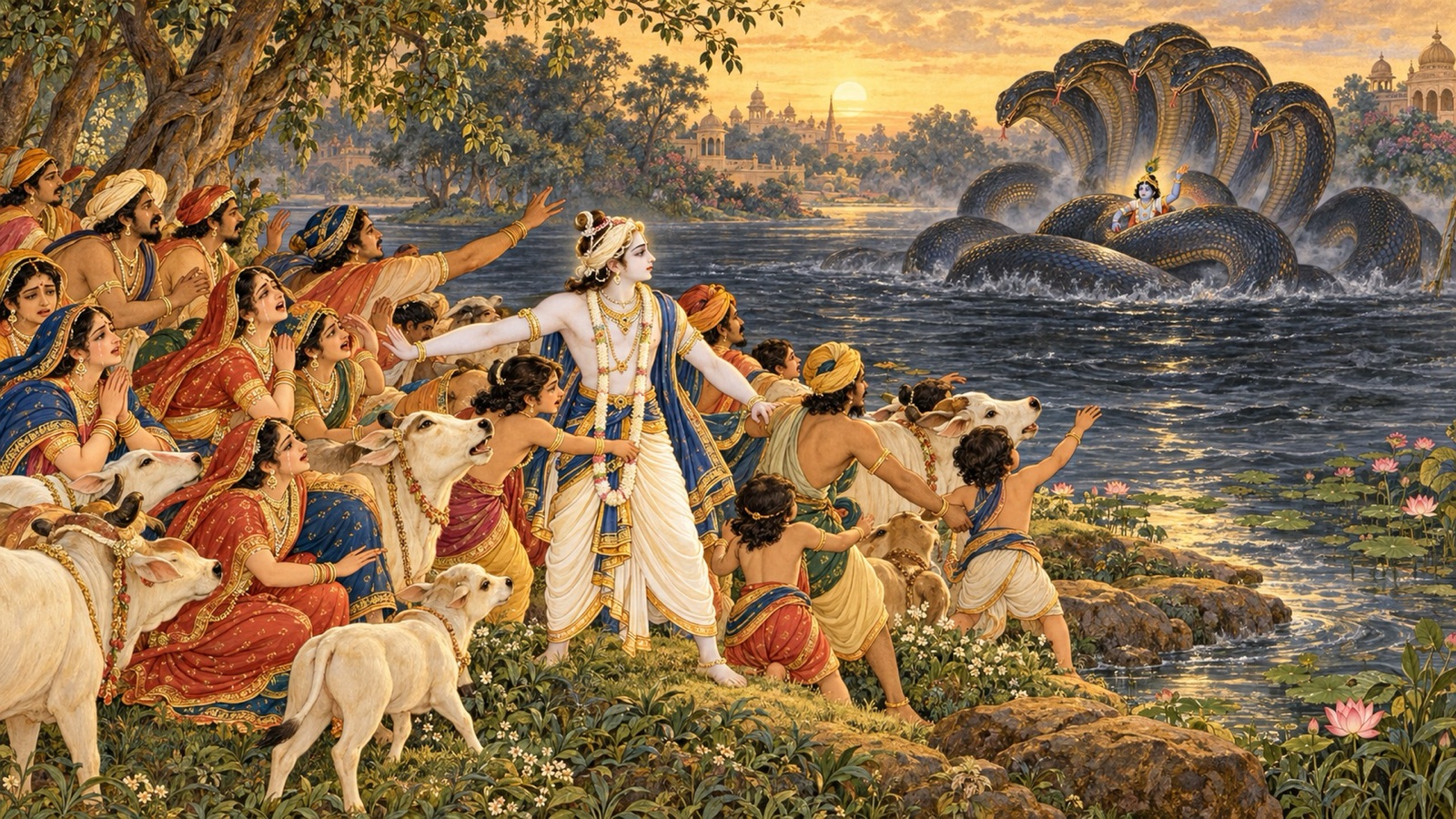
The gopis, their minds fixed in love upon the infinite Lord, remembering His tender smiles and words, saw the three worlds as empty without Him and burned with grief. They held back Krishna’s mother, who would have thrown herself into the lake, and all stood on the bank like corpses, their eyes fixed upon His face. When Nanda and the others made to enter the water, Balarama, who knew Krishna’s glory, restrained them. And the Lord, seeing His own people so stricken with grief for His sake and following the way of mortals, remained a while in the coils and then rose up from the serpent’s bondage.
The Dance upon Kaliya
As Krishna expanded His body, the serpent, its coils pained, was forced to release Him and reared up its hoods, hissing, its eyes like firebrands and its breath like poison. Krishna played about it as Garuda might, and the serpent, watching for an opening, was worn down by the whirling. Then the primeval Lord, the origin of all arts, bent down its exhausted, raised shoulders, climbed upon its broad hundred hoods, and began to dance, His lotus feet reddened by the touch of the jewels upon its heads.
एवं परिभ्रमहतौजसमुन्नतांस-
मानम्य तत्पृथुशिर:स्वधिरूढ आद्य: ।
तन्मूर्धरत्ननिकरस्पर्शातिताम्र-
पादाम्बुजोऽखिलकलादिगुरुर्ननर्त ॥ २६ ॥
evaṁ paribhrama-hataujasam unnatāṁsam ānamya tat-pṛthu-śiraḥsv adhirūḍha ādyaḥ tan-mūrdha-ratna-nikara-sparśāti-tāmra- pādāmbujo ’khila-kalādi-gurur nanarta
Meaning: Bending down the serpent’s raised shoulders, now drained of strength by the whirling, the primeval Lord, the origin of all arts, climbed upon its broad heads and danced, His lotus feet turned coppery-red by the touch of the mass of jewels upon its hoods. (Canto 10, Chapter 16, verse 26)
At once the Gandharvas, Siddhas, sages, Charanas, and the wives of the gods came joyfully with drums and songs, flowers and praise. Whichever of the hundred hoods would not bow, Krishna trampled it down with His heels; and the serpent, his life ebbing, vomited blood and venom and at last found relief. Remembering within his heart the ancient Person Narayana, the guru of all that moves and does not move, Kaliya surrendered to Him in his mind.
The Prayers of the Serpent’s Wives
Seeing their husband crushed beneath the weight of the Lord who bears the universe, his hoods broken by those heels, the wives of Kaliya approached, their garments and ornaments loosened in distress. Placing their children before them, they bowed to the Lord of all beings and, with folded hands, prayed for the release of their sinful husband, taking shelter of the giver of shelter. Their prayer is among the most beautiful in the Bhagavatam, a confession that whatever the Lord metes out to the wicked is never cruelty but correction, measured by One who holds friend and foe in exactly the same regard.
नागपत्न्य ऊचु:
न्याय्यो हि दण्ड: कृतकिल्बिषेऽस्मिं-
स्तवावतार: खलनिग्रहाय ।
रिपो: सुतानामपि तुल्यदृष्टि-
र्धत्से दमं फलमेवानुशंसन् ॥ ३३ ॥
nāga-patnya ūcuḥ nyāyyo hi daṇḍaḥ kṛta-kilbiṣe ’smiṁs tavāvatāraḥ khala-nigrahāya ripoḥ sutānām api tulya-dṛṣṭir dhatse damaṁ phalam evānuśaṁsan
Meaning: The wives of the serpent said: This punishment of our sinful husband is entirely just, for Your descent is to curb the wicked; and being equal even toward the sons of Your enemy, You inflict this chastisement only intending it as a true benefit. (Canto 10, Chapter 16, verse 33)
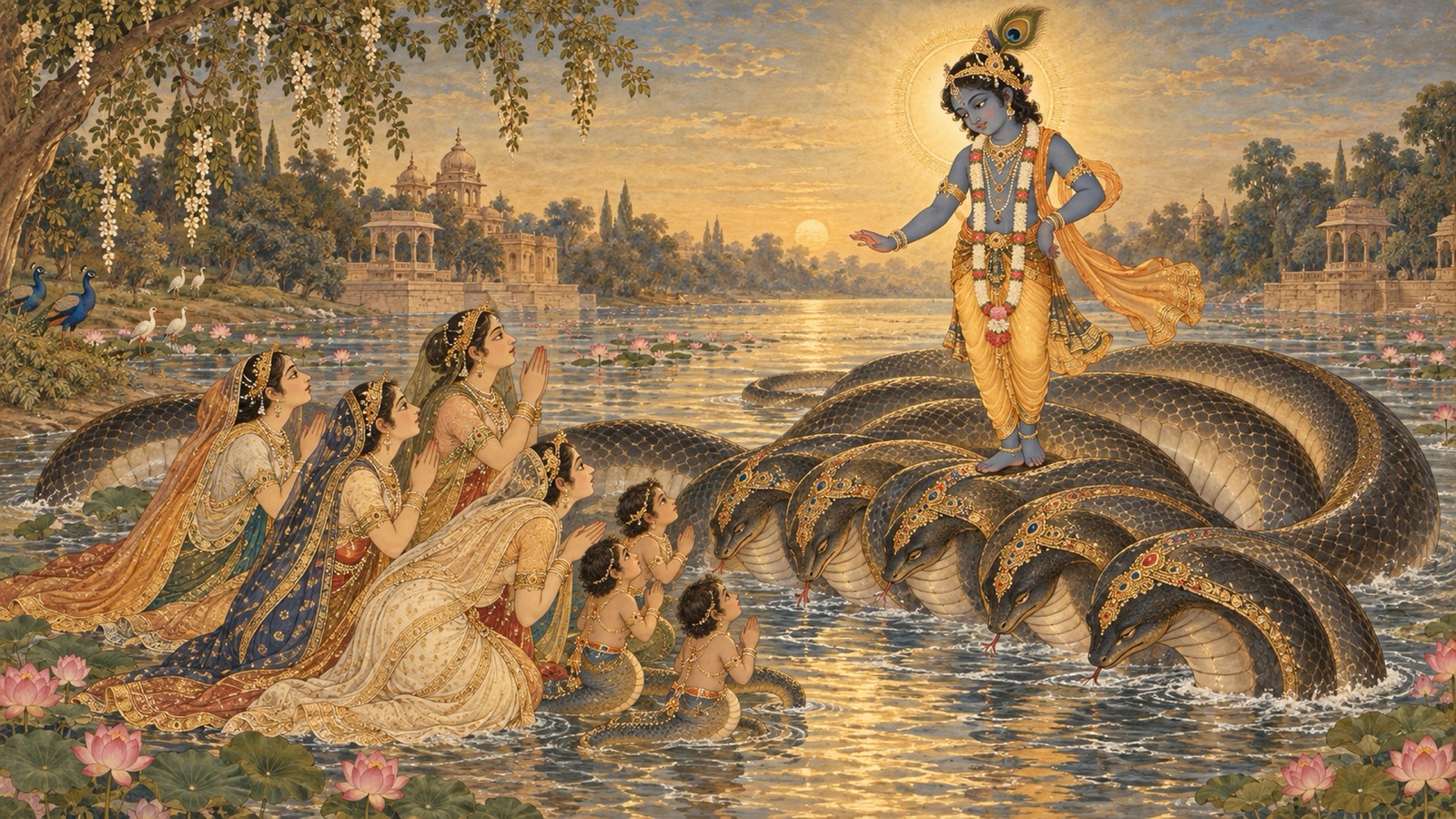
They declared that even the Lord’s anger upon the wicked is His grace, cleansing their sins; that they could not imagine what austerity, charity, or compassion their husband had performed to earn the touch of the dust of His feet — that very dust which the goddess of fortune herself sought by long penance. And they spoke the truth that those who attain the dust of His feet no longer desire anything else at all.
न नाकपृष्ठं न च सार्वभौमं
न पारमेष्ठ्यं न रसाधिपत्यम् ।
न योगसिद्धीरपुनर्भवं वा
वाञ्छन्ति यत्पादरज:प्रपन्ना: ॥ ३७ ॥
na nāka-pṛṣṭhaṁ na ca sārva-bhaumaṁ na pārameṣṭhyaṁ na rasādhipatyam na yoga-siddhīr apunar-bhavaṁ vā vāñchanti yat-pāda-rajaḥ-prapannāḥ
Meaning: Those who have attained the dust of Your feet desire neither the heavenly planets, nor sovereignty over the earth, nor the post of Brahma, nor rulership of the lower worlds, nor the perfections of yoga, nor even liberation itself. (Canto 10, Chapter 16, verse 37)
Kaliya’s Surrender and Banishment
Thus praised by the serpent’s wives, the Lord released Kaliya, who lay senseless, his heads crushed by the trampling. Slowly regaining his breath and his senses, the wretched serpent, with folded hands, spoke to Krishna: ‘We serpents are wicked by our very birth, filled with long-standing anger, and our nature is hard to give up; deluded by Your own Maya, how can we abandon it of ourselves? You are the cause of all, the all-knowing Lord of the universe; do with us as You see fit, whether grace or punishment.’ Hearing this, the Lord, playing the human part, gave His command.
श्रीशुक उवाच
इत्याकर्ण्य वच: प्राह भगवान् कार्यमानुष: ।
नात्र स्थेयं त्वया सर्प समुद्रं याहि मा चिरम् ।
स्वज्ञात्यपत्यदाराढ्यो गोनृभिर्भुज्यते नदी ॥ ६० ॥
śrī-śuka uvāca ity ākarṇya vacaḥ prāha bhagavān kārya-mānuṣaḥ nātra stheyaṁ tvayā sarpa samudraṁ yāhi mā ciram sva-jñāty-apatya-dārāḍhyo go-nṛbhir bhujyate nadī
Meaning: Hearing these words, the Lord, acting the part of a man, said: You must not remain here, O serpent; go without delay to the ocean, together with your kinsmen, children, and wives. Let the river be enjoyed by the cows and by men. (Canto 10, Chapter 16, verse 60)
And the Lord promised His grace to all who would remember this pastime, declaring that whoever recalls His command to Kaliya and recites it at dawn and dusk will have no fear of serpents; that whoever bathes in that place of His pastime, worships Him, and offers water to the gods, will be freed from all sins; and that because Kaliya’s heads now bore the mark of His feet, even Garuda, from whom the serpent had once fled, would no longer harm him.
य एतत् संस्मरेन्मर्त्यस्तुभ्यं मदनुशासनम् ।
कीर्तयन्नुभयो: सन्ध्योर्न युष्मद् भयमाप्नुयात् ॥ ६१ ॥
ya etat saṁsmaren martyas tubhyaṁ mad-anuśāsanam kīrtayann ubhayoḥ sandhyor na yuṣmad bhayam āpnuyāt
Meaning: Any mortal who remembers this command of Mine to you, and recites it at the two junctions of the day, will never have any fear of you serpents. (Canto 10, Chapter 16, verse 61)
The Yamuna Made Sweet Again
Released and blessed by the Lord of wondrous deeds, Kaliya and his wives worshipped Him with joy — with divine garments, priceless jewels and ornaments, fragrant sandal-paste, and a great garland of lotuses. Having pleased the Lord who bears Garuda on His banner, and being given leave, Kaliya circumambulated Him, bowed, and departed with his family to an island in the sea. And at that very moment, by the grace of the Lord who had assumed a human form for His pastimes, the Yamuna became wholly free of poison, its waters sweet as nectar once more.
Principal Teachings of This Chapter
1. The Lord descends to purify what is poisoned. Krishna leaps into the venomous lake to cleanse the very source of poison (verse 6). He does not avoid our corruption but enters it to heal it at the root.
2. Faith holds firm when love is tested. When Krishna seems overcome, Balarama restrains the grieving people, knowing His power (verses 22-23). Trust in the Lord steadies the heart even in the darkest moment.
3. The Lord conquers with grace, not cruelty. Krishna subdues Kaliya by a dance, and spares his life at his wives’ prayer (verses 26-54). His victory over evil is measured, merciful, and beautiful.
4. Even His punishment is His mercy. The serpent’s wives praise the Lord’s chastisement as a cleansing grace (verses 33-34). What corrects us from His hand is never mere anger but love intending our good.
5. The dust of His feet is the highest gift. Those who attain it desire neither heaven, nor power, nor even liberation (verse 37). To belong to the Lord is itself the fulfilment of every desire.
A Devotional Reflection
The image of Krishna dancing upon the hoods of the serpent has been beloved by devotees for centuries, and this chapter shows us why. The Lord does not slay Kaliya; He dances upon him, and spares him at the pleading of his frightened wives. Even the punishment is restrained, even the enemy is blessed, and the serpent who came only to poison is sent away marked forever by the Lord’s feet, protected now even from his old enemy Garuda. There is a deep comfort in this. The poisons of our own lives — our anger, our long-standing habits ‘hard to give up,’ as Kaliya confessed — are not beyond the Lord’s reach; He enters the very lake of them, and where we expect destruction He brings a dance, and a chastening that is really a cleansing. And the prayer of the serpent’s wives leaves us with the whole secret of devotion: those who have touched the dust of His feet no longer want heaven, or power, or even liberation, for they have found the one thing that makes all else unnecessary. When trouble coils around us, this chapter asks us to trust, as Balarama trusted, that the Lord is not overcome but is already turning our poison into sweet water.
A Daily Devotional Practice
Today, offer the Lord one ‘poison’ of your own — a habit, an anger, a fear that seems hard to give up — as Kaliya at last surrendered his nature, saying, ‘Do with me as You see fit.’ Recall the pastime of Kaliya at the two junctions of the day, morning and evening, as the Lord Himself promised protection to those who remember it. And ask not for heaven or power, but only for the dust of His feet. Begin by chanting gently: Om Namo Bhagavate Vasudevaya.
Conclusion
The sixteenth chapter of the Tenth Canto gives us the glorious pastime of Kaliya-damana. To purify the poisoned Yamuna, Krishna leaps fearlessly into the serpent’s lake; He allows Himself to be coiled, so that all Vraja may pour out its love in grief, and then rises to dance upon the hundred hoods of the serpent until it is subdued. At the prayer of Kaliya’s wives, who glorify even His punishment as grace, the Lord spares the serpent’s life and banishes him to the sea, blessing all who will remember the deed — and the river is made sweet again. In this pastime the Lord shows that He enters the very source of our poison to heal it, conquers evil with grace rather than cruelty, and asks of us only that we surrender our stubborn nature into His hands. May we, remembering His dance upon the serpent, trust Him with the poisons of our own hearts and seek nothing higher than the dust of His feet.
May the divine wisdom of Srimad Bhagavatam awaken pure devotion within our hearts.
Om Namo Bhagavate Vasudevaya.
Jay Shree Madhav.
References and Attribution
- Primary edition: Gita Press, Śrīmad Bhāgavata Mahāpurāṇa (Sanskrit-Hindi, Volume 2), Book Ten (First Half), Discourse 16.
- Series: Srimad Bhagavatam Wisdom · Biswa Sanatan Dharma Seva Trust.
- Presented following the spiritual guidance and recommendation of Pandit Dr. Shri Kashinath Mishra.
This is an original, faithful retelling in the writer’s own words, with brief quoted verses shown in Devanāgarī and transliteration and their meanings given as summaries. It is not a reproduction of any single publisher’s continuous translation or commentary. No affiliation with or endorsement by any publisher is implied.
Jay Shree Madhav