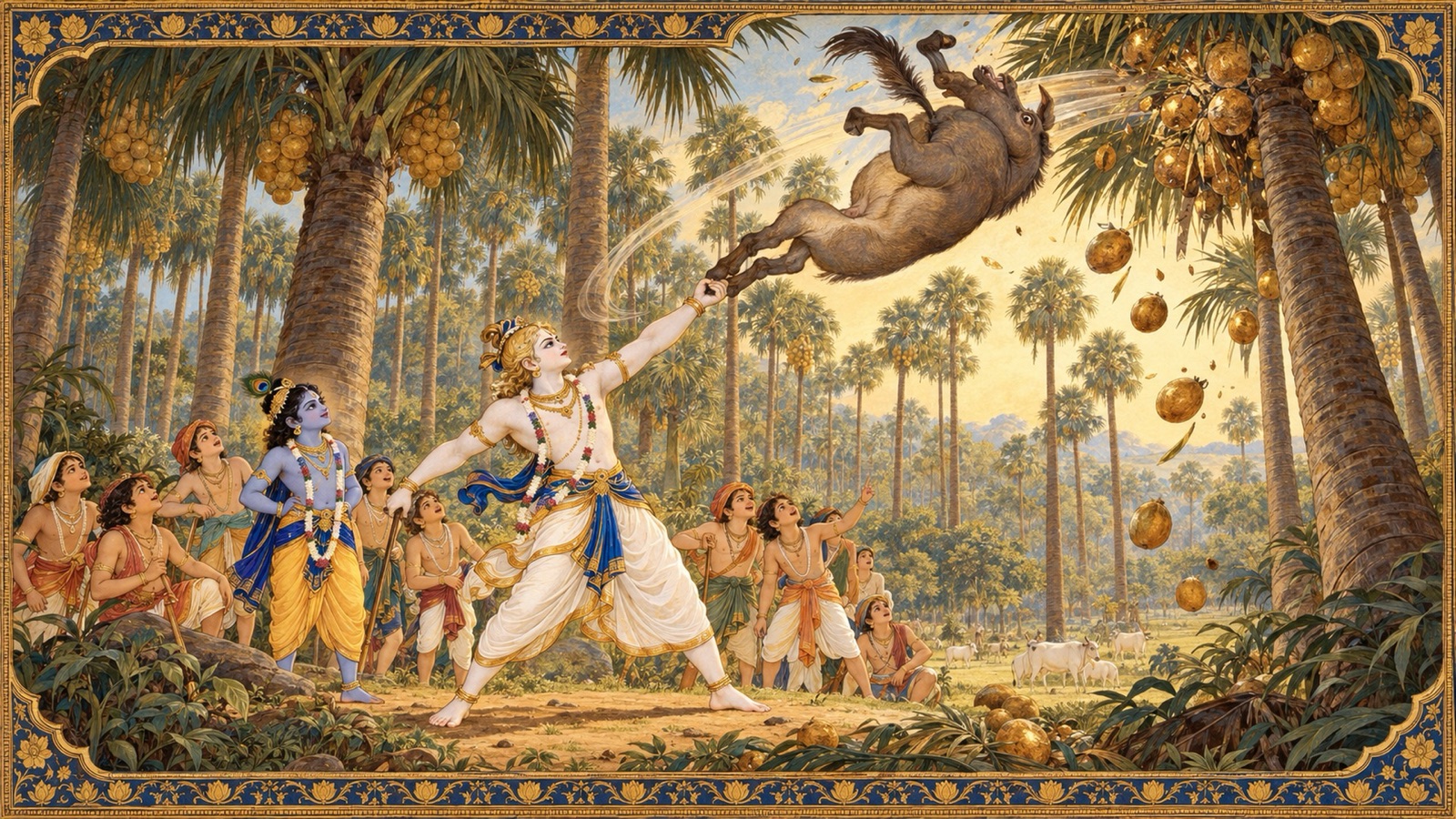
When the wicked ass-demon Dhenuka kicks at Him, Balarama seizes it by the hind legs, whirls it in the air, and flings it into the top of a tall palm tree, freeing the Talavana forest for all.
Om Namo Bhagavate Vasudevaya.
Om Namo Bhagavate Vasudevaya.
Om Namo Bhagavate Vasudevaya.
Welcome back to Srimad Bhagavatam Wisdom, our devotional journey through the sacred histories and teachings of the Srimad Bhagavat Mahapurana. This fifteenth chapter of the Tenth Canto opens a new season in the pastimes of the Lord. Krishna and Balarama, grown into the age of cowherds, roam a blossoming Vrindavana grazing the cows, and Krishna’s flute and play fill the forest with beauty. When their friends tell them of the nearby palm forest of the Talavana — laden with sweet fruit but guarded by the wicked ass-demon Dhenuka — the two Brothers go there to please them, and Balarama slays Dhenuka and his demon herd, freeing the grove for all. On another day, when the cows and boys drink from the Yamuna and fall lifeless from its poisoned water, Krishna revives them all with a single merciful glance — quietly preparing the great pastime of the serpent Kaliya that the next chapter will tell.
Chapter Information
- Scripture: Śrīmad Bhāgavata Mahāpurāṇa
- Canto: 10 (Book Ten, First Half)
- Chapter: 15 (Discourse 15)
- Chapter title: The Killing of the Demon Dhenukasura
- Principal speaker: Sukadeva Gosvami (narrating to King Parikshit)
- Principal listener: King Parikshit
- Main setting: Vrindavana, the Talavana palm forest, and the bank of the Yamuna in Vraja
- Central subject: Krishna and Balarama as cowherds; the beauty of Vrindavana; the request about the Talavana; the killing of Dhenukasura and his herd; and the reviving of the cows and boys from the poisoned water of the Yamuna
- Principal verse range: Canto 10, Chapter 15, verses 1–52
- Primary edition: Gita Press Śrīmad Bhāgavata Mahāpurāṇa (Sanskrit-Hindi, Volume 2)
Context From the Previous Chapter
In Chapter 14, the humbled Brahma offered his celebrated prayers and departed, and Krishna returned to His waiting friends, for whom a year had passed as a moment. This chapter continues Krishna’s boyhood as He and Balarama, now of cowherd age, take the cows out to graze and meet the demons who still lurk in the forests of Vraja.
The Young Cowherds of Vrindavana
Having reached the age of cowherds, Krishna and Balarama came to be honoured as keepers of the cattle, and with their friends they grazed the cows through Vrindavana, making that holy forest lovelier still by the touch of their feet. Playing His flute, glorified in song by the gopas, and accompanied by Balarama, Krishna entered the flowering woodland, delighting in its beauty — its humming bees and singing birds, its lake as clear as the mind of a great soul, its breezes fragrant with lotus.
Gazing upon the trees bowed low with the weight of their fruit and flowers, their branches touching His feet, Krishna smiled and spoke to His elder brother of the fortune of all Vrindavana. The trees, He said, bow down offering their fruit and flowers to remove the darkness of their own tree-birth; the bees follow Him singing His glories like the best of sages; the peacocks dance and the does gaze at Him with love as the gopis do. And blessed above all, He said, is this very land, whose grasses and creepers and hills and rivers are touched by holy feet.
धन्येयमद्य धरणी तृणवीरुधस्त्वत्-
पादस्पृशो द्रुमलता: करजाभिमृष्टा: ।
नद्योऽद्रय: खगमृगा: सदयावलोकै-
र्गोप्योऽन्तरेण भुजयोरपि यत्स्पृहा श्री: ॥ ८ ॥
dhanyeyam adya dharaṇī tṛṇa-vīrudhas tvat- pāda-spṛśo druma-latāḥ karajābhimṛṣṭāḥ nadyo ’drayaḥ khaga-mṛgāḥ sadayāvalokair gopyo ’ntareṇa bhujayor api yat-spṛhā śrīḥ
Meaning: Blessed today is this earth, whose grass and plants are touched by Your feet, whose trees and creepers are brushed by Your fingernails, and whose rivers, mountains, birds, and beasts are honoured by Your merciful glances — and blessed are the gopis, for whom is reserved that embrace between Your arms which even the goddess of fortune longs for. (Canto 10, Chapter 15, verse 8)
Krishna’s Play in the Forest
Through the days Krishna sported in Vrindavana, sometimes singing while the intoxicated bees sang around Him, imitating the parrots, the cuckoos, and the swans, dancing with the peacocks and calling the far-off cows by name in a voice deep as a rain-cloud. When Balarama grew tired from play, Krishna would let Him rest His head upon a cowherd’s lap and would Himself massage His feet; and the gopa boys, their hearts melting with love, would fan Him, massage His feet, and sing sweet songs to Him. Thus the Lord whose lotus feet are served by the goddess of fortune concealed His divinity and played like a simple village boy among village boys.
एवं निगूढात्मगति: स्वमायया
गोपात्मजत्वं चरितैर्विडम्बयन् ।
रेमे रमालालितपादपल्लवो
ग्राम्यै: समं ग्राम्यवदीशचेष्टित: ॥ १९ ॥
evaṁ nigūḍhātma-gatiḥ sva-māyayā gopātmajatvaṁ caritair viḍambayan reme ramā-lālita-pāda-pallavo grāmyaiḥ samaṁ grāmya-vad īśa-ceṣṭitaḥ
Meaning: Thus concealing His true nature by His own power, and imitating by His deeds the role of a cowherd’s son, the Lord — whose tender feet are tended by the goddess of fortune — sported like a village boy among the village boys, though His every act was that of the Supreme Lord. (Canto 10, Chapter 15, verse 19)
The Request About the Talavana
One day the cowherd Sridama, a friend of Rama and Krishna, together with Subala, Stokakrishna, and the other boys, spoke to them with affection. Not far away, they said, was a great forest thick with palm trees, where sweet fruit lay fallen and ripening in abundance — but it was held by the wicked ass-demon Dhenuka, who, surrounded by many powerful kinsmen of his own kind, devoured men, so that neither people nor beasts nor even birds would go there. Drawn by the fragrance of the untasted fruit, the boys begged Krishna and Balarama to win it for them.
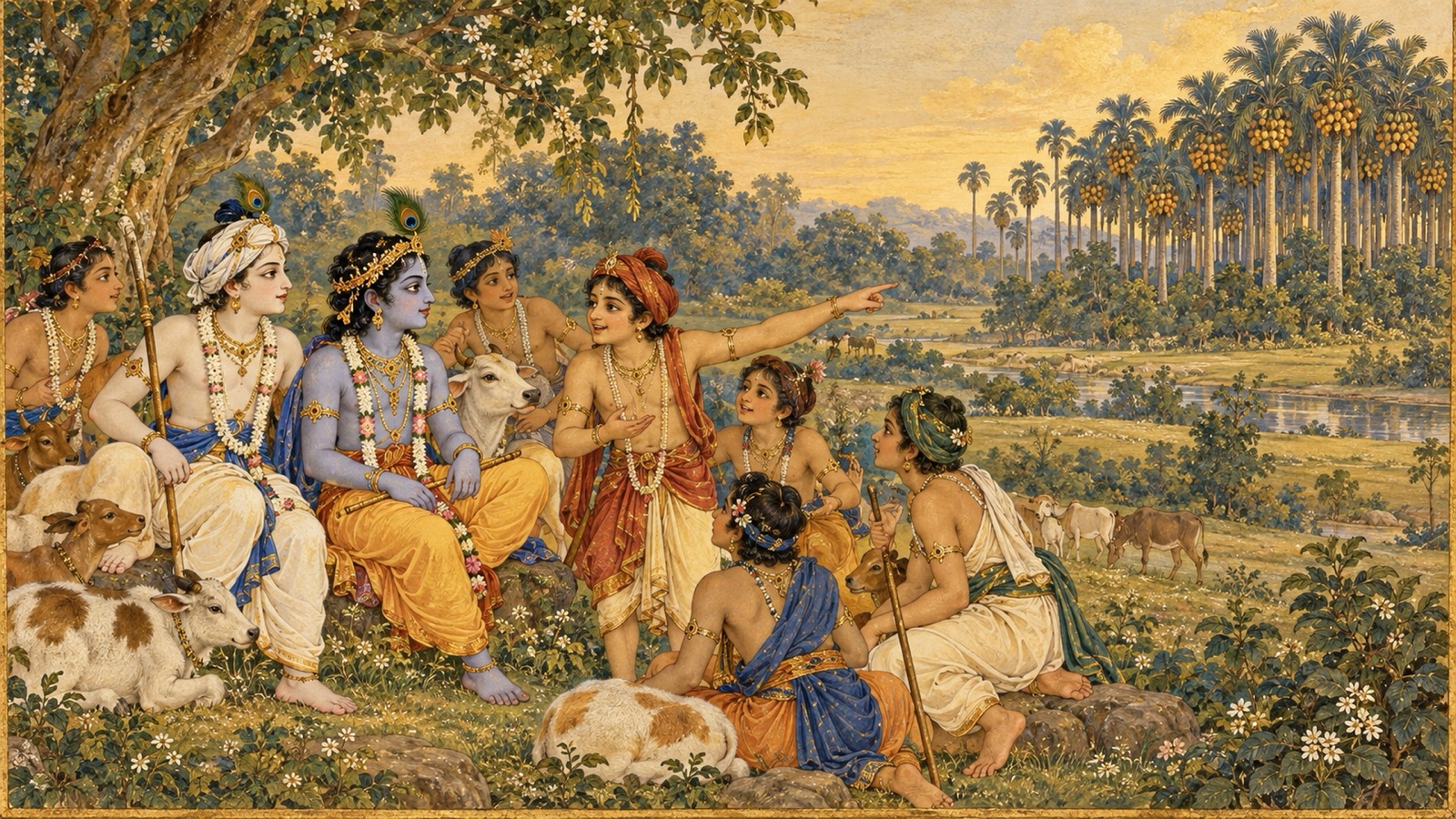
Hearing the loving words of their friends, and wishing to please them, the two Brothers laughed and went to the Talavana, surrounded by the cowherd boys.
The Killing of Dhenukasura
Entering the grove, Balarama shook the palm trees with His powerful arms, as a great elephant might, and brought the ripe fruit tumbling down. Hearing the sound of the falling fruit, the ass-demon Dhenuka rushed forward, shaking the earth and the trees, and struck Balarama’s chest with a violent kick of his hind legs; then, braying loudly, he ran about. But when he charged again and flung his legs at Balarama, the Lord seized him by the hooves, whirled him about with a single hand, and hurled him, lifeless, into the crown of a tall palm tree.
स तं गृहीत्वा प्रपदोर्भ्रामयित्वैकपाणिना ।
चिक्षेप तृणराजाग्रे भ्रामणत्यक्तजीवितम् ॥ ३२ ॥
sa taṁ gṛhītvā prapador bhrāmayitvaika-pāṇinā cikṣepa tṛṇa-rājāgre bhrāmaṇa-tyakta-jīvitam
Meaning: Balarama seized the demon by the hooves, whirled him around once with a single hand, and flung him into the top of a tall palm tree, his life crushed out by the whirling. (Canto 10, Chapter 15, verse 32)
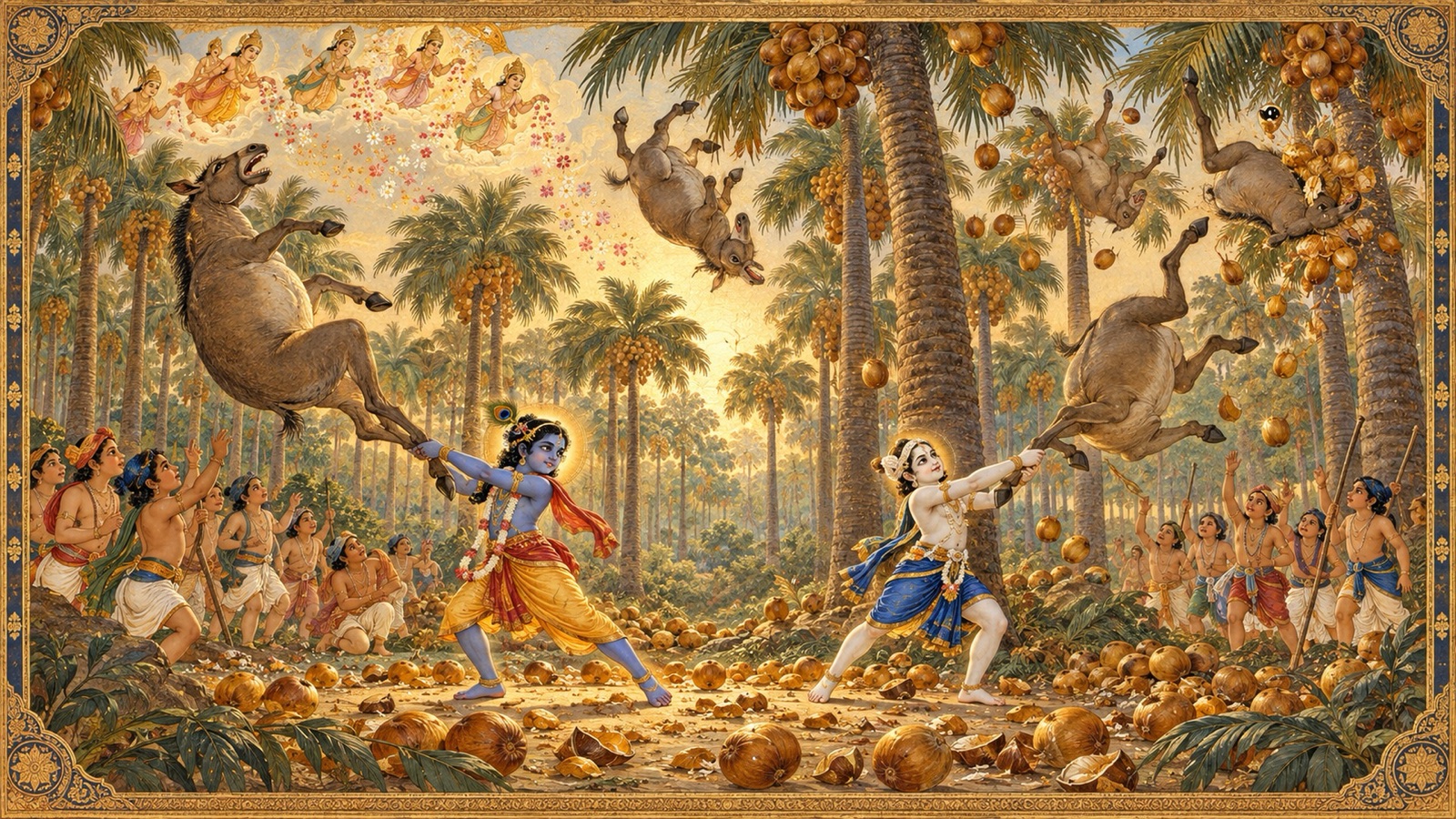
The other demons, Dhenuka’s kinsmen, charged in a fury to avenge him; but Krishna and Balarama caught each one by the hind legs and threw them, too, onto the palm trees, until the ground was strewn with fruit and demon-bodies and shone like the sky filled with clouds. The gods rained down flowers, sounded their instruments, and offered praise. Sukadeva reminds us that such a feat is no wonder in the infinite Lord, upon whom the whole universe is woven as a cloth upon its threads.
नैतच्चित्रं भगवति ह्यनन्ते जगदीश्वरे ।
ओतप्रोतमिदं यस्मिंस्तन्तुष्वङ्ग यथा पट: ॥ ३५ ॥
naitac citraṁ bhagavati hy anante jagad-īśvare ota-protam idaṁ yasmiṁs tantuṣv aṅga yathā paṭaḥ
Meaning: This is no wonder in the infinite Lord, the master of the universe, upon whom this whole world is woven, dear King, as a cloth is woven upon its threads. (Canto 10, Chapter 15, verse 35)
From that day, freed of the demon, people fearlessly ate the palm fruit and the cattle grazed the grass of the once-forbidden forest.
The Return to Vraja
Then the lotus-eyed Krishna, whose glories are holy to hear and to sing, returned to Vraja with Balarama, praised by the following gopas. Dust from the grazing herds still clung to His curls, a peacock plume rose from His hair, and forest blossoms were strewn about Him as He walked — one hand resting lightly on a friend’s shoulder, the other lifting His flute to His lips. The gopis, who had waited all day, came out together, longing to see Him.
तं गोरजश्छुरितकुन्तलबद्धबर्ह-
वन्यप्रसूनरुचिरेक्षणचारुहासम् ।
वेणुम्क्वणन्तमनुगैरुपगीतकीर्तिं
गोप्यो दिदृक्षितदृशोऽभ्यगमन् समेता: ॥ ४२ ॥
taṁ gorajaś-churita-kuntala-baddha-barha- vanya-prasūna-rucirekṣaṇa-cāru-hāsam veṇum kvaṇantam anugair upagīta-kīrtiṁ gopyo didṛkṣita-dṛśo ’bhyagaman sametāḥ
Meaning: His locks powdered with the dust of the cows, a peacock feather bound in His hair, adorned with wild flowers, His glances beautiful and His smile charming, playing His flute while His companions sang His glory — toward Him the gopis, their eyes eager to behold Him, came out all together. (Canto 10, Chapter 15, verse 42)
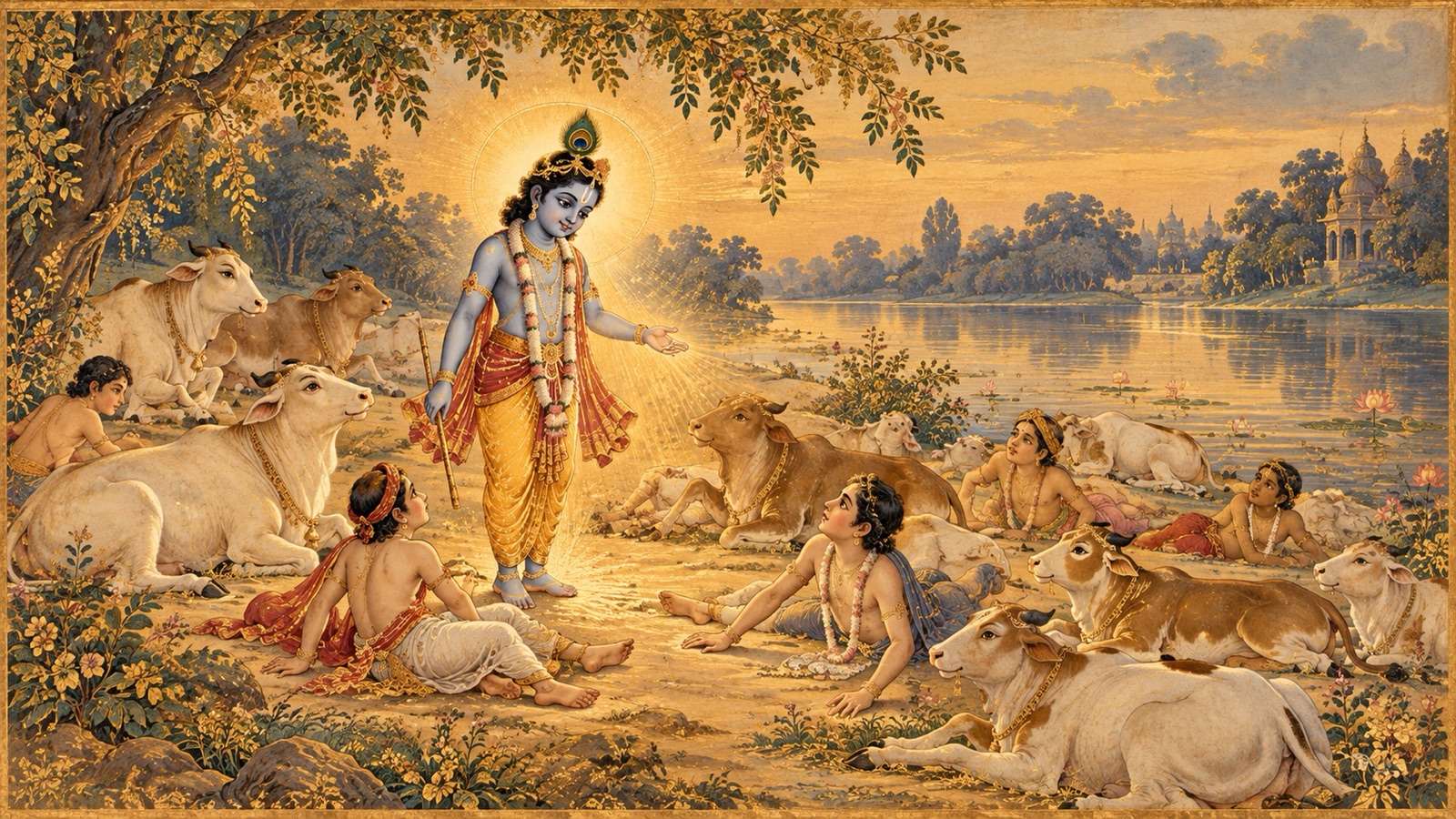
Drinking with the bees of their eyes the honey of Mukunda’s face, the women of Vraja cast off the pain of the day’s separation. Krishna, receiving their loving welcome, entered the cow-pen; and Yasoda and Rohini, tender toward their sons, bathed them, adorned them with fine garlands and fragrances, fed them their favourite food, and laid them to sleep in comfort.
The Poisoned Water of the Yamuna
On another day Krishna went to the Yamuna with the cowherd boys, but without Balarama. The cows and the boys, tormented by the summer heat and parched with thirst, drank the water of the river — water that had been poisoned by the venom of a great serpent. The moment they touched it, their consciousness overpowered, all of them fell down lifeless upon the bank. Seeing His dear ones in such a state, Krishna, the Lord of all masters of yoga, revived them with a glance that rained down nectar. Rising from beside the water with their memory restored, they looked at one another in amazement, understanding that it was only by the merciful glance of Govinda that they had risen again, as if from death, after drinking poison.
अन्वमंसत तद् राजन् गोविन्दानुग्रहेक्षितम् ।
पीत्वा विषं परेतस्य पुनरुत्थानमात्मन: ॥ ५२ ॥
anvamaṁsata tad rājan govindānugrahekṣitam pītvā viṣaṁ paretasya punar utthānam ātmanaḥ
Meaning: They understood, O King, that it was by the merciful glance of Govinda that they, having died from drinking the poison, had risen again to life. (Canto 10, Chapter 15, verse 52)
Principal Teachings of This Chapter
1. The Lord’s presence blesses the whole of creation. Krishna declares the very earth, trees, rivers, and creatures of Vrindavana blessed by the touch of holy feet (verse 8). Wherever the Lord is honoured, all creation is sanctified.
2. God hides His greatness to share our life. Krishna, served by the goddess of fortune, plays as a simple village boy (verse 19). He conceals His majesty so that we may come near Him in love rather than fear.
3. The Lord acts for the joy of His devotees. He goes to the dangerous Talavana only to please His friends who longed for its fruit (verses 20-27). His deeds flow from love for those who depend on Him.
4. All power rests effortlessly in Him. The slaying of Dhenuka is no wonder, for the whole universe is woven upon the Lord like cloth upon its threads (verse 35). What astonishes us is effortless to Him.
5. His merciful glance restores life. When the boys and cows fall from the poisoned water, a single glance from Krishna revives them (verse 52). The Lord’s grace can bring life even out of death.
A Devotional Reflection
There is a quiet beauty in the way Krishna sees Vrindavana. To Him the bowing trees are devotees offering their fruit, the bees are sages singing His praise, the very grass and dust are blessed. He looks upon the ordinary world and sees it shining with devotion — and perhaps that is the vision this chapter invites us to share. The same Lord who whirls a demon into a palm tree and revives the dead with a glance also walks quietly through the forest praising the flowers and calling the cows by name. His power is boundless, yet He wields it only to protect and to please those He loves, hiding His majesty so completely that His friends dare to ask Him for palm fruit and rest their heads in His lap. When our own lives feel poisoned, when strength fails and we fall by the water’s edge, this chapter assures us that a single glance of His mercy is enough to raise us up again. We need not earn that glance; we need only, like the boys of Vraja, belong to Him.
A Daily Devotional Practice
Today, try to see the world as Krishna sees Vrindavana — as a place shining with the possibility of devotion. Look upon some small part of nature, a tree, a bird, the earth beneath your feet, and offer silent gratitude that it belongs to the Lord and may be touched by His grace. When you feel weakened or poisoned by the cares of the day, remember the boys revived by a single glance, and rest in the trust that His mercy can raise you again. Begin by chanting gently: Om Namo Bhagavate Vasudevaya.
Conclusion
The fifteenth chapter of the Tenth Canto brings Krishna and Balarama into their years as cowherds, roaming a Vrindavana that Krishna sees as radiant with devotion. To please their friends, the two Brothers enter the forbidden Talavana, where Balarama slays the ass-demon Dhenuka and his herd, freeing the grove for all; and when the cows and boys fall lifeless from the poisoned water of the Yamuna, Krishna revives them with a merciful glance. Through heroic deeds and tender play alike, the Lord conceals His majesty and acts only for the love of His own, until the whole of Vraja is drawn ever more deeply to Him. May we learn to see the world with His eyes, to depend on Him as His friends did, and to trust that His grace can raise us up from whatever poison threatens our lives.
May the divine wisdom of Srimad Bhagavatam awaken pure devotion within our hearts.
Om Namo Bhagavate Vasudevaya.
Jay Shree Madhav.
References and Attribution
- Primary edition: Gita Press, Śrīmad Bhāgavata Mahāpurāṇa (Sanskrit-Hindi, Volume 2), Book Ten (First Half), Discourse 15.
- Series: Srimad Bhagavatam Wisdom · Biswa Sanatan Dharma Seva Trust.
- Presented following the spiritual guidance and recommendation of Pandit Dr. Shri Kashinath Mishra.
This is an original, faithful retelling in the writer’s own words, with brief quoted verses shown in Devanāgarī and transliteration and their meanings given as summaries. It is not a reproduction of any single publisher’s continuous translation or commentary. No affiliation with or endorsement by any publisher is implied.
Jay Shree Madhav