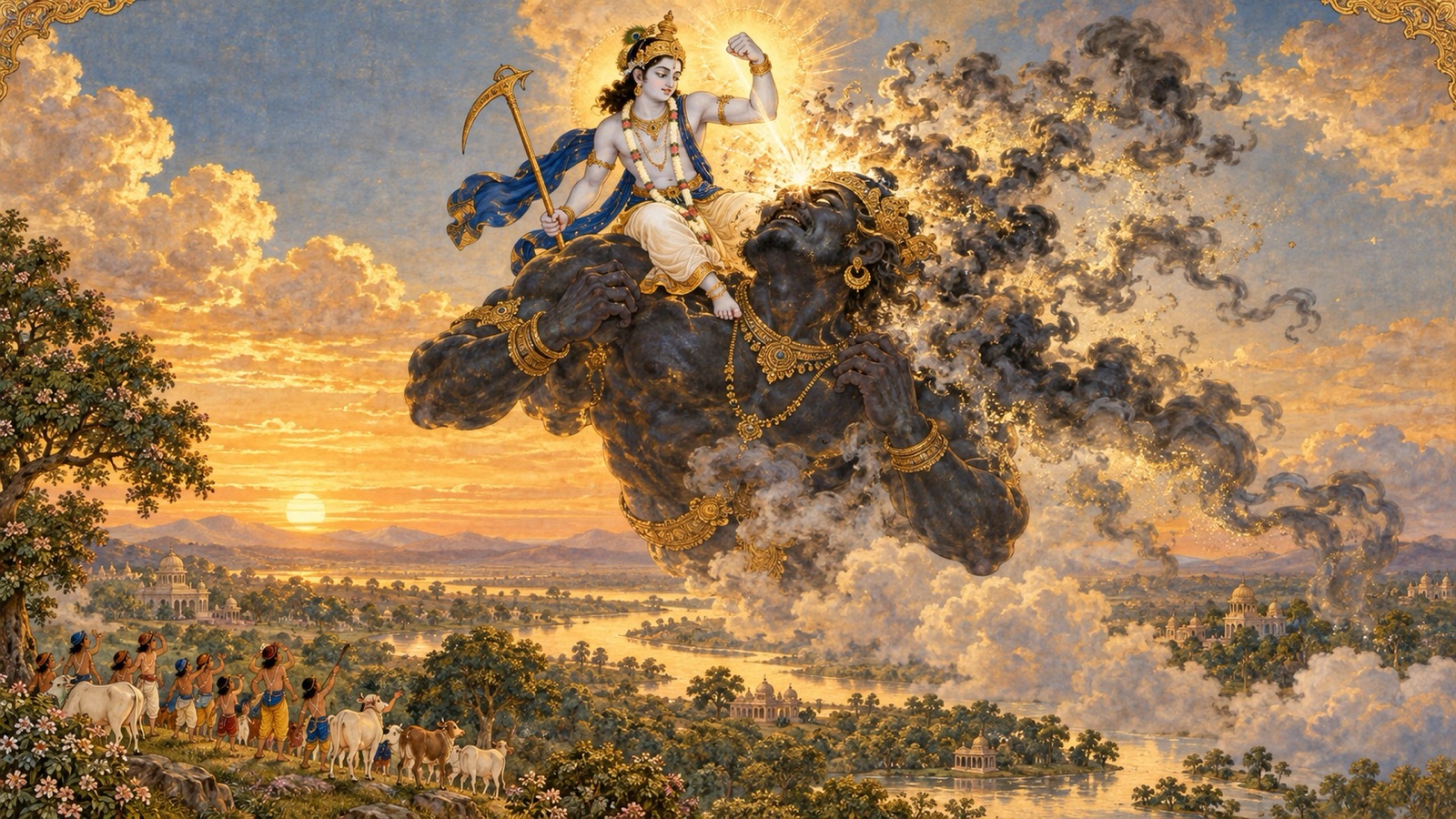
A towering cloud-dark form races through the summer sky carrying Balarama upon its shoulders — until the Lord’s radiant fist falls like a bolt of lightning, and the demon’s shape dissolves before the astonished eyes of the cowherd boys below.
Om Namo Bhagavate Vasudevaya.
Om Namo Bhagavate Vasudevaya.
Om Namo Bhagavate Vasudevaya.
Welcome back to Srimad Bhagavatam Wisdom, our devotional journey through the sacred histories and teachings of the Srimad Bhagavat Mahapurana. The eighteenth chapter of the Tenth Canto carries us from a rescued riverbank into the bright heat of a Vraja summer that feels, wherever the Lord walks, like an endless spring. Sukadeva Gosvami tells King Parikshit how Balarama and Krishna spent those days at play among the cowherd boys of Vrindavana — until a newcomer joined their circle wearing a borrowed face, the mighty demon Pralamba, who had come to carry the two divine Brothers away.
Chapter Information
- Scripture: Śrīmad Bhāgavata Mahāpurāṇa
- Canto: 10 (Book Ten, First Half)
- Chapter: 18 (Discourse 18)
- Chapter title: Lord Balarama Slays the Demon Pralamba
- Principal speaker: Sukadeva Gosvami (narrating to King Parikshit)
- Principal listener: King Parikshit
- Main setting: The forest of Vrindavana in Vraja, near the Bhandiraka banyan tree
- Central subject: The summer play of Krishna and Balarama with the cowherd boys; the demon Pralamba’s disguise and his plan to kidnap them; Balarama’s slaying of Pralamba
- Principal verse range: Canto 10, Chapter 18, verses 1–32
- Primary edition: Gita Press Śrīmad Bhāgavata Mahāpurāṇa (Sanskrit-Hindi, Volume 2)
Context From the Previous Chapter
In Chapter 17, Sukadeva explained why the serpent Kaliya had taken refuge in a lake of the Yamuna, and then told how, that same night, Krishna drank up a forest fire that had surrounded the sleeping people of Vraja as they rested on the riverbank. This chapter opens in the glow of that rescue, with Krishna returning to the village amid kinsmen who cannot stop singing His praises, and then moves forward into the long bright days of a Vrindavana summer and the pastime of the demon Pralamba.
The Return to Joyful Vraja
Surrounded by His kinsmen, whose hearts overflowed with gladness and whose voices rose again and again in song, Krishna came back into the village of Vraja, that home so lovingly decorated by its herds of cows. (verse 1)
A Summer That Felt Like Spring
Then, Sukadeva continued, while Krishna and Balarama still lived among the cowherds in the simple guise of ordinary boys, the season of summer arrived — a season that in most places brings little delight to those who dwell in bodies. Yet because the Supreme Lord Himself walked that land with His elder brother, this summer carried all the gentleness of spring, for such are the hidden qualities of Vrindavana: the roar of waterfalls drowned the harsh noise of crickets, cooling breezes off the lakes and rivers carried the fragrance of countless lotuses, and the land never knew the fierce heat or sudden wildfires that summer brings elsewhere, its grass remaining green and its rivers keeping their banks damp and cool. Flowers of every colour crowded the forest while peacocks and bees filled it with music and the cuckoo called sweetly from the trees. (verses 2-7)
Play in the Forest of Vrindavana
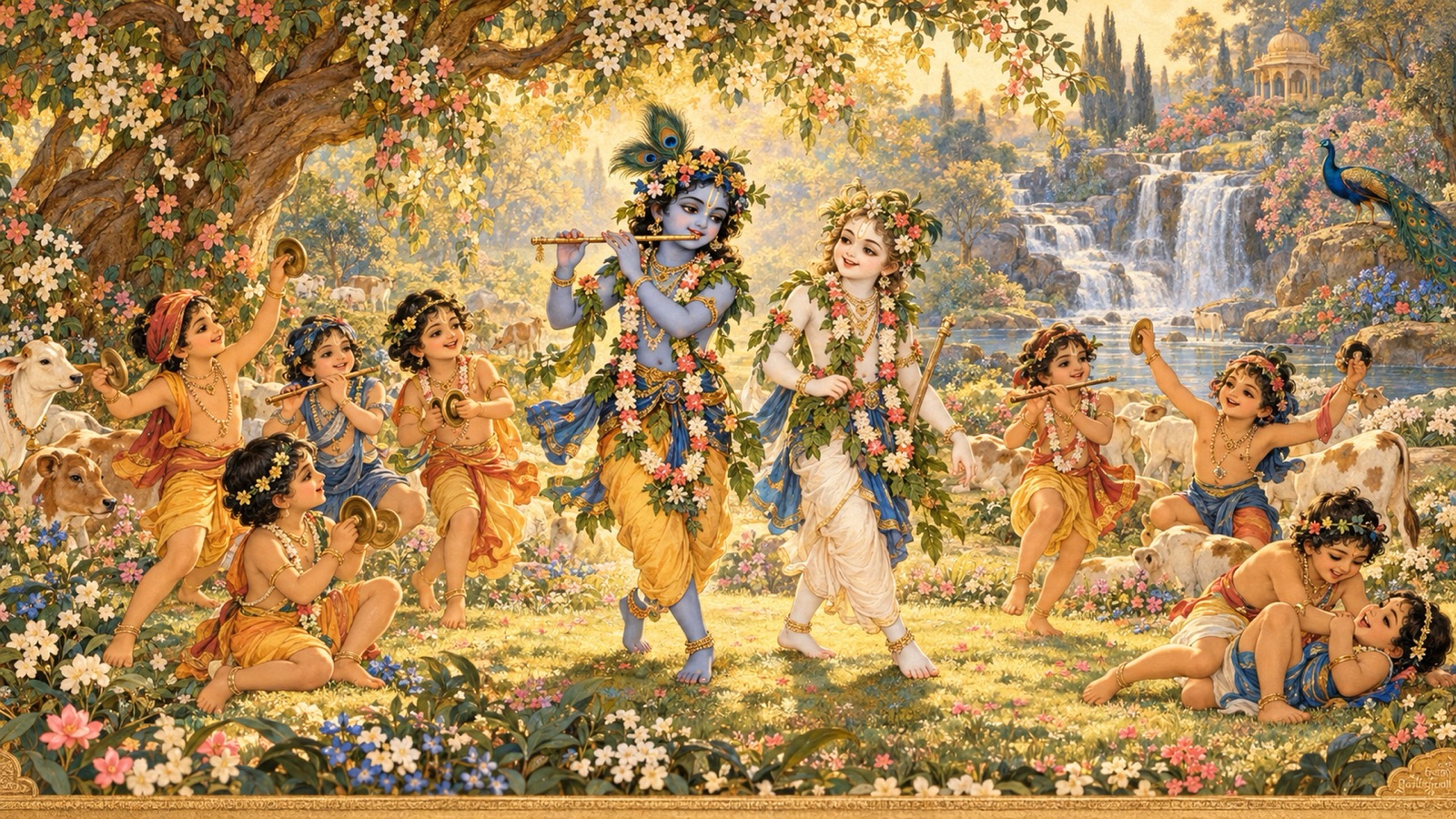
Meaning only to enjoy the day, Krishna entered the forest with Balarama, surrounded by the cowherd boys and their grazing cattle, His flute sounding sweetly before Him. Decking themselves with leaves, peacock feathers, and garlands of wildflowers, the two Brothers and their companions filled the glades with dancing, wrestling, and song — some boys singing as Krishna danced, others answering on flutes and cymbals, and unseen among the crowd the demigods, taking the humble shape of cowherds, came down to adore the two Brothers who played so simply as village boys. (verses 8-11) They played every game their boyhood could invent: whirling about, leaping, wrestling in friendly jest, and tugging at each other’s hair in laughter, while Krishna and Balarama joined every round, praising their friends’ dancing. At other moments they tossed fruits among themselves, bound one boy’s eyes so the rest could test his guessing, mimicked forest birds and beasts, leapt about like frogs, and played at kings and subjects — and wandering thus among the rivers, hills, and lakes of Vrindavana, the two Lords and their friends filled every hour with unhurried delight. (verses 12-16)
The Demon Who Wished to Be a Cowherd
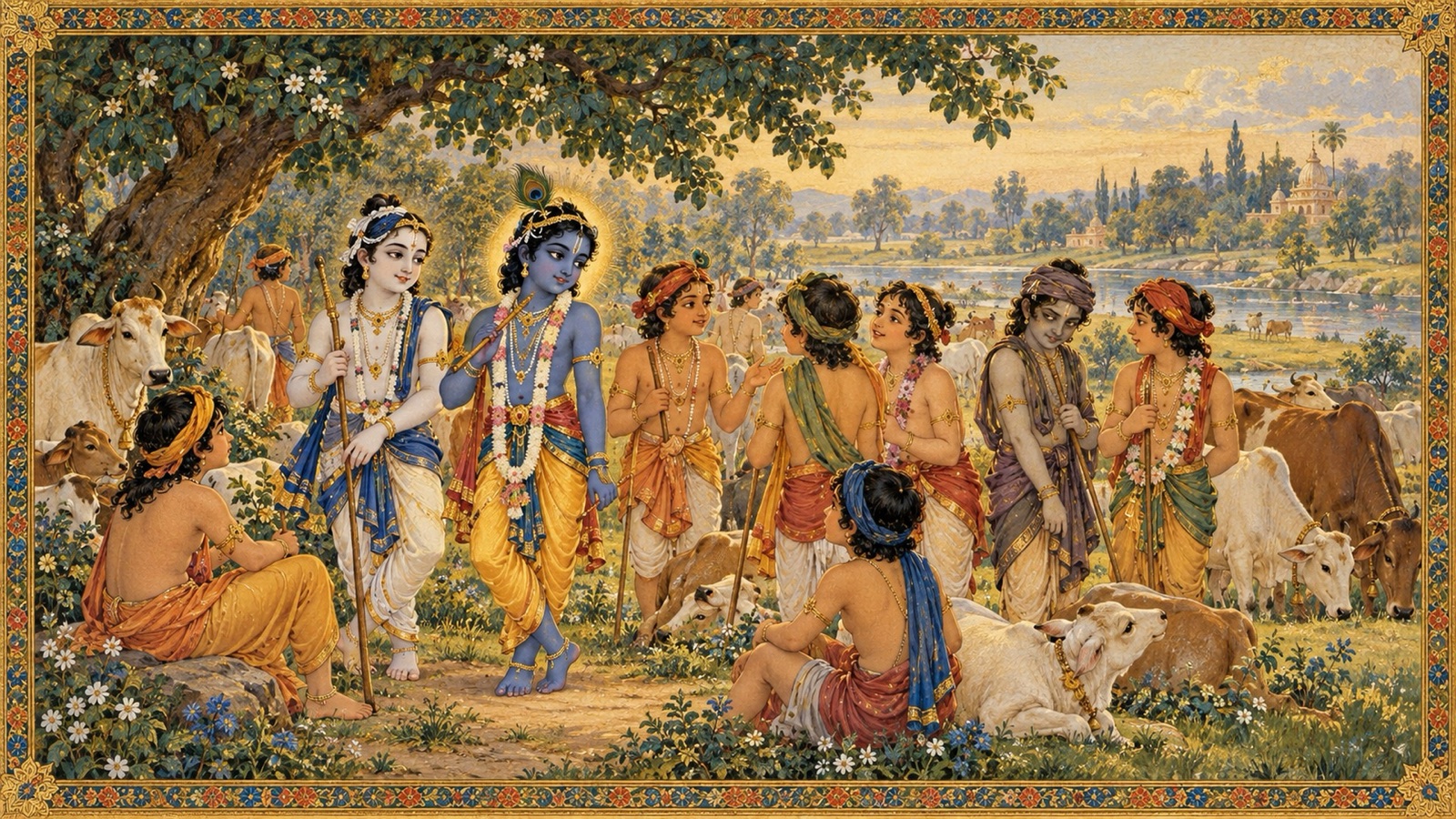
One day, while the two Brothers and the cowherds were out pasturing the cattle in that same forest, a demon named Pralamba came quietly among them in the guise of a cowherd boy, his heart set on nothing less than carrying off Balarama and Krishna.
पशूंश्चारयतोर्गोपैस्तद्वने रामकृष्णयो: ।
गोपरूपी प्रलम्बोऽगादसुरस्तज्जिहीर्षया ॥ १७ ॥
paśūṁś cārayator gopais tad-vane rāma-kṛṣṇayoḥ gopa-rūpī pralambo ‘gād asuras taj-jihīrṣayā
Meaning: While Balarama and Krishna were grazing cattle in that forest with the cowherds, the demon Pralamba came there disguised as a cowherd boy, wishing to carry the two Brothers away. (Canto 10, Chapter 18, verse 17)
Yet nothing about this newcomer escaped the Lord; Krishna, all-perceiving and born in the line of the Dasarhas, knew exactly who stood before Him, and still He welcomed Pralamba’s friendship with ease, holding quietly within His own mind the manner and the hour of the demon’s coming death.
तं विद्वानपि दाशार्हो भगवान् सर्वदर्शन: ।
अन्वमोदत तत्सख्यं वधं तस्य विचिन्तयन् ॥ १८ ॥
taṁ vidvān api dāśārho bhagavān sarva-darśanaḥ anvamodata tat-sakhyaṁ vadhaṁ tasya vicintayan
Meaning: Though He knew him for what he truly was, the all-perceiving Lord of the Dasarha line accepted the demon’s friendship, all the while turning over in His mind how he would be slain. (Canto 10, Chapter 18, verse 18)
The Game of Mount and Rider
Skilled in every manner of play, Krishna proposed a fresh game: let the boys divide into two bands, some gathering to Him, the rest to Balarama, and sport in a game where the losing side would carry the winners as mounts, until they reached a great banyan tree called Bhandiraka. There Sridama, Vrishabha, and the other boys of Balarama’s side won, and so Krishna’s companions had to carry them: Krishna bore Sridama, Bhadrasena carried Vrishabha, and the demon Pralamba, who judged Krishna far too dangerous a burden to attempt, took up Balarama instead. (verses 19-24) Carrying Him, Pralamba began to run with sudden, unnatural speed, meaning to bear Balarama far beyond the boundary fixed for setting a rider down.
अविषह्यं मन्यमान: कृष्णं दानवपुङ्गव: ।
वहन् द्रुततरं प्रागादवरोहणत: परम् ॥ २५ ॥
aviṣahyaṁ manyamānaḥ kṛṣṇaṁ dānava-puṅgavaḥ vahan drutataraṁ prāgād avarohaṇataḥ param
Meaning: Thinking Krishna unbearable to carry, that foremost of demons ran off very swiftly while bearing Balarama, carrying Him far beyond the place appointed for setting the rider down. (Canto 10, Chapter 18, verse 25)
Pralamba Reveals His Fearsome Form
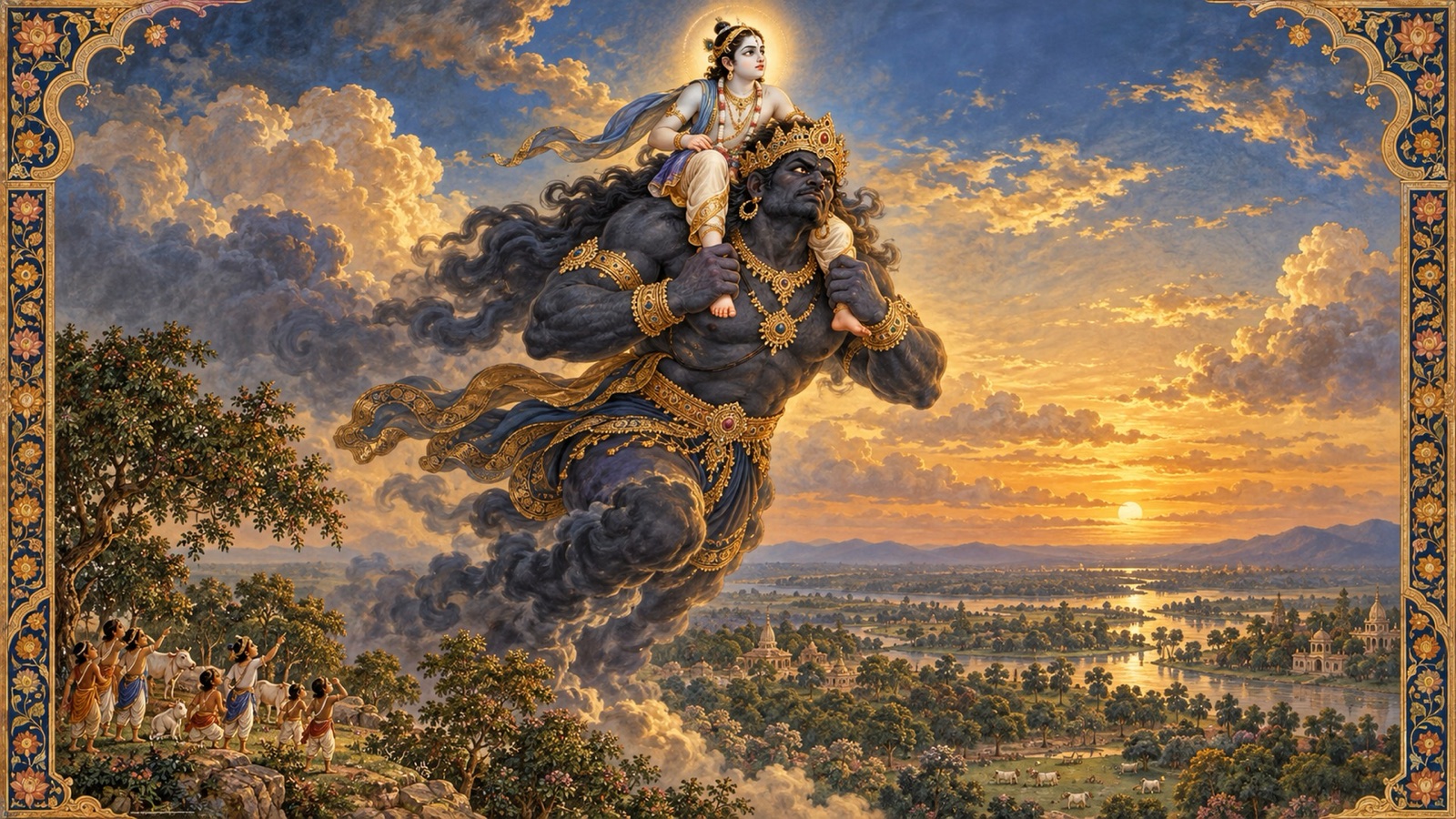
But Balarama simply made Himself as heavy as Mount Meru, king of mountains; and as the demon’s speed failed beneath that weight, he could keep his disguise no longer and stood revealed in his own true shape, gleaming with gold, like a dark cloud lit by lightning and bearing the moon upon its back.
तमुद्वहन् धरणिधरेन्द्रगौरवं महासुरो विगतरयो निजं वपु: ।
स आस्थित: पुरटपरिच्छदो बभौ तडिद्द्युमानुडुपतिवाडिवाम्बुद: ॥ २६ ॥
tam udvahan dharaṇi-dharendra-gauravaṁ mahāsuro vigata-rayo nijaṁ vapuḥ sa āsthitaḥ puraṭa-paricchado babhau taḍid-dyumān uḍupati-vāḍ ivāmbudaḥ
Meaning: Carrying that weight like the king of mountains, the great demon, his speed now spent, gave up his borrowed shape and stood in his own, gleaming with gold like a cloud flashing with lightning and carrying the moon upon its back. (Canto 10, Chapter 18, verse 26)
Seeing that vast form in the sky, with burning eyes, a fearsome brow, terrible tusks, and flame-like hair, Balarama, the wielder of the plough, felt for a single breath a touch of fear.
निरीक्ष्य तद्वपुरलमम्बरे चरत् प्रदीप्तदृग् भ्रुकुटितटोग्रदंष्ट्रकम् ।
ज्वलच्छिखं कटककिरीटकुण्डलत्विषाद्भुतं हलधर ईषदत्रसत् ॥ २७ ॥
nirīkṣya tad-vapur alam ambare carat pradīpta-dṛg bhru-kuṭi-taṭogra-daṁṣṭrakam jvalac-chikhaṁ kaṭaka-kirīṭa-kuṇḍala- tviṣādbhutaṁ haladhara īṣad atrasat
Meaning: Seeing that body moving so vastly through the sky, with burning eyes, a fearsome brow and fierce tusks, hair like flame, and a wondrous light from its bracelets, crown, and earrings, Balarama, who bears the plough, felt a brief touch of fear. (Canto 10, Chapter 18, verse 27)
Balarama’s Radiant Blow
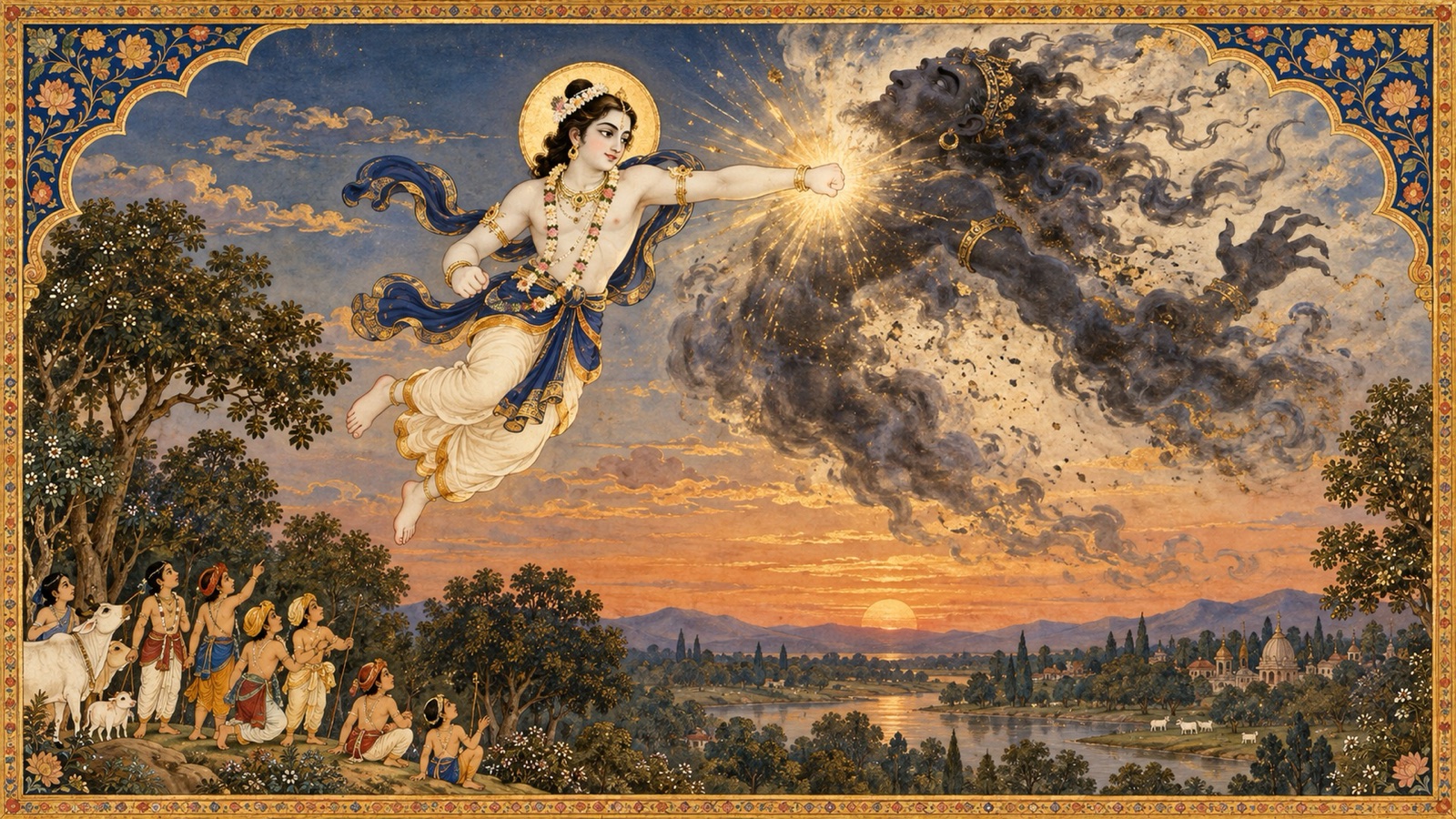
That fear lasted no longer than an instant; His own fearless remembrance returned at once, and Balarama struck the enemy who had dared bear Him away as if He were stolen treasure, bringing His firm fist down upon the demon’s head in righteous anger, exactly as Indra might shatter a mountain with his thunderbolt.
अथागतस्मृतिरभयो रिपुं बलो विहायसार्थमिव हरन्तमात्मन: ।
रुषाहनच्छिरसि दृढेन मुष्टिना सुराधिपो गिरिमिव वज्ररंहसा ॥ २८ ॥
athāgata-smṛtir abhayo ripuṁ balo vihāya sārtham iva harantam ātmanaḥ ruṣāhanac chirasi dṛḍhena muṣṭinā surādhipo girim iva vajra-raṁhasā
Meaning: His memory now returned, the fearless Balarama struck the enemy who was carrying Him off through the sky as a prize, bringing His firm fist down upon his head in anger, with the force of the thunderbolt by which the lord of the gods strikes a mountain. (Canto 10, Chapter 18, verse 28)
At that single touch of the Lord’s hand the demon’s dark splendour could not endure; his towering shape lost all its strength and fell from the sky, undone, exactly as a mountain crumbles beneath Indra’s thunderbolt — and so the game that had begun as a boy’s sport of mounts and riders closed with the demon’s own ambition carrying him, quite literally, to his end.
स आहत: सपदि विशीर्णमस्तको मुखाद् वमन् रुधिरमपस्मृतोऽसुर: ।
महारवं व्यसुरपतत् समीरयन् गिरिर्यथा मघवत आयुधाहत: ॥ २९ ॥
sa āhataḥ sapadi viśīrṇa-mastako mukhād vaman rudhiram apasmṛto ‘suraḥ mahā-ravaṁ vyasur apatat samīrayan girir yathā maghavata āyudhāhataḥ
Meaning: Struck in that instant, that demon lost his life and fell from the sky with a great cry resounding through the air, exactly as a mountain falls when struck by Indra’s own weapon. (Canto 10, Chapter 18, verse 29)
The Joy of the Cowherds and the Praise of the Gods
Seeing Pralamba brought down by mighty Balarama’s strength, the cowherd boys were overcome with wonder and cried out again and again, “Well done! Well done!”; they embraced Him as one who had returned from death, their hearts overwhelmed with love. And high above, the demigods, supremely gladdened that the sinful Pralamba had met his end, rained garlands of flowers down upon Balarama in the very same glad cry.
पापे प्रलम्बे निहते देवा: परमनिर्वृता: ।
अभ्यवर्षन् बलं माल्यै: शशंसु: साधु साध्विति ॥ ३२ ॥
pāpe pralambe nihate devāḥ parama-nirvṛtāḥ abhyavarṣan balaṁ mālyaiḥ śaśaṁsuḥ sādhu sādhv iti
Meaning: With the sinful Pralamba now slain, the demigods, filled with supreme delight, showered garlands of flowers upon Balarama and praised Him, crying, “Well done! Well done!” (Canto 10, Chapter 18, verse 32)
Principal Teachings of This Chapter
1. The Lord’s knowledge never sleeps, even within His play. Krishna recognised Pralamba as a demon the instant he arrived disguised as a cowherd (verse 17), yet welcomed his company, quietly holding the moment of justice within His own will (verse 18). Nothing escapes Him, and nothing need be feared while He is watching.
2. The simplest joy can carry the deepest purpose. The long hours of dancing, fruit-games, and frog-leaps (verses 9-16) show that the Lord’s pastimes are never idle; even a carefree summer afternoon in Vrindavana was already unfolding toward the protection of His own.
3. A wicked plan prepares its own undoing. Pralamba came to kidnap the two Brothers (verse 17), and his own fear of carrying Krishna, which led him to run beyond the game’s boundary carrying Balarama instead (verse 25), led him straight to his death. The schemer’s cunning so often becomes the very road of his ruin.
4. A flicker of fear dissolves the instant the Lord remembers Himself. Balarama’s brief hesitation before the demon’s terrifying form (verse 27) vanished the moment His fearless nature returned (verse 28) — a reminder that even the smallest turn toward the Lord’s true strength ends all dread at once.
5. The fall of evil is a joy shared by the whole creation. Both the cowherds on earth and the demigods in heaven rejoiced when Pralamba was slain (verses 30-32); the removal of wickedness is never a private triumph but a gladness reaching every corner of dharma’s world.
A Devotional Reflection
This chapter sets its wonder inside the gentlest of scenes: a boy’s game of mounts and riders on a warm afternoon. A demon slips in wearing a borrowed smile, and the two Brothers he has come to destroy go on laughing and tending their cattle as though nothing at all were amiss — because, in truth, nothing was. We who read this today so often feel that danger must announce itself with dread long before it arrives, that we must worry our way to safety. But here Krishna simply plays, fully aware of the demon beside Him, and Balarama, even in that one breath of fear, is never more than an instant from His own fearless strength. Perhaps this is the quiet comfort this story leaves with us: the Lord does not need our anxiety to protect us, only our willingness to stay near Him. The cowherds never even knew they had been in danger until the sky itself darkened with a monster’s shoulders — and by then it was already finished, the blow already falling. May we learn, from this unhurried victory, to rest as easily as those boys did, letting His remembrance carry us through whatever disguise our fears happen to wear.
A Daily Devotional Practice
Today, when something or someone unsettles you, pause and notice whether you are carrying that worry alone, or quietly placing it instead in the Lord’s hands, the way the cowherd boys kept playing without fear while Krishna alone watched over every one of them. Recall how swiftly Balarama’s own strength returned to Him the instant He remembered who He truly was, and let a brief, steady thought of Him stand in place of a long spiral of anxious thinking. Begin, and end, by chanting gently: Om Namo Bhagavate Vasudevaya.
Conclusion
The eighteenth chapter of the Tenth Canto carries Krishna and Balarama from a rescued Vraja into the flower-scented days of a summer that felt like spring, filling their hours with every game the cowherd boys could invent. Into that gentle world comes the demon Pralamba, disguised and determined to carry the two Brothers away; but Krishna’s unfailing knowledge had already seen through him, and it is Balarama who, carried high into the sky upon the demon’s own fearsome shoulders, brings him down with a single blow of His fist. The cowherds embrace Balarama as though He had returned from death itself, and the gods above shower Him with flowers in glad praise. From a summer’s game to a demon’s fall, this chapter shows that the Lord’s vigilance never rests even while He plays, and that no disguise can outlast His remembrance of who He is. May we, too, learn to rest within that same unhurried, ever-watchful protection.
May the divine wisdom of Srimad Bhagavatam awaken pure devotion within our hearts.
Om Namo Bhagavate Vasudevaya.
Jay Shree Madhav.
References and Attribution
- Primary edition: Gita Press, Śrīmad Bhāgavata Mahāpurāṇa (Sanskrit-Hindi, Volume 2), Book Ten (First Half), Discourse 18.
- Series: Srimad Bhagavatam Wisdom · Biswa Sanatan Dharma Seva Trust.
- Presented following the spiritual guidance and recommendation of Pandit Dr. Shri Kashinath Mishra.
This is an original, faithful retelling in the writer’s own words, with brief quoted verses shown in Devanāgarī and transliteration and their meanings given as summaries. It is not a reproduction of any single publisher’s continuous translation or commentary. No affiliation with or endorsement by any publisher is implied.
Jay Shree Madhav