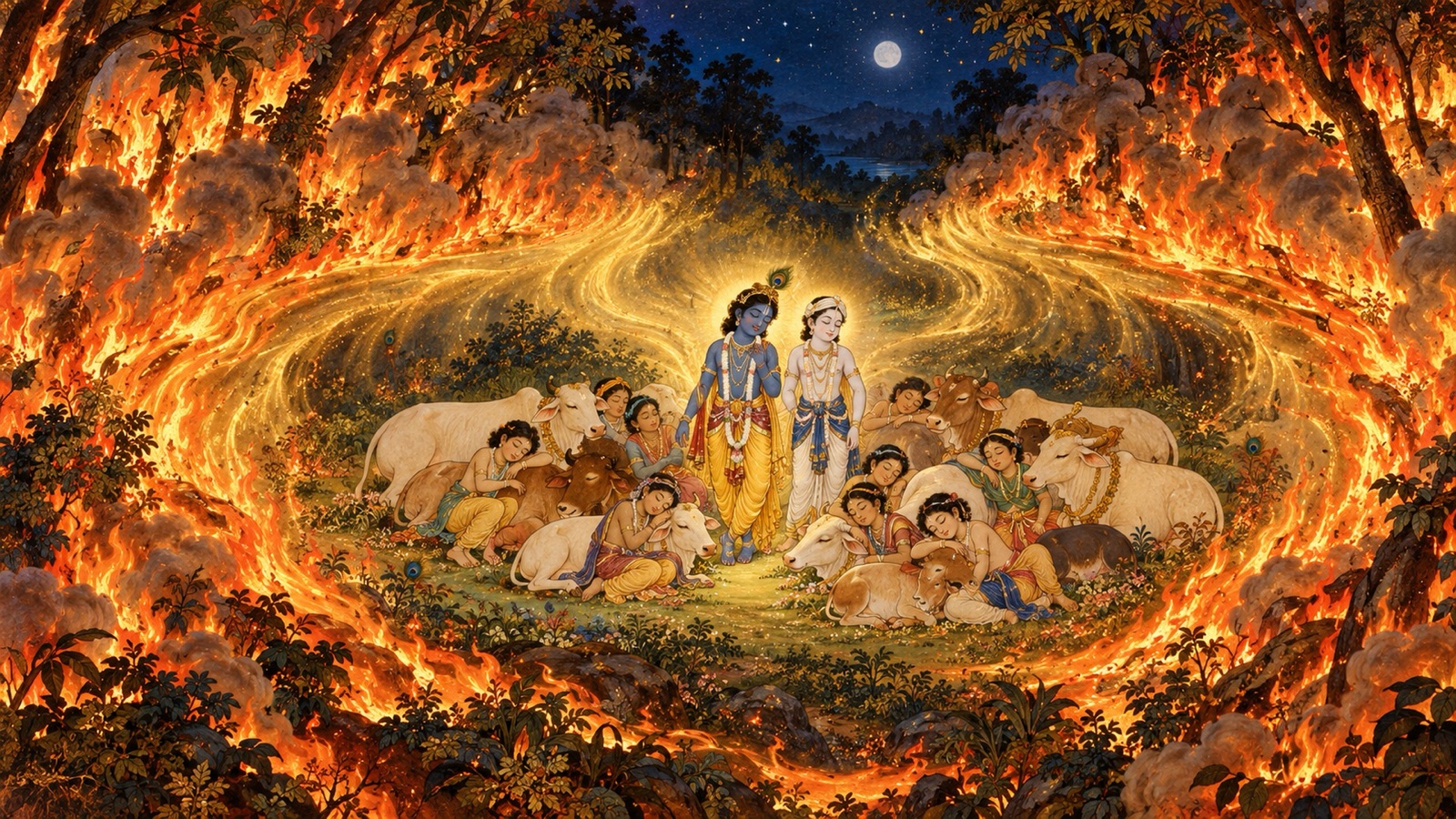
A ring of wild flame closes in on the lost cowherd boys and their cattle, and the Lord of Vraja, asking only that they shut their eyes in trust, draws the whole blaze into Himself.
Om Namo Bhagavate Vasudevaya.
Om Namo Bhagavate Vasudevaya.
Om Namo Bhagavate Vasudevaya.
Welcome back to Srimad Bhagavatam Wisdom, our devotional journey through the sacred histories and teachings of the Srimad Bhagavat Mahapurana. The nineteenth chapter of the Tenth Canto is short, but it carries one of the sweetest proofs of how completely the cowherd boys of Vraja had learned to trust their Krishna. Absorbed in their games, the boys let their cattle wander far into an unfamiliar forest; and while everyone is still searching for the lost herd, a roaring wildfire rises out of nowhere and surrounds them all. There is no plan, no weapon, no escape route — only a Lord who tells His frightened friends to close their eyes, and who then simply drinks the fire whole. Sukadeva Gosvami offers this pastime to King Parikshit as a quiet, radiant sequel to the thunder of the previous chapter.
Chapter Information
- Scripture: Śrīmad Bhāgavata Mahāpurāṇa
- Canto: 10 (Book Ten, First Half)
- Chapter: 19 (Discourse 19)
- Chapter title: Swallowing the Forest Fire
- Principal speaker: Sukadeva Gosvami (narrating to King Parikshit)
- Principal listener: King Parikshit
- Main setting: The forests of Vraja near the Yamuna, and the great banyan tree at Bhandiravana
- Central subject: The cattle straying into a dense forest, the sudden wildfire that surrounds the cowherds, and Krishna’s swallowing of the flames to deliver His own people
- Principal verse range: Canto 10, Chapter 19, verses 1–16
- Primary edition: Gita Press Śrīmad Bhāgavata Mahāpurāṇa (English, Complete Edition)
Context From the Previous Chapter
In Chapter 18, a demon named Pralamba joined the cowherd boys in disguise, hoping to carry off Krishna and Balarama during their games. Dividing into two teams for a game of mounts and riders, the losing side had to carry the winners; Pralamba, worsted, took Balarama upon his back and sped off beyond the playing bounds, intending to steal Him away. He soon revealed his true, towering demon form, but Balarama, regaining His composure, struck his head with a single mighty blow and slew him on the spot, to the astonished joy of the cowherds and the blessings of the gods.
The Cattle Stray into an Unfamiliar Forest
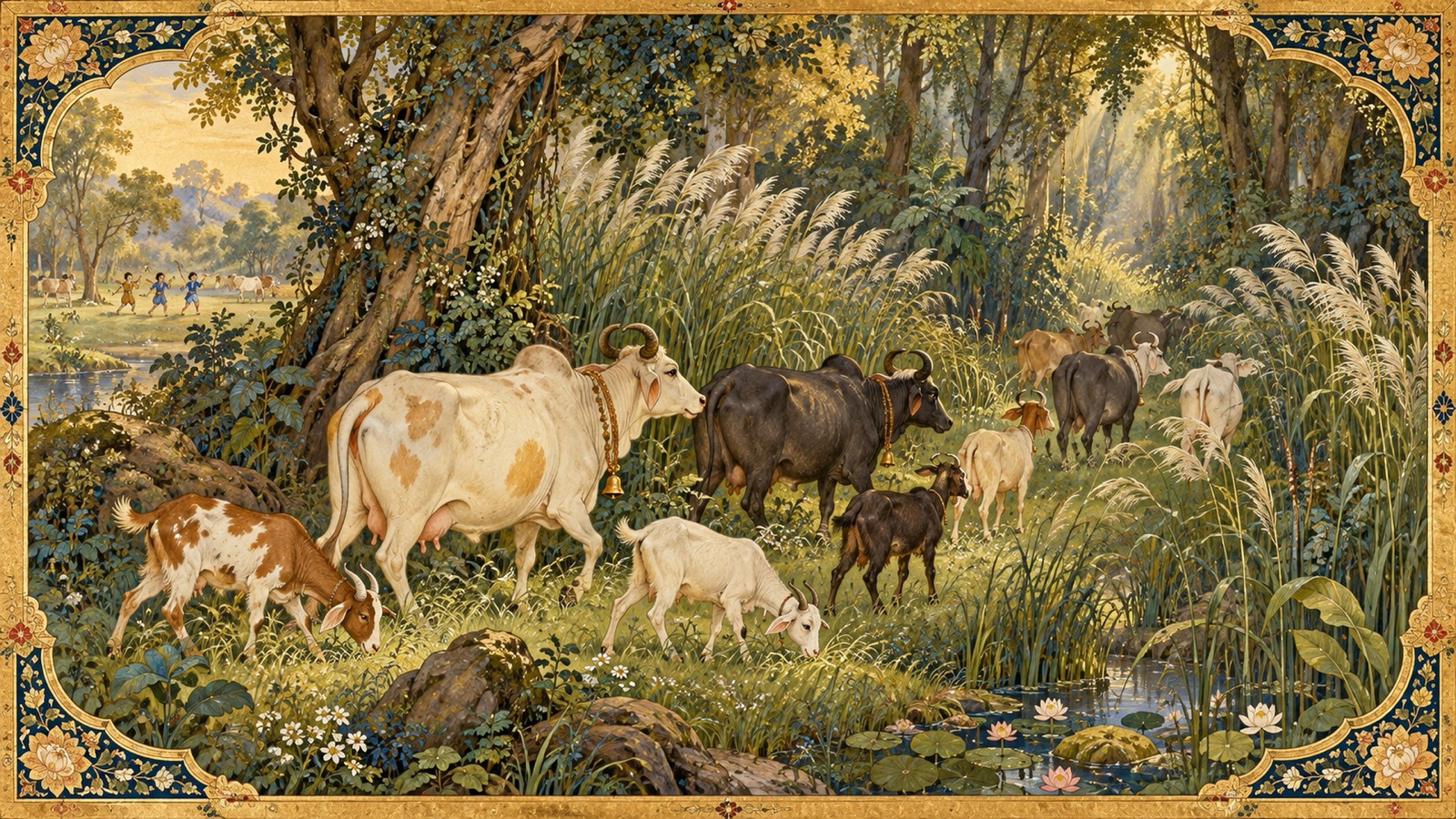
Sri Sukadeva resumed his narration. While the cowherd boys were still lost in the delight of their play, their cows, grazing freely and unwatched, drifted farther and farther away. Tempted at every step by the sweetness of fresh green grass, they moved on without a backward glance until they had wandered deep into a dense, unfamiliar woodland.
श्रीशुक उवाच
क्रीडासक्तेषु गोपेषु तद्गावो दूरचारिणी: ।
स्वैरं चरन्त्यो विविशुस्तृणलोभेन गह्वरम् ॥ १ ॥
śrī-śuka uvāca krīḍāsakteṣu gopeṣu tad-gāvo dūra-cāriṇīḥ svairaṁ carantyo viviśus tṛṇa-lobhena gahvaram
Meaning: Sri Sukadeva said: While the cowherd boys remained absorbed in their play, their cows strayed far, grazing freely, and, lured on by the green grass, wandered into a dense and unfamiliar forest. (Canto 10, Chapter 19, verse 1)
The she-goats, cows, and she-buffaloes pressed on from one patch of woodland to the next, until the rising heat of the day made them unbearably thirsty. Crying out piteously, they pushed their way into a thicket overgrown with ishika reeds, hoping to find water, and found themselves trapped and bewildered among the dense growth instead.
Following the Lost Tracks
When Krishna, Balarama, and the other cowherd boys looked up from their games, not a single animal was to be seen. A wave of remorse swept over them, for in that pastoral life their cattle were their very livelihood, and search as they might, no trace of the missing herd could be found.
Undeterred, they set themselves to the task with care. Noticing the blades of grass that had been nipped and bitten by grazing mouths, and the hoofprints pressed freshly into the soft earth, the whole party of boys followed this faint trail, their hearts anxious and their minds troubled by the loss.
The patient tracking led them at last into the Munja forest, where they found their entire herd — thirsty, exhausted, and still crying out in distress, its path blocked by the dense tangle of grass and reed. Weary and parched themselves, the cowherds gently worked the animals free of the thicket and began to lead them home.
Then Krishna called out to His cows in a voice as deep and resonant as monsoon thunder, and at the very sound of their own names, the frightened animals answered back at once, overjoyed.
ता आहूता भगवता मेघगम्भीरया गिरा ।
स्वनाम्नां निनदं श्रुत्वा प्रतिनेदु: प्रहर्षिता: ॥ ६ ॥
tā āhūtā bhagavatā megha-gambhīrayā girā sva-nāmnāṁ ninadaṁ śrutvā pratineduḥ praharṣitāḥ
Meaning: Called by the Lord in a voice deep as the rumbling of monsoon clouds, the cows, overjoyed to hear the sound of their own names, called back to Him at once. (Canto 10, Chapter 19, verse 6)
A Wildfire Rises on Every Side
No sooner had the cattle been gathered than a fresh calamity broke upon them. By the turning of providence, a huge wildfire sprang up on every side of that summer forest, fed and driven by a fierce wind, its hungry tongues of flame licking at everything living and unmoving in their path.
ततः समन्ताद्देवधूमकेतु-
र्यदृच्छयाभूत् क्षयकृद् वनौकसाम् ।
समीरितः सारथिनोल्बणोल्मुकै-
र्विलेलिहानः स्थिरजङ्गमान् महान् ॥ ७ ॥
tataḥ samantād dava-dhūmaketur yadṛcchayābhūt kṣaya-kṛd vanaukasām samīritaḥ sārathinolbaṇolmukair vilelihānaḥ sthira-jaṅgamān mahān
Meaning: Then, of its own accord, a mighty forest fire rose up on every side, like death’s own banner of smoke, fanned by fierce gusts of wind, and began to devour with its darting flames every living and unmoving thing in that woodland. (Canto 10, Chapter 19, verse 7)
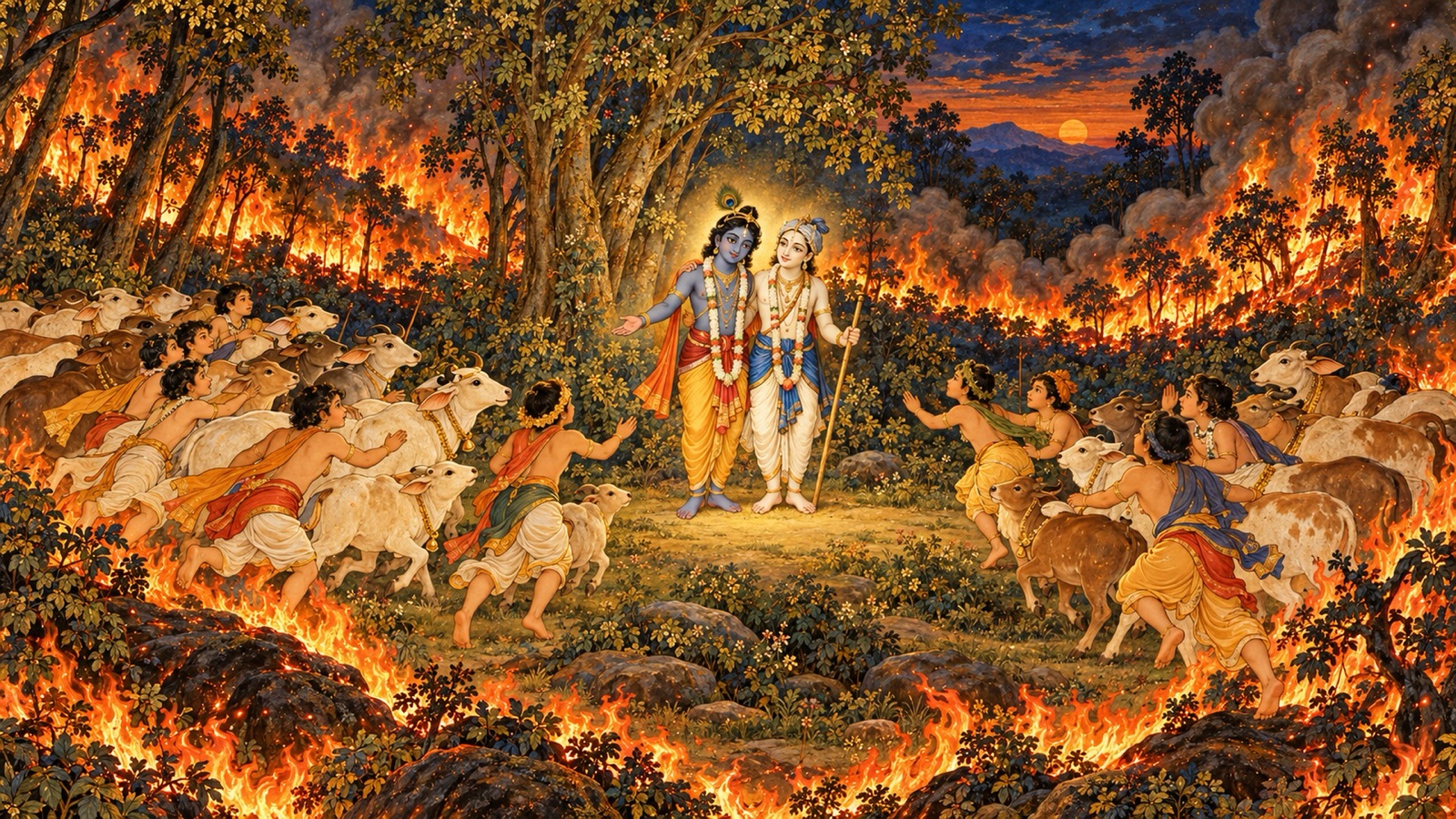
Hemmed in on every side by the advancing blaze, the cowherds and their cattle were seized with terror. There was nowhere left to run. As people overcome by the fear of death turn at once to the Lord for refuge, so the frightened boys and animals rushed toward Krishna and Balarama, their only hope, and cried out in anguish.
“Our Only Refuge Is You”
Surrounded by flame and smoke, the cowherds poured out their fear in a single desperate plea, calling on the two Brothers by name and begging to be spared from the fire closing in around them.
कृष्ण कृष्ण महावीर हे रामामोघविक्रम ।
दावाग्निना दह्यमानान् प्रपन्नांस्त्रातुमर्हथ: ॥ ९ ॥
kṛṣṇa kṛṣṇa mahā-vīra he rāmāmogha-vikrama dāvāgninā dahyamānān prapannāṁs trātum arhathaḥ
Meaning: “O Krishna, Krishna, mighty hero! O Rama of unfailing prowess! We are being burned alive by this forest fire and have taken shelter of You — be pleased to save us.” (Canto 10, Chapter 19, verse 9)
They pressed their plea further still, reminding the Lord, almost as kinsmen reminding a kinsman, that those who belong to Him should never have to suffer so, for He alone, the knower of all righteousness, was their shelter and their only resting place.
“Close Your Eyes and Do Not Fear”
Hearing the helpless cry of His own dear friends, Hari, the Supreme Lord, answered them not with any show of power, but with a few plain, gentle words.
श्रीशुक उवाच
वचो निशम्य कृपणं बन्धूनां भगवान् हरि: ।
निमीलयत मा भैष्ट लोचनानीत्यभाषत ॥ ११ ॥
śrī-śuka uvāca vaco niśamya kṛpaṇaṁ bandhūnāṁ bhagavān hariḥ nimīlayata mā bhaiṣṭa locanānīty abhāṣata
Meaning: Sri Sukadeva said: Hearing the piteous cry of His kinsmen, the Lord Sri Hari spoke gently: “Close your eyes, and do not be afraid.” (Canto 10, Chapter 19, verse 11)
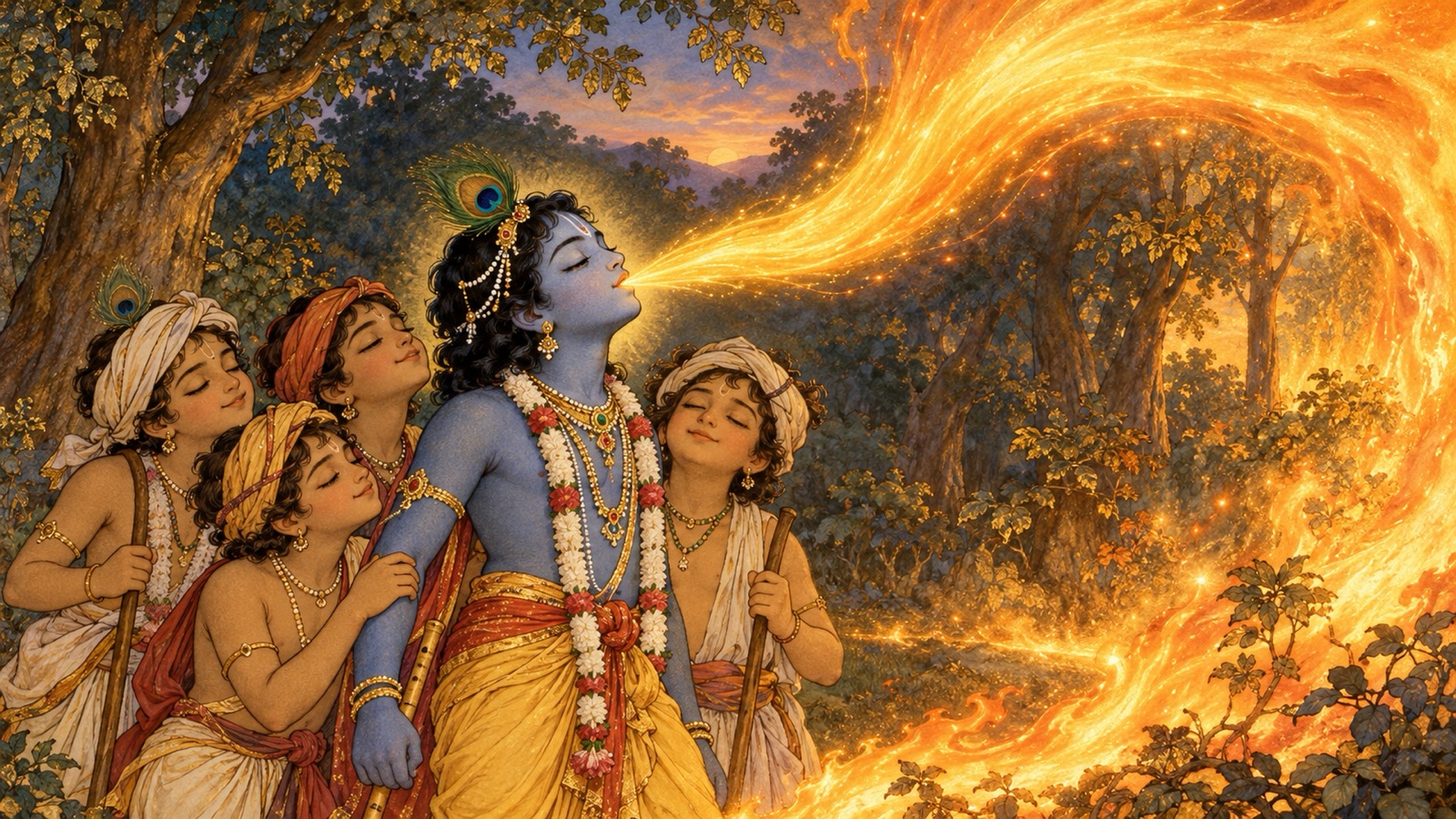
Without question or hesitation, the boys and the cattle did exactly as He said, shutting their eyes and saying only, “So be it.” And in that instant of trusting darkness, the Master of all mystic power drew the whole terrible blaze into His own mouth and swallowed it, setting every one of them free from the peril.
तथेति मीलिताक्षेषु भगवानग्निमुल्बणम् ।
पीत्वा मुखेन तान्कृच्छ्राद् योगाधीशो व्यमोचयत् ॥ १२ ॥
tatheti mīlitākṣeṣu bhagavān agnim ulbaṇam pītvā mukhena tān kṛcchrād yogādhīśo vyamocayat
Meaning: Saying, “So be it,” they closed their eyes; and the Lord, the very Master of mystic power, drew that fierce fire into His mouth and swallowed it, delivering them at once from that peril. (Canto 10, Chapter 19, verse 12)
Awakening Safe at Bhandiravana
When the cowherds opened their eyes again, the roaring fire was gone without a trace. They found themselves, along with every head of their cattle, standing unharmed beneath the great banyan tree of Bhandiravana, a good distance from where they had shut their eyes only moments before. Wonder and disbelief filled them as they looked at one another, alive and untouched.
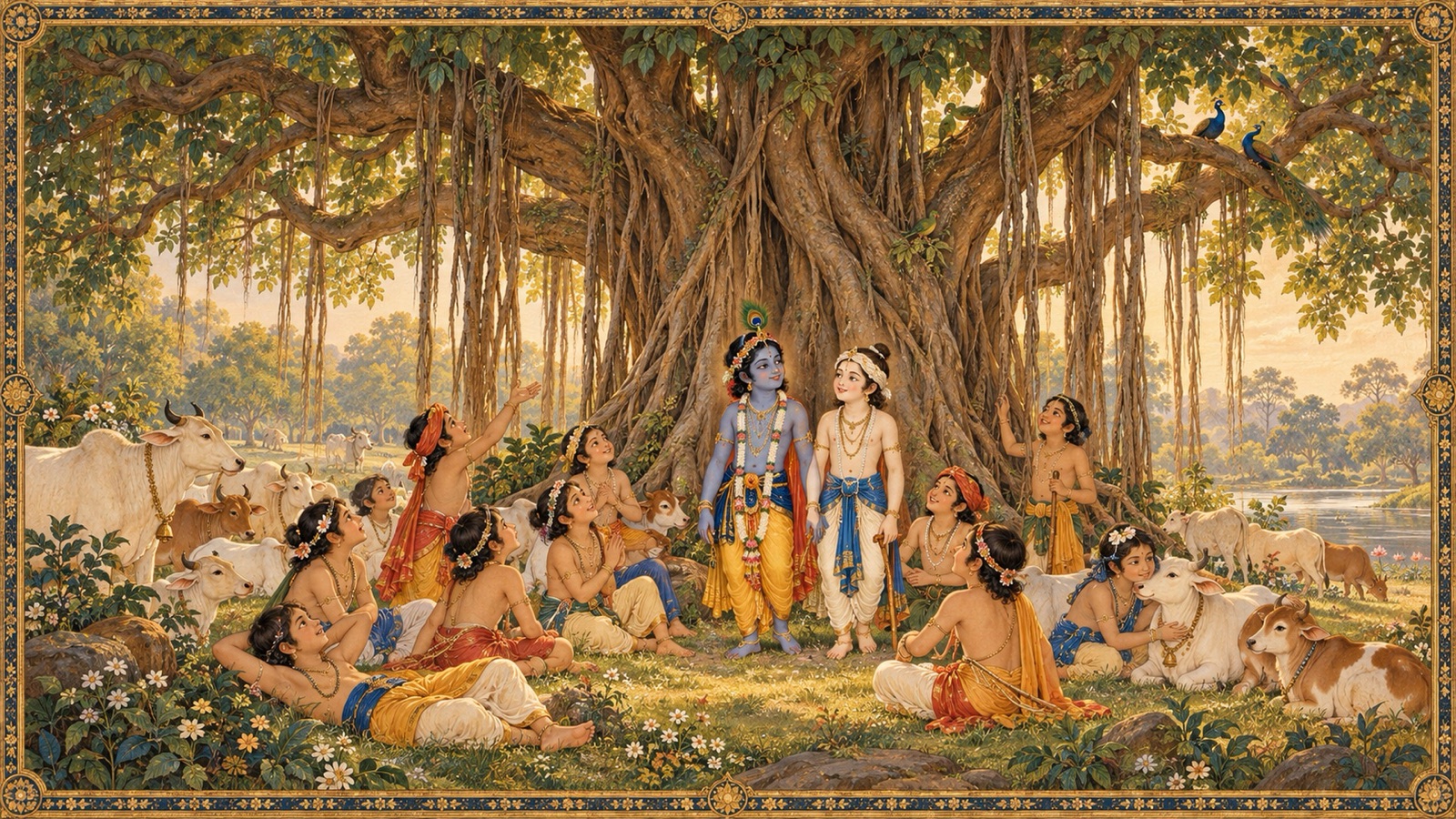
Turning this wonder over in their minds, the cowherds understood that it was Krishna’s own yogic power, veiled by His Yogamaya, that had carried them beyond the fire to safety. So complete was this rescue that they could only conclude their beloved friend was no ordinary child, but an immortal being walking among them.
कृष्णस्य योगवीर्यं तद् योगमायानुभावितम् ।
दावाग्नेरात्मन: क्षेमं वीक्ष्य ते मेनिरेऽमरम् ॥ १४ ॥
kṛṣṇasya yoga-vīryaṁ tad yoga-māyānubhāvitam dāvāgner ātmanaḥ kṣemaṁ vīkṣya te menire ’maram
Meaning: Beholding that yogic power of Krishna, manifest through His own Yogamaya, which had carried them safely through the forest fire, the cowherds came to regard Him as an immortal being. (Canto 10, Chapter 19, verse 14)
The Flute Calls Vraja Home
As evening fell, Krishna gathered the cattle and, together with Balarama, turned homeward toward Vraja, playing softly on His flute while the cowherd boys walked beside Him, singing His praises on every side. For the gopis of Vraja, who had waited anxiously through that long and uncertain day, the sight of Govinda returning was pure, unbounded joy.
गोपीनां परमानन्द आसीद् गोविन्ददर्शने ।
क्षणं युगशतमिव यासां येन विनाभवत् ॥ १६ ॥
gopīnāṁ paramānanda āsīd govinda-darśane kṣaṇaṁ yuga-śatam iva yāsāṁ yena vinābhavat
Meaning: Supreme was the joy of the gopis at the sight of Govinda, for to them, every moment spent apart from Him had felt like a hundred ages. (Canto 10, Chapter 19, verse 16)
Principal Teachings of This Chapter
1. Unwatched desire wanders far. The cattle, drawn step by step by nothing more than the taste of fresh grass, drifted from safety into a forest they could not find their way out of (verses 1–2). A small, unexamined craving, indulged without a second thought, can carry us surprisingly far from where we meant to stay.
2. The Lord knows and calls His own by name. When Krishna calls out in a voice like thunder, the lost cows know His sound at once and answer with joy (verse 6). However far we have strayed, the Lord’s call to the soul that belongs to Him is never without recognition or response.
3. There is no shelter but Him. Ringed by fire with no way out, the cowherds do not devise a plan of escape; they simply run to Krishna and declare that He alone is their refuge (verses 9–10). Real surrender begins exactly where every other resource has failed.
4. Faith acts before the eyes can see the result. Krishna asks only that His friends close their eyes and trust; they obey instantly, without proof, without argument (verses 11–12). The devotee’s faith does not wait for the danger to visibly end before it takes the Lord at His word.
5. Divine power is hidden even while it is working. Krishna rescues everyone through His own Yogamaya, so quietly that His friends only sense an immortal presence rather than see an open display of divinity (verse 14). The Lord’s grace often moves beneath the surface of ordinary events, asking to be recognised rather than witnessed as spectacle.
6. Separation from Him is its own fire. The gopis’ joy at Govinda’s return, after a single day felt like a hundred ages (verse 16), reminds us that longing for the Lord’s presence is itself a kind of burning that only His nearness can cool.
A Devotional Reflection
What stays with the heart from this short chapter is the sheer simplicity of the deliverance. Krishna does not call down rain, nor strike the fire with a weapon, nor part the flames before His friends like a wall of light they could watch in awe. He asks them to do the one thing that feels hardest in a crisis — to stop looking at the danger, to close their eyes, and to trust someone else completely with what their own eyes cannot solve. They obey instantly, without needing to understand how it will work. Perhaps that is the real wonder of this pastime, more than the swallowing of the fire itself: that frightened children and cattle could be asked to surrender their very sight to their Lord, and did so without a moment’s resistance. We spend so much of our lives keeping our eyes fixed on our troubles, as though watching them will tame them. This chapter quietly suggests another way — that a deeper safety opens the moment we stop insisting on seeing for ourselves, and simply rest in the word of the One who loves us.
A Daily Devotional Practice
Today, when anxiety or fear rises in you, try following the cowherds’ example in miniature. Pause for a moment, gently close your eyes, and silently offer the Lord your worry exactly as it is, trusting Him rather than your own vigilance to carry you through it. Let this small act of closing your eyes in faith become your daily reminder that the One who once swallowed a forest fire for His friends is just as near to you now. Begin with a quiet chant: Om Namo Bhagavate Vasudevaya.
Conclusion
The nineteenth chapter of the Tenth Canto tells a brief but tender pastime: cattle straying into an unknown forest, a sudden wildfire closing in on the cowherds who go searching for them, and Krishna’s quiet, overwhelming act of drawing the entire blaze into Himself at His friends’ simple word of trust. Sukadeva shows King Parikshit how completely the Lord answers those who have nowhere else to turn, and how little He asks of them in return — only that they shut their eyes and believe. From the thunder of Pralamba’s death in the previous chapter to this gentler rescue by the Yamuna’s forests, the Lord of Vraja continues to prove, again and again, that He will not let harm touch those who call Him their only refuge. May we, too, learn to close our eyes before our fears and open our hearts instead to His protection.
May the divine wisdom of Srimad Bhagavatam awaken pure devotion within our hearts.
Om Namo Bhagavate Vasudevaya.
Jay Shree Madhav.
References and Attribution
- Primary edition: Gita Press, Śrīmad Bhāgavata Mahāpurāṇa (English, Complete Edition), Book Ten (First Half), Discourse 19.
- Series: Srimad Bhagavatam Wisdom · Biswa Sanatan Dharma Seva Trust.
- Presented following the spiritual guidance and recommendation of Pandit Dr. Shri Kashinath Mishra.
This is an original, faithful retelling in the writer’s own words, with brief quoted verses shown in Devanāgarī and transliteration and their meanings given as summaries. It is not a reproduction of any single publisher’s continuous translation or commentary. No affiliation with or endorsement by any publisher is implied.
Jay Shree Madhav