
As the great recitation ends, Suta Gosvami proclaims the glory of the Srimad Bhagavatam itself — the cream of all the Upanishads, a radiant lamp of divine wisdom passed down from the Lord through the sages, wiping away the impurities of the age.
Om Namo Bhagavate Vasudevaya.
Om Namo Bhagavate Vasudevaya.
Om Namo Bhagavate Vasudevaya.
Welcome to Srimad Bhagavatam Wisdom, a devotional journey through the sacred histories and teachings of the Srimad Bhagavat Mahapurana. We come now to the final chapter of the entire Bhagavatam. Here, in the forest of Naimisharanya, Suta Gosvami brings the great recitation to its close. He begins by bowing to the Lord who remains beyond full comprehension even for the celestials, tallies out how many verses each of the eighteen Puranas contains, and then builds toward an exalted declaration of why this particular scripture stands apart from every other sacred text. From there his words turn inward and reflective, tracing how this teaching has moved hand to hand across generations of realized souls before finally reaching this present telling, and he ends by asking only that devotion remain constant birth after birth. What follows is less a summary than a homecoming — the narration circles back to the very grove where it first began, handing the listener something to carry onward long after the last word is spoken.
Chapter Information
- Scripture: Śrīmad Bhāgavata Mahāpurāṇa
- Canto: 12 (Book Twelve — the final Canto)
- Chapter: 13 (Discourse XIII — the last chapter of the Bhagavatam)
- Chapter title: Measuring the Puranas and Crowning the Bhagavata Supreme
- Principal speaker: Suta Gosvami (Ugrashrava), narrating to the sages of Naimisharanya
- Principal listener: The sages of Naimisharanya, led by Saunaka
- Main setting: The forest hermitage of Naimisharanya
- Central subject: The number of verses in the eighteen Puranas, the supreme glory of the Srimad Bhagavatam, and the meditation on the disciplic succession
- Principal verse range: Canto 12, Chapter 13, verses 1–23
- Primary edition: Gita Press Śrīmad Bhāgavata Mahāpurāṇa
The Opening Salutation
Suta begins the final chapter with reverent praise of the Lord — the glorious One whom Brahma, Varuna, Indra, Rudra, and the wind-gods extol through heavenly hymns, whom the chanters of the Sama Veda glorify, and whom the Yogis perceive in meditation, yet whose whole truth neither gods nor demons are able to know. He offers a benediction upon the incoming and outgoing breaths of the Lord in His form as the divine Tortoise, at whose subtle rhythm the ocean still rises and falls in tide, so that all may be protected.
The Extent of the Eighteen Puranas
Suta then tells the number of verses comprised in each of the eighteen Puranas. The Brahma Purana has ten thousand verses; the Padma, fifty-five thousand; the Vishnu, twenty-three thousand; and so through the Shiva, Narada, Markandeya, Agni, Bhavishya, Brahmavaivarta, Linga, Varaha, Skanda, Vamana, Kurma, Matsya, Garuda, and Brahmanda Puranas. The aggregate of all the Puranas together, he says, is four hundred thousand verses; and of these, the Srimad Bhagavata is recognized as consisting of eighteen thousand.
The Glory of the Bhagavata
Now Suta rises to the theme with which the whole scripture closes: the supreme glory of the Bhagavata. It was first graciously revealed by the Lord to Brahma, seated on the lotus sprung from His navel; it is enriched at beginning, middle, and end with legends illustrating the glory of dispassion; and it has for its theme the one reality without a second — the oneness of Brahman and the soul — with detachment of spirit from matter as its object.
आदिमध्यावसानेषु वैराग्याख्यानसंयुतम् । हरिलीलाकथाव्रातामृतानन्दितसत्सुरम् ॥ ११ ॥ सर्ववेदान्तसारं यद ब्रह्मात्मैकत्वलक्षणम् । वस्त्वद्वितीयं तन्निष्ठं कैवल्यैकप्रयोजनम् ॥ १२ ॥
ādi-madhyāvasāneṣu vairāgyākhyāna-saṁyutam hari-līlā-kathā-vrātā- mṛtānandita-sat-suram sarva-vedānta-sāraṁ yad brahmātmaikatva-lakṣaṇam vastv advitīyaṁ tan-niṣṭhaṁ kaivalyaika-prayojanam
Meaning: Enriched from beginning to end with narratives of dispassion, delighting the saints and gods with the nectar of the stories of the Lord’s pastimes, it is the essence of all Vedanta, marked by the oneness of Brahman and the soul; its subject is the one reality without a second, and its sole purpose is liberation. (Canto 12, Chapter 13, verses 11-12)
Suta declares that one who gifts a copy of the Bhagavata, placed on a golden throne, on the full-moon day of Bhadrapada, attains the highest goal.
प्रौष्ठपद्यां पौर्णमास्यां हेमसिंहसमन्वितम् । ददाति यो भागवतं स याति परमां गतिम् ॥ १३ ॥
prauṣṭhapadyāṁ paurṇamāsyāṁ hema-siṁha-samanvitam dadāti yo bhāgavataṁ sa yāti paramāṁ gatim
Meaning: He who, on the full-moon day of Bhadrapada, gifts a copy of the Bhagavata placed upon a golden throne, attains the supreme goal. (Canto 12, Chapter 13, verse 13)
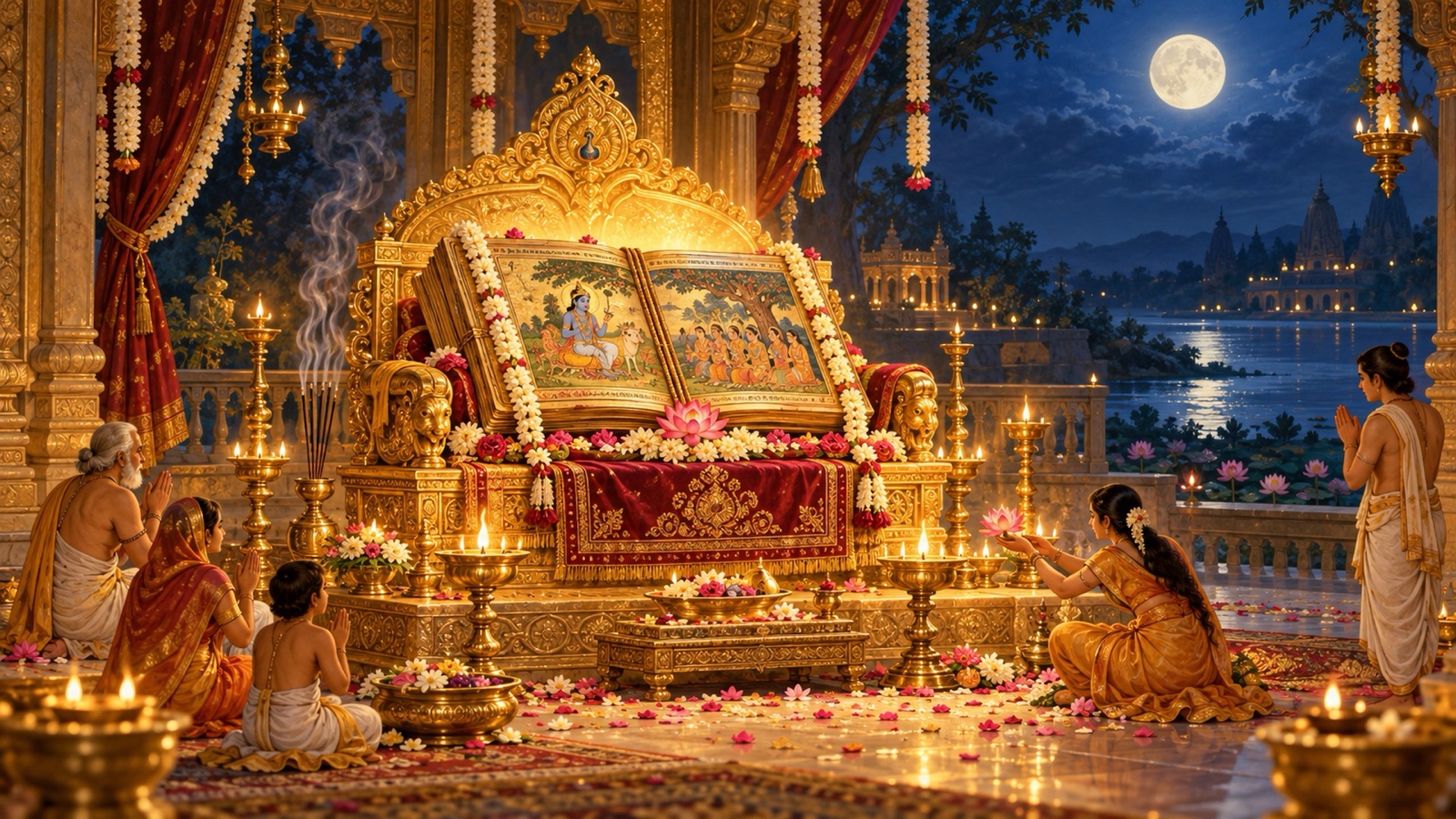
The other Puranas, Suta says, shine in an assembly of the righteous only until the great Bhagavata becomes directly visible. It is the very cream of the Upanishads, and one sated with its nectar finds delight nowhere else.
सर्ववेदान्तसारं हि श्रीभागवतमिष्यते । तद्रसामृततृप्तस्य नान्यत्र स्याद्रति: क्वचित् ॥ १५ ॥
sarva-vedānta-sāraṁ hi śrī-bhāgavatam iṣyate tad-rasāmṛta-tṛptasya nānyatra syād ratiḥ kvacit
Meaning: The Srimad Bhagavata is held to be the essence of all Vedanta; one who is satisfied with the nectar of its flavour finds no delight anywhere else. (Canto 12, Chapter 13, verse 15)
It occupies among the Puranas the place of the Ganga among rivers, of Vishnu among the gods, and of Kashi among holy places. It is a faultless Purana, beloved of the Vaishnavas, in which the one supreme Reality is celebrated; and the one who devoutly hears it, carefully reads it, and ponders it bids fair to be liberated.
श्रीमद्भागवतं पुराणममलं यद्वैष्णवानां प्रियं यस्मिन् पारमहंस्यमेकममलं ज्ञानं परं गीयते । तत्र ज्ञानविरागभक्तिसहितं नैष्कर्म्यमाविष्कृतं तच्छृण्वन् सुपठन् विचारणपरो भक्त्या विमुच्येन्नर: ॥ १८ ॥
śrīmad-bhāgavataṁ purāṇam amalaṁ yad vaiṣṇavānāṁ priyaṁ yasmin pāramahaṁsyam ekam amalaṁ jñānaṁ paraṁ gīyate tatra jñāna-virāga-bhakti-sahitaṁ naiṣkarmyam āviskṛtaṁ tac chṛṇvan su-paṭhan vicāraṇa-paro bhaktyā vimucyen naraḥ
Meaning: The Srimad Bhagavata is the faultless Purana, dear to the Vaishnavas, in which is sung that one pure supreme knowledge belonging to the Paramahamsas; there is revealed the state of freedom from action, joined with knowledge, dispassion, and devotion. A person who hears it, reads it well, and reflects upon it with devotion attains liberation. (Canto 12, Chapter 13, verse 18)
The Lamp of Wisdom Passed Down
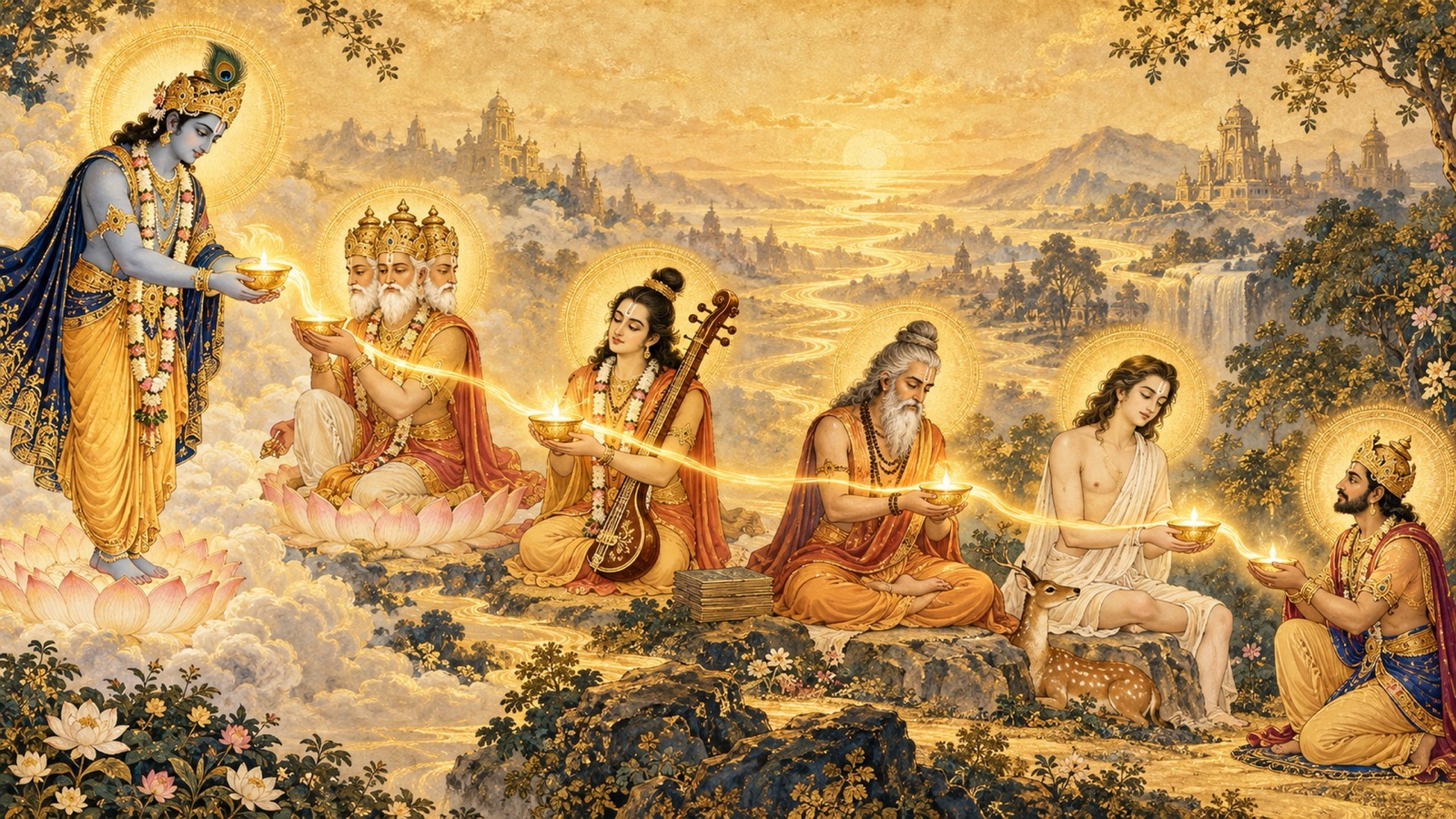
Suta now offers the meditation with which the Bhagavatam draws to its close — a remembrance of the chain of grace through which this lamp of wisdom has descended, from the Lord to Brahma at the dawn of creation, from Brahma to Narada, from Narada to Vyasa, from Vyasa to Suka, and from Suka to King Pariksit.
कस्मै येन विभासितोऽयमतुलो ज्ञानप्रदीप: पुरा तद्रूपेण च नारदाय मुनये कृष्णाय तद्रूपिणा । योगीन्द्राय तदात्मनाथ भगवद्राताय कारुण्यत- स्तच्छुद्धं विमलं विशोकममृतं सत्यं परं धीमहि ॥ १९ ॥
kasmai yena vibhāsito ’yam atulo jñāna-pradīpaḥ purā tad-rūpeṇa ca nāradāya munaye kṛṣṇāya tad-rūpiṇā yogīndrāya tad-ātmanātha bhagavad-rātāya kāruṇyatas tac chuddhaṁ vimalaṁ viśokam amṛtaṁ satyaṁ paraṁ dhīmahi
Meaning: We meditate upon that pure, taintless, sorrowless, immortal, and supreme Truth — by whom this matchless lamp of wisdom was revealed of old to Brahma, and by Brahma to the sage Narada, by Narada to the sage Krishna (Vyasa), by him to the great Yogi Suka, and by Suka, out of compassion, to King Pariksit, the favoured of the Lord. (Canto 12, Chapter 13, verse 19)
He salutes Lord Vasudeva, the Witness of all, who first taught this Purana to Brahma; he bows to the sage Suka, who redeemed Pariksit from the fear of rebirth; and he prays that devotion to the Lord’s feet may sprout in his heart in every birth to come. Then, with the final words of the whole scripture, Suta bows to Sri Hari.
नामसङ्कीर्तनं यस्य सर्वपापप्रणाशनम् । प्रणामो दु:खशमनस्तं नमामि हरिं परम् ॥ २३ ॥
nāma-saṅkīrtanaṁ yasya sarva-pāpa praṇāśanam praṇāmo duḥkha-śamanas taṁ namāmi hariṁ param
Meaning: I bow to that Supreme Lord Hari, the loud chanting of whose names destroys all sin, and reverent salutation to whom stills all sorrow. (Canto 12, Chapter 13, verse 23)
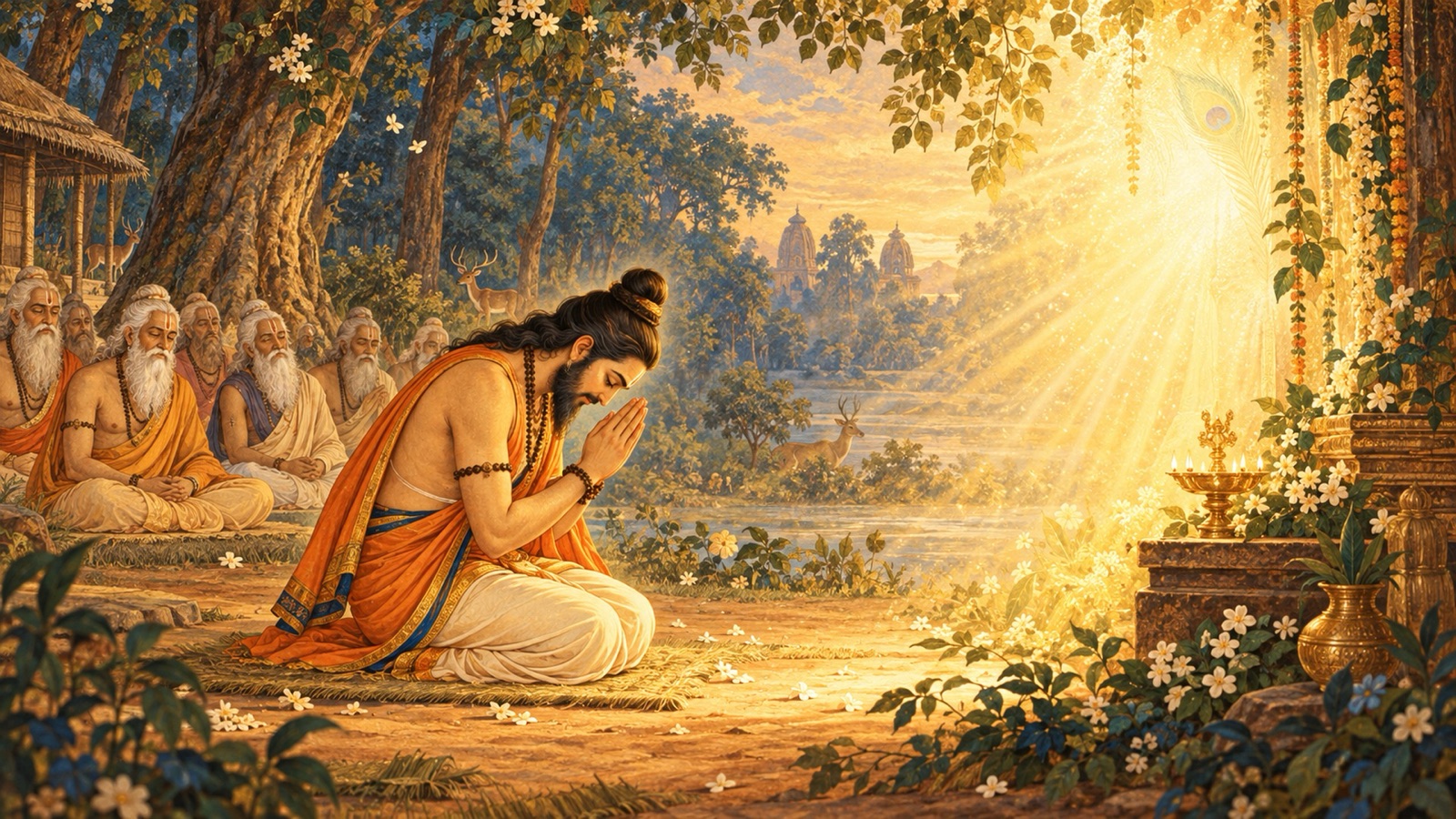
With this salutation the great and glorious Bhagavata-Purana — composed by the sage Vedavyasa and consisting of eighteen thousand verses — comes to its end.
Principal Teachings of This Chapter
1. The Bhagavata is the cream of all scripture. As the Ganga among rivers and Kashi among holy places, the Bhagavata is the essence of the Upanishads; one satisfied by its nectar seeks delight nowhere else (verses 15-17).
2. Its purpose is liberation through devotion. The faultless Purana reveals pure knowledge joined with dispassion and devotion; to hear, read, and reflect upon it with love is itself the path to freedom (verse 18).
3. Sacred wisdom lives through a chain of grace. The lamp of wisdom passed from the Lord to Brahma, to Narada, to Vyasa, to Suka, to Pariksit — and reaches us today only through this unbroken succession of compassion (verse 19).
4. The holy name is the final refuge. The scripture closes not with a doctrine but with a bow — to Sri Hari, whose name destroys all sin and whose remembrance stills all sorrow (verse 23).
A Devotional Reflection
There is a beautiful symmetry in how the Bhagavatam ends. It began in this same forest of Naimisharanya, with the sages asking Suta to speak of the Lord in the darkness of the age of Kali; and it ends here too, with Suta placing into their hands — and into ours — the whole of what he has received. The last chapter does not strive for a dramatic climax. Instead, it grows quiet and grateful, remembering the teachers: the Lord who lit the lamp, Brahma who received it, Narada, Vyasa, Suka, Pariksit. We are the newest names in that list. When we read even a single verse of this Purana, the lamp is handed once more. And notice where the scripture chooses to rest at the very end — not on philosophy, however sublime, but on a simple act of love: a bow to Sri Hari, whose name wipes away all sin and whose remembrance stills all sorrow. After twelve Cantos and eighteen thousand verses, the last word is devotion. This is the Bhagavatam’s parting gift: that the highest wisdom and the humblest love are, in the end, the same — and that both are available to anyone who will simply chant the holy name and bow.
A Daily Devotional Practice
Today, as we complete this final chapter, receive the lamp of wisdom and resolve to pass it on. Bring to mind, with gratitude, the chain of teachers through whom the Bhagavatam has reached you — from the Lord and the sages of old to those who taught you in your own life. Then honour the scripture’s closing gesture by making it your own: chant the holy name aloud, and offer a heartfelt bow to Sri Hari, “the loud chanting of whose names destroys all sin.” If you can, resolve to share even one verse or one story of the Bhagavatam with another, so that the lamp is handed forward. Close by chanting “Om Namo Bhagavate Vasudevaya” a fixed number of times, praying with Suta that devotion to the Lord’s feet may sprout in your heart in every birth to come.
Conclusion
The thirteenth chapter of the Twelfth Canto brings the entire Srimad Bhagavatam to its close. Suta Gosvami tallies the size of each of the eighteen Puranas before elevating this one above all the rest, likening its place among sacred texts to what the Ganga is among rivers — a work whose sincere study alone is said to carry a soul toward final freedom. He then walks back through the very line of realized teachers that delivered this knowledge into the present moment, and brings the whole narration to rest in a single act of surrender. So concludes the vast and radiant Bhagavata-Purana, eighteen thousand verses composed by Vedavyasa — the telling arriving back at Naimisharanya where it opened, with something quietly entrusted to every listener who stayed to the end: a light meant to be kept, lived by, and passed on.
May the divine wisdom of Srimad Bhagavatam awaken pure devotion within our hearts.
Om Namo Bhagavate Vasudevaya.
Jay Shree Madhav.
References and Attribution
- Primary edition: Gita Press, Śrīmad Bhāgavata Mahāpurāṇa (English, complete), Book Twelve, Discourse 13 (final chapter).
- Series: Srimad Bhagavatam Wisdom · Biswa Sanatan Dharma Seva Trust.
- Presented following the spiritual guidance and recommendation of Pandit Dr. Shri Kashinath Mishra.
This is an original, faithful retelling in the writer’s own words, with brief quoted verses shown in Devanāgarī and transliteration and their meanings given as summaries. It is not a reproduction of any single publisher’s continuous translation or commentary. No affiliation with or endorsement by any publisher is implied.
Jay Shree Madhav