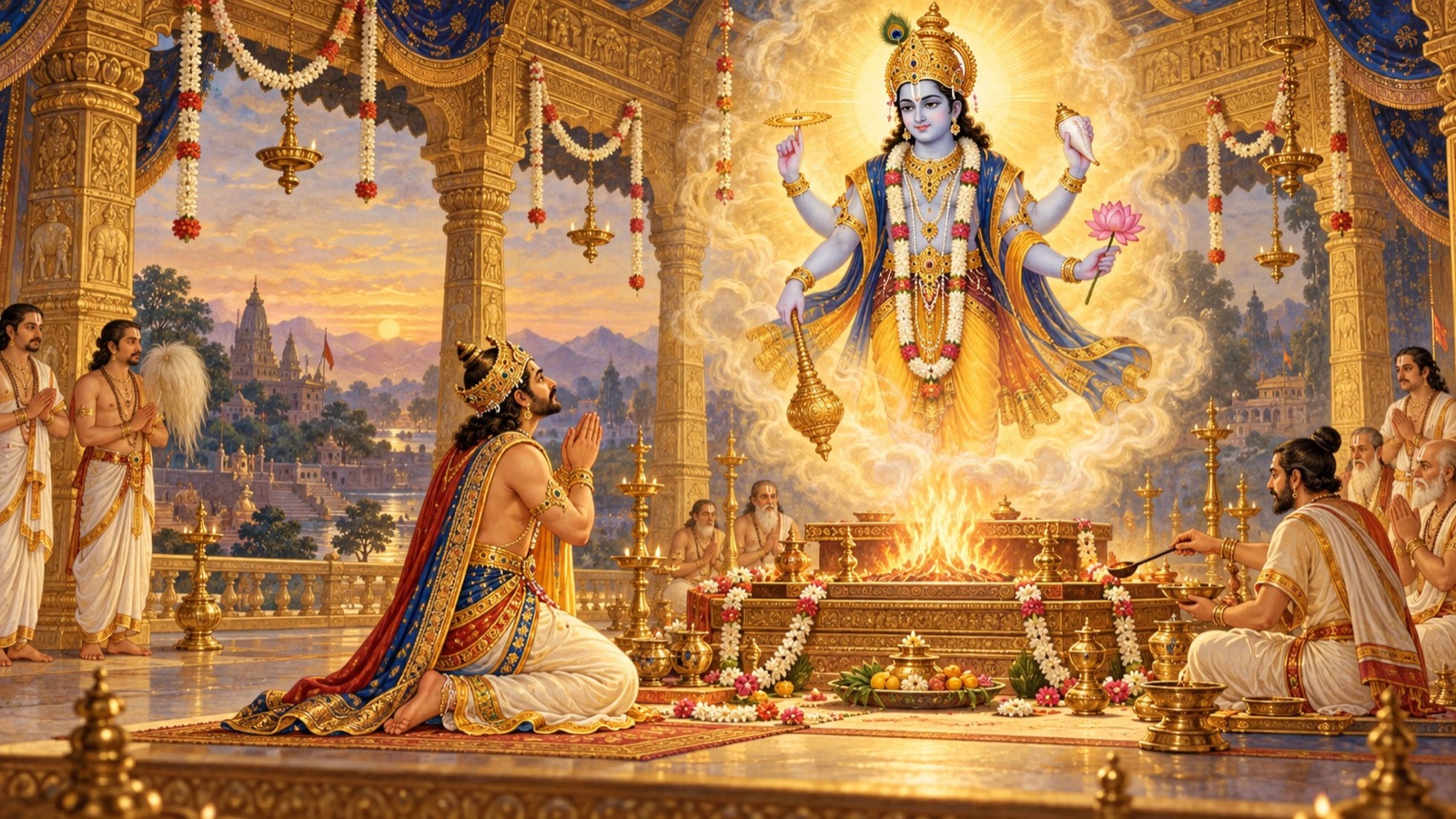
Enthroned in humility and radiant with devotion, King Gaya offers his every sacrifice to Lord Vishnu — and the Lord Himself, the Soul of all offerings, comes in person to accept the fruit of a heart made pure by love.
Om Namo Bhagavate Vasudevaya.
Om Namo Bhagavate Vasudevaya.
Om Namo Bhagavate Vasudevaya.
Welcome back to Srimad Bhagavatam Wisdom, a devotional journey through the sacred histories and teachings of the Srimad Bhagavat Mahapurana. In the previous chapter, Sri Suka unfolded for us the meaning of Jada Bharata’s forest allegory — the soul wandering the trackless woods of worldly life until it finds shelter in the company of saints. Now that great river of narration flows onward into the royal line that sprang from Emperor Bharata’s own house. Here Sri Suka names, one by one, the noble kings born in that lineage, and lingers with loving wonder upon one shining soul among them — King Gaya, a very ray of Lord Vishnu, whose devotion was so pure that the Lord Himself came to accept his offerings, and at whose gladness the whole of creation was gladdened.
Chapter Information
- Scripture: Śrīmad Bhāgavata Mahāpurāṇa
- Canto: 5 (Book Five)
- Chapter: 15 (Discourse 15)
- Chapter title: Bharata’s Royal Line and the Glory of King Gaya
- Principal speaker: Sukadeva Gosvami (Sri Suka), narrating to King Parikshit
- Principal listener: King Parikshit — the discourse related in turn by Suta Gosvami to the sages gathered at Naimisaranya
- Main setting: The royal succession of the house of Priyavrata, recounted in the assembly where Sri Suka instructs King Parikshit
- Central subject: The unbroken royal line descending from Emperor Bharata — from his son Sumati down to Viraja — and, at its devotional summit, the glorious King Gaya, a partial manifestation of Lord Vishnu, whose selfless rule and pure worship delighted the Lord and all beings
- Principal verse range: Canto 5, Chapter 15, verses 1–16
- Primary edition: Gita Press Śrīmad Bhāgavata Mahāpurāṇa
From the Previous Chapter
In the fourteenth discourse, Sri Suka explained to King Parikshit the inner meaning of Jada Bharata’s forest allegory — the soul likened to a merchant lost in the dense forest of worldly existence, harried by the robbers of the senses and the many hardships of material life, and finding his only sure escape in the shelter of saintly company and loving devotion to the Lord. That teaching closed with the glorification of the great devotee Bharata, whose very remembrance purifies the heart. Now the narration returns to the royal house that sprang from Bharata himself, following it faithfully down through the generations.
Sri Suka Continues the Sacred Line
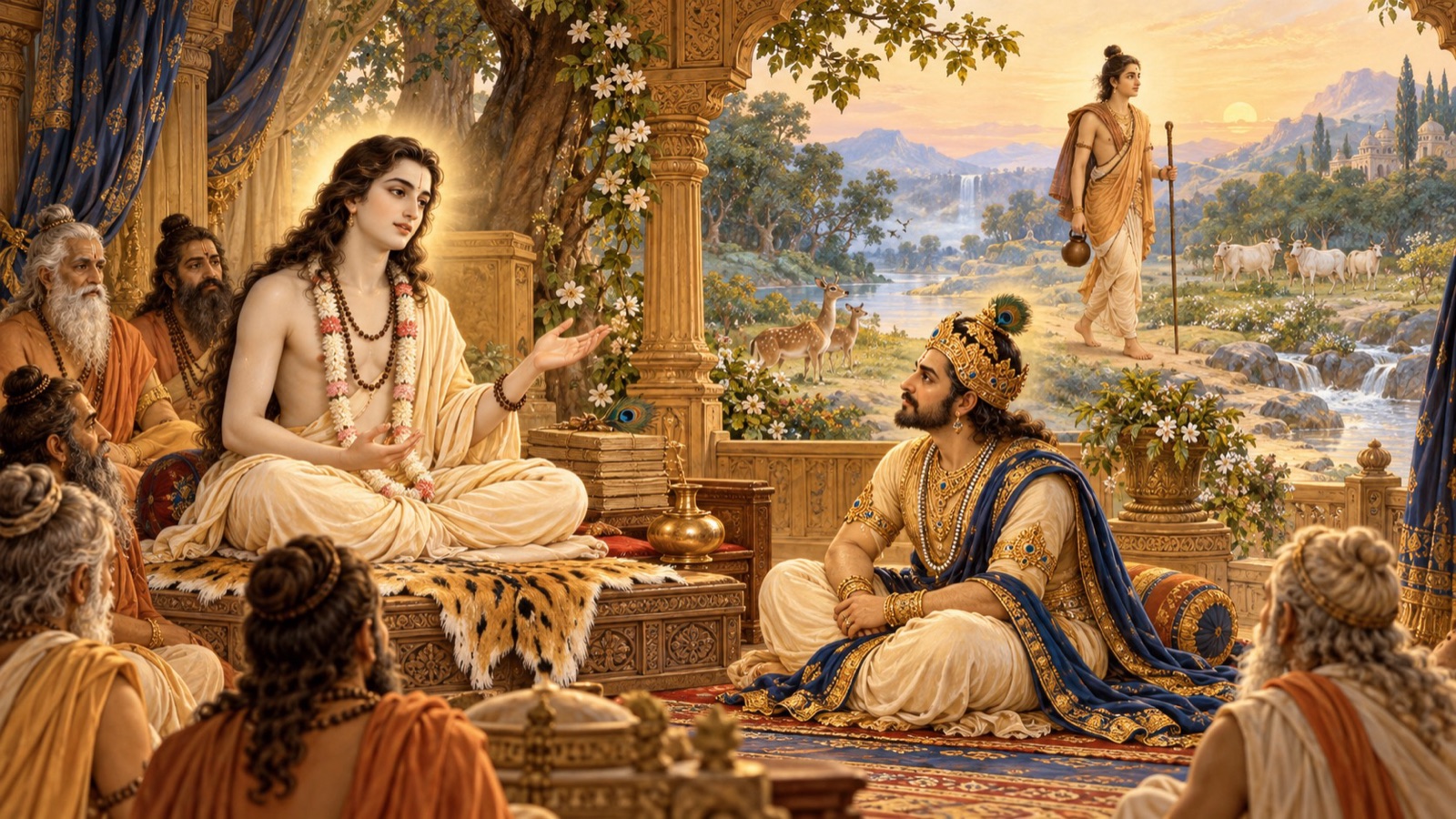
Taking up the thread once more, Sri Suka spoke of the eldest son of Emperor Bharata, a soul named Sumati, who walked steadfastly in the footsteps of Lord Rsabha, living the life of a serene ascetic freed of all worldly craving. So luminous was his renunciation that in the distant age of Kali certain misled men, having cast aside all reverence for the Vedas, would seize upon his memory and, by their own corrupt imagining, set him up as a deity nowhere sanctioned in the sacred texts.
श्रीशुक उवाच भरतस्यात्मज: सुमतिर्नामाभिहितो यमु ह वाव केचित्पाखण्डिन ऋषभपदवीमनुवर्तमानं चानार्या अवेदसमाम्नातां देवतां स्वमनीषया पापीयस्या कलौ कल्पयिष्यन्ति ॥ १ ॥
śrī-śuka uvāca bharatasyātmajaḥ sumatir nāmābhihito yam u ha vāva kecit pākhaṇḍina ṛṣabha-padavīm anuvartamānaṁ cānāryā aveda-samāmnātāṁ devatāṁ sva-manīṣayā pāpīyasyā kalau kalpayiṣyanti
Meaning: Sri Suka said: The son of Emperor Bharata was named Sumati, who faithfully followed the path of Lord Rsabha; and it is he whom certain heretics, having no regard for the Vedas, will in the age of Kali set up, by their own corrupt imagining, as a deity not sanctioned by the sacred scriptures. (Canto 5, Chapter 15, verse 1)
From Sumati to the Birth of Gaya
From Sumati, through his wife Vrddhasena, was born a son named Devatajit. From Devatajit, through Asuri, came Devadyumna; from Devadyumna, through Dhenumati, was born Paramesthi; and from Paramesthi, through Suvarcala, was born Pratiha — a king who, having taught the science of the Self to many and grown wholly pure within, realized the Supreme Person as his own very self.
Sri Suka pauses over this name for a reason. Pratiha did not merely repeat what he had heard from others; he became a teacher of the science of the Self only after his own heart had grown wholly pure and he had realized the Supreme Person directly, as his very own self. This is the standard the Bhagavatam quietly sets for every guide of souls across the ages — one who has not first seen the Truth has nothing true to give another. Set beside the fate of Sumati’s memory, twisted in a later age into a worship no scripture ever sanctioned (verse 1), Pratiha’s example stands as its answer: not clever imagining but genuine realization is the only ground on which a true teaching can stand.
य आत्मविद्यामाख्याय स्वयं संशुद्धो महापुरुषमनुसस्मार ॥ ४ ॥
ya ātma-vidyām ākhyāya svayaṁ saṁśuddho mahā-puruṣam anusasmāra
Meaning: Only once he himself had grown wholly pure and had directly realized the Supreme Person within his own heart did Pratiha take up the role of guiding others in the science of the Self. (Canto 5, Chapter 15, verse 4)
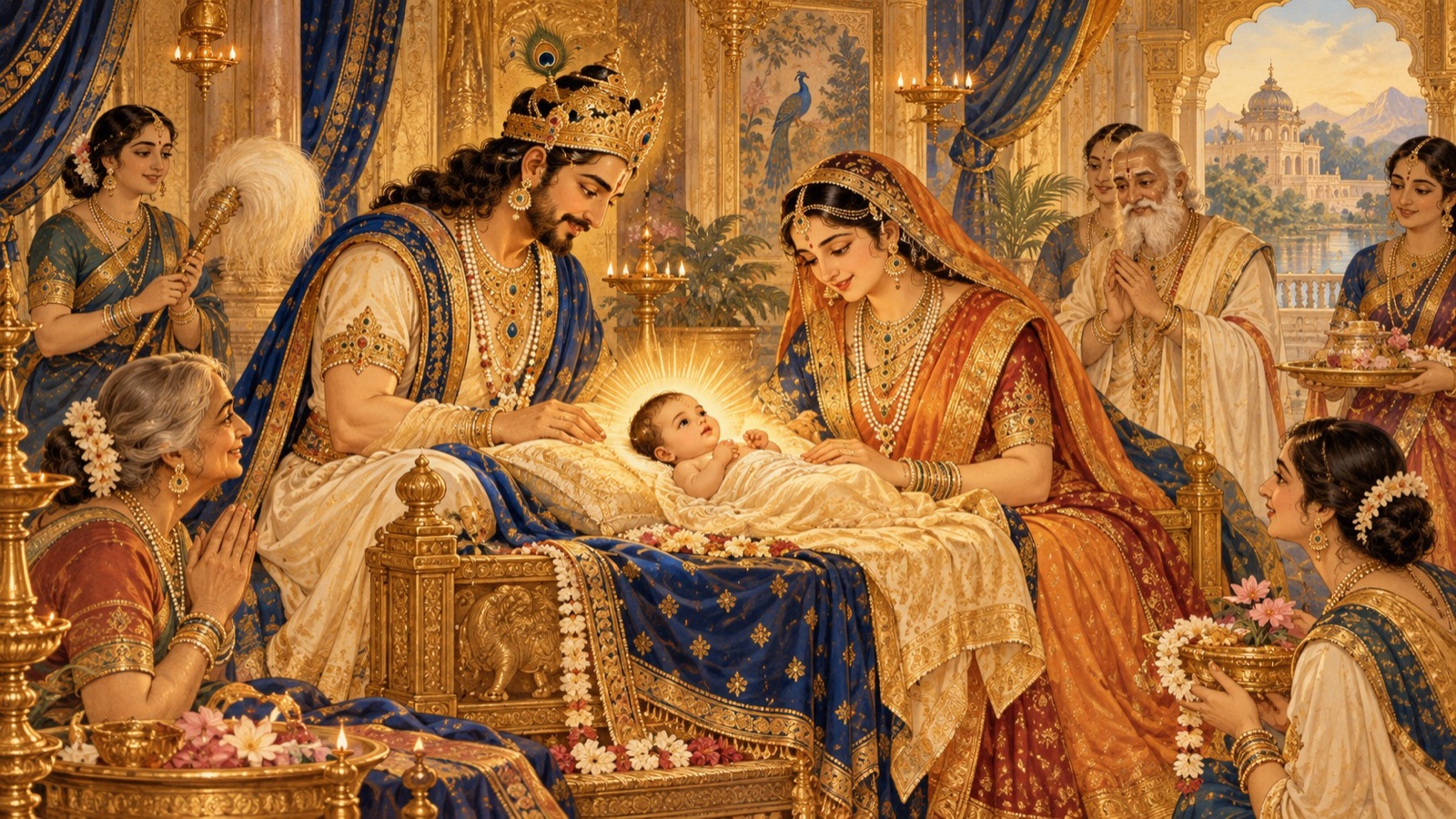
From Pratiha, through his wife Suvarcala, sprang three sons well-versed in sacrifice — Pratiharta, Prastota and Udgata — and from Pratiharta, through Stuti, were born Aja and Bhuma. From Bhuma onward, generation followed generation, each a fresh link in a chain of righteous souls, until the line reached its most luminous soul of all — for from Nakta, through his queen Druti, was born the illustrious Gaya, foremost among royal sages, of noble and far-reaching renown, a direct ray of Lord Vishnu Himself, who takes on pure goodness to guard the worlds.
भूम्न ऋषिकुल्यायामुद्गीथस्तत: प्रस्तावो देवकुल्यायां प्रस्तावान्नियुत्सायां हृदयज आसीद्विभुर्विभो रत्यां च पृथुषेणस्तस्मान्नक्त आकूत्यां जज्ञे नक्ताद्द्रुतिपुत्रो गयो राजर्षिप्रवर उदारश्रवा अजायत साक्षाद्भगवतो विष्णोर्जगद्रिरक्षिषया गृहीतसत्त्वस्य कलाऽऽत्मवत्त्वादिलक्षणेन महापुरुषतां प्राप्त: ॥ ६ ॥
bhūmna ṛṣikulyāyām udgīthas tataḥ prastāvo devakulyāyāṁ prastāvān niyutsāyāṁ hṛdayaja āsīd vibhur vibho ratyāṁ ca pṛthuṣeṇas tasmān nakta ākūtyāṁ jajñe naktād druti-putro gayo rājarṣi-pravara udāra-śravā ajāyata sākṣād bhagavato viṣṇor jagad-rirakṣiṣayā gṛhīta-sattvasya kalātmavattvādi-lakṣaṇena mahā-puruṣatāṁ prāptaḥ
Meaning: From Bhuma, through Rsikulya, came Udgitha; from Udgitha, through Devakulya, Prastava; from Prastava, through Niyutsa, Vibhu; from Vibhu, through Rati, Prthusena; and from Prthusena, through Akuti, Nakta. To Nakta and his queen Druti was granted Gaya — foremost among royal sages, far-famed and glorious, a direct portion of Lord Vishnu who assumes pure goodness to guard the universe, raised to the exalted rank of a great soul through his own self-mastery and other noble qualities. (Canto 5, Chapter 15, verse 6)
Gaya, the Ray of Vishnu Who Ruled Without Pride
What made Gaya so dear was not his birth alone, but the way he lived. Through his own royal duty — protecting his people, nourishing them, pleasing them, tending them with a father’s affection and gently guiding them, and through sacrifices and pious works — he offered everything, with his whole being, to the Supreme Person, Lord Vishnu, who is higher than the highest and one with the infinite Brahman. By constantly serving the feet of those who had realized Brahman, he was granted the treasure of loving devotion; and his mind, thus purified again and again, became fit to yield the highest fruit of all. In that mind, freed of every false claim upon the body, the presence of Brahman shone of its own accord, and he knew his oneness with the Supreme Spirit. Yet — and here lies the wonder — he carried no trace of pride, and in that spirit of perfect humility he ruled over the whole earth.
The Songs Sung in Praise of King Gaya
So great was this king that those learned in the ancient lore still sing his glories in sacred verse. What other king, they ask, unless he were a very portion of the Lord, could rival Gaya by his deeds — a master of great sacrifices, a soul of vast learning, a fearless defender of righteousness, wooed by the Goddess of Fortune, the honoured head of assemblies of holy men, and the humble servant of the pious?
At his consecration, the chaste daughters of Daksa — whose blessings never fail — together with the sacred rivers, bathed and anointed him in supreme joy. And though he himself desired nothing for himself, mother Earth, drawn by his virtues as a cow’s udder flows at the sight of her calf, freely yielded to his subjects all that they could wish.
यमभ्यषिञ्चन् परया मुदा सती:सत्याशिषो दक्षकन्या: सरिद्भि: । यस्य प्रजानां दुदुहे धराऽऽशिषोनिराशिषो गुणवत्सस्नुतोधा: ॥ १० ॥
yam abhyaṣiñcan parayā mudā satīḥ satyāśiṣo dakṣa-kanyāḥ saridbhiḥ yasya prajānāṁ duduhe dharāśiṣo nirāśiṣo guṇa-vatsa-snutodhāḥ
Meaning: In supreme joy the chaste daughters of Daksa, whose blessings never fail, together with the sacred rivers, consecrated Gaya with holy water. And though he himself desired nothing, mother Earth — drawn by his virtues as a cow whose udder flows at the sight of her calf — yielded to his subjects all that they desired. (Canto 5, Chapter 15, verse 10)
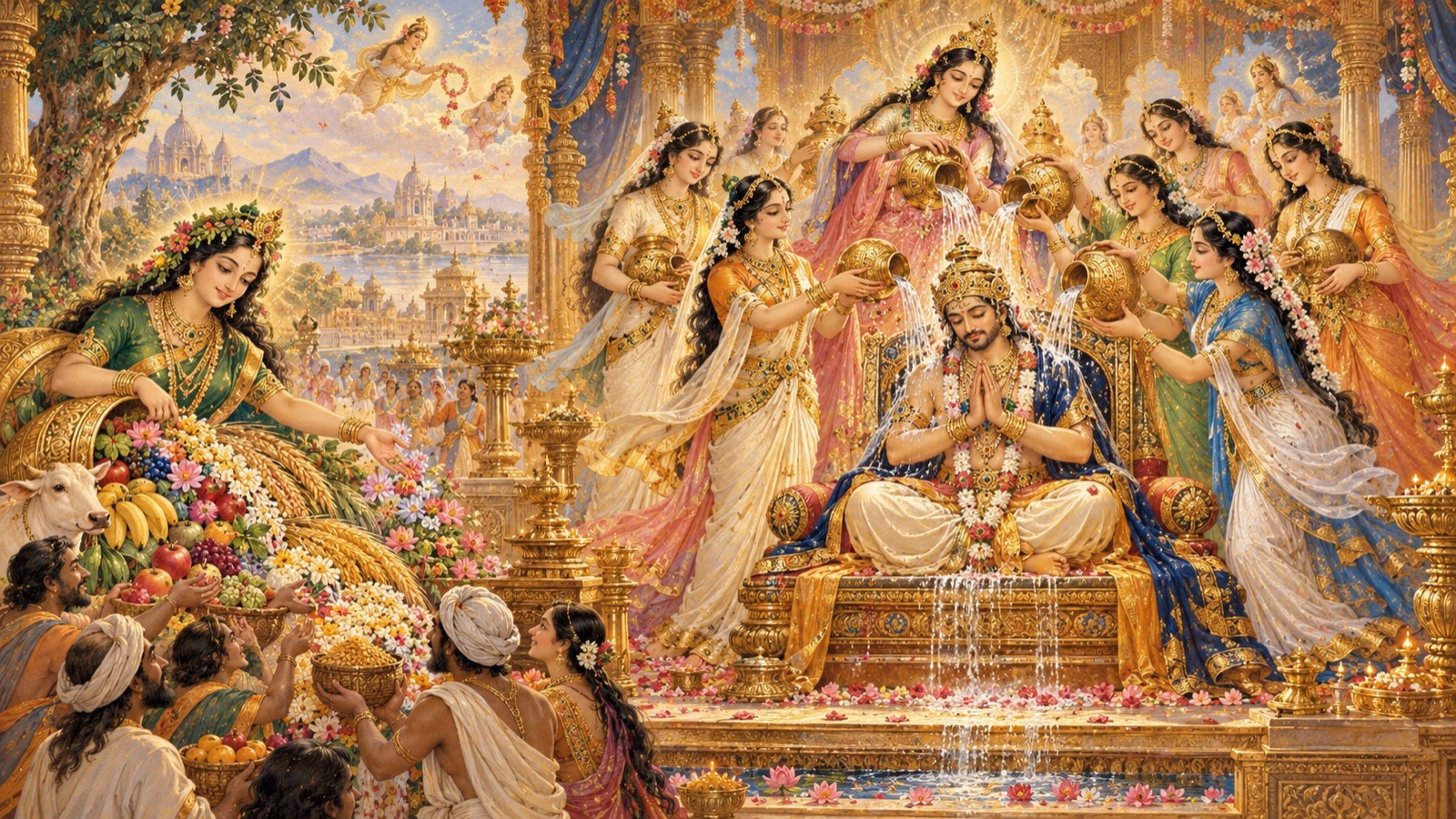
Even the Vedas and the sacred rites yielded him every enjoyment, though he craved none; kings once hostile brought him tribute; and the Brahmanas, honoured by his righteousness, gave over to him a sixth of the merit earned by their austerities.
The Lord Himself Accepts Gaya’s Offering
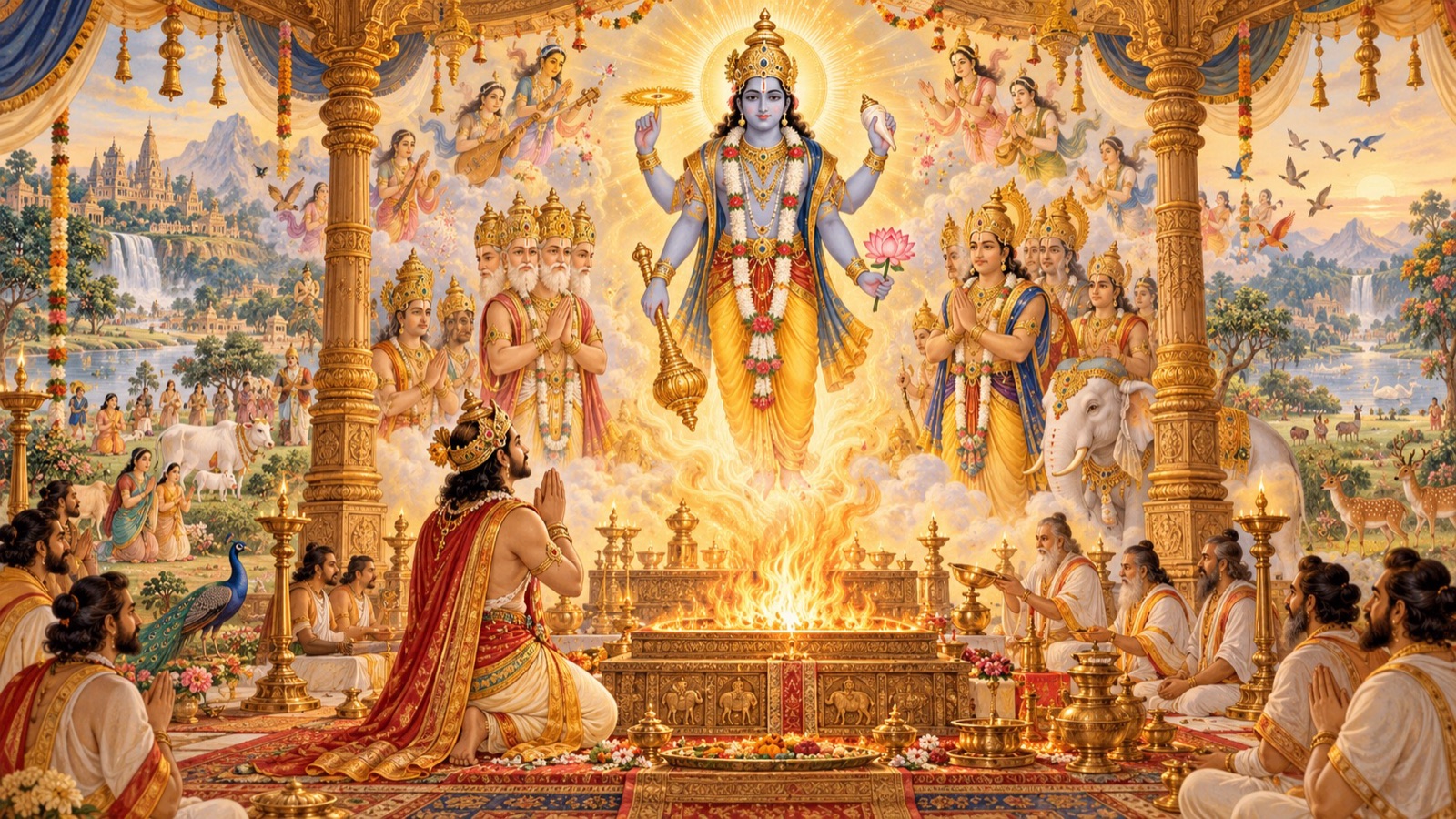
Here the praise rises to its highest note. At Gaya’s great sacrifice, where copious draughts of Soma were poured out, even Indra, chief of the gods, grew exhilarated with the offering. Yet the Supreme Lord Himself, the very Soul of all sacrifice, came in person and accepted the fruit of that worship — for Gaya had offered it with a faith made spotless by unwavering, loving devotion.
यस्याध्वरे भगवानध्वरात्मामघोनि माद्यत्युरुसोमपीथे । श्रद्धाविशुद्धाचलभक्तियोग-समर्पितेज्याफलमाजहार ॥ १२ ॥
yasyādhvare bhagavān adhvarātmā maghoni mādyaty uru-soma-pīthe śraddhā-viśuddhācala-bhakti-yoga- samarpitejyā-phalam ājahāra
Meaning: At that sacrifice of Gaya’s, awash in Soma that left even Indra elated, it was the Lord Himself who came — He who is the very Self of every offering — and took up the fruit of that worship, given as it was with a faith purified by unshaken devotion. (Canto 5, Chapter 15, verse 12)
And why should the Lord not come? When He is pleased, all that lives is pleased at once — for He is the very life of the universe. From Brahma the creator down to the gods, to human beings, to the beasts, to the plants and the smallest blade of grass, the whole of creation is gratified when He is gratified. That Lord, ever satisfied within Himself and needing nothing, felt a palpable delight at the sacrifice of Gaya.
यत्प्रीणनाद्बर्हिषि देवतिर्यङ्-मनुष्यवीरुत्तृणमाविरिञ्चात् । प्रीयेत सद्य: स ह विश्वजीव:प्रीत: स्वयं प्रीतिमगाद्गयस्य ॥ १३ ॥
yat-prīṇanād barhiṣi deva-tiryaṅ- manuṣya-vīrut-tṛṇam āviriñcāt prīyeta sadyaḥ sa ha viśva-jīvaḥ prītaḥ svayaṁ prītim agād gayasya
Meaning: When the Lord is pleased, the whole of creation — from Brahma down to the gods, human beings, animals, plants, and the smallest blade of grass — is at once gratified, for He is the very life of all. That Lord, ever satisfied within Himself, felt a palpable delight at the sacrifice of Gaya. (Canto 5, Chapter 15, verse 13)
The Line Continues to Viraja
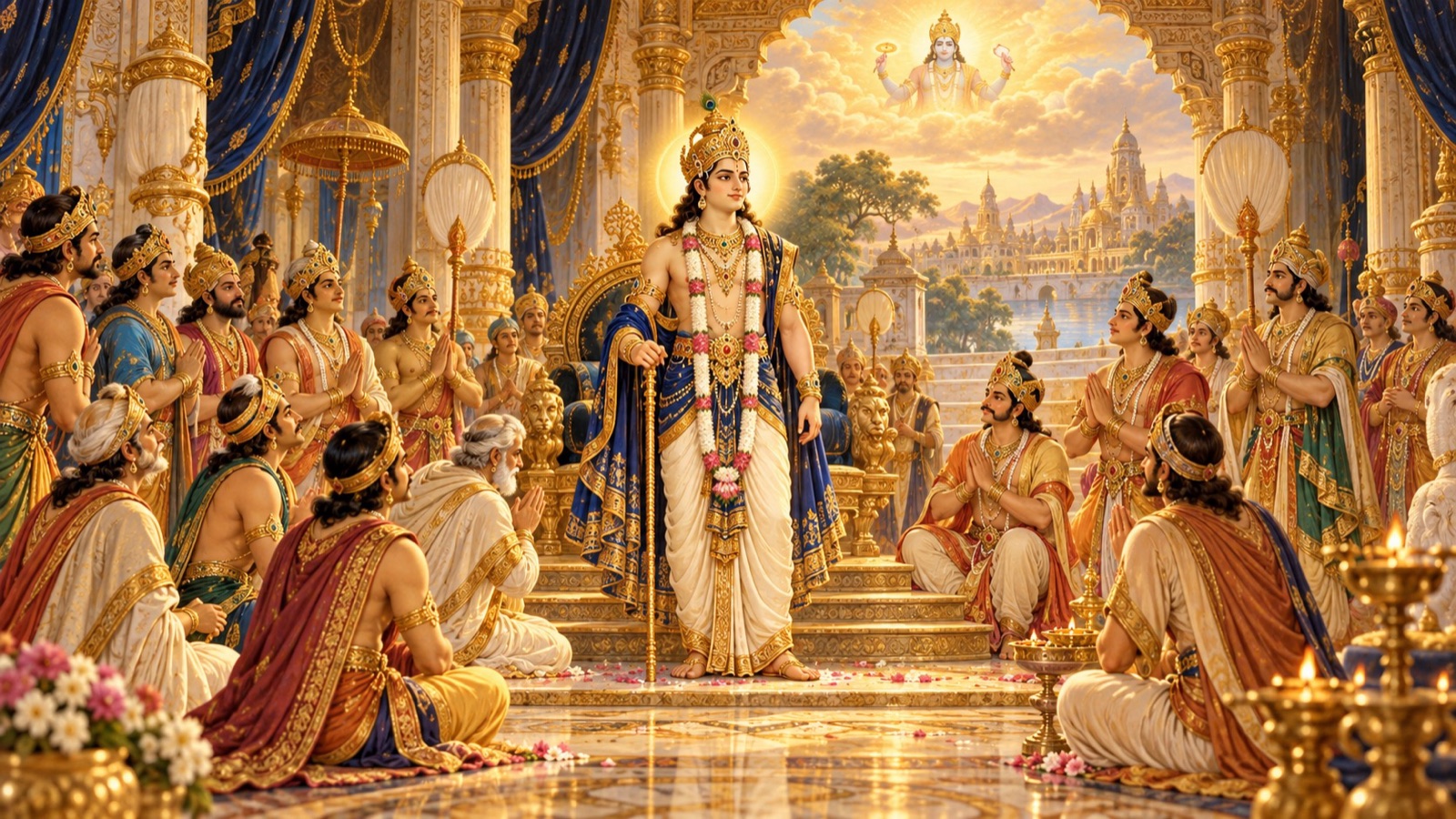
From Gaya, through his wife Gayanti, were born three sons — Citraratha, Sugati and Avarodhana. From Citraratha, through Urna, came Samrat; from Samrat, through Utkala, Marici; from Marici, through Bindumati, Binduman; from Binduman, through Saragha, Madhu; from Madhu, through Sumana, Viravrata; from Viravrata, through Bhoja, Manthu and Pramanthu; from Manthu, through Satya, Bhauvana; from Bhauvana, through Dusana, Twasta; from Twasta, through Virocana, Viraja; and from Viraja, through Visuci, were born a hundred sons — the eldest being Satajit — and a daughter besides.
Of this Viraja, the last-born in the line, the sacred verse still sings: that he adorned the whole dynasty of Priyavrata with his glory, even as Lord Vishnu once brought glory to the gods by appearing among them as Vamana, the divine dwarf.
प्रैयव्रतं वंशमिमं विरजश्चरमोद्भव: । अकरोदत्यलं कीर्त्या विष्णु: सुरगणं यथा ॥ १६ ॥
praiyavrataṁ vaṁśam imaṁ virajaś caramodbhavaḥ akarod aty-alaṁ kīrtyā viṣṇuḥ sura-gaṇaṁ yathā
Meaning: As the last-born of this line, Viraja became its ornament, lending luster to the whole house of Priyavrata just as Lord Vishnu, appearing among the demigods as Vamana, brought splendor to their assembly. (Canto 5, Chapter 15, verse 16)
Principal Teachings of This Chapter
A holy lineage is a chain of surrendered souls. From Sumati to Viraja, this royal house is remembered not for its conquests or its wealth, but because generation after generation walked the path of dharma and devotion. Our truest inheritance is not what we own, but the faith we receive and pass on.
Greatness is measured by surrender, not by power. Gaya ruled the whole earth, yet the Bhagavatam praises him above all for offering his every act to Lord Vishnu and for carrying no pride at all. Real dignity is not in what we command, but in Whom we serve.
Devotion draws the Lord Himself near. Gaya’s faith was made spotless by unwavering love, and so the Lord came in person to accept his offering. It is not the grandeur of the rite but the purity of the heart that the Lord answers.
When the Lord is pleased, all beings are blessed. Because Gaya pleased Him who is the life of all, the whole of creation — gods, humans, animals, even the humblest blade of grass — shared in the joy. To love the Lord is to bless the entire world.
True devotion never seeks its own reward. Gaya desired nothing for himself, yet Earth, the Vedas and the sacred rites poured their gifts upon his people. When the heart stops grasping, abundance flows through it to others.
A Devotional Reflection
It would be easy to pass quickly over a chapter of names, as though it were only a register of kings. But listen more closely, and this lineage sings. Each name is a soul who once lived, who ruled and prayed and passed on the lamp of devotion to the next — a long procession of hearts turned toward the Lord, stretching across ages we can scarcely imagine. And in their midst stands Gaya, and something in him stops us. Here was a man who held the whole earth in his hand and desired nothing from it; who performed the mightiest sacrifices and claimed no credit; who was worshipped by the sacred rivers and the daughters of Daksa, and yet ruled without a shred of pride. What crowned his life was not his throne but his surrender — and to that surrender the Lord Himself responded, coming in person to receive his love. This is the quiet promise the Bhagavatam holds out to every one of us: that greatness in the eyes of Heaven is nothing more, and nothing less, than a heart emptied of pride and full of love for God. We need not rule an empire. We need only offer what we have, as Gaya did, and the same Lord will draw just as near.
A Daily Devotional Practice
Today, choose one duty that is yours to do — your work, your care for your family, some small service to another — and offer it silently to Lord Vishnu before you begin, as King Gaya offered his whole reign. Do it with care and without seeking praise, and when it is finished, claim no credit for it; place the fruit at the Lord’s feet and say inwardly: “Om Namo Bhagavate Vasudevaya.” In this way even an ordinary act becomes a sacrifice, and even an ordinary day becomes worship. Let Gaya’s example remind you that the Lord does not weigh the size of our offering, but the love with which it is given.
Conclusion
The fifteenth discourse of Book Five carries us along the sacred royal line that flowed from Emperor Bharata — from his son Sumati, through many righteous kings, down to Viraja, the last-born who adorned the whole dynasty of Priyavrata with his glory. At the devotional heart of this lineage shines King Gaya, a very ray of Lord Vishnu, who protected and cherished his people, offered his every act in loving service, and ruled the entire earth without a trace of pride. His devotion was so pure that the sacred rivers consecrated him, the Earth poured abundance upon his subjects though he asked for nothing, and the Supreme Lord Himself came in person to accept the fruit of his sacrifice — and at the Lord’s gladness, all creation was gladdened. It is a chapter that turns a mere genealogy into a hymn, teaching us that the truest greatness is not conquest or crown, but a heart wholly surrendered to God.
May the divine wisdom of Srimad Bhagavatam awaken pure devotion within our hearts.
Om Namo Bhagavate Vasudevaya.
Jay Shree Madhav.
References and Attribution
- Primary edition: Gita Press, Śrīmad Bhāgavata Mahāpurāṇa, Book Five, Discourse 15, “An account of Priyavrata’s posterity continued.”
- Series: Srimad Bhagavatam Wisdom · Biswa Sanatan Dharma Seva Trust.
- Presented following the spiritual guidance and recommendation of Pandit Dr. Shri Kashinath Mishra.
This is an original, faithful retelling in the writer’s own words, with brief quoted verses shown in Devanāgarī and transliteration and their meanings given as summaries. It is not a reproduction of any single publisher’s continuous translation or commentary. No affiliation with or endorsement by any publisher is implied.
Jay Shree Madhav