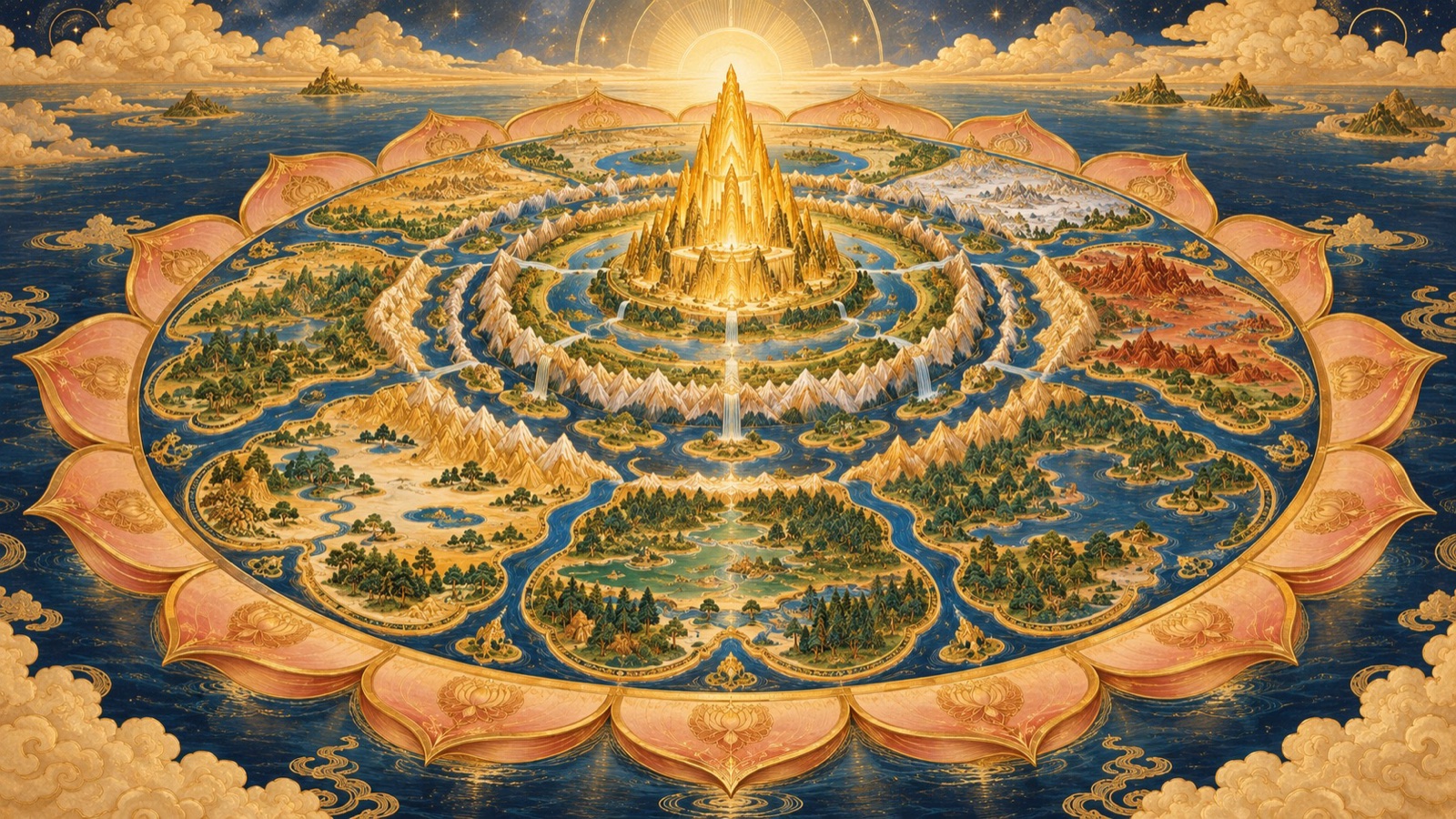
Jambudvipa, the land in which we dwell, shines like an open lotus upon the waters — golden Mount Meru rising at its heart as the seed-cup, ringed by the boundary-mountains and the nine realms, the whole earth a flower of the Lord’s own making.
Om Namo Bhagavate Vasudevaya.
Om Namo Bhagavate Vasudevaya.
Om Namo Bhagavate Vasudevaya.
Welcome back to Srimad Bhagavatam Wisdom, a devotional journey through the sacred histories and teachings of the Srimad Bhagavat Mahapurana. Having heard of Emperor Priyavrata and the saintly kings born in his line, King Parikshit now turns his heart to the very earth beneath our feet — not as a lifeless thing, but as the visible form of the Lord. In this sixteenth chapter of Book Five, Sukadeva Gosvami unfolds a vision of Jambudvipa, the lotus-shaped land in which we live: golden Meru at its centre, the ranges dividing its realms, the great trees with their rivers of nectar, and the shining city of Brahma upon the crown. It is a chapter to be received in wonder, for the sage offers it as a doorway by which the mind, resting on the Lord’s vast form, is drawn toward His transcendent Self.
Chapter Information
- Scripture: Śrīmad Bhāgavata Mahāpurāṇa
- Canto: 5 (Book Five)
- Chapter: 16 (Discourse 16)
- Chapter title: The Wonders of Jambudvipa and Mount Meru
- Principal speaker: Sukadeva Gosvami (Sri Suka), answering King Parikshit
- Principal listener: King Parikshit — the discourse related in turn by Suta Gosvami to the sages gathered at Naimisaranya
- Main setting: Jambudvipa, the innermost of the seven concentric lands of the terrestrial world, with golden Mount Meru at its centre
- Central subject: The scale and layout of the terrestrial world — lotus-shaped Jambudvipa, the golden mountain Meru at its centre, the eight ranges marking off the nine realms, the four fruit-bearing trees with their flowing waters, and the cities of Brahma and the eight guardians of the quarters
- Principal verse range: Canto 5, Chapter 16, verses 1–29
- Primary edition: Gita Press Śrīmad Bhāgavata Mahāpurāṇa
From the Previous Chapter
The fifteenth discourse of Book Five continued the noble lineage of Emperor Priyavrata through the descendants of Bharata, dwelling with reverence upon the saintly King Gaya, whose devotion and virtue shone among his forefathers. Having heard the glories of the kings of that great line, King Parikshit now turns from the rulers of the earth to the earth itself — its measure, its shape and its wonders.
The King’s Question
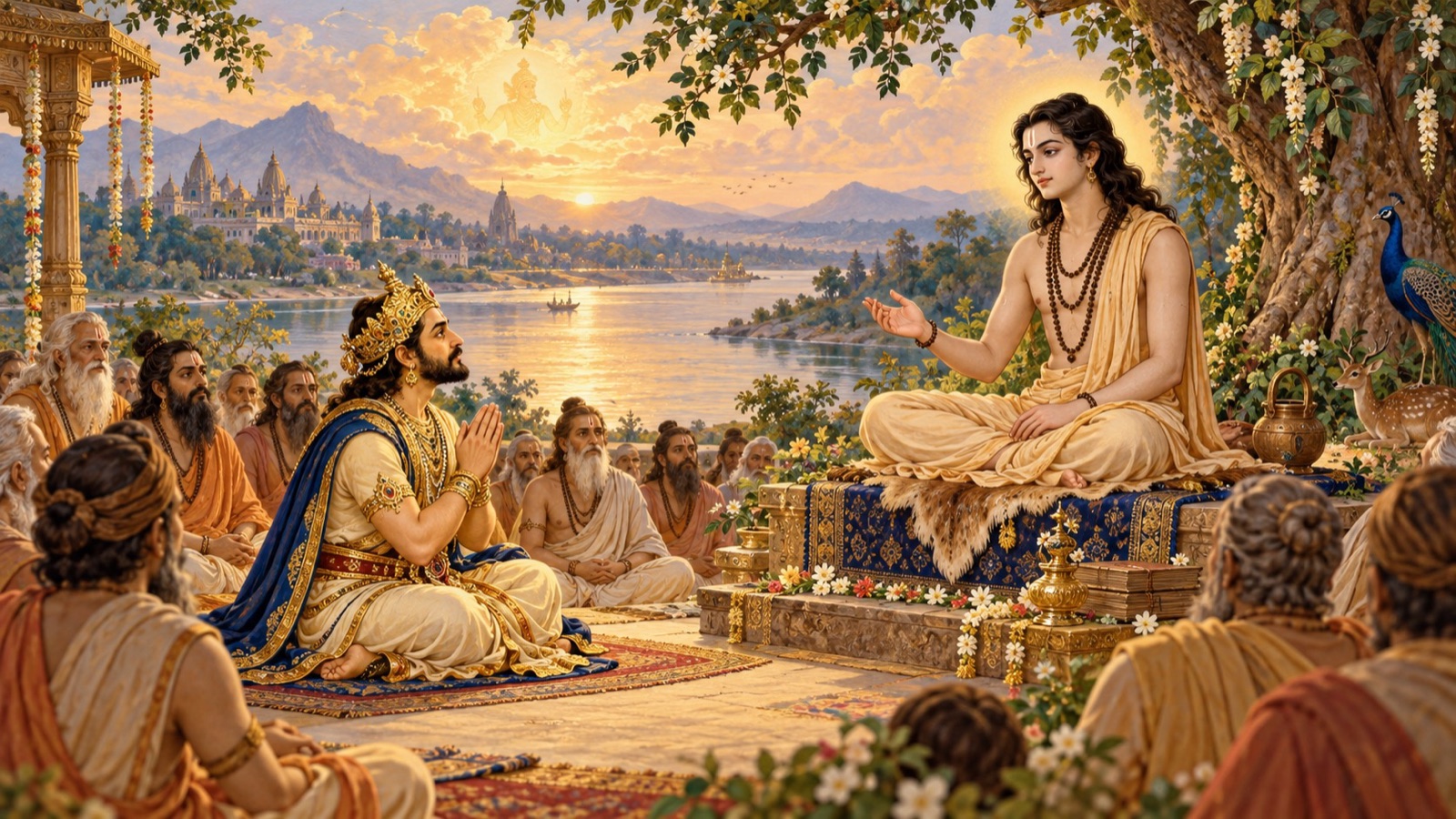
King Parikshit recalled that his teacher had spoken of the terrestrial globe as reaching across the whole range where the sun sheds its light and the moon and stars are seen, and that within it lie the seven oceans formed by the furrows of Emperor Priyavrata’s chariot-wheels, which divided the earth into seven Dwipas. Now the king longed to know it all fully — yet he asked not as one gathering facts, but as a devotee seeking the Lord. For, as he explained, the mind first steadied upon the Lord’s vast material form grows fit to be turned inward at last toward the subtle, self-luminous Reality known as Lord Vasudeva.
भगवतो गुणमये स्थूलरूप आवेशितं मनो ह्यगुणेऽपि सूक्ष्मतम आत्मज्योतिषि परे ब्रह्मणि भगवति वासुदेवाख्ये क्षममावेशितुं तदु हैतद् गुरोऽर्हस्यनुवर्णयितुमिति ॥ ३ ॥
bhagavato guṇamaye sthūla-rūpa āveśitaṁ mano hy aguṇe ’pi sūkṣmatama ātma-jyotiṣi pare brahmaṇi bhagavati vāsudevākhye kṣamam āveśituṁ tad u haitad guro ’rhasy anuvarṇayitum iti
Meaning: When the mind is first absorbed in the Lord’s gross material form — this universe of the three modes — it becomes fit, in time, to be absorbed in the subtle, self-effulgent, transcendent Supreme Brahman known as Lord Vasudeva; therefore, O my teacher, be pleased to describe this. (Canto 5, Chapter 16, verse 3)
The Sage’s Reply and the Lotus-Earth
The sage received the question with humility. No man, he said, could ever measure with his mind, far less tell in words, the boundless display that the Lord’s power of Maya has set forth as this universe. And so he would speak only of what can be told: the chief features of the terrestrial world. The land in which we dwell, he began, he likened to a lotus itself.
यो वायं द्वीप: कुवलयकमलकोशाभ्यन्तरकोशो नियुतयोजन विशाल: समवर्तुलो यथा पुष्करपत्रम् ॥ ५ ॥
yo vāyaṁ dvīpaḥ kuvalaya-kamala-kośābhyantara-kośo niyuta-yojana-viśālaḥ samavartulo yathā puṣkara-patram
Meaning: This Dwipa in which we live is the innermost whorl of the lotus-like earth; it measures one lakh yojanas across and is perfectly round, like the corolla of a lotus. (Canto 5, Chapter 16, verse 5)
Within this lotus-land, he related, lie nine Varsas, or realms, each nine thousand yojanas in extent, clearly set apart by eight great mountain ranges that form their boundaries.
Golden Meru at the Heart of Ilavrta
At the very centre of these nine realms lies the inner land called Ilavrta, and at its heart rises the king of all mountains — Meru, also called Sumeru — made entirely of gold, forming the very seed-cup of the lotus-earth.
एषां मध्ये इलावृतं नामाभ्यन्तरवर्षं यस्य नाभ्यामवस्थित: सर्वत: सौवर्ण: कुलगिरिराजो मेरुर्द्वीपायामसमुन्नाह: कर्णिकाभूत: कुवलयकमलस्य मूर्धनि द्वात्रिंशत् सहस्रयोजनविततो मूले षोडशसहस्रं तावतान्तर्भूम्यां प्रविष्ट: ॥ ७ ॥
eṣāṁ madhye ilāvṛtaṁ nāmābhyantara-varṣaṁ yasya nābhyām avasthitaḥ sarvataḥ sauvarṇaḥ kula-giri-rājo merur dvīpāyāma-samunnāhaḥ karṇikā-bhūtaḥ kuvalaya-kamalasya mūrdhani dvā-triṁśat sahasra-yojana-vitato mūle ṣoḍaśa-sahasraṁ tāvat āntar-bhūmyāṁ praviṣṭaḥ
Meaning: At the centre of these lands lies the inner realm named Ilavrta, and at its heart stands golden Meru, king of mountains, as high as the Dwipa is wide, forming the seed-cup of the lotus-earth — thirty-two thousand yojanas across at its summit, sixteen thousand at its base, its root sunk sixteen thousand yojanas beneath the ground. (Canto 5, Chapter 16, verse 7)
The Mountain Ranges that Divide the Land
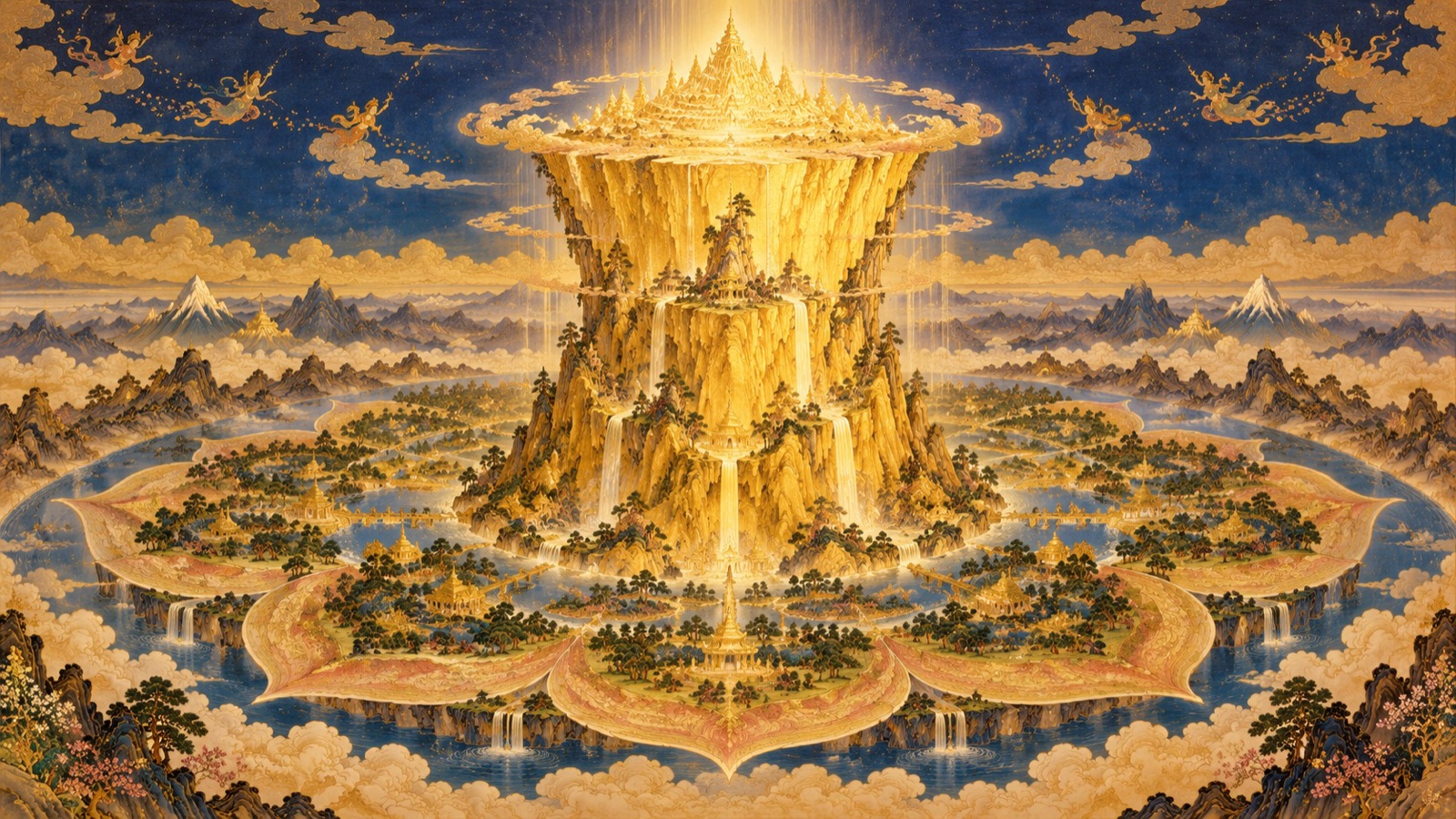
Around this golden centre stand the ranges that mark off realm from realm. To the north of Ilavrta rise Nila, Sweta and Srngavan, bounding the realms of Ramyaka, Hiranmaya and Kuru. To the south rise Nisadha, Hemakuta and Himalaya, bounding Harivarsa, Kimpurusavarsa and Bharatavarsa — this last the holy land we ourselves inhabit. And to the west and east stand Malyavan and Gandhamadana, bounding Ketumala and Bhadraswa. So the one lotus-land is divided by its eight ranges into nine shining realms, with golden Meru enthroned at the centre of all.
The Four Great Trees, Lakes and Gardens
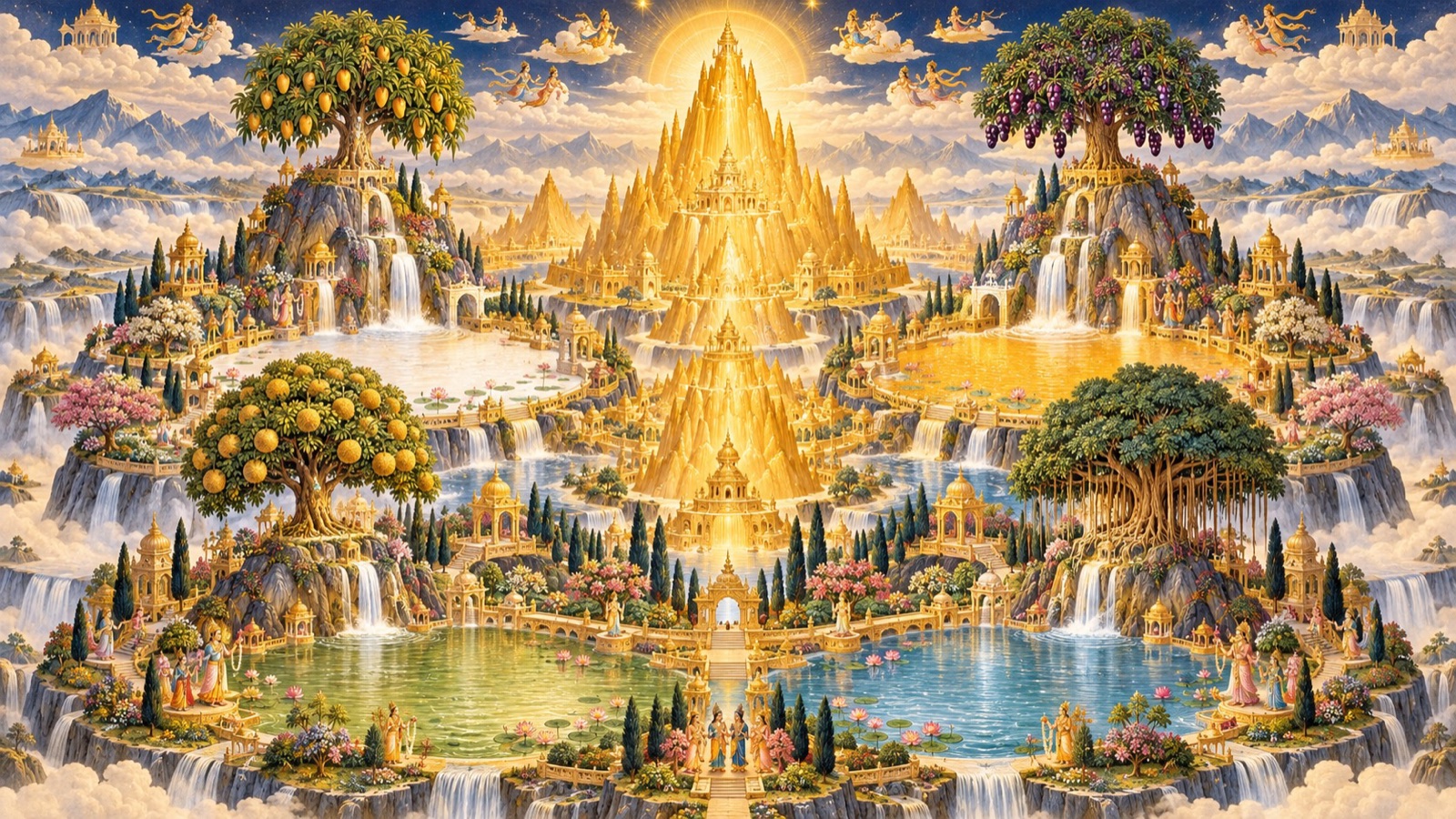
On the four sides of Meru stand four mountains — Mandara, Merumandara, Suparswa and Kumuda — like buttresses upholding the central peak. Upon them rise four mighty trees, standing like banners: a mango, a Jambu or rose-apple, a Kadamba and a banyan, each eleven hundred yojanas tall, their branches spreading as wide as they are high.
Nearby lie four great lakes — of milk, honey, sugar-cane juice and pure sweet water — whose demigods, sipping from them, come by their own nature to possess the powers of yoga; and there are four celestial gardens as well: Nandana, Caitraratha, Vaibhrajaka and Sarvatobhadra.
ह्रदाश्चत्वार: पयोमध्विक्षुरसमृष्टजला यदुपस्पर्शिन उपदेवगणा योगैश्वर्याणि स्वाभाविकानि भरतर्षभ धारयन्ति ॥ १३ ॥ देवोद्यानानि च भवन्ति चत्वारि नन्दनं चैत्ररथं वैभ्राजकं सर्वतोभद्रमिति ॥ १४ ॥
hradāś catvāraḥ payo-madhv-ikṣurasa-mṛṣṭa-jalā yad-upasparśina upadeva-gaṇā yogaiśvaryāṇi svābhāvikāni bharatarṣabha dhārayanti; devodyānāni ca bhavanti catvāri nandanaṁ caitrarathaṁ vaibhrājakaṁ sarvatobhadram iti
Meaning: There are four lakes — of milk, honey, sugar-cane juice and pure water — and the demigods who drink of them naturally gain mystic powers, O best of the Bharatas; and there are four celestial gardens: Nandana, Caitraratha, Vaibhrajaka and Sarvatobhadra. (Canto 5, Chapter 16, verses 13-14)
There the foremost gods take their delight, their glories sung by hosts of the demigods.
Rivers of Nectar from the Four Great Trees
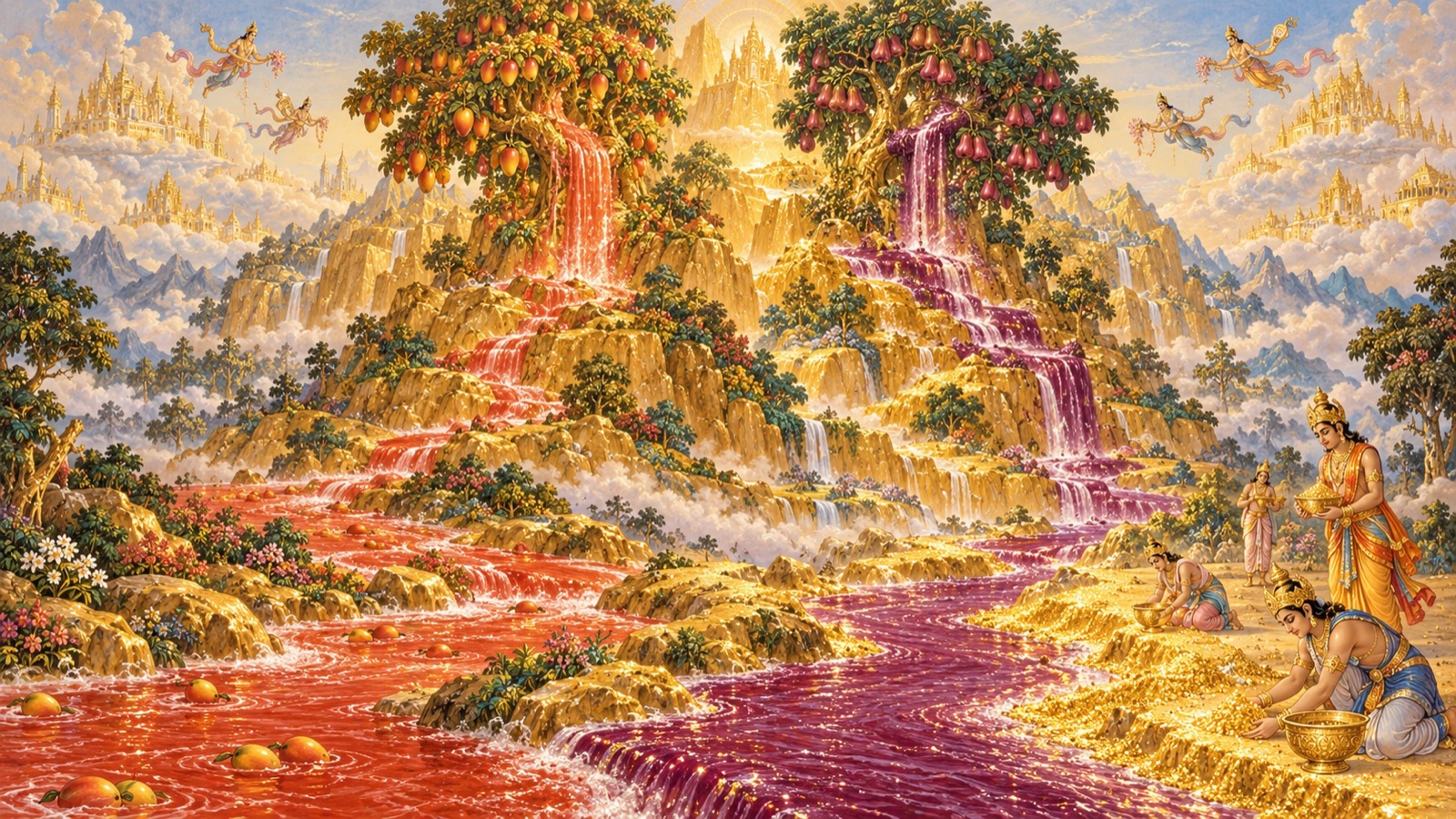
From these towering trees flow rivers of wonder. From the crown of the mango tree upon Mount Mandara, fruits huge as mountain-peaks and sweet as nectar come tumbling down; from their bursting, fragrant, scarlet juice is born the river Arunoda, which pours from the summit to water the eastern part of Ilavrta, so sweet that the breeze carries its fragrance for ten yojanas around.
In the same way, from the rose-apples of the Jambu tree — each as large as an elephant — springs the river Jambu, falling from the summit of Merumandara to water the southern part of Ilavrta. And here a marvel unfolds upon its banks.
तावदुभयोरपि रोधसोर्या मृत्तिका तद्रसेनानुविध्यमाना वाय्वर्कसंयोगविपाकेन सदामरलोकाभरणं जाम्बूनदं नाम सुवर्णं भवति ॥ २० ॥ यदु ह वाव विबुधादय: सह युवतिभिर्मुकुटकटककटिसूत्राद्याभरणरूपेण खलु धारयन्ति ॥ २१ ॥
tāvad ubhayor api rodhasor yā mṛttikā tad-rasenānuvidhyamānā vāyv-arka-saṁyoga-vipākena sadāmara-lokābharaṇaṁ jāmbū-nadaṁ nāma suvarṇaṁ bhavati; yad u ha vāva vibudhādayaḥ saha yuvatibhir mukuṭa-kaṭaka-kaṭi-sūtrādy-ābharaṇa-rūpeṇa khalu dhārayanti
Meaning: The clay on both banks of that river, drenched with the juice and ripened by wind and sun, turns into the gold called Jambunada, the eternal ornament of the immortals, which the gods and their consorts wear as crowns, bangles and girdles. (Canto 5, Chapter 16, verses 20-21)
Yet the sage does not leave this description as an idle wonder. That the very mud of a riverbank there hardens into the gold that crowns the immortals is a hint of the whole heavenly order, and Vaishnava teachers have long read it as an unspoken caution (verses 20–21): what is treasure to this earth is common dust in a higher horizon of the Lord’s creation, and a soul who has tasted devotion to the Lord no more covets the ornaments of the demigods than gilded dirt. The lesson cuts sharper still where the world below is concerned — where scarcity turns even a small and borrowed showing of gold into proof of divinity for the unwary. True wealth, the sage’s whole vision here quietly insists, is never the metal but the shelter of the Lord’s own feet.
The trees give still more. From the hollows of the great Kadamba on Mount Suparswa flow five torrents of honey, delighting the western region of Ilavrta; and from the banyan Satavalsa upon Mount Kumuda stream down all that one could wish — milk and curds, honey and clarified butter, grains, and even raiment, beds and ornaments — blessing the northern region. And of those who partake of these rivers the sage tells us a beautiful thing: they never know wrinkles or grey hairs, old age or disease or untimely death, but pass their whole lives in happiness beyond measure.
The Mountains Around Meru and the City of Brahma
Like filaments encircling the seed-cup of a lotus, twenty mountains stand around the foot of Meru — among them Kuranga, Trikuta, Sisira, Sankha, Vaidurya, Hamsa, Rsabha and Narada. And nearer still, guarding the four quarters, rise eight great mountains: Jathara and Devakuta to the east, Pavana and Pariyatra to the west, Kailasa and Karavira to the south, and Trisrnga and Makara to the north. Enclosed by these eight, golden Sumeru shines like a sacred fire ringed about with blades of kusa grass.
Upon the summit of Meru, at the very centre of all, stands the city of Brahma the self-born, built entirely of gold — a vast and shining square realm, the seat of the first of created beings.
मेरोर्मूर्धनि भगवत आत्मयोनेर्मध्यत उपक्लृप्तां पुरीमयुतयोजनसाहस्रीं समचतुरस्रां शातकौम्भीं वदन्ति ॥ २८ ॥
meror mūrdhani bhagavata ātma-yoner madhyata upakḷptāṁ purīm ayuta-yojana-sāhasrīṁ sama-caturasrāṁ śātakaumbhīṁ vadanti
Meaning: Upon the summit of Meru, at its very centre, stands the golden city of Brahma the self-born; the wise declare it to be a vast square realm of great extent, fashioned wholly of gold. (Canto 5, Chapter 16, verse 28)
Round about that city, built after the same pattern, stand the eight cities of the guardians of the quarters — Indra and the rest — each set in its allotted direction and a fourth the extent of Brahma’s own. So the sage completes his vision of the terrestrial world, up to the golden crown of Meru where the guardians of creation dwell.
Principal Teachings of This Chapter
The earth itself is a form of the Lord. Parikshit asks about the world not from idle curiosity, but because the mind that rests upon the Lord’s vast visible form is being prepared to rest upon His formless Self. To behold creation with wonder is the beginning of devotion — and, as even Sukadeva confesses that the Lord’s Maya cannot be measured by any mind, to behold it in humility.
The world is fashioned like a lotus. The lotus, born in water yet unstained by it, is the scripture’s own emblem for the earth — round and open, with golden Meru as its seed-cup — a reminder that the world rests upon the Lord from whose navel the first lotus sprang.
Abundance flows from a divine centre. The trees pouring out rivers of nectar, the streams that yield every good thing, the banks whose clay becomes gold — all speak of a creation overflowing with the Lord’s generosity. And as ranges, mountains and cities stand arrayed around golden Meru, so the devotee learns to order every part of life around the one sacred centre — the Lord.
A Devotional Reflection
There is a quiet tenderness in the way King Parikshit asks about mountains and oceans and measures, and in the way his teacher answers. This is not the curiosity of one who would conquer the earth, but the longing of a soul who wishes to love the Lord more fully by beholding the greatness of what He has made. This whole vision — the lotus-land, the golden mountain, the rivers whose banks turn to gold — is offered not as a puzzle to be solved but as a wonder to be received; and when we let ourselves marvel at it, the heart is led gently from the visible to the Invisible who upholds it. This, the sage tells us at the outset, is the whole purpose: that the mind, first steadied upon the Lord’s immense form, may be carried at last to the Reality that is Lord Vasudeva. To read this chapter slowly is itself a kind of worship.
A Daily Devotional Practice
Today, step outside for a few quiet moments and look upon some small part of the earth — a hill on the horizon, a river, a tree heavy with fruit, the light of the sun or the moon. Instead of passing it by, pause and remember, as Sukadeva teaches, that this visible world is the gross form of the Lord, fashioned to lead the mind toward Him. Let the wonder you feel become a prayer, and say inwardly: “Om Namo Bhagavate Vasudevaya.” In this simple turning of attention — from what is made to the One who made it — you practise the very thing this chapter teaches.
Conclusion
The sixteenth discourse of Book Five opens a vision of the terrestrial world as the visible form of the Lord. In answer to King Parikshit, Sukadeva describes Jambudvipa, the land in which we dwell, as a lotus one lakh yojanas wide, with golden Meru rising at its centre like the flower’s seed-cup. He tells of the eight ranges that divide the land into nine realms, of the four buttress-mountains crowned with their mighty trees, and of the rivers of nectar whose banks turn to gold and whose waters free all who drink from age and sorrow. Upon the summit stands the golden city of Brahma, encircled by the cities of the guardians. Through it all runs a single note of wonder — that the mind, resting upon this immense creation, may be led beyond it to the Lord who is its source and its refuge.
May the divine wisdom of Srimad Bhagavatam awaken pure devotion within our hearts.
Om Namo Bhagavate Vasudevaya.
Jay Shree Madhav.
References and Attribution
- Primary edition: Gita Press, Śrīmad Bhāgavata Mahāpurāṇa, Book Five, Discourse 16, “A description of the terrestrial world.”
- Series: Srimad Bhagavatam Wisdom · Biswa Sanatan Dharma Seva Trust.
- Presented following the spiritual guidance and recommendation of Pandit Dr. Shri Kashinath Mishra.
This is an original, faithful retelling in the writer’s own words, with brief quoted verses shown in Devanāgarī and transliteration and their meanings given as summaries. It is not a reproduction of any publisher’s continuous translation or commentary, and no affiliation or endorsement is implied.
Jay Shree Madhav