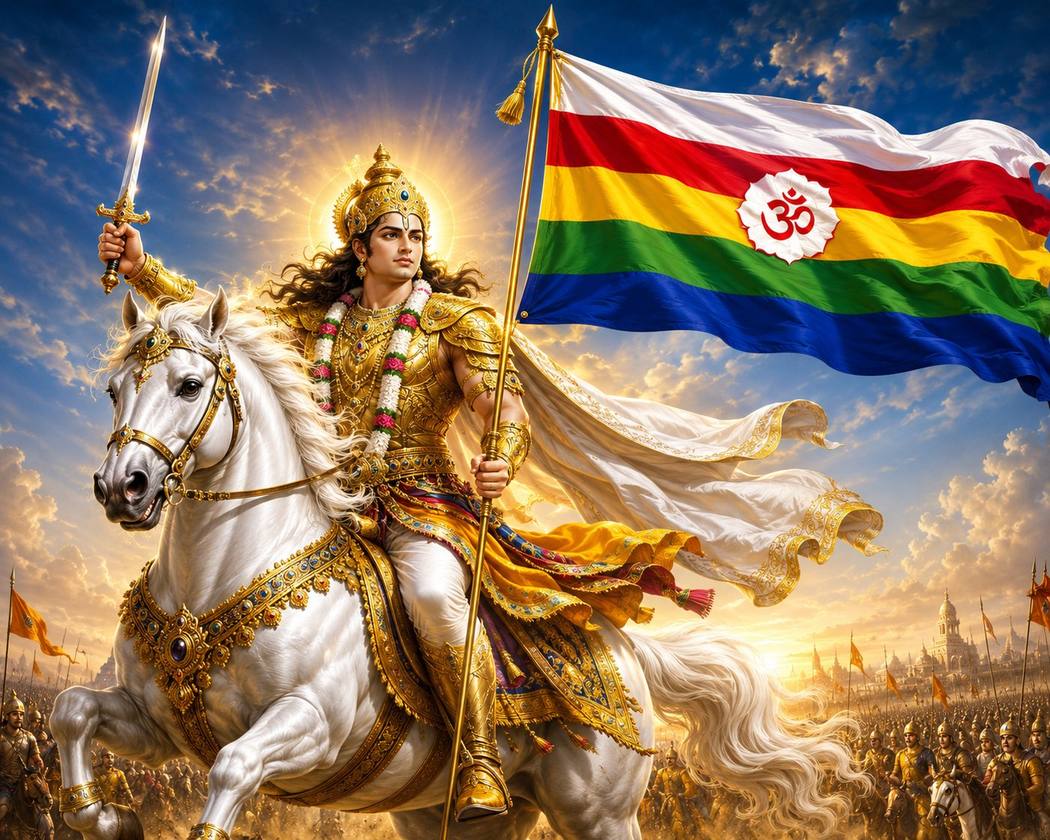
Any prediction can claim victory quietly by staying vague. "A great teacher will come" is unfalsifiable in every direction — it can absorb almost any claimant without friction. The Bhavishya Malika does not take that easy path. Centuries before the question could even arise, it made a specific, checkable claim: before the true Lord Kalki is recognized, a number of false claimants would appear first — and it named the number.
1. The prophecy: twelve false Kalkis
Mahapurush Achyutananda Das, writing in Kuta Bodhuni, states plainly that before the true Lord Kalki manifests, twelve false Kalkis — pretenders — will appear and mislead people, and that devotees must test each one against the Malika's own signs rather than accept a claim at face value.
Source: Kuta Bodhuni (Achyutananda Das), p.51
Notice what this prophecy does not do. It does not say "beware of false teachers" as generic spiritual caution — every tradition says that. It gives a specific count, twelve, and frames the false claimants as a predictable phase of the end-time transition itself, arriving in a sequence, before the real one is known. That is a claim with edges. It can be checked against events, and it can be wrong.
2. The dated event: August 2025
On 10 August 2025, multiple men publicly claimed to be Kalki — a cluster of claims appearing in close succession, reported at the time and logged on the bhavishyamalika.com proofs registry as a direct match to the Malika's twelve-false-Kalkis warning. It sits beside two other 2025 developments in the same window: the Pahalgam attack (22 April) and Operation Sindoor (7 May), both matching the Malika's foretold conflict sequence, and both already documented on this site's predictions ledger.
The claimants were not a single isolated eccentric. They were plural, public, and clustered in time — which is exactly the shape the six-hundred-year-old warning described, long before anyone alive today could have staged it to fit.
3. Why a prophecy would predict its own counterfeits at all
This is worth sitting with, because it is not the obvious move for anyone inventing a scripture after the fact. If you wanted to build a following around a coming Avatar, the simplest strategy is to say nothing about impostors — let every claimant, including a fraud, borrow your credibility freely. Warning your own readers that fakes are coming, and telling them exactly how many, only makes sense if you actually expect the fakes to show up and want your community to survive contact with them intact.
Put differently: the twelve-false-Kalkis verse is not decoration. It is the Malika inoculating its own readers against exactly the kind of confusion a real prophetic tradition would expect to generate once the timing window opened — which, as the Saturn-in-Pisces article on this site explains, is precisely where the world now stands.
4. How the Malika says to test a claimant
The Malika does not leave devotees to guess. Kuta Bodhuni's instruction is to test each claimant against the Malika's own signs — not charisma, not the size of a following, not a claimant's own say-so. Those signs are laid out across this site's teaching chapters: birth in Sambhal, as the Srimad Bhagavat and Mahabharata both record; recognition tied to the signs at Shri Jagannath Temple; a life aligned with dharma rather than self-promotion; and timing that matches the scripture's own count, not a claimant's convenience. A true sign-set is checkable by anyone willing to look; a false claim asks only to be believed.
This is also why Pandit Dr. Shri Kashinath Mishra's own teaching insists repeatedly that devotion is not owed to a person's declaration about himself — it is owed to a pattern that either matches six centuries of specific, dated prophecy, or does not.
5. What the false claimants prove, and what they don't
A false Kalki appearing does not weaken the prophecy — the prophecy said this would happen. If anything, the arrival of plural, public claimants in the very window the Malika's timing verses describe strengthens the case that the described transition is genuinely underway: the counterfeit only exists because there is something worth counterfeiting. What it proves is not that any particular man is the Avatar; it proves that the Malika's authors, writing centuries ago, correctly anticipated a specific social phenomenon that has now, in fact, occurred.
6. Discernment, not fear
None of this calls for suspicion of every spiritual teacher or a retreat into cynicism — that would be its own kind of error. It calls for the same steady practice the Malika recommends everywhere else: hold to Tri-Sandhya, chant Madhava, read the Shrimad Bhagavat, and let the scripture's own dated, specific signs — not a claimant's charisma — be the measure. The twelve false Kalkis are a described feature of the corridor we are in, not a reason to fear it.
Jay Shree Madhava