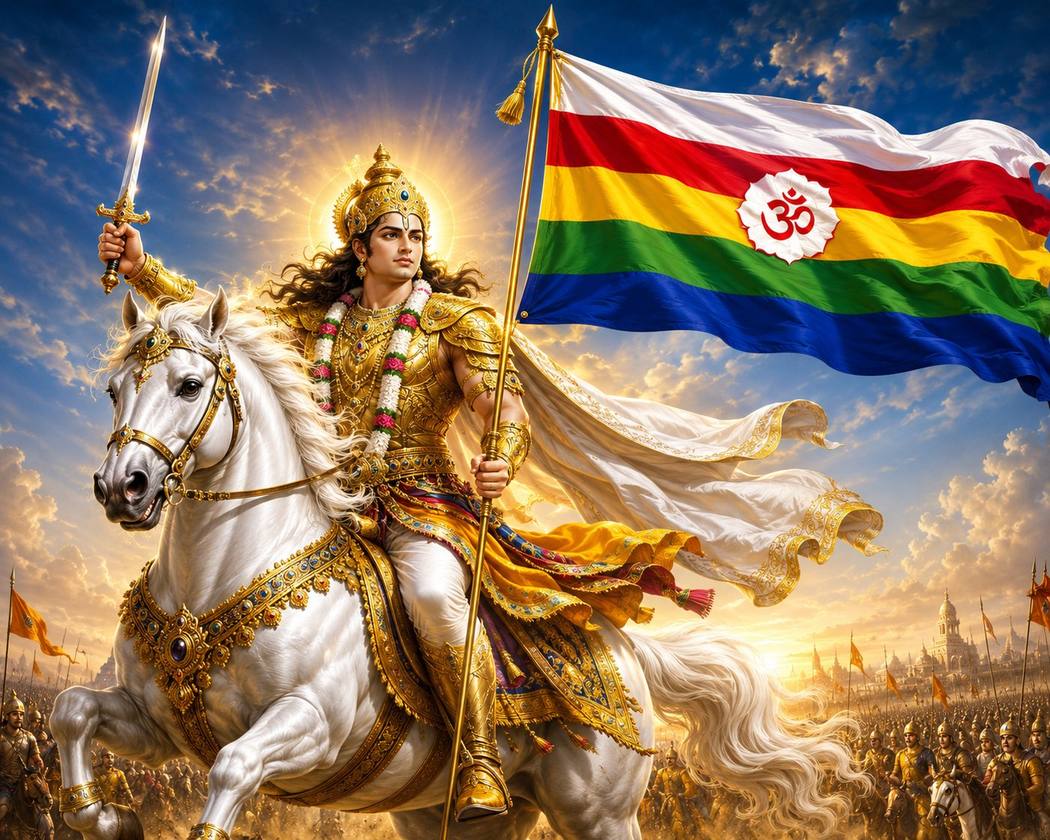
Ask most people where a prophecy about a coming avatar comes from, and they assume it must be a recent claim — a modern guru, a new movement, a text nobody can verify. The question of Kalki's birthplace is different. It does not begin with the Bhavishya Malika at all. It begins over a thousand years earlier, in two texts every school of Sanatana Dharma already accepts as scripture: the Srimad Bhagavatam and the Mahabharata, both attributed to Maharishi Vyasa. Both name the same village. The Malika, composed some six hundred years ago by the Panchasakha, adds nothing new here — it simply repeats, in its own verses, a location its authors inherited rather than invented.
1. The Srimad Bhagavatam names it first
The Bhagavatam's twelfth canto, describing the final events of Kali Yuga, states plainly where the last avatar of Vishnu will appear:
"śambala-grāma-mukhyasya brāhmaṇasya mahātmanaḥ / bhavane viṣṇuyaśasaḥ kalkiḥ prādurbhaviṣyati"
Source: Srimad Bhagavatam (Maharishi Vyasa)
Meaning: Lord Kalki will manifest in the home of Vishnu Yash — a great-souled brahmin, foremost of the village of Sambal (Sambhal).
This is not an obscure or disputed line. It is one of the standard verses cited whenever the Bhagavatam's account of Kali Yuga's end is discussed, in a text with a settled place in the canon long before the Malika's authors were born. The father named here — Vishnu Yash — is the same figure the Bhavishya Malika itself identifies as Kalki's father, a detail that will matter shortly.
2. The Mahabharata's Vana Parva says the same
The Mahabharata, in the section of its Vana Parva known as the Markandeya-Samasya Parva, gives an almost identical account, this time naming the child directly by the family name he will carry:
"kalki viṣṇuyaśā nāma dvijaḥ kālapracoditaḥ … sambhūtaḥ sambhalagrāme…"
Source: Mahabharata, Vana Parva (Maharishi Vyasa)
Meaning: Kalki, named for his father Vishnu Yash, a brahmin impelled by time itself, will be born in the village of Sambhal.
Two separate scriptures, two separate sections of the vast Vyasa corpus, composed centuries apart from one another in the traditional chronology — and both converge on the identical village name: Sambal Gram, known today as Sambhal. Neither verse hedges. Neither is framed as a possibility among several. Both simply state it as settled fact, the way a genealogist records a birth registry rather than floats a theory.
3. What "Sambhal" refers to today
The village named in these ancient texts is widely identified in the living tradition with the town of Sambhal in Uttar Pradesh, home to an ancient Kalki-Vishnu temple that has drawn pilgrims associated with this prophecy for generations. This site is the "Sambhal" this teaching refers to — the same name the Bhagavatam and the Mahabharata already recorded, long before any modern claim was made about it.
4. The Bhavishya Malika's own confirmation
When the Panchasakha came to compose the Bhavishya Malika roughly six centuries ago, they were not introducing a new geography for the avatar's birth. They were writing inside a tradition that had already fixed the location twice over. Achyutananda Das's own verse reflects exactly this inherited detail:
"gupatare mu hiṁ kheḷa karibi / sambala nagre muṁ janma hoibi / nabama janma mo gopana heba / … sudāma aṅgare heba prakāśa"
Source: Kali Kalpa Gita (Achyutananda Das), Ch.3, p.12
Meaning: Secretly I will perform My play; I will take birth in Sambal Nagar; this, My ninth birth, will remain hidden — and will be revealed through the devotee Sudama.
Separately, the Malika states that Sambal Gram is confirmed as the prophesied location of the Lord's manifestation, and that devotees who go there and keep Trisandhya are among those recognized when the time comes — a teaching drawn together across Pata Madana (Sishu Ananta Das) and Tera Kanu Sharana (Achyutananda Das). The wording differs from Vyasa's Sanskrit, as one would expect from a text composed in Odia over a thousand years later — but the place-name does not move. Three scriptures, three languages of composition, three different centuries, one village.
5. Why this convergence matters more than any single verse
A single prophecy can always be read as coincidence, or as a later addition slipped into an older text. What is harder to dismiss is agreement across independent sources that never consulted each other. The Bhagavatam and the Mahabharata were compiled long before any of the Panchasakha lived. The Panchasakha, writing centuries later in a different language and region, had no need to match Vyasa's geography unless they believed — or had independently received — the same underlying truth. Coincidence has a budget, and three separate scriptural traditions naming the identical village for the same unborn avatar spends most of it.
This is also why the Malika's authors treat Sambhal as settled background rather than as their own discovery. Their attention goes elsewhere — to the timing (the Meena-Shani window already fulfilled on 29 March 2025), to the signs at Jagannath Temple, to the practice that prepares a devotee for what is coming. The birthplace was never the part in question. It was recorded, twice, a thousand years before the Malika existed to record it a third time.
6. What this asks of a reader now
None of this is offered as a location to travel to in anxiety, or as a countdown to fear. The same corpus that names Sambhal also names the path that matters far more than geography: chanting Madhava, keeping Tri-Sandhya at its three daily windows, living simply and honestly. A birthplace fixed a thousand years in advance, confirmed across three scriptures, is a sign of how carefully this account was assembled — not a summons to worry about where He appears, but an invitation to be ready in the one place that has always been within reach: one's own conduct, as the world crosses into Satya Yuga, beginning 2032.
Jay Shree Madhava