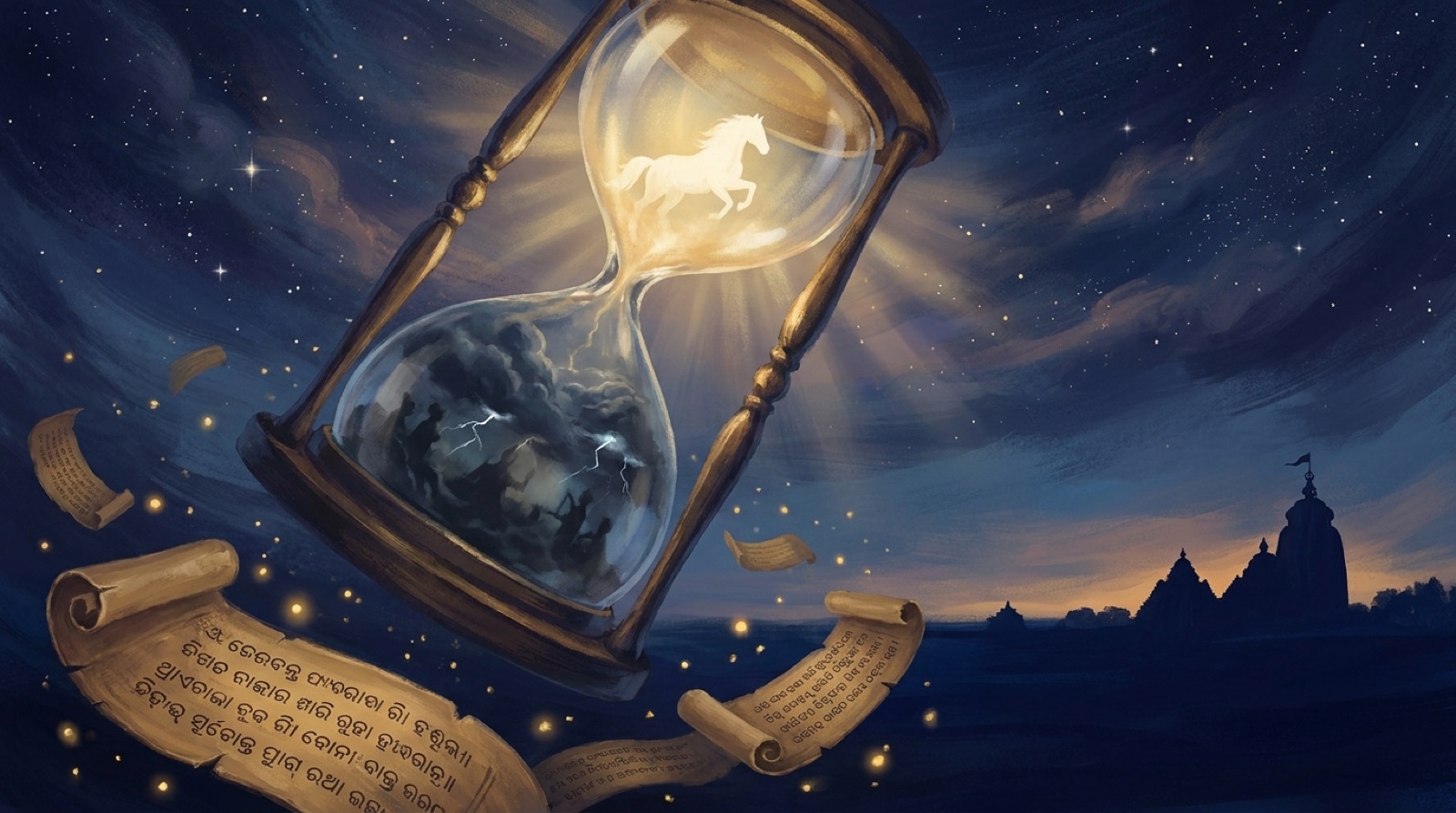
If you learned about the Hindu cosmic ages from an encyclopedia, you were probably told that Kali Yuga — the age of discord — began in 3102 BCE and will last 432,000 years. By that arithmetic, humanity has more than four hundred thousand years of darkness still ahead, and any talk of a new golden age is fantasy.
But the scriptures themselves tell a more precise, and far more hopeful, story. When the classical texts of Sanatana Dharma are read side by side — Manusmriti, Nirnay Sindhu, Garga Samhita, and the 600-year-old Bhavishya Malika of Odisha — they converge, with remarkable consistency, on a very different figure: Kali Yuga's experienced lifespan is 5,000 years.
And by the traditional count from the beginning of Kali Yuga, 5,124 years have already passed.
That is the entire claim of this article, and it deserves to be examined verse by verse. Not asserted — examined.
1. The 432,000-year figure is the potential lifespan — not the destined one
The Bhavishya Malika does not deny the classical figure; it explains it. Mahapurush Achyutananda Das, chief of the Panchasakha — the five saint-poets who composed the Malika in 15th–16th century Odisha at the direction of Lord Jagannath — writes:
“cāri lakhya je batiśa sahastra,
kali Yuga ra aṭai āyuṣa
pāpa bhārā re kali tuṭi jiba,
pānca sasra kali bhoga hoiba”
Source: Bhakta Cetāvanī, Achyutananda Das
Meaning: The total potential lifespan of Kali Yuga is 432,000 years. However, under the burden of humanity's sins, the age will be cut short — only 5,000 years will actually be lived through.
An age shortened by the weight of its own adharma: the scriptures use the analogy of a lifespan reduced by one's own deeds. The 432,000 years is the vessel; 5,000 years is what the vessel actually holds.
2. Three classical scriptures arrive at the same window — independently
What makes the 5,000-year figure compelling is that it does not rest on the Malika alone. Consider three texts written centuries apart, in different regions, for different purposes.
Manusmriti, one of the oldest law-books of Sanatana Dharma, states:
“catvāryāhuḥ sahastrāṇi varṣāṇāṁ tu kr̥tam yugam
tasya tāvacchatī sandhyā sandhyāśaśca tathāvidhaḥ”
Source: Manusmriti 1.69
Meaning: The age runs 4,000 years, with two twilight periods (sandhyā) — each one-tenth of the age, 400 years — one at its dawn and one at its dusk. Total: 4,800 years.
Nirnay Sindhu, the authoritative dharmaśāstra digest, repeats the calculation:
“catvāryabdasahastrāṇi catvāryabdaśatāni ca
kaleryada gamisyanti tadā pūrva yugāśritam”
Source: Nirnay Sindhu
Meaning: When 4,000 years of Kali, plus its 400-year twilights, have passed — the previous (Satya) Yuga returns.
And the Garga Samhita of the sage Garga Muni — the astrologer of Lord Krishna's own family — goes one step further. It does not merely end the age; it names what happens next:
“abdāścatuḥ sahastrāṇi kalau catuḥ śatāni ca
gate girivare hi śrīnāthaḥ prādu bhaviṣyati”
Source: Garga Saṁhitā
Meaning: When 4,000 years of Kali Yuga and the 400 years of its twilight have passed, Lord Maha-Vishnu (Shree Nath) will incarnate on Earth.
Three classical sources: 4,800 years. The Panchasakha, writing under divine instruction six centuries ago, amended the figure by 200 years — declaring the full experienced span of Kali Yuga to be 5,000 years, followed by the twilight age of transition in which the Lord takes His final avatar.
3. The Malika's own verses: after 5,000 years, the Lord takes human birth
Across the Panchasakha's books, the same prophecy is repeated with the precision of a signature. Sishu Ananta Das writes:
“kali Yuga pānca sahasra gale, Biṣṇu je janama hoibe bhale
pānca sahasra re nara śarīre, Biṣṇu je rājuti karibe bhale”
Source: Pata Madana, Sishu Ananta Das
Meaning: When 5,000 years of Kali Yuga have passed, Lord Vishnu will take a noble human birth — and in a human body He will reign.
Achyutananda Das records where the Lord will come from:
“thikaṇā amara pura,
thākura tahīn ru hebe bāhāra, Rāmacandra re,
ṭhāri pānca sahasra ku dhara, Rāmacandra re”
Source: Bhabisyata Chautisā, Achyutananda Das
Meaning: From the immortal abode — Nilachal Dham, the seat of Lord Jagannath in Puri — the Lord will emerge, when the count of 5,000 years is held.
And Hadidas of Chhatia, revered as a later incarnation of Achyutananda, completes the picture:
“sambaschar panch sahasra kali hoib shesha,
satya yuga adya hoib shubh joge prakash”
Source: Kali Chautisā, Hadidas
Meaning: After 5,000 years Kali Yuga ends — and in an auspicious conjunction, the dawn of Satya Yuga is revealed.
4. Now do the arithmetic
The traditional epoch of Kali Yuga is fixed by the passing of Lord Krishna. Count forward from that epoch to today and you arrive at 5,124 years elapsed.
Pandit Dr. Shri Kashinath Mishra — the Odia scholar who has spent more than four decades studying the Bhavishya Malika and is its foremost living interpreter — states the conclusion without hedging: "Kali Yuga has ended. It has been 5,124 years." We are not waiting for the end of the dark age. We are living just past it, in the period the Malika calls Sangam Yuga or Yuga-Sandhya — the twilight between two ages, when the old world dissolves and the new one quietly takes root.
The Malika even marks the twilight with an astronomical signature. Achyutananda encodes the number 5,000 in a riddle of Odia numerals, and ties the turning point to Shani entering Meena Rashi — Saturn's transit into Pisces, an event of our own decade:
“thikana Achyuta kale,
tha tini bame pancha rakhile Ramachandra he
thaki jiba mina shani bhale Ramachandra he”
Source: Bhaviṣya Mālikā, Achyutananda Das
Meaning: Write the numeral zero three times, place five to its left — 5,000. When those years have passed, Saturn will stand in Pisces; then the upheaval comes, and only then will people finally understand the Malika.
A 600-year-old palm-leaf manuscript pointing to a planetary transit in the 2020s: this is the kind of specificity that separates the Bhavishya Malika from vague apocalyptic literature. Either the verses are wrong — or the age has turned while most of the world wasn't looking.
5. What this means — and what it does not mean
It does not mean doom. This must be said clearly, because the internet is full of fear, and fear is precisely what the Malika does not teach. The teaching is that the transition we are now living through — with its wars, pandemics, strange weather and stranger omens — is the final clearing before something unprecedented: Satya Yuga, the age of truth, beginning in 2032.
The Garga Samhita's promise is the heart of it: at exactly this point in the count, the Lord incarnates. The Malika teaches that Lord Jagannath Himself takes His final avatar as Kalki — born, as the Srimad Bhagavat and Mahabharata both record, in the home of a Vishnu-devoted Brahmin of Sambhal — and that those who hold to dharma cross the twilight safely into the new age.
What should a person actually do with this knowledge? The Malika's answer has not changed in six hundred years: chant the name of Madhava, keep the three daily prayer-windows of Tri-Sandhya, read the Srimad Bhagavat, live cleanly, and keep the company of truth. Not panic — practice.
In the coming days on this blog we will examine the evidence the other way around: not what the scriptures predicted, but what has actually been happening — dated, documented, and often reported in the mainstream press — at the temple of Lord Jagannath in Puri and across the world. The correspondence is not subtle.
Verses quoted verbatim from the Bhavishya Malika corpus and classical scriptures as compiled in our Teaching Chapter 3: Age of the Four Yugas. Explore all 10 chapters, or ask any question in the Q&A App, which searches 200+ recorded sessions of Pandit Dr. Shri Kashinath Mishra.
Jay Shree Madhava