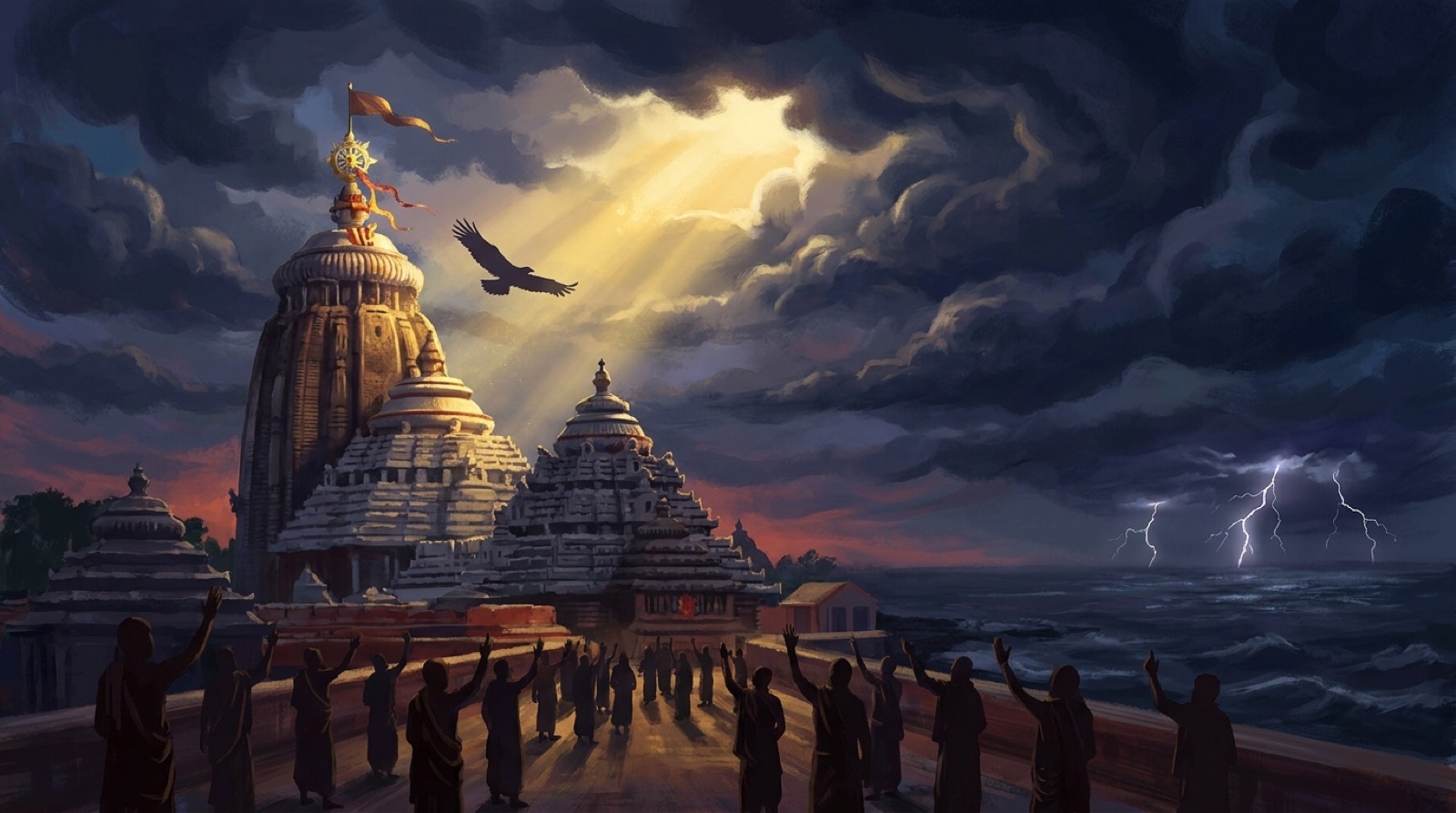
The Rath Yatra of Puri is one of the most witnessed religious events on Earth: over a million pilgrims pull the chariots by hand through the streets, millions more watch it live on television and phone screens, and the national press covers every hour of it. If a 600-year-old scripture wanted to name a stage on which its signs could never quietly go unnoticed, it could not have chosen a more public one. Which makes what has now happened at that same temple complex, three years running — 2024, 2025, and 2026 — difficult to read as ordinary bad luck.
1. What the Malika says about the Rath Yatra halting
Mahapurush Achyutananda Das, in the Kali Kalpa Gita, ties the completion of Kali Yuga's scriptural 5,000 years directly to a disruption at the Srimandir and its chariot festival:
“kaḷi pāñca sahasra baraṣa bhoga heba, sehidinu satya kaḷi prakāśa pāiba”
Source: Kali Kalpa Gita (Achyutananda Das) Ch.7, p.21
Meaning: "Kali's 5,000 years will come to completion — that very day, Satya's light begins to appear." The same passage states that in this period the Srimandir becomes shrihina — it loses its splendour for a time — and that Lord Jagannath's Patitapavana Rath Yatra comes to a halt.
Elsewhere, in the Hari-Arjuna Chautisa, the Lord's own words describe falling stone and falling forms at the temple as part of the same departure-signal — a verse we have quoted in full in an earlier article: "bada deūlu mohara khasiba patthara" — stones will fall from the great temple. A festival built entirely around carrying the Lord's forms through the streets is, on the Malika's own terms, exactly where such a sign would first be seen.
2. 7 July 2024 — the idol falls
On 7 July 2024, during the Rath Yatra, the idol of Lord Balabhadra fell onto the servitors carrying it, injuring nine — reported by The Hindu and across the national press. Devotees at the time noted that the festival had fallen at what was considered an astrologically inauspicious moment. Taken alone, it is a distressing accident. Read against the verse above — Srimandir losing its splendour, the Rath Yatra itself faltering — it is also the first item in a pattern.
3. Not a single year — a pattern at the same temple
What makes 2024 hard to file away as an isolated incident is what followed it, dated and documented at the very same temple complex. Not every item below happened during the nine days of the festival itself — but every one happened at the one temple, and to the one Lord, the Malika names:
- 7 July 2024 — Rath Yatra itself: Lord Balabhadra's idol falls onto the servitors carrying it.
- 14 February 2025 — outside the festival calendar, but at the same Srimandir: the Akshay Danda, the mast that has carried the Neela Chakra's flag for generations, breaks. The "indestructible staff," broken, within seven months of the falling idol.
- 16 July 2026 — Rath Yatra itself, again: a crowd crush on Bada Danda kills one devotee and hospitalizes more than 200 — described in the press coverage as the second consecutive year of serious incident at the festival (The Week; Business Today).
- 16 July 2026, the same day — the Dadhinauti, the chariot's own spire, strikes a tree branch and breaks during the procession at Paradip, critically injuring two devotees; separately, five more suffer electric-shock injuries at Ranasinghpur, Jaleswar block, in an unrelated incident the same day (OdishaTV).
Two Rath Yatras, two years apart, each with a dated failure of its own — and, in the year between them, a break at the same temple's own flag-mast. Three years running, the temple complex behind the festival has produced something dated and press-reported: a falling idol, a broken mast, then two separate failures at the 2026 festival itself. We have added the 2026 incidents to the predictions ledger as of today, alongside the already-logged 2024 and 2025 events.
4. Coincidence has a budget
Chariots break down; crowds are occasionally dangerous; any single year's mishap can be explained away with ordinary causes. But the honest test of a 600-year-old prediction is not whether any one event is remarkable on its own — it is whether the tradition named the category in advance and whether the record then keeps landing in that category, at the specific place named. The Malika did not predict "temples sometimes have accidents." It named the Rath Yatra of Puri and the Srimandir itself, by name, as the festival and temple that would halt and falter as Kali Yuga's 5,000 years close. Two Rath Yatras with dated failures, two years apart, and a broken flag-mast at the same temple in between — each independently reported — is not proof by itself, but it is a pattern that keeps failing to go away.
5. Not fear — a countdown with a happy ending
It would be easy to read three years of disruption at Puri's Srimandir as an omen of dread. Pandit Dr. Shri Kashinath Mishra, drawing on more than four decades studying these texts, teaches the opposite: these are not misfortunes but confirmations, exactly as the Malika itself frames them — evidence that the Lord has kept His word, that the age has turned, and that the Srimandir's temporary loss of splendour is the visible marker of a much larger and much more hopeful transition already underway. The same verses that describe the halting Rath Yatra describe what carries a devotee through it: the name of Madhava on the tongue, the three daily windows of Tri-Sandhya, the Srimad Bhagavat kept in the home. What the Malika calls the falling of the great temple's splendour, it also calls the doorway to Satya Yuga, beginning 2032.
Jay Shree Madhava