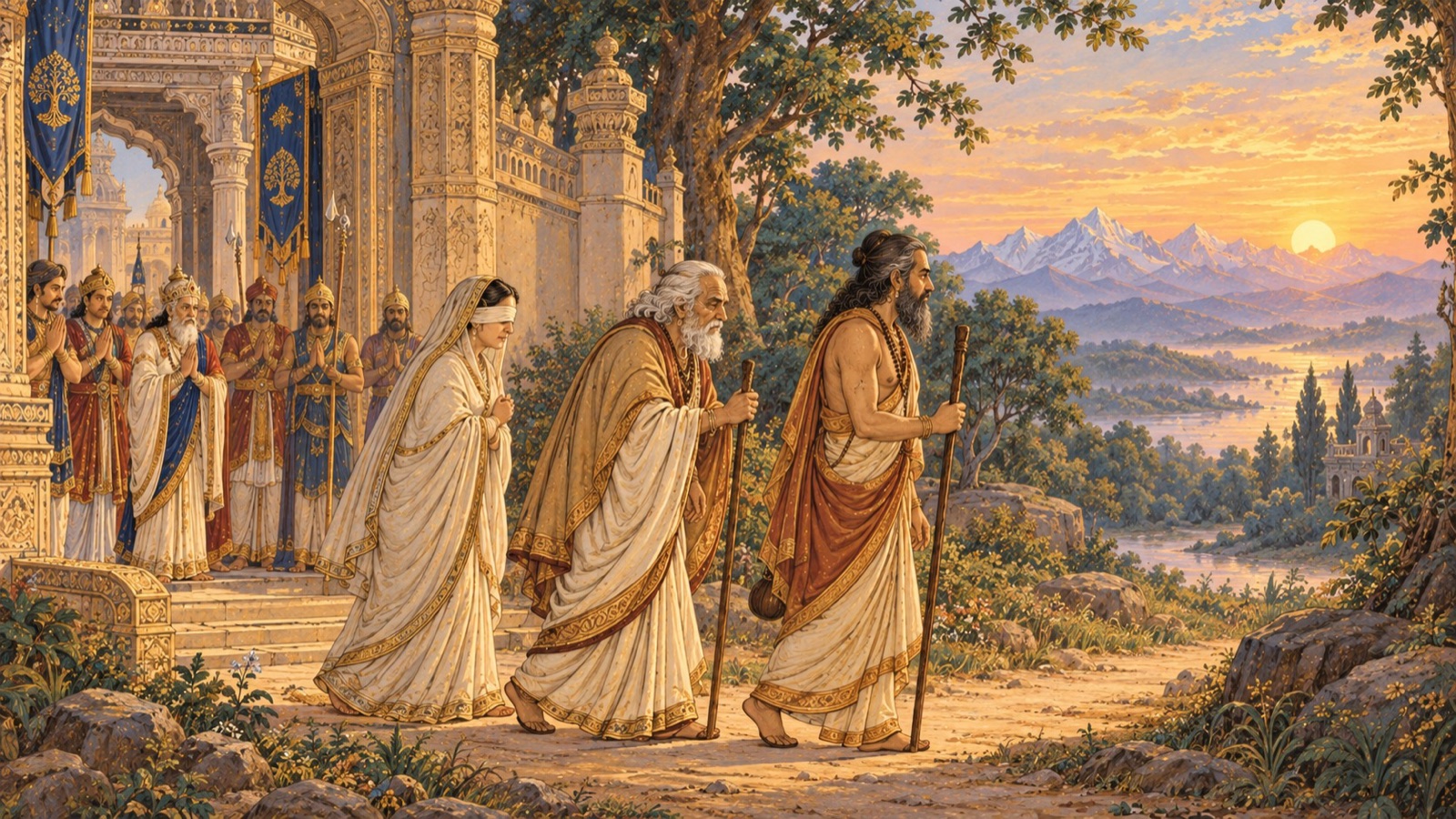
Led by his brother Vidura and followed by the faithful Gandhari, the aged blind king Dhritarashtra turns his back on the palace at dawn and sets out for the forest.
Om Namo Bhagavate Vasudevaya.
Om Namo Bhagavate Vasudevaya.
Om Namo Bhagavate Vasudevaya.
Welcome to Srimad Bhagavatam Wisdom, a devotional journey through the sacred histories and teachings of the Srimad Bhagavat Mahapurana. In the thirteenth chapter of the First Canto, the great war has long passed and the survivors have settled into the comfort of home. Into that comfort walks a returning pilgrim, Vidura, whose heart has been made new by wisdom. What he brings is not more consolation but a summons — a call to the aged, blind king Dhritarashtra to wake before the end, to loosen the last cords of attachment, and to walk out toward God while there is still time. Here the Bhagavata teaches, gently and without cruelty, the great art of letting go.
Chapter Information
- Scripture: Śrīmad Bhāgavata Mahāpurāṇa
- Canto: 1 (Book One)
- Chapter: 13 (Discourse 13)
- Chapter title: Dhritarashtra Leaves Home for the Forest
- Principal speakers: the blessed Sūta, Ugraśravā (narrator); Vidura; King Yudhiṣṭhira; Sañjaya; the divine sage Nārada
- Principal listener: the sages of Naimiṣāraṇya, headed by Śaunaka
- Main setting: the city of Hastināpura, after the Mahābhārata war
- Central subject: Vidura’s return and his counsel of renunciation, the departure of Dhṛtarāṣṭra and Gāndhārī for the forest, and Nārada’s teaching on divine providence
- Principal verse range: Canto 1, Chapter 13, verses 1–60
- Primary edition: Gita Press Śrīmad Bhāgavata Mahāpurāṇa
Context from the Previous Chapter
In the twelfth discourse, the child protected in Uttarā’s womb was born and named Parīkṣit, and learned Brāhmaṇas foretold his glorious and righteous reign, closing with the prophecy that he would in time renounce all attachment and take refuge in the feet of Śrī Hari. King Yudhiṣṭhira, having recovered his kingdom, performed three horse-sacrifices with the help of Śrī Kṛṣṇa; and the Lord, after remaining some months for the joy of His kinsmen, at last proceeded to Dwārakā. It is into this settled and prosperous house that the thirteenth chapter brings the returning pilgrim Vidura.
Vidura Returns to Hastinapura
Having ascertained the truth about the Spirit from the sage Maitreya in the course of his pilgrimage, Vidura returned to Hastināpura, for he had thereby come to know all that he wished to know. So great was the exclusive devotion to Śrī Govinda that had welled up within his heart that, even before Maitreya could answer the last of the questions he had raised, Vidura pressed no further — his longing had already found its rest in the Lord.
सूत उवाच विदुरस्तीर्थयात्रायां मैत्रेयादात्मनो गतिम् । ज्ञात्वागाद्धास्तिनपुरं तयावाप्तविवित्सित: ॥ १ ॥
sūta uvāca viduras tīrtha-yātrāyāṁ maitreyād ātmano gatim jñātvāgād dhāstinapuraṁ tayāvāpta-vivitsitaḥ
Meaning: Sūta said: Having learned the truth of the self from the sage Maitreya during his pilgrimage, Vidura — his longing to know now satisfied — returned to the city of Hastināpura. (SB 1.13.1)
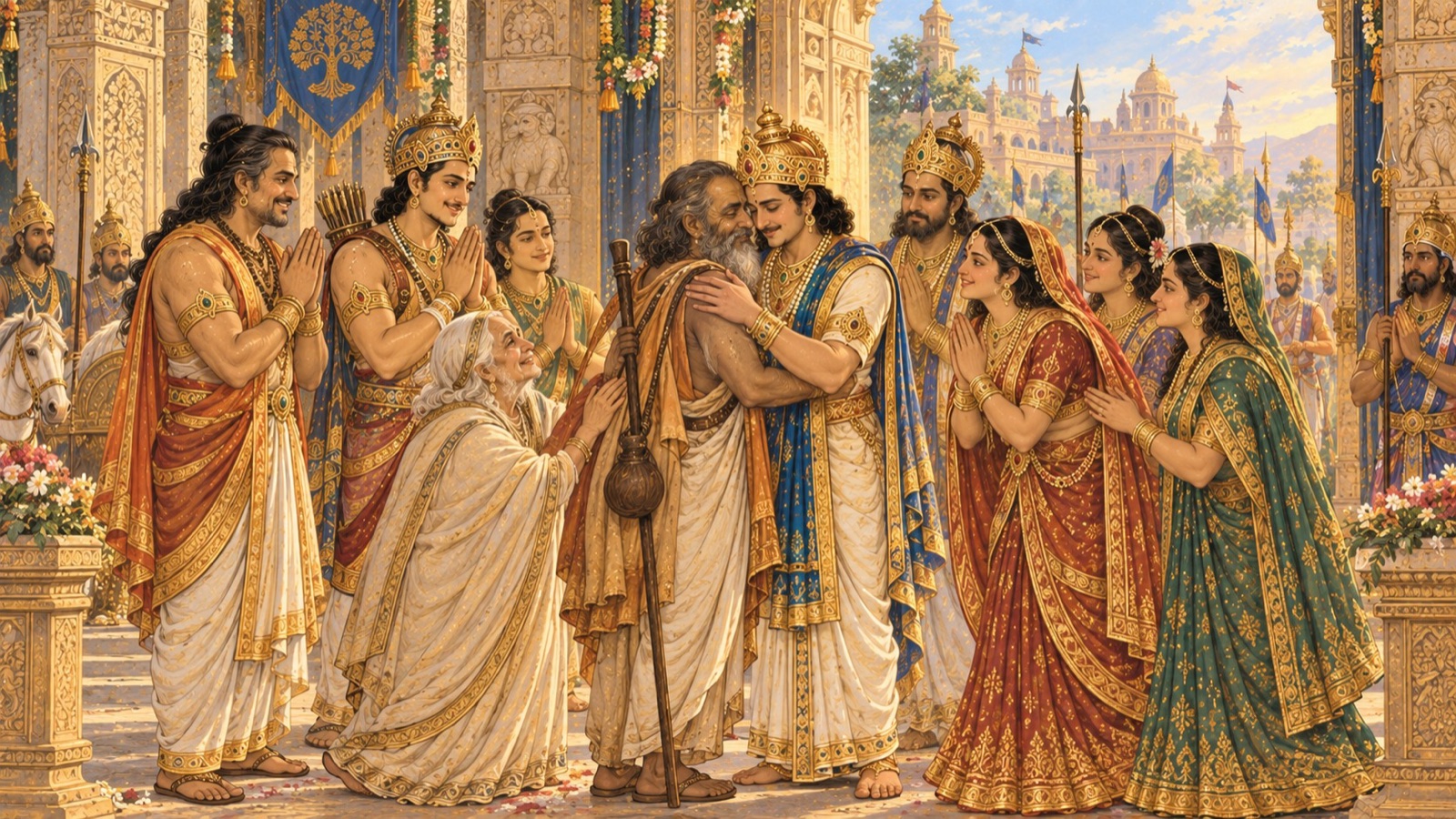
Seeing their kinsman come home again, the whole household rushed forth in joy. Yudhiṣṭhira and his brothers, the blind king Dhṛtarāṣṭra, Yuyutsu, Sañjaya, Kṛpa, Kuntī, Gāndhārī, Draupadī, Subhadrā, Uttarā, and all the other members of the family met him the way the senses spring back to life when breath returns to a body that had seemed dead. They embraced and greeted him, weeping tears of love born of long separation; and when Vidura had rested and eaten and taken his seat, King Yudhiṣṭhira, his head bent low in humility, questioned him before them all.
The News That Vidura Would Not Speak
Yudhiṣṭhira asked whether Vidura remembered how, in their childhood, he had protected them and their mother from a chain of calamities — from poison and from fire; he asked how his uncle had sustained himself through his wanderings, and which holy places he had sanctified by his presence; and, tenderly, he asked after their kinsmen the Yādavas, the devotees of Śrī Kṛṣṇa in far Dwārakā.
To all this Vidura replied in order, recounting what he had come to know at first hand — but he left one thing unspoken. He said nothing of the destruction that was to overtake the Yādava race, for he was compassionate by nature and could not bear to wound his kinsmen with news they were not able to endure, knowing that grief would reach them soon enough of its own accord. So, honoured among them like a god, he lived quietly at Hastināpura for a time, seeking always the welfare of his eldest brother, Dhṛtarāṣṭra, and bringing gladness to all. Yet time — whose movements are most difficult to master — passed unnoticed by a family grown comfortable and attached to home.
Vidura’s Awakening Counsel to Dhritarashtra
At last Vidura perceived that the hour had come, and he spoke to the aged blind king with a love that would not flatter him. A terrible time, he warned, had drawn near; they should not linger. That all-powerful Time from which there is no escape had overtaken them all, and when it comes a man is parted in an instant even from the life he holds dearest, to say nothing of wealth and the rest.
विदुरस्तदभिप्रेत्य धृतराष्ट्रमभाषत । राजन्निर्गम्यतां शीघ्रं पश्येदं भयमागतम् ॥ १८ ॥
viduras tad abhipretya dhṛtarāṣṭram abhāṣata rājan nirgamyatāṁ śīghraṁ paśyedaṁ bhayam āgatam
Meaning: Perceiving this, Vidura said to Dhṛtarāṣṭra: O king, depart at once — behold, this fearful hour has come upon us. (SB 1.13.18)
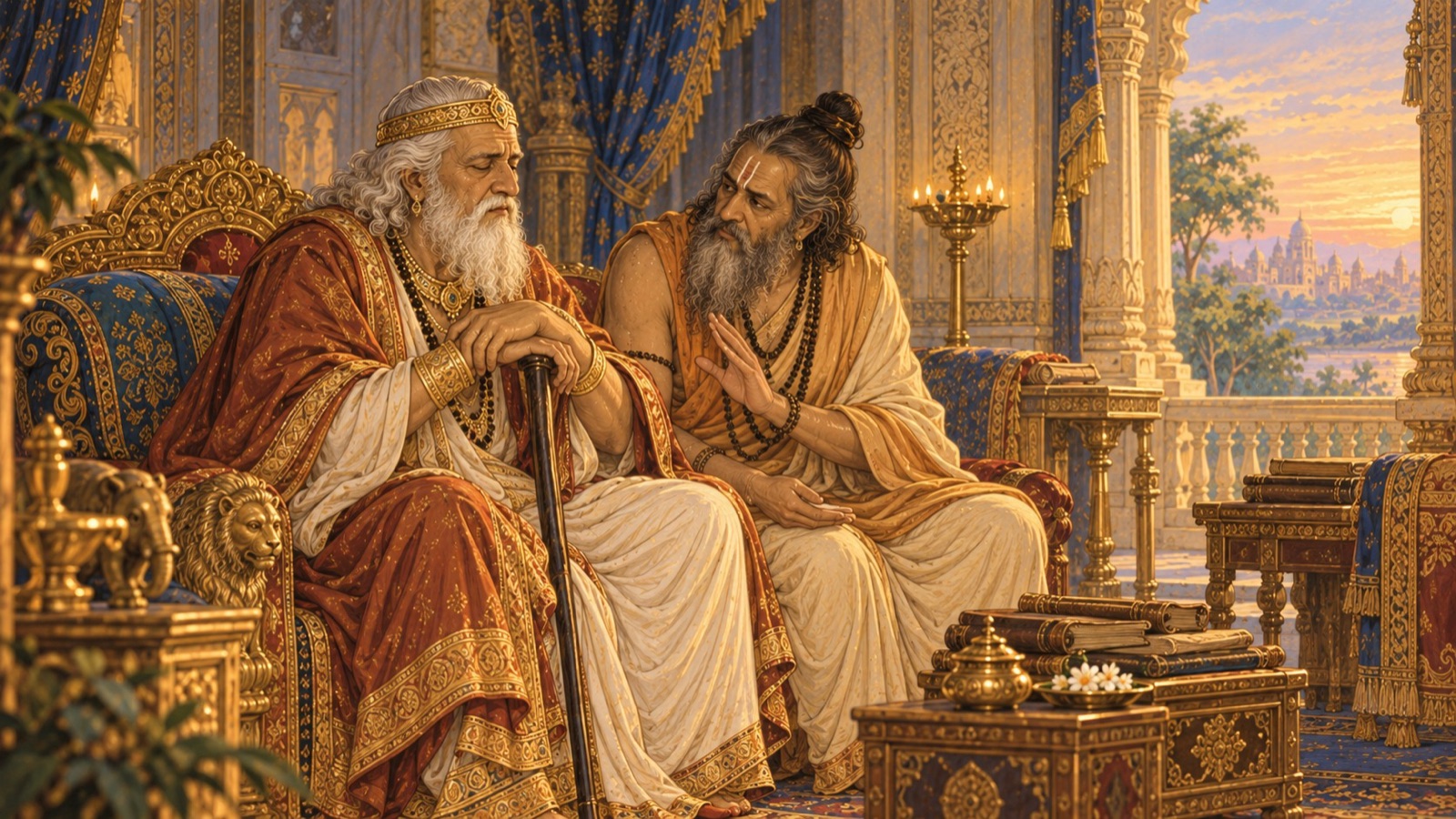
Then Vidura held up a mirror to his brother’s life. Dhṛtarāṣṭra’s fathers and brothers and sons had all been slain; his body was wasted by old age; and he was living now under the roof of Yudhiṣṭhira, the very household he had once wronged, accepting his food like a dependent. How much longer, Vidura asked, would he cling to a life sustained by the charity of those whose home was set on fire, whose queen was insulted, whose lands were seized? Age would strip this body from him as surely as tattered clothes fall away, whether he willed it or not. Far wiser, said Vidura, is the man who — free of attachment, his bondage cut — quietly gives up a body that has served its purpose, unnoticed and far from his kin. The one who, wearied of the world, holds Śrī Hari in his heart and leaves his home, is foremost among men.
य: स्वकात्परतो वेह जातनिर्वेद आत्मवान् । हृदि कृत्वा हरिं गेहात्प्रव्रजेत्स नरोत्तम: ॥ २७ ॥
yaḥ svakāt parato veha jāta-nirveda ātmavān hṛdi kṛtvā hariṁ gehāt pravrajet sa narottamaḥ
Meaning: He who, whether by his own insight or by another’s counsel, grows detached from the world, becomes self-possessed, and — holding Śrī Hari within his heart — goes forth from his home, that man is the best among men. (SB 1.13.27)
Therefore, Vidura urged, let him steal away unnoticed by his kinsmen and turn toward the north, toward the Himalayas.
The Blind King’s Silent Departure
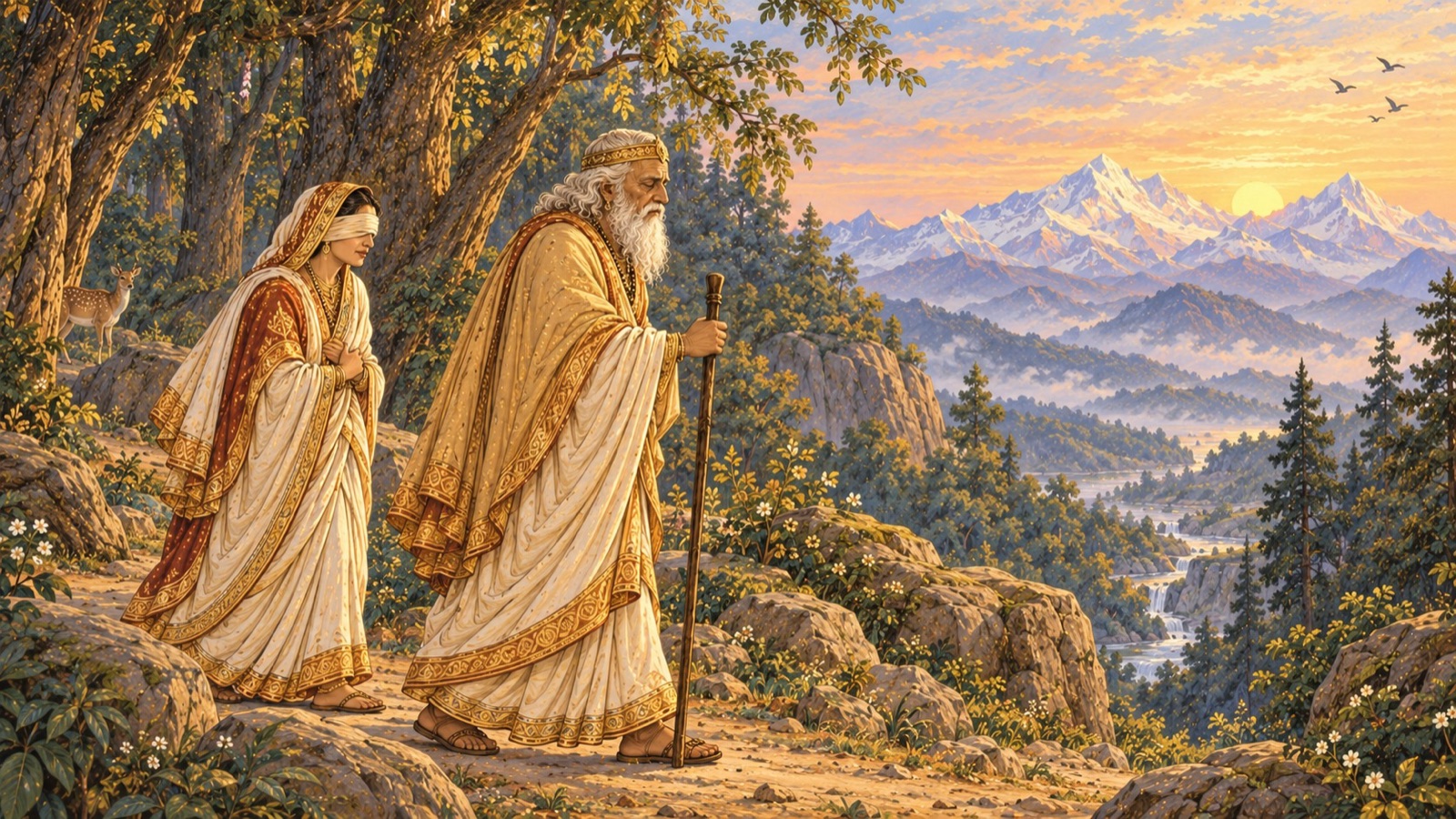
The words found their mark. Though his outer eyes were dark, the blind king’s inner eye of wisdom was opened by his younger brother’s counsel. Cutting asunder the strong cords of affection that bound him to his kinsmen, Dhṛtarāṣṭra rose and departed, with Vidura himself walking before him as his guide.
एवं राजा विदुरेणानुजेन प्रज्ञाचक्षुर्बोधित आजमीढ: । छित्त्वा स्वेषु स्नेहपाशान्द्रढिम्नो निश्चक्राम भ्रातृसन्दर्शिताध्वा ॥ २९ ॥
evaṁ rājā vidureṇānujena prajñā-cakṣur bodhita ājamīḍhaḥ chittvā sveṣu sneha-pāśān draḍhimno niścakrāma bhrātṛ-sandarśitādhvā
Meaning: Thus awakened in the eye of wisdom by his younger brother Vidura, King Dhṛtarāṣṭra, descendant of Ajamīḍha, cut the tight cords of affection for his own people and went forth, his brother showing him the way. (SB 1.13.29)
Seeing her husband set out for the Himalayas — a destination as welcome to renunciants as a righteous battle is to a hero — the virtuous Gāndhārī, daughter of King Subala and ever devoted in her service to her lord, followed quietly after him.
पतिं प्रयान्तं सुबलस्य पुत्री पतिव्रता चानुजगाम साध्वी । हिमालयं न्यस्तदण्डप्रहर्षं मनस्विनामिव सत्सम्प्रहार: ॥ ३० ॥
patiṁ prayāntaṁ subalasya putrī pati-vratā cānujagāma sādhvī himālayaṁ nyasta-daṇḍa-praharṣaṁ manasvinām iva sat samprahāraḥ
Meaning: The saintly Gāndhārī, daughter of Subala and devoted to her husband, followed her lord as he set out for the Himalayas — that place which gladdens those who have laid down the rod of violence, even as a noble battle gladdens the brave. (SB 1.13.30)
Yudhishthira Searches for His Elders
The next morning King Yudhiṣṭhira, having said his dawn prayers, poured oblations into the sacred fire, and made his customary gifts to the Brāhmaṇas, went as always to the apartments of his elders to offer his salutations — and found no one there. Neither of his uncles, nor his aunt Gāndhārī, was to be seen. With an anxious heart he turned to Sañjaya, who sat nearby, and asked where his aged and blind uncle had gone; where his grieving aunt was; and where his kindly younger uncle Vidura had gone. Distressed, he even feared that they might have drowned themselves in the Gaṅgā, apprehending ill-treatment at his own foolish hands — the same uncles who, after King Pāṇḍu’s death, had protected him and his brothers, tender children as they were, through every danger.
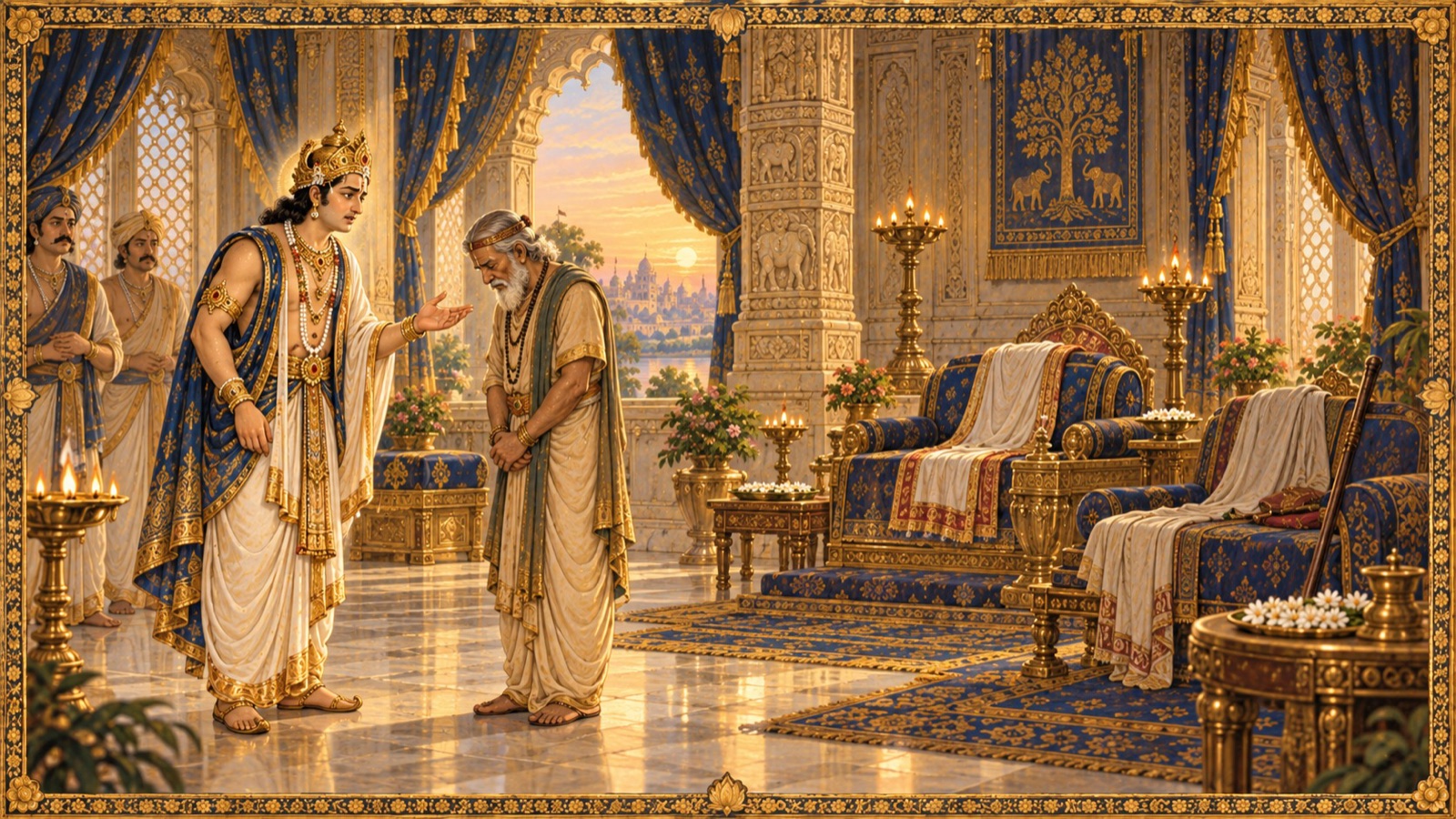
But Sañjaya, so afflicted with grief at the sudden disappearance of his own master Dhṛtarāṣṭra that he could not at first speak a word, only wiped his tears and steadied his mind, and confessed that he knew nothing of the resolve of the king or the queen — he too had been left behind by those noble souls.
Narada’s Teaching: The World Rests in God’s Hand
At that very moment the divine sage Nārada arrived, accompanied by Tumburu. Yudhiṣṭhira and his brothers rose to receive them with reverence, and the king laid his sorrow before the sage: he did not know where his uncles and his aunt had gone, and he begged Nārada, who alone could ferry him across this shoreless ocean of grief like a pilot across the deep, to guide him. And Nārada, foremost of sages, gave him a teaching that lifts the whole chapter from a family’s private sorrow into the light of eternal truth.
Grieve for no one, Nārada said, for the entire world moves under the control of God; all beings and their rulers offer their worship to Him. It is He who brings living creatures together, and He alone who parts them.
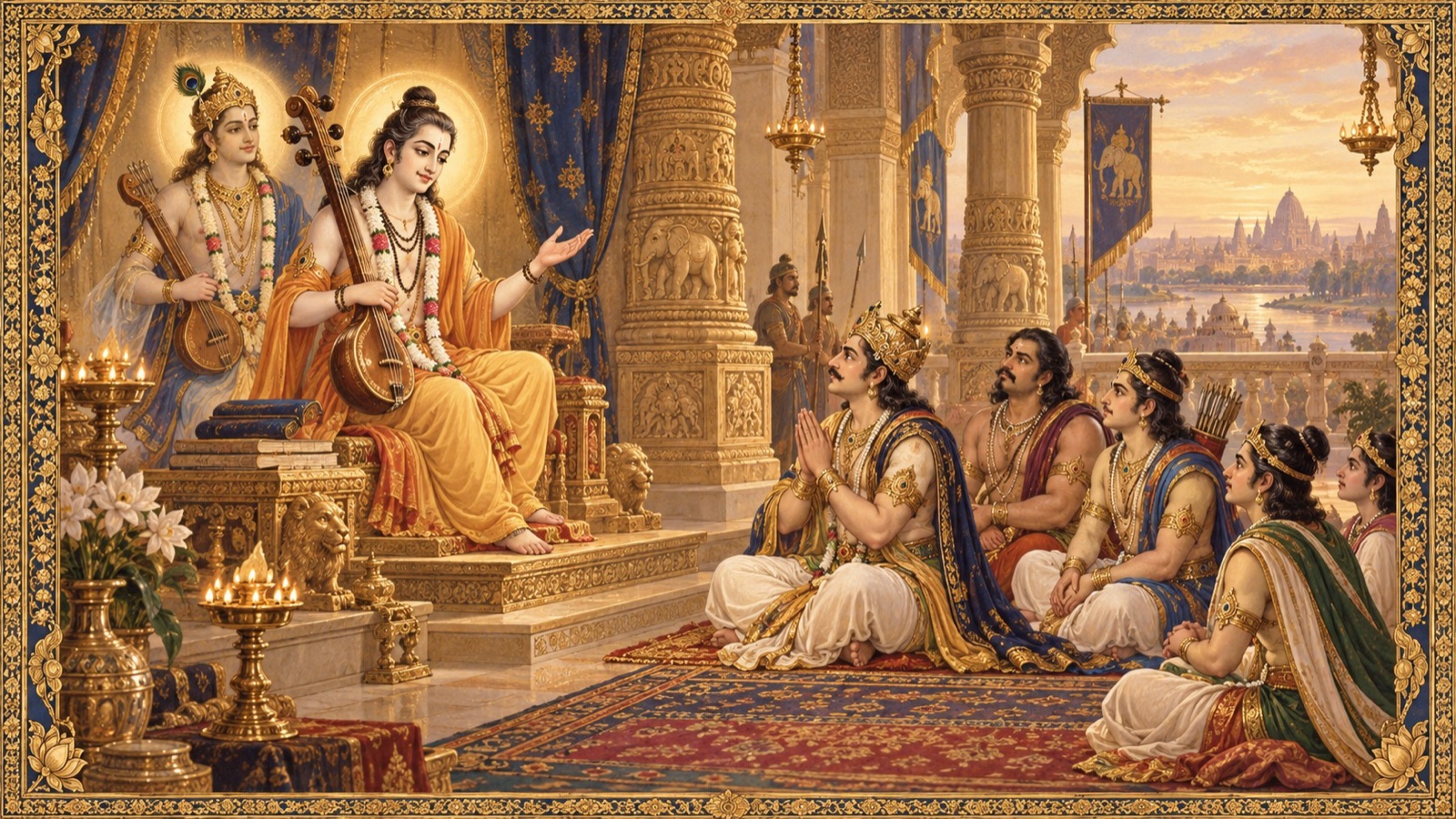
नारद उवाच मा कञ्चन शुचो राजन् यदीश्वरवशं जगत् । लोका: सपाला यस्येमे वहन्ति बलिमीशितु: । स संयुनक्ति भूतानि स एव वियुनक्ति च ॥ ४१ ॥
nārada uvāca mā kañcana śuco rājan yad īśvara-vaśaṁ jagat lokāḥ sapālā yasyeme vahanti balim īśituḥ sa saṁyunakti bhūtāni sa eva viyunakti ca
Meaning: Nārada said: Grieve for no one, O king, for this whole world is under the control of the Lord; all the worlds with their guardians bring their offerings to Him, the supreme Ruler. It is He who unites all beings, and He alone who separates them. (SB 1.13.41)
As oxen are led by cords passed through their noses and bound together by one great rope, Nārada explained, so are human beings bound by the cords of their varied names and duties to the one rope of the divine word, and by it made to serve the Lord. And just as a player’s toys are brought together and taken apart at the player’s own pleasure, so the meeting and parting of human beings rests entirely upon the will of God.
यथा क्रीडोपस्कराणां संयोगविगमाविह । इच्छया क्रीडितु: स्यातां तथैवेशेच्छया नृणाम् ॥ ४३ ॥
yathā krīḍopaskarāṇāṁ saṁyoga-vigamāv iha icchayā krīḍituḥ syātāṁ tathaiveśecchayā nṛṇām
Meaning: Just as the coming together and the separating of a player’s toys happen only by the will of the one who plays, so too the union and parting of human beings occur solely by the will of the Lord. (SB 1.13.43)
Whether one holds the soul to be eternal, or the body to be perishable, or takes some view between, Nārada continued, there is no real cause for grief except the grief that springs from the delusion of affection. This body, made of the five elements and ruled by time, fate, and the three modes of Nature, cannot even protect itself — how then can it shelter another? Beings live upon beings, the strong sustained by the weak, and through it all it is the one self-luminous Lord, the Self of every embodied soul, who shines as both the seer and the seen, appearing in countless forms through His Māyā. And that same Lord who brings creation into being has now descended upon the earth in the form of Kāla, Time itself, to remove the burden of those who oppose the gods.
सोऽयमद्य महाराज भगवान् भूतभावन: । कालरूपोऽवतीर्णोऽस्यामभावाय सुरद्विषाम् ॥ ४९ ॥
so ’yam adya mahārāja bhagavān bhūta-bhāvanaḥ kāla-rūpo ’vatīrṇo ’syām abhāvāya sura-dviṣām
Meaning: That same Lord, O great king, the source of all beings, has now descended upon this earth in the form of Time, for the destruction of those who are hostile to the gods. (SB 1.13.49)
The work of the gods, Nārada said, is now nearly accomplished; the Lord tarries only until what remains is done. Yudhiṣṭhira too should wait, so long as the Lord is still present in the world.
Where Dhritarashtra Has Gone
Then Nārada told the anxious king exactly where his elders had gone, so that his fear might be replaced by wonder. Dhṛtarāṣṭra, with Vidura and his faithful wife Gāndhārī, had reached a hermitage to the south of the Himalayas, at the place called Saptasrota, where the celestial Gaṅgā divides herself into seven streams for the pleasure of the seven great sages. There the old king, bathing thrice daily, offering oblations into the fire, and living upon water alone, had grown serene and free of all craving. Controlling his posture and his breath, withdrawing his senses from their objects, he had, through steady contemplation of Śrī Hari, washed his mind clean of the three modes; dissolving his sense of self into the intellect, the intellect into the individual soul, and the soul into the Absolute, he now sat motionless as a post, having renounced every duty. Let no one, said Nārada, disturb him.
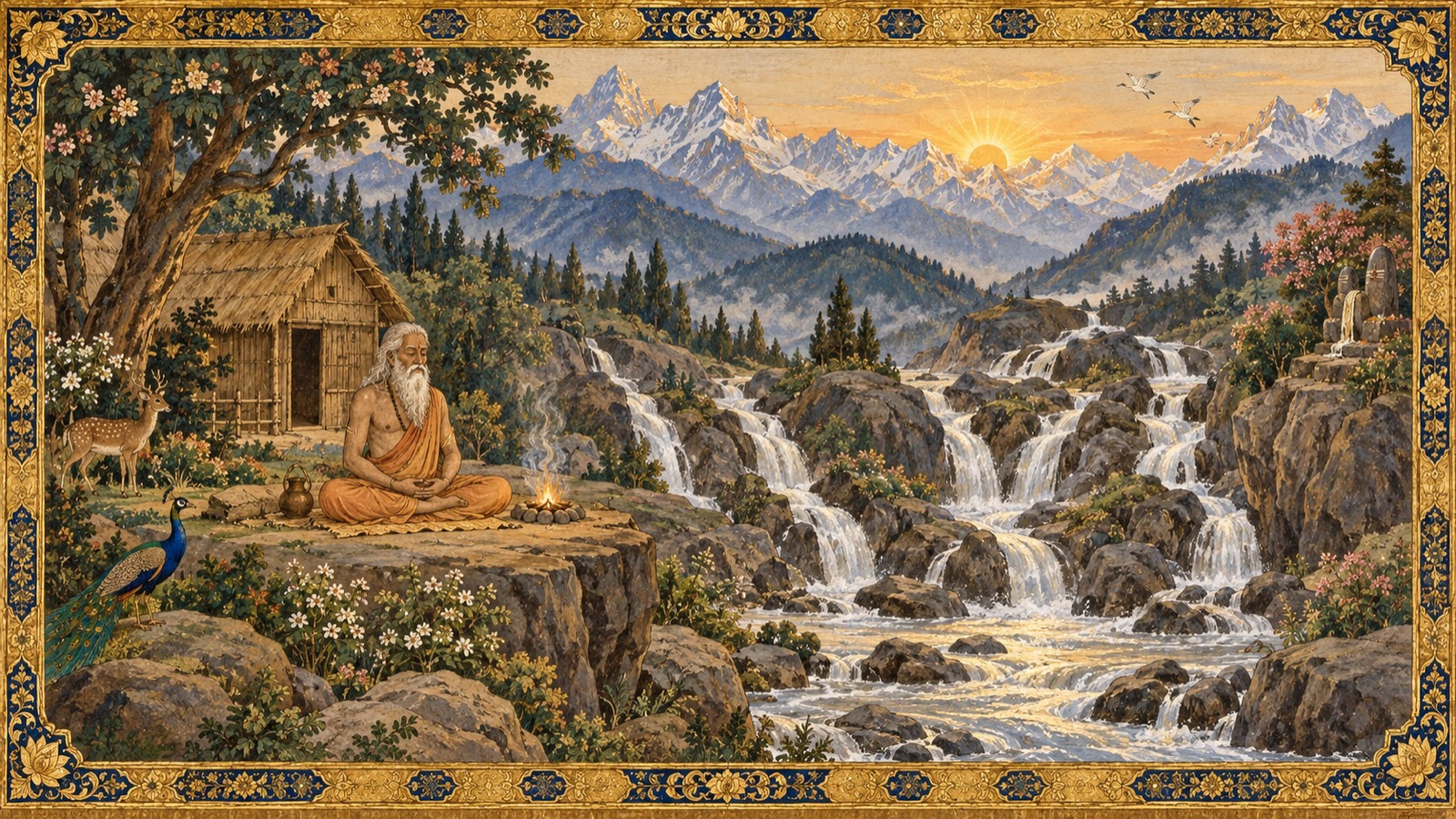
On the fifth day from now, Nārada foretold, Dhṛtarāṣṭra would cast off his body, and it would be reduced to ashes; and his virtuous wife, seeing the hut and her lord’s body consumed by fire, would herself enter the flames to follow her husband.
दह्यमानेऽग्निभिर्देहे पत्यु: पत्नी सहोटजे । बहि: स्थिता पतिं साध्वी तमग्निमनु वेक्ष्यति ॥ ५८ ॥
dahyamāne ’gnibhir dehe patyuḥ patnī sahoṭaje bahiḥ sthitā patiṁ sādhvī tam agnim anu vekṣyati
Meaning: When the body of her husband is consumed by the fire together with his hut, the saintly wife, standing outside, will follow her lord by entering that same fire. (SB 1.13.58)
And Vidura, Nārada said, witnessing that marvel with a heart mingling joy and sorrow, would depart once more upon his pilgrimage to holy places.
Yudhishthira’s Grief Dissolved
Having spoken all this, the sage Nārada, with Tumburu, at once ascended to the heavens. And Yudhiṣṭhira, treasuring the sage’s words within his heart, gave up his grief.
Important Verses
The chapter closes with the fruit of Nārada’s counsel — the quieting of a righteous man’s sorrow through wisdom:
इत्युक्त्वाथारुहत् स्वर्गं नारद: सहतुम्बुरु: । युधिष्ठिरो वचस्तस्य हृदि कृत्वाजहाच्छुच: ॥ ६० ॥
ity uktvāthāruhat svargaṁ nāradaḥ saha-tumburuḥ yudhiṣṭhiro vacas tasya hṛdi kṛtvājahāc chucaḥ
Meaning: Having spoken thus, Nārada, together with Tumburu, ascended to the heavens; and Yudhiṣṭhira, keeping the sage’s words within his heart, cast off his sorrow. (SB 1.13.60)
Principal Teachings
1. Wisdom is the truest form of love. Vidura returns not to comfort his brother but to wake him (verse 18). The counsel that seems hard — “depart at once” — is in fact the deepest kindness, for it points the aging king toward liberation while there is still time. Real love sometimes asks us to say the difficult, saving word.
2. Renunciation crowns a life well-lived. The one who, weary of the world, keeps Śrī Hari in his heart and leaves his home is called “foremost among men” (verse 27). The Bhagavata honours the soul who lets go of possessions and attachments not out of despair, but to seek God in the final stretch of life.
3. The inner eye can open even when the outer eye is dark. Blind all his life, Dhṛtarāṣṭra receives the eye of wisdom through his brother’s words and cuts the cords of affection (verse 29). Spiritual sight does not depend on the body’s senses; it is awakened by truth received in humility.
4. Union and separation belong to God alone. Nārada teaches that the Lord both joins and parts all beings, as a player gathers and scatters his toys (verses 41, 43). When we grasp that meetings and partings are held in a wiser hand than ours, grief loses its power to crush us.
5. Faithful devotion follows love to the end. Gāndhārī, ever devoted, follows her husband to the forest and, as Nārada foretells, into the fire (verses 30, 58). Her steadfastness is honoured by the scripture as the fruit of a life of loyal service.
6. Sacred words, kept in the heart, dissolve sorrow. Yudhiṣṭhira’s grief does not vanish by force but melts as he treasures Nārada’s teaching within (verse 60). Wisdom heard and held, not merely heard and forgotten, is what quiets the mourning heart.
A Devotional Reflection
There is a rare tenderness in the way this chapter treats the end of a life. Dhṛtarāṣṭra is not a spotless man; he has been weak, partial, and complicit in great wrongs, and the scripture does not hide it. Yet the Bhagavata does not leave him in his failure. Through a brother who loves him enough to tell the truth, and a destination that turns his last days into worship, the old king is given the chance to end well — to walk out of a comfortable house and into the presence of God. That is a quietly hopeful teaching for all of us. It says that no life is too flawed, and no hour too late, to turn homeward. Much of our own suffering comes from clutching what must one day be released: our roles, our possessions, the people we love. Nārada’s image of the player and his toys is not cold; it is freeing. If the great gatherings and partings of our lives rest in the hand of One who is wiser and kinder than we are, then we may hold everything a little more lightly, and hold Him a little more closely.
A Daily Devotional Practice
Today, choose one thing you are gripping too tightly — a worry about the future, a role you fear to lose, an attachment that has quietly become a chain — and, in imitation of Dhṛtarāṣṭra’s awakening, offer it inwardly into the hand of the Lord. Sit quietly for a few minutes, breathe slowly, and repeat a simple thought from Nārada’s teaching: “The Lord both unites and parts; all is safe in His hand.” Then, like Yudhiṣṭhira, do not merely hear these words but keep one of them in your heart through the day, and let it loosen your grip whenever the worry returns.
Conclusion
So ends the thirteenth discourse of the Śrīmad Bhāgavata, forming part of the story of the Naimiṣa forest, in Book One, the great scripture known to the God-realized as the Paramahaṁsa-Saṁhitā. In this chapter, Srimad Bhagavatam Canto 1 Chapter 13, we have seen the pilgrim Vidura return to Hastināpura with a heart made new by devotion; we have heard him counsel his blind brother Dhṛtarāṣṭra to cast off attachment and walk toward God before the end; and we have watched the old king’s inner eye open, so that he departs in silence for the forest with the faithful Gāndhārī following behind. We have shared Yudhiṣṭhira’s anxious search for his vanished elders, and received, through the divine sage Nārada, the great consolation that all union and separation rest in the will of the Lord, who has Himself descended as Time to relieve the earth. And we have learned where the old king has gone — to a life of yoga at Saptasrota, and to an end that is not defeat but liberation. May we, too, learn to hold our loved ones and our days in God’s hand, and to walk homeward while the way is open.
May the divine wisdom of Srimad Bhagavatam awaken pure devotion within our hearts.
Om Namo Bhagavate Vasudevaya.
Jay Shree Madhav.
References and Attribution
Primary edition: Gita Press, Śrīmad Bhāgavata Mahāpurāṇa (English), Book One (Skandha 1), Discourse 13, book pages 49–54.
Srimad Bhagavatam Wisdom · Biswa Sanatan Dharma Seva Trust. Presented following the spiritual guidance and recommendation of Pandit Dr. Shri Kashinath Mishra.
This article is an original, faithful devotional retelling (Copyright MODE B). No publisher translation or purport is reproduced; verse “Meaning” lines are original faithful paraphrase. This article does not imply that any publisher, library, or organization sponsors or endorses it.
Jay Shree Madhav