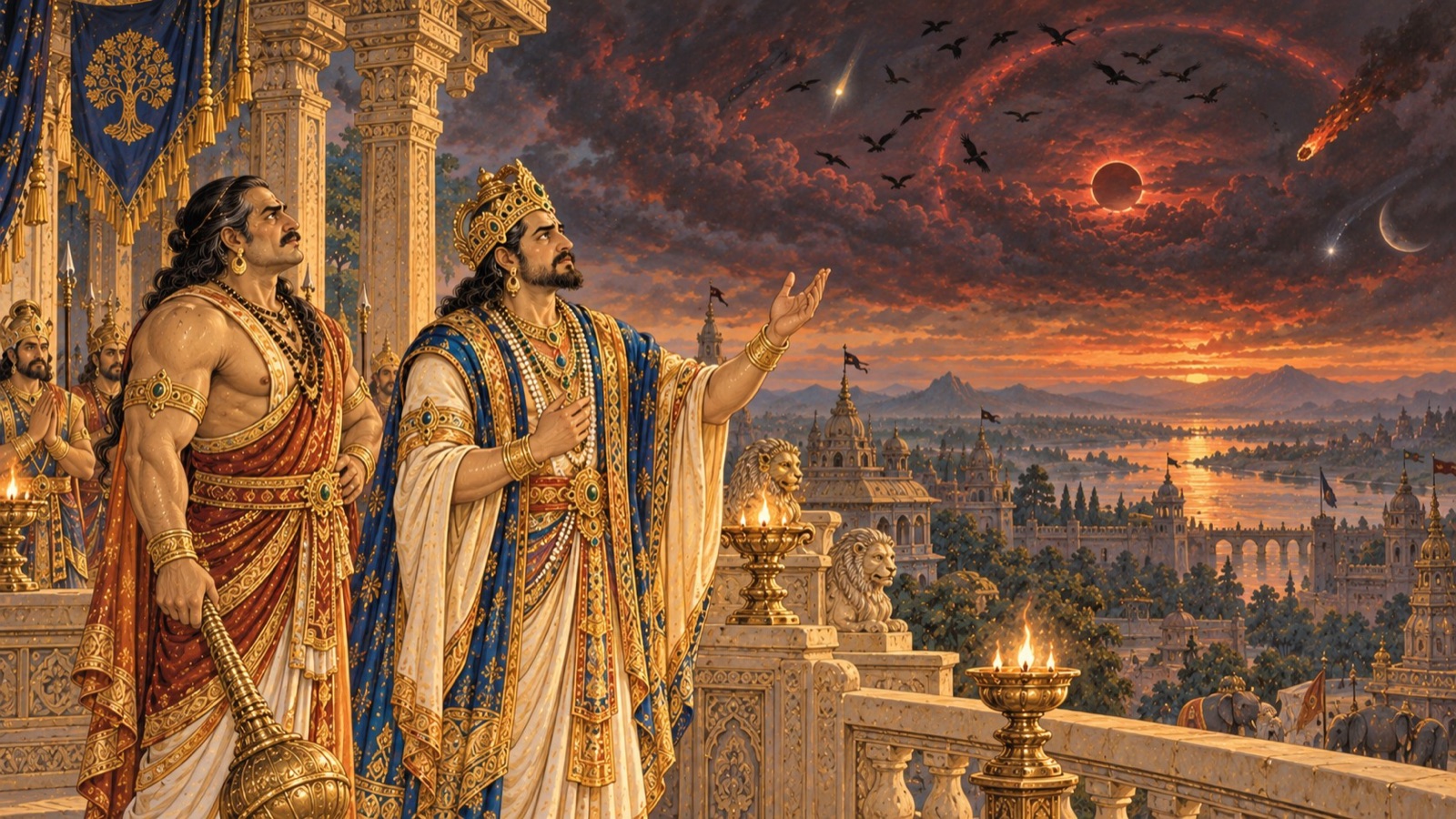
As Arjuna lingers in Dwaraka, King Yudhishthira watches the sky darken with dreadful portents and senses that the Lord’s presence is about to leave the earth.
Om Namo Bhagavate Vasudevaya.
Om Namo Bhagavate Vasudevaya.
Om Namo Bhagavate Vasudevaya.
Welcome to Srimad Bhagavatam Wisdom, a devotional journey through the sacred histories and teachings of the Srimad Bhagavat Mahapurana. In the fourteenth chapter of the First Canto, the peace that had settled over Hastinapura begins to tremble. Arjuna has gone to Dwaraka to see Sri Krishna and His kinsmen, and month after month passes without his return. In that silence, King Yudhishthira watches the world itself grow strange — the seasons turn unnatural, hearts turn cruel, and the heavens fill with fearful signs. With the heart of a devotee rather than a fearful man, he reads in these omens a single dread: that the Lord who is the soul of all their fortune is about to withdraw His presence from the earth. This chapter is a portrait of love that senses separation before it is spoken.
Chapter Information
- Scripture: Śrīmad Bhāgavata Mahāpurāṇa
- Canto: 1 (Book One)
- Chapter: 14 (Discourse 14)
- Chapter title: Evil Omens and the Coming Disappearance of Lord Krishna
- Principal speakers: the blessed Sūta, Ugraśravā (narrator); King Yudhiṣṭhira
- Principal listener: the sages of Naimisaranya, headed by Śaunaka
- Main setting: the city of Hastināpura, some time after the Mahābhārata war
- Central subject: the fearful portents seen by Yudhiṣṭhira as the age of Kali approaches, his apprehension that Śrī Kṛṣṇa is about to leave the world, and the sorrowful return of Arjuna from Dwārakā
- Principal verse range: Canto 1, Chapter 14, verses 1–44
- Primary edition: Gita Press Śrīmad Bhāgavata Mahāpurāṇa
Context from the Previous Chapter
In the thirteenth discourse, Vidura returned from his long pilgrimage and was joyfully received at Hastinapura. He counselled his blind elder brother Dhṛtarāṣṭra to give up his lingering attachments and turn to a life of renunciation. Heeding him, the old king slipped away in the dead of night toward the Himalayas, accompanied by his devoted wife Gāndhārī. When Yudhiṣṭhira grew anxious at their disappearance, the celestial sage Nārada came and revealed that Dhṛtarāṣṭra was performing austerities upon the Saptasrota stream of the Gaṅgā and would soon give up his body through yoga; that Gāndhārī would follow him into the fire; and that Vidura, witnessing this, would once again set out on pilgrimage. Comforted by Nārada’s words, Yudhiṣṭhira ceased his grieving. It is here, with Arjuna still away in Dwaraka, that the fourteenth discourse opens.
The Dreadful Turn of Time
The blessed Sūta continued. Arjuna, he said, had set out for Dwaraka in order to see his relations — Śrī Kṛṣṇa and the others — and to learn how the Lord of sacred renown was faring. Yet many months went by, and still he did not return.
व्यतीता: कतिचिन्मासास्तदा नायात्ततोऽर्जुन: । ददर्श घोररूपाणि निमित्तानि कुरूद्वह: ॥ २ ॥
vyatītāḥ katicin māsās tadā nāyāt tato ’rjunaḥ dadarśa ghora-rūpāṇi nimittāni kurūdvahaḥ
Meaning: Several months passed, yet Arjuna did not return; and meanwhile Yudhiṣṭhira, the foremost of the Kurus, beheld omens of a fearful kind. (Canto 1, Chapter 14, verse 2)
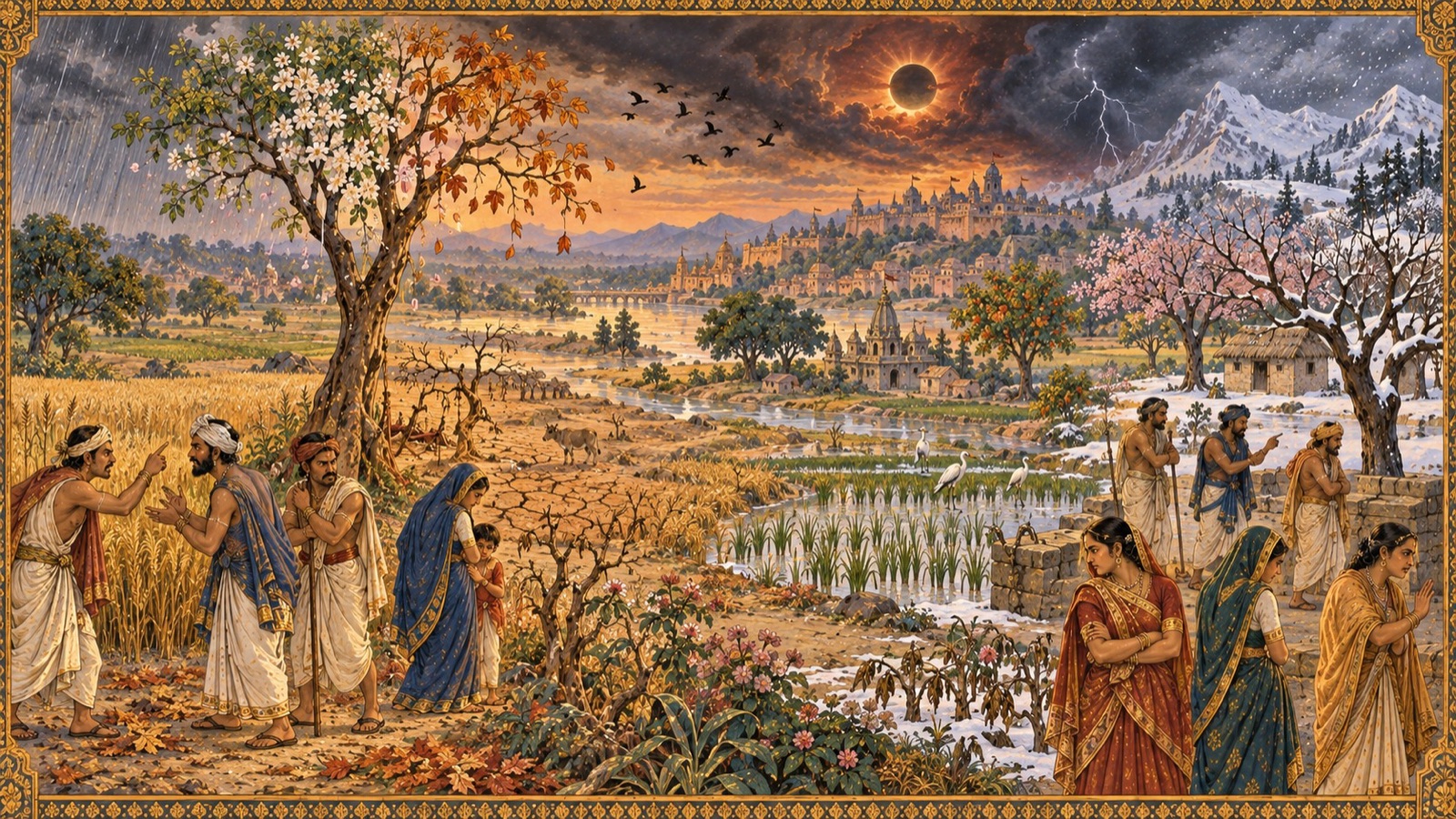
Time itself had taken a dreadful turn. The characteristics of the seasons were wholly changed, and people had taken to sinful ways of living, their hearts possessed by anger, greed, and falsehood. Dealings between people had grown crooked; even friendship was marred by deceit; and quarrels broke out between parents and children, between kinsmen, between brothers, and even between husbands and wives. With Kali’s advancing shadow, greed and its kindred vices had taken root in human nature, while omens boding the worst of calamities appeared throughout the cosmos. Witnessing all this, King Yudhiṣṭhira turned and spoke to his younger brother Bhīma.
The King Reads the Omens
Yudhiṣṭhira reminded Bhīma that Arjuna had been sent to Dwaraka to see their relations and to find out what Śrī Kṛṣṇa was doing. Seven months had now elapsed, and still their brother had not returned. Then the king gave voice to the fear beneath his unease.

अपि देवर्षिणादिष्ट: स कालोऽयमुपस्थित: । यदात्मनोऽङ्गमाक्रीडं भगवानुत्सिसृक्षति ॥ ८ ॥
api devarṣiṇādiṣṭaḥ sa kālo ’yam upasthitaḥ yadātmano ’ṅgam ākrīḍaṁ bhagavān utsisṛkṣati
Meaning: Can it be that the time foretold by the celestial sage Nārada has now arrived — the time when the Lord will lay aside the beloved form He assumed for His pastimes? (Canto 1, Chapter 14, verse 8)
It was to the Lord’s grace, Yudhiṣṭhira said, that they owed everything — their fortune and their kingdom, their spouses and their very lives, the continuance of their race, their progeny, their victory over enemies, and their claim to the higher worlds. Now he begged Bhīma to observe the portents in the heavens, on the earth, and in their own bodies, all of them boding some calamity near at hand that would distract the mind.
His own left thigh, left eye, and left arm, he confessed, were throbbing again and again, and his heart quaked without cause.
ऊर्वक्षिबाहवो मह्यं स्फुरन्त्यङ्ग पुन: पुन: । वेपथुश्चापि हृदये आराद्दास्यन्ति विप्रियम् ॥ ११ ॥
ūrv-akṣi-bāhavo mahyaṁ sphuranty aṅga punaḥ punaḥ vepathuś cāpi hṛdaye ārād dāsyanti vipriyam
Meaning: My left thigh, eye, and arm throb again and again, dear brother, and my heart trembles within me; surely these signs will soon bring unwelcome news. (Canto 1, Chapter 14, verse 11)
He pointed to the omens all around. A she-jackal, vomiting fire, howled at the rising sun; a dog barked fearlessly at the king himself. Auspicious animals passed by on his left while inauspicious ones turned to his right, and his very horses seemed to weep. The dove — that harbinger of death — together with the owl and its enemy the crow, kept awake through the night and shook his heart with their horrible cries, as if to turn the whole world into a desert.
Signs in Heaven and Earth
The portents were not confined to birds and beasts. The quarters of the sky looked smoky; the orbs of the sun and moon appeared ringed with a misty halo; the earth with its mountains quaked, and thunderclaps burst with violent lightning. The wind blew hard, spreading darkness with dust, while the clouds seemed to rain blood, creating a ghastly scene everywhere.
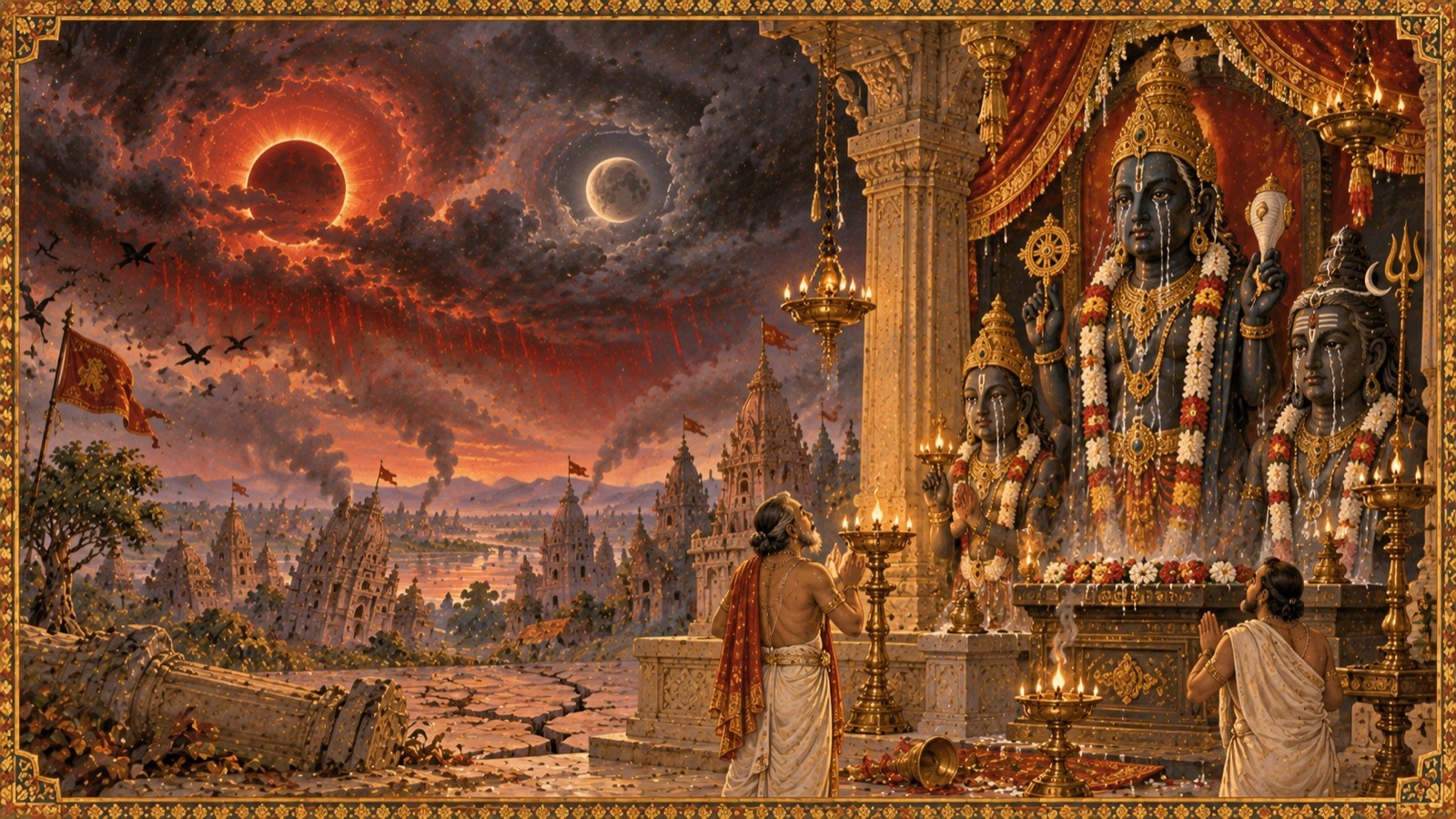
The sun lost its brilliance and the planets seemed to contend against one another in the heavens; the sky and the earth alike appeared to be set on fire by multitudes of ghosts and spirits. Streams and rivers, lakes and the minds of people were all agitated; fire would not blaze even when fed with clarified butter. Calves refused to suck, and cows would not be milked; the cattle wept, tears trickling down their faces, and the bulls took no joy in the herd. The very images of the gods seemed to weep and perspire and to move from their seats, while the outlying districts, villages, cities, gardens, mines, and hermitages all looked cheerless and robbed of their splendour. From all of this Yudhiṣṭhira drew a single, sorrowful conclusion.
मन्य एतैर्महोत्पातैर्नूनं भगवत: पदै: । अनन्यपुरुषश्रीभिर्हीना भूर्हतसौभगा ॥ २१ ॥
manya etair mahotpātair nūnaṁ bhagavataḥ padaiḥ ananya-puruṣa-śrībhir hīnā bhūr hata-saubhagā
Meaning: From these great portents I am certain that the earth, deprived of the touch of the Lord’s feet — whose auspicious grace belongs to no other person — has lost her good fortune and her beauty. (Canto 1, Chapter 14, verse 21)
Arjuna Returns from Dwaraka
Even as the king was speaking his anxious thoughts, his heart weighed down by the omens he had seen, the one he had been waiting for at last appeared.
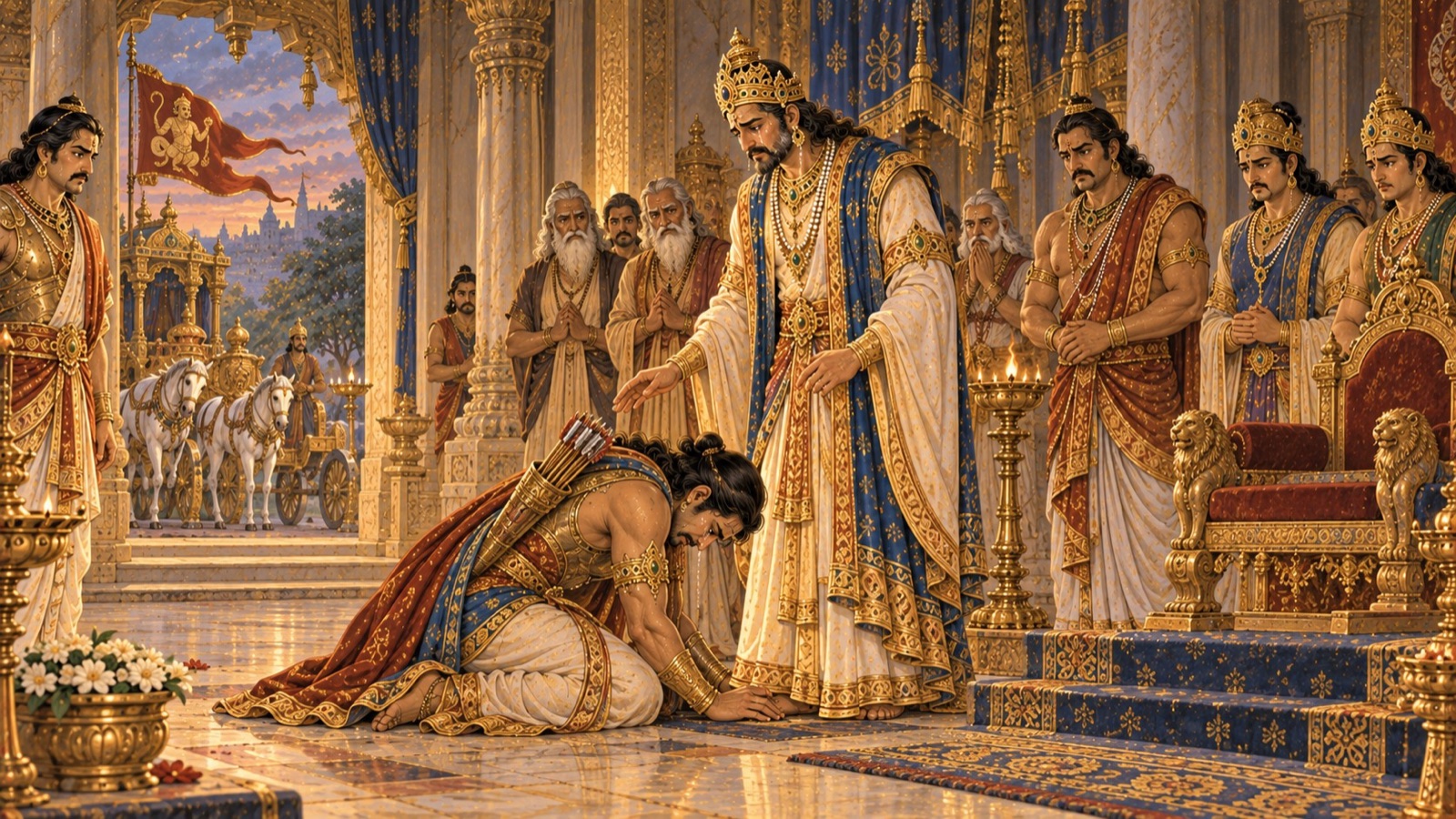
इति चिन्तयतस्तस्य दृष्टारिष्टेन चेतसा । राज्ञ: प्रत्यागमद् ब्रह्मन् यदुपुर्या: कपिध्वज: ॥ २२ ॥
iti cintayatas tasya dṛṣṭāriṣṭena cetasā rājñaḥ pratyāgamad brahman yadu-puryāḥ kapi-dhvajaḥ
Meaning: As the king was brooding thus, his heart troubled by the omens he had seen, O Brāhmaṇa, Arjuna — whose banner bore the emblem of Hanumān — returned from the city of the Yadus. (Canto 1, Chapter 14, verse 22)
But the sight of him deepened rather than relieved the king’s fear. Arjuna fell at his brother’s feet with a strange look about him, his face lacklustre and cast down, tears trickling from his lotus-like eyes. Recalling the words of Nārada, Yudhiṣṭhira felt his heart grow anxious, and in the midst of his other kinsmen he began to question his brother.
Are the Yadus and the Lord Well?
The questions poured out of him in a rush of love and dread. Were their relations — the Madhus, the Bhojas, the Dāśārhas, the Ārhas, the Sātvatas, the Andhakas, and the Vṛṣṇis — happy in Dwaraka? Was their revered grandfather Śūrasena well, and were their maternal uncles Vasudeva and his brothers in good health? Were the seven wives of Vasudeva — Devakī and her sisters — hale, together with their sons and daughters-in-law? Did King Ugrasena and his brother Devaka still live? Were Kṛtavarmā, Akrūra, Jayanta, Gada, Sāraṇa, and Sātrujit faring well, and was the divine Balarāma, Lord of the Sātvatas, happy? Were Pradyumna, the greatest of the Vṛṣṇi warriors, and the mighty Aniruddha prospering? Were Sāmba and the other sons of Śrī Kṛṣṇa, and Uddhava and the other devoted attendants, all doing well, protected by the arms of Balarāma and Kṛṣṇa — and did they still remember the Pāṇḍavas with affection? Then came the question at the centre of his heart.
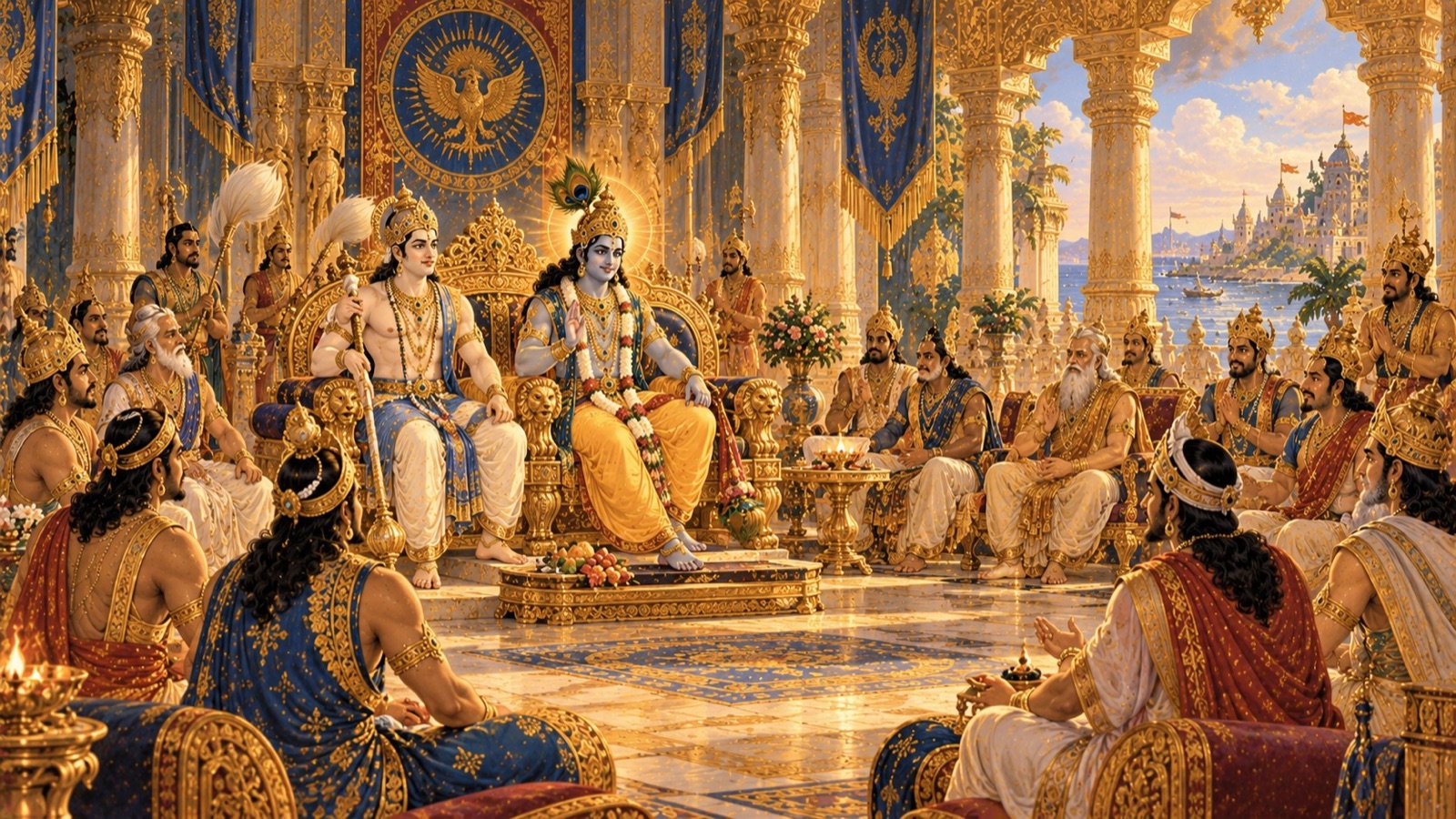
भगवानपि गोविन्दो ब्रह्मण्यो भक्तवत्सल: । कच्चित्पुरे सुधर्मायां सुखमास्ते सुहृद्वृत: ॥ ३४ ॥
bhagavān api govindo brahmaṇyo bhakta-vatsalaḥ kaccit pure sudharmāyāṁ sukham āste suhṛd-vṛtaḥ
Meaning: And is Lord Govinda — friend of the Brāhmaṇas and lovingly devoted to His devotees — dwelling happily amid His kinsmen in the Sudharmā hall of His city? (Canto 1, Chapter 14, verse 34)
He spoke on of the glory of the Lord and His people: how the Supreme Person dwelt among the Yadus for the protection and welfare of all the worlds, with Balarāma ever at His side; how the Yadus revelled in their city like the attendants of Lord Viṣṇu, guarded by His mighty arms; and how the great Yādava warriors fearlessly frequented the celebrated Sudharmā council-hall.
Yudhishthira’s Tender Questions
At last the king turned from the welfare of others to Arjuna himself, and his questions softened into tender concern.
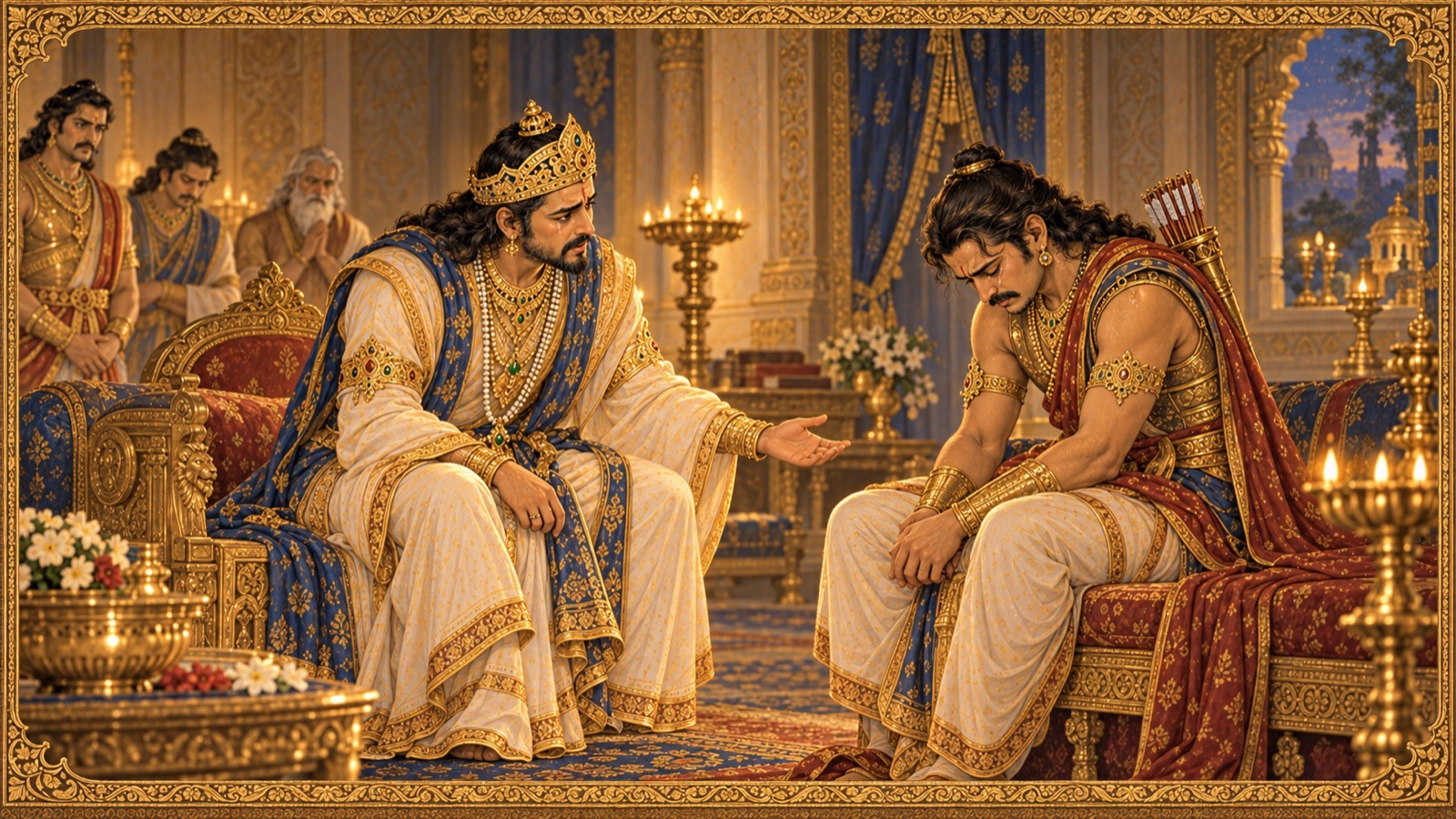
Was Arjuna in good health? He seemed to have lost the brightness of his face. Had he failed to receive proper welcome, or been treated with disrespect during his long stay? Had anyone wounded him with unkind words? Had he ever turned away a suppliant, or failed to keep a promise freely given? Had he refused shelter to any Brāhmaṇa, child, cow, aged or ailing person, woman, or helpless creature that came to him for protection? Yudhiṣṭhira ran through every possible cause of his brother’s sorrow — and then, unable to find it, spoke the fear he had held back the longest.
कच्चित् प्रेष्ठतमेनाथ हृदयेनात्मबन्धुना । शून्योऽस्मि रहितो नित्यं मन्यसे तेऽन्यथा न रुक् ॥ ४४ ॥
kaccit preṣṭhatamenātha hṛdayenātma-bandhunā śūnyo ’smi rahito nityaṁ manyase te ’nyathā na ruk
Meaning: Or is it that, parted from your dearest friend and very Self, Śrī Kṛṣṇa, you feel utterly empty and forlorn? For I can find no other cause for your grief. (Canto 1, Chapter 14, verse 44)
With this question the chapter closes — the answer, and the great sorrow it carries, held back for the discourse that follows.
Principal Teachings
1. The world’s beauty rests upon the Lord’s presence. Yudhiṣṭhira reads in the disordered seasons, the weeping cattle, and the blood-red clouds a single truth: that the earth has “lost her good fortune” because she is losing the touch of the Lord’s feet (verse 21). Where the Divine is honoured, life flourishes in harmony; where His presence withdraws, even nature falls into disarray. The outer world is a mirror of its inner grace.
2. A devotee fears separation, not misfortune. The king does not grieve for his throne, his safety, or his wealth. His one dread is that the Lord may be about to depart (verses 8–9). For the devotee, every good thing is valued only as a gift of the Lord, and the Lord Himself is the one treasure whose loss cannot be borne.
3. Providence speaks through signs, and love learns to read them. Yudhiṣṭhira interprets the omens not with superstition but with a heart attuned to the Lord’s will, recalling the very words Nārada had spoken (verses 22–24). Devotion makes the soul sensitive to the movements of divine providence.
4. The approach of Kali is a decline of dharma within the heart. The corruption the king observes is first of all moral — greed, falsehood, deceit, and the breaking of the closest bonds (verses 3–5). The age of Kali is described not merely as a span of time but as a hardening of the human heart, a warning to guard truthfulness and affection in our own lives.
5. The Lord is the very Self of His devotee. Yudhiṣṭhira’s final question names Kṛṣṇa as Arjuna’s “dearest friend and very Self” (verse 44). To be separated from the Lord is to feel emptied of one’s own being. This is the measure of true devotion: that the Beloved becomes dearer to us than our own life.
A Devotional Reflection
There is a tenderness in this chapter that is easy to miss beneath the frightening omens. Yudhiṣṭhira is a great emperor, victorious in war, secure upon his throne — and yet the throbbing of his own arm frightens him, because it whispers that Kṛṣṇa may be leaving the world. We often measure our lives by what we can hold: our security, our people, our accomplishments. The Bhāgavata gently turns that measure around. All of these, it reminds us, are borrowed light; their true source is the Lord, and when He withdraws, the borrowed light grows dim. To love God in this way is to feel His nearness as our very life-breath, and His absence as a kind of death. It is a demanding love, but also a liberating one, for it teaches the heart to rest not in fragile possessions but in the one Presence that never truly departs from those who call upon Him.
A Daily Devotional Practice
Take a quiet moment today to name, one by one, the good things in your life — those you love, the shelter you enjoy, the strength of your body, the peace of your mind — and offer each of them back to the Lord as His gift, saying gently in your heart, “This too is Yours.” As you do, remember Yudhiṣṭhira, who saw in every blessing the grace of Kṛṣṇa. Let the practice end with a single loving remembrance of the Lord’s name, so that, come what may in the changing seasons of life, the heart learns to hold fast to Him who never leaves.
Important Verses
Beyond the verses shown above, one verse marks the turning point of the whole chapter, as the king first gives voice to his foreboding.
निमित्तान्यत्यरिष्टानि काले त्वनुगते नृणाम् । लोभाद्यधर्मप्रकृतिं दृष्ट्वोवाचानुजं नृप: ॥ ५ ॥
nimittāny atyariṣṭāni kāle tv anugate nṛṇām lobhādy-adharma-prakṛtiṁ dṛṣṭvovācānujaṁ nṛpaḥ
Meaning: Seeing the most inauspicious omens, and how, as the age of Kali drew near, the nature of the people had become unrighteous through greed and the like, the king spoke to his younger brother. (Canto 1, Chapter 14, verse 5)
Conclusion
The fourteenth chapter of the First Canto is a study in the sensitivity of a loving heart. While Arjuna lingers in Dwaraka, King Yudhiṣṭhira watches the seasons turn strange, society sink into discord, and the very heavens fill with dread. Where another might have seen only calamity, he sees the shadow of a single loss: that Śrī Kṛṣṇa, the source of every blessing his family has known, may be about to withdraw His presence from the earth. When Arjuna at last returns — pale, crestfallen, and silent — the king’s fear only deepens, and he pours out a flood of anxious, tender questions about the Yadus and about the Lord, until at last he names the one grief he most dreads: that his brother has been parted from Kṛṣṇa Himself. The chapter leaves us on this threshold of sorrow, teaching us that to love the Lord truly is to feel His nearness as our life and to hold nothing dearer than Him.
May the divine wisdom of Srimad Bhagavatam awaken pure devotion within our hearts.
Om Namo Bhagavate Vasudevaya.
Jay Shree Madhav.
References and Attribution
Primary edition: Gita Press, Śrīmad Bhāgavata Mahāpurāṇa (English), Book One (Skandha 1), Discourse 14, book pages 55–58.
Srimad Bhagavatam Wisdom · Biswa Sanatan Dharma Seva Trust. Presented following the spiritual guidance and recommendation of Pandit Dr. Shri Kashinath Mishra.
This article is an original, faithful devotional retelling (Copyright MODE B). No publisher translation or purport is reproduced; the verse “Meaning” lines are original faithful paraphrase. This article does not imply that any publisher, library, or organization sponsors or endorses it.
Jay Shree Madhav