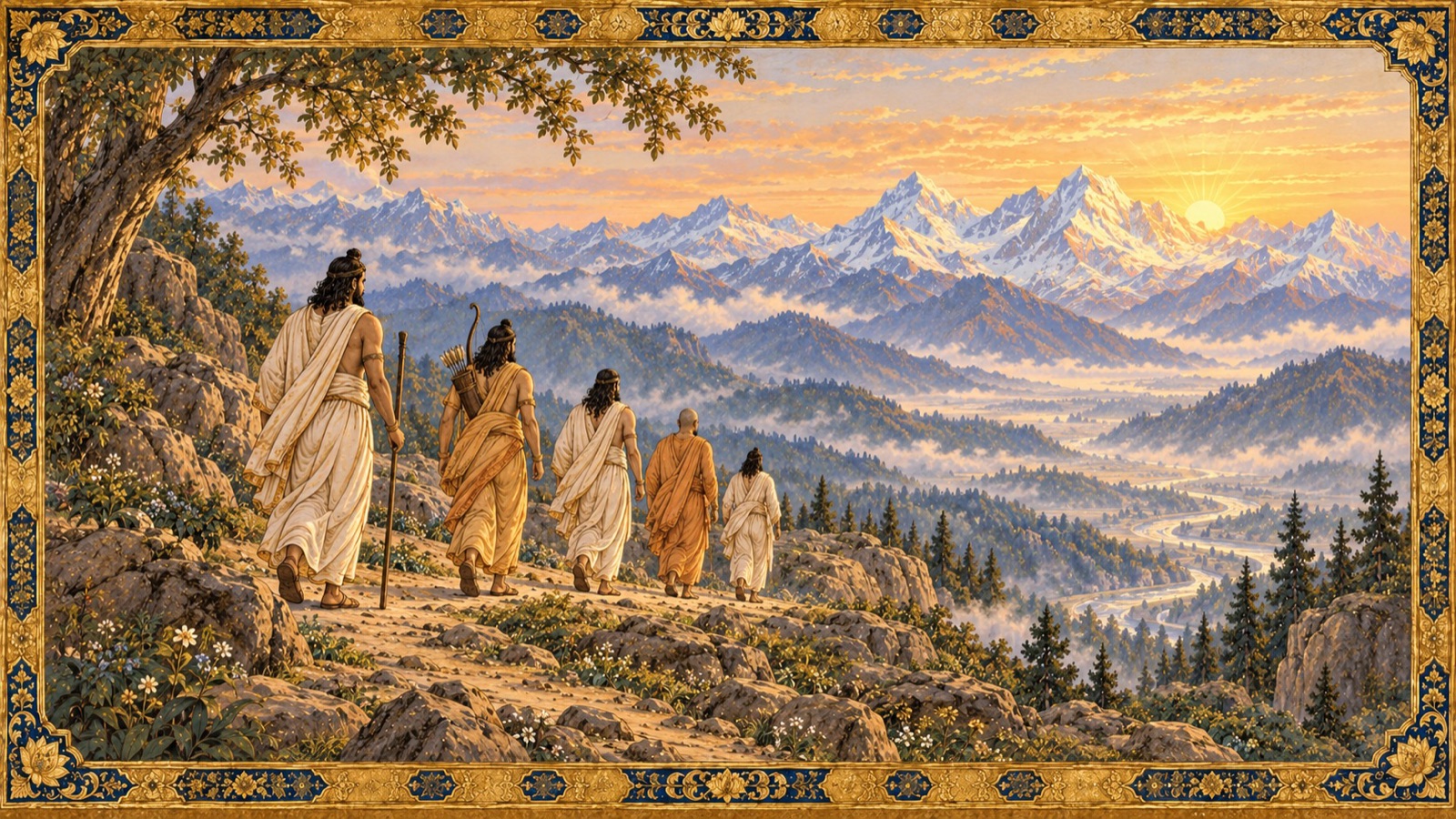
Renouncing the throne and every earthly tie, the sons of Pandu turn their faces to the north and set out on the great journey from which one never returns.
Om Namo Bhagavate Vasudevaya.
Om Namo Bhagavate Vasudevaya.
Om Namo Bhagavate Vasudevaya.
Welcome to Srimad Bhagavatam Wisdom, a devotional journey through the sacred histories and teachings of the Srimad Bhagavat Mahapurana. In the fifteenth chapter of the First Canto, the long story of the Pandavas draws toward its serene close. Sri Krishna has withdrawn His earthly pastimes, and Arjuna returns from Dwaraka a changed and broken man. Out of his grief, however, rises one of the most moving confessions in all of scripture — the admission that every victory of his life was borrowed from the Lord — and out of that confession comes a quiet spiritual awakening. King Yudhishthira, hearing the news, sets his own house in order, enthrones the child Parikshit, and leads his brothers north on the great departure. This is a chapter about letting go: of power, of possessions, of the body itself, and of everything except the lotus-feet of the Lord.
Chapter Information
- Scripture: Śrīmad Bhāgavata Mahāpurāṇa
- Canto: 1 (Book One)
- Chapter: 15 (Discourse 15)
- Chapter title: The Pandavas Retire in Time
- Principal speaker: the blessed Sūta, Ugraśravā (narrator); within the narration, Arjuna
- Principal listener: the sages of Naimiṣāraṇya, headed by Śaunaka; within the narration, King Yudhiṣṭhira
- Main setting: the palace at Hastināpura, with recollections of Kurukṣetra and Dwārakā
- Central subject: Arjuna’s grief at his separation from Śrī Kṛṣṇa, his spiritual recovery, and the renunciation and final journey of the Pāṇḍavas
- Principal verse range: Canto 1, Chapter 15, verses 1–51
- Primary edition: Gita Press Śrīmad Bhāgavata Mahāpurāṇa
Context from the Previous Chapter
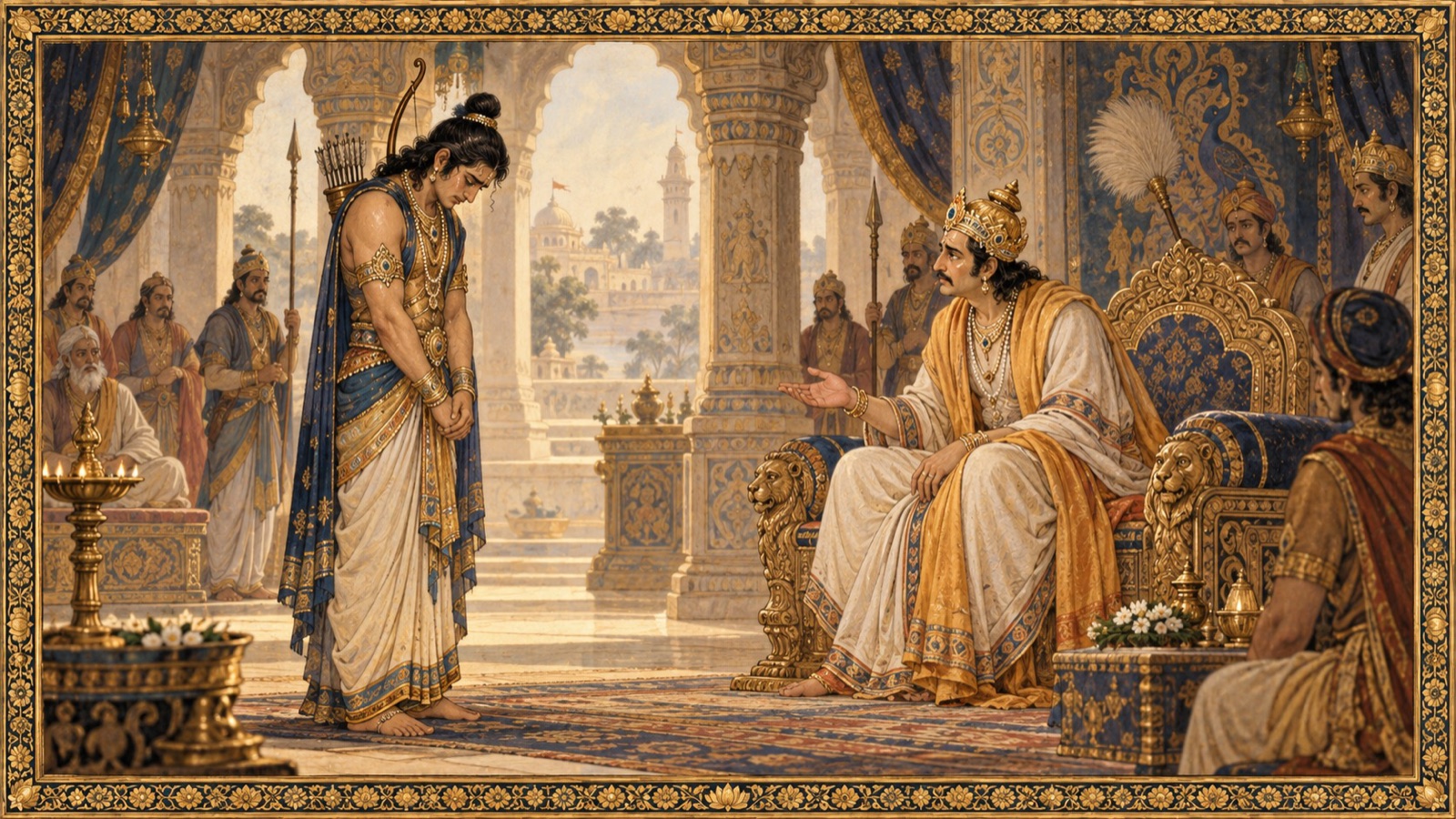
In the fourteenth discourse, King Yudhiṣṭhira had grown uneasy. Fearful omens appeared on every side, and Arjuna, who had gone to Dwārakā, was long overdue. When at last Arjuna returned — pale, downcast, and unlike himself — Yudhiṣṭhira pressed him with anxious questions about their kinsmen and, above all, about Śrī Kṛṣṇa. The fifteenth chapter opens at that very moment, with Arjuna standing before his elder brother, unable to speak.
Arjuna’s Silent Grief
Śrī Kṛṣṇa’s dear friend Arjuna — himself nicknamed Kṛṣṇa — had grown lean and worn from the pain of separation, and his gloomy appearance had given rise to many a doubt in the mind of his elder brother. Questioned by King Yudhiṣṭhira, he could not answer. His lotus-like face and heart were withering with grief, his brightness gone, and his whole being was absorbed in the thought of the Lord alone.
सूत उवाच एवं कृष्णसख: कृष्णो भ्रात्रा राज्ञा विकल्पित: । नानाशङ्कास्पदं रूपं कृष्णविश्लेषकर्शित: ॥ १ ॥
sūta uvāca evaṁ kṛṣṇa-sakhaḥ kṛṣṇo bhrātrā rājñā vikalpitaḥ । nānā-śaṅkāspadaṁ rūpaṁ kṛṣṇa-viśleṣa-karśitaḥ ॥ 1 ॥
Meaning: Sūta said: Thus the friend of Kṛṣṇa — Arjuna, also called Kṛṣṇa — worn thin by his separation from Śrī Kṛṣṇa and wearing an appearance that gave rise to many doubts, was questioned by his brother, the king. (Canto 1, Chapter 15, verse 1)
Overwhelmed by a love that had swelled all the more since the Lord’s disappearance, and recalling His friendship, His kindness, and His good-will while playing the humble role of a charioteer, Arjuna checked his tears with difficulty, wiped his cheeks with his hands, and in a voice choked with weeping began at last to speak to King Yudhiṣṭhira.
“I Have Been Deceived by My Friend”
Arjuna’s first words are startling in their intimacy. He does not begin with news; he begins with heartbreak.
अर्जुन उवाच वञ्चितोऽहं महाराज हरिणा बन्धुरूपिणा । येन मेऽपहृतं तेजो देवविस्मापनं महत् ॥ ५ ॥
arjuna uvāca vañcito ’haṁ mahā-rāja hariṇā bandhu-rūpiṇā । yena me ’pahṛtaṁ tejo deva-vismāpanaṁ mahat ॥ 5 ॥
Meaning: Arjuna said: O great king, I have been outwitted by Śrī Hari, who came to me in the guise of a kinsman and friend; for He has now taken back from me that mighty splendour of mine which once amazed even the gods. (Canto 1, Chapter 15, verse 5)
Separation from Him even for a moment, Arjuna says, makes the whole world a loathsome and lifeless thing — just as this body, once the breath has left it, is called a corpse. In these opening words the deepest teaching of the chapter is already sounded: a devotee’s strength was never truly his own. It was the presence of the Lord, and that alone.
The Deeds Done by the Lord’s Power
Arjuna then pours out a long remembrance of the wonders of his life, and one by one he lays each of them at Krishna’s feet. It was by taking refuge in Him, he says, that he won Draupadī at her svayaṁvara.
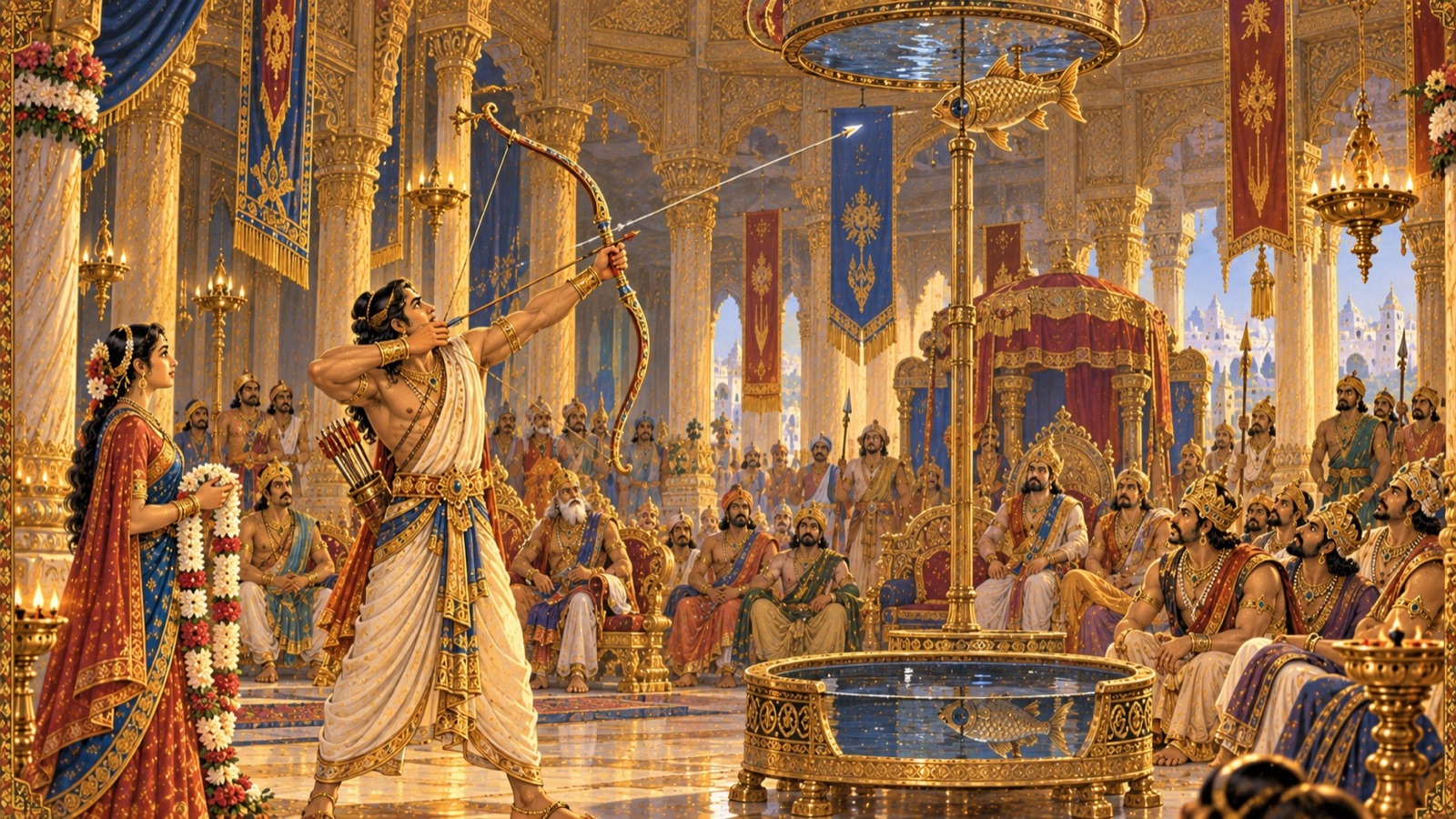
यत्संश्रयाद् द्रुपदगेहमुपागतानां राज्ञां स्वयंवरमुखे स्मरदुर्मदानाम् । तेजो हृतं खलु मयाभिहतश्च मत्स्य: सज्जीकृतेन धनुषाधिगता च कृष्णा ॥ ७ ॥
yat-saṁśrayād drupada-geham upāgatānāṁ rājñāṁ svayaṁvara-mukhe smara-durmadānām । tejo hṛtaṁ khalu mayābhihataś ca matsyaḥ sajjīkṛtena dhanuṣādhigatā ca kṛṣṇā ॥ 7 ॥
Meaning: It was by taking shelter in Him that, at Draupadī’s own choosing of her husband, I outshone the kings gathered in Drupada’s hall — princes maddened with desire — and, fitting the bow with an arrow, struck down the fish target and thereby won the hand of Kṛṣṇā (Draupadī). (Canto 1, Chapter 15, verse 7)
By His nearness, Arjuna continues, he conquered Indra and the gods and offered the Khāṇḍava forest to the fire-god; through Him the demon Maya built their marvellous assembly-hall. It was by His grace that mighty Bhīmasena slew the arrogant Jarāsandha and freed the captive princes destined for slaughter. It was He who avenged the outrage done to Draupadī in open court, and He who saved them from the terrible trap of Durvāsā and his ten thousand disciples by accepting a single stray morsel of food and thereby satisfying the three worlds. By His might Arjuna astonished even Lord Śaṅkara and his consort Girijā in single combat and received the Pāśupata weapon; he ascended to heaven in this very body and shared Indra’s own throne, helping the gods destroy the Nivātakavaca demons.
The Same Bow, and Yet Nothing
Krishna, Arjuna recalls, was the charioteer who carried him across the shoreless ocean of the Kaurava army; whose very glance drained the strength and life-span of the great warriors arrayed against him; in whose arms the deadliest missiles of Bhīṣma, Droṇa, Karṇa, and the rest could not so much as touch his body — even as the weapons of the demons could never harm the devotee Prahlāda.
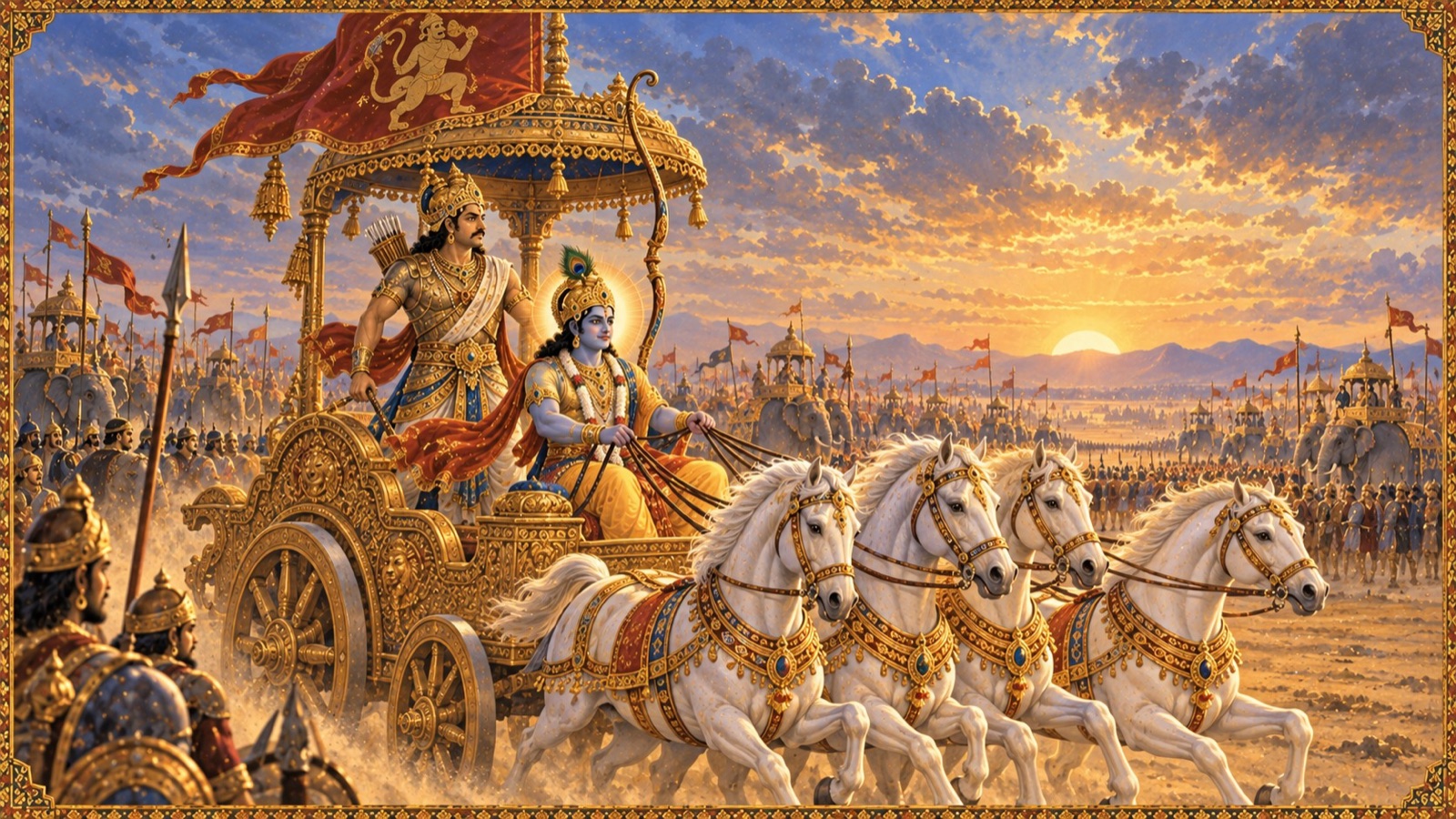
Foolish as he was, Arjuna says, he had dared to make his charioteer the very Lord whose feet the greatest souls adore for release from birth and death. He remembers Krishna’s affectionate jokes, His bright smile, and the tender names by which He called him — “son of Pṛthā,” “friend,” “delight of the Kurus” — and how the Lord, in His boundless greatness, forgave his every impertinence as a father forgives a son. Now, bereft of that friend, his heart is empty; and it was in this state that a band of common cowherds could defeat him and carry off the very women he had been escorting from Dwārakā. Then comes his most famous lament of all.
तद्वै धनुस्त इषव: स रथो हयास्ते सोऽहं रथी नृपतयो यत आनमन्ति । सर्वं क्षणेन तदभूदसदीशरिक्तं भस्मन्हुतं कुहकराद्धमिवोप्तमूष्याम् ॥ २१ ॥
tad vai dhanus ta iṣavaḥ sa ratho hayās te so ’haṁ rathī nṛpatayo yata ānamanti । sarvaṁ kṣaṇena tad abhūd asad īśa-riktaṁ bhasman hutaṁ kuhaka-rāddham ivoptam ūṣyām ॥ 21 ॥
Meaning: The bow is the same, the arrows are the same, the same is my chariot drawn by the same horses, and I am the same warrior before whom kings once bowed. Yet, emptied of the Lord, in a single moment all of it became worthless — like an oblation poured upon ashes, like wealth conjured by a trickster, like seed sown in barren ground. (Canto 1, Chapter 15, verse 21)
The Passing of the Yadus
Then Arjuna answers the question that Yudhiṣṭhira most feared to ask. The kinsmen at Dwārakā, he says, lost their reason under the influence of a Brāhmaṇa’s curse, fell to drinking, and in their reeling madness struck one another down like strangers, until all but four or five had perished. It is the sport of the almighty Lord, he explains, that living beings now destroy and now protect one another.
जलौकसां जले यद्वन्महान्तोऽदन्त्यणीयस: । दुर्बलान्बलिनो राजन्महान्तो बलिनो मिथ: ॥ २५ ॥ एवं बलिष्ठैर्यदुभिर्महद्भिरितरान् विभु: । यदून्यदुभिरन्योन्यं भूभारान् सञ्जहार ह ॥ २६ ॥
jalaukasāṁ jale yadvan mahānto ’danty aṇīyasaḥ । durbalān balino rājan mahānto balino mithaḥ ॥ 25 ॥ evaṁ baliṣṭhair yadubhir mahadbhir itarān vibhuḥ । yadūn yadubhir anyonyaṁ bhū-bhārān sañjahāra ha ॥ 26 ॥
Meaning: Just as in the water the larger creatures devour the smaller and the strong the weak, so the almighty Lord, O king, employed the mighty Yādavas to destroy the other rulers who burdened the earth, and then had the Yādavas themselves slay one another. (Canto 1, Chapter 15, verses 25–26)
Even so, the sting of grief begins to give way to something sweeter, for the words of Lord Govinda — so fitting to the time and place, so healing to the aching heart — ravish Arjuna’s soul the moment he recalls them.
देशकालार्थयुक्तानि हृत्तापोपशमानि च । हरन्ति स्मरतश्चित्तं गोविन्दाभिहितानि मे ॥ २७ ॥
deśa-kālārtha-yuktāni hṛt-tāpopaśamāni ca । haranti smarataś cittaṁ govindābhihitāni me ॥ 27 ॥
Meaning: The teachings Govinda once gave me — perfectly suited to time, place, and need, and able to soothe the very burning of the heart — master my mind the instant I recall them. (Canto 1, Chapter 15, verse 27)
Arjuna’s Mind Grows Tranquil
As Arjuna contemplates the lotus-feet of Śrī Kṛṣṇa with the most intense love, a quiet transformation comes over him.
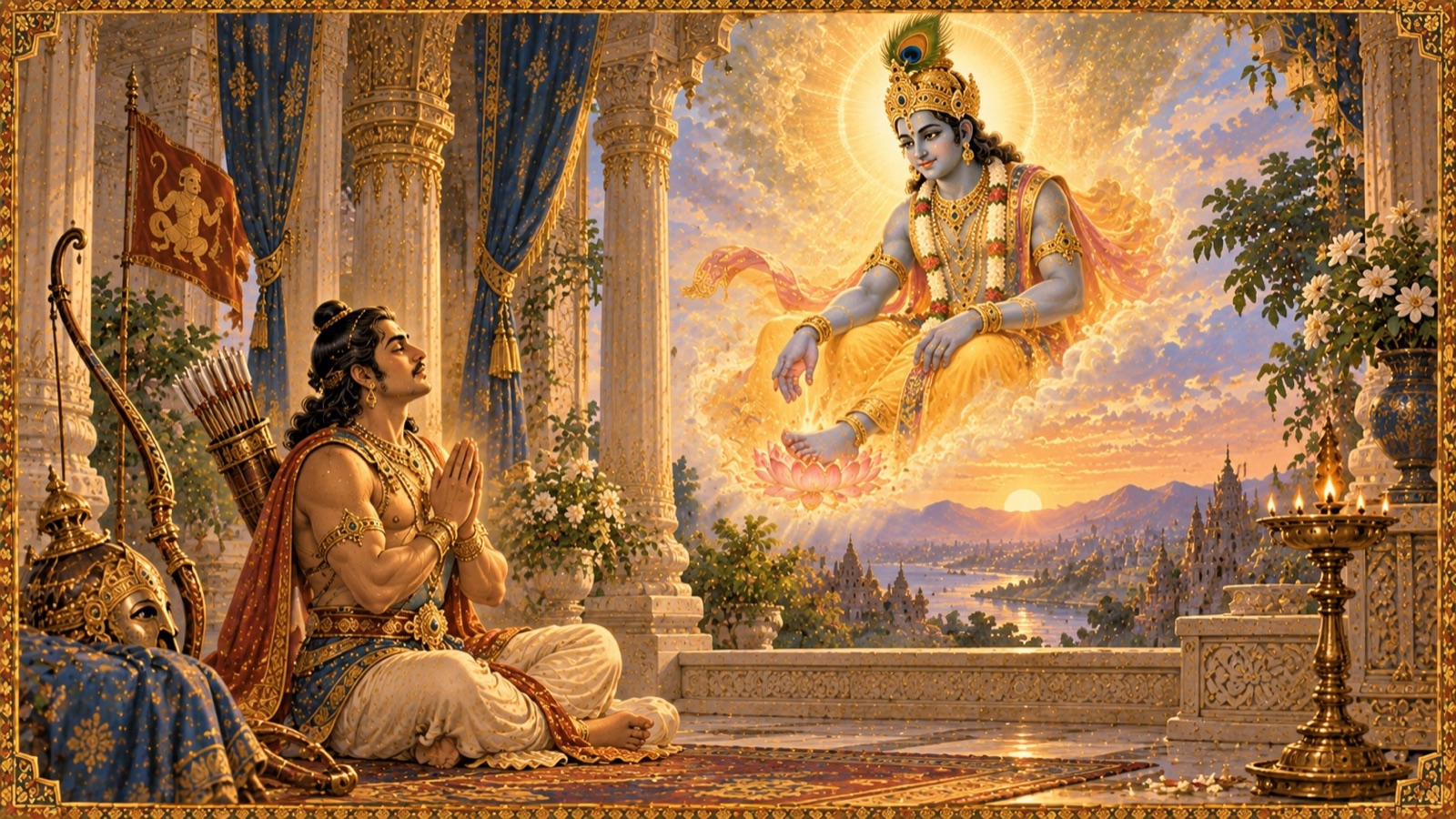
सूत उवाच एवं चिन्तयतो जिष्णो: कृष्णपादसरोरुहम् । सौहार्देनातिगाढेन शान्तासीद्विमला मति: ॥ २८ ॥
sūta uvāca evaṁ cintayato jiṣṇoḥ kṛṣṇa-pāda-saroruham । sauhārdenātigāḍhena śāntāsīd vimalā matiḥ ॥ 28 ॥
Meaning: Sūta said: As Arjuna thus dwelt, with the deepest friendship and love, upon the lotus-feet of Śrī Kṛṣṇa, his mind grew calm, clear, and free of every impurity. (Canto 1, Chapter 15, verse 28)
The impurities of lust and anger washed away as this devotion deepened; the last residue of worldly desire subsided, and once more he became master of his own senses. The veil of Māyā lifted: realizing the Absolute, he rose above the three modes of Nature, the illusion of duality was dissolved, and he was freed at last from sorrow and from the round of rebirth (verses 29–31).
Yudhishthira and Kunti Turn Homeward
Hearing all this, King Yudhiṣṭhira’s mind grew still.
निशम्य भगवन्मार्गं संस्थां यदुकुलस्य च । स्व:पथाय मतिं चक्रे निभृतात्मा युधिष्ठिर: ॥ ३२ ॥
niśamya bhagavan-mārgaṁ saṁsthāṁ yadu-kulasya ca । svaḥ-pathāya matiṁ cakre nibhṛtātmā yudhiṣṭhiraḥ ॥ 32 ॥
Meaning: Hearing of the Lord’s departure to His own abode and of the passing of the Yadu race, the self-composed Yudhiṣṭhira resolved to set out upon the path leading to the higher worlds. (Canto 1, Chapter 15, verse 32)
The same tidings that stilled her son’s mind reached Queen Kuntī as well: hearing them from Arjuna’s own lips, she resolved at once to leave the world of birth and death behind for ever.
पृथाप्यनुश्रुत्य धनञ्जयोदितं नाशं यदूनां भगवद्गतिं च ताम् । एकान्तभक्त्या भगवत्यधोक्षजे निवेशितात्मोपरराम संसृते: ॥ ३३ ॥
pṛthāpy anuśrutya dhanañjayoditaṁ nāśaṁ yadūnāṁ bhagavad-gatiṁ ca tām । ekānta-bhaktyā bhagavaty adhokṣaje niveśitātmopararāma saṁsṛteḥ ॥ 33 ॥
Meaning: Pṛthā (Kuntī) too, hearing from Arjuna of the destruction of the Yadus and of the Lord’s departure, fixed her heart with unswerving devotion upon Bhagavān Adhokṣaja and withdrew for ever from the cycle of worldly existence. (Canto 1, Chapter 15, verse 33)
The Lord Departs and the Age of Kali Enters
When Lord Śrī Kṛṣṇa cast off from the sight of the world the very body by which He had relieved the earth of its burden, a great turning of the age took place.
यदा मुकुन्दो भगवानिमां महीं जहौ स्वतन्वा श्रवणीयसत्कथ: । तदाहरेवाप्रतिबुद्धचेतसा- मभद्रहेतु: कलिरन्ववर्तत ॥ ३६ ॥
yadā mukundo bhagavān imāṁ mahīṁ jahau sva-tanvā śravaṇīya-sat-kathaḥ । tadāhar evāpratibuddha-cetasām abhadra-hetuḥ kalir anvavartata ॥ 36 ॥
Meaning: On the very day that Lord Mukunda — the Supreme Lord, whose glorious tales are worthy of hearing — departed from this earth in His own form, the age of Kali, source of misfortune for those of unawakened mind, set in. (Canto 1, Chapter 15, verse 36)
The wise Yudhiṣṭhira saw the vices of the new age — greed, falsehood, deceit, and violence — spreading through the city, the kingdom, the home, and the very hearts of the people, and he understood that the time to depart had come.
Parikshit Enthroned, Yudhishthira Renounces
Before setting out, the emperor put the world in order.
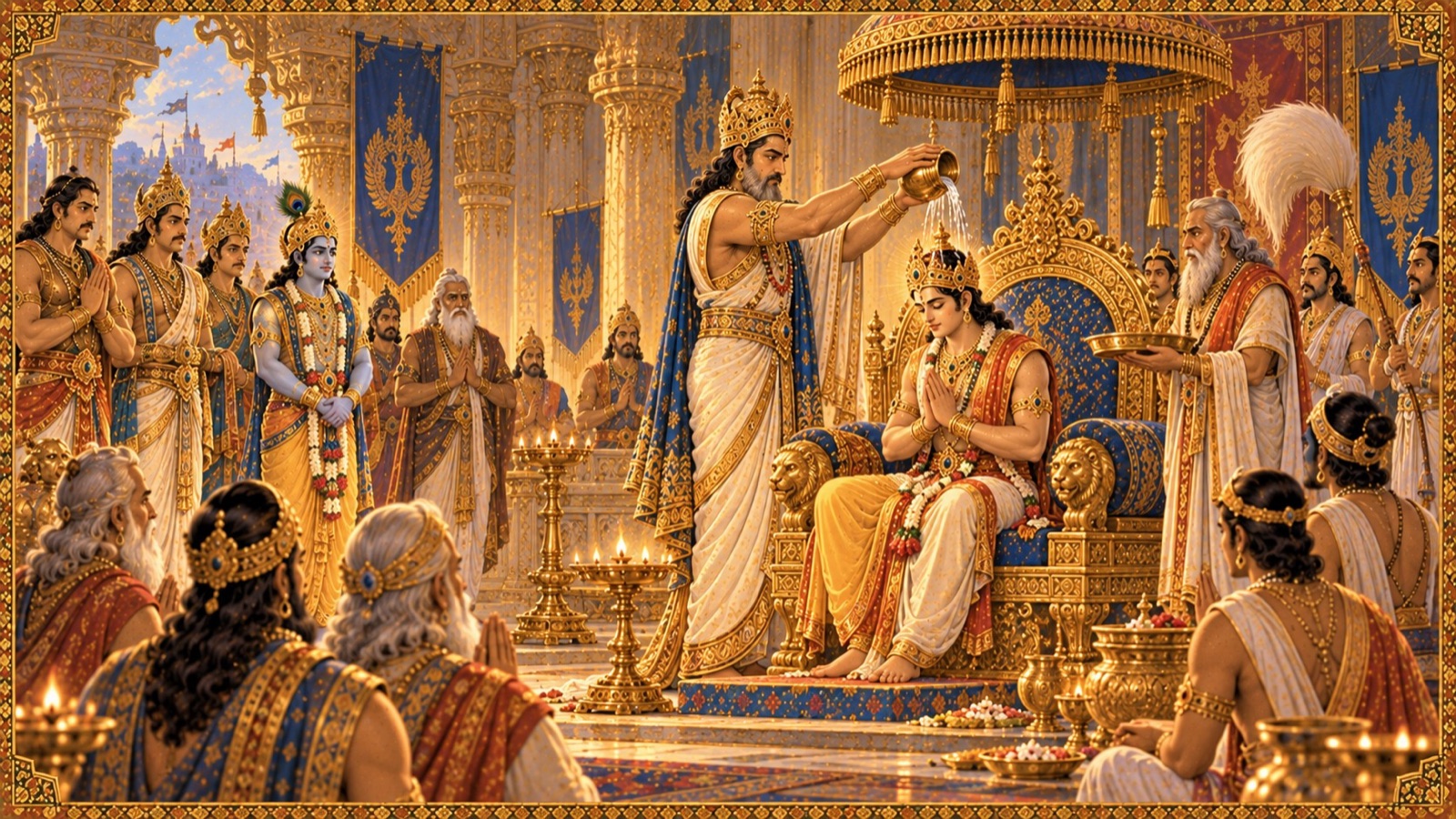
स्वराट् पौत्रं विनयिनमात्मन: सुसमं गुणै: । तोयनीव्या: पतिं भूमेरभ्यषिञ्चद्गजाह्वये ॥ ३८ ॥
sva-rāṭ pautraṁ vinayinam ātmanaḥ susamaṁ guṇaiḥ । toya-nīvyāḥ patiṁ bhūmer abhyaṣiñcad gajāhvaye ॥ 38 ॥
Meaning: At Hastināpura the sovereign Yudhiṣṭhira anointed his grandson — well-disciplined and his own equal in virtue — as the lord of the earth that is girdled by the seas. (Canto 1, Chapter 15, verse 38)
At Mathurā he enthroned Vajra, grandson of the Lord, as ruler of the Śūrasenas. Then, having offered the sacrifice to Prajāpati and merged the sacred fires within himself, he renounced his kingdom. Leaving behind his fine garments, ornaments, and every mark of royalty, he cast off all sense of “I” and “mine.” Step by step he then withdrew his very being inward.
वाचं जुहाव मनसि तत्प्राण इतरे च तम् । मृत्यावपानं सोत्सर्गं तं पञ्चत्वे ह्यजोहवीत् ॥ ४१ ॥
vācaṁ juhāva manasi tat prāṇa itare ca tam । mṛtyāv apānaṁ sotsargaṁ taṁ pañcatve hy ajohavīt ॥ 41 ॥
Meaning: He merged his speech into the mind, his mind into the vital air, and that vital air, together with the outgoing breath, he offered into death itself — and death, in turn, he dissolved into his body of the five elements. (Canto 1, Chapter 15, verse 41)
From there the dissolution went further still: the elemental body into the three modes of Nature, the modes into unmanifest Nature, and Nature at last into the imperishable Absolute (verse 42). Clad in rags, silent, taking no food, his hair unbound, he moved through the palace like one deaf and dumb, heeding no one and hearing nothing.
The Great Journey to the North
Then, contemplating the supreme Brahman within his heart, Yudhiṣṭhira walked out of the palace and set his face to the north.
उदीचीं प्रविवेशाशां गतपूर्वां महात्मभि: । हृदि ब्रह्म परं ध्यायन्नावर्तेत यतो गत: ॥ ४४ ॥
udīcīṁ praviveśāśāṁ gata-pūrvāṁ mahātmabhiḥ । hṛdi brahma paraṁ dhyāyan nāvarteta yato gataḥ ॥ 44 ॥
Meaning: Meditating within his heart upon the supreme Brahman, he set out toward the northern quarter — the path trodden of old by great souls, treading which one never again returns. (Canto 1, Chapter 15, verse 44)
Seeing that the age of Kali had gripped the earth, his younger brothers made the same resolve and followed him. Having fulfilled every duty of life and knowing the lotus-feet of Lord Vaikuṇṭha to be their eternal home, they fixed their minds upon Him alone. Their hearts purified by that unbroken devotion, they attained the supreme abode of Bhagavān Nārāyaṇa — a goal beyond the reach of the wicked and the worldly-minded.
Vidura, Draupadi, and the Fruit of Hearing
Vidura too, his mind wholly possessed by Śrī Kṛṣṇa, gave up his body at the holy place of Prabhāsa and returned to his own divine post, welcomed by the departed ancestors. And Draupadī, learning that her lords had turned away from the world, concentrated her heart upon the divine son of Vasudeva and attained to Him.
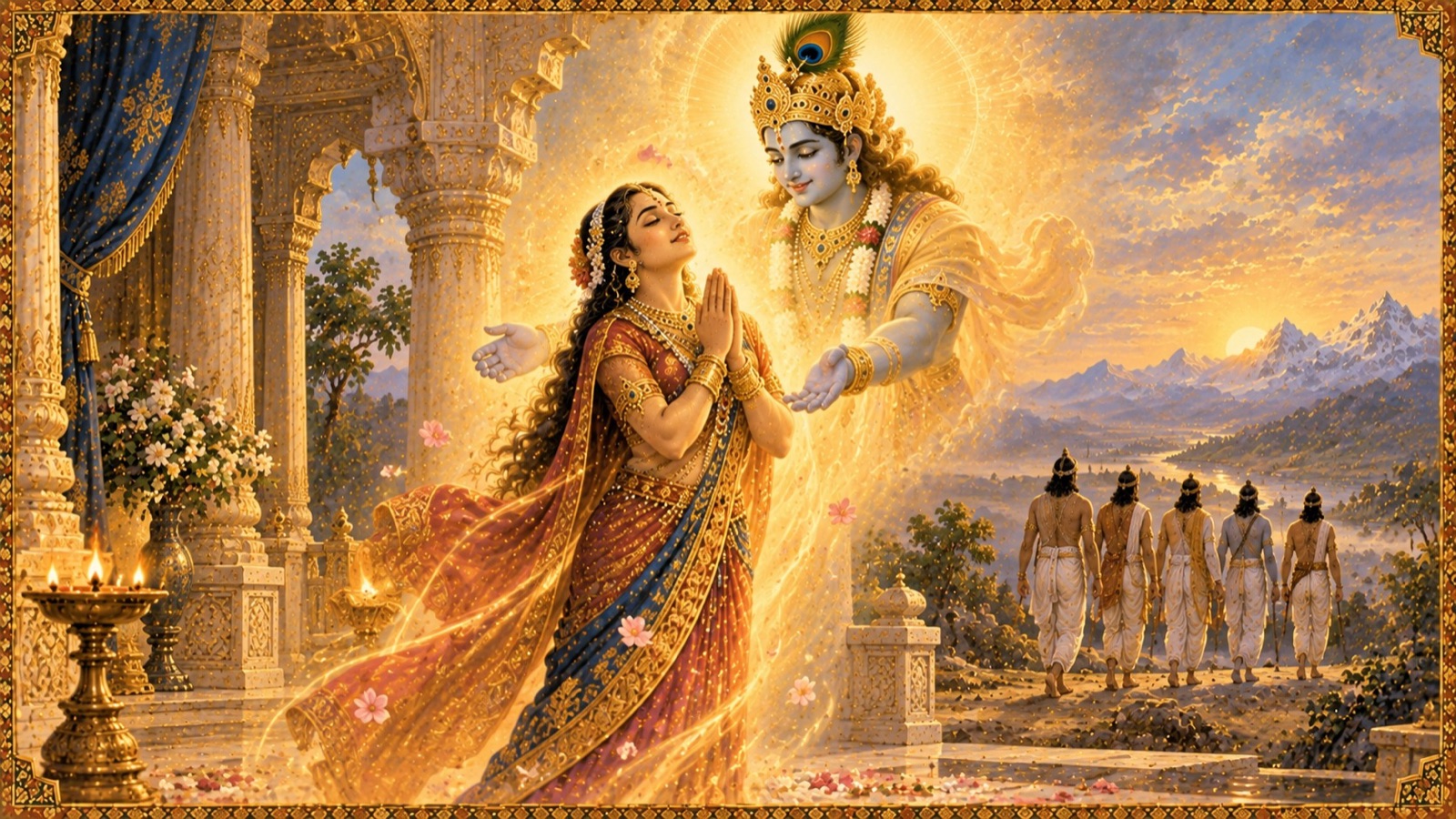
The chapter closes with a promise to everyone who listens to this sacred story.
य: श्रद्धयैतद् भगवत्प्रियाणां पाण्डो: सुतानामिति सम्प्रयाणम् । शृणोत्यलं स्वस्त्ययनं पवित्रं लब्ध्वा हरौ भक्तिमुपैति सिद्धिम् ॥ ५१ ॥
yaḥ śraddhayaitad bhagavat-priyāṇāṁ pāṇḍoḥ sutānām iti samprayāṇam । śṛṇoty alaṁ svastyayanaṁ pavitraṁ labdhvā harau bhaktim upaiti siddhim ॥ 51 ॥
Meaning: Whoever hears with faith this pure and blessed account of the final journey of the sons of Pāṇḍu — so dear to the Lord — gains loving devotion to Śrī Hari and attains the highest perfection. (Canto 1, Chapter 15, verse 51)
Principal Teachings
1. All our strength is borrowed from the Lord. Arjuna, the mightiest archer of his age, discovers that his valour was never his own — it was the presence of Śrī Kṛṣṇa (verses 5, 21). When we succeed, humility remembers the true source; when we fail, faith knows where to turn.
2. Remembrance of the Lord heals grief. Arjuna’s sorrow does not vanish by force of will. It dissolves as he dwells on Kṛṣṇa’s lotus-feet and recalls His words, until his mind grows calm and clear (verse 28). Loving remembrance, not distraction, is the cure for a broken heart.
3. Even cosmic destruction is the Lord’s design. The self-destruction of the Yadus and the great war alike are shown to be the Lord’s way of relieving the earth of its burden (verses 24–26). What looks like ruin from within time is order from the standpoint of eternity.
4. Renounce in time, before time forces the choice. Yudhiṣṭhira reads the signs of the age and departs while still master of himself, first securing the welfare of his people (verses 37–39). Wise detachment prepares for the end rather than being overtaken by it.
5. Withdraw the self, step by step, into the Absolute. The king’s inward merging — senses into mind, mind into breath, and all into Brahman (verses 41–42) — is the scripture’s picture of a conscious, God-centred death, the fruit of a life of discipline.
6. Devotion carries the whole family home. Kuntī, the brothers, Vidura, and Draupadī each attain the Lord by fixing the mind on Him at the last (verses 33, 45–50). The chapter ends by assuring us that merely hearing this story with faith awakens the same devotion in us (verse 51).
A Devotional Reflection
There is a rare kind of courage in this chapter — the courage to let go. Arjuna, who feared no army, is undone by the absence of one friend, and in that undoing he learns the truth that all his triumphs had only hinted at: that the Lord was the whole of his strength, and that a life is measured not by what it grasps but by Whom it loves. His brothers do not cling to the throne they had suffered so much to win; they set it gently in the hands of a child and walk away toward the mountains and the unknown. We spend so much of our lives accumulating — securing, defending, holding on. This chapter turns us the other way. It asks whether we could, when the time comes, open our hands as freely as these great souls did, keeping back nothing except our devotion to the Lord who was, all along, the source of everything we thought we owned.
A Daily Devotional Practice
Today, choose one thing you are anxiously holding — a role, a possession, a plan, a fear of the future — and, in the manner of the Pandavas, mentally place it at the feet of the Lord. Sit quietly for a few minutes and remember, as Arjuna did, that whatever strength or good has come through you was truly His gift. Then recite slowly, “Om Namo Bhagavate Vasudevaya,” letting the name settle the heart. Let this small act of surrender be a first step northward, on the path that leads home.
Conclusion
So ends the fifteenth discourse of the Śrīmad Bhāgavata, which the God-realized call the Paramahaṁsa-Saṁhitā. In this chapter, Srimad Bhagavatam Canto 1 Chapter 15, we have seen Arjuna return from Dwārakā broken with grief, confess that every victory of his life was borrowed from Śrī Kṛṣṇa, and then, through loving remembrance of the Lord’s feet, recover the peace and wisdom of the Gītā. We have heard how Queen Kuntī turned her heart to Adhokṣaja and left the world; how Yudhiṣṭhira, reading the coming of the Age of Kali, enthroned Parikshit and Vajra, renounced his kingdom, and merged his whole being into the Absolute; and how he and his brothers walked north on the great departure, attaining the eternal abode of Nārāyaṇa. Vidura and Draupadī, their minds fixed on Kṛṣṇa, reached the same goal. The chapter closes by promising that all who hear this sacred account with faith will themselves gain pure devotion. May we learn from the Pandavas to hold the Lord more dearly than we hold our very lives.
May the divine wisdom of Srimad Bhagavatam awaken pure devotion within our hearts.
Om Namo Bhagavate Vasudevaya.
Jay Shree Madhav.
References and Attribution
Primary edition: Gita Press, Śrīmad Bhāgavata Mahāpurāṇa (English), Book One (Skandha 1), Discourse 15, book pages 59–64.
Srimad Bhagavatam Wisdom · Biswa Sanatan Dharma Seva Trust. Presented following the spiritual guidance and recommendation of Pandit Dr. Shri Kashinath Mishra.
This article is an original, faithful devotional retelling (Copyright MODE B). No publisher translation or purport is reproduced; verse “Meaning” lines are original faithful paraphrase. This article does not imply that any publisher, library, or organization sponsors or endorses it.
Jay Shree Madhav