Om Namo Bhagavate Vasudevaya.
Om Namo Bhagavate Vasudevaya.
Om Namo Bhagavate Vasudevaya.
With Lord Śrī Kṛṣṇa having withdrawn from mortal sight, the world enters a new and darker season. Yet the light of dharma does not vanish all at once. In this chapter of the Śrīmad Bhāgavata, the noble emperor Parīkṣit rises to protect the earth, and we are given a scene of rare tenderness — the god of virtue and Mother Earth, standing in the twilight of the age, remembering together the Lord who has departed. It is a chapter about how a devotee governs, how dharma weakens, and how remembrance of Kṛṣṇa remains the one refuge that never fails.
Chapter Information
- Scripture: Śrīmad Bhāgavata Mahāpurāṇa (Bhāgavata Purāṇa)
- Canto: One
- Chapter: Sixteen
- Chapter title: How King Parīkṣit Received the Age of Kali
- Principal speaker: Sūta Gosvāmī (Ugraśravā)
- Principal listeners: Śaunaka and the assembled sages at Naimiṣāraṇya
- Inner dialogue: Dharma (the god of piety) and Mother Earth (Dharaṇī)
- Central subject: King Parīkṣit’s righteous reign and world-conquest, and the lament of Dharma and the Earth over the onset of the Kali age
- Principal verse range: SB 1.16.1–36
- Primary edition: Gita Press
Context from the Previous Chapter
In the fifteenth chapter, the Pāṇḍavas, learning that Lord Kṛṣṇa had concluded His earthly pastimes and departed for His eternal abode, renounced their kingdom and set out on the great northward path. Before leaving, Emperor Yudhiṣṭhira installed his grandson Parīkṣit as sovereign of the earth at Hastināpura and Vajra as ruler at Mathurā. On the very day the Lord withdrew from the world, the age of Kali quietly entered. It is into this changed world that King Parīkṣit now steps forward.
A Devotee Ascends the Throne
Sūta Gosvāmī continues the sacred history for the sages. After the Pāṇḍavas’ ascent, King Parīkṣit — a great devotee of the Lord — ruled the earth exactly as the foremost Brāhmaṇas advised, embodying every noble virtue that expert astrologers had foretold at his birth.
सूत उवाच तत: परीक्षिद् द्विजवर्यशिक्षया महीं महाभागवत: शशास ह । यथा हि सूत्यामभिजातकोविदा: समादिशन् विप्र महद्गुणस्तथा ॥ १ ॥
sūta uvāca / tataḥ parīkṣid dvija-varya-śikṣayā / mahīṁ mahā-bhāgavataḥ śaśāsa ha / yathā hi sūtyām abhijāta-kovidāḥ / samādiśan vipra mahad-guṇas tathā
Meaning: Sūta said — Thereafter Parīkṣit, a great devotee of the Lord, ruled the earth under the guidance of the best of the twice-born, displaying all the exalted qualities that learned astrologers had predicted at the time of his birth. (SB 1.16.1)
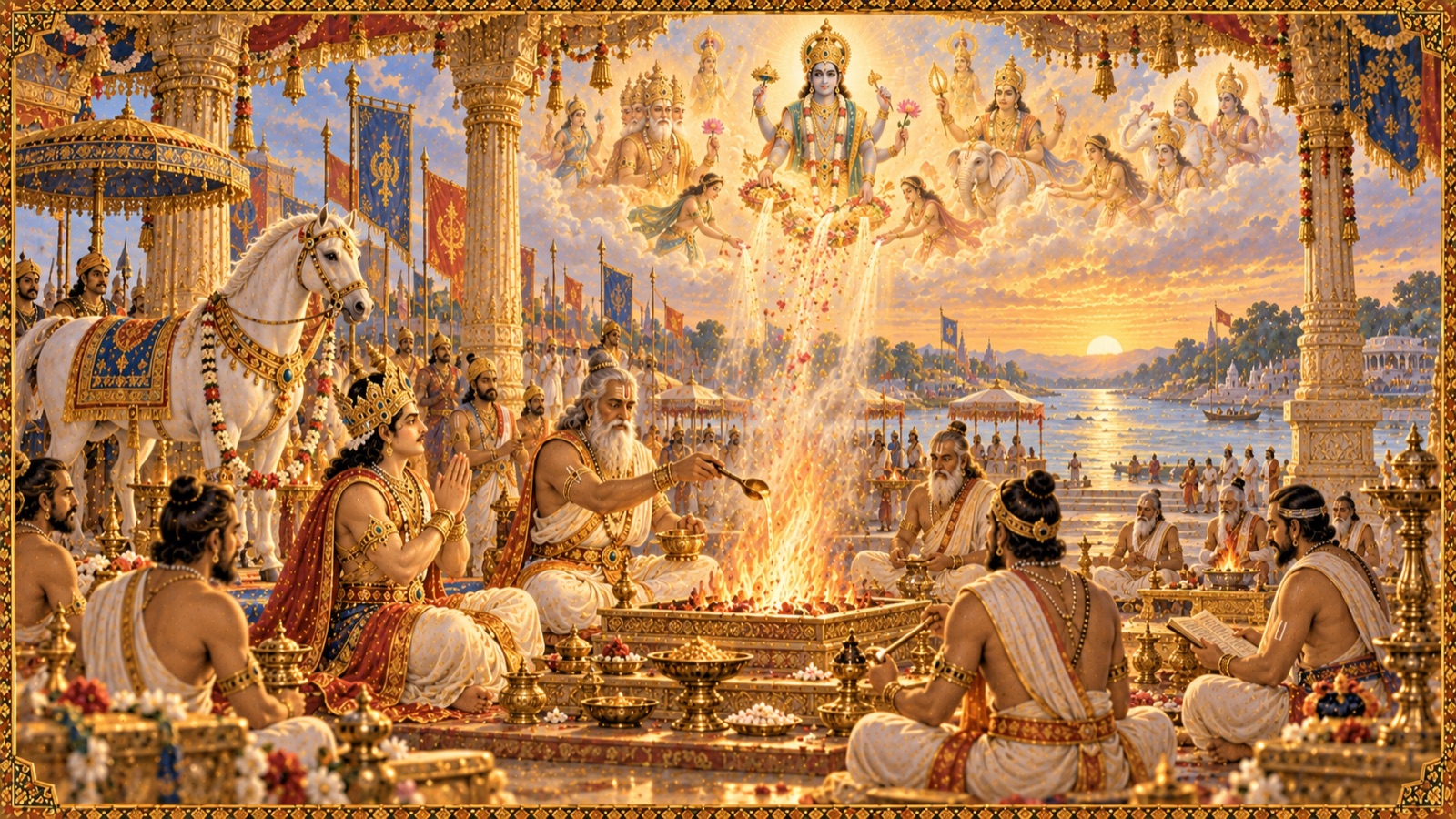
He married Irāvatī, daughter of Uttara, and through her fathered four sons, of whom Janamejaya was the eldest. Taking Kṛpa, the son of Śaradvān, as his spiritual guide, he performed three horse-sacrifices (Aśvamedhas) on the bank of the Gaṅgā with lavish gifts to the priests — sacrifices so pure that the gods appeared and accepted their offerings before the eyes of all.
The Spirit of Kali in Disguise
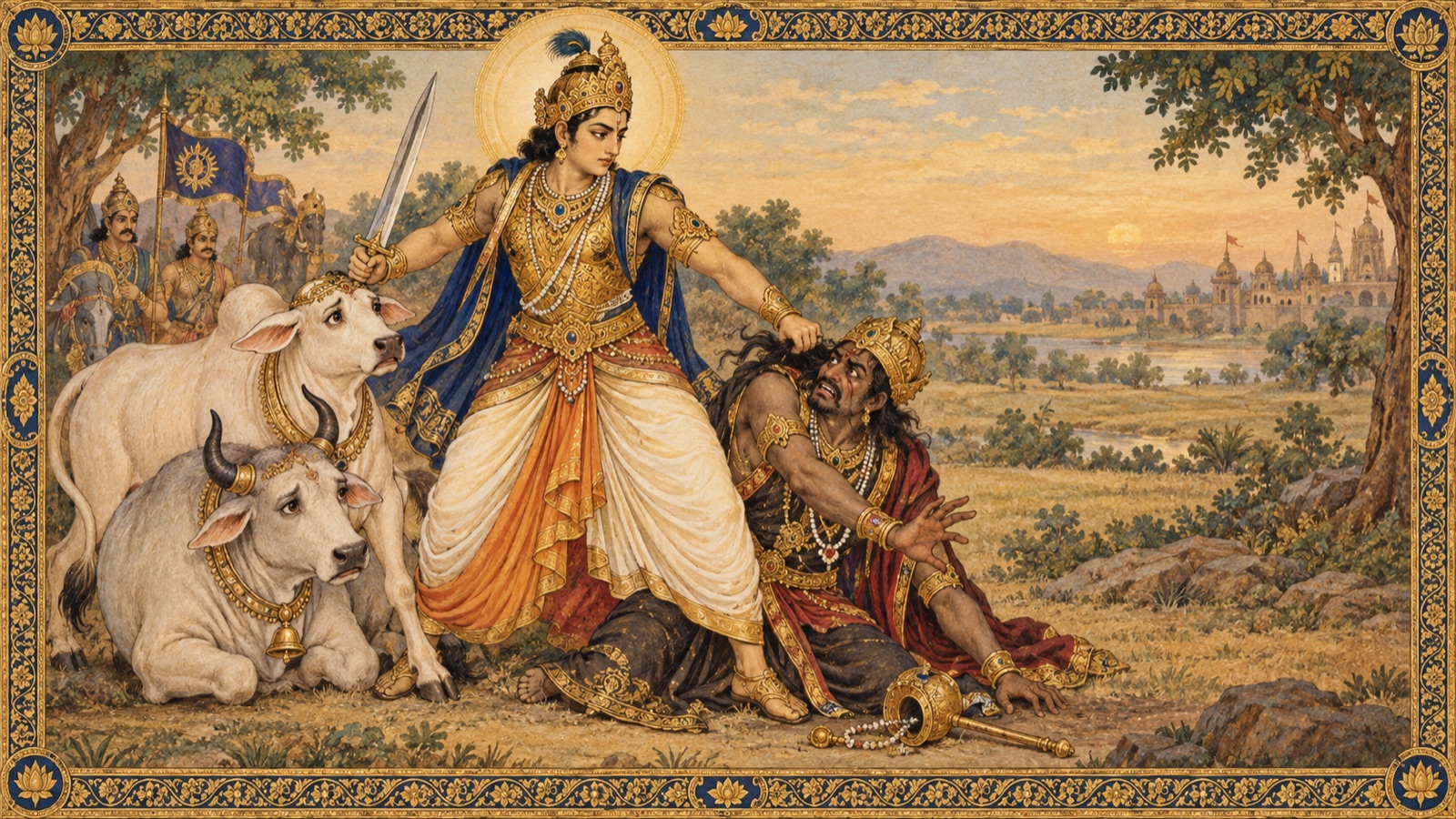
Somewhere in the course of his conquest of the world, the heroic king came upon a startling sight: a lowly figure, dressed as a king but a Śūdra by conduct, cruelly striking a cow and a bull with his foot. This was the very spirit of the Kali age wearing a royal disguise. With his superior might, Parīkṣit seized and subdued him.
निजग्राहौजसा वीर: कलिं दिग्विजये क्वचित् । नृपलिङ्गधरं शूद्रं घ्नन्तं गोमिथुनं पदा ॥ ४ ॥
nijagrāhaujasā vīraḥ / kaliṁ digvijaye kvacit / nṛpa-liṅga-dharaṁ śūdraṁ / ghnantaṁ go-mithunaṁ padā
Meaning: In the course of his conquest, the hero once forcibly subdued Kali, who, disguised in the marks of a king though a Śūdra at heart, was striking a cow and a bull with his foot. (SB 1.16.4)
Saunaka’s Question
Hearing this, Śaunaka interrupts with a searching question: why did the king merely subdue Kali rather than kill him outright and rid the world of his influence forever? And he asks Sūta to relate only what is connected with Śrī Kṛṣṇa or with the saints devoted to Him, for other idle talk is a waste of a fleeting life (SB 1.16.5–6). Sūta explains a deeper design at work in that very assembly: the sages had invited even the god of death himself so that mortal, short-lived people might have the leisure to hear the nectarean pastimes of Śrī Hari.
क्षुद्रायुषां नृणामङ्ग मर्त्यानामृतमिच्छताम् । इहोपहूतो भगवान्मृत्यु: शामित्रकर्मणि ॥ ७ ॥
kṣudrāyuṣāṁ nṛṇām aṅga / martyānām ṛtam icchatām / ihopahūto bhagavān / mṛtyuḥ śāmitra-karmaṇi
Meaning: For the sake of short-lived mortals who yet long for the truth, the mighty god of death has here been invited to the performance of the propitiatory rites. (SB 1.16.7)
While death waits, none will die; and in that reprieve, people may hear and relish the deeds of the Lord. How tragic, then, that the life-span of the unfortunate — dull of understanding and short-lived — is squandered in sleep by night and frivolity by day (SB 1.16.9).
Parīkṣit’s Conquest of the World
Sūta resumes the story of the king. While Parīkṣit was dwelling in the Kuru-jāṅgala country, he heard the unwelcome news that Kali had entered the domain under his protection. Ever eager to defend the right, he at once took up his bow.
सूत उवाच यदा परीक्षित् कुरुजाङ्गलेऽवसत् कलिं प्रविष्टं निजचक्रवर्तिते । निशम्य वार्तामनतिप्रियां तत: शरासनं संयुगशौण्डिराददे ॥ १० ॥
sūta uvāca / yadā parīkṣit kuru-jāṅgale ‘vasat / kaliṁ praviṣṭaṁ nija-cakravartite / niśamya vārtām anatipriyāṁ tataḥ / śarāsanaṁ saṁyuga-śauṇḍir ādade
Meaning: Sūta said — When Parīkṣit, dwelling in Kuru-jāṅgala, heard the unpleasant news that Kali had entered his empire, that lover of battle took up his bow. (SB 1.16.10)
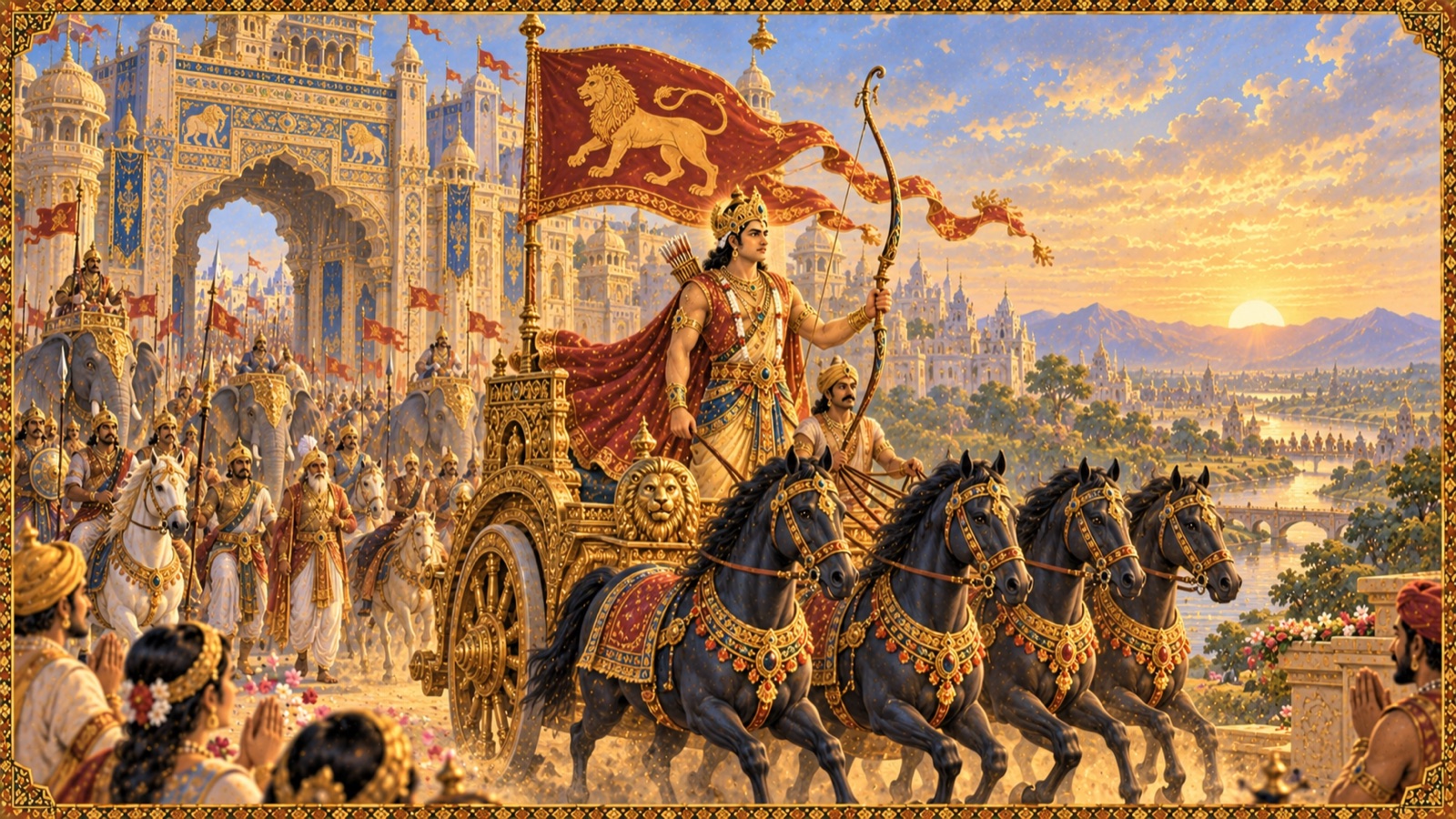
Mounting his well-adorned chariot — drawn by dark horses and flying an ensign marked with a lion — he rode out from his capital, surrounded by his army of chariots, elephants, cavalry and foot, to conquer the four quarters of the world.
स्वलङ्कृतं श्यामतुरङ्गयोजितं रथं मृगेन्द्रध्वजमाश्रित: पुरात् । वृतो रथाश्वद्विपपत्तियुक्तया स्वसेनया दिग्विजयाय निर्गत: ॥ ११ ॥
svalaṅkṛtaṁ śyāma-turaṅga-yojitaṁ / rathaṁ mṛgendra-dhvajam āśritaḥ purāt / vṛto rathāśva-dvipapatti-yuktayā / sva-senayā digvijayāya nirgataḥ
Meaning: Mounting his beautifully decorated chariot, yoked with dark horses and bearing a lion-marked flag, and surrounded by his army of chariots, horses, elephants and infantry, he set forth from his city for the conquest of the directions. (SB 1.16.11)
Having subdued Bhadrāśva, Ketumāla, Bhārata, the northern Kurus, Kimpuruṣa and other lands, he levied tribute from them. Everywhere he went, he heard the people singing the glories of his high-souled forefathers, the Pāṇḍavas — and in those songs, the glory of Śrī Kṛṣṇa always shone through.
Hearing the Glories of Krishna
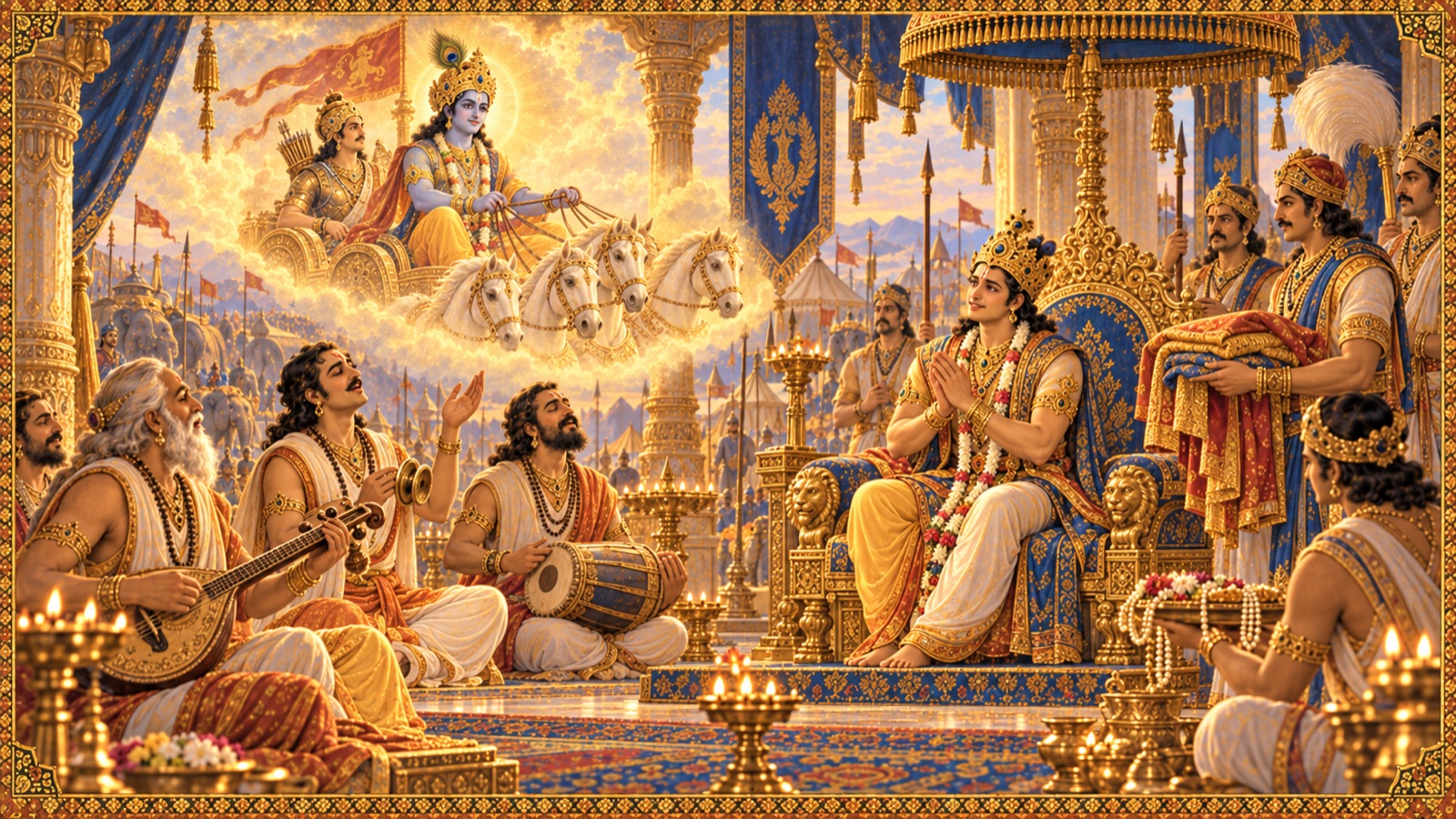
As he journeyed, the king heard the story of his own miraculous rescue, while yet in the womb, from the blazing weapon of Aśvatthāmā, and of the loving bond between the Vṛṣṇis and the sons of Pṛthā. Delighted, the noble emperor rewarded the singers with costly garments and necklaces, his eyes wide with joy. And as he heard how Lord Viṣṇu had served the Pāṇḍavas — as their charioteer, counsellor, messenger, friend and night-guard, even bowing to Yudhiṣṭhira and causing the whole world to bow at the feet of His beloved devotees — devotion to the Lord’s lotus feet awakened and deepened within him.
सारथ्यपारषदसेवनसख्यदौत्य- वीरासनानुगमनस्तवनप्रणामान् । स्निग्धेषु पाण्डुषु जगत्प्रणतिं च विष्णो- र्भक्तिं करोति नृपतिश्चरणारविन्दे ॥ १६ ॥
sārathya-pāraṣada-sevana-sakhya-dautya- / vīrāsanānugamana-stavana-praṇāmān / snigdheṣu pāṇḍuṣu jagat-praṇatiṁ ca viṣṇor / bhaktiṁ karoti nṛ-patiś caraṇāravinde
Meaning: Hearing how Lord Viṣṇu, out of affection for the Pāṇḍavas, acted as their charioteer, councillor, servant, friend, envoy and guard, followed and praised them, offered them obeisance, and made the whole world bow to them, the king developed devotion to the Lord’s lotus feet. (SB 1.16.16)
A Strange Sight: Dharma and the Earth
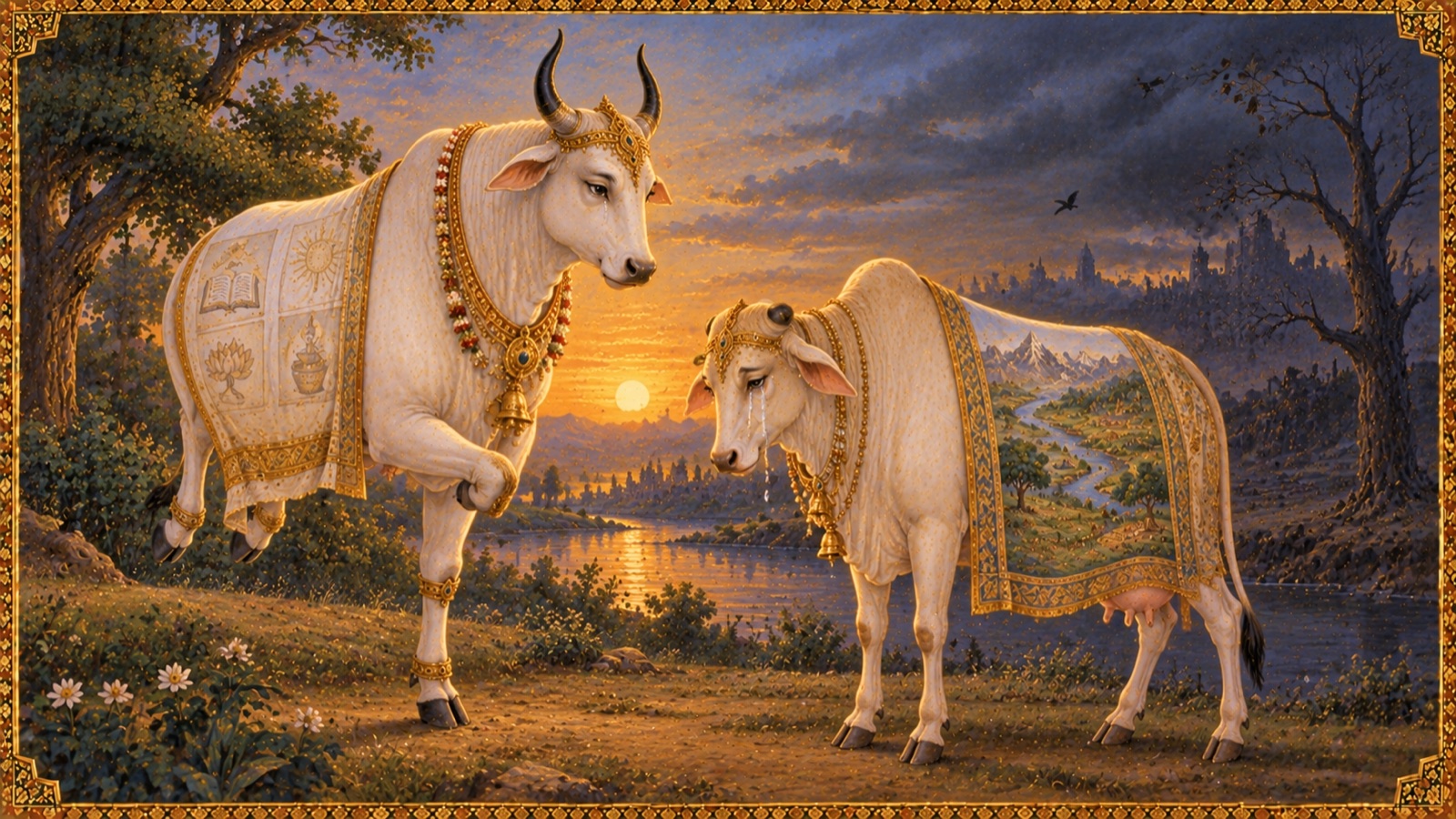
As Parīkṣit followed day by day in his forefathers’ footsteps, a strange incident occurred not far from his borders. Dharma, the god of virtue, wandered in the form of a bull, hobbling upon a single foot. He came upon Mother Earth appearing as a cow — pale, robbed of her lustre, and bathing her cheeks in tears like a mother who has lost her calf. Moved by her sorrow, Dharma began to question her.
धर्म: पदैकेन चरन् विच्छायामुपलभ्य गाम् । पृच्छति स्माश्रुवदनां विवत्सामिव मातरम् ॥ १८ ॥
dharmaḥ padaikena caran / vicchāyām upalabhya gām / pṛcchati smāśru-vadanāṁ / vivatsām iva mātaram
Meaning: Dharma, walking on but one foot, met the Earth in the form of a cow who had lost her lustre and was weeping like a mother bereft of her calf, and he questioned her. (SB 1.16.18)
Dharma’s Compassionate Questions
The one-footed bull gently asks whether she is well, for her face is pale and her heart heavy with hidden grief (SB 1.16.19). Is she sorrowing for him, he wonders, now stripped of three of his four legs and left standing on one? Or does she grieve for herself, foreseeing that unworthy men will rule her; for the gods deprived of their sacrificial shares; or for people afflicted by drought (SB 1.16.20)? Does she mourn for women left unprotected, for children treated cruelly, for sacred learning fallen into unworthy hands, or for worthy Brāhmaṇas serving disrespectful royal houses (SB 1.16.21)? Does she weep for fallen Kṣatriyas and ruined kingdoms, or for a humanity lost in eating, drinking and sensual indulgence with no restraint (SB 1.16.22)?
Then Dharma turns to the question that troubles him most.
यद्वाम्ब ते भूरिभरावतार- कृतावतारस्य हरेर्धरित्रि । अन्तर्हितस्य स्मरती विसृष्टा कर्माणि निर्वाणविलम्बितानि ॥ २३ ॥
yad vāmba te bhūri-bharāvatāra- / kṛtāvatārasya harer dharitri / antarhitasya smaratī visṛṣṭā / karmāṇi nirvāṇa-vilambitāni
Meaning: Or, mother, do you dwell on the deeds of Hari, who descended as Kṛṣṇa for no purpose but to lift the immense weight you once carried — deeds so purely transcendental that they eclipse even the joy of liberation — and grieve simply because He has now withdrawn from your sight? (SB 1.16.23)
Or has all-conquering time, mightier than the mightiest, quietly carried off the very fortune that even the celestials once adored in you (SB 1.16.24)? Each question is a portrait of the Kali age dawning — and each is asked with a father’s tenderness rather than a judge’s severity.
The Earth Remembers Krishna
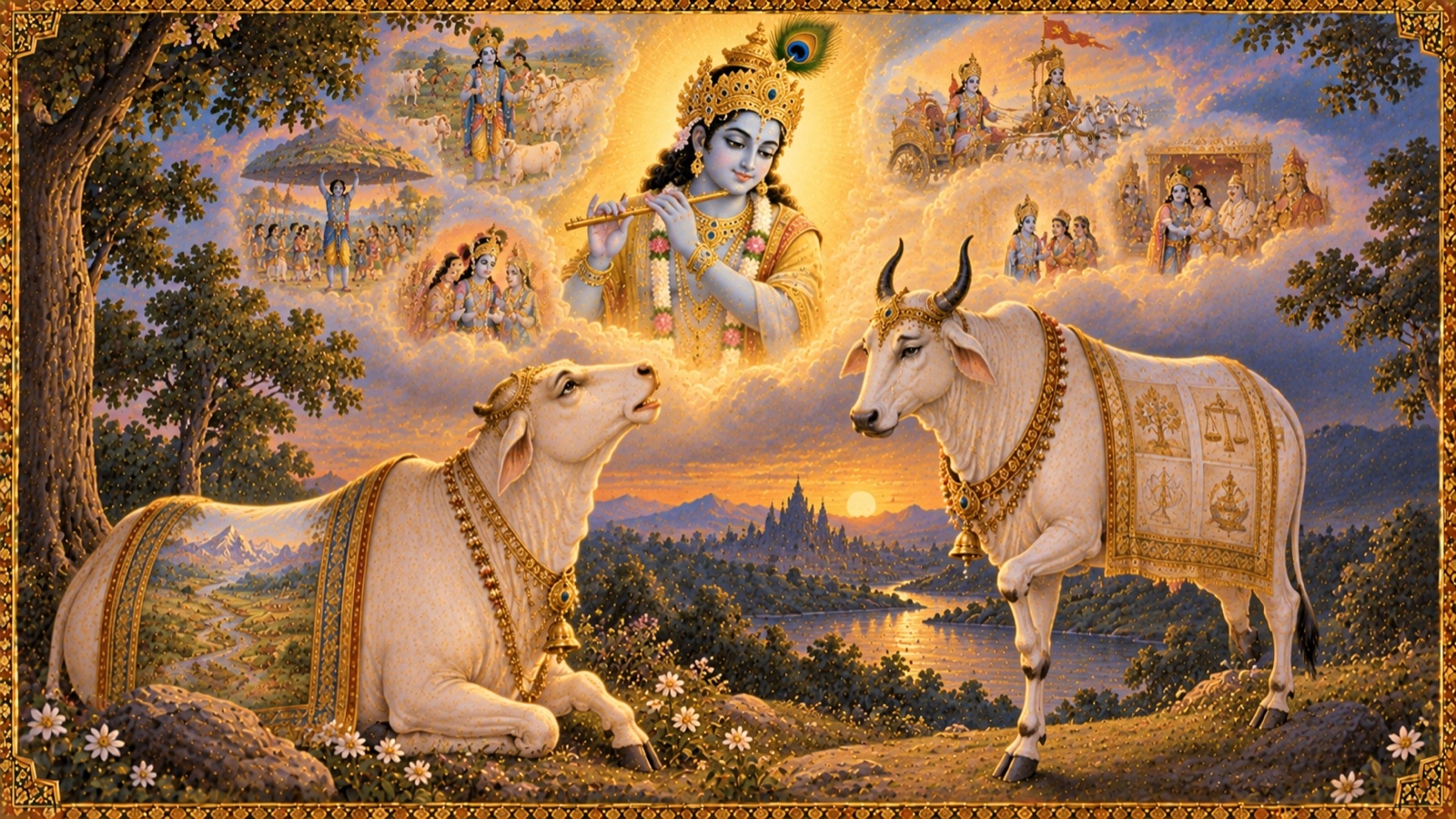
Mother Earth replies that Dharma, being wise, already knows the true cause of her grief. Everything she has valued rested upon one foundation — the Lord Himself. It was by His presence that Dharma once stood firmly on all four feet, for the happiness of the world.
धरण्युवाच भवान् हि वेद तत्सर्वं यन्मां धर्मानुपृच्छसि । चतुर्भिर्वर्तसे येन पादैर्लोकसुखावहैः ॥ २५ ॥
dharaṇy uvāca / bhavān hi veda tat sarvaṁ / yan māṁ dharmānupṛcchasi / caturbhir vartase yena / pādair loka-sukhāvahaiḥ
Meaning: The Earth replied — Revered Dharma, you yourself know all that you ask me. It was through Him that you stood upon your four feet, which bring happiness to the world. (SB 1.16.25)
She then pours out a long remembrance of the Lord’s boundless perfections.
सत्यं शौचं दया क्षान्तिस्त्याग: सन्तोष आर्जवम् । शमो दमस्तप: साम्यं तितिक्षोपरति: श्रुतम् ॥ २६ ॥
satyaṁ śaucaṁ dayā kṣāntis / tyāgaḥ santoṣa ārjavam / śamo damas tapaḥ sāmyaṁ / titikṣoparatiḥ śrutam
Meaning: Truthfulness, cleanliness, compassion, forbearance, generosity, contentment, honesty, an unwavering mind, mastery of the senses, fidelity to duty, equal regard for friend and foe, tolerance of every wrong, and knowledge drawn from scripture — these dwell in Him always. (SB 1.16.26)
She continues in the same breath, naming knowledge and detachment, sovereignty and chivalry, influence and inner strength, natural beauty and unshaken steadiness, gentleness and undying fame among the countless other virtues that never leave Him for even a moment, however greatly others may aspire to possess them (SB 1.16.27–29). Now that He who is this very reservoir of every virtue, the eternal resting place of the goddess of fortune, has closed His pastimes on this earth, she is sorrowing not for herself alone but for Dharma, for the gods, the sages and every soul who once lived by the fourfold order of society (SB 1.16.30–31). She recalls, too, how Lakṣmī herself, the goddess of fortune, forsook her own lotus-abode to serve at His feet, and how those same feet once marked and adorned the Earth, raising her beauty above all three planetary systems (SB 1.16.32–33). And she remembers that when she herself was once crushed beneath the weight of a hundred armies raised by demon-hearted kings, and Dharma stood weakened beside her, it was to lift that very burden from them both that the wholly independent Lord chose to appear in the family of the Yadus (SB 1.16.34). What woman, she asks, could bear separation from that Supreme Person, whose glances and smiles once thrilled her very being (SB 1.16.35)?
Parīkṣit Reaches the Sarasvatī
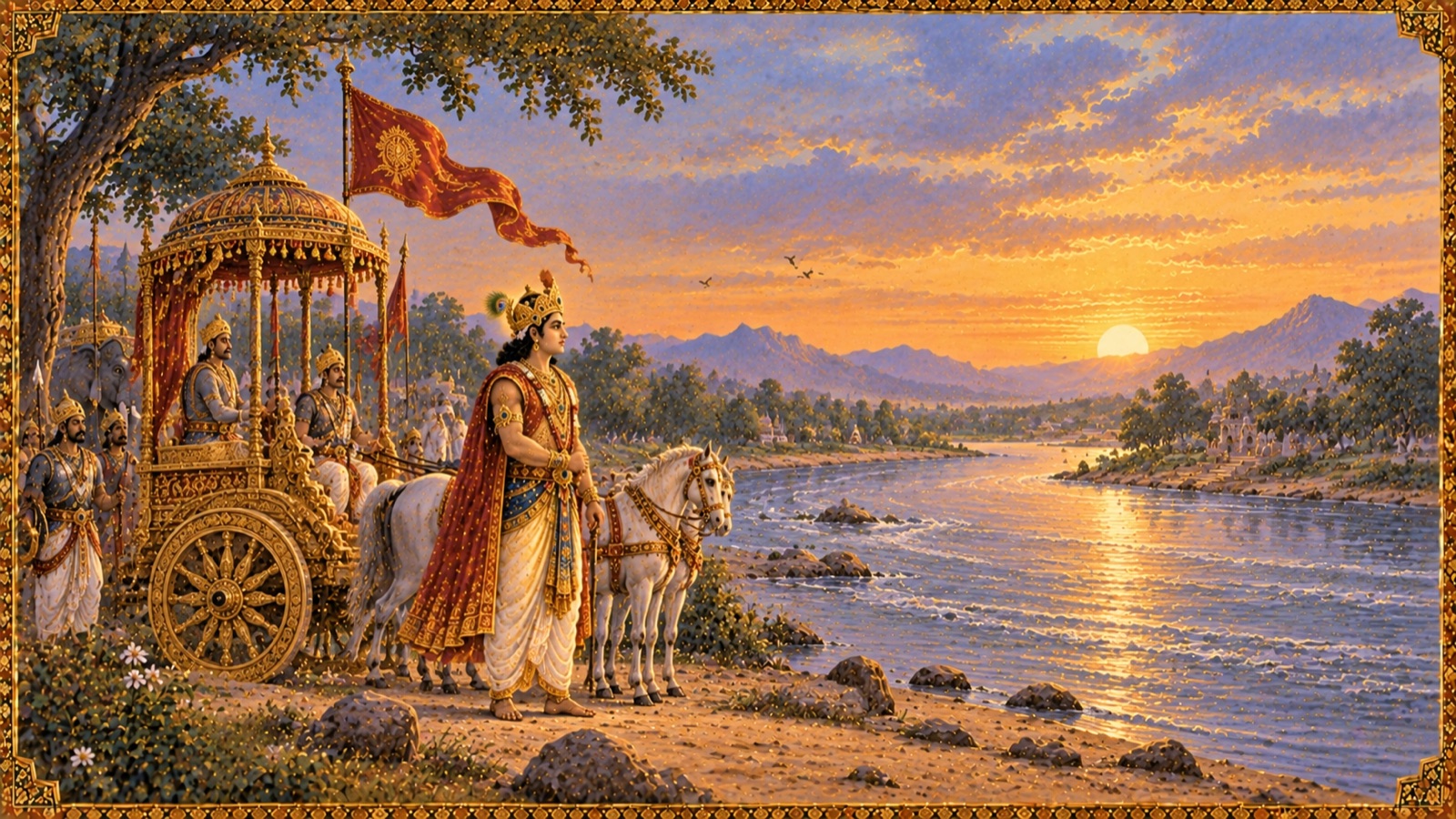
As Mother Earth and Dharma were still speaking together, the royal sage Parīkṣit arrived at the bank of the Sarasvatī river, where it flows toward the east. Here the chapter gently closes, poised at the threshold of the king’s decisive encounter with Kali in the chapter to follow.
तयोरेवं कथयतो: पृथिवीधर्मयोस्तदा । परीक्षिन्नाम राजर्षि: प्राप्त: प्राचीं सरस्वतीम् ॥ ३६ ॥
tayor evaṁ kathayatoḥ / pṛthivī-dharmayos tadā / parīkṣin nāma rājarṣiḥ / prāptaḥ prācīṁ sarasvatīm
Meaning: While the Earth and Dharma were thus conversing, the royal sage named Parīkṣit reached the eastward-flowing Sarasvatī. (SB 1.16.36)
Principal Teachings of This Chapter
1. A true ruler governs under guidance, not ego. Parīkṣit ruled “under the guidance of the best of the twice-born” (SB 1.16.1). Even an emperor of unmatched virtue submitted his power to wisdom and dharma. Real strength is the humility to be guided.
2. Protecting the innocent is the heart of righteousness. The moment Parīkṣit saw a cow and bull — symbols of the earth and dharma — being struck, he acted (SB 1.16.4). Compassion that defends the defenceless is the living form of piety.
3. Human life is precious and easily wasted. The invitation of death itself so that people may hear Hari’s pastimes, and the lament over lives frittered in sleep and frivolity (SB 1.16.7–9), remind us that our brief span is meant for remembering the Lord.
4. Devotion grows by hearing. Parīkṣit’s love for Kṛṣṇa deepened simply by hearing of the Lord’s dealings with the Pāṇḍavas (SB 1.16.14–16). Hearing sacred narration (śravaṇa) is itself a complete path of devotion.
5. All virtue rests on the Lord. The Earth’s reply reveals the chapter’s core truth: dharma’s four feet, and every noble quality, are sustained by Kṛṣṇa (SB 1.16.25–29). When remembrance of Him fades, virtue itself begins to wither.
6. The Lord descends only to lighten our burden. Dharma’s question to the Earth recalls why Hari came at all — solely to lift the weight she carried, His every deed here so purely transcendental that it eclipses even the joy of liberation (SB 1.16.23). Grace, not grievance, is the reason for His descent.
A Devotional Reflection
There is something deeply moving in the picture of a bull on one leg and a weeping cow, speaking softly of a Lord who has gone. It is the ache of every heart that has known nearness to the Divine and now feels the distance. Yet notice what the Earth does in her grief: she remembers. She does not merely mourn the loss; she recounts, one by one, the qualities of the Beloved. In the darkest turning of the age, her response to absence is remembrance — and that remembrance itself becomes a kind of presence. This is the quiet instruction the chapter offers us. We too live in an age where dharma seems to limp and the world grows careless. We cannot always change the season we are born into. But we can choose, like Mother Earth, to fill our sorrow with the names and deeds of the Lord, until longing turns to love and absence turns to communion.
A Daily Devotional Practice
Follow the Earth’s example. Once today, sit quietly and slowly recall the qualities of the Lord — His compassion, His faithfulness to His devotees, His readiness to serve those who love Him. You may softly repeat, “Om Namo Bhagavate Vasudevaya,” letting each repetition become a small act of remembrance. When you notice worry or discouragement about the state of the world, gently turn that feeling, as Mother Earth did, into the remembrance of Kṛṣṇa.
Conclusion
The sixteenth chapter of the First Canto shows us the meeting of two ages. On one side stands King Parīkṣit — a devotee upon the throne, guided by the wise, defending cow and dharma, his heart softening into devotion as he hears the glories of Kṛṣṇa. On the other side stands the newly arrived age of Kali, whose shadow falls across the world the moment the Lord departs. Between them, in a quiet field, the god of virtue and Mother Earth grieve and remember together, teaching us that when the Divine seems distant, remembrance is the bridge that remains. As the chapter ends, Parīkṣit reaches the sacred Sarasvatī, and the stage is set for his encounter with Kali. We are left with the assurance that as long as even one heart remembers the Lord, dharma has a protector, and the darkness of the age can never be complete.
May the divine wisdom of Srimad Bhagavatam awaken pure devotion within our hearts.
Om Namo Bhagavate Vasudevaya.
Jay Shree Madhav.
References and Attribution
Primary edition: Gita Press, Śrīmad Bhāgavata Mahāpurāṇa (English, Complete), Book One (First Canto), Discourse XVI, pages 65–68.
This article is an original, faithful retelling in the writer’s own words. Brief Sanskrit verses are quoted with their meanings for study. It is not a reproduction of any publisher’s translation or commentary. No affiliation with or endorsement by Gita Press, the Bhaktivedanta Book Trust, or ISKCON is implied.
Srimad Bhagavatam Wisdom · Biswa Sanatan Dharma Seva Trust Presented following the spiritual guidance and recommendation of Pandit Dr. Shri Kashinath Mishra.
Jay Shree Madhav