Om Namo Bhagavate Vasudevaya.
Om Namo Bhagavate Vasudevaya.
Om Namo Bhagavate Vasudevaya.
When a righteous king rides out at dawn and hears the cry of the helpless, the whole earth holds its breath. In this seventeenth chapter of the First Canto of the Śrīmad Bhāgavata Mahāpurāṇa, Emperor Parīkṣit comes upon a scene of naked cruelty — and what he does there decides the fate of an age. Here the personality of Kali, the very spirit of unrighteousness, is confronted, judged, and yet, in a stroke of extraordinary mercy, spared. This is a chapter about the duty of the strong toward the weak, about the slow erosion of virtue across the ages, and about how a single soul devoted to dharma can hold back the darkness of a whole era.
Chapter Information
- Scripture: Śrīmad Bhāgavata Mahāpurāṇa (Bhāgavata Purāṇa)
- Canto: One
- Chapter: Seventeen
- Chapter title: Punishment and Reward of Kali
- Principal speaker: Sūta Gosvāmī (narrating the deeds of Emperor Parīkṣit)
- Principal listeners: Śaunaka and the sages assembled at Naimiṣāraṇya
- Main setting: The bank of the river Sarasvatī, within the realm of Emperor Parīkṣit
- Central subject: King Parīkṣit’s confrontation with the personality of Kali; the punishment, the pardon, and the restoration of dharma
- Principal verse range: SB 1.17.1–45
- Primary edition: Gita Press Śrīmad Bhāgavata Mahāpurāṇa, Book One, Discourse 17
A Cry on the Riverbank
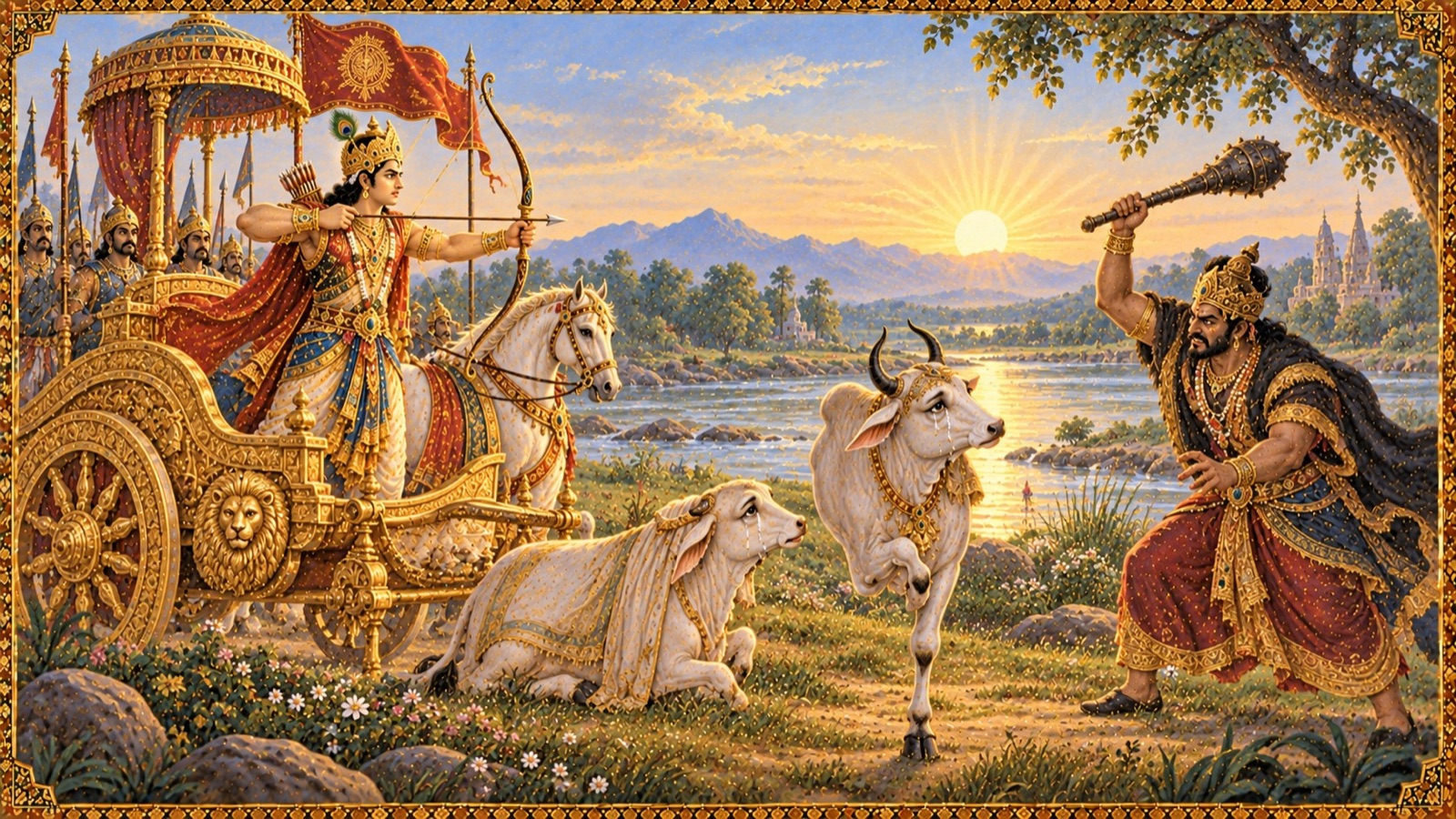
Sūta Gosvāmī continues the story of Emperor Parīkṣit, the grandson of Arjuna, who had set out to establish his sovereignty. On the bank of the Sarasvatī the king came upon a shocking sight: a man dressed in the insignia of royalty, club in hand, beating a bull and a cow as though the animals had no protector in the world.
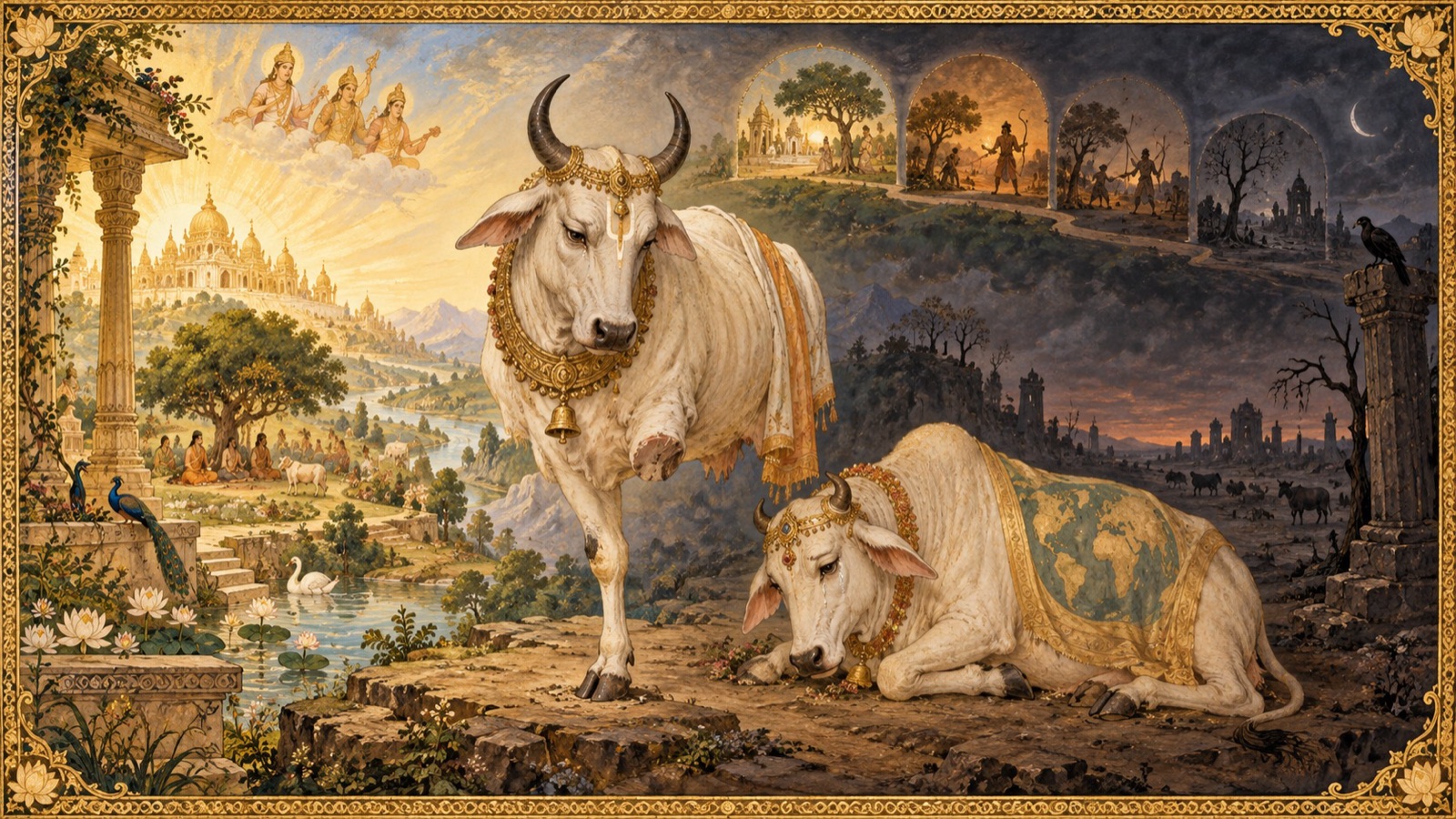
The bull was white as the stalk of a lotus. It stood trembling on one leg, terrified, struck again and again by the tyrant. The cow beside it — she who yields the milk and ghee that sustain sacrifice and the whole world — had been kicked and separated from her calf, her face bathed in tears, grown thin and hungry.
गां च धर्मदुघां दीनां भृशं शूद्रपदाहताम् । विवत्सामश्रुवदनां क्षामां यवसमिच्छतीम् ॥
Meaning: And he saw the cow, who yields all that is needed for righteous acts, now wretched — struck by the śūdra’s foot, deprived of her calf, tears on her face, emaciated and longing for a little grass. (SB 1.17.3)
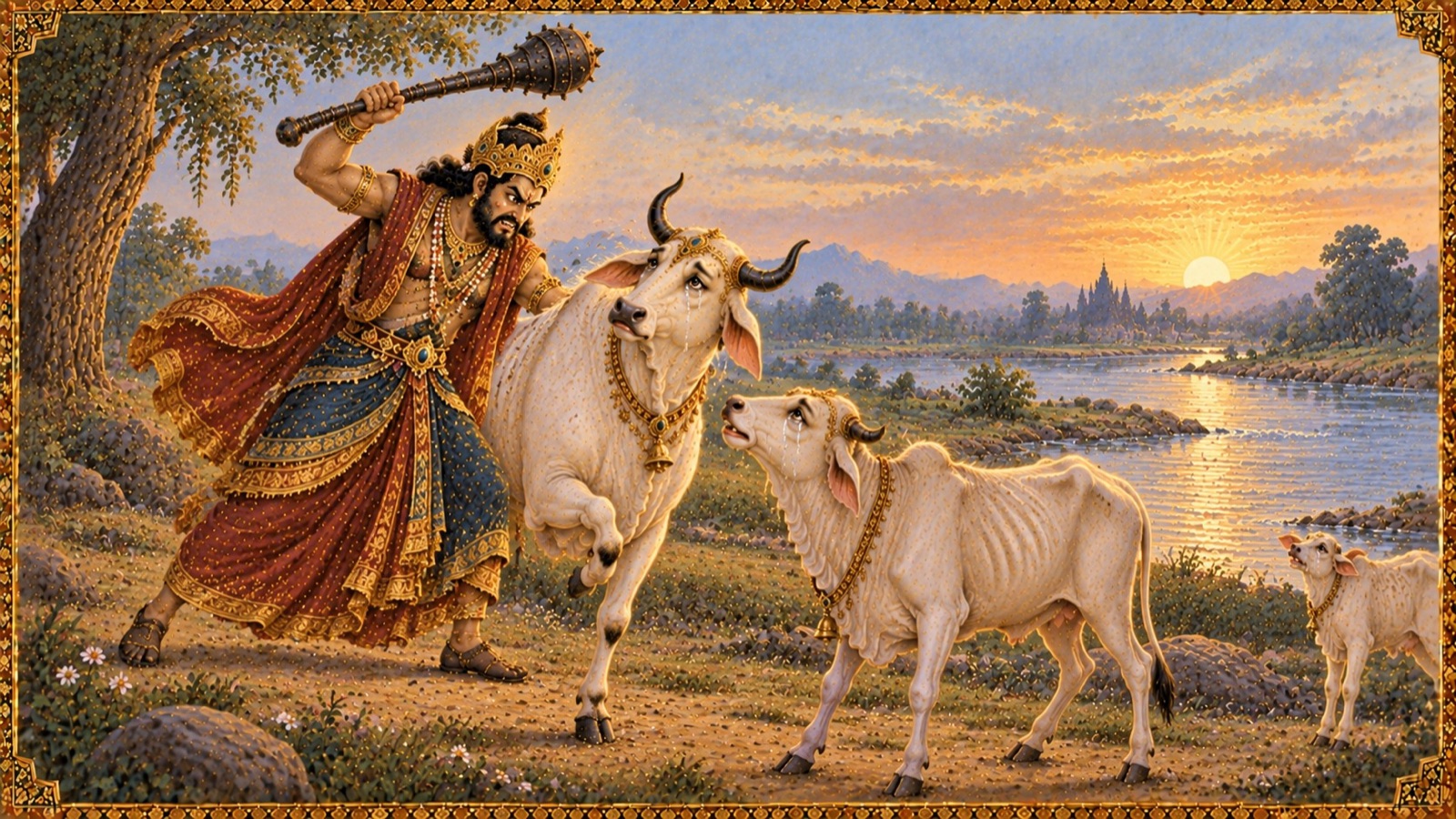
The bull, we will learn, is Dharma himself in the guise of an animal; the cow is Mother Earth. The one who beats them, wearing a king’s clothes but acting like the lowest of men, is the personality of Kali.
The King Draws His Bow
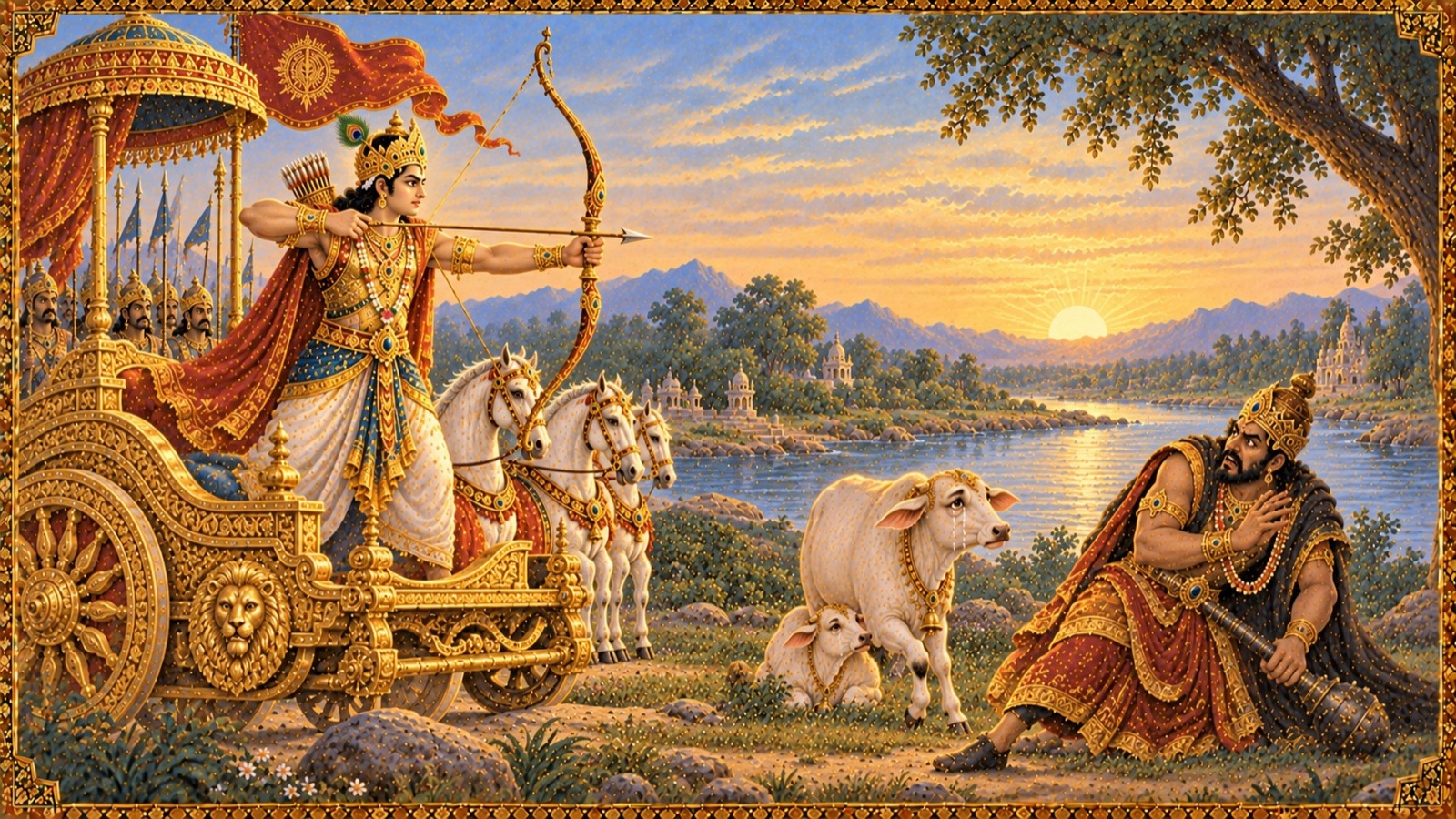
Parīkṣit did not hesitate. Mounted on his gold-plated chariot, he strung his bow and challenged the oppressor in a voice deep as the rumbling of a cloud.
कस्त्वं मच्छरणे लोके बलाद्धंस्यबलान् बली । नरदेवोऽसि वेषेण नटवत्कर्मणाद्विजः ॥
Meaning: “Who are you, so strong that you strike the weak by force here in this land under my protection? By your dress you appear to be a ruler among men, yet by your act you are no twice-born at all — like an actor on a stage.” (SB 1.17.5)
The king declared that by striking harmless creatures in a lonely place — and at a time when Śrī Kṛṣṇa had departed for His divine abode, along with Arjuna — the offender had proven himself deserving of death.
The Foremost Duty of a King
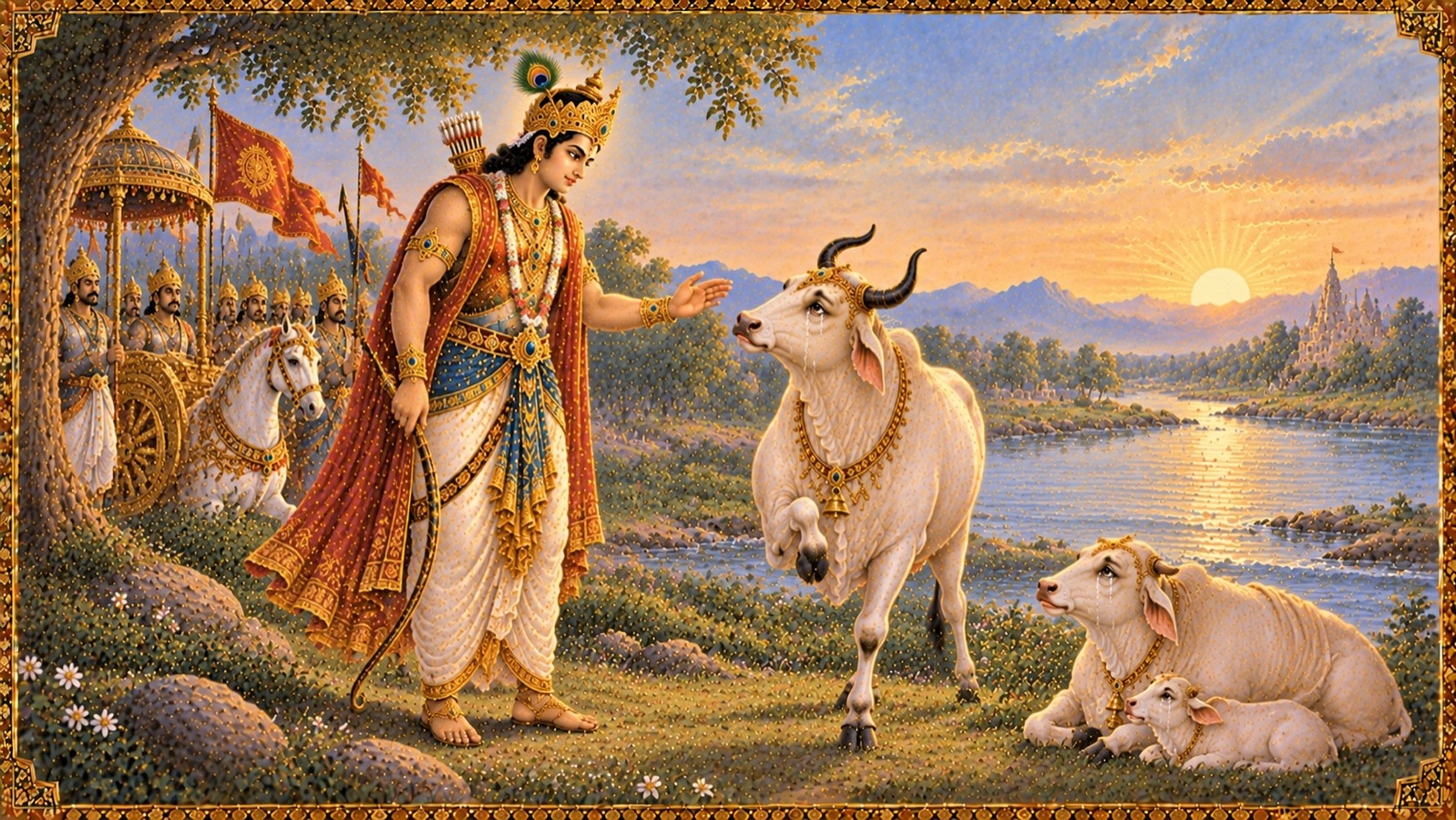
Turning to the bull, Parīkṣit asked whether this was some divinity in the form of an animal, white as a lotus stalk, moving on one foot with its other three lost, causing such grief. On the earth guarded by the arms of the Paurava kings, he said, no creature had ever been seen to weep. Then he spoke the principle that stands at the moral centre of the chapter:
यस्य राष्ट्रे प्रजाः सर्वास्त्रस्यन्ते साध्व्यसाधुभिः । तस्य मत्तस्य नश्यन्ति कीर्तिरायुर्भगो गतिः ॥ एष राज्ञां परो धर्मो ह्यार्तानामार्तिनिग्रहः । अत एनं वधिष्यामि भूतद्रुहमसत्तमम् ॥
Meaning: “In whose kingdom all the subjects are terrorized by the wicked, the fame, longevity, fortune and destiny of that heedless ruler are destroyed. This indeed is the foremost duty of kings — to relieve the distress of the afflicted. Therefore I shall slay this most wicked enemy of living beings.” (SB 1.17.10–11)
He asked the bull who had cut away its three feet, promising that no such affliction should exist in the realm of kings who are devoted to Śrī Kṛṣṇa. And he named the ideal plainly:
राज्ञो हि परमो धर्मः स्वधर्मस्थानुपालनम् । शासतोऽन्यान् यथाशास्त्रमनापद्युत्पथानिह ॥
Meaning: “It is indeed the highest duty of a king to protect those who abide by their own dharma, and, according to the scriptures, to restrain the others who have strayed from the right path — except in times of emergency.” (SB 1.17.16)
Dharma’s Answer
The bull’s reply is one of the great teachings of humility in the scripture. Such an assurance of protection, Dharma said, is entirely worthy of the descendants of Pāṇḍu, whose host of virtues once moved Śrī Kṛṣṇa Himself to serve as their envoy. Yet, he said, bewildered as living beings are by the conflicting statements of philosophers, he could not simply point to the one responsible for suffering. Some declare the self to be the cause; some attribute it to Providence; some to one’s own past deeds; some to nature; some to God; and some hold the cause to be beyond all speech and thought. Dharma gently invited the royal sage to weigh these views by his own discernment. In refusing to blame even his tormentor, Dharma embodied the very forbearance he stands for.
The Four Legs of Dharma
Parīkṣit, hearing this, understood. He recognized that the bull was Dharma himself, and that his reluctance to name the culprit came from a deep truth: the one who denounces a wrongdoer may share in the wrongdoer’s fate. The king then unveiled the great cosmic pattern behind the scene:
तपः शौचं दया सत्यमिति पादाः कृते कृताः । अधर्मांशैस्त्रयो भग्नाः स्मयसङ्गमदैस्तव ॥
Meaning: “In the Kṛta age you stood on four feet — austerity, purity, compassion and truthfulness. Three of them have been broken by the offshoots of unrighteousness: pride, attachment to the opposite sex, and intoxication.” (SB 1.17.24)
इदानीं धर्म पादस्ते सत्यं निर्वर्तयेद्यतः । तं जिघृक्षत्यधर्मोऽयमनृतेनैधितः कलिः ॥
Meaning: “O Dharma, now you have only one foot left — truthfulness — by which you somehow sustain yourself. This Kali, unrighteousness swollen by falsehood, seeks to seize even that.” (SB 1.17.25)
The cow, the king continued, is none other than Mother Earth, whose burden Śrī Hari had relieved and whose surface His footprints once adorned. Forsaken now by Him, she grieves like an unlucky woman, dreading the rule of those who hate the holy and merely pretend to be kings.
Mercy for the Surrendered
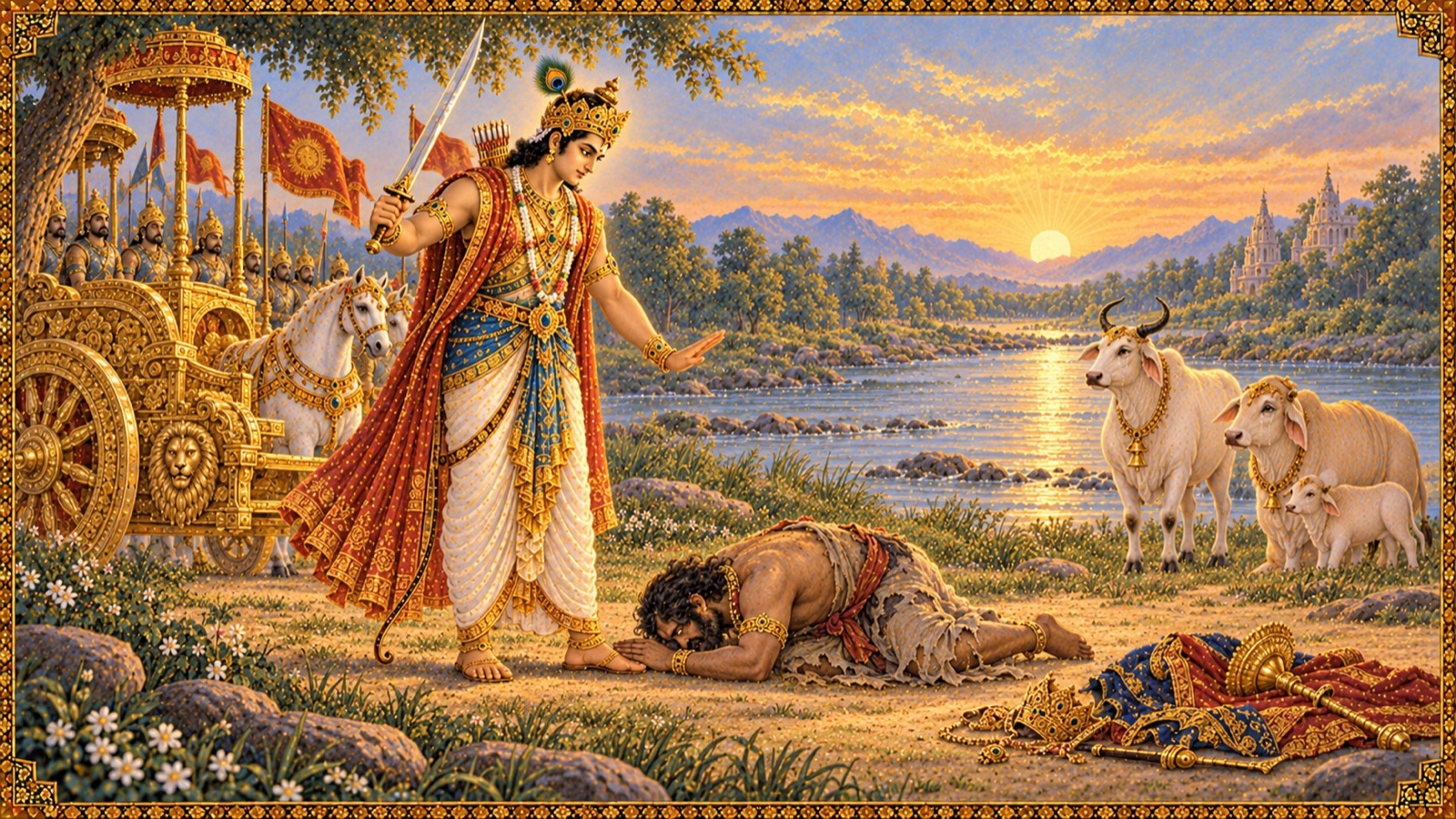
Having comforted both Dharma and Mother Earth, the great chariot-warrior drew his sharp sword to make an end of Kali, the wellspring of unrighteousness.
इति धर्मं महीं चैव सान्त्वयित्वा महारथः । निशातमाददे खड्गं कलयेऽधर्महेतवे ॥
Meaning: “Having thus consoled both Dharma and the Earth, the mighty chariot-warrior took up his sharpened sword to slay Kali, the very cause of unrighteousness.” (SB 1.17.28)
Seeing that the king meant to kill him, Kali cast off his royal disguise and, overcome with fear, laid his head at Parīkṣit’s feet. And here the chapter turns. The king, kind to the meek and a refuge to all who seek his shelter, took compassion on the one fallen before him. He did not strike. Smiling, he spoke.
Banished from the Realm
“You who have joined your palms before us, heirs as we are to the glory of Arjuna, have no cause for fear,” the king said. “But on no account may you remain in my realm, for you are the friend of unrighteousness.” Ever since Kali had entered the hearts of rulers, Parīkṣit observed, the vices had followed him — greed, falsehood, thieving, wickedness, and hypocrisy. Least of all, he said, should Kali dwell in Brahmāvarta, the sacred land where the wise worship the Lord of sacrifice, and where Śrī Hari abides as the Universal Soul, moving within and without all beings like the air, granting the desires of His devotees.
Where Shall I Live?
Kali trembled to hear the command of the king, who stood ready to strike like Yama with his rod of punishment. Then, with joined palms, he made a humble plea: wherever he might think to settle in obedience to the emperor’s order, he found the king standing there, bow and arrow in hand. Therefore he begged Parīkṣit, “jewel among champions of righteousness,” to name a place where he might lawfully dwell under the king’s protection.
The Five Abodes of Kali
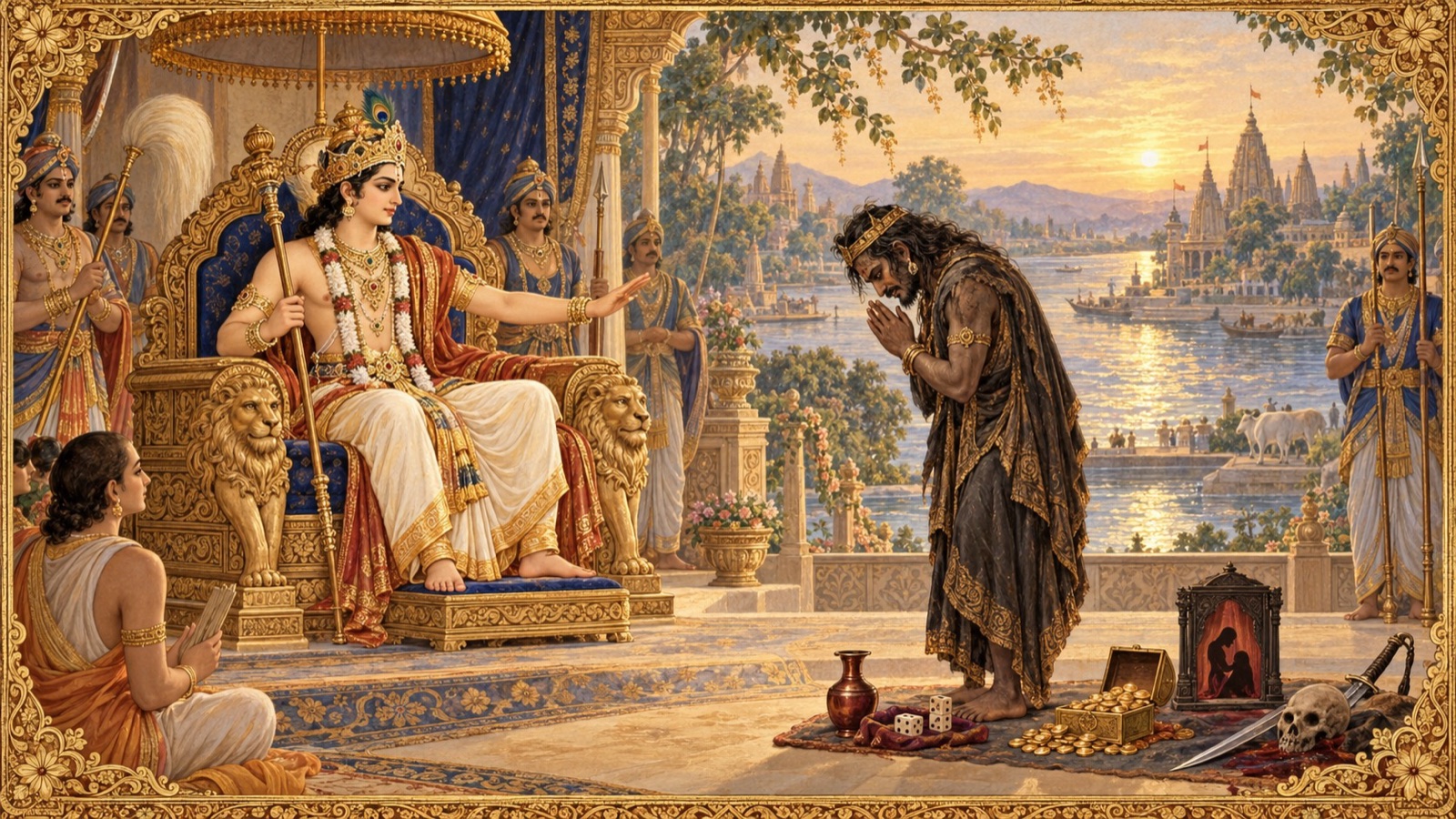
The king’s response is one of the most quietly practical passages in the whole Bhāgavata. Rather than let unrighteousness roam free, Parīkṣit contained it — assigning it fixed dwellings so that a wise person would know exactly what to avoid.
सूत उवाच अभ्यर्थितस्तदा तस्मै स्थानानि कलये ददौ । द्यूतं पानं स्त्रियः सूना यत्राधर्मश्चतुर्विधः ॥
Meaning: Sūta said: “Thus entreated, the king then allotted to Kali these places — gambling, drinking, illicit union with women, and slaughter — where unrighteousness of four kinds resides.” (SB 1.17.38)
पुनश्च याचमानाय जातरूपमदात्प्रभुः । ततोऽनृतं मदं कामं रजो वैरं च पञ्चमम् ॥
Meaning: “And when Kali asked for still more, the mighty king gave him gold as a fifth abode. So in these dwell falsehood, intoxication, lust, resentment and enmity.” (SB 1.17.39)
In obedience to the command, Kali took up residence in these five seats — gambling, drinking, illicit relations, violence, and gold wrongly used. From this the chapter draws a direct, personal counsel for every seeker.
Dharma Restored
His work complete, the king turned back to healing what had been broken. He restored to the bull its three lost legs — penance, purity and compassion — and comforted and nourished Mother Earth.
वृषस्य नष्टांस्त्रीन् पादान् तपः शौचं दयामिति । प्रतिसन्दध आश्वास्य महीं च समवर्धयत् ॥
Meaning: “He reunited the bull’s three lost legs — austerity, purity and compassion — and, consoling the Earth, caused her to flourish once more.” (SB 1.17.42)
Sūta reminded the sages that this same emperor still occupies the royal throne bequeathed to him by his grand-uncle Yudhiṣṭhira, who had retired to the forest, and that he reigns in glory at Hastināpura. He closed with the very reason the sages were performing their long sacrifice:
इत्थम्भूतानुभावोऽयमभिमन्युसुतो नृपः । यस्य पालयतः क्षौणीं यूयं सत्राय दीक्षिताः ॥
Meaning: “Such is the majesty of this king, the son of Abhimanyu, under whose righteous protection of the earth you have been consecrated for this sacrifice.” (SB 1.17.45)
Principal Teachings
1. The strong exist to protect the weak. Parīkṣit’s first response to cruelty is neither indifference nor rage but responsibility. The foremost dharma of one who holds power is to relieve the distress of the afflicted (1.17.10–11, 16). Wherever we are entrusted with strength — as parents, leaders, or simply as the more capable person in a room — that strength is meant to shelter, not to dominate.
2. Dharma stands on four legs, and they can be worn away. Austerity, purity, compassion and truthfulness are the four supports of righteousness. Age by age, pride, attachment and intoxication break them, until in Kali-yuga only truthfulness remains (1.17.24–25). The teaching is a mirror: these same four legs support the dharma of our own lives, and the same three vices quietly saw them away.
3. Justice is complete only when tempered by mercy. The king who lifts his sword also lowers it when his enemy surrenders (1.17.28–30). True strength is not the inability to forgive; it is the freedom to punish and yet to spare.
4. Unrighteousness cannot be destroyed, but it can be confined. Kali is not annihilated; he is given fixed abodes (1.17.38–39). The wise soul reads this as a map of the places where the mind is most easily corrupted — gambling, intoxication, illicit desire, violence and the misuse of wealth — and keeps a careful distance.
5. One righteous soul can hold back an entire age. Kali had already entered the world, yet where Parīkṣit ruled, dharma still stood. The presence of even one person devoted to the Lord restrains the darkness around them.
A Devotional Reflection
It would have been easy for Parīkṣit to kill Kali and call the matter finished. Evil, after all, had thrown itself at his feet. But the chapter shows us a wiser king. He understood that unrighteousness is not a person to be slain but a tendency to be contained — and that the tendency lives, in seed form, in every human heart. So he did two things at once: he refused to let adharma rule his kingdom, and he refused to answer surrender with cruelty.
There is a lesson here for the inner life. We cannot cut the tendency toward pride, greed and falsehood out of ourselves with a single stroke. But we can do what Parīkṣit did: deny it the throne, confine it to the narrow corners where it lurks, name those corners honestly, and keep the sword of vigilance close. And we can restore what it has broken — rebuilding austerity, purity and compassion one small act at a time — so that, like Mother Earth under a righteous king, our own hearts may flourish again.
A Daily Devotional Practice
Today, choose one of the “four legs of dharma” — austerity (simplicity), purity, compassion, or truthfulness — and strengthen it through a single, deliberate act. Speak one wholly truthful word where it would be easier to shade it; or show one unhurried kindness to someone who cannot repay you. As you do it, quietly offer the act to the Lord, remembering that in guarding even the smallest creature, King Parīkṣit was guarding dharma itself.
Conclusion
Chapter Seventeen of the First Canto gives us the portrait of an ideal king and, through him, an ideal soul. Hearing the cry of a beaten bull and a weeping cow on the bank of the Sarasvatī, Emperor Parīkṣit rides to their defence, uncovers in them Dharma and Mother Earth, and faces the personality of Kali himself. He declares the eternal duty of the powerful to shelter the helpless; he traces the slow decline of virtue from the golden age to our own; he raises his sword against unrighteousness and then, when it surrenders, lowers it in mercy. Refusing Kali a place in his realm, he confines the spirit of the age to its five familiar haunts and warns every seeker to shun them. Finally he heals what was harmed — restoring the legs of Dharma and gladdening the Earth — and reigns on in glory. In these forty-five verses the Bhāgavata teaches us that darkness can be contained by even one devoted heart, and that justice reaches its fullness only in mercy.
May the divine wisdom of Srimad Bhagavatam awaken pure devotion within our hearts.
Om Namo Bhagavate Vasudevaya.
Jay Shree Madhav.
A Verse to Carry With You
अथैतानि न सेवेत बुभूषुः पुरुषः क्वचित् । विशेषतो धर्मशीलो राजा लोकपतिर्गुरुः ॥
Meaning: “A person who seeks his own welfare should never resort to these five abodes of Kali — and least of all one devoted to dharma: a king, a leader of the people, or a spiritual teacher.” (SB 1.17.41)
References and Attribution
Primary edition: Gita Press, Śrīmad Bhāgavata Mahāpurāṇa — English (Complete), Book One, Discourse 17 (“The Subjugation of Kali”), book pages 69–73.
This article is an original, faithful retelling in the writer’s own words; it does not reproduce any publisher’s complete translation or commentary. Brief quoted passages are given only where noted. Neither Gita Press nor any other publisher sponsors or endorses this article.
Presented following the spiritual guidance and recommendation of Pandit Dr. Shri Kashinath Mishra.
Srimad Bhagavatam Wisdom · Biswa Sanatan Dharma Seva Trust
Jay Shree Madhav