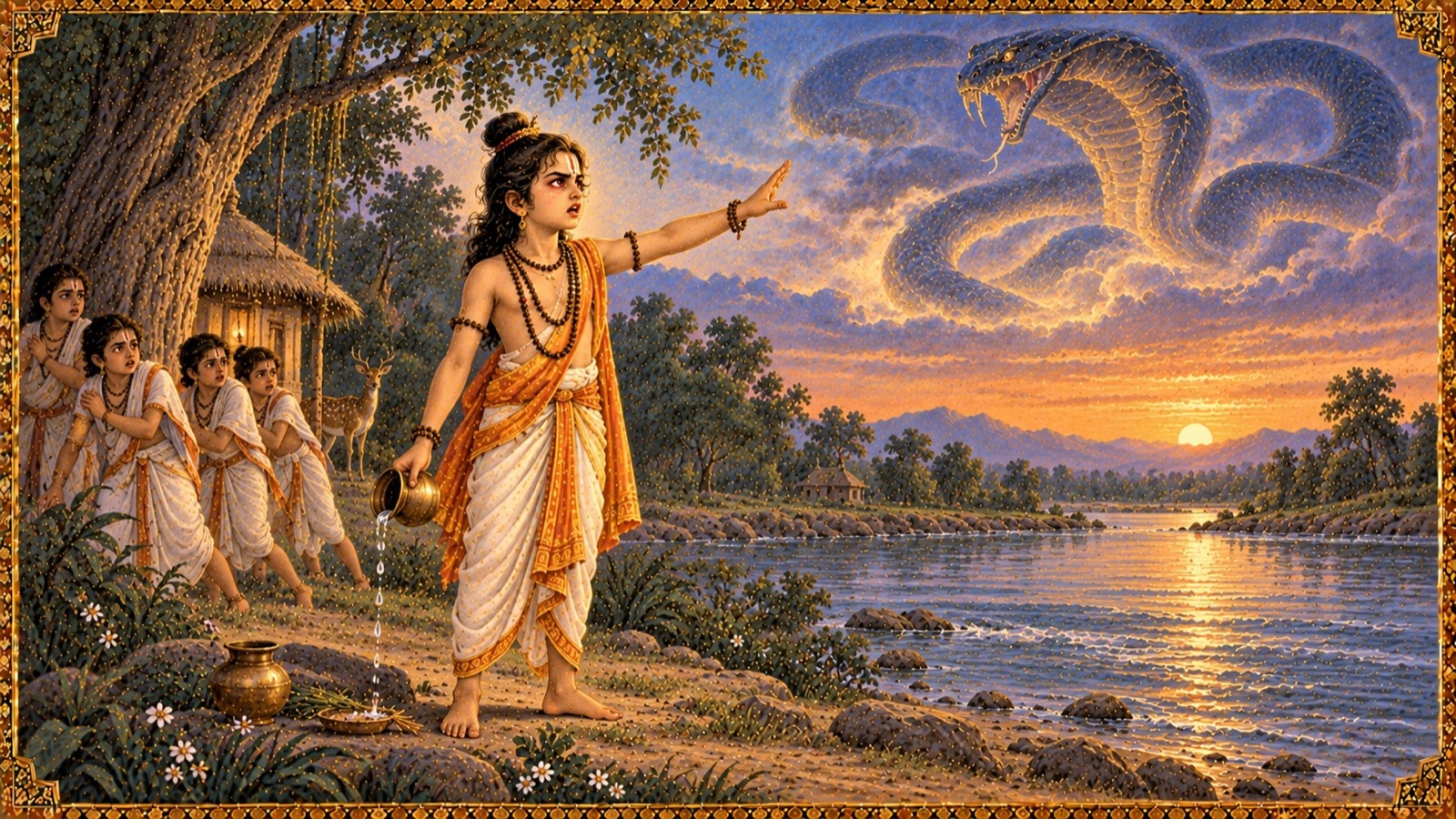
By the waters of the Kausiki, the youthful sage Srngi, his eyes crimson with anger, hurls the curse that will fall upon the noble king Pariksit within seven days.
Om Namo Bhagavate Vasudevaya.
Om Namo Bhagavate Vasudevaya.
Om Namo Bhagavate Vasudevaya.
Welcome to Srimad Bhagavatam Wisdom, a devotional journey through the sacred histories and teachings of the Srimad Bhagavat Mahapurana. In this eighteenth discourse of the first Canto, the blessed Suta unfolds one of the most poignant turns in the whole Bhagavata — the moment a single rash word from an angry boy sets in motion the death of a righteous emperor. Yet in that sorrow the scripture hides a great tenderness: the fearlessness of a devotee before death, the restraint of a true saint, and the quiet greatness of a soul who neither grieves nor rejoices at the blows of the world. Let us listen with reverence.
Chapter Information
- Scripture: Śrīmad Bhāgavata Mahāpurāṇa
- Canto: 1 (Book One)
- Chapter: 18 (Discourse 18)
- Chapter title: Mahārāja Parīkṣit Cursed by a Brāhmaṇa Boy
- Principal speaker: the blessed Sūta, Ugraśravā, the reciter of the ancient lore
- Principal listeners: the sage Śaunaka and the seers assembled at Naimiṣāraṇya
- Main setting: the assembly at Naimiṣāraṇya, and the forest hermitage of the sage Śamīka beside the river Kauśikī
- Central subject: the last cause of King Parīkṣit’s passing — the curse pronounced by the boy-sage Śṛṅgi, and the exemplary forbearance of his father Śamīka
- Principal verse range: Canto 1, Chapter 18, verses 1–50
- Primary edition: Gita Press Śrīmad Bhāgavata Mahāpurāṇa
Context from the Previous Chapter
In the seventeenth discourse, the emperor Parīkṣit came upon a lowly figure clad in royal insignia — Kali in disguise — brutally beating a cow and a bull, the forms in which Mother Earth and Dharma stood helpless and trembling. The king restrained the wrongdoer, spared his life when he sought shelter, and confined the influence of Kali to a few impure haunts, so that righteousness might endure. It is with the fruits of that righteous reign that the present chapter begins.
The Blessed End of King Parikshit
Suta resumes his narration, and he begins not with the king’s fall but with the king’s glory. Though scorched while yet in his mother’s womb by the fiery missile of Aśvatthāmā, the infant Parīkṣit did not perish — the grace of Lord Śrī Kṛṣṇa, of marvellous deeds, preserved him. And when, in the fullness of his life, he learned that he must die within seven days from the bite of the serpent Takṣaka, spurred on by the curse of a Brāhmaṇa boy (a youth born into the priestly, scripture-learned class), he felt no terror at all. Having given his whole heart to the Lord, he shook off every attachment, accepted the discipleship of the sage Śuka, realized the truth of Śrī Hari, and gave up his body serenely upon the bank of the Gaṅgā.
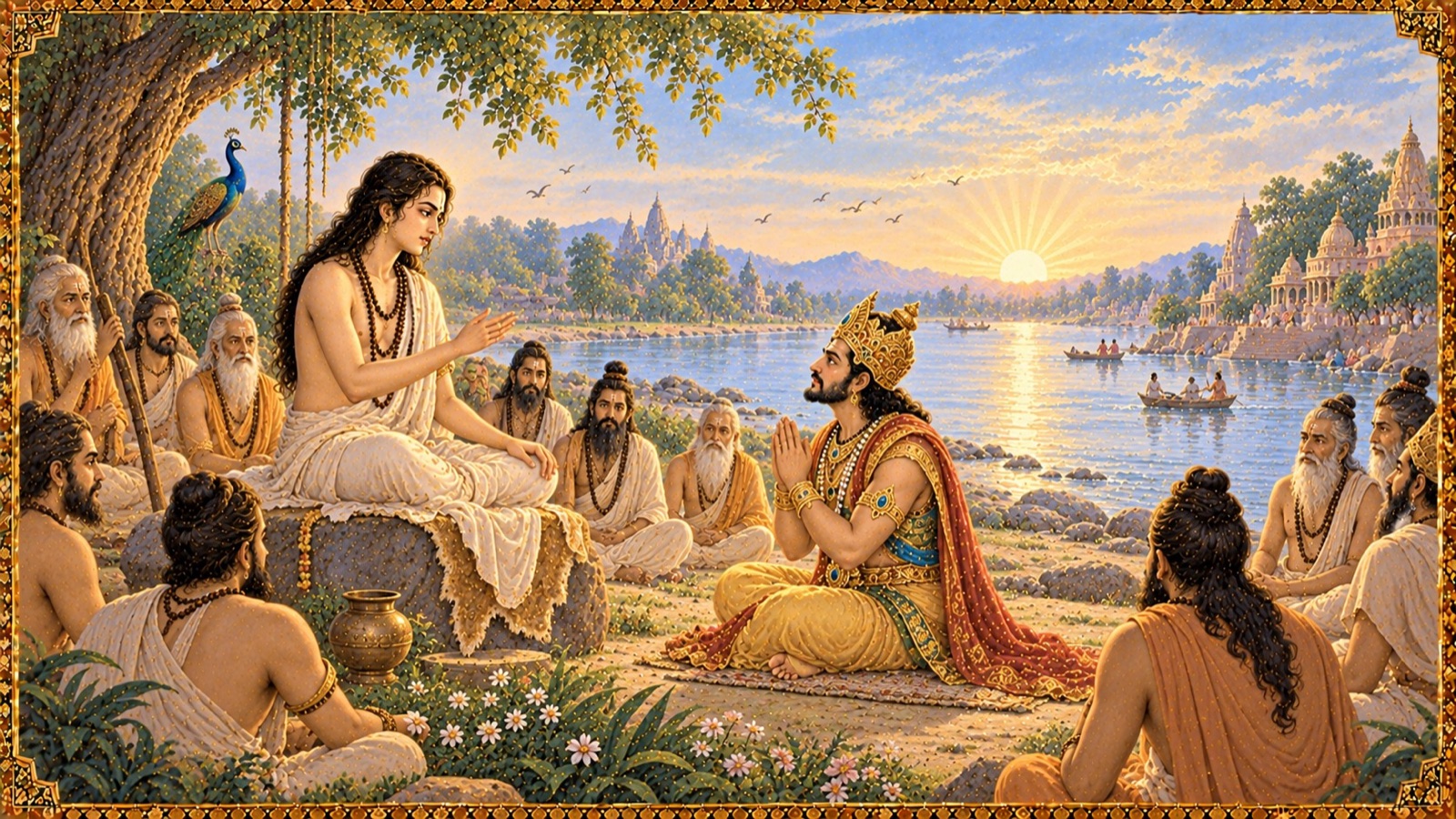
For no confusion arises, even at the hour of death, in the hearts of those who speak of none but Kṛṣṇa, who relish His nectar-like stories and meditate upon His lotus feet. Suta states this not merely as Parīkṣit’s fortune but as a settled law of the spiritual path:
नोत्तमश्लोकवार्तानां जुषतां तत्कथामृतम् । स्यात्सम्भ्रमोऽन्तकालेऽपि स्मरतां तत्पदाम्बुजम् ॥ ४ ॥
nottama-śloka-vārtānāṁ juṣatāṁ tat-kathāmṛtam syāt sambhramo ‘nta-kāle ‘pi smaratāṁ tat-padāmbujam ॥ 4 ॥
Meaning: Even at life’s final moment, no bewilderment touches those who delight in the ambrosial narrations of the Lord of matchless glory and hold His lotus feet in constant remembrance. (Canto 1, Chapter 18, verse 4)
Here, at the very outset, the Bhagavata quietly reveals the reward of a life given to God: a death without dread.
Why Kali Could Not Prevail
Suta then explains a hidden truth about the age we live in. So long as the great king Parīkṣit ruled the earth as its undisputed sovereign, the age of Kali — though it had entered every quarter — could gain no real power.
तावत्कलिर्न प्रभवेत् प्रविष्टोऽपीह सर्वत: । यावदीशो महानुर्व्यामाभिमन्यव एकराट् ॥ ५ ॥
tāvat kalir na prabhavet praviṣṭo ‘pīha sarvataḥ yāvad īśo mahān urvyām ābhimanyava eka-rāṭ ॥ 5 ॥
Meaning: Kali could not prevail on this earth, though he had entered it on every side, so long as the mighty son of Abhimanyu, Parīkṣit, reigned as sole sovereign. (Canto 1, Chapter 18, verse 5)
In truth, Kali had set foot upon the earth the very moment the Lord departed for His abode. Yet the emperor, like a bee that draws only the nectar from every flower, bore Kali no grudge — for he knew that in this age good intentions bear fruit at once, while evil deeds bear fruit only when actually committed, so that a watchful heart has little to fear. And what, after all, is Kali? He is a coward’s tyrant.
किं नु बालेषु शूरेण कलिना धीरभीरुणा । अप्रमत्त: प्रमत्तेषु यो वृको नृषु वर्तते ॥ ८ ॥
kiṁ nu bāleṣu śūreṇa kalinā dhīra-bhīruṇā apramattaḥ pramatteṣu yo vṛko nṛṣu vartate ॥ 8 ॥
Meaning: Of what account is Kali, who is heroic only among the ignorant but cowardly before the wise, and who, like a wolf, preys upon heedless men caught unaware? (Canto 1, Chapter 18, verse 8)
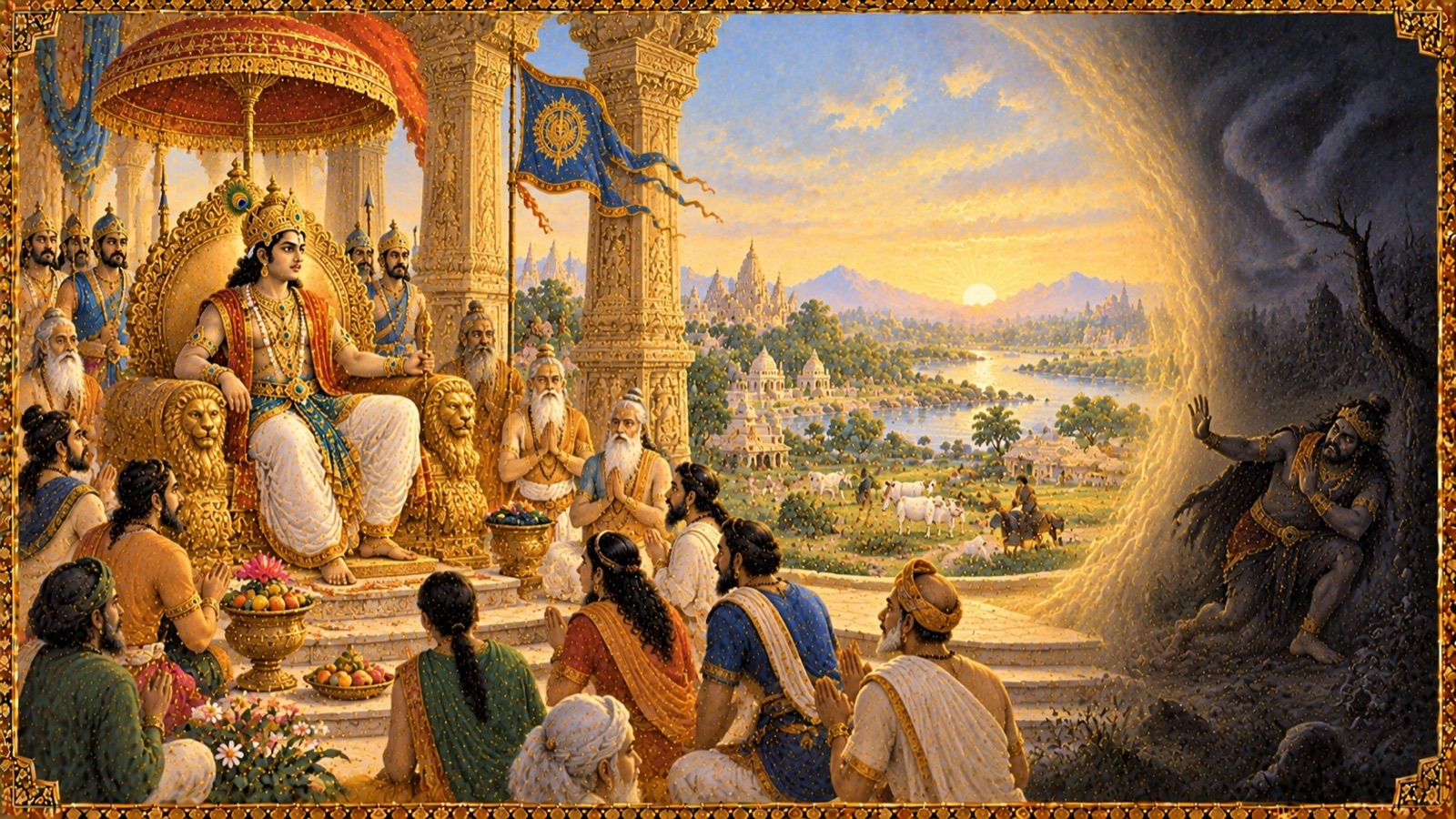
The teaching is gentle but firm: the darkness of the age has power only over the careless. To the vigilant and the devout, it is a wolf that dares not approach.
Suta’s Summary and the Sages’ Blessing
Having recounted the sacred life of Parīkṣit — bound up as it is with the story of Śrī Kṛṣṇa, the son of Vasudeva — Suta tells the sages that this was the very matter of their inquiry. The Lord performed countless deeds worthy of remembrance; therefore those who seek the highest good should listen with rapt attention to His glories.
The sages of Naimiṣāraṇya are moved to bless him. “Good Suta,” they say, “may you live for years beyond number — you who pour out for us the untarnished, nectar-like glory of Śrī Kṛṣṇa. Our bodies are soiled by the smoke of these long sacrificial fires, whose fruit is uncertain; yet you give us to drink the sweet honey flowing from the lotus feet of Govinda. We would not exchange a single moment’s fellowship with the Lord’s loving devotees for the joys of heaven, nor even for final liberation, still less for the fleeting pleasures men chase.” Indeed, they say, weighed against such company, nothing else holds any value at all:
तुलयाम लवेनापि न स्वर्गं नापुनर्भवम् । भगवत्सङ्गिसङ्गस्य मर्त्यानां किमुताशिष: ॥ १३ ॥
tulayāma lavenāpi na svargaṁ nāpunar-bhavam bhagavat-saṅgi-saṅgasya martyānāṁ kim utāśiṣaḥ ॥ 13 ॥
Meaning: Not even an instant of a devotee’s company can be weighed against the heavenly worlds or freedom from rebirth — how much less, then, against the fleeting blessings that mortal men pursue? (Canto 1, Chapter 18, verse 13)
What soul of true taste, they ask, could ever be sated with the Lord’s story — a Lord whose virtues even Śiva and the lotus-born Brahmā, masters of Yoga, have never been able to exhaust? And so they beg Suta to narrate at length the noble doings of Śrī Hari.
Suta’s Humility and the Glory of the Name
Before he continues, Suta speaks with disarming humility about himself. Though born of a mixed union, he says, his lowly birth has been made fruitful this very day through the service of noble elders — for even conversation with the pure of heart swiftly drives away the sorrow of a despised birth. How much more, then, for one who utters the Name of the Lord, whom the wise call Ananta — “the Endless One” — for His virtues, like His being, know no limit. To show how peerless He is, Suta recalls that Goddess Lakṣmī herself sought the dust of His feet, though He never courted her; and that the sacred water which washed His feet — flowing as the Gaṅgā — sanctifies the whole universe. Who else in this world, he asks, could truly deserve the name Bhagavān?
Such love changes a soul entirely, Suta says. The wise who awaken this love for the Lord soon shake off, without a backward glance, their deep attachment to the body and its concerns, and pass at once into the highest stage of the God-absorbed recluse — the paramahaṁsa state, whose very nature is harmlessness and inward peace:
यत्रानुरक्ता: सहसैव धीरा व्यपोह्य देहादिषु सङ्गमूढम् । व्रजन्ति तत्पारमहंस्यमन्त्यं यस्मिन्नहिंसोपशम: स्वधर्म: ॥ २२ ॥
yatrānuraktāḥ sahasaiva dhīrā vyapohya dehādiṣu saṅgam ūḍham vrajanti tat pārama-haṁsyam antyaṁ yasminn ahiṁsopaśamaḥ sva-dharmaḥ ॥ 22 ॥
Meaning: Steady souls whose love binds them to the Lord cast off at once their tangled attachment to body and kin, and pass into that final, swan-like state of the paramahaṁsa, whose whole duty is harmlessness and inward stillness. (Canto 1, Chapter 18, verse 22)
“O sages who shine like the sun,” Suta says, “what you have asked, I shall tell you as far as my own understanding allows. As birds fly through the sky each according to its strength, so do the learned recount the pastimes of the all-pervading Lord, each according to his own insight.” With this reverent modesty, he turns to the story itself.
The King, the Hunt, and the Silent Sage
One day King Parīkṣit, bow in hand, was hunting in the forest. Chasing the game, he grew weary, and was overcome by a burning hunger and thirst. Finding no water anywhere near, he entered the well-known hermitage of the sage Śamīka. There he saw the hermit seated perfectly still, his eyes closed.
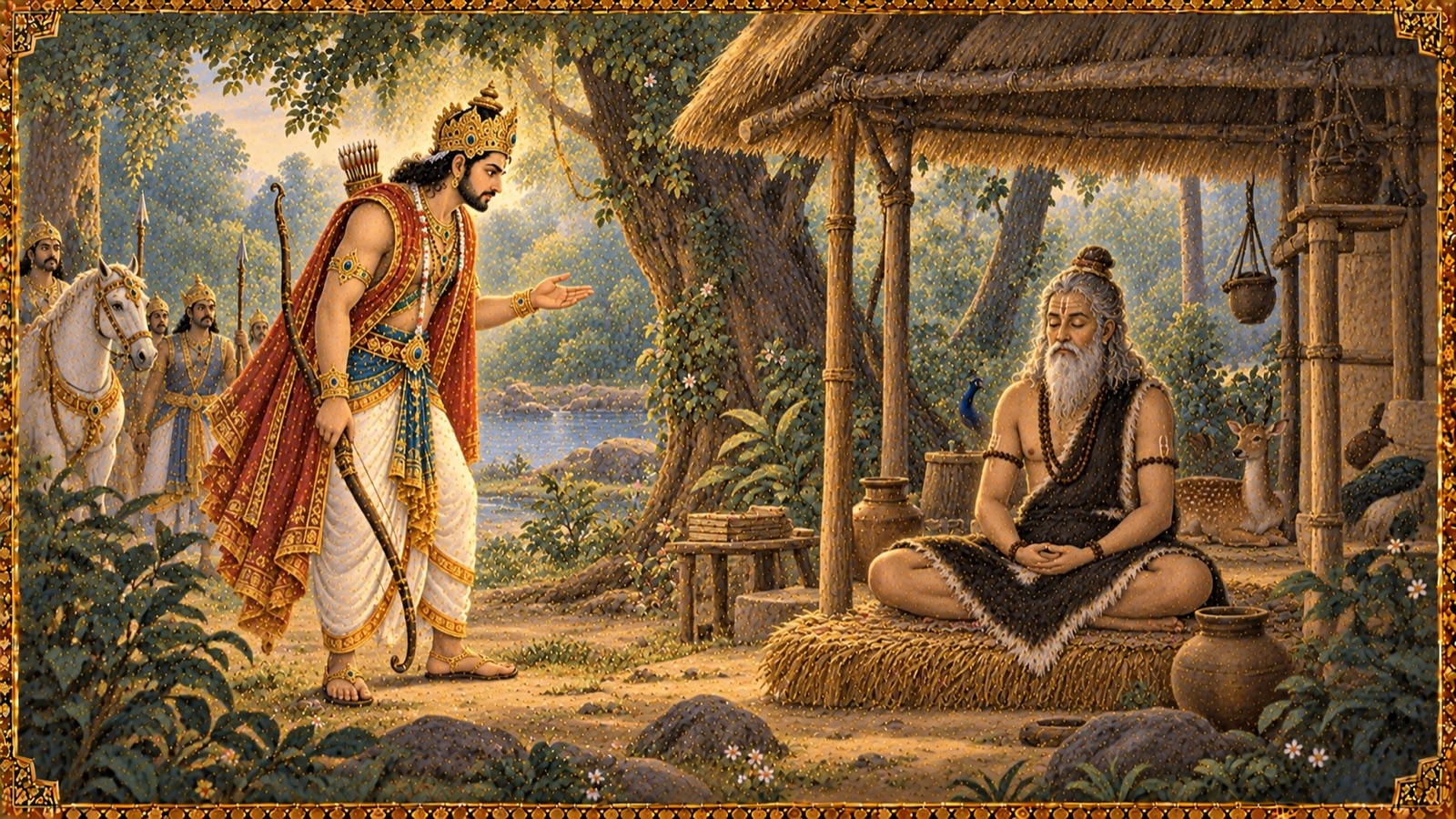
The sage had drawn his senses, breath, mind and intellect into perfect control; withdrawn from the world, he had reached that changeless state beyond waking, dream and dreamless sleep, and had become one with Brahman. His body was wrapped in loose matted hair and the skin of a black deer. Seeing him thus, the king — his tongue parched — asked him for water. But the sage, absorbed beyond all awareness of the world, made no reply.
An Uncharacteristic Anger
Offered no seat of straw, no water for his hands, not even a kind word, the king felt himself slighted, and grew indignant. Oppressed by hunger and thirst, there rose in him all at once a feeling of enmity and anger against the sage — an emotion, O Śaunaka, that he had never before harboured against a Brāhmaṇa. And while departing, he took up a dead serpent lying nearby and, with the end of his bow, flung it across the shoulder of the silent sage; then he returned to his capital.
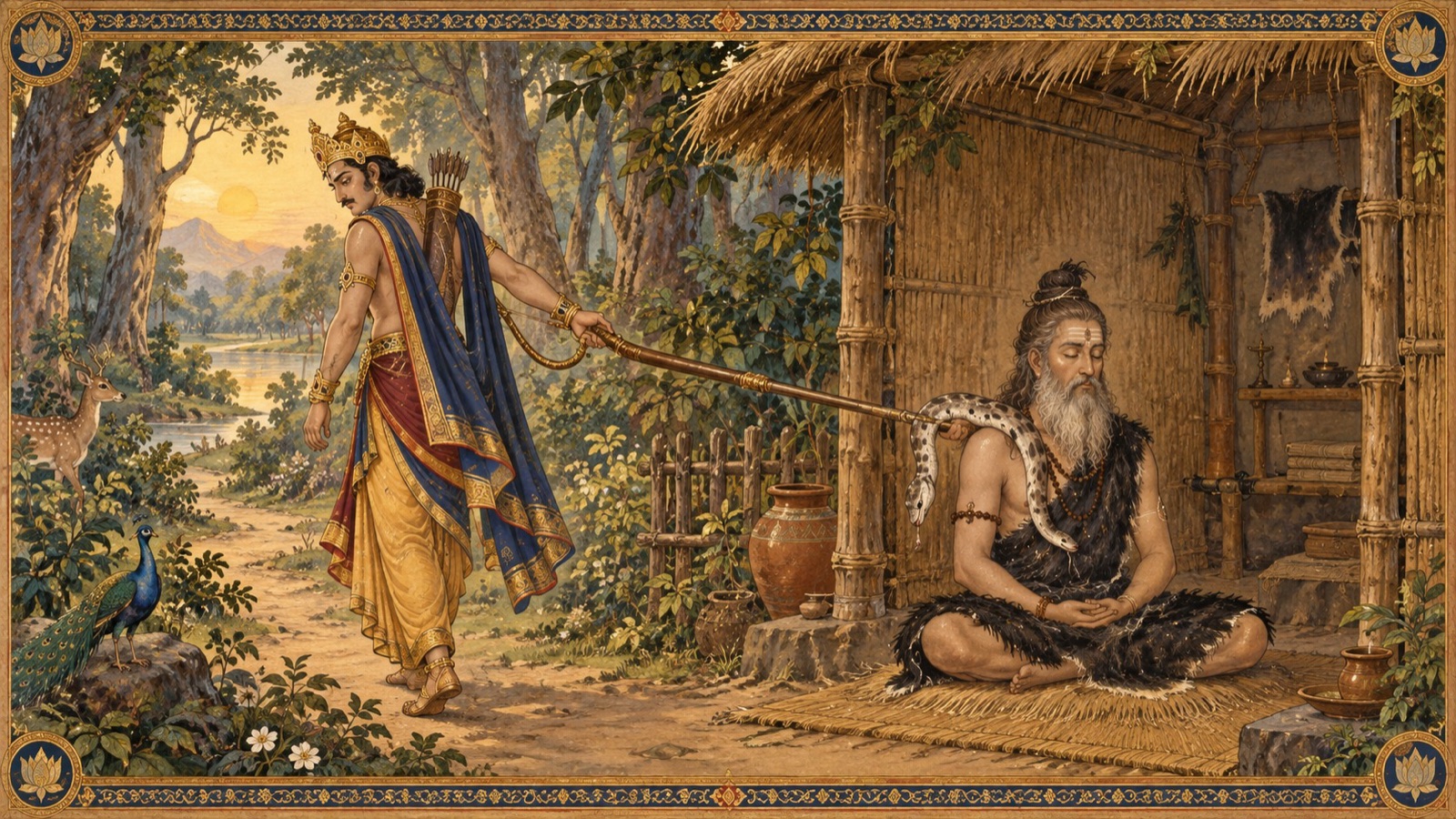
The Bhagavata is careful to show us that this was not the king’s true nature but a passing cloud — a moment’s weakness in a great and righteous soul, brought on by his bodily distress (verses 24–28).
Only once he was back within his own walls did misgivings rise in him: had the sage truly been sunk in a trance beyond the senses, or had he merely feigned that stillness to avoid welcoming a warrior he judged unworthy of a true ṛṣi’s courtesy (verse 31)? The scripture lets the question hang unanswered, for the doubt itself belonged to the king’s troubled mind, not to any fact about the sage.
The Youthful Sage’s Curse
Śamīka had a son — a boy of tender years but abundant spiritual fire, named Śṛṅgi — who was at that time playing with other Brāhmaṇa children nearby. When he heard how his father had been insulted by the king, the boy blazed with indignation. He decried the rulers who had “grown fat like crows,” servants who dare to insult the very masters they were set to guard. And in the pride of his youth he declared:
कृष्णे गते भगवति शास्तर्युत्पथगामिनाम् । तद्भिन्नसेतूनद्याहं शास्मि पश्यत मे बलम् ॥ ३५ ॥
kṛṣṇe gate bhagavati śāstary utpatha-gāminām tad bhinna-setūn adyāhaṁ śāsmi paśyata me balam ॥ 35 ॥
Meaning: “Now that Lord Kṛṣṇa, the chastiser of those who stray from the path, has departed, I shall today punish those who have broken the bounds of decorum. Behold my power!” (Canto 1, Chapter 18, verse 35)
Then, sipping water from the river Kauśikī, his eyes turning crimson with rage, the boy hurled his curse like a thunderbolt:
इति लङ्घितमर्यादं तक्षक: सप्तमेऽहनि । दङ्क्ष्यति स्म कुलाङ्गारं चोदितो मे ततद्रुहम् ॥ ३७ ॥
iti laṅghita-maryādaṁ takṣakaḥ saptame ‘hani daṅkṣyati sma kulāṅgāraṁ codito me tata-druham ॥ 37 ॥
Meaning: “Impelled by me, Takṣaka, chief of serpents, shall on the seventh day from now bite that disgrace of his race, who has transgressed all propriety by his hostility toward my father.” (Canto 1, Chapter 18, verse 37)
In that single flash of anger, the fate of an emperor was sealed. The scripture does not hide the danger of a curse spoken in haste — even by one whose spiritual power is real, and whose grievance seems, on its surface, just.
Yet the Bhagavata does not ask us to read this as mere accident. Beneath the king’s uncharacteristic anger and the sting of neglect that provoked it (verses 24–25, 28), and beneath the doubt that afterward gnawed at him on the road home (verse 31), the tradition sees the Lord’s own unseen hand at work — quietly arranging the very circumstances that would part Parīkṣit from his throne and lead him to Śuka, so that the Bhagavatam itself could come into being for the good of the world. Even Śamīka reads events this way: rather than take satisfaction in his son’s power, he mourns the deed outright (verse 49), as if sensing that a far greater purpose, not a father’s wounded honour, was moving beneath the surface of that single week.
The Father’s Grief and Forgiveness
The boy returned to the hermitage and, seeing his father with a dead snake draped about his neck, wept aloud. Hearing his son’s lament, the sage Śamīka — a scion of Aṅgirā — gradually opened his eyes, cast off the serpent, and gently asked why the child wept and who had wronged him. When the boy told him all that had happened, the sage did not rejoice in the curse. He was grieved.
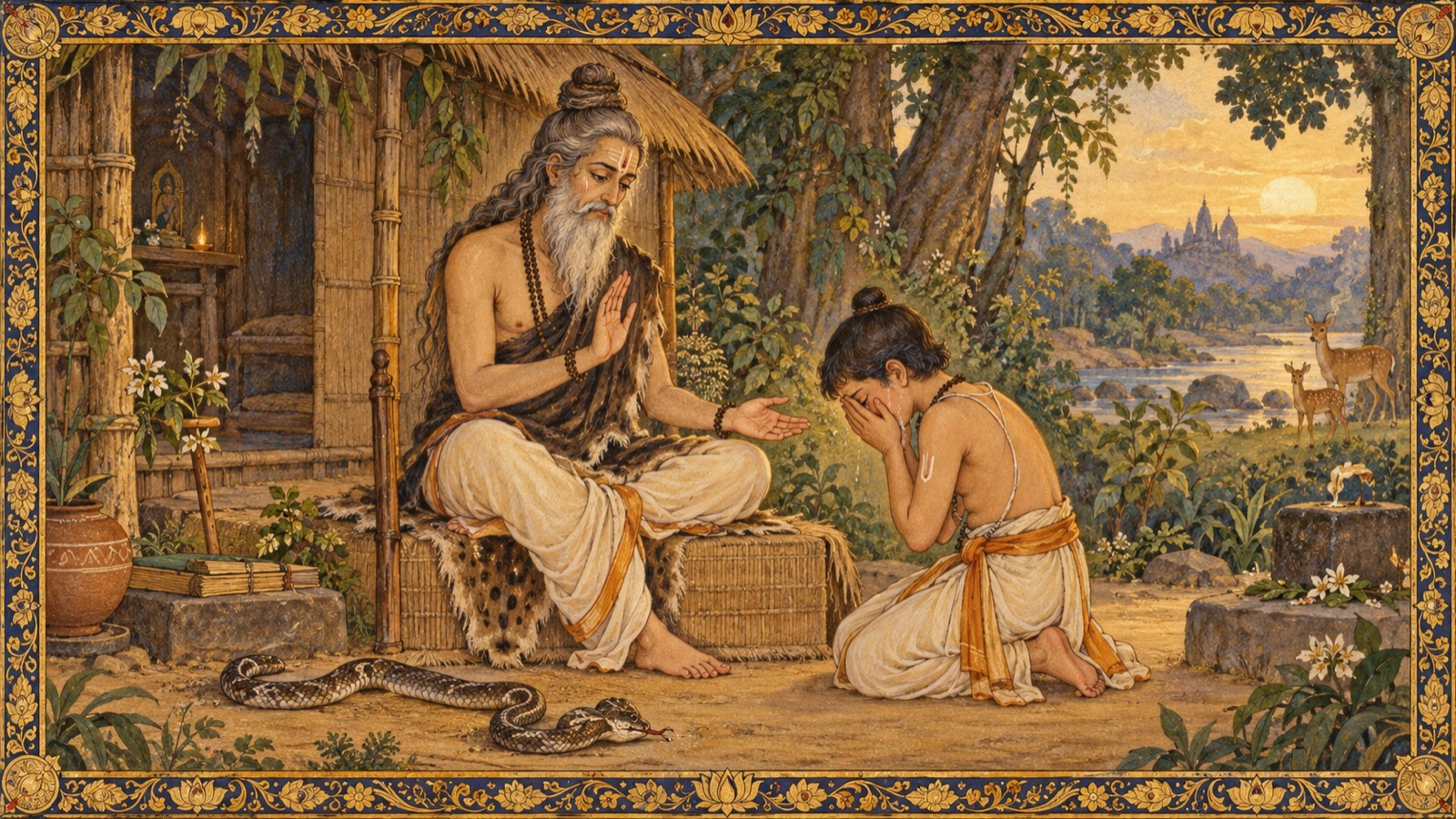
निशम्य शप्तमतदर्हं नरेन्द्रं स ब्राह्मणो नात्मजमभ्यनन्दत् । अहो बतांहो महदद्य ते कृत- मल्पीयसि द्रोह उरुर्दमो धृत: ॥ ४१ ॥
niśamya śaptam atad-arhaṁ narendraṁ sa brāhmaṇo nātmajam abhyanandat aho batāṁho mahad adya te kṛtam alpīyasi droha urur damo dhṛtaḥ ॥ 41 ॥
Meaning: Hearing that the king — a man deserving no such curse — had been condemned, the sage found no cause to praise his son: “Alas, my child! You have committed a grave sin today; for a trivial offence you have inflicted a terrible punishment.” (Canto 1, Chapter 18, verse 41)
A king, the sage explained, bears the very name of Viṣṇu and must never be judged, by an immature reasoning, by the standard of ordinary men — for it is by his own unbearable power that the people live sheltered, fearless, and blessed:
न वै नृभिर्नरदेवं पराख्यं सम्मातुमर्हस्यविपक्वबुद्धे । यत्तेजसा दुर्विषहेण गुप्ता विन्दन्ति भद्राण्यकुतोभया: प्रजा: ॥ ४२ ॥
अलक्ष्यमाणे नरदेवनाम्नि रथाङ्गपाणावयमङ्ग लोक: । तदा हि चौरप्रचुरो विनङ्क्ष्य- त्यरक्ष्यमाणोऽविवरूथवत् क्षणात् ॥ ४३ ॥
na vai nṛbhir nara-devaṁ parākhyaṁ sammātum arhasy avipakva-buddhe yat-tejasā durviṣaheṇa guptā vindanti bhadrāṇy akutobhayāḥ prajāḥ ॥ 42 ॥
alakṣyamāṇe nara-deva-nāmni rathāṅga-pāṇāv ayam aṅga lokaḥ tadā hi caura-pracuro vinaṅkṣyaty arakṣyamāṇo ‘vivarūthavat kṣaṇāt ॥ 43 ॥
Meaning: My child, do not weigh the king — who bears the very name of the Supreme — by an immature judgment; it is his unbearable power alone that keeps the people sheltered and fearless. Let this presence, the Lord’s own power under the name of king, go unmarked, and in an instant the world would be overrun by thieves, like a flock with no one to guard it. (Canto 1, Chapter 18, verses 42–43)
When such kingship is undone, Śamīka warned, the plundering of the people’s wealth brings violence and grief on every side, and the whole ordered scheme of the castes and stations of life gives way, so that a generation grows up no better disciplined than dogs and monkeys, adrift from the Vedic path (verses 44–45). Parīkṣit himself, moreover, was a monarch of great renown, a defender of righteousness, a devotee of the Lord and a royal sage who had performed many horse-sacrifices; overcome by hunger, thirst and fatigue, and utterly helpless, he had done nothing to deserve a curse. Śamīka could only pray that the Lord, the Soul of the universe, might forgive the wrong his child had done to the Lord’s own innocent servant. For, he said, this is the very mark of a devotee:
तिरस्कृता विप्रलब्धा: शप्ता: क्षिप्ता हता अपि । नास्य तत् प्रतिकुर्वन्ति तद्भक्ता: प्रभवोऽपि हि ॥ ४८ ॥
tiraskṛtā vipralabdhāḥ śaptāḥ kṣiptā hatā api nāsya tat pratikurvanti tad-bhaktāḥ prabhavo ‘pi hi ॥ 48 ॥
Meaning: Though scorned, deceived, cursed, disregarded, or even struck, the devotees of the Lord do not retaliate against the wrongdoer, even when they have the power to do so. (Canto 1, Chapter 18, verse 48)
So grieved was the sage at his own son’s wrong that he did not even dwell upon the offence the king had done to him. And with this Suta offers a final, luminous truth about the saints:
प्रायश: साधवो लोके परैर्द्वन्द्वेषु योजिता: । न व्यथन्ति न हृष्यन्ति यत आत्माऽगुणाश्रय: ॥ ५० ॥
prāyaśaḥ sādhavo loke parair dvandveṣu yojitāḥ na vyathanti na hṛṣyanti yata ātmā ‘guṇāśrayaḥ ॥ 50 ॥
Meaning: As a rule, holy souls in this world are neither pained nor pleased when others place them in circumstances of pleasure and pain; for the self is ever beyond the three modes of nature — sattva, rajas and tamas, the strands of goodness, passion and ignorance that colour all worldly experience. (Canto 1, Chapter 18, verse 50)
Principal Teachings
1. A life given to God ends without fear. Parīkṣit, told of his death seven days away, felt no dread (verses 2–4). The soul who has surrendered his heart to Kṛṣṇa meets even death in serenity.
2. Kali’s shadow falls only on the unwary heart. Kali could not touch the earth while a vigilant, righteous king reigned (verse 5), and preys, like a wolf, only upon the heedless (verse 8). Watchfulness and devotion are our protection.
3. The company of the holy outweighs heaven itself. The sages would not trade one moment’s fellowship with the Lord’s devotees for celestial joy or even liberation (verse 13) — a stirring measure of the worth of holy company.
4. Anger, even when the grievance seems just, brings ruin. Śṛṅgi’s power was real and his sense of insult understandable, yet his curse was a “grave sin” (verse 41). Righteous indignation without restraint becomes destruction.
5. Authority deserves reverence and patience. A king who protects Dharma bears the very name of Viṣṇu, and it is his own unbearable power that keeps the people fearless (verses 42–43); where that protection lapses, society collapses into lawlessness. Honour and forbearance are owed to those who shelter the common good.
6. The true devotee does not retaliate. Though able to strike back, the devotee returns no wrong for wrong (verse 48). This non-retaliation is not weakness but the strength of a soul anchored beyond the ego.
7. The saint is unmoved by pleasure and pain. Śamīka neither nursed his own injury nor rejoiced in his son’s power (verses 49–50), for the awakened soul rests beyond the three modes of nature.
A Devotional Reflection
This chapter holds two hearts side by side, and asks us quietly which we will resemble. There is Śṛṅgi — young, gifted, spiritually powerful, and utterly sincere in his love for his father. His anger is not villainy; it is zeal that has slipped its reins. And there is Śamīka — old, silent, wronged in his own body, and yet incapable of striking back, grieving only that harm has come through his household to an innocent man. Between them lies the whole distance of the spiritual life: the distance from power to peace, from being right to being good. It is sobering to notice that the great tragedy of Parīkṣit’s death does not begin with a demon or a villain, but with a good boy’s ungoverned temper. How often our own peace is broken not by great evils but by small, hot, self-righteous moments. The Bhagavata sets before us the calmer greatness of the saint who has learned to hold his heart still, and gently invites us toward it.
A Daily Devotional Practice
Today, when some slight or provocation stirs anger in you — a harsh word, a discourtesy, an injustice — pause before you answer, and silently utter one of the Lord’s holy names. Let the Name come between the sting and your response, as Śamīka’s patience came between his son’s fire and his own heart. Even a single breath of remembrance can turn a curse into a blessing.
Conclusion
So ends the eighteenth discourse of the first Canto of the Śrīmad Bhāgavata — the story of how the noble emperor Parīkṣit, protected in the womb by Kṛṣṇa and fearless before death, came to be cursed by a boy’s rash word. In Srimad Bhagavatam Canto 1 Chapter 18 we watch a single flash of anger set a serpent on its seven-day path, and we watch a true saint refuse to add anger to anger, praying instead for the forgiveness of the very king who wronged him. Suta has shown us both the fearlessness of a devotee and the forbearance of a sage, and has reminded us that Kali’s power reaches only the careless heart. The story now bends toward the king’s own response — how Parīkṣit will receive the news of his death, and how the sage Śuka will come to him — but already this chapter has given us its treasure: that the peace of the God-absorbed soul is greater than any power, and that the Name of the Lord is our refuge in every trial.
May the divine wisdom of Srimad Bhagavatam awaken pure devotion within our hearts.
Om Namo Bhagavate Vasudevaya.
Jay Shree Madhav.
References and Attribution
Primary edition: Gita Press, Śrīmad Bhāgavata Mahāpurāṇa (English), Book One (Skandha 1), Discourse 18, book pages 74–78.
Srimad Bhagavatam Wisdom · Biswa Sanatan Dharma Seva Trust. Presented following the spiritual guidance and recommendation of Pandit Dr. Shri Kashinath Mishra.
Jay Shree Madhav