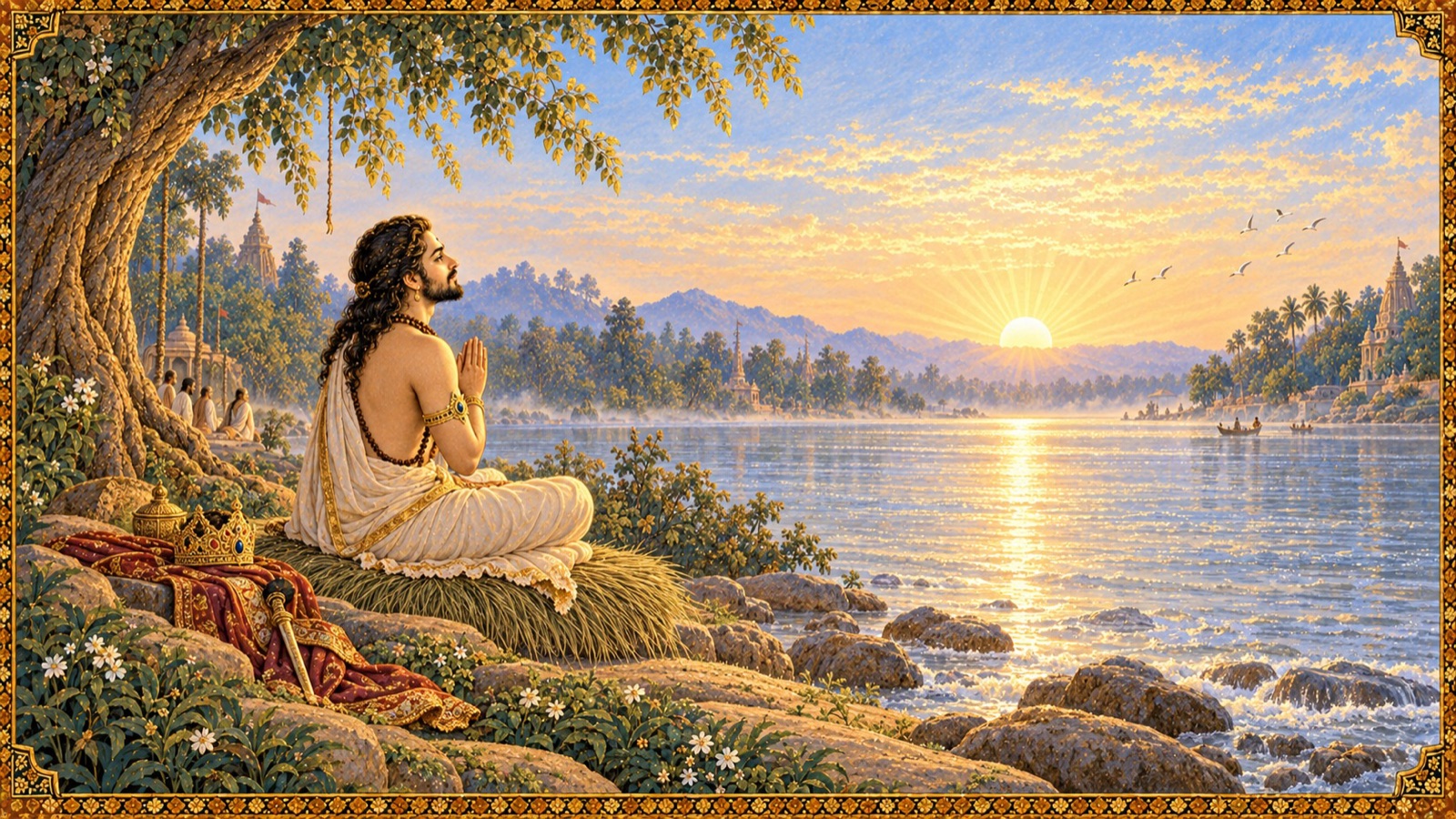
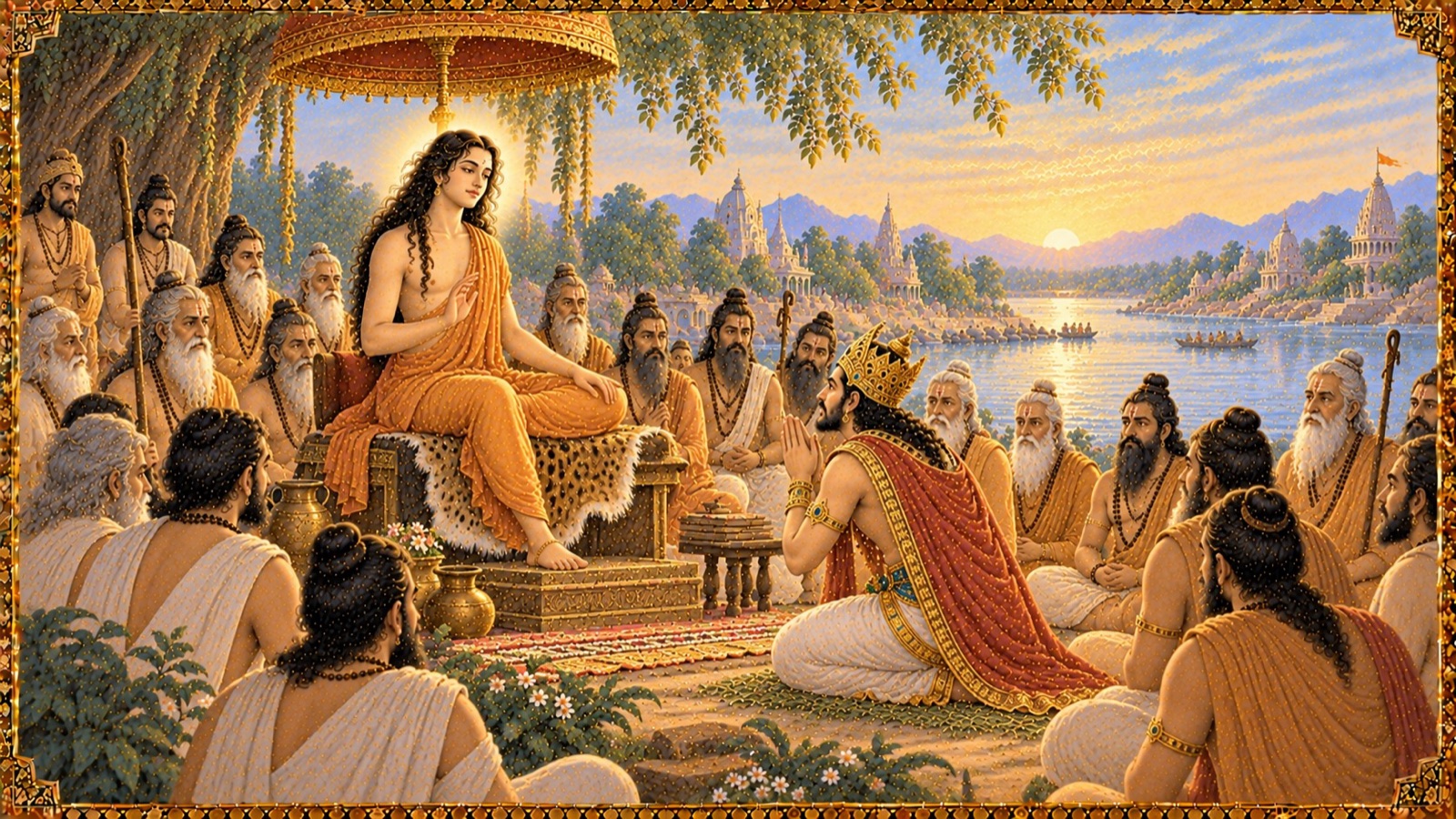
Renouncing both worlds, King Parikshit sits on the bank of the sacred Ganga, his mind fixed on the lotus-feet of Sri Krishna, and takes a vow to fast until death.
Om Namo Bhagavate Vasudevaya.
Om Namo Bhagavate Vasudevaya.
Om Namo Bhagavate Vasudevaya.
Welcome to Srimad Bhagavatam Wisdom, a devotional journey through the sacred histories and teachings of the Srimad Bhagavat Mahapurana. In this nineteenth and final discourse of the First Canto, a great emperor turns a curse into a doorway to God. Learning that he has only seven days to live, King Parikshit does not tremble or scheme for a cure. He lays down his crown, seats himself on the bank of the holy Ganga, and resolves to spend his last days in fasting, prayer, and hearing about the Lord. To that riverbank the foremost sages of the age come streaming, and at last there arrives the one for whom the whole scripture has been waiting — the young, God-intoxicated sage Sukadeva Goswami. With the king’s single, heartfelt question, the stage is set for everything that follows.
Chapter Information
- Scripture: Śrīmad Bhāgavata Mahāpurāṇa
- Canto: 1 (Book One)
- Chapter: 19 (Discourse 19) — the closing chapter of the First Canto
- Chapter title: The Appearance of Śukadeva Gosvāmī
- Principal speakers: the blessed Sūta, Ugraśravā (narrator); King Parīkṣit; the assembled sages
- Principal listener: the sages of Naimiṣāraṇya, headed by Śaunaka
- Main setting: the southern bank of the Gaṅgā, where Parīkṣit sits fasting till death
- Central subject: Parīkṣit’s vow of fasting till death and the arrival of the sage Śukadeva Gosvāmī
- Principal verse range: Canto 1, Chapter 19, verses 1–40
- Primary edition: Gita Press Śrīmad Bhāgavata Mahāpurāṇa
Context from the Previous Chapter
In the eighteenth discourse, King Parīkṣit — tired, thirsty, and provoked while hunting — entered the hermitage of the meditating sage Śamīka and, receiving no welcome, draped a dead snake over the silent sage’s shoulder in a moment of anger. The sage’s young son Śṛṅgi, hearing of the slight, cursed the king to die within seven days from the bite of the serpent Takṣaka. The gentle Śamīka grieved over his son’s rashness. It is with this curse hanging over him that the nineteenth chapter opens.
The King’s Remorse
Returning to his capital, the king could find no peace. He turned the deed over and over in his mind, deeply pained, blaming himself for having behaved “like a vulgar man” toward an innocent Brāhmaṇa of hidden spiritual power. Far from resenting the curse, he welcomed the coming calamity as a just expiation, praying that it fall directly upon him so that he would never dare repeat such an offence. Let fire in the shape of the angered Brāhmaṇa race, he thought, consume his kingdom, army, and treasury this very day, so that he might never again harbour a sinful thought toward the Brāhmaṇas, the gods, and the cows.
While he was reflecting thus, word reached him of how death, impelled by the sage’s son, awaited him under the name of Takṣaka. And here the king’s greatness shines: he looked upon the fire-like poison of Takṣaka not as a disaster but as a blessing, for he saw that it would swiftly awaken detachment in one who had been deeply attached to the world. A lesser man would have run from death; Parīkṣit walked toward it as toward a teacher.
A Vow on the Bank of the Ganga
Having concluded that both this world and the next were worth renouncing, and recognizing loving service to the feet of Śrī Kṛṣṇa as higher than everything else, the king sat down on the bank of the Gaṅgā with a resolve to fast until death.
अथो विहायेमममुं च लोकं विमर्शितौ हेयतया पुरस्तात् । कृष्णाङ्घ्रिसेवामधिमन्यमान उपाविशत् प्रायममर्त्यनद्याम् ॥ ५ ॥
atho vihāyemam amuṁ ca lokaṁ vimarśitau heyatayā purastāt kṛṣṇāṅghri-sevām adhimanyamāna upāviśat prāyam amartya-nadyām
Meaning: Renouncing this world and the next, both of which he had already judged worth rejecting, and prizing service to the feet of Śrī Kṛṣṇa above all else, he sat down beside the immortal river to fast until death. (Canto 1, Chapter 19, verse 5)
He chose the Gaṅgā for good reason. Her waters excel all others, for they are mingled with the dust of Śrī Kṛṣṇa’s feet and with the lovely Tulasī leaves offered there, and so she sanctifies all the worlds, above and below, together with their guardian deities.
या वै लसच्छ्रीतुलसीविमिश्र- कृष्णाङ्घ्रिरेण्वभ्यधिकाम्बुनेत्री । पुनाति लोकानुभयत्र सेशान् कस्तां न सेवेत मरिष्यमाण: ॥ ६ ॥
yā vai lasac-chrī-tulasī-vimiśra- kṛṣṇāṅghri-reṇv-abhyadhikāmbu-netrī punāti lokān ubhayatra seśān kas tāṁ na seveta mariṣyamāṇaḥ
Meaning: What dying person would not resort to the Gaṅgā, whose water is made supremely pure by the dust of Śrī Kṛṣṇa’s feet mixed with fresh Tulasī, and who purifies all the worlds along with their ruling deities? (Canto 1, Chapter 19, verse 6)
Having thus resolved, the scion of Pāṇḍu shook off every attachment, took up the vow of a hermit, and fixed his mind with undivided devotion upon the feet of Mukunda, the Bestower of Liberation.
इति व्यवच्छिद्य स पाण्डवेय: प्रायोपवेशं प्रति विष्णुपद्याम् । दधौ मुकुन्दाङ्घ्रिमनन्यभावो मुनिव्रतो मुक्तसमस्तसङ्ग: ॥ ७ ॥
iti vyavacchidya sa pāṇḍaveyaḥ prāyopaveśaṁ prati viṣṇu-padyām dadhau mukundāṅghrim ananya-bhāvo muni-vrato mukta-samasta-saṅgaḥ
Meaning: Having thus decided to fast until death beside the Gaṅgā, which flows from the feet of Lord Viṣṇu, the descendant of Pāṇḍu — free of all attachment and vowed to silence and austerity — fixed his mind single-heartedly on the feet of Mukunda. (Canto 1, Chapter 19, verse 7)
The Great Sages Gather
News of the emperor’s holy resolve spread quickly, and to that riverbank came the foremost sages of the earth, each with his pupils — saints who bring sanctity wherever they go, for the pure consecrate the very places of pilgrimage they visit. The gathering reads like a roll-call of the spiritual glory of the age.
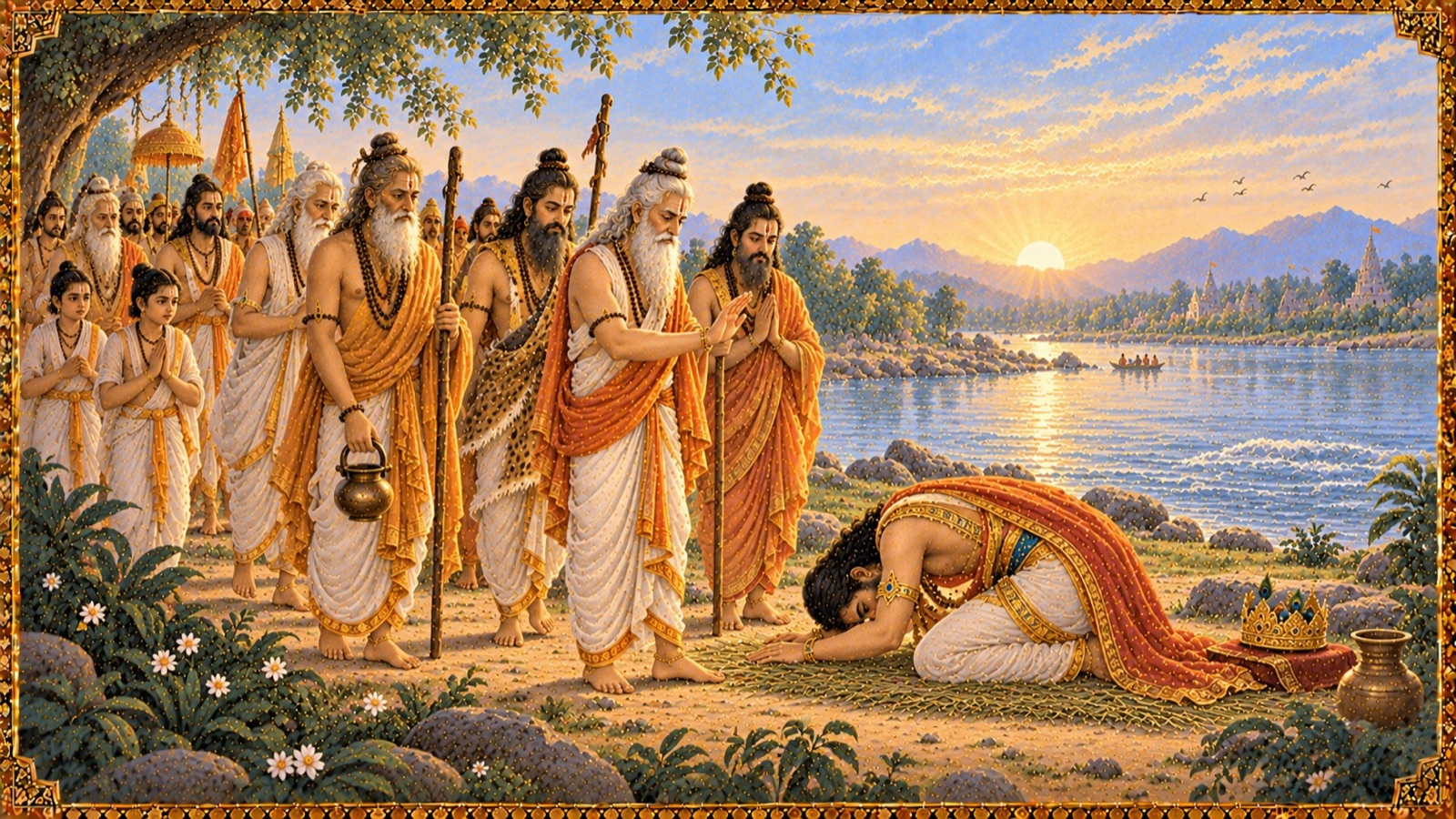
अत्रिर्वसिष्ठश्च्यवन: शरद्वा- नरिष्टनेमिर्भृगुरङ्गिराश्च । पराशरो गाधिसुतोऽथ राम उतथ्य इन्द्रप्रमदेध्मवाहौ ॥ ९ ॥ मेधातिथिर्देवल आर्ष्टिषेणो भारद्वाजो गौतम: पिप्पलाद: । मैत्रेय और्व: कवष: कुम्भयोनि- र्द्वैपायनो भगवान्नारदश्च ॥ १० ॥
atrir vasiṣṭhaś cyavanaḥ śaradvān ariṣṭanemir bhṛgur aṅgirāś ca parāśaro gādhi-suto ‘tha rāma utathya indrapramadedhmavāhau medhātithir devala ārṣṭiṣeṇo bhāradvājo gautamaḥ pippalādaḥ maitreya aurvaḥ kavaṣaḥ kumbhayonir dvaipāyano bhagavān nāradaś ca
Meaning: There came Atri, Vasiṣṭha, Cyavana, Śaradvān, Ariṣṭanemi, Bhṛgu, Aṅgirā, Parāśara, Viśvāmitra the son of Gādhi, and Rāma (Paraśurāma); Utathya, Indrapramada and Idhmavāha; Medhātithi, Devala, Ārṣṭiṣeṇa, Bhāradvāja, Gautama, and Pippalāda; Maitreya, Aurva, Kavaṣa, the jar-born Agastya, the island-born Vedavyāsa, and the divine sage Nārada. (Canto 1, Chapter 19, verses 9–10)
With these came other great celestial sages, Brāhmaṇa sages, and eminent royal sages such as Aruṇa. Seeing the foremost of so many ṛṣi families gathered before him, the king worshipped them and bowed his head to the ground.
अन्ये च देवर्षिब्रह्मर्षिवर्या राजर्षिवर्या अरुणादयश्च । नानार्षेयप्रवरान् समेता- नभ्यर्च्य राजा शिरसा ववन्दे ॥ ११ ॥
anye ca devarṣi-brahmarṣi-varyā rājarṣi-varyā aruṇādayaś ca nānārṣeya-pravarān sametān abhyarcya rājā śirasā vavande
Meaning: And there came other foremost sages among the gods, the Brāhmaṇas, and the kings, headed by Aruṇa; the king worshipped all these leaders of the various sage families and bowed his head to them. (Canto 1, Chapter 19, verse 11)
When they were seated at ease, the king made obeisance once more and, standing before them with joined palms, disclosed with a guileless heart what he intended to do.
The King’s Prayer
Then the king spoke. He called himself and his line the most blessed of monarchs, for their character had earned the grace of the noblest souls — though he humbly confessed that the ruling class is generally far removed from the sanctifying water that has bathed the feet of the Brāhmaṇas. To one so sinful and so attached to home, he said, the Lord Himself, Ruler of the universe, had now come in the form of a Brāhmaṇa’s curse, awakening in him a saving aversion to worldly pleasure. He asked the assembled Brāhmaṇas and goddess Gaṅgā to accept him as a surrendered soul who had fixed his mind on the Lord, and he invited Takṣaka — or anyone in Takṣaka’s guise — to bite him at will, asking only that the sages continue meanwhile to sing the stories of Lord Viṣṇu. Then came his one great prayer.
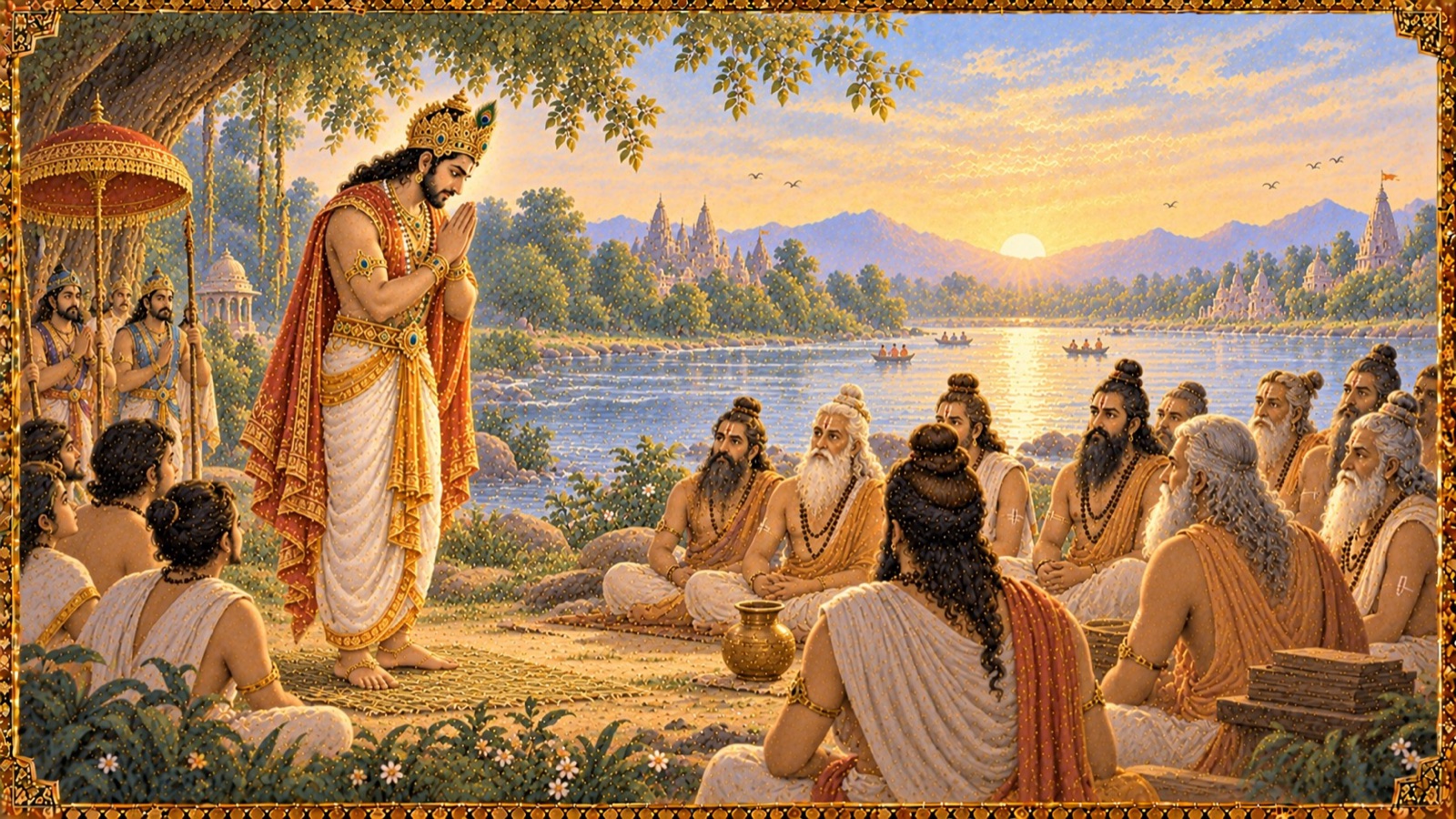
पुनश्च भूयाद्भगवत्यनन्ते रति: प्रसङ्गश्च तदाश्रयेषु । महत्सु यां यामुपयामि सृष्टिं मैत्र्यस्तु सर्वत्र नमो द्विजेभ्य: ॥ १६ ॥
punaś ca bhūyād bhagavaty anante ratiḥ prasaṅgaś ca tad-āśrayeṣu mahatsu yāṁ yām upayāmi sṛṣṭiṁ maitry astu sarvatra namo dvijebhyaḥ
Meaning: In whatever species I may be born, may I again and again have loving attachment to the infinite Lord, the company of the great souls who have taken shelter of Him, and friendship toward all beings. My obeisances to the Brāhmaṇas. (Canto 1, Chapter 19, verse 16)
Having spoken thus, and having placed the burdens of kingship on the shoulders of his eldest son, Janamejaya, the wise king sat down on the southern bank of the Gaṅgā upon blades of kuśa grass, their tips turned east, himself facing north. When that emperor had taken his seat with a vow of fasting till death, the hosts of gods in heaven cried out their applause and joyfully rained down flowers upon the earth, while celestial drums sounded again and again. The great ṛṣis, ever devoted to the welfare of all beings, also praised his resolve, exclaiming “Splendid!”
The Essential Question
The sages assured the king that such renunciation was no wonder in one so devoted to Śrī Kṛṣṇa, for in his eagerness to attain the Lord he had cast aside a throne that other kings would kill to keep. They resolved to remain with him until he cast off his body and ascended to the highest abode, beyond the reach of Māyā and free from sorrow. Moved by their words — impartial, sweet, and true — Parīkṣit greeted these sages who had become one with the Supreme Spirit, and, eager to hear the glories of Lord Viṣṇu, placed before them the one question worth asking.
ततश्च व: पृच्छ्यमिमं विपृच्छे विश्रभ्य विप्रा इति कृत्यतायाम् । सर्वात्मना म्रियमाणैश्च कृत्यं शुद्धं च तत्रामृशताभियुक्ता: ॥ २४ ॥
tataś ca vaḥ pṛcchyam imaṁ vipṛcche viśrabhya viprā iti kṛtyatāyām sarvātmanā mriyamāṇaiś ca kṛtyaṁ śuddhaṁ ca tatrāmṛśatābhiyuktāḥ
Meaning: Reposing full faith in you, O Brāhmaṇas, I ask this question about my duty: after careful thought, tell me what is the pure and proper course for every person in all circumstances — and especially for one who is about to die. (Canto 1, Chapter 19, verse 24)
This is the question upon which the entire remaining Bhāgavata is built: what should a person do who has only a little time left to live? It is the question every mortal must one day face, and Parīkṣit asks it for all of us.
The Coming of Sukadeva
At that very moment, as if in answer, there arrived on the scene the divine Śuka — Śukadeva, the son of Vyāsa — wandering the earth at will, expecting nothing, content in the joy of his own Self.
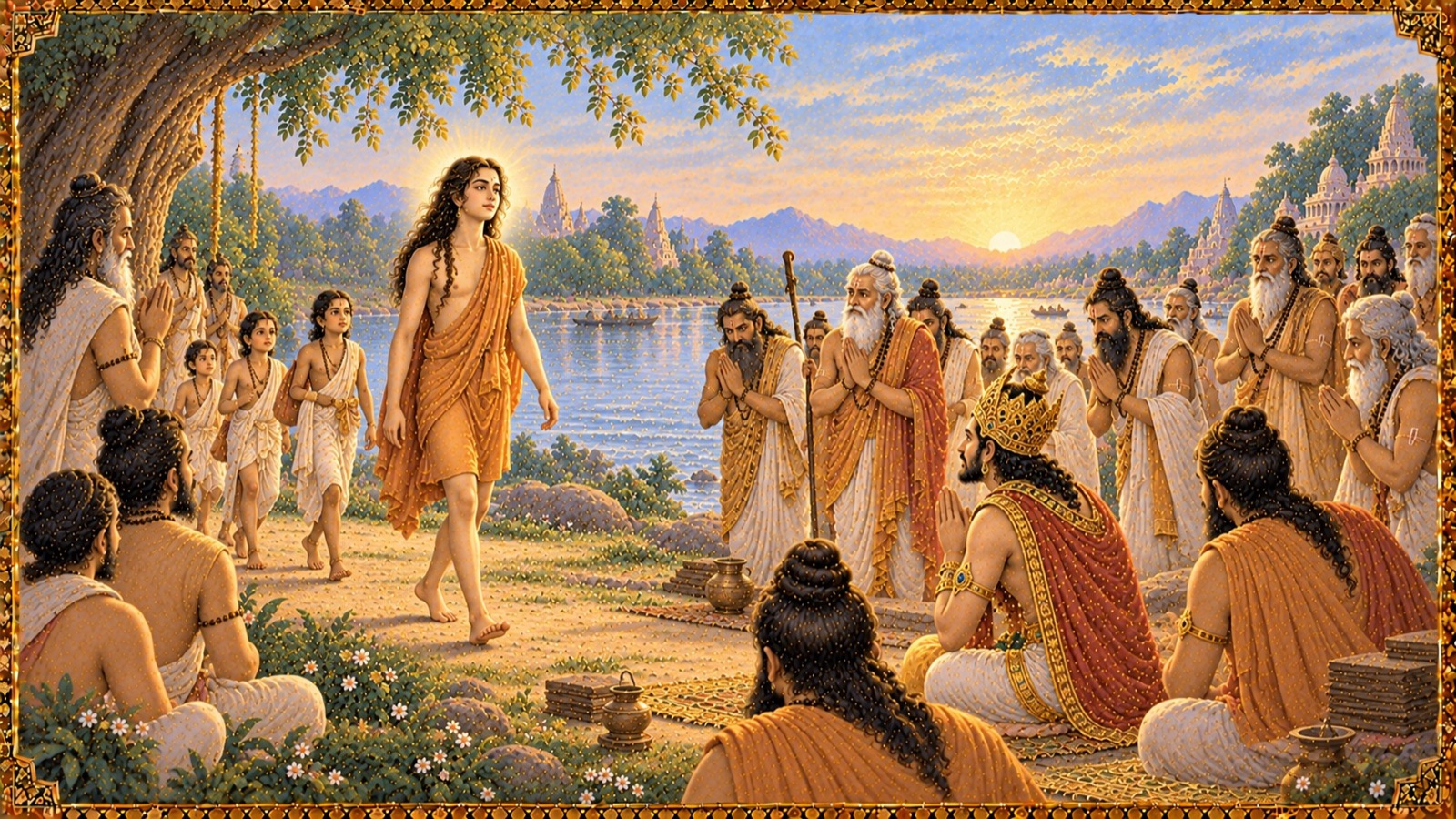
तत्राभवद्भगवान् व्यासपुत्रो यदृच्छया गामटमानोऽनपेक्ष: । अलक्ष्यलिङ्गो निजलाभतुष्टो वृतश्च बालैरवधूतवेष: ॥ २५ ॥
tatrābhavad bhagavān vyāsa-putro yadṛcchayā gām aṭamāno ‘napekṣaḥ alakṣya-liṅgo nija-lābha-tuṣṭo vṛtaś ca bālair avadhūta-veṣaḥ
Meaning: There appeared the powerful son of Vyāsa, wandering the earth as he pleased, indifferent and self-satisfied, bearing no outward marks of any social order, surrounded by children, and wearing the guise of an avadhūta. (Canto 1, Chapter 19, verse 25)
He was but sixteen years of age, with tender feet, hands, and limbs, large eyes, a shapely nose, and a conch-like neck — beautiful as one of the highest gods, though he cared nothing for his own beauty and went about like one who had renounced every worldly connection. Though he had concealed his spiritual glow behind the appearance of a carefree wanderer, the assembled sages recognized him at once by his marks and rose from their seats to receive him.
King Viṣṇurāta — Parīkṣit, so named because his life had been preserved in the womb by Lord Viṣṇu Himself — bowed his head to the unexpected guest and honoured him. The children and the curious withdrew, and, worshipped by all, Śukadeva took an exalted seat. Surrounded by hosts of Brāhmaṇa sages, royal sages, and celestial sages, he shone most resplendent among them, like the full moon amid the planets and stars.
At the Feet of the Sage
When that sage of unfailing wisdom had taken his seat, fully composed, the king approached him, touched his feet with his head, and stood before him with joined palms. Then, in sweet and humble words, he questioned Śukadeva.
परीक्षिदुवाच अहो अद्य वयं ब्रह्मन् सत्सेव्या: क्षत्रबन्धव: । कृपयातिथिरूपेण भवद्भिस्तीर्थका: कृता: ॥ ३२ ॥
parīkṣid uvāca aho adya vayaṁ brahman sat-sevyāḥ kṣatra-bandhavaḥ kṛpayātithi-rūpeṇa bhavadbhis tīrthakāḥ kṛtāḥ
Meaning: Parīkṣit said: O holy Brāhmaṇa, how blessed we are today! We unworthy Kṣatriyas, fit to be served by the saintly, have by your kindness been sanctified through your coming to us as a guest. (Canto 1, Chapter 19, verse 32)
The king marvelled that a mere remembrance of such a soul purifies a home, much more his sight, his touch, and the washing of his feet; that a saint’s very presence destroys the gravest sins as swiftly as the presence of Lord Viṣṇu scatters the demons. He took the sage’s unlooked-for arrival as a sign that Śrī Kṛṣṇa, the friend of the Pāṇḍavas, was pleased with him. Then he laid bare his heart’s need: what, he asked, should a man on the verge of death do? And more — what should all people everywhere hear, what should they chant with their tongues, what should they hold in their minds, what should they worship, and what should they avoid? Parīkṣit marvelled that so great a sage rarely stays even long enough to milk a cow at a householder’s door, and yet had come to him in his final days.
Thus questioned in gentle words by the king, Śuka — the son of Bādarāyaṇa, knower of Dharma — prepared to reply.
सूत उवाच एवमाभाषित: पृष्ट: स राज्ञा श्लक्ष्णया गिरा । प्रत्यभाषत धर्मज्ञो भगवान् बादरायणि: ॥ ४० ॥
sūta uvāca evam ābhāṣitaḥ pṛṣṭaḥ sa rājñā ślakṣṇayā girā pratyabhāṣata dharma-jño bhagavān bādarāyaṇiḥ
Meaning: Sūta said: Thus addressed and questioned by the king in gentle words, the powerful son of Bādarāyaṇa, the knower of Dharma, began to reply. (Canto 1, Chapter 19, verse 40)
With these words the First Canto comes to its close. The great answer that Śukadeva now begins — the answer to how a dying man, and indeed every living being, should spend the time that remains — unfolds through all the Cantos that follow.
Principal Teachings of This Chapter
1. A curse can be received as grace. Parīkṣit does not fight his fate; he recognizes the Brāhmaṇa’s curse as the Lord Himself coming to free him from attachment (verses 4, 14). What looks like calamity becomes the very means of his liberation.
2. Impending death is an invitation to devotion. Rather than seeking a cure, the king renounces both worlds and turns wholly to the feet of Śrī Kṛṣṇa (verses 5, 7). Awareness of death, rightly received, sharpens the soul’s longing for God.
3. Holy places and holy company sanctify the seeker. The saints consecrate the very tīrthas they visit, and Parīkṣit chooses the bank of the Gaṅgā — hallowed by the dust of Kṛṣṇa’s feet — for his final days (verses 6, 8). Sacred place and sacred association support the mind in its last work.
4. The highest prayer is for devotion itself. Given the chance to ask for anything, the king asks only for love of the Lord, the company of His devotees, and friendship toward all beings in every future life (verse 16). This is the summit of a devotee’s desiring.
5. The one question worth asking. Parīkṣit’s inquiry — what should one do who is about to die, and what should all people hear, chant, and remember? — is the seed of the entire Bhāgavata (verses 24, 38). To ask it sincerely is already to begin the answer.
A Devotional Reflection
We spend much of our lives arranging to avoid this very moment — the moment when time runs short and nothing external can help. Parīkṣit, the emperor of the world, is handed exactly seven days, and he does something startling: he treats them as a gift. He does not blame the boy who cursed him or the anger that provoked it. He sits down by the river and turns his face toward God. There is a quiet lesson here for those of us who are not emperors and do not know our seven days. The Bhāgavatam does not wait for a deathbed to be relevant; it simply asks us to live now the way Parīkṣit chose to live at the end — loosening our grip on what must be left behind, seeking the company of the wise, and letting the holy name and story of the Lord fill the hours. His single prayer, to love God and God’s devotees in every birth, is a prayer any of us can make today. The riverbank, the sages, and the young God-sent teacher are all still available to the heart that turns, as the king did, toward the Lord.
A Daily Devotional Practice
Take a few unhurried minutes today to sit as Parīkṣit sat — settled, unhurried, facing the Lord. Set down for a moment the plans and worries you are gripping, and gently repeat the holy name, “Om Namo Bhagavate Vasudevaya.” Then make the king’s prayer your own: ask not for advantage or escape, but only for lasting love of the Lord, the blessing of holy company, and friendship toward every living being. Carry that threefold prayer into your day.
Conclusion
The nineteenth chapter of the First Canto is the hinge on which the whole Śrīmad Bhāgavata turns. A cursed king becomes a model of surrender: hearing that death approaches in seven days, Parīkṣit renounces his kingdom, seats himself on the bank of the Gaṅgā, and vows to fast until the end with his mind fixed on the feet of Śrī Kṛṣṇa. The greatest sages of the age gather to bless him, the gods rain down flowers, and the king prays only for undying devotion. Then, as if summoned by his longing, the young avadhūta Śukadeva Goswami arrives — self-satisfied, radiant, indifferent to the world — and takes his honoured seat. Bowing at the sage’s feet, Parīkṣit voices the query every mortal must eventually confront: how must a soul standing at death’s door conduct itself, and what ought every person to hear, chant, and keep in remembrance? With that question, Book One ends, and the answer that follows becomes the treasure of every Canto to come. May we, like the king, learn to meet whatever comes as an invitation to remember the Lord.
May the divine wisdom of Srimad Bhagavatam awaken pure devotion within our hearts.
Om Namo Bhagavate Vasudevaya.
Jay Shree Madhav.
References and Attribution
- Primary edition: Gita Press, Śrīmad Bhāgavata Mahāpurāṇa (English, complete), Book One, Discourse 19, pages 79–84.
- Series: Srimad Bhagavatam Wisdom · Biswa Sanatan Dharma Seva Trust.
- Presented following the spiritual guidance and recommendation of Pandit Dr. Shri Kashinath Mishra.
This is an original, faithful retelling in the writer’s own words, with brief quoted verses shown in Devanāgarī and transliteration and their meanings given as summaries. It is not a reproduction of any single publisher’s continuous translation or commentary. No affiliation with or endorsement by any publisher is implied.
Jay Shree Madhav