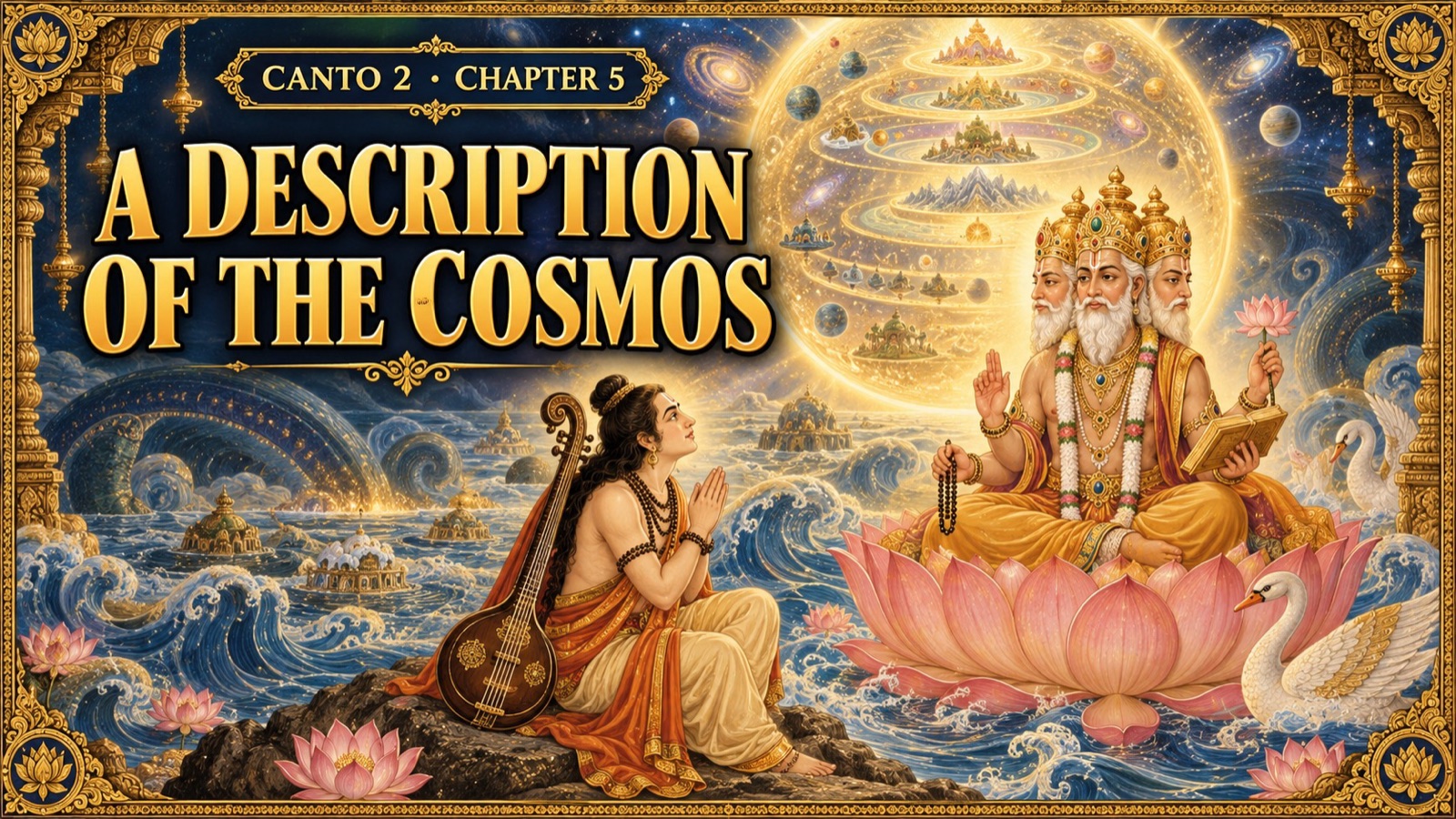
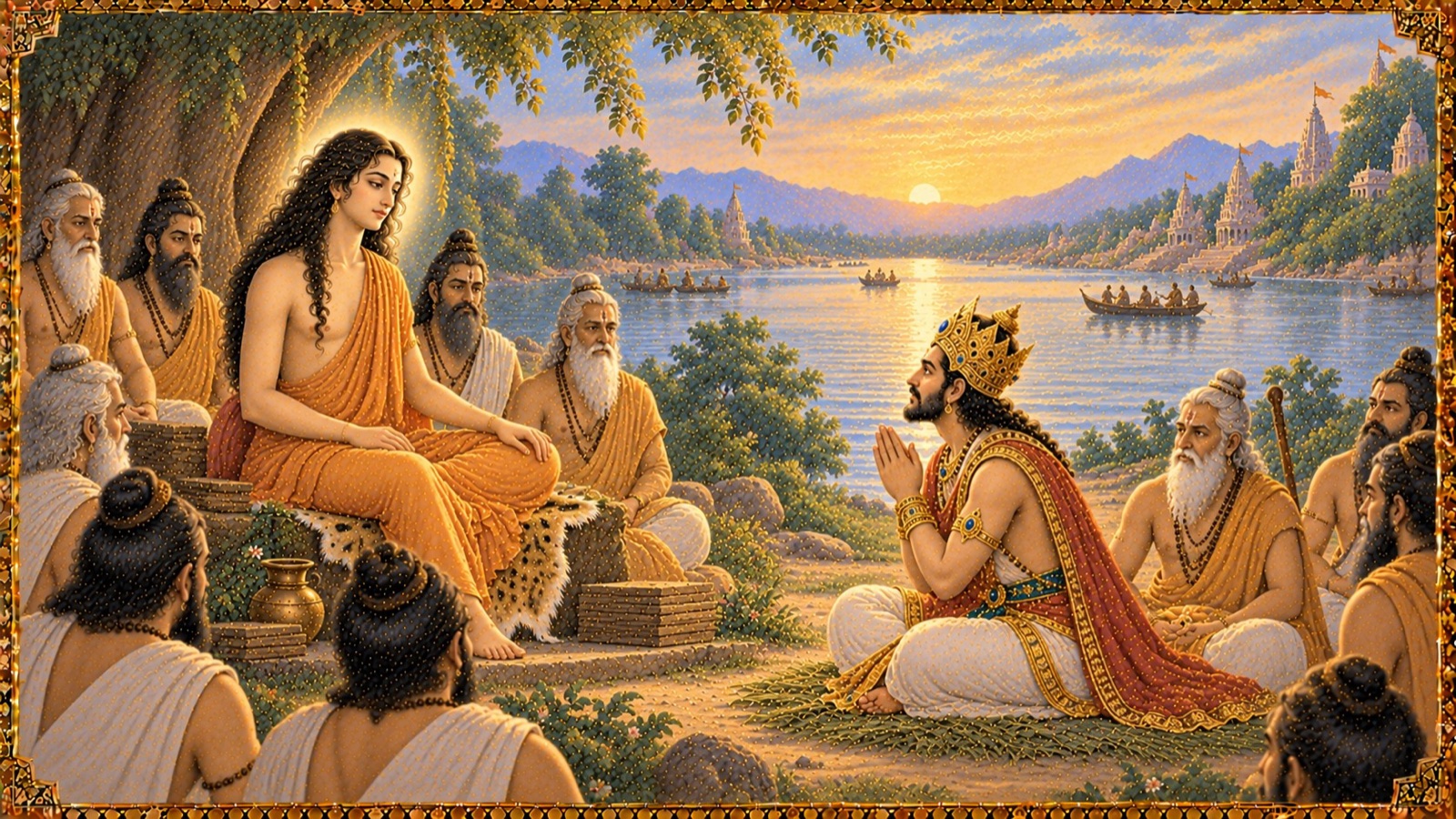
Seated in honour beside the Ganga, the young sage Sukadeva Goswami begins his answer to King Parikshit’s question — the discourse that will become the entire Srimad Bhagavatam.
Om Namo Bhagavate Vasudevaya.
Om Namo Bhagavate Vasudevaya.
Om Namo Bhagavate Vasudevaya.
Welcome to Srimad Bhagavatam Wisdom, a devotional journey through the sacred histories and teachings of the Srimad Bhagavat Mahapurana. With this chapter we cross into the Second Canto, and the answer promised at the end of the First Canto finally begins. King Parikshit, seven days from death, has asked the sage Sukadeva Goswami a single urgent question: what should a person do who is about to die, and what should everyone hear, chant, and remember? Sukadeva’s reply opens here — first with the supreme value of hearing about the Lord, then with a step-by-step path of meditation, and finally with a majestic description of the universe itself as the body of the Lord, the Virat Purusha, the Cosmic Form.
Chapter Information
- Scripture: Śrīmad Bhāgavata Mahāpurāṇa
- Canto: 2 (Book Two) — the opening chapter of the Second Canto
- Chapter: 1 (Discourse 1)
- Chapter title: Sukadeva’s teaching on meditation at the hour of death, culminating in his account of the Lord’s cosmic body, the Virat Purusha
- Principal speakers: Sri Suka (Sukadeva Gosvami), continuing his discourse; King Parikshit, who asks the central question of this chapter
- Principal listener: King Parikshit, and through him the sages of Naimisharanya
- Main setting: the bank of the Ganga, where Parikshit sits fasting in his final days
- Central subject: the supreme value of hearing about the Lord; the yogic path of withdrawing the senses and fixing the mind on the Lord’s form; and the detailed description of the Lord’s cosmic body, the Virat Purusha
- Principal verse range: Canto 2, Chapter 1, verses 1–39
- Primary edition: Gita Press Śrīmad Bhāgavata Mahāpurāṇa
Context from the End of the First Canto
The First Canto closed with King Parikshit, cursed to die within seven days, seated on the bank of the Ganga among the greatest sages of the age. When the young avadhuta Sukadeva Goswami arrived unbidden — self-satisfied, radiant with inner knowledge — the assembled sages rose to honour him, and the king bowed at his feet. There Parikshit asked his question: for a soul on the verge of death, what is left to do? What should all people hear, chant, worship, remember, and avoid? Book One ended with Sukadeva preparing to answer. Book Two — and this chapter — is that answer, begun.
Why Hearing About the Lord Comes First
Sukadeva opens not with technique but with praise for the question itself, telling the king that this enquiry, made for the good of the whole world, is approved by every knower of the Self and foremost among all things worth hearing.
श्रीशुक उवाच वरीयानेष ते प्रश्न: कृतो लोकहितं नृप । आत्मवित्सम्मत: पुंसां श्रोतव्यादिषु य: पर: ॥ १ ॥
śrī-śuka uvāca varīyān eṣa te praśnaḥ kṛto loka-hitaṁ nṛpa ātmavit-sammataḥ puṁsāṁ śrotavyādiṣu yaḥ paraḥ
Meaning: Sri Suka said: This question of yours, O king, made for the welfare of the world, is most excellent. It is approved by the knowers of the Self and is the highest of all subjects worth hearing. (Canto 2, Chapter 1, verse 1)
Ordinary householders, he continues, have a thousand things to occupy their ears — but these are the concerns of people blind to the truth of the Self, whose nights are stolen away by sleep or sensual indulgence and whose days vanish in the pursuit of money and family upkeep. Bound by affection for a body, children, and a wife that are themselves impermanent, such a person fails to see the end already staring back at him. Against this, Sukadeva sets a clear alternative:
तस्माद्भारत सर्वात्मा भगवानीश्वरो हरि: । श्रोतव्य: कीर्तितव्यश्च स्मर्तव्यश्चेच्छताभयम् ॥ ५ ॥
tasmād bhārata sarvātmā bhagavān īśvaro hariḥ śrotavyaḥ kīrtitavyaś ca smartavyaś cecchatābhayam
Meaning: Therefore, O descendant of Bharata, whoever desires to be free of all fear must hear about, glorify, and remember Sri Hari, the Supreme Soul and Lord of all. (Canto 2, Chapter 1, verse 5)
To be reminded of Sri Narayana at life’s final moment, he says, is the one supreme reward of a human birth, whether earned through knowledge, mystic practice, or simple faithfulness to one’s duty. Even the greatest ascetics still delight in discoursing on the glories of Sri Hari.
Sukadeva shares something personal: he studied this very Purana, sacred as the Vedas, from his own father, the sage Dvaipayana Vyasa, at the end of the Dvapara age — and though already established in the Absolute, his heart was captured afresh by the pastimes of Sri Krishna. Because Parikshit is a devotee of Lord Vishnu, Sukadeva promises to recite the same Bhagavata to him, for hearing it with faith swiftly awakens disinterested love for Sri Krishna, the Bestower of Liberation. For those weary of this world and for souls already established in union with the Divine alike, the chanting of Sri Hari’s names is declared to be both the means and the goal:
एतन्निर्विद्यमानानामिच्छतामकुतोभयम् । योगिनां नृप निर्णीतं हरेर्नामानुकीर्तनम् ॥ ११ ॥
etan nirvidyamānānām icchatām akuto-bhayam yogināṁ nṛpa nirṇītaṁ harer nāmānukīrtanam
Meaning: O King, the great authorities have settled this: chanting of the Lord’s holy name is a certain and fearless path to success, alike for the renunciate free of all desire, for one still full of worldly longing, and for the yogi seeking self-realisation. (Canto 2, Chapter 1, verse 11)
The Value of a Single Conscious Hour
Sukadeva sharpens the point: what use are long years spent unconsciously, slipping away unnoticed? A single hour, spent with full awareness in pursuit of the highest good, is worth infinitely more. He offers the example of the royal sage Khatvanga, who was told he had only a moment left to live — and in that moment renounced everything and took refuge in Sri Hari, the dispeller of all fear.
Then comes the line that must have struck Parikshit to the heart: Sukadeva reminds him plainly that his own remaining span of life is exactly seven days, and urges him to use that time for his ultimate welfare — a teacher speaking the truth because the king has asked for it.
How to Die Well: The Path of Meditation
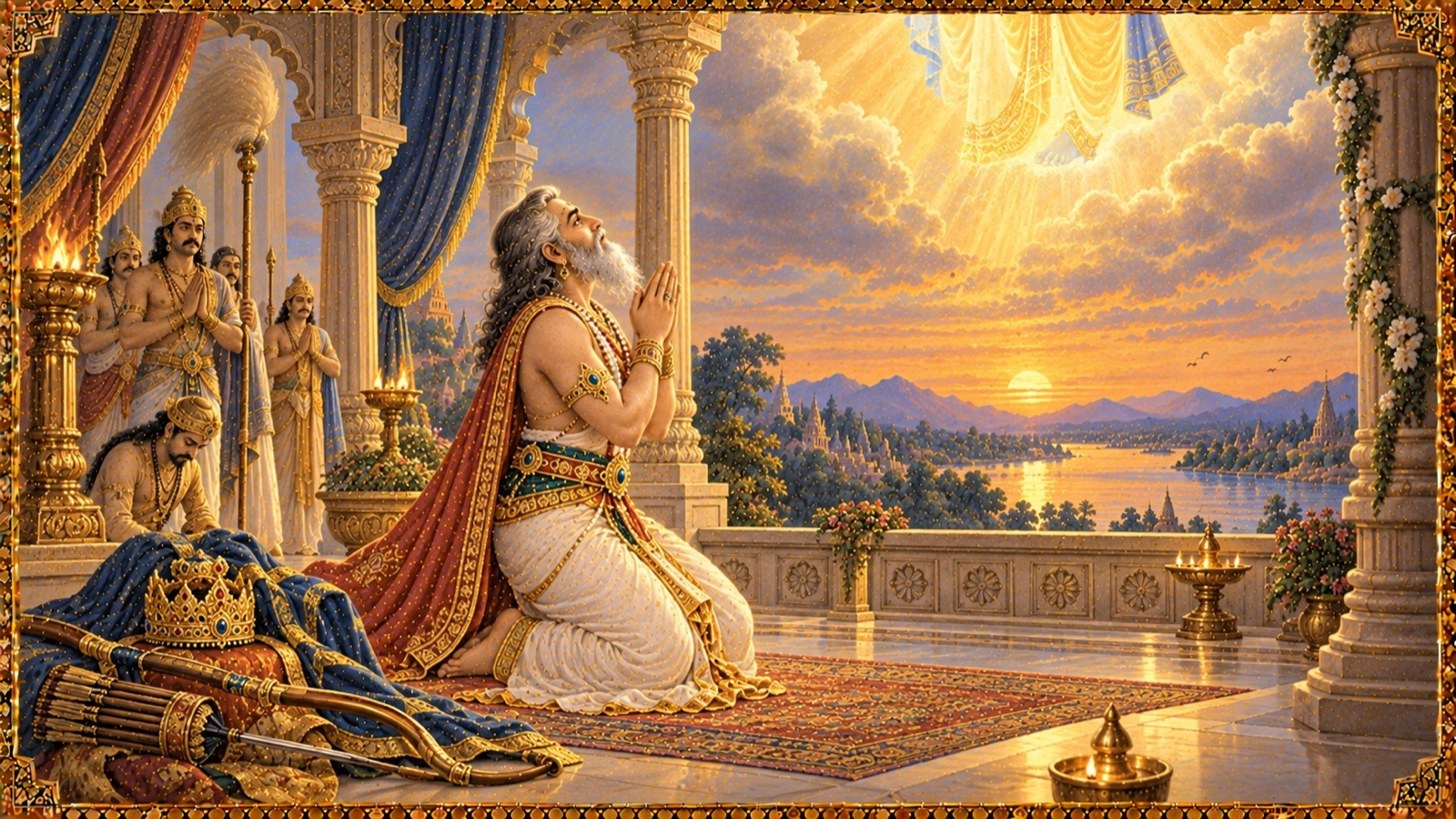
What follows is a compact, practical sadhana. When death’s hour comes, Sukadeva teaches, one should shed all fear and, with the sword of non-attachment, cut the bonds of affection for the body and for those connected to it. Full of self-control, the seeker should leave the household, bathe in sacred waters, and sit in a clean, secluded, properly ordained spot. There, repeating the sacred Pranava — Om, composed of its three parts A, U, and M — and regulating the breath, the mind is drawn inward and steadied.
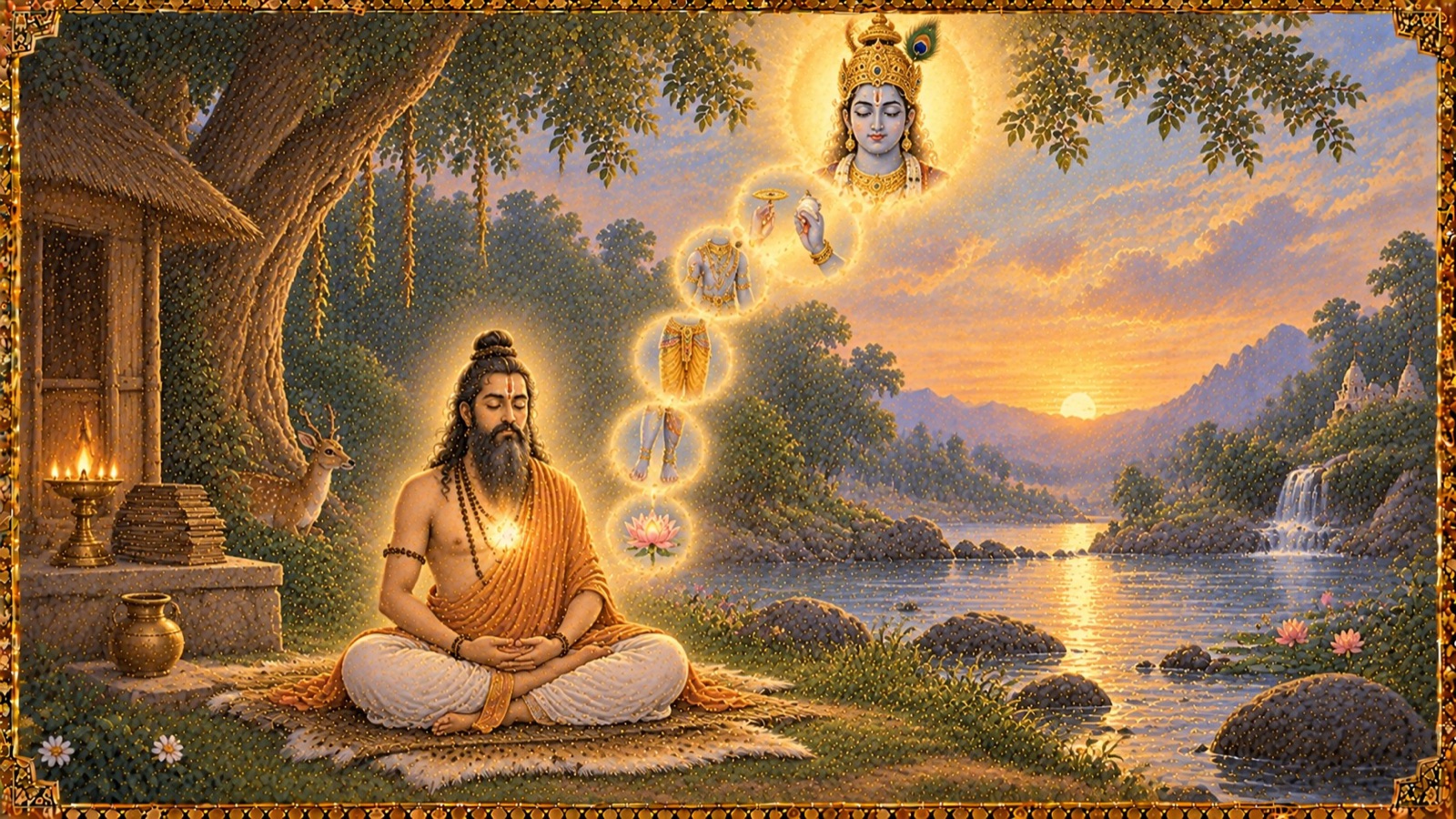
With reason as his guide, the practitioner withdraws the senses from their objects and, little by little, fixes the mind upon the blessed form of the Lord — one limb at a time — until it is so completely absorbed that no other thought can enter. This, Sukadeva says, is the supreme reality of Lord Vishnu, a state in which the mind floods with the ecstasy of divine love. If the mind strays under passion (rajas) or grows clouded by inertia (tamas), the wise practitioner curbs it through steady concentration, which alone dissolves these impurities. When concentration matures, the yogi beholds the blissful object of meditation directly and attains Yoga — union with God — marked by Bhakti, loving devotion.
The King Asks How
Parikshit does not let the matter rest in generalities. He asks precisely the kind of question a sincere seeker asks: on what object, exactly, should this concentration be practiced, and by what method does the mind’s impurity fall away most swiftly?
राजोवाच यथा सन्धार्यते ब्रह्मन् धारणा यत्र सम्मता । यादृशी वा हरेदाशु पुरुषस्य मनोमलम् ॥ २२ ॥
rājovāca yathā sandhāryate brahman dhāraṇā yatra sammatā yādṛśī vā hared āśu puruṣasya mano-malam
Meaning: The king said: O Brahmana, how is this concentration to be held, and upon what object is it approved? And by what kind of concentration is the impurity of the mind swiftly removed? (Canto 2, Chapter 1, verse 22)
Fixing the Mind on the Lord’s Gross Form
श्रीशुक उवाच जितासनो जितश्वासो जितसङ्गो जितेन्द्रिय: । स्थूले भगवतो रूपे मन: सन्धारयेद्धिया ॥ २३ ॥
śrī-śuka uvāca jitāsano jita-śvāso jita-saṅgo jitendriyaḥ sthūle bhagavato rūpe manaḥ sandhārayed dhiyā
Meaning: Sri Suka replied: Having mastered one’s sitting posture and breath, and having conquered attachment and the senses, one should fix the mind, with the aid of reason, upon the gross form of the Lord. (Canto 2, Chapter 1, verse 23)
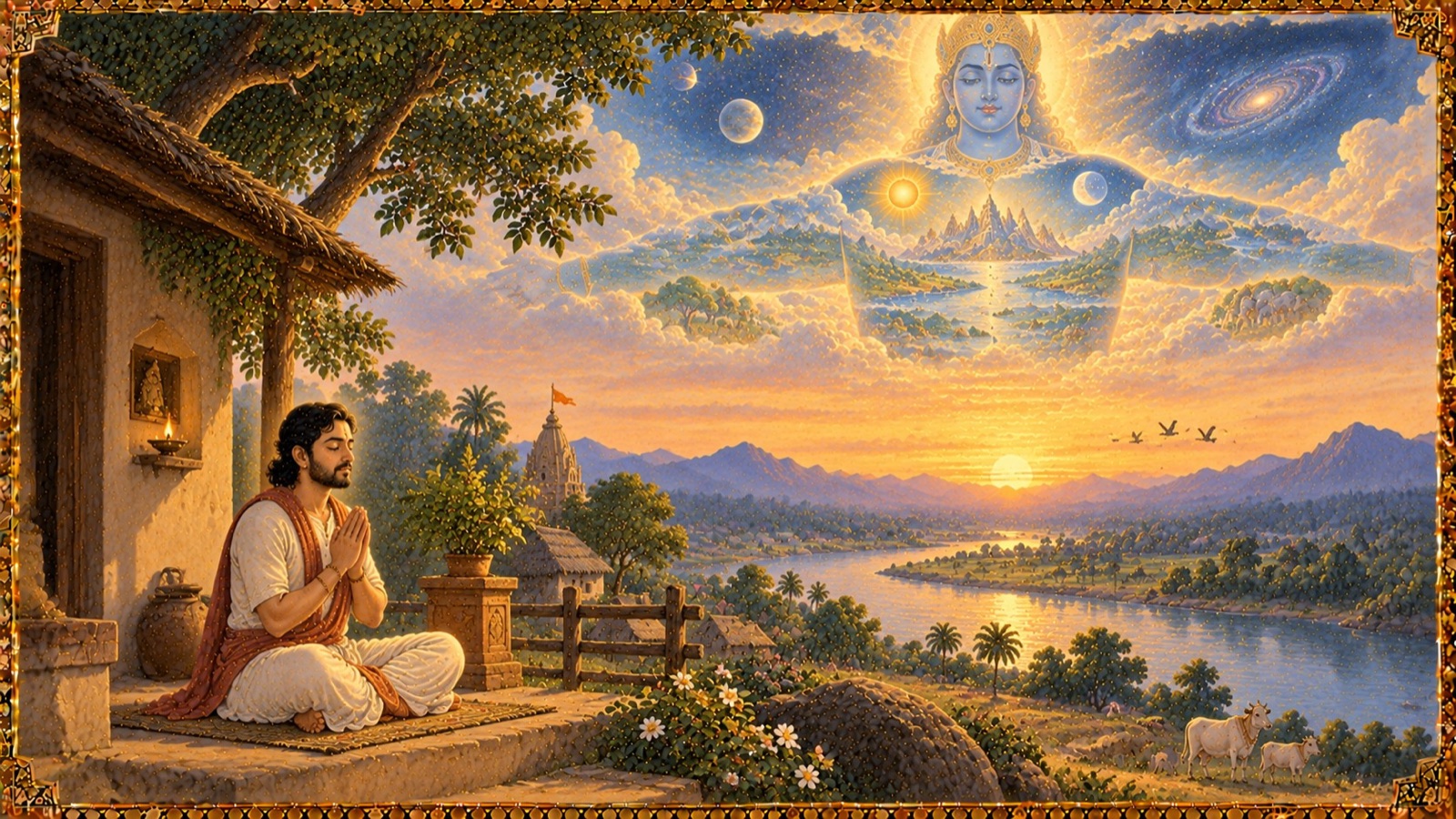
That “gross form,” Sukadeva explains, is the Lord’s cosmic or universal body — the grossest of the gross — in which this entire phenomenal universe is seen in its past, present, and future. Clothed in seven sheaths of primordial elements (water, fire, air, ether, ego, cosmic intelligence, and primordial matter), this Great Being, the Virat Purusha, becomes the object of the seeker’s concentration.
The Cosmic Form: A Universe Described Limb by Limb
What follows is one of the most remarkable passages in the entire Bhagavatam — the universe itself mapped onto the body of the Lord. The netherworld Patala forms the soles of His feet, and the successive subterranean regions rise as His heels, ankles, shanks, knees, and thighs. The surface of the earth is His loins; the sphere just above it, His navel. Indra’s heaven forms His breast, the higher heavens His neck and face, and the topmost heaven, Satyaloka, the crown of His thousand heads.
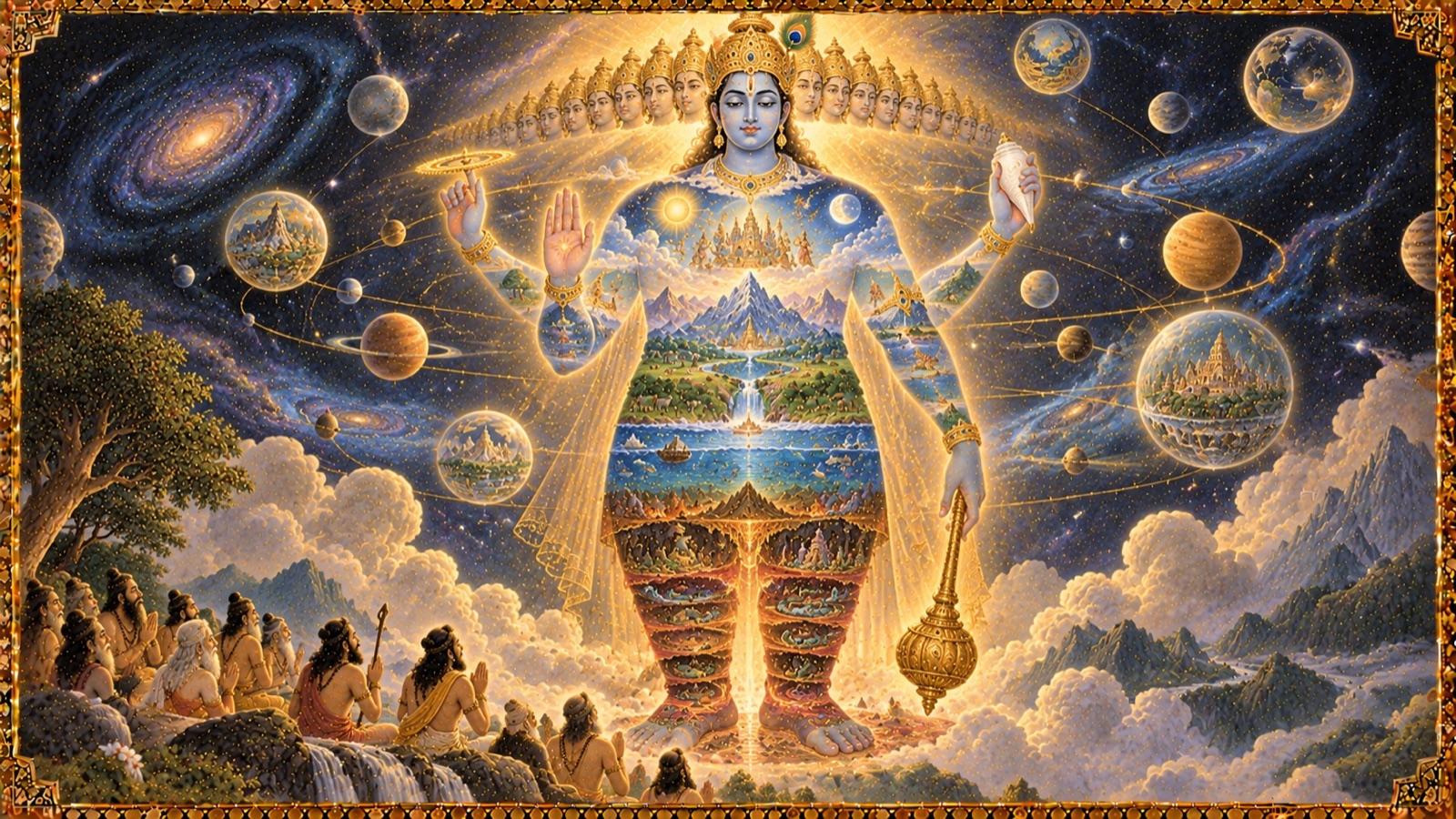
The gods become His arms; the cardinal directions, His ears; sound, His hearing. The Ashwini-kumaras are His nostrils, fragrance His smell, blazing fire His mouth. The sky is His eyes, the sun His sight, day and night His eyelids; the Vedas the crown of His head, Yama His teeth, Maya’s illusion His smile. Modesty is His upper lip, greed the lower; piety His breast, unrighteousness His back; Prajapati His generative power, the oceans His abdomen, the mountains His bones.
The rivers are His veins, the trees His hair, the wind His breath, Time His movement. The clouds are the hair of His head, twilight His raiment, the moon His mind. The great principle of matter is His awareness, and Rudra is His sense of self; the horse, mule, camel, and elephant are His nails, and the wild beasts of the forest rest at His waist. Manu is His intellect, humanity His dwelling; the varied beauty of birds shows His artistry, the singing Gandharvas and Vidyadharas voice His mastery of rhythm, and even the armies of the demons display nothing but His own matchless strength. The Brahmana is His mouth, the Kshatriya His arms, the Vaishya His thighs, the Shudra His feet. Every sacrifice offered to the various deities is, in truth, His own occupation — for there is no deity, offering, or worshipper apart from Him.
Having laid out this magnitude, Sukadeva draws the essential conclusion: it is upon this grossest, most tangible form that the reasoning mind is first to be concentrated, for nothing exists apart from it. And just as a dreamer sees himself projected into countless shapes within a single dream, it is the one all-witnessing Self who experiences everything through the intellects of all beings. The seeker, therefore, should devote himself wholly to that one embodiment of Truth, the storehouse of bliss, without attachment to anything else — for such attachment alone is the cause of the soul’s fall.
स सर्वधीवृत्त्यनुभूतसर्व आत्मा यथा स्वप्नजनेक्षितैक: । तं सत्यमानन्दनिधिं भजेत नान्यत्र सज्जेद् यत आत्मपात: ॥ ३९ ॥
sa sarva-dhī-vṛtty-anubhūta-sarva ātmā yathā svapna-janekṣitaikaḥ taṁ satyam ānanda-nidhiṁ bhajeta nānyatra sajjed yata ātma-pātaḥ
Meaning: He alone is the Self, witnessed through every mode of intelligence in all beings, just as a person sees many things projected within his own dream. One should worship Him alone, the true storehouse of bliss, and not become attached to anything else, for such attachment causes the fall of the soul. (Canto 2, Chapter 1, verse 39)
With this verse the chapter closes. “Thus ends the first discourse in Book Two,” reads the colophon, “describing among other things the Cosmic Body of the Great Being, of the great and glorious Bhagavata-Purana, otherwise known as the Paramahamsa-Samhita.”
Principal Teachings of This Chapter
1. Hearing about the Lord is the highest of all things worth hearing. Amid the countless subjects that occupy the human mind, Sukadeva places the stories and names of Sri Hari above all others (verses 1–11).
2. A single conscious moment outweighs a lifetime of forgetfulness. Khatvanga’s example shows that even the barest instant, rightly used, secures the soul’s liberation (verses 12–13).
3. Meditation is a practical, learnable discipline. Steady posture, regulated breath, withdrawn senses, and a mind fixed patiently on the Lord’s form, limb by limb, form a concrete path (verses 16–21).
4. The whole universe is already His body. The Virat Purusha teaching reveals that earth, sky, ocean, mountain, and heaven were always the limbs of the one Being the mind is trying to reach (verses 25–37).
5. Nothing lies outside Him, so nothing else deserves the heart’s attachment. The closing verse makes the point explicit: clinging to anything apart from Him is the cause of the soul’s fall (verse 39).
A Devotional Reflection
There is something quietly reassuring in the order Sukadeva chooses. He does not begin with cosmic grandeur; he begins with an ordinary observation — that our nights are spent in sleep, our days in earning, and our years slip by while we remain blind to what actually matters. Only after naming that common forgetfulness does he offer the cure: hear about the Lord, remember Him, and when the mind is ready, learn to see Him everywhere, beginning with the ground beneath your feet. The Cosmic Form is not an abstraction reserved for advanced yogis; it is a teaching that the earth we walk on, the rivers we drink from, and the breath in our lungs already belong to one living, divine Being. To remember this, even for the length of an unhurried breath today, is to begin exactly where Sukadeva told Parikshit to begin — with a mind gathered and turned toward God.
A Daily Devotional Practice
Set aside a few quiet minutes today. Sit comfortably, let the breath settle, and gently withdraw your attention from the day’s noise, as Sukadeva describes in this chapter. Then, softly repeat the holy name, “Om Namo Bhagavate Vasudevaya,” and for a moment simply consider: the sky above you, the earth beneath you, the air you are breathing — all of it resting within the one Cosmic Form described in this chapter. Let that remembrance, however brief, be your offering for the day.
Conclusion
The first chapter of the Second Canto is where Sukadeva’s promised answer truly begins. He opens by placing the hearing of the Lord’s glories above every other pursuit, sharpens the point with Khatvanga’s single conscious hour, and lays out the discipline that gradually draws the senses inward and steadies the mind upon the Lord’s form. When Parikshit asks precisely how this is done, Sukadeva answers with the majestic teaching of the Virat Purusha — the universe described, world by world and limb by limb, as the body of the Divine. The chapter closes on a note of practical wisdom: since nothing exists apart from Him, the seeker’s task is simply to stop looking elsewhere. What began as a dying king’s question becomes the doorway into the whole of the Bhagavatam’s teaching on God, the universe, and the self.
May the divine wisdom of Srimad Bhagavatam awaken pure devotion within our hearts.
Om Namo Bhagavate Vasudevaya.
Jay Shree Madhav.
References and Attribution
- Primary edition: Gita Press, Śrīmad Bhāgavata Mahāpurāṇa (English, complete), Book Two, Discourse 1, pages 85–89.
- Series: Srimad Bhagavatam Wisdom · Biswa Sanatan Dharma Seva Trust.
- Presented following the spiritual guidance and recommendation of Pandit Dr. Shri Kashinath Mishra.
This is an original, faithful retelling in the writer’s own words, with brief quoted verses shown in Devanāgarī and transliteration and their meanings given as summaries. It is not a reproduction of any single publisher’s continuous translation or commentary. No affiliation with or endorsement by any publisher is implied.
Jay Shree Madhav