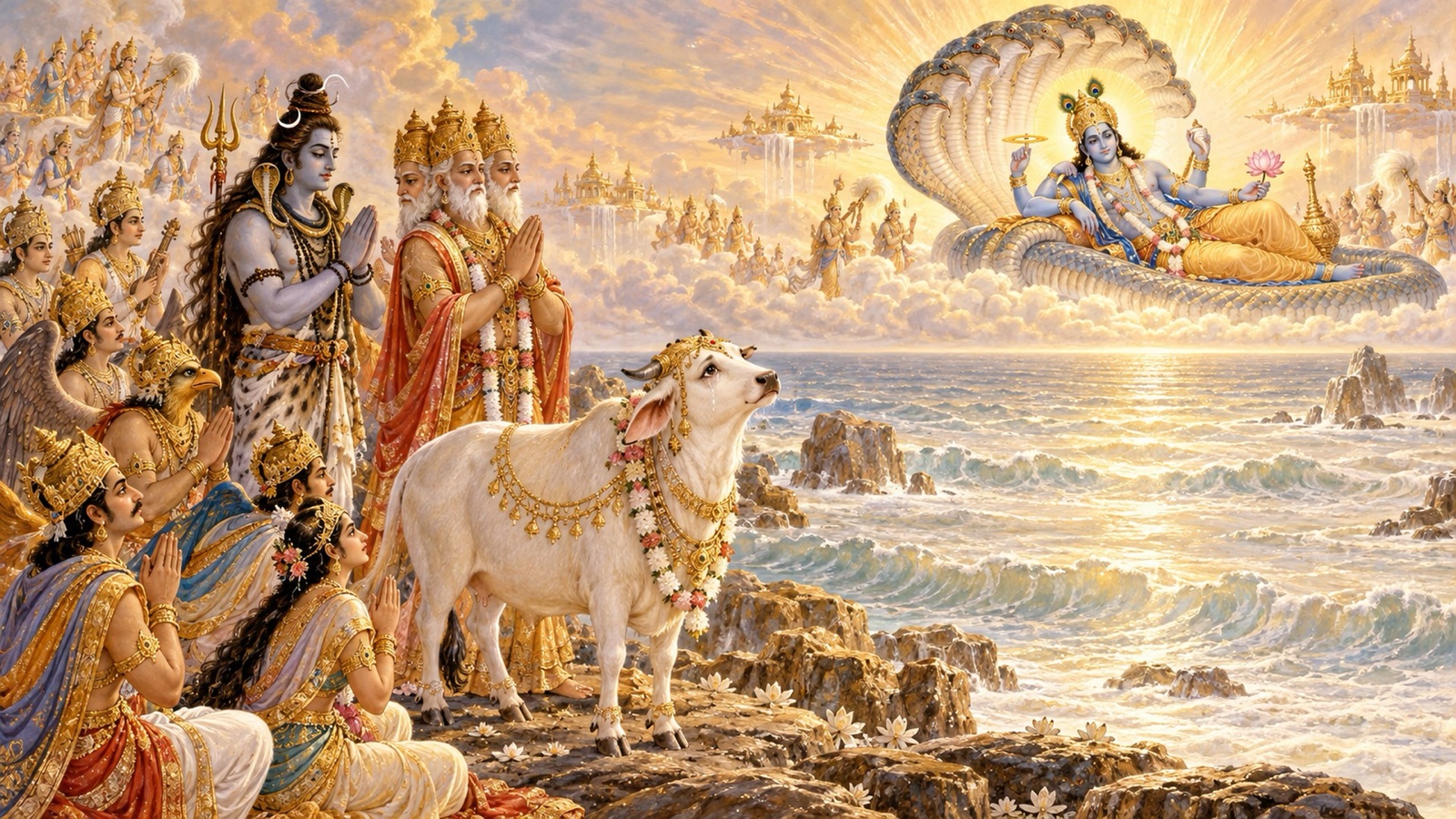
Oppressed beyond bearing, Mother Earth takes the form of a weeping cow and appeals to the gods — and from the shore of the Ocean of Milk comes the promise that will change the history of the world: the Supreme Lord Himself will descend.
Om Namo Bhagavate Vasudevaya.
Om Namo Bhagavate Vasudevaya.
Om Namo Bhagavate Vasudevaya.
Welcome to Srimad Bhagavatam Wisdom, a devotional journey through the sacred histories and teachings of the Srimad Bhagavat Mahapurana. With this chapter we arrive at the very heart of the entire scripture: the Tenth Canto, the Book that recounts the descent, life, and pastimes of Lord Sri Krishna Himself. King Parikshit, who has heard the histories of the solar and lunar dynasties from the sage Sukadeva, can wait no longer — he begs to hear the story of the Lord who appeared in the line of Yadu. Sukadeva, delighted, begins at the beginning: the earth groaning under the weight of arrogant kings, the gods’ prayer at the Ocean of Milk, the promise of the Lord’s advent, and the dark opening act of that advent in the prison-city of Mathura, where the tyrant Kamsa waits to destroy every child born to Devaki. This first chapter sets the stage for everything that follows.
Chapter Information
- Scripture: Śrīmad Bhāgavata Mahāpurāṇa
- Canto: 10 (Book Ten, First Half)
- Chapter: 1 (Discourse 1)
- Chapter title: The Advent of Lord Krishna Foretold
- Principal speakers: Sukadeva Gosvami (narrating to King Parikshit); King Parikshit (asking the opening questions) — the whole related by Suta Gosvami to the sages at Naimisharanya
- Principal listener: King Parikshit (within Sukadeva’s narration); the sage Saunaka and the assembly at Naimisharanya (hearing it from Suta)
- Main setting: The riverside where Sukadeva instructs the fasting King Parikshit; within the narrative, the Ocean of Milk, and the city of Mathura, capital of the Yadus
- Central subject: Mother Earth’s appeal, the gods’ prayer and the Lord’s promise to descend, the wedding of Vasudeva and Devaki, the heavenly omen of Kamsa’s death, and Kamsa’s imprisonment of the couple and destruction of their sons
- Principal verse range: Canto 10, Chapter 1, verses 1–69
- Primary edition: Gita Press Śrīmad Bhāgavata Mahāpurāṇa
Parikshit’s Longing to Hear of Krishna
The Tenth Canto opens not with a narrator’s flourish but with a devotee’s hunger. King Parikshit, seated at the feet of Sukadeva and fasting unto death upon the bank of the Ganga, tells the sage that he has already heard the vast history of the solar and lunar dynasties, and the wonderful deeds of the pious Yadus. Now, he pleads, recount the exploits of Lord Vishnu who descended in that very line together with Sri Balarama. He reminds Sukadeva how the Lord, using His own person as a raft, carried the Pandavas across the ocean of the Kaurava army, and how the Lord entered the womb of his own mother Uttara, discus in hand, to shield the unborn Parikshit from the fiery missile of Ashwatthama. Who, the king asks, other than a killer of animals, could ever turn away from the recital of such glories?
निवृत्ततर्षैरुपगीयमानाद्भवौषधाच्छ्रोत्रमनोऽभिरामात् । क उत्तमश्लोकगुणानुवादात्पुमान् विरज्येत विना पशुघ्नात् ॥ ४ ॥
nivṛtta-tarṣair upagīyamānād bhavauṣadhāc chrotra-mano-‘bhirāmāt ka uttamaśloka-guṇānuvādāt pumān virajyeta vinā paśughnāt
Meaning: Sung by those freed from all craving, a very medicine for the disease of worldly existence, delightful to both the ear and the mind — who, other than one who would slaughter animals, could turn away from the recital of the glories of the Lord of sacred renown? (Canto 10, Chapter 1, verse 4)
Parikshit then asks a series of questions that will shape the entire Canto: How was Balarama, known as the son of Rohini, connected with the womb of Devaki? Why did Krishna move to Vraja from His father’s home? What did He do in Vraja and in Mathura? Why did He personally slay Kamsa, His own mother’s cousin? How many years did He dwell among the Vrishnis, and how many were His wives? Sustained, he says, by drinking the nectar of Sri Hari’s story flowing from Sukadeva’s lips, he no longer feels even the pangs of his fast. Suta tells the sages of Naimisharanya that Sukadeva, complimenting the king on so worthy a question, replied that an inquiry into the story of Lord Vasudeva purifies all three — the reciter, the questioner, and the listener — just as water that has touched the Lord’s feet hallows all it meets.
The Cry of Mother Earth
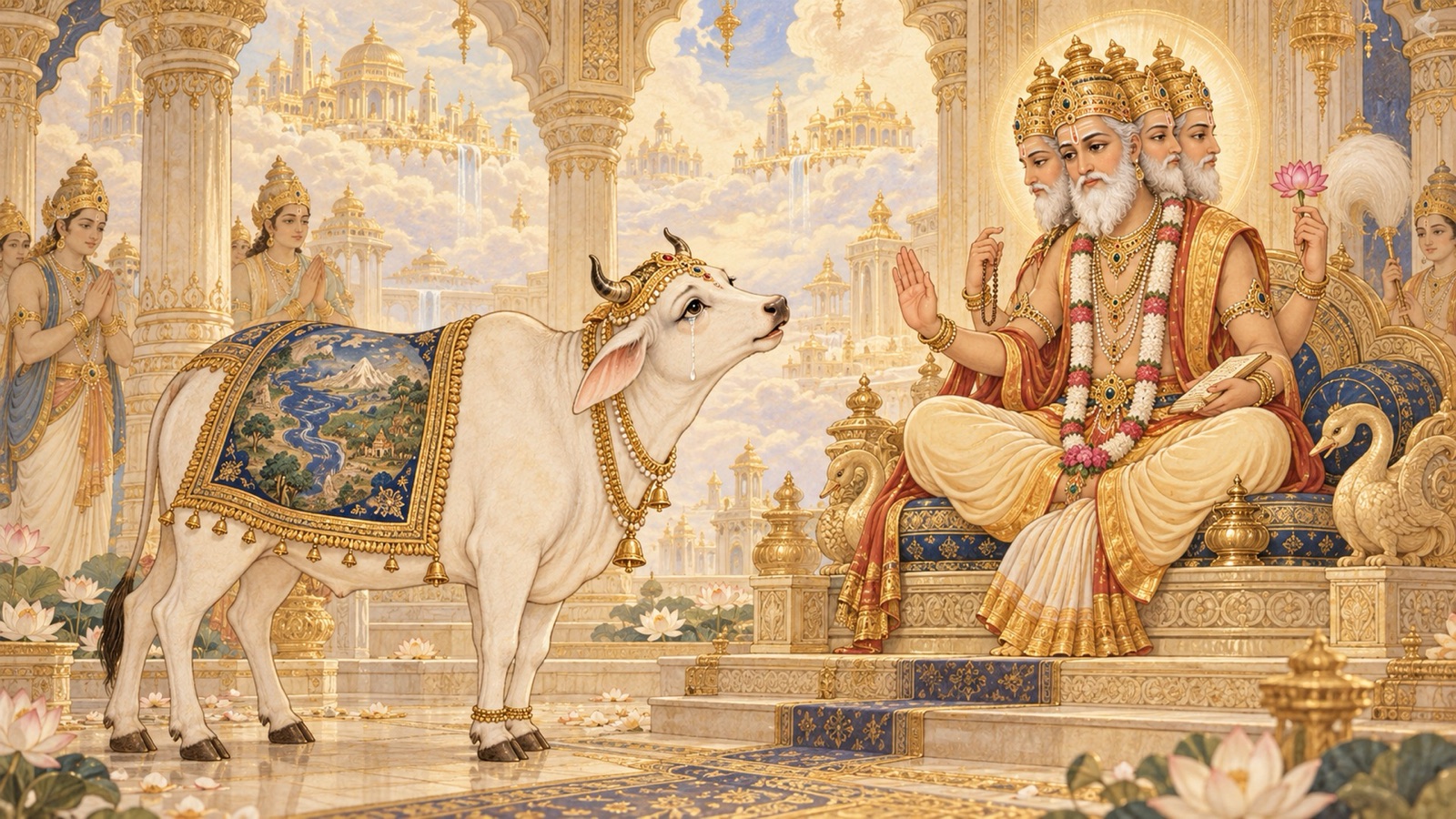
To explain why the Lord chose to descend, Sukadeva begins with the suffering of the earth herself. Oppressed beyond endurance by countless armies of Daityas who had taken birth as arrogant, overbearing kings, Mother Earth assumed the form of a disconsolate cow. With her face wet with tears, lowing piteously, she sought the presence of Brahma, the creator, and laid her distress before him. Understanding her calamity, Brahma set out at once, accompanied by Lord Shiva and the other gods, for the shore of the Ocean of Milk — the abode where Lord Vishnu reclines — taking Mother Earth with him.
The Prayer at the Ocean of Milk and the Lord’s Promise
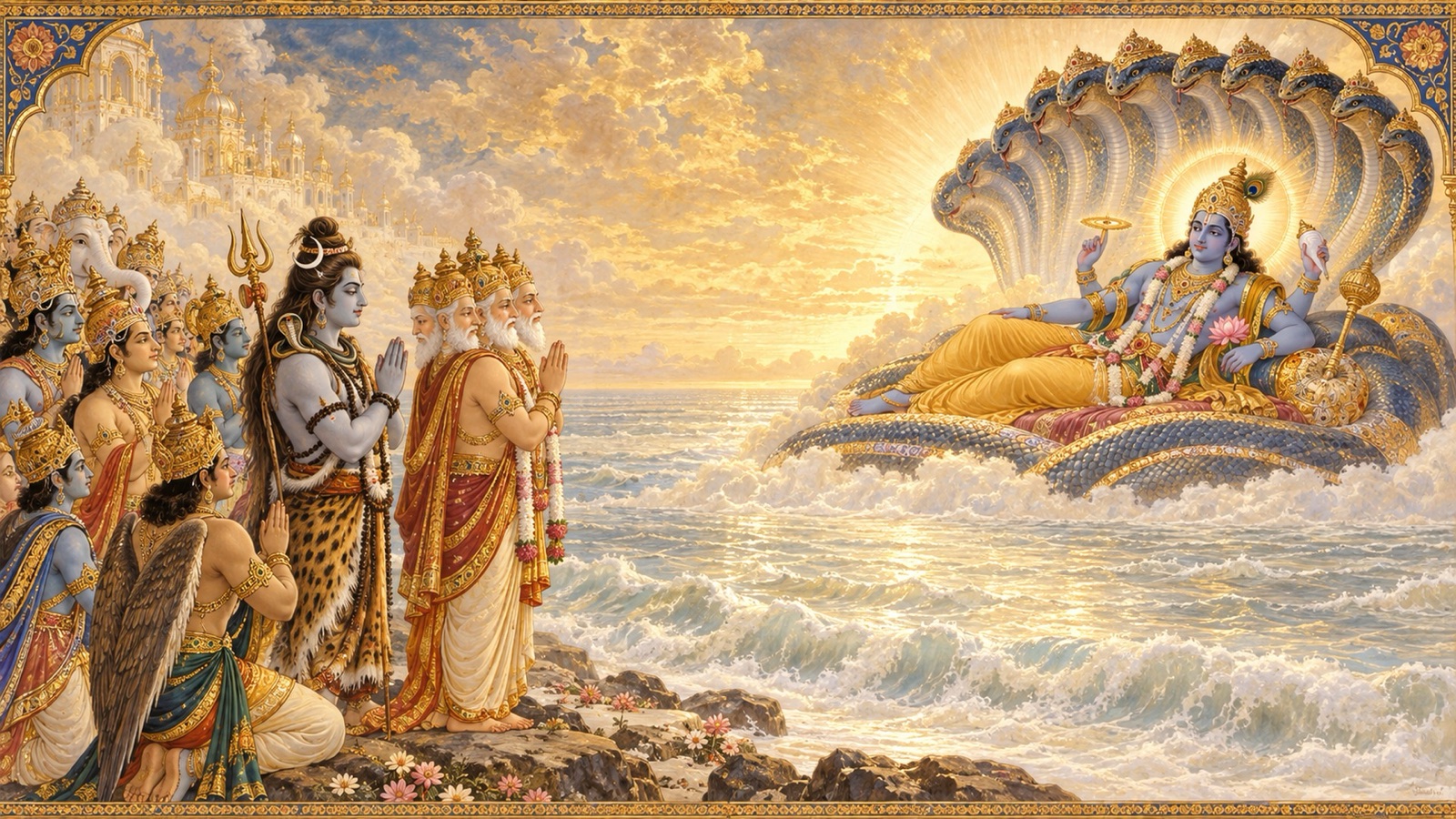
Arriving at the milk-ocean and fully collected in mind, Brahma prayed to Lord Vishnu, the Supreme Person, in the words of the Purusha-Sukta, the celebrated Vedic hymn. Absorbed in a trance, he heard a voice sound from the sky, and then relayed its message to the assembled gods: the Supreme Person already knows the affliction of Mother Earth; let the gods therefore take birth in part among the Yadus and remain there until the Lord Himself walks the earth to relieve her burden through His own energy in the form of Time. The Lord Vishnu Himself, the voice declared, will be manifested in the house of Vasudeva.
वसुदेवगृहे साक्षाद् भगवान्पुरुष: पर: । जनिष्यते तत्प्रियार्थं सम्भवन्तु सुरस्त्रिय: ॥ २३ ॥
vasudeva-gṛhe sākṣād bhagavān puruṣaḥ paraḥ janiṣyate tat-priyārthaṁ sambhavantu sura-striyaḥ
Meaning: The Supreme Person, Lord Vishnu Himself, will appear directly in the house of Vasudeva; therefore let celestial women also take birth for His pleasure. (Canto 10, Chapter 1, verse 23)
The voice added that the thousand-headed, self-effulgent Lord Ananta — Shesha, a part manifestation of the Lord — would precede Him as His elder brother, and that the divine Maya of Lord Vishnu, by whom the whole universe stands enchanted, would also be born in part to accomplish His work. Having thus directed the hosts of gods and reassured Mother Earth, Brahma returned to his own abode.
The Wedding of Vasudeva and Devaki
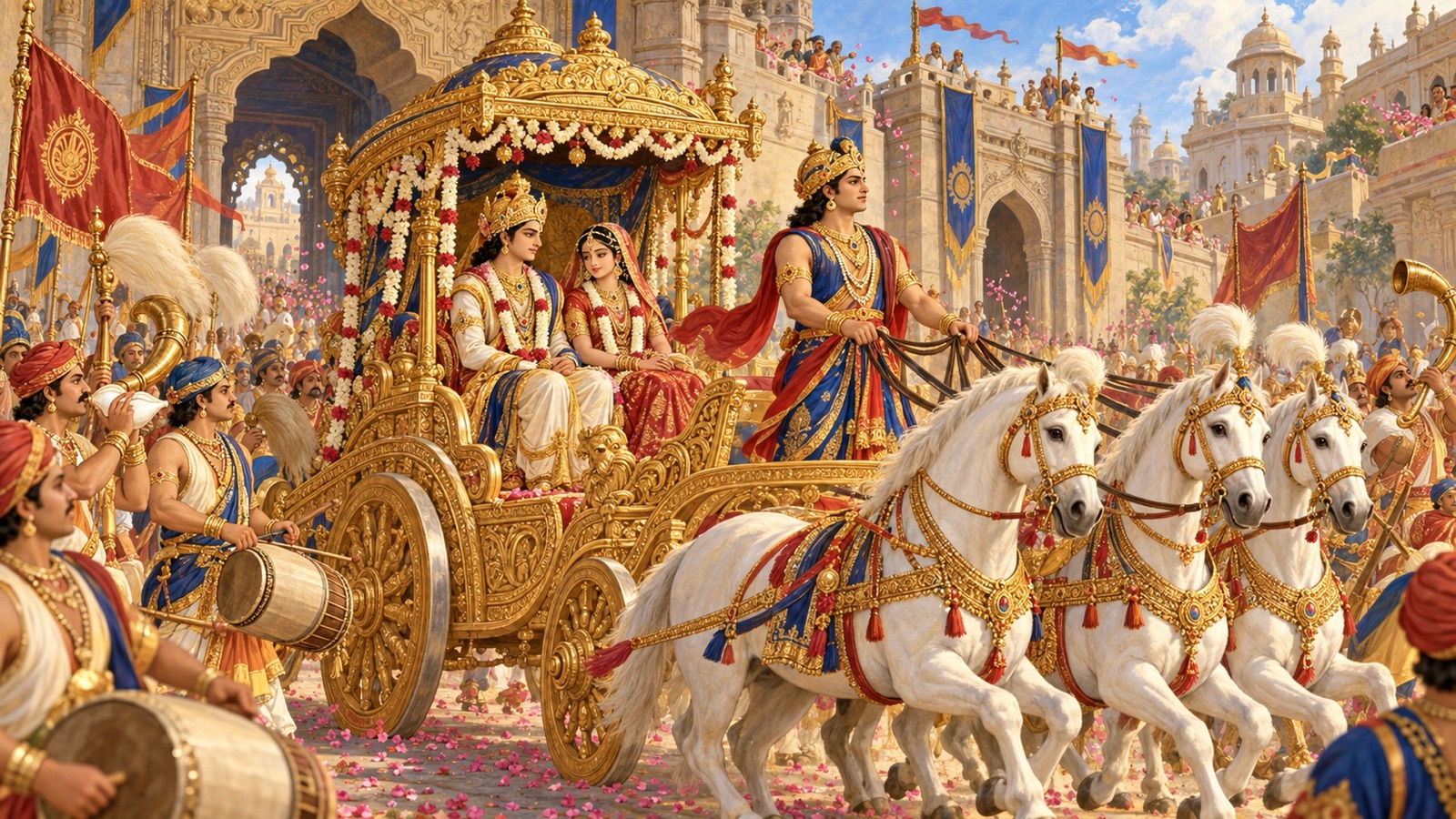
Sukadeva now turns to Mathura, the ancient capital of the Yadus, ruled long ago by Surasena and ever hallowed by the presence of Sri Hari. In that city Vasudeva, son of Sura, was married to Devaki. As the newly wedded couple departed by chariot, Prince Kamsa — the son of King Ugrasena — himself took up the reins to drive the horses, doing this to please his cousin Devaki. Devaka, Devaki’s father, so fond of his daughter, gave her a splendid dowry: four hundred elephants adorned with gold necklaces, fifteen thousand horses, eighteen hundred chariots, and two hundred graceful, richly ornamented serving-maids. As the joyful procession set out, conches, clarionets, drums, and kettledrums all sounded together in a most auspicious welcome.
The Voice From Heaven
The auspicious moment was shattered by a warning from the unseen. As Kamsa drove the chariot along the road, an incorporeal voice addressed him from the sky.
पथि प्रग्रहिणं कंसमाभाष्याहाशरीरवाक् । अस्यास्त्वामष्टमो गर्भो हन्ता यां वहसेऽबुध ॥ ३४ ॥
pathi pragrahiṇaṁ kaṁsam ābhāṣyāhāśarīra-vāk asyās tvām aṣṭamo garbho hantā yāṁ vahase ‘budha
Meaning: Addressing Kamsa, who held the reins on the way, the bodiless voice said: “O foolish one, the eighth child of this very girl whom you are now conducting will be your slayer.” (Canto 10, Chapter 1, verse 34)
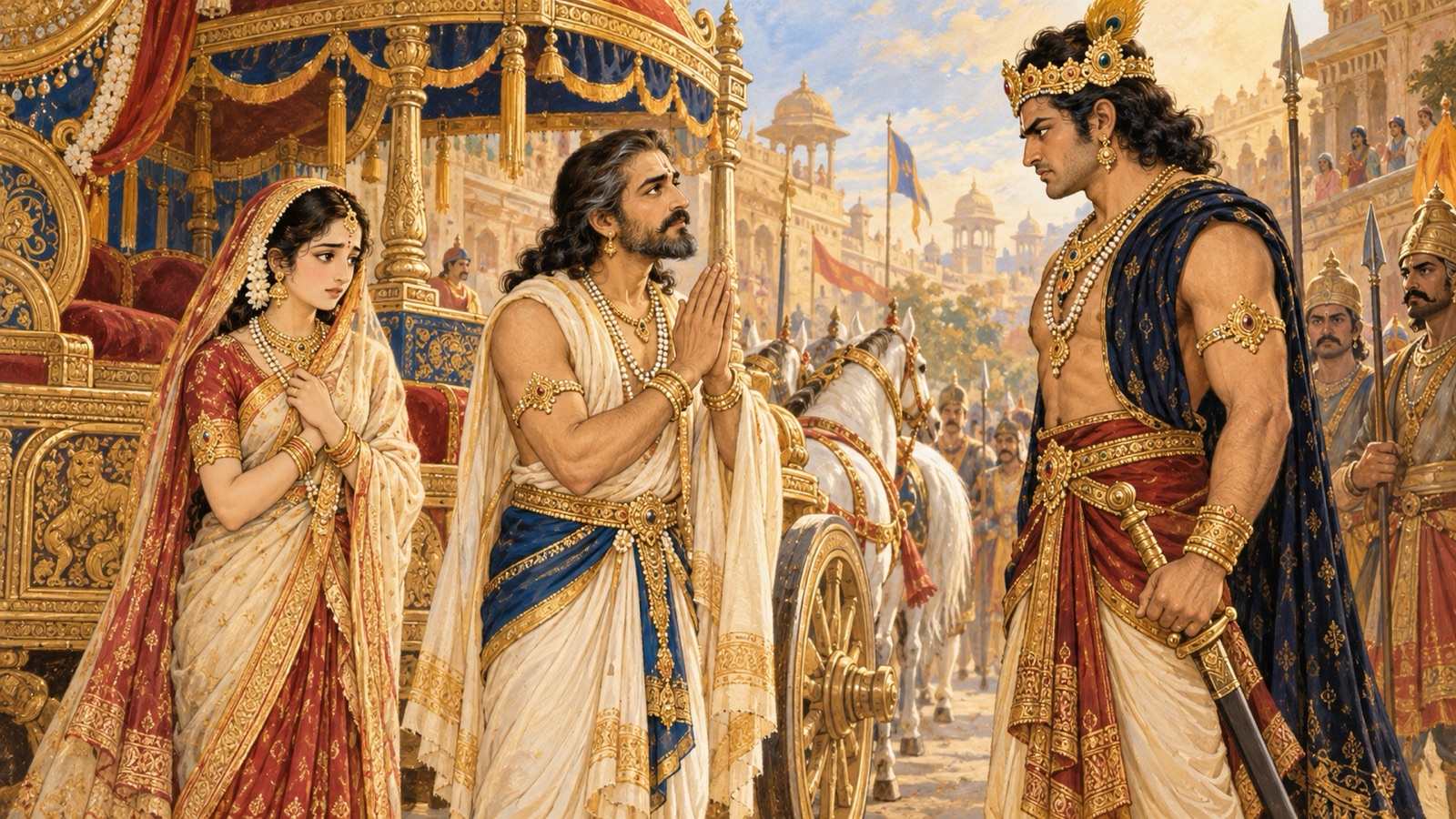
Hearing this, Kamsa — a disgrace to the Bhoja line, wicked and cruel by nature — at once seized his cousin by the hair and, sword in hand, made ready to kill her then and there. It was Vasudeva who stepped between them, pleading with that hard-hearted man to spare his bride.
Vasudeva’s Plea and the Teaching on Death
Vasudeva’s appeal is one of the great short teachings of the Bhagavatam. How, he asked, could a hero praised for his virtues and the glory of the Bhojas slay a helpless woman — his own cousin — on the very festival of her wedding? Then he turned to a deeper truth: death, he said, is born together with every creature that is born.
मृत्युर्जन्मवतां वीर देहेन सह जायते । अद्य वाब्दशतान्ते वा मृत्युर्वै प्राणिनां ध्रुव: ॥ ३८ ॥
mṛtyur janmavatāṁ vīra dehena saha jāyate adya vābda-śatānte vā mṛtyur vai prāṇināṁ dhruvaḥ
Meaning: O valiant one, for all who are born, death is born along with the body. Whether it comes this very day or at the end of a hundred years, death is certain for every living being. (Canto 10, Chapter 1, verse 38)
The embodied soul, Vasudeva explained, leaves one body only when it has taken hold of another — as a walking man moves his second foot only after the first is set down, or as a caterpillar reaches the next blade of grass before releasing the one it clings to. Just as a dreamer or one lost in longing identifies with the form his mind dwells upon, so the soul, impelled by destiny, passes into the body toward which its mind flows. Therefore, he urged, a person who seeks his own welfare should never do harm to any creature, for wrongdoing returns upon the wrongdoer. This girl, he pleaded, is like a daughter to Kamsa; a man kind to the helpless should not kill her on her wedding day.
A Father’s Terrible Bargain
Kamsa, heartless and following the ways of ogres, would not relent. Seeing this, Vasudeva — also called Anakadundubhi — resolved upon an expedient. A wise man, he reasoned within himself, should ward off death as long as his intelligence and strength endure; and if death cannot be turned back, no blame attaches to the one who tried. He would promise to hand over to Kamsa every son that Devaki might bear; her life would be spared now, and the loss of the sons was only a future possibility — for Kamsa might yet die first, or the children never be born, since the ways of Providence are hard to fathom. With a smiling face but an aching heart, Vasudeva praised the tyrant and offered him this bargain: there is no danger to you from this girl; it is her sons you fear, and those I shall deliver to you. Kamsa, knowing Vasudeva to be truthful, ceased from killing Devaki, and Vasudeva returned home.
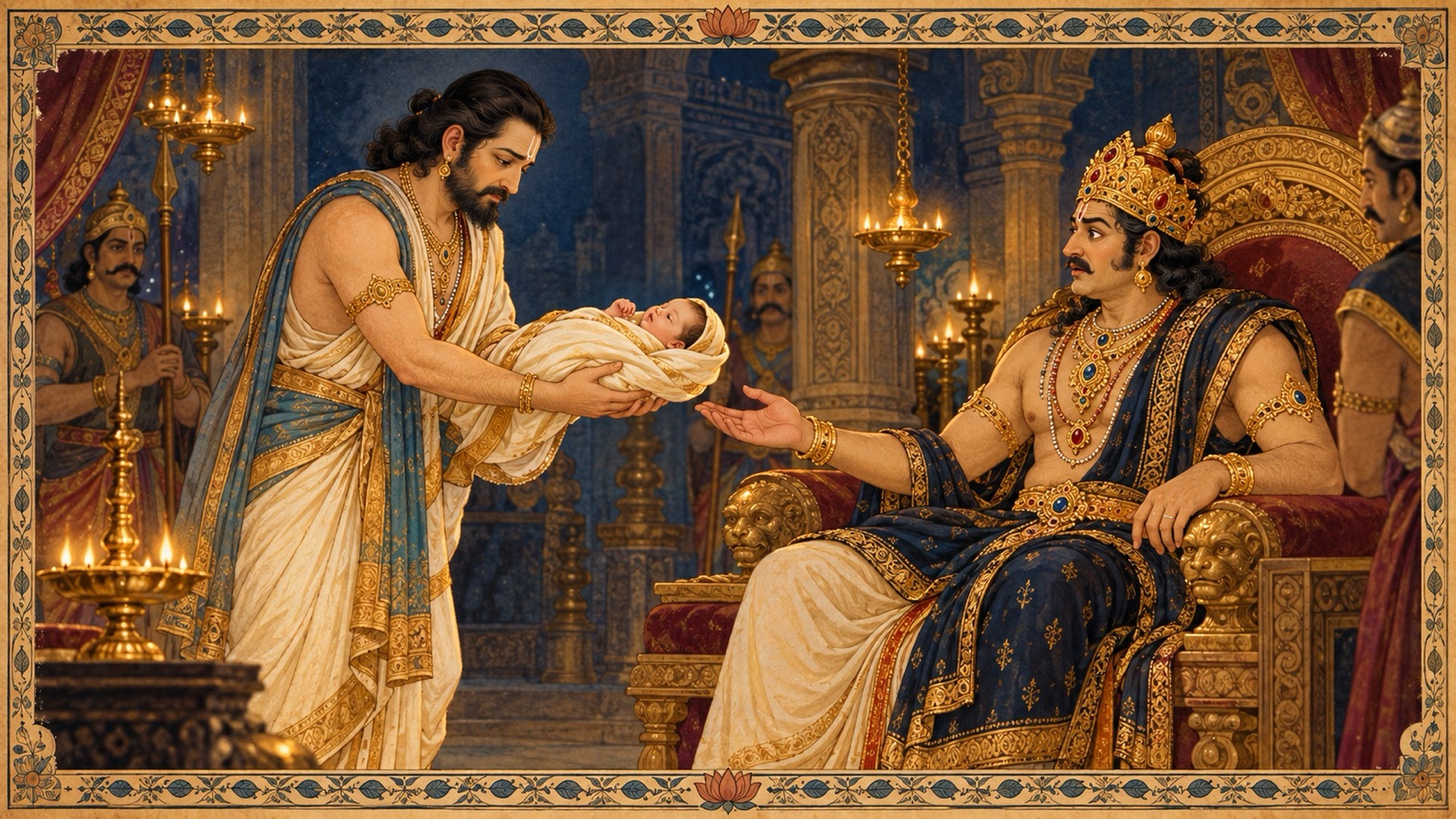
In the course of time Devaki, who bore all the gods within her, gave birth to eight sons and one daughter, one every year. Faithful to his dreadful promise and abhorring falsehood above all, Vasudeva carried his first-born son, named Kirtiman, to Kamsa. For what is unbearable to the righteous, Sukadeva asks, or difficult to give up for those who have taken Sri Hari into their hearts? Astonished at Vasudeva’s equanimity and unshakable devotion to truth, Kamsa for the moment relented, saying, “Let this child return to you; I have no fear from him. My death has been decreed at the hands of your eighth child.” Vasudeva took the boy back, but he did not rejoice, for he did not trust the words of the wicked king.
Narada’s Visit and Kamsa’s Descent Into Cruelty
The uneasy peace did not last. The sage Narada came of his own accord to Kamsa and revealed to him that the cowherds of Vraja led by Nanda, together with their wives, the Vrishnis led by Vasudeva, and the Yadava women led by Devaki — indeed all the kinsmen and friends of both households — were for the most part gods themselves, and that the gods were labouring to remove the Daitya burden from the earth. Believing now that the Yadus were gods and that Vishnu would appear from Devaki’s womb to slay him, Kamsa bound both Devaki and Vasudeva in fetters within their own residence, and put to death each of their sons as he was born, suspecting each to be the Lord. Greedy monarchs bent on their own gratification, Sukadeva observes, will kill even father, mother, and brothers. Knowing himself to have been, in a former life, the great demon Kalanemi slain by Vishnu, Kamsa set himself in open enmity against the Yadus. He even imprisoned his own father, Ugrasena, lord of the Yadus, Bhojas, and Andhakas, and seized the rule of the Surasena kingdom for himself.
उग्रसेनं च पितरं यदुभोजान्धकाधिपम् । स्वयं निगृह्य बुभुजे शूरसेनान् महाबल: ॥ ६९ ॥
ugrasenaṁ ca pitaraṁ yadu-bhojāndhakādhipam svayaṁ nigṛhya bubhuje śūrasenān mahā-balaḥ
Meaning: Having imprisoned even his own father Ugrasena, the ruler of the Yadus, Bhojas, and Andhakas, the mighty Kamsa himself seized and enjoyed the kingdom of Surasena. (Canto 10, Chapter 1, verse 69)
With this the stage is fully set: a groaning earth, a promised deliverer, and a tyrant so terrified of prophecy that he turns his own capital into a prison. Into this darkness the Lord is about to descend.
Principal Teachings of This Chapter
1. Hearing about the Lord purifies everyone it touches. Sukadeva assures Parikshit that an inquiry into the story of Lord Vasudeva sanctifies the speaker, the questioner, and the listener alike — the very act of turning our attention to Krishna is purifying (verses 15-16).
2. The Lord descends to relieve the burden of the world. Krishna’s advent is not arbitrary; it answers the cry of Mother Earth, oppressed by the arrogance of the powerful. The Lord appears to protect the righteous and lighten the load of the earth (verses 17-25).
3. Death is certain, and the soul is never destroyed. Vasudeva’s plea contains the essence of the Gita: whatever is born must die, and the soul simply passes from one body to another according to its destiny (verses 38-43).
4. Do no harm, for wrongdoing returns upon the doer. Because every soul faces the fear of death, one who seeks true welfare should never injure another; violence rebounds upon the violent (verse 44).
5. Devotion to truth can be unshakable even at the greatest cost. Vasudeva, abhorring falsehood, keeps his terrible promise and hands over his firstborn — a portrait of steadfastness that even his enemy cannot help but admire (verses 55-58).
A Devotional Reflection
It is striking that the Book most beloved for Krishna’s sweetness begins in a prison. Before we ever meet the child of Vrindavana, we are shown the weight of a suffering world and the cruelty of a frightened king. Perhaps that is exactly the point. The Lord does not descend into an easy world but into a broken one — into fetters, fear, and grief — and it is there, in the darkest cell of Mathura, that the light will be born. Vasudeva’s steadiness through it all is its own quiet teaching: he neither abandons truth to save his sons nor curses the God who has not yet come. He simply does the next right thing, again and again, trusting that “the ways of Providence are hard to comprehend.” When our own lives feel like a locked room, this chapter reminds us that the Lord’s advent often begins precisely where hope seems most impossible.
A Daily Devotional Practice
Today, before beginning any anxious or difficult task, pause and remember Vasudeva’s faith that “what is imminent may turn away, and what has turned away may appear again.” Whatever you cannot control, entrust it gently to the Lord, and then simply do the next honest thing before you. Sit for a moment in stillness and repeat: “Om Namo Bhagavate Vasudevaya.” Let that name — the very name of the house into which the Lord chose to be born — steady your heart amid uncertainty.
Conclusion
The first chapter of the Tenth Canto is the doorway into the whole life of Lord Sri Krishna. It gives us the reason for His coming — the appeal of Mother Earth and the prayer of the gods — and the human drama into which He will be born: the wedding of Vasudeva and Devaki, the chilling prophecy that the eighth child will slay Kamsa, and the tyrant’s descent into fear, imprisonment, and cruelty. Sukadeva has set every piece in place, from the promise at the Ocean of Milk to the fetters in the palace of Mathura. All that remains is for the Lord Himself to appear. As we stand at the threshold of Krishna’s advent, we carry with us Vasudeva’s example of unbroken faith and Parikshit’s unquenchable thirst to hear of the Lord.
May the divine wisdom of Srimad Bhagavatam awaken pure devotion within our hearts.
Om Namo Bhagavate Vasudevaya.
Jay Shree Madhav.
References and Attribution
- Primary edition: Gita Press, Śrīmad Bhāgavata Mahāpurāṇa (English, complete), Book Ten (First Half), Discourse 1.
- Series: Srimad Bhagavatam Wisdom · Biswa Sanatan Dharma Seva Trust.
- Presented following the spiritual guidance and recommendation of Pandit Dr. Shri Kashinath Mishra.
This is an original, faithful retelling in the writer’s own words, with brief quoted verses shown in Devanāgarī and transliteration and their meanings given as summaries. It is not a reproduction of any single publisher’s continuous translation or commentary. No affiliation with or endorsement by any publisher is implied.
Jay Shree Madhav