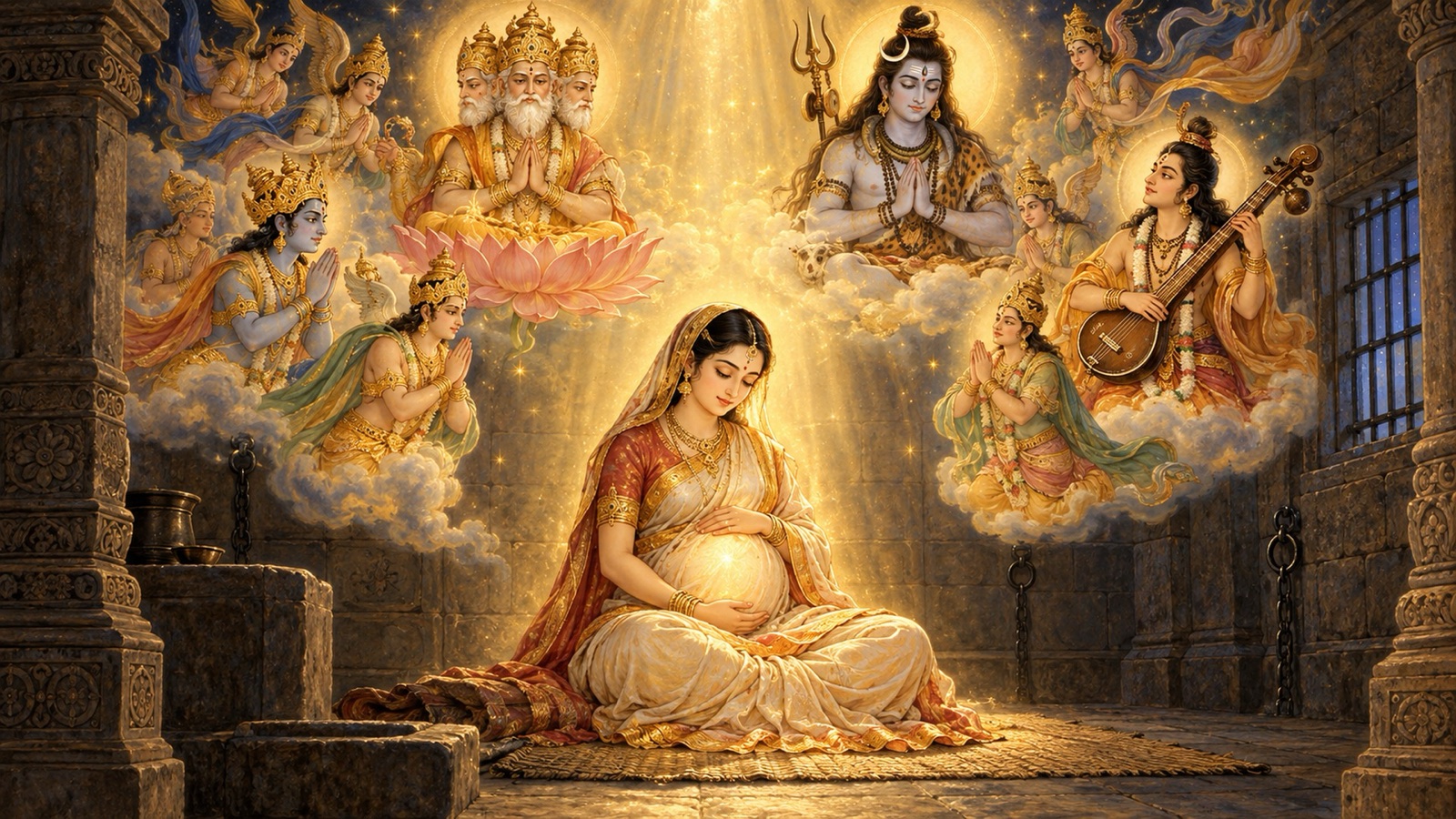
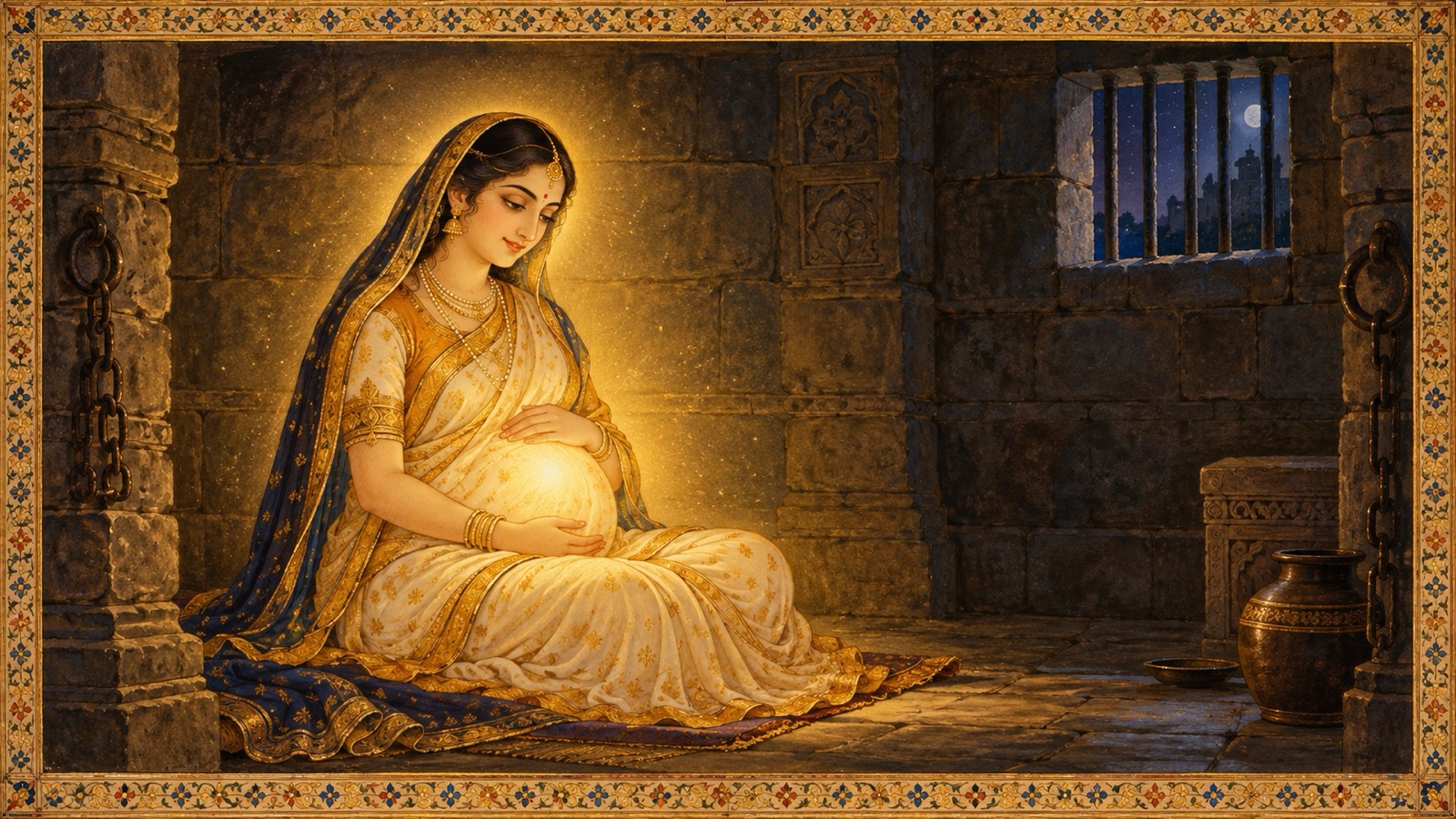
As the Lord takes His place within the womb of Devaki, the imprisoned mother shines like a flame enclosed in a jar — and Brahma, Shiva, Narada, and all the gods gather to sing one of the most beautiful prayers in all of scripture.
Om Namo Bhagavate Vasudevaya.
Om Namo Bhagavate Vasudevaya.
Om Namo Bhagavate Vasudevaya.
Welcome back to Srimad Bhagavatam Wisdom, our devotional journey through the sacred histories and teachings of the Srimad Bhagavat Mahapurana. In the previous chapter the stage was set for the Lord’s descent: Mother Earth’s appeal, the promise at the Ocean of Milk, and the tyranny of Kamsa, who imprisoned Vasudeva and Devaki and destroyed their newborn sons. This second chapter carries the story forward to the very threshold of Krishna’s birth. Kamsa’s persecution scatters the Yadus; the Lord’s part-manifestation Ananta enters Devaki’s womb as her seventh child and is mystically transferred to Rohini; and at last the Supreme Lord Himself takes His place within Devaki. When the imprisoned mother begins to shine with an unearthly radiance, Kamsa is seized with dread — and the gods, led by Brahma and Shiva, descend to offer the celebrated prayers known as the Garbha-stuti, the eulogy of the Lord within the womb.
Chapter Information
- Scripture: Śrīmad Bhāgavata Mahāpurāṇa
- Canto: 10 (Book Ten, First Half)
- Chapter: 2 (Discourse 2)
- Chapter title: Prayers of the Gods for the Lord in the Womb
- Principal speaker: Sukadeva Gosvami (narrating to King Parikshit); related in turn by Suta Gosvami to the sages at Naimisharanya
- Principal listener: King Parikshit (within Sukadeva’s narration); the sages assembled at Naimisharanya
- Main setting: The prison-palace of Kamsa in Mathura; the cowherd village of Gokula in Vraja; and the celestial realms from which the gods descend
- Central subject: Kamsa’s persecution of the Yadus, the transfer of the embryo of Ananta (Balarama) to Rohini, the entry of the Supreme Lord into Devaki’s womb, and the prayers of the gods
- Principal verse range: Canto 10, Chapter 2, verses 1–42
- Primary edition: Gita Press Śrīmad Bhāgavata Mahāpurāṇa
Context From the Previous Chapter
In Chapter 1, the burden of the earth under arrogant kings moved the gods to pray at the Ocean of Milk, where the Lord promised to descend in the house of Vasudeva. A heavenly voice warned Kamsa that Devaki’s eighth child would slay him; the terrified king imprisoned the couple, killed their sons one by one, and even usurped the throne of his own father, Ugrasena. This chapter opens with Kamsa’s tyranny at its height.
Kamsa’s Persecution and the Flight of the Yadus
Sukadeva resumes his narration by describing how deeply Kamsa’s cruelty had spread. Allied with Jarasandha, the mighty ruler of Magadha whose two daughters he had married, and supported by a host of demon kings — Pralamba, Baka, Canura, Trnavarta, and the voracious Aghasura, together with Mustika, Arishta, Dvivida, Putana, Kesi, and Dhenuka, and other Daitya rulers led by Bana and Bhauma — the powerful Kamsa set himself to the destruction of the Yadu dynasty.
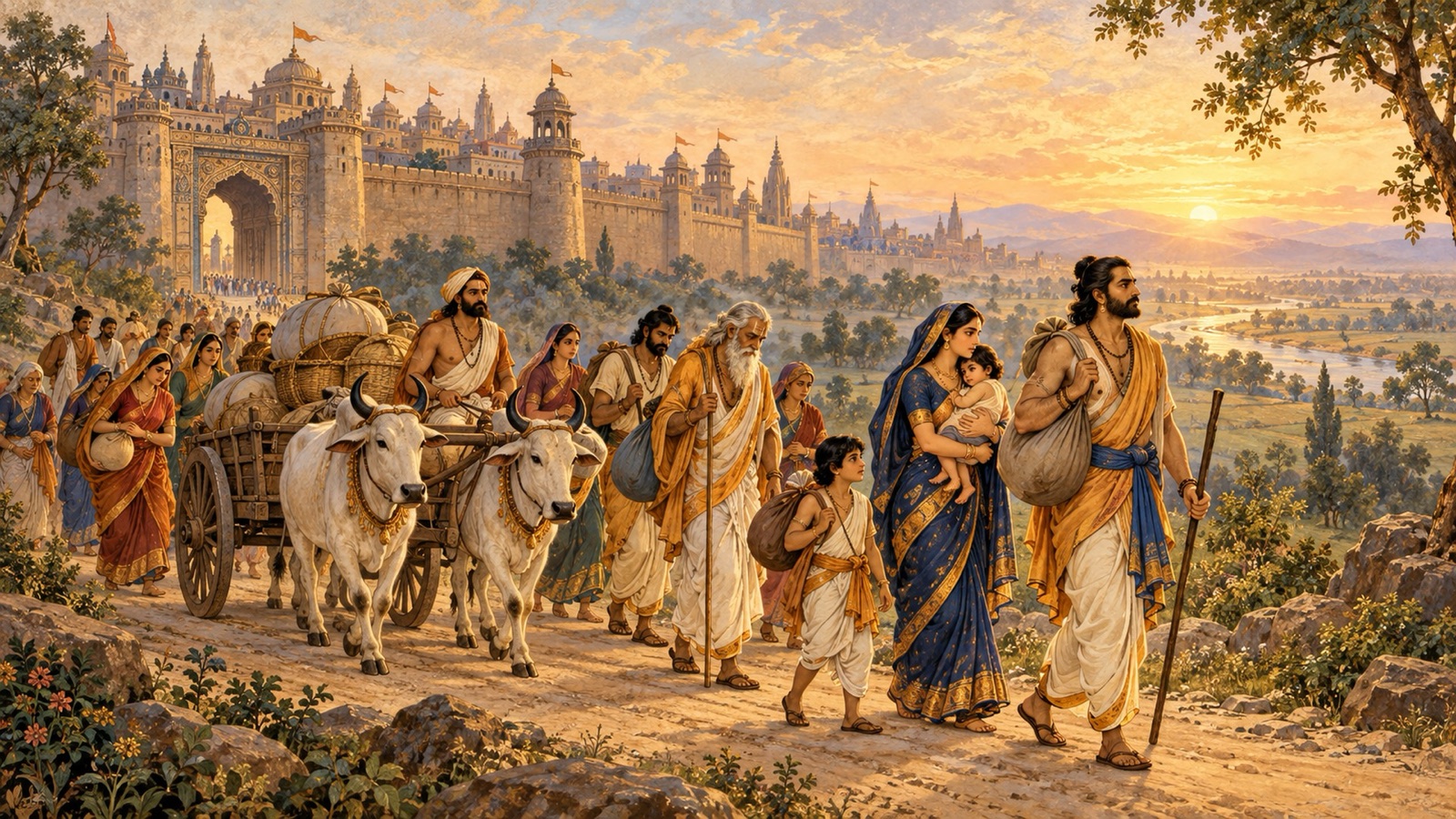
Hard pressed on every side, the Yadus were forced to leave their homes, migrating for safety into the neighbouring kingdoms of the Kurus, Pancalas, Kekayas, Salvas, Vidarbhas, Nishadhas, Videhas, and Kosalas. Yet a faithful few among their kinsmen remained near Kamsa and continued to serve him.
The Seventh Child: Balarama Enters Devaki’s Womb
When six infant sons of Devaki had already been destroyed, a ray of Lord Vishnu — whom the wise speak of as Ananta, the endless one — entered Devaki’s womb as her seventh child, becoming a source of both joy and sorrow to her: joy because the Lord’s own portion now dwelt within her, and sorrow at the memory of the children already lost.
एके तमनुरुन्धाना ज्ञातय: पर्युपासते । हतेषु षट्सु बालेषु देवक्या औग्रसेनिना ॥ ४ ॥ सप्तमो वैष्णवं धाम यमनन्तं प्रचक्षते । गर्भो बभूव देवक्या हर्षशोकविवर्धन: ॥ ५ ॥
hateṣu ṣaṭsu bāleṣu devakyā augraseninā saptamo vaiṣṇavaṁ dhāma yam anantaṁ pracakṣate garbho babhūva devakyā harṣa-śoka-vivardhanaḥ
Meaning: When six of Devaki’s infants had been slain by the son of Ugrasena, the seventh, that abode of Vishnu whom the wise call Ananta, became her embryo, increasing at once her joy and her grief. (Canto 10, Chapter 2, verses 4-5)
The Lord’s Command to Yogamaya
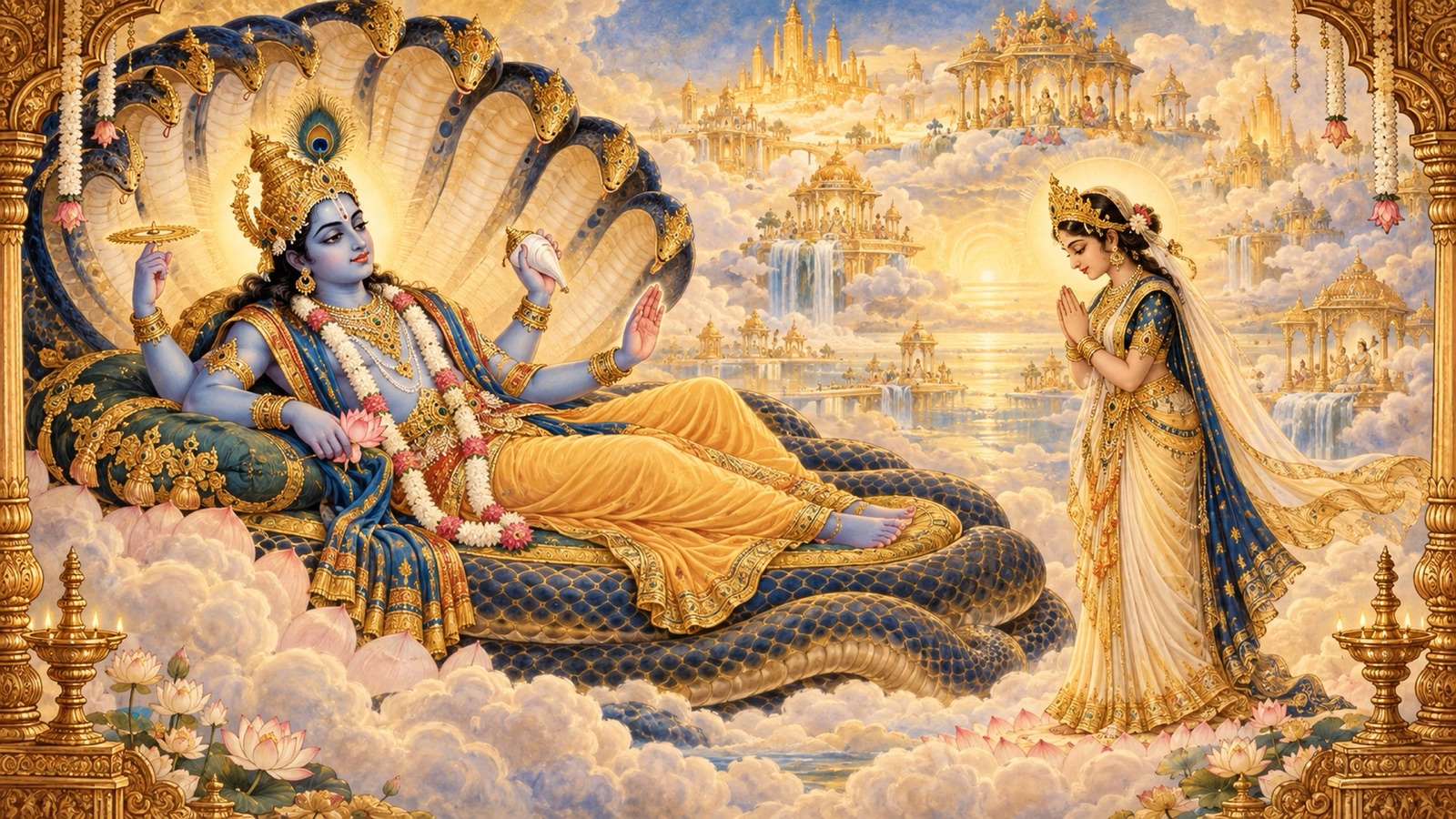
Seeing the fear that Kamsa had struck into the hearts of the Yadus, His own devotees, the Lord, the Soul of the universe, summoned His transcendent creative energy, Yogamaya, and gave her His instructions. “Proceed, O gracious goddess, to Vraja, the land enriched by cowherds and cows. There Rohini, the wife of Vasudeva, is dwelling in the village of Gokula, home of Nanda; and out of fear of Kamsa his other wives too are hiding in secret places.”
Then came the divine plan by which the seventh child would be saved.
देवक्या जठरे गर्भं शेषाख्यं धाम मामकम् । तत् सन्निकृष्य रोहिण्या उदरे सन्निवेशय ॥ ८ ॥
devakyā jaṭhare garbhaṁ śeṣākhyaṁ dhāma māmakam tat sannikṛṣya rohiṇyā udare sanniveśaya
Meaning: Within Devaki’s womb rests My own abode, the part-manifestation known as Shesha; drawing it forth, place it in the womb of Rohini. (Canto 10, Chapter 2, verse 8)
The Lord continued: “Then I Myself, with all My divine potencies, shall become the son of Devaki, O blessed one, while you shall be born of Yasoda, the wife of Nanda.”
अथाहमंशभागेन देवक्या: पुत्रतां शुभे । प्राप्स्यामि त्वं यशोदायां नन्दपत्न्यां भविष्यसि ॥ ९ ॥
athāham aṁśa-bhāgena devakyāḥ putratāṁ śubhe prāpsyāmi tvaṁ yaśodāyāṁ nanda-patnyāṁ bhaviṣyasi
Meaning: Then I, with a portion of My being, shall attain to sonship of Devaki, O blessed lady; and you shall be born of Yasoda, the wife of Nanda. (Canto 10, Chapter 2, verse 9)
The Lord foretold that Yogamaya would be honoured on earth with incense, offerings, and gifts, that people would raise temples to her, and that she would be worshipped under many hallowed names — Durga, Bhadrakali, Vijaya, Vaishnavi, Kumuda, Candika, Krishna, Madhavi, Kanyaka, Maya, Narayani, Ishani, Sarada, and Ambika. He also foretold the names by which Rohini’s son would be known.
गर्भसङ्कर्षणात् तं वै प्राहु: सङ्कर्षणं भुवि । रामेति लोकरमणाद् बलभद्रं बलोच्छ्रयात् ॥ १३ ॥
garbha-saṅkarṣaṇāt taṁ vai prāhuḥ saṅkarṣaṇaṁ bhuvi rāmeti loka-ramaṇād balabhadraṁ balocchrayāt
Meaning: Because he will be drawn from one womb to another, people on earth will call him Sankarshana; because he gives delight to the world, Rama; and because of his surpassing strength, Balabhadra. (Canto 10, Chapter 2, verse 13)
The Transfer of the Embryo
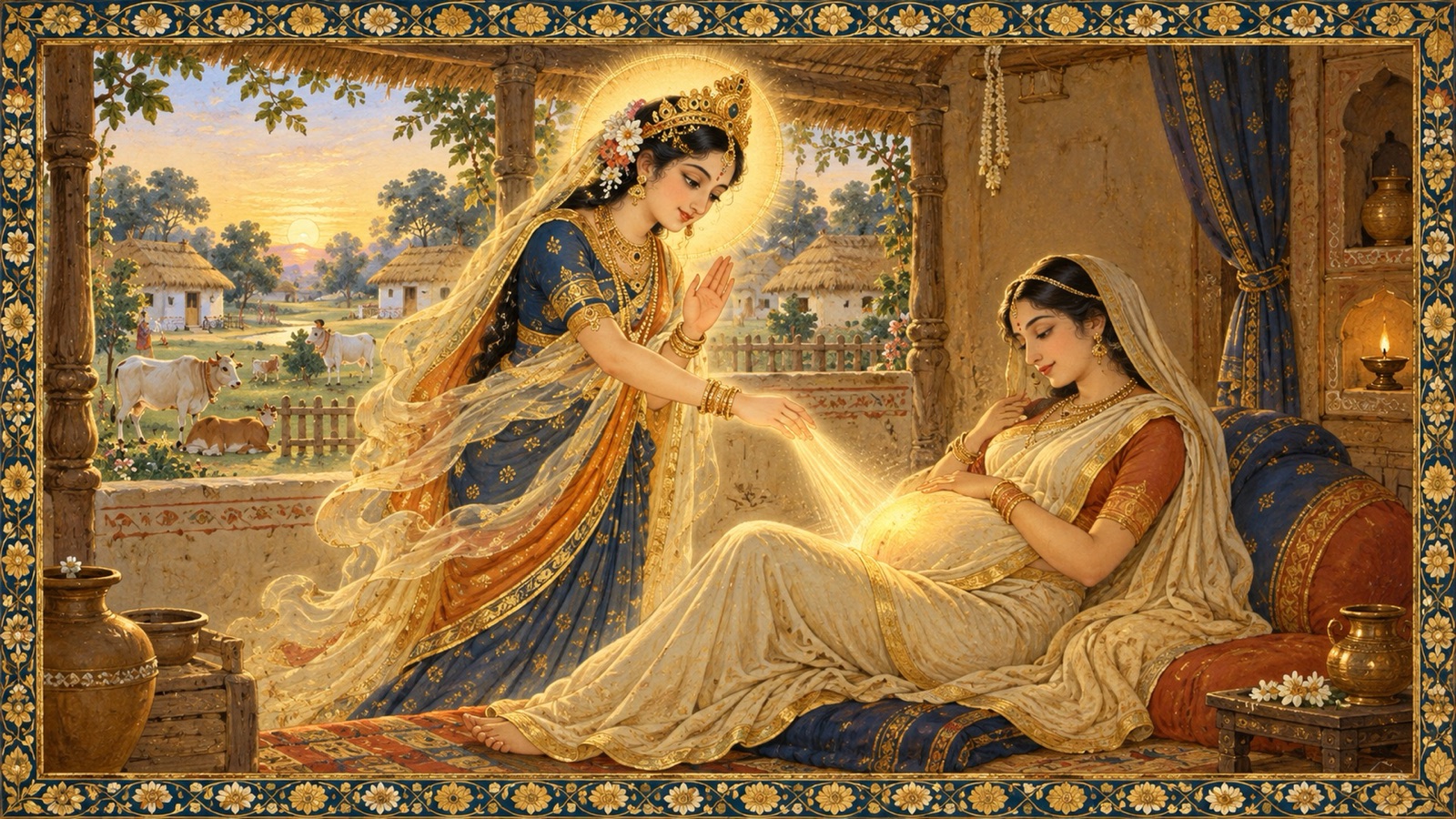
Thus instructed, the goddess accepted the Lord’s command with the words, “So be it,” and, circling Him reverently from left to right, descended to earth and carried out His behest exactly as she had been told. When Yogamaya — who embodies the Lord’s own mystic sleep at the time of universal dissolution — transferred the embryo from the womb of Devaki to that of Rohini, the people of Mathura cried aloud in grief, believing that Devaki’s child had miscarried and perished.
The Lord Enters the Heart of Devaki
Then came the supreme moment. The Lord, the Soul of the universe and the remover of His devotees’ fear, entered the mind of Vasudeva with all His divine potencies. Bearing within himself the glorious presence of Lord Vishnu, Vasudeva shone like the sun and grew so majestic that he became difficult even to look upon. From Vasudeva, as though from a teacher impressing a sacred image upon a disciple’s heart, the Lord passed into the mind of Devaki, just as the eastern horizon receives the rising moon. Devaki, now the very dwelling-place of the Lord who comprises all things, conceived Him within her.
Imprisoned within the four walls of Kamsa’s palace, however, she was like a flame shut inside a jar, or like precious knowledge locked away in the mind of a scholar who shares it with no one — her radiance could not shine forth to gladden the outside world.
Kamsa’s Torment
Kamsa could not fail to notice the change. Seeing Devaki illumine the palace with an uncommon lustre and a serene, bright smile, he said to himself in terror, “Hari, who is destined to take my life, has surely entered her womb, like a lion slipping into a cave — for she was never so radiant before.” He turned the danger over and over in his mind. To strike at the unborn child would be futile, for that child would not withhold His power. Yet to kill Devaki herself — a woman, his own cousin, and now with child — would blast his reputation, his fortune, and his very lifespan. Such a man, he reflected, who clings to life through the most atrocious deeds, is as good as dead even while he breathes, cursed by the living and destined for the blinding darkness of hell.
Restraining himself, therefore, from that darkest of designs, Kamsa spared Devaki and settled into a grim vigil, awaiting the birth of Sri Hari with unrelenting enmity. So obsessed did he become that whether sitting, lying down, standing, eating, or walking, he thought only of Krishna, and saw the whole world as filled with Him.
The Prayers of the Gods
At this sacred juncture, Brahma and Shiva, the very source of the created order, came to the prison-house accompanied by the sage Narada, by other great sages, and by the gods with their attendants. Together they lifted their voices in a magnificent hymn of praise to Lord Vishnu, now enshrined within Devaki’s womb — the prayer cherished by the tradition as the Garbha-stuti. Its opening words take refuge in the Lord as truth itself.
सत्यव्रतं सत्यपरं त्रिसत्यंसत्यस्य योनिं निहितं च सत्ये । सत्यस्य सत्यमृतसत्यनेत्रंसत्यात्मकं त्वां शरणं प्रपन्ना: ॥ २६ ॥
satya-vrataṁ satya-paraṁ tri-satyaṁ satyasya yoniṁ nihitaṁ ca satye satyasya satyam ṛta-satya-netraṁ satyātmakaṁ tvāṁ śaraṇaṁ prapannāḥ
Meaning: We take refuge in You, whose vow is truth, who are supreme over truth, who are the truth in all three phases of time, the very source of truth abiding within truth, the truth of truth, the eye that sees all truth, and truth itself in essence. (Canto 10, Chapter 2, verse 26)
The gods went on to contemplate the whole of creation as a single beginningless tree, rooted in primordial nature, bearing the twin fruits of pleasure and pain and branching out through the elements, the senses, and the vital airs — a tree of which the Lord alone is the cause, the support, and the preserver. Those whose vision is clouded by His Maya, they said, mistake the one Lord for many, but the wise perceive Him as one. For the welfare of the world He repeatedly reveals forms of pure goodness that delight the righteous. Those who fix their minds upon Him cross the fathomless ocean of birth and death as easily as one steps over the hoof-print of a calf, holding to the raft of His lotus feet; and the great souls who have crossed, out of boundless compassion, leave that raft behind for others to follow.
By contrast, they observed, those who pursue liberation through dry knowledge without devotion, and who neglect His feet, fall even from lofty attainments; but His loving devotees, protected on every side, never stray from the path and move through the world without fear. The Lord assumes His pure-goodness form so that people may worship Him through the Vedas, sacred rites, austerity, and meditation; without that gracious manifestation, saving knowledge itself would be impossible. His names and forms, they confessed, can never be fully grasped by the mind or exhausted in words — yet those who hear, chant, remember, and help others remember His glories, keeping their minds fixed on His feet even amid daily activity, are freed from the round of rebirth.
Rejoicing, the gods declared that the burden of the earth was already being lifted by the Lord’s descent, and that they would soon behold the world adorned with His auspicious footprints. They confessed that they could imagine no reason for His birth other than His own loving play, for He is birthless, and that birth and death belong to the soul only through ignorance of Him. Recalling His earlier descents — as the fish, the horse-necked Hayagriva, the tortoise, the man-lion, the boar, the swan, the princely Rama, the brahmana Parashurama, and the divine dwarf Vamana — they prayed Him now to relieve the earth once more. Finally they turned to Devaki herself with words of comfort: “Fortunately, O mother, the almighty Supreme Person has entered your womb with all His potencies for our welfare. Fear Kamsa no longer, for he is courting his own death; your son will be the protector of the Yadus.”
The Gods Return
Having thus glorified the Supreme Person — whose true essence is other than this visible universe — and placing Brahma and Shiva at their head, the assembled gods returned to their heavenly abodes, leaving the imprisoned mother carrying the hope of all the worlds.
Principal Teachings of This Chapter
1. The Lord protects His devotees through unseen arrangements. The transfer of the embryo to Rohini shows that the Lord’s protection often works quietly, through means the world cannot perceive — even a moment the people of Mathura mourned as a loss was in truth a rescue (verses 6-15).
2. God is truth itself. The Garbha-stuti opens by taking refuge in the Lord as truth in every sense — the truth behind all that is real, in past, present, and future. To seek Him is to seek the one unchanging reality (verse 26).
3. Devotion carries us across where knowledge alone cannot. The gods contrast the devotee, who crosses the ocean of existence effortlessly by the raft of the Lord’s feet, with the dry philosopher who, lacking love, falls even from high attainment (verses 30-33).
4. Hearing and chanting the Lord’s names liberates. Those who hear, recite, and remember His glories, keeping their minds on His feet even amid activity, are freed from rebirth — the very practice this series exists to encourage (verse 37).
5. The Lord descends out of love, not necessity. The gods can conceive of no cause for His birth except His own gracious play; His advent is pure grace, undertaken for the welfare of the world (verses 38-40).
A Devotional Reflection
There is a quiet marvel in the image of Devaki shining like a lamp sealed inside a jar. The greatest light in all creation has entered her, and yet, imprisoned, she cannot let it shine outward. How often our own hearts feel like that cell — carrying something luminous within, unable, for a time, to show it to the world. This chapter gently insists that the hidden light is no less real for being hidden. The gods do not wait for the Lord to be born in the open before they come to worship; they gather at the prison itself and sing to the child still unseen. Faith, this teaches, is precisely the readiness to adore the light while it is still concealed — to trust that what God has placed within us in secret He will, in His own time, reveal to all. Until then, like Devaki, we simply hold the light and wait.
A Daily Devotional Practice
Today, choose one of the Lord’s holy names and repeat it quietly through the ordinary moments of your day — while walking, working, or resting — just as the gods urged that those who remember Him even amid activity are freed. Let the name be a small light carried within, as Devaki carried hers. Before you begin, sit for a moment and chant: “Om Namo Bhagavate Vasudevaya.”
Conclusion
The second chapter of the Tenth Canto brings us to the very brink of Krishna’s birth. Kamsa’s cruelty scatters the Yadus; the Lord’s mystic energy transfers the child Ananta to Rohini, saving the seventh son who will be known as Balarama; and the Supreme Lord Himself enters the womb of Devaki, filling her prison with a radiance that terrifies the watching king. Above all, this chapter gives us the Garbha-stuti — the gods’ luminous prayer taking refuge in the Lord as truth itself, praising the power of devotion and remembrance, and rejoicing that the burden of the earth is about to be lifted. The whole of creation now holds its breath. In the next chapter, the long-promised advent finally comes to pass.
May the divine wisdom of Srimad Bhagavatam awaken pure devotion within our hearts.
Om Namo Bhagavate Vasudevaya.
Jay Shree Madhav.
References and Attribution
- Primary edition: Gita Press, Śrīmad Bhāgavata Mahāpurāṇa (English, complete), Book Ten (First Half), Discourse 2.
- Series: Srimad Bhagavatam Wisdom · Biswa Sanatan Dharma Seva Trust.
- Presented following the spiritual guidance and recommendation of Pandit Dr. Shri Kashinath Mishra.
This is an original, faithful retelling in the writer’s own words, with brief quoted verses shown in Devanāgarī and transliteration and their meanings given as summaries. It is not a reproduction of any single publisher’s continuous translation or commentary. No affiliation with or endorsement by any publisher is implied.
Jay Shree Madhav