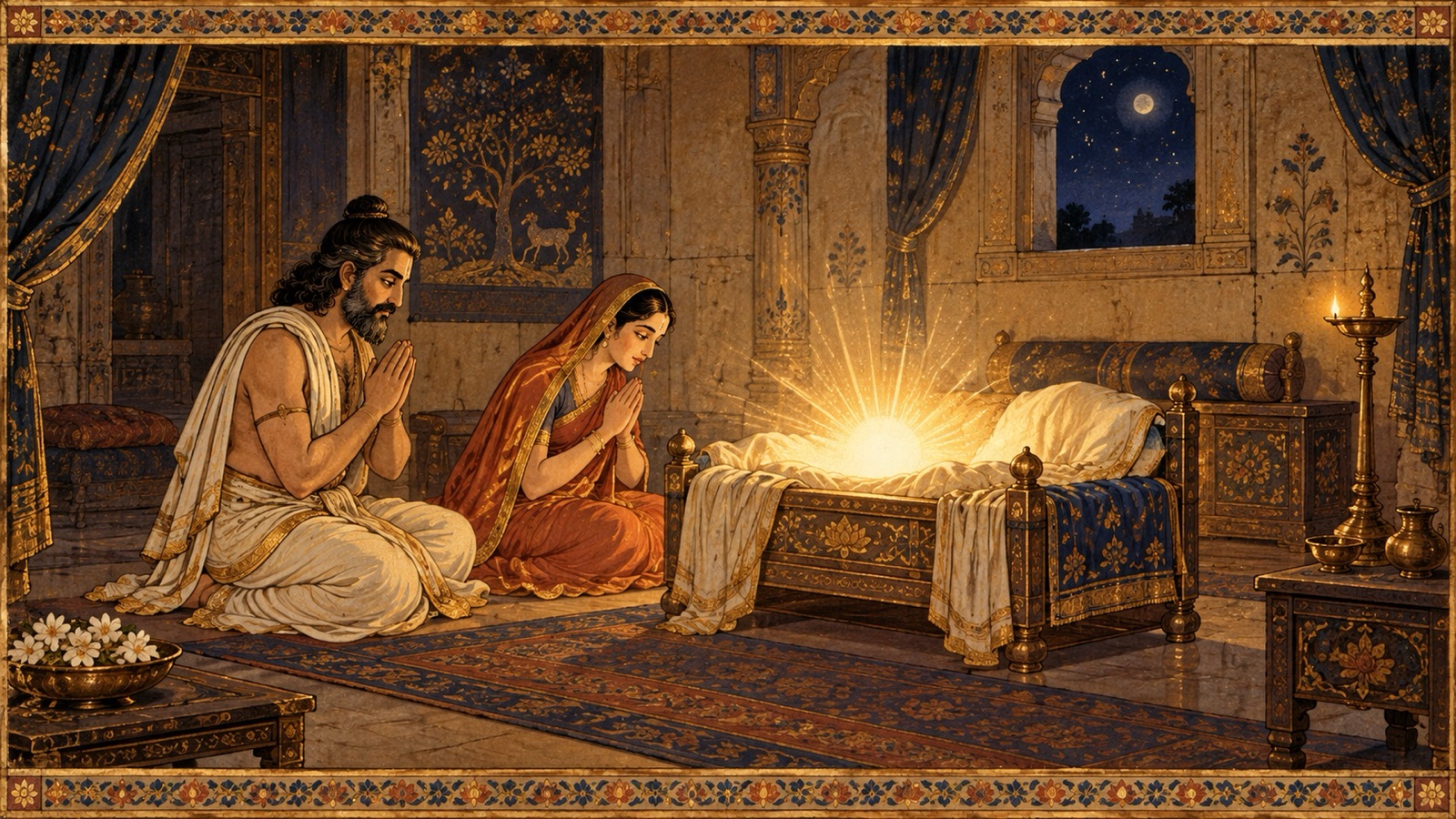
Through a hundred names and seven generations the river of the Yadu line has been flowing toward this one shore: the house of Vasudeva and Devaki, where the Supreme Lord Himself chooses, at last, to be born.
Om Namo Bhagavate Vasudevaya.
Om Namo Bhagavate Vasudevaya.
Om Namo Bhagavate Vasudevaya.
Welcome to Srimad Bhagavatam Wisdom, a devotional journey through the sacred histories and teachings of the Srimad Bhagavat Mahapurana. This twenty-fourth chapter of Book Nine is the summit toward which all the genealogies of this canto have been climbing. Sukadeva traces the Yadu house down through Vrishni and Andhaka to Sura and his ten sons, follows the tender and testing story of Sura’s daughter Pritha, and then, at the very center of it all, names the eighth child born to Vasudeva and Devaki as none other than Lord Hari Himself. The chapter closes with Sukadeva’s own hymn of wonder at why the Lord comes and why merely to hear of His glory heals a soul wearied by the world. It is, fittingly, the final chapter of Book Nine — the doorway through which the Bhagavatam now walks into the pastimes of Sri Krishna.
Chapter Information
- Scripture: Śrīmad Bhāgavata Mahāpurāṇa
- Canto: 9 (Book Nine)
- Chapter: 24 (Discourse 24)
- Chapter title: Krishna, the Supreme Personality of Godhead
- Principal speaker: Sukadeva Gosvami, narrating to King Parikshit — the whole related by Suta Gosvami to the sage Saunaka and the assembly of sages at Naimisaranya
- Principal listener: King Parikshit
- Main setting: The house of the Yadus, Vrishnis and Andhakas, centering on Sura’s household and, at last, on Vasudeva and Devaki’s home among the Surasenas at Mathura
- Central subject: The genealogy of Vasudeva’s family culminating in the Lord’s own advent as the eighth son of Devaki, with Sukadeva’s glorification of that advent
- Principal verse range: Canto 9, Chapter 24, verses 1–67
- Primary edition: Gita Press Śrīmad Bhāgavata Mahāpurāṇa
Context from the Previous Chapter
In the chapter before this one, Sukadeva surveyed the lines of Yayati’s elder sons before turning, at last, to the line of Yadu itself, declaring that merely to hear of this dynasty frees a soul from sin, for in it the Supreme Lord would one day descend in human form. Chapter twenty-four now follows that very promise to its fulfillment.
The Houses of Vrishni and Andhaka
Sukadeva resumed the Yadu line through Viduratha, whose descendants gave rise to Bhajamana, Sini, Svayambhoja and Hrdika. Among the branches of Vrishni, Andhaka’s sons carried the family forward for several generations down to Punarvasu, whose son Ahuka fathered Devaka and Ugrasena. Devaka’s own daughters, among them one named Devaki, were given in marriage to a single man, Vasudeva — the father who was waiting, though he did not yet know it, to receive the Lord Himself into his home. Elsewhere in this wide family, Svaphalka’s line gave the world Akrura, while Devamidha’s line gave the world Sura, whose own household now takes the chapter’s full attention.
Sura’s Household and the Naming of Vasudeva
Sura, the son of Devamidha, had a wife named Marisa, and through her he begot ten sons without blemish — Vasudeva, Devabhaga, Devasrava, Anaka, Srnjaya, Syamaka, Kanka, Samika, Vatsaka and Vrka — and five daughters, among them Pritha, who would later be known as Kunti. Vasudeva was marked out even before his birth: the gods sounded their kettledrums and larger drums in the sky at the hour he was born, and so he came to be called Anakadundubhi, “he at whose birth the drums of heaven sounded.”
वसुदेवं हरेः स्थानं वदन्त्यानकदुन्दुभिम् । पृथा च श्रुतदेवा च श्रुतकीर्तिः श्रुतश्रवाः ॥ ३० ॥ राजाधिदेवी चैतेषां भगिन्यः पञ्च कन्यकाः । कुन्तेः सख्युः पिता शूरो ह्यपुत्रस्य पृथामदात् ॥ ३१ ॥
vasudevaṁ hareḥ sthānaṁ vadanty ānakadundubhim pṛthā ca śrutadevā ca śrutakīrtiḥ śrutaśravāḥ rājādhidevī caiteṣāṁ bhaginyaḥ pañca kanyakāḥ kunteḥ sakhyuḥ pitā śūro hy aputrasya pṛthām adāt
Meaning: They call Vasudeva “Anakadundubhi,” the chosen abode of Lord Hari. Pritha, Srutadeva, Srutakirti, Srutasrava and Rajadhidevi were his five sisters; and their father Sura gave Pritha to his own friend Kunti, who had no children of his own. (Canto 9, Chapter 24, verses 30–31)
Pritha’s Boon and the Sun-god’s Visit
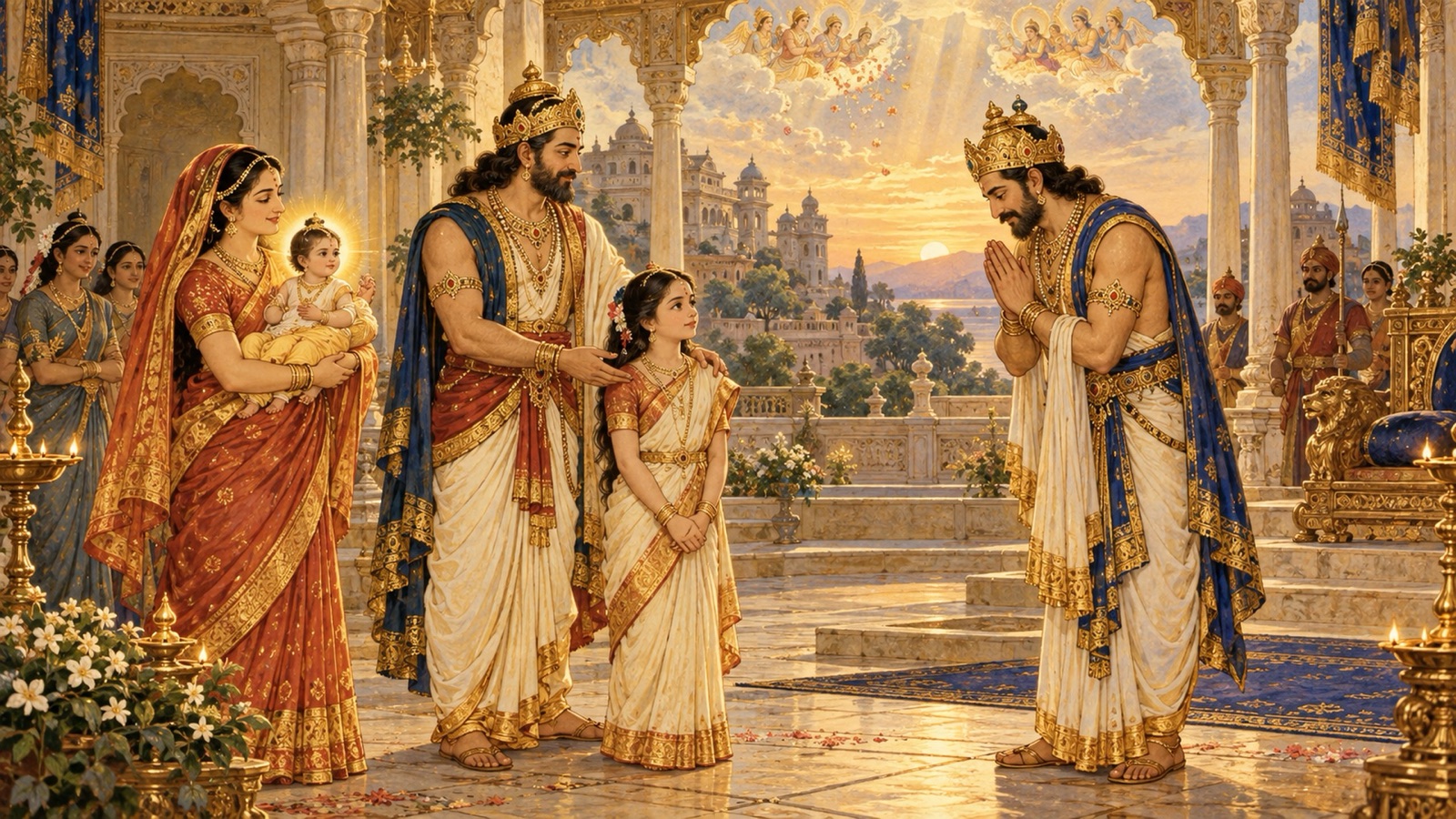
Pritha, now called Kunti after her foster father, once served the sage Durvasa so devotedly during an unexpected visit that he taught her, in his pleasure, a rare mantra by which the celestials could be summoned at will. Young and only curious to test its truth, she called upon the sun-god himself, and to her astonishment he appeared before her that very instant. Frightened, she begged him to withdraw, saying she had invoked him only in jest. But the sun-god would not leave without fulfilling his own purpose.
अमोघं देवसन्दर्शमादधे त्वयि चात्मजम् । योनिर्यथा न दुष्येत कर्ताहं ते सुमध्यमे ॥ ३४ ॥
amoghaṁ deva-sandarśam ādadhe tvayi cātmajam yonir yathā na duṣyeta kartāhaṁ te sumadhyame
Meaning: “A god’s appearance is never in vain, O slender one. I shall place a son in you, and I shall see to it that your maidenhood remains unimpaired.” (Canto 9, Chapter 24, verse 34)
So saying, the sun-god placed his radiance in her womb and returned to the heavens; and without any labor, a male child bright as a second sun was born to her that same hour. Fearing the world’s censure, the young Pritha, with great sorrow, gave the newborn child over to the waters of a river. Years afterward, it was this same Pritha whom Pandu, true to his valor, took as his honored wife.
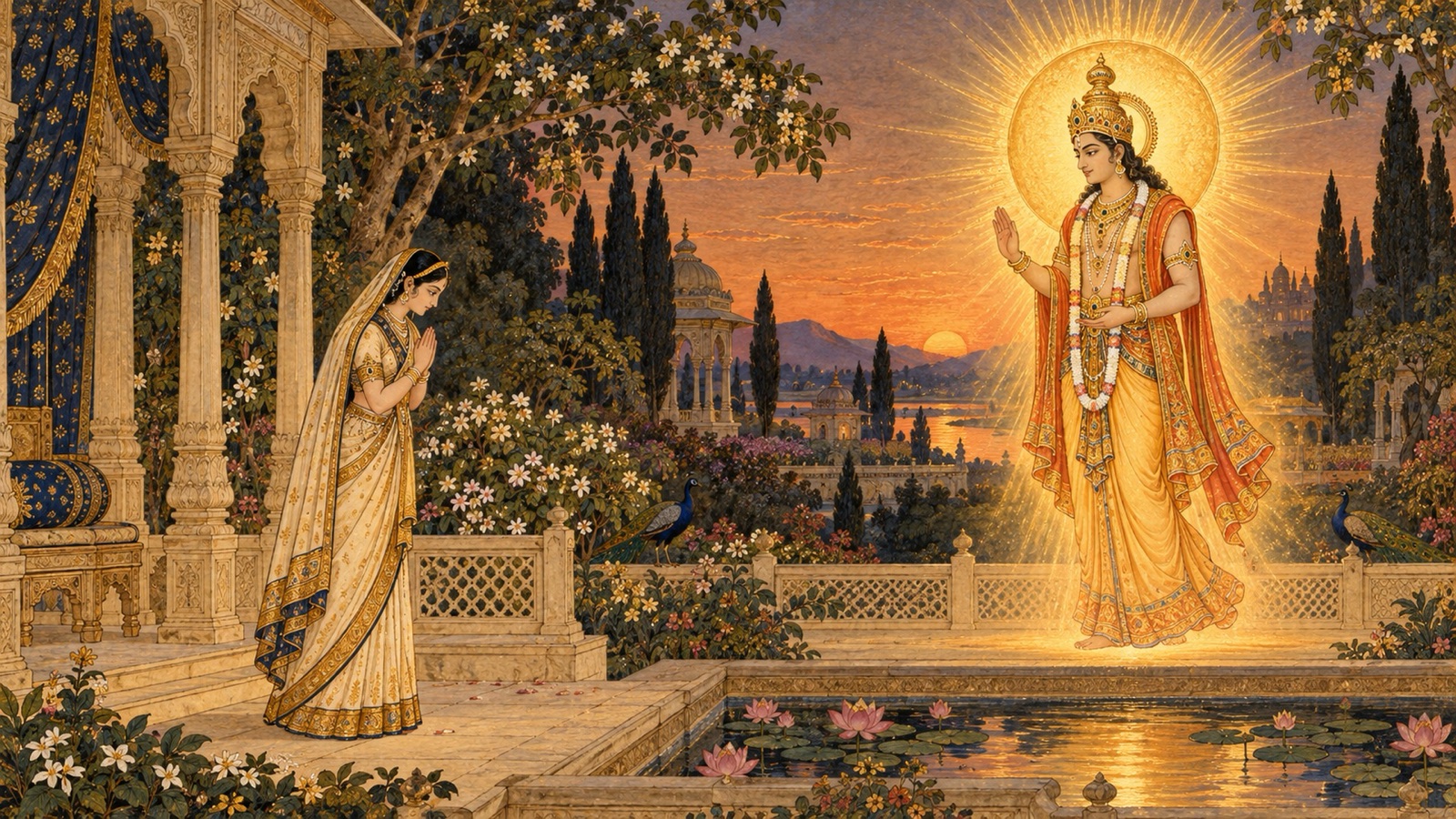
Sukadeva then named, briefly, how Pritha’s sisters married into Karusa, Kekaya, Avanti and Cedi — the Cedi marriage, through Srutasrava and Damaghosa, later giving the world Sisupala — before turning back to Vasudeva’s own household.
The Many Wives and Sons of Vasudeva
Vasudeva was not married to Devaki alone. Pauravi, Rohini, Bhadra, Madira, Rocana, Ila, Devaki and others — sisters by birth in Devaka’s house — all became his wives. Through Rohini came Balarama Himself, together with Gada and other sons; through Pauravi, Madira, Rocana and Ila came still more, each a leaf on the same vast and fortunate tree, too numerous, Sukadeva said, for even a careful memory to hold entire.
The Eighth Son Is the Lord Himself
Then, without raising his voice, Sukadeva came to the center of the whole genealogy. Through Devaraksita and Sahadeva, Vasudeva had seventeen more sons. But it was through Devaki that the real wonder came to pass.
प्रवरश्रुतमुख्यांश्च साक्षाद् धर्मो वसूनिव । वसुदेवस्तु देवक्यामष्ट पुत्रानजीजनत् ॥ ५३ ॥ कीर्तिमन्तं सुषेणं च भद्रसेनमुदारधीः । ऋजुं सम्मर्दनं भद्रं सङ्कर्षणमहीश्वरम् ॥ ५४ ॥ अष्टमस्तु तयोरासीत् स्वयमेव हरिः किल । सुभद्रा च महाभागा तव राजन् पितामही ॥ ५५ ॥
pravara-śruta-mukhyāṁś ca sākṣād dharmo vasūn iva vasudevas tu devakyām aṣṭa putrān ajījanat kīrtimantaṁ suṣeṇaṁ ca bhadrasenam udāra-dhīḥ ṛjuṁ sammardanaṁ bhadraṁ saṅkarṣaṇam ahīśvaram aṣṭamas tu tayor āsīt svayam eva hariḥ kila subhadrā ca mahābhāgā tava rājan pitāmahī
Meaning: Through Devaki, Vasudeva begot eight sons, exactly as Dharma begot the eight Vasus — Kirtiman, Susena, Bhadrasena, the noble-minded Rju, Sammardana, and Lord Sankarshana, the very Lord of serpents; and the eighth among them was none other than Lord Hari Himself. Subhadra, the greatly blessed, your own grandmother, O King, was their sister. (Canto 9, Chapter 24, verses 53–55)
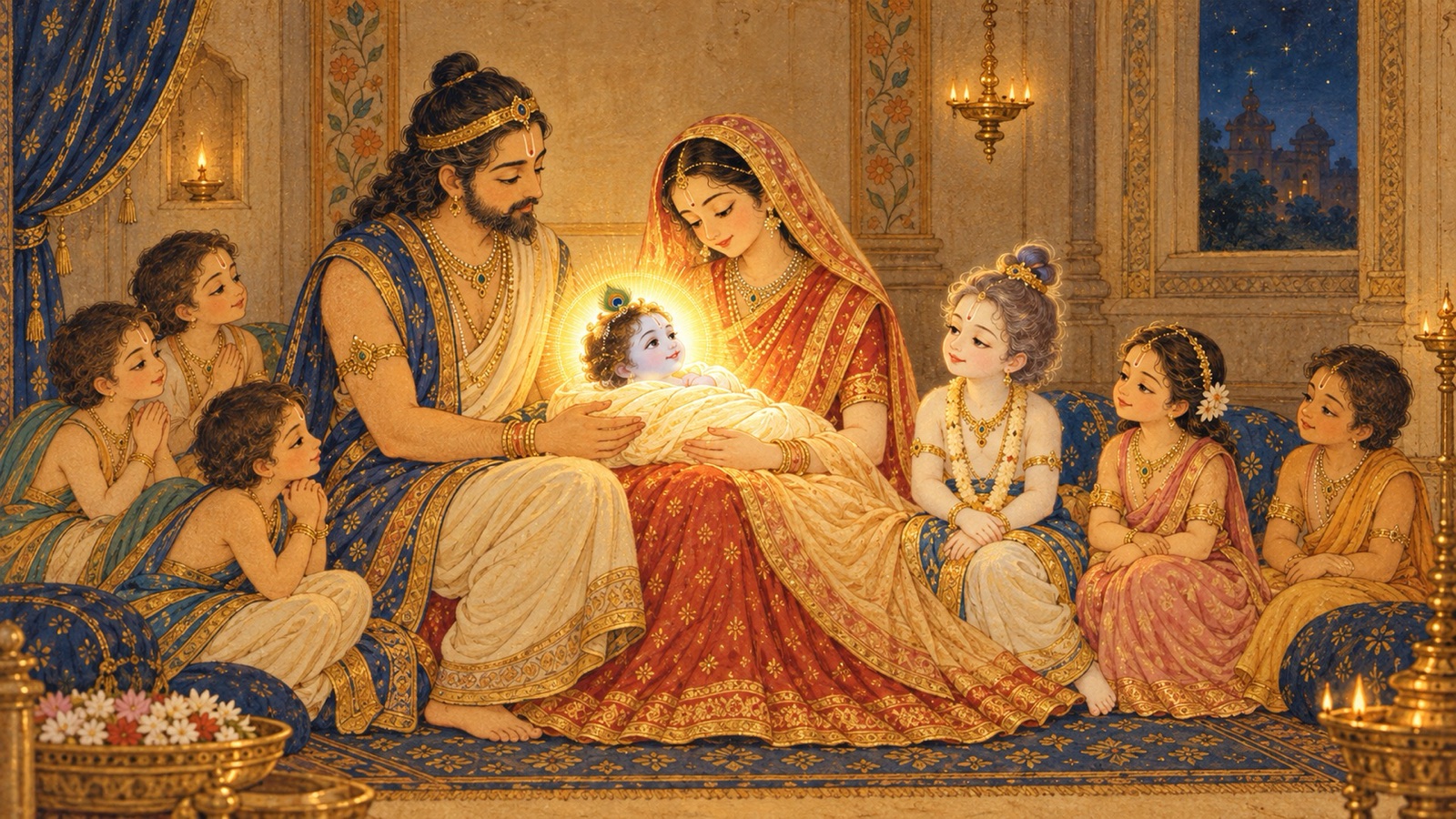
Sukadeva let the statement stand by itself: the eighth child of Vasudeva and Devaki, the Lord of all the worlds, had taken birth in this family whose every branch we have just traced. Every marriage, every son, every sister given and received had led, without a single soul in the family knowing it in advance, to this.
Why the Lord Chooses to Appear
Sukadeva then turned from genealogy to glorification, speaking a truth that a devotee returns to again and again.
यदा यदा हि धर्मस्य क्षयो वृद्धिश्च पाप्मनः । तदा तु भगवानीश आत्मानं सृजते हरिः ॥ ५६ ॥
yadā yadā hi dharmasya kṣayo vṛddhiś ca pāpmanaḥ tadā tu bhagavān īśa ātmānaṁ sṛjate hariḥ
Meaning: Whenever virtue declines and sin increases in this world, the almighty Lord Hari manifests Himself. (Canto 9, Chapter 24, verse 56)
न ह्यस्य जन्मनो हेतुः कर्मणो वा महीपते । आत्ममायां विनेशस्य परस्य द्रष्टुरात्मनः ॥ ५७ ॥ यन्मायाचेष्टितं पुंसः स्थित्युत्पत्त्यप्ययाय हि । अनुग्रहस्तन्निवृत्तेरात्मलाभाय चेष्यते ॥ ५८ ॥
na hy asya janmano hetuḥ karmaṇo vā mahīpate ātma-māyāṁ vineśasya parasya draṣṭur ātmanaḥ yan māyā-ceṣṭitaṁ puṁsaḥ sthity-utpatty-apyayāya hi anugrahas tan-nivṛtter ātma-lābhāya ceṣyate
Meaning: For the Lord, O ruler of the earth — the independent, unattached witness of all — there is no cause for His birth or action other than His own will and His own creative power. The working of that same divine power governs the birth, continuance and dissolution of every embodied soul; but the Lord’s own grace is meant to free a soul from that very cycle, that it may attain its true self. (Canto 9, Chapter 24, verses 57–58)
Here Sukadeva opens the chapter’s deepest truth: the Lord’s descent was not forced upon Him by any debt of past action, as an ordinary soul’s birth is forced by karma — He comes solely because He wills to come. That same descent, costing Him nothing, is offered to us entirely as grace: while the impersonal working of His power keeps every soul circling through birth and death, His own personal appearance and mercy are the one door by which a soul may finally come home to itself. This is the deepest reason the Bhagavatam gives for Krishna’s birth — not that the Lord needed to be born, but that we needed Him to be.
Krishna and Balarama Lift the Earth’s Burden
Having explained why the Lord comes, Sukadeva told what His coming would accomplish.
अक्षौहिणीनां पतिभिरसुरैर्नृपलाञ्छनैः । भुव आक्रम्यमाणाया अभाराय कृतोद्यमः ॥ ५९ ॥ कर्माण्यपरिमेयाणि मनसापि सुरेश्वरैः । सहसङ्कर्षणश्चक्रे भगवान् मधुसूदनः ॥ ६० ॥
akṣauhiṇīnāṁ patibhir asurair nṛpa-lāñchanaiḥ bhuva ākramyamāṇāyā abhārāya kṛtodyamaḥ karmāṇy aparimeyāṇi manasāpi sureśvaraiḥ saha-saṅkarṣaṇaś cakre bhagavān madhusūdanaḥ
Meaning: The earth, overwhelmed by commanders of great armies — demons wearing the mere outward form of kings — stood in need of relief; and to lighten that burden, Lord Madhusudana, together with Lord Sankarshana, undertook deeds so vast that even the rulers of heaven could not fully grasp them, even in thought. (Canto 9, Chapter 24, verses 59–60)
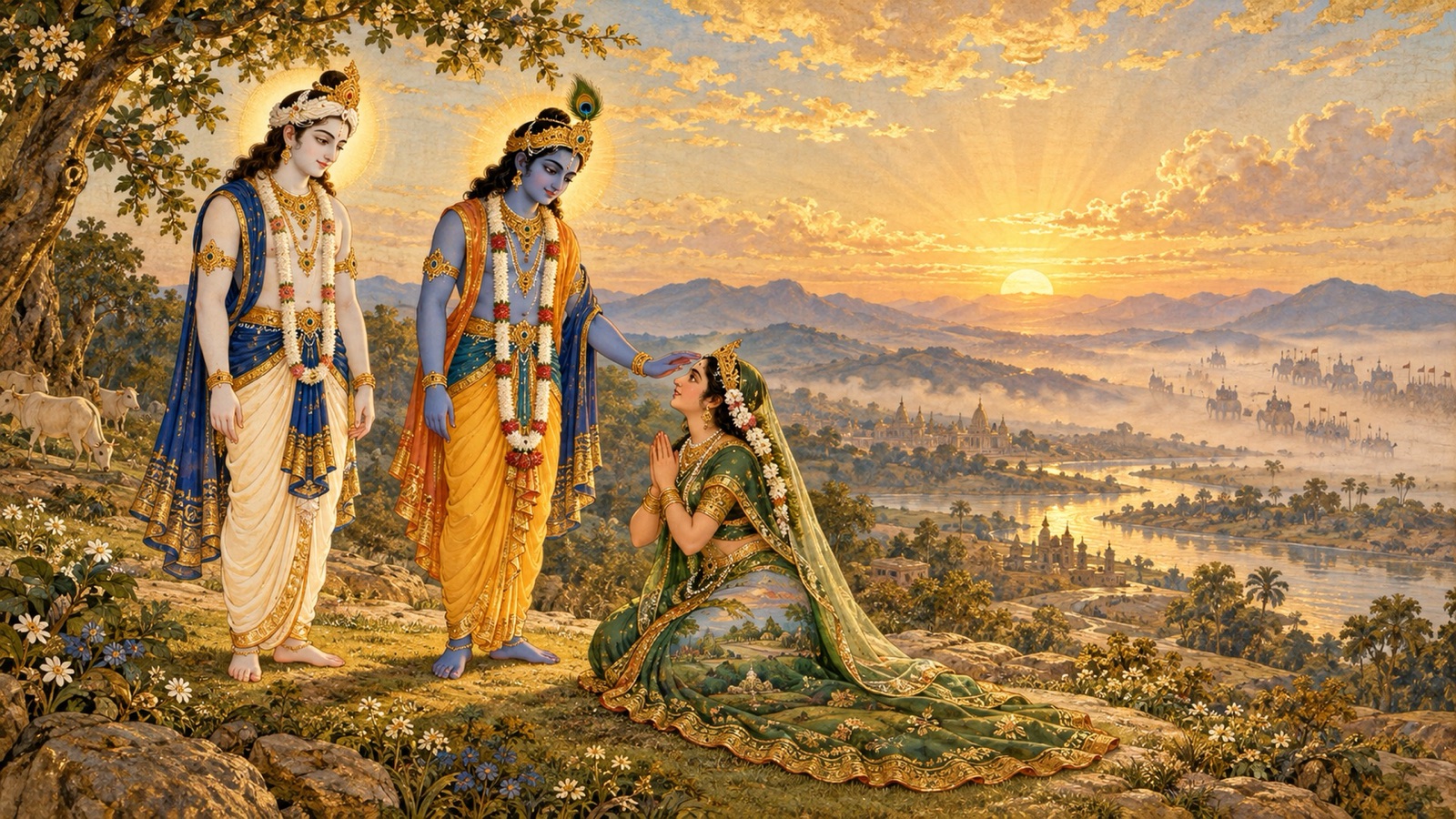
Through those deeds, Sukadeva added, the Lord spread abroad a glory so pure that it alone is enough to drive away the sorrow, grief and darkness awaiting the souls who would be born in the troubled age of Kali, not yet come when Parikshit heard this, but close enough that its shadow lay ahead of him, as it lies, still, ahead of us.
The Nectar That Heals the Ears
It is here, at the chapter’s close, that Sukadeva speaks the words a devotee most loves to carry home.
यस्मिन् सत्कर्णपीयुषे यशस्तीर्थवरे सकृत् । श्रोत्राञ्जलिरुपस्पृश्य धुनुते कर्मवासनाम् ॥ ६२ ॥
yasmin sat-karṇa-pīyuṣe yaśas-tīrtha-vare sakṛt śrotrāñjalir upaspṛśya dhunute karma-vāsanām
Meaning: Cupping the hollow of one’s joined ears like two open palms, and sipping only once from that excellent sacred stream of His glory — nectar indeed to righteous ears — a person shakes off the deep-seated tendencies of past action that otherwise bind the soul. (Canto 9, Chapter 24, verse 62)
Through His gentle words, His smiles and His form charming in every limb, Sukadeva said, the Lord brought such joy to His own Yadu kinsmen and to the Kurus and Pandavas alike that men and women drank the beauty of His face with their eyes and were never sated.
Krishna’s Deeds and His Return to His Own Abode
Sukadeva closed the chapter with a swift, loving glance across the Lord’s whole earthly life — born, carried to the pastures of Vraja, returned to Mathura, where He slew His enemies, married, fathered sons, and performed sacrifices of His own worship so that His own Vedic path might shine before the world.
पृथ्व्याः स वै गुरुभरं क्षपयन् कुरूणा- मन्तःसमुत्थकलिना युधि भूपचम्व्वः । दृष्ट्या विधूय विजये जयमुद्विघोष्य प्रोच्योद्धवाय च परं समगात् स्वधाम ॥ ६७ ॥
pṛthvyāḥ sa vai guru-bharaṁ kṣapayan kurūṇām antaḥ-samuttha-kalinā yudhi bhūpa-camvaḥ dṛṣṭyā vidhūya vijaye jayam udvighoṣya procyoddhavāya ca paraṁ samagāt sva-dhāma
Meaning: Lightening the earth’s heavy burden through the very discord that rose among the Kurus, He swept away, by His glance alone, the assembled armies of kings upon the battlefield; proclaimed aloud the victory of Vijaya, Arjuna; imparted the supreme truth to Uddhava; and then, with a tranquil mind, returned to His own transcendental abode. (Canto 9, Chapter 24, verse 67)
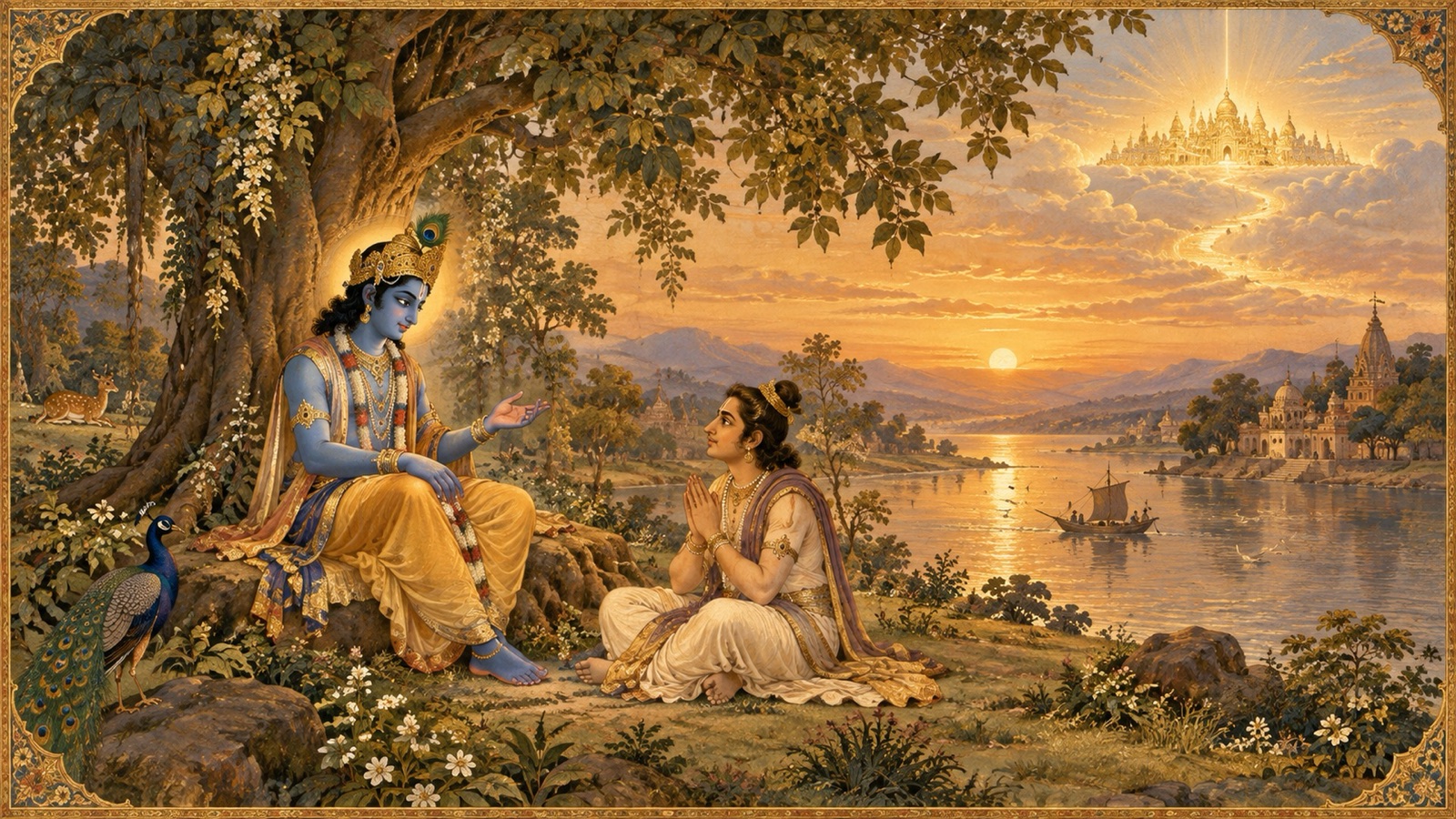
With this verse Sukadeva closed not only the chapter but the whole of Book Nine, its colophon calling it “an account of the posterity of Yadu,” part of the greater history of the solar and lunar dynasties told by the sage Vedavyasa. Book Nine ends here; and with it, the Bhagavatam stands ready, at the threshold of Book Ten, to tell in full the very pastimes this chapter has only glimpsed.
Principal Teachings of This Chapter
1. The Lord’s descent is never compelled, only willed. Unlike every other soul, whose birth is governed by karma, the Lord’s appearance has no cause outside His own desire to sport and to bless (verses 56–57).
2. His grace, not His power, liberates us. The same divine power that keeps souls circling through birth and death is also, through the Lord’s personal mercy, the means by which a soul may finally come home to itself (verse 58).
3. The Lord comes to lift real burdens. When the earth groaned under rulers who were demons in all but name, the Lord undertook deeds beyond the comprehension even of the gods to set her free (verses 59–60).
4. A single hearing of His glory is purifying. Sukadeva likens hearing of the Lord, even once, to sipping nectar with cupped, listening ears — enough to loosen the hold of old habits and past actions (verse 62).
5. The ordinary families of this world can carry the extraordinary. Through generations of marriages, sons and quiet domestic histories, an entirely human lineage became, without anyone foreseeing it, the very house in which God was born (verses 53–55).
A Devotional Reflection
There is something deeply moving in watching a family tree, name after name, carry within it — unknown to anyone living inside it — the seed of the Lord’s own advent. Sura could not have known, naming his drum-heralded son Anakadundubhi, that this child would one day hold the infant Krishna in his arms. Pritha could not have known, weeping over a river at the child she feared to keep, that her sorrow would one day be answered by a far greater mercy toward her whole family. Yet the Bhagavatam treats none of this as accident; it treats it as grace quietly working through ordinary lives, through marriages arranged for practical reasons and children born and named for family honor. Perhaps this is the chapter’s gentlest teaching: that we too live inside a story whose true shape we cannot yet see, and that the Lord’s hand may be at work in our own quiet histories exactly as patiently as it worked in the house of Vasudeva.
A Daily Devotional Practice
Today, follow Sukadeva’s own counsel and give your ears, even briefly, to the Lord’s glory — read or recite a single verse of His pastimes, or simply repeat with full attention, “Om Namo Bhagavate Vasudevaya,” letting the sound settle like nectar in a listening heart. Then, remembering how an entire family’s unremarkable history became the vessel for God’s own birth, look at your own household and daily life, however ordinary it may seem, and offer it silently to the Lord, trusting that He can work through it exactly as He worked through the house of Sura and Vasudeva.
Conclusion
What began, chapters ago, as a long unspooling of kings and dynasties arrives here at its true purpose: the house of Vasudeva and Devaki, where the eighth child born is revealed to be the Supreme Lord Himself, descending by His own free will to lighten the earth of her burden and to offer every listening soul the purifying nectar of His glory. Sukadeva’s closing hymn reminds us that the Lord’s birth asks nothing of Him and gives everything to us. With this, Book Nine comes to its close, and the Bhagavatam stands at the very doorway of the pastimes of Sri Krishna Himself.
May the divine wisdom of Srimad Bhagavatam awaken pure devotion within our hearts.
Om Namo Bhagavate Vasudevaya.
Jay Shree Madhav.
References and Attribution
- Primary edition: Gita Press, Śrīmad Bhāgavata Mahāpurāṇa (English, complete), Book Nine, Discourse 24, pages 92–96.
- Series: Srimad Bhagavatam Wisdom · Biswa Sanatan Dharma Seva Trust.
- Presented following the spiritual guidance and recommendation of Pandit Dr. Shri Kashinath Mishra.
This is an original, faithful retelling in the writer’s own words, with brief quoted verses shown in Devanāgarī and transliteration and their meanings given as summaries. It is not a reproduction of any single publisher’s continuous translation or commentary. No affiliation with or endorsement by any publisher is implied.
Jay Shree Madhav