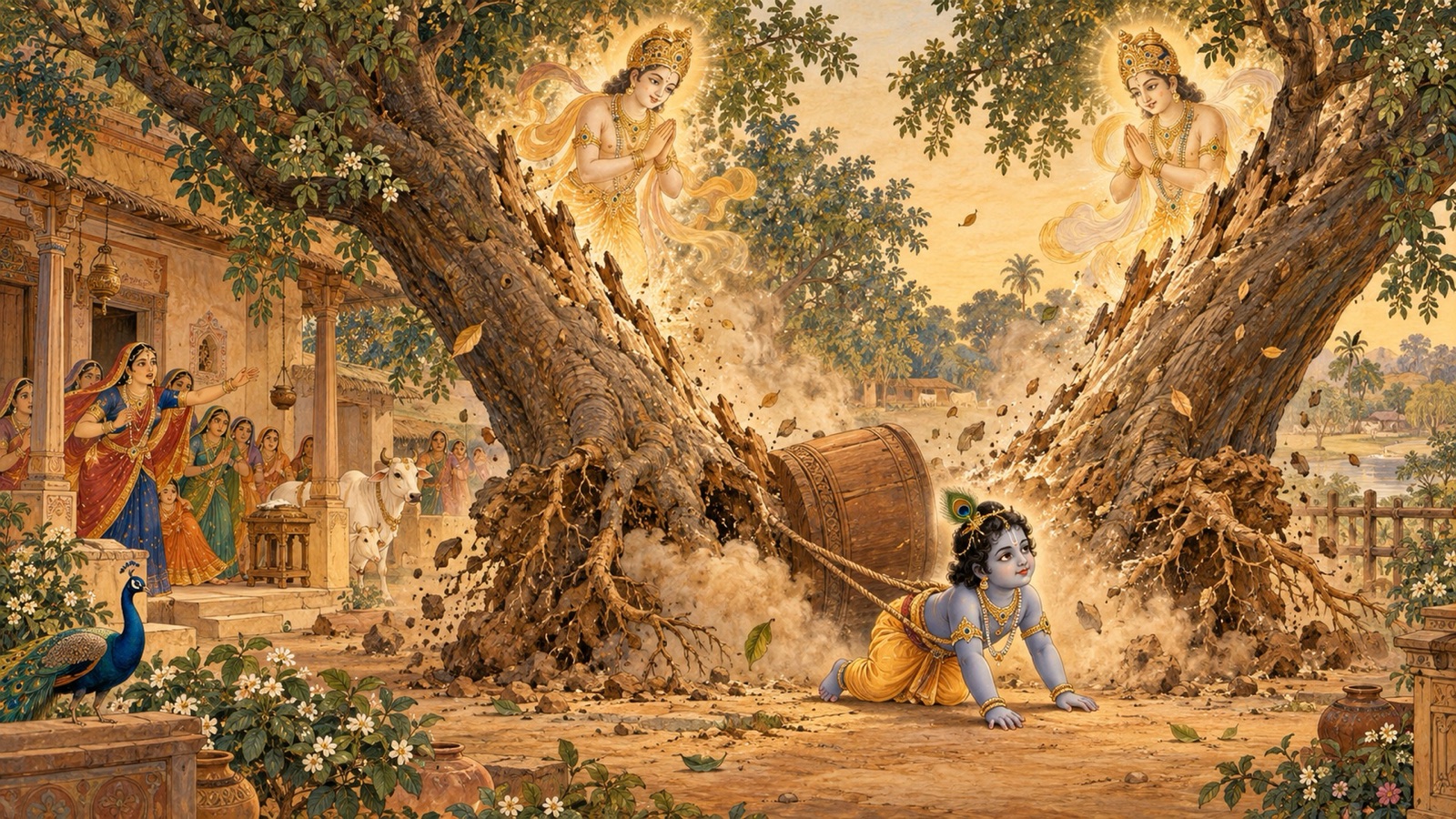
As the child Krishna, dragging the wooden mortar behind Him, passes between the twin arjuna trees, the two great trees are uprooted and crash to the ground — and from them two radiant beings are set free.
Om Namo Bhagavate Vasudevaya.
Om Namo Bhagavate Vasudevaya.
Om Namo Bhagavate Vasudevaya.
Welcome back to Srimad Bhagavatam Wisdom, our devotional journey through the sacred histories and teachings of the Srimad Bhagavat Mahapurana. This tenth chapter of the Tenth Canto completes the pastime begun in the last: bound to a wooden mortar by His mother’s love, the child Krishna now crawls out into the courtyard and delivers two souls long imprisoned in the bodies of trees. King Parikshit asks what these two — Nalakuvara and Manigriva, the sons of Kubera — had done to earn the sage Narada’s curse, and Sukadeva answers with a searching teaching on the blindness of wealth and pride and the hidden blessing within Narada’s stern words. Then the great pastime unfolds: Krishna drags the mortar between the twin arjuna trees, uproots them with a mighty crash, and the two celestial beings, restored and humbled, pour out their prayers at His feet before departing home with pure devotion awakened in their hearts.
Chapter Information
- Scripture: Śrīmad Bhāgavata Mahāpurāṇa
- Canto: 10 (Book Ten, First Half)
- Chapter: 10 (Discourse 10)
- Chapter title: The Deliverance of Nalakuvara and Manigriva
- Principal speaker: Sukadeva Gosvami (narrating to King Parikshit)
- Principal listener: King Parikshit
- Main setting: The courtyard of Nanda’s home in Gokula, Vraja; within the narration, the heavenly garden of Kailasa
- Central subject: The cause of the curse upon Kubera’s two sons; Narada’s teaching on the blindness of wealth and the blessing of simplicity; his curse and its hidden grace; and Krishna’s uprooting of the twin arjuna trees that liberates the two celestial beings
- Principal verse range: Canto 10, Chapter 10, verses 1–43
- Primary edition: Gita Press Śrīmad Bhāgavata Mahāpurāṇa (Sanskrit-Hindi, Volume 2)
Context From the Previous Chapter
In Chapter 9, mother Yasoda bound the mischievous infant Krishna to a wooden grinding mortar with a rope that forever fell short by two fingers, until the Lord mercifully allowed Himself to be tied. Left alone, He turned His gaze toward two great twin arjuna trees in the courtyard — once Nalakuvara and Manigriva, the sons of Kubera, cursed by Narada. This chapter tells their story and their deliverance.
Parikshit’s Question
King Parikshit, hearing that the two trees had once been living beings, asked Sukadeva to explain the cause of their curse. What offensive act had the two committed that so displeased even the gentle sage Narada, and how had they come to bear his stern words? Sukadeva answered by recounting their story.
The Blindness of Wealth and Pride
Nalakuvara and Manigriva were the sons of Kubera, the treasurer of the gods, and had become attendants of Lord Shiva. Proud of their wealth and position, one day they were sporting in the lovely garden of Kailasa on the banks of the celestial Mandakini. Having drunk the intoxicating varuni wine, their eyes rolling, they roamed the flowering forest and entered the waters of the Ganga to play among a company of young women, like two elephants among she-elephants.
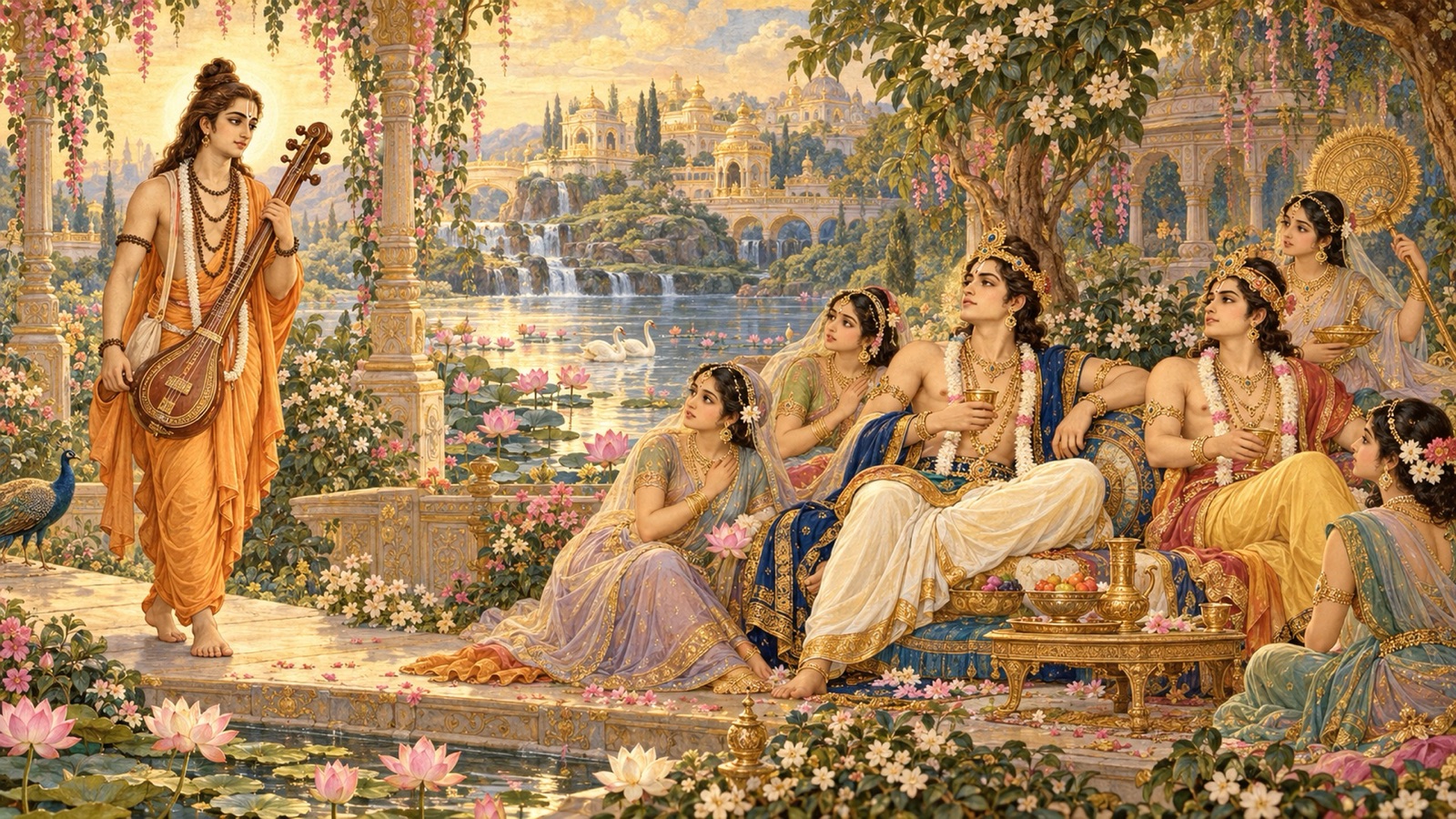
By chance the divine sage Narada came upon them there and understood at once that the two were blind with drink. Seeing the sage, the women, ashamed and fearful of a curse, hastily covered themselves — but the two sons of Kubera, too intoxicated even to know they were unclothed, did not. Looking upon them thus blinded by wine and by the pride of wealth, Narada, out of compassion and to bless them, spoke words that were at once a rebuke and a teaching.
श्रीनारद उवाच
न ह्यन्यो जुषतो जोष्यान्बुद्धिभ्रंशो रजोगुण: ।
श्रीमदादाभिजात्यादिर्यत्र स्त्री द्यूतमासव: ॥ ८ ॥
śrī-nārada uvāca na hy anyo juṣato joṣyān buddhi-bhraṁśo rajo-guṇaḥ śrī-madād ābhijātyādir yatra strī dyūtam āsavaḥ
Meaning: Narada said: Nothing so ruins the intelligence of one who indulges in enjoyable things as the mode of passion born of the pride of wealth and high birth — where there is woman, gambling, and drink. (Canto 10, Chapter 10, verse 8)
At length the sage taught the hidden virtue of poverty and simplicity. For one blind with the pride of wealth, he said, poverty is the finest collyrium for the eyes: the poor man, seeing others as equal to himself, understands their pain as his own, as one pierced by a thorn knows the pain of another so pierced. Free of pride and false ego, released from every intoxication, the simple man’s very hardships become his highest austerity; his senses grow lean, and even his tendency to violence subsides. The saints, equal to all and longing only for the feet of Mukunda, naturally keep the company of the humble and the poor — and why should one waste concern upon the arrogant rich who take shelter in the unreal?
The Curse and Its Hidden Grace
Then Narada pronounced the sentence that was truly a mercy. Since these two sons of a guardian of the worlds, sunk in darkness and so drunk that they could not tell they stood naked, had fallen so low, they deserved to become immovable — to be born as trees — so that they might never again fall into such pride. Yet even in the curse the sage placed his grace: by his blessing they would retain their memory, and after standing as trees for a hundred celestial years, they would obtain the direct nearness of Lord Vasudeva, and would return at last to the heavenly world with pure devotion awakened in them.
यदिमौ लोकपालस्य पुत्रौ भूत्वा तम:प्लुतौ ।
न विवाससमात्मानं विजानीत: सुदुर्मदौ ॥ २० ॥
अतोऽर्हत: स्थावरतां स्यातां नैवं यथा पुन: ।
स्मृति: स्यान्मत्प्रसादेन तत्रापि मदनुग्रहात् ॥ २१ ॥
वासुदेवस्य सान्निध्यं लब्ध्वा दिव्यशरच्छते ।
वृत्ते स्वर्लोकतां भूयो लब्धभक्ती भविष्यत: ॥ २२ ॥
yad imau loka-pālasya putrau bhūtvā tamaḥ-plutau na vivāsasam ātmānaṁ vijānītaḥ sudurmadau ato ’rhataḥ sthāvaratāṁ syātāṁ naivaṁ yathā punaḥ smṛtiḥ syān mat-prasādena tatrāpi mad-anugrahāt vāsudevasya sānnidhyaṁ labdhvā divya-śarac-chate vṛtte svarlokatāṁ bhūyo labdha-bhaktī bhaviṣyataḥ
Meaning: Because these two sons of the world-guardian Kubera, sunk in the mode of darkness and utterly maddened, do not even know that they stand unclothed, they deserve to become immovable trees, so that they may not fall this way again. Yet by my grace they shall retain their memory; and by my grace, after a hundred celestial years, having obtained the nearness of Lord Vasudeva, they shall return again to the heavenly world with loving devotion attained. (Canto 10, Chapter 10, verses 20-22)
Having spoken thus, Narada departed for the hermitage of Narayana, and the two became the twin arjuna trees that stood in the courtyard of Nanda’s home — waiting through the long years for the Lord who had now appeared as the child of Yasoda.
The Falling of the Twin Trees
To make true the words of the great devotee-sage, the Lord slowly made His way, dragging the mortar, to the place where the twin arjuna trees stood. ‘The divine sage is most dear to Me,’ He thought within Himself; ‘since these two are the sons of Kubera, I shall accomplish exactly what that great soul foretold.’ Then the child passed between the two trees, and the wooden mortar tied to Him turned crosswise and caught fast between them.
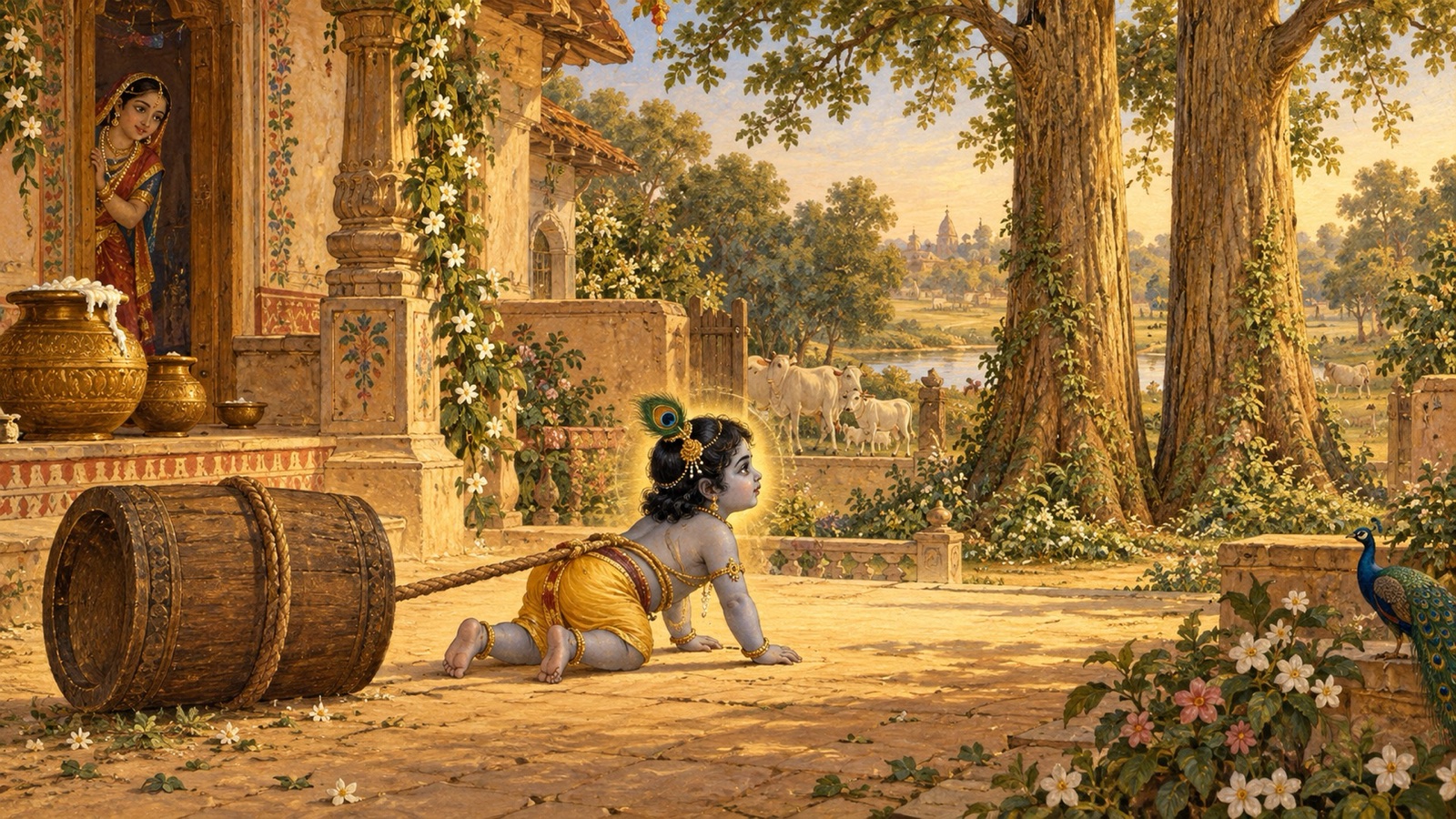
As the little Damodara pulled the wedged mortar onward, the two great trees were torn up by their roots and came crashing to the ground, their trunks, branches, and leaves trembling violently at the touch of His supreme power, and a mighty sound rang out across Vraja.
बालेन निष्कर्षयतान्वगुलूखलं तद्
दामोदरेण तरसोत्कलिताङ्घ्रिबन्धौ ।
निष्पेततु: परमविक्रमितातिवेप-
स्कन्धप्रवालविटपौ कृतचण्डशब्दौ ॥ २७ ॥
bālena niṣkarṣayatānvag ulūkhalaṁ tad dāmodareṇa tarasotkalitāṅghri-bandhau niṣpetatuḥ parama-vikramitātivepa- skandha-pravāla-viṭapau kṛta-caṇḍa-śabdau
Meaning: As the child dragged the wedged mortar behind Him, the bonds of the roots of the two trees were torn asunder by the power of Damodara; with their trunks, branches, and leaves shaking violently, the two trees fell with a tremendous crash. (Canto 10, Chapter 10, verse 27)
The Prayers of the Liberated Beings
From the fallen trees there emerged two beings of dazzling splendour, lighting up all the directions like fire. These were Nalakuvara and Manigriva, restored to their celestial forms and, at last, freed of the darkness of pride. Bowing their heads to Krishna, the Lord of all the worlds, with folded hands and hearts now clear, they glorified Him: ‘Krishna, Krishna, O great yogi! You are the original Supreme Person, and the wise know this whole universe, manifest and unmanifest, to be Your very form. You alone are the Lord of the bodies, senses, and minds of all beings; You are time; You are the imperishable Vishnu; You are both the subtle nature woven of the three modes and the Supreme Person who oversees it all.’ They confessed that no one covered by the modes of nature could ever know Him by their own power, and offered obeisance to Him as Vasudeva, the Supreme Brahman whose glory is veiled by His own effulgence.
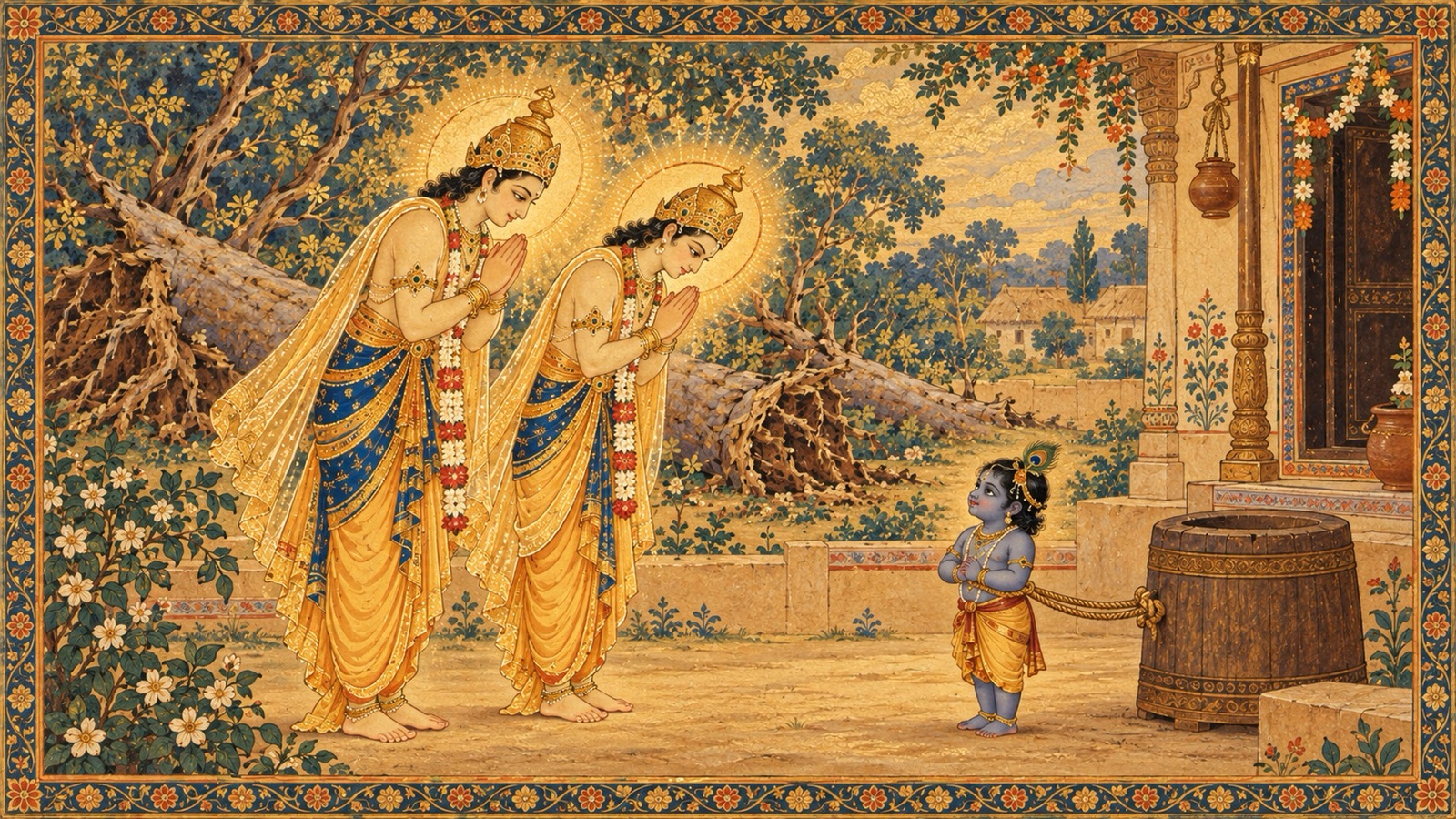
Recognising that He had descended for the welfare of all the worlds, they made a prayer that has become the prayer of every devotee — asking not for wealth or heaven, but only that their every faculty be engaged in His service.
वाणी गुणानुकथने श्रवणौ कथायां
हस्तौ च कर्मसु मनस्तव पादयोर्न: ।
स्मृत्यां शिरस्तव निवासजगत्प्रणामे
दृष्टि: सतां दर्शनेऽस्तु भवत्तनूनाम् ॥ ३८ ॥
vāṇī guṇānukathane śravaṇau kathāyāṁ hastau ca karmasu manas tava pādayor naḥ smṛtyāṁ śiras tava nivāsa-jagat-praṇāme dṛṣṭiḥ satāṁ darśane ’stu bhavat-tanūnām
Meaning: May our speech be engaged in describing Your qualities, our ears in hearing Your stories, our hands in Your work, our mind at Your feet, our memory upon You, our head in bowing to the world that is Your dwelling, and our eyes in beholding the saints who are Your very forms. (Canto 10, Chapter 10, verse 38)
Krishna’s Blessing and Their Departure
Thus praised, the Lord of Gokula — still bound to the mortar by His mother’s rope — laughed and spoke to the two. He told them He had known all along that the compassionate sage Narada’s words, though they sounded like a curse, had been a blessing; for those whose minds are fixed on Him, the very sight of the equal-minded saints brings liberation, as sunlight brings sight to the eyes. Their long punishment had been the sage’s mercy, leading them straight to His presence.
तद्गच्छतं मत्परमौ नलकूवर सादनम् ।
सञ्जातो मयि भावो वामीप्सित: परमोऽभव: ॥ ४२ ॥
tad gacchataṁ mat-paramau nalakūvara sādanam sañjāto mayi bhāvo vām īpsitaḥ paramo ’bhavaḥ
Meaning: Now go home, O Nalakuvara, you who are supremely devoted to Me; for the supreme love toward Me, free from all rebirth, which you desired, has now arisen in you both. (Canto 10, Chapter 10, verse 42)
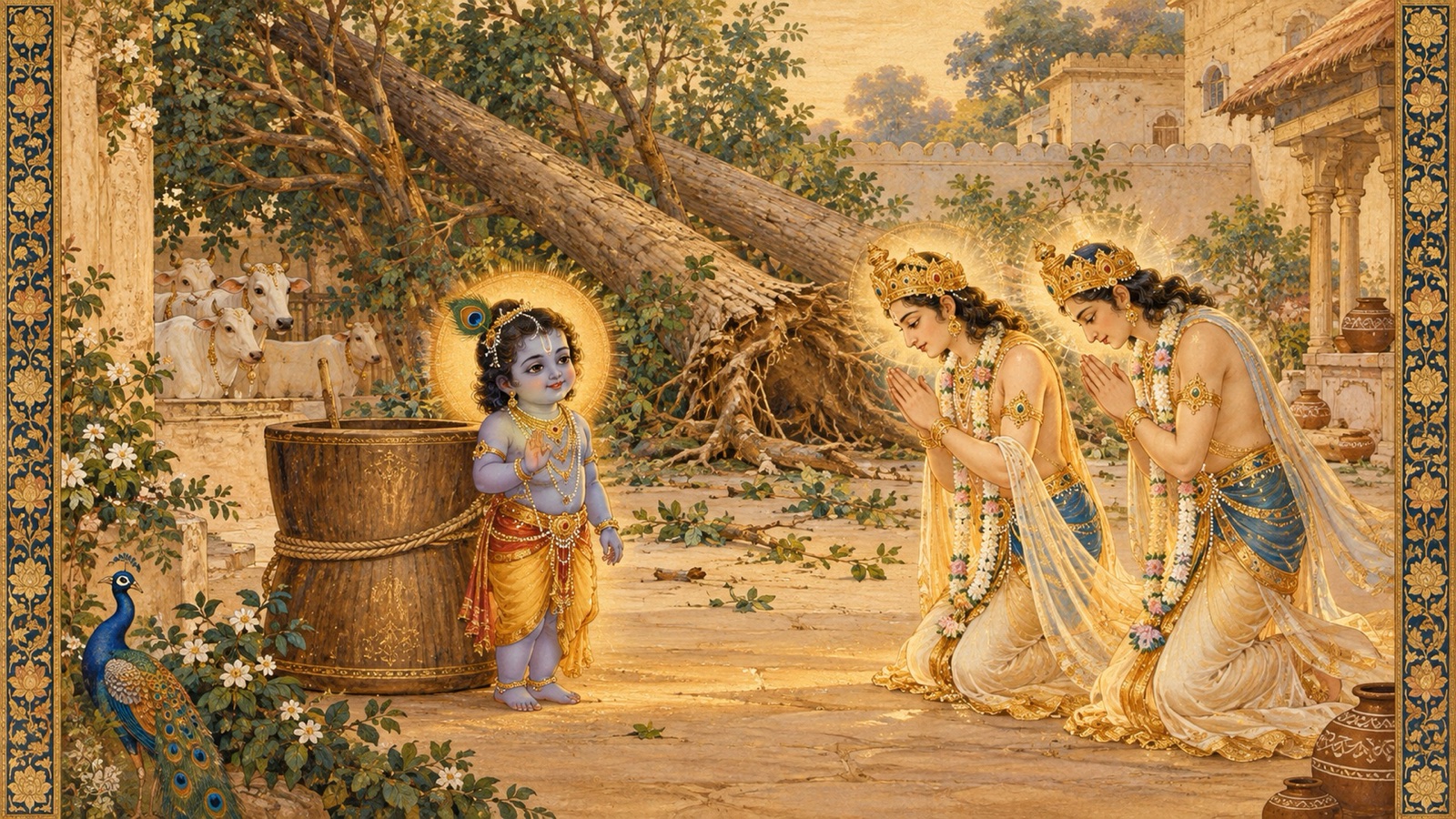
Hearing this, the two circumambulated the mortar-bound Lord and bowed to Him again and again; then, taking their leave, they departed toward the north, their hearts full of the devotion for which they had waited so long.
Principal Teachings of This Chapter
1. Wealth and pride can blind the soul. Narada teaches that the pride of riches and birth, joined with indulgence, ruins the intelligence (verse 8). What the world calls fortune can quietly become the greatest misfortune of all.
2. Simplicity is a hidden austerity. In the sage’s words, poverty humbles the ego, teaches fellow-feeling, and quiets even the urge to harm. The Lord is more easily found by the simple than by the proud.
3. A saint’s curse is a saint’s mercy. Narada’s sentence upon the two (verses 20-22) was in truth a rescue, arranging their liberation across a hundred years. What looks like punishment from a pure heart may be the hand of grace.
4. The Lord honours the words of His devotees. Krishna uproots the trees to make Narada’s promise come true (verses 24-27). He binds Himself to the desires and words of those who love Him.
5. True prayer asks only for service. The liberated beings ask not for wealth or heaven but that every faculty be given to the Lord (verse 38). This is the pattern of pure devotion.
A Devotional Reflection
It is striking that the same child who let Himself be bound by a rope that could never quite reach around Him is the one who now snaps the roots of two great trees as though they were threads. The Lord who is helpless before His mother’s love is all-powerful before the bondage of two proud souls. And what frees them is not the fall of the trees alone but the long, patient mercy hidden inside a saint’s hard words. Narada did not curse Nalakuvara and Manigriva in anger; he loved them enough to take away everything that was destroying them — their wealth, their bodies, their pride — and to arrange, across a hundred years, their meeting with God. We rarely recognise such mercy when it comes to us disguised as loss. Yet this chapter quietly asks us to trust that the hand which strips away our pride may be the very hand that is drawing us home, and that the prayer worth praying is not for the return of what we lost, but that every part of us might at last be turned toward Him.
A Daily Devotional Practice
Today, take to heart the prayer of the two liberated beings: offer each of your faculties, one by one, to the Lord. Let your words speak of Him, your ears seek His stories, your hands serve others in His name, and your mind rest at His feet. Where you notice pride in wealth, position, or knowledge, gently set it down, remembering that the Lord draws near to the humble. Begin by chanting gently: Om Namo Bhagavate Vasudevaya.
Conclusion
The tenth chapter of the Tenth Canto joins a stern teaching to a tender pastime. Through the story of Kubera’s two proud sons, Narada shows how wealth and pride can blind the soul and how simplicity opens the eyes; and through his curse, which was truly a blessing, he arranges their deliverance at the hands of the Lord Himself. Bound to the mortar by His mother, the child Krishna crawls between the twin trees, uproots them with a crash that shakes all Vraja, and sets two long-imprisoned beings free. Humbled and restored, they offer the purest of prayers and depart with devotion awakened at last. May we learn from them to welcome whatever strips away our pride, to trust the mercy hidden within our losses, and to ask, above all, that every faculty we possess be given in loving service to the Lord.
May the divine wisdom of Srimad Bhagavatam awaken pure devotion within our hearts.
Om Namo Bhagavate Vasudevaya.
Jay Shree Madhav.
References and Attribution
- Primary edition: Gita Press, Śrīmad Bhāgavata Mahāpurāṇa (Sanskrit-Hindi, Volume 2), Book Ten (First Half), Discourse 10.
- Series: Srimad Bhagavatam Wisdom · Biswa Sanatan Dharma Seva Trust.
- Presented following the spiritual guidance and recommendation of Pandit Dr. Shri Kashinath Mishra.
This is an original, faithful retelling in the writer’s own words, with brief quoted verses shown in Devanāgarī and transliteration and their meanings given as summaries. It is not a reproduction of any single publisher’s continuous translation or commentary. No affiliation with or endorsement by any publisher is implied.
Jay Shree Madhav