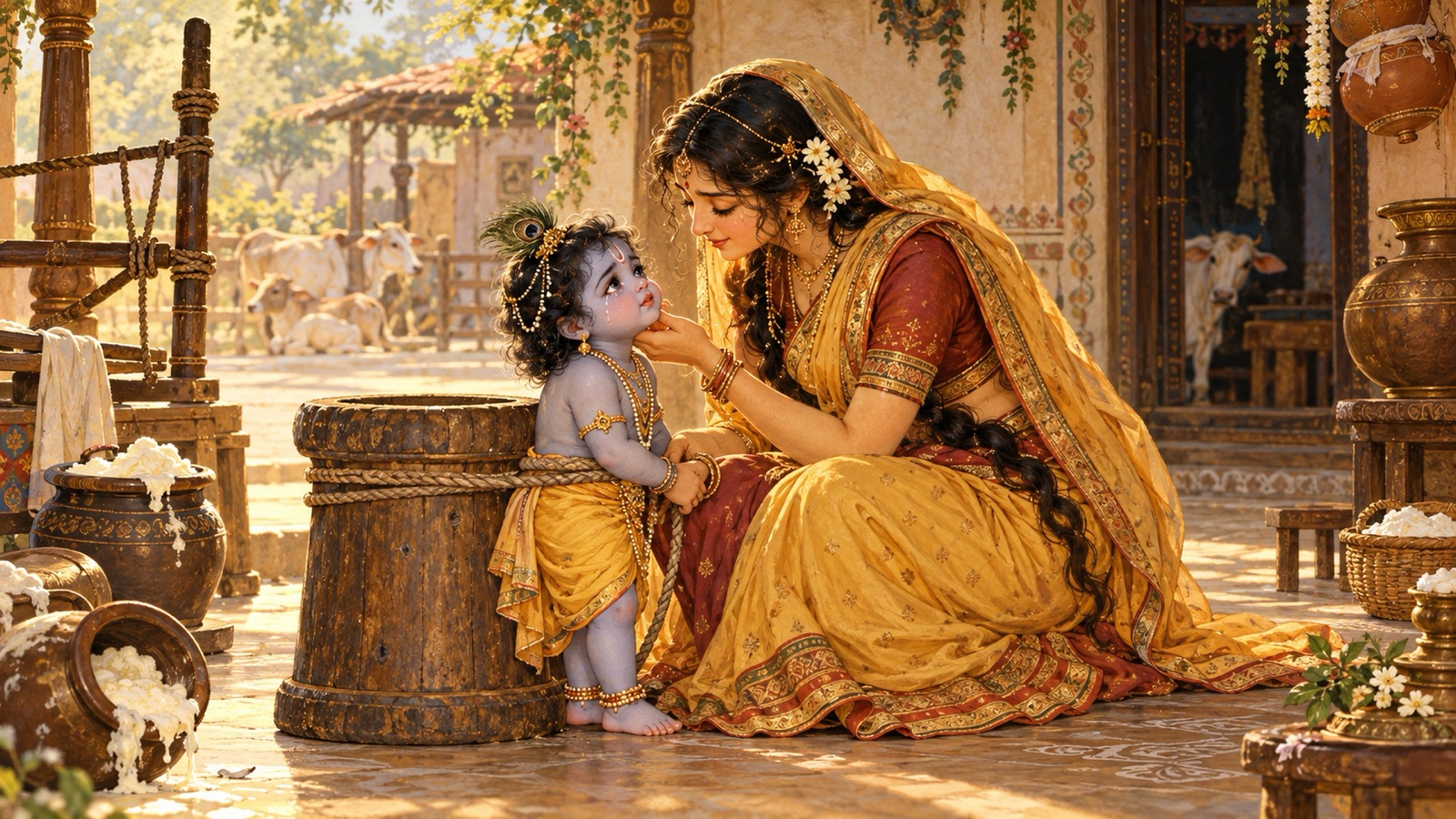
Mother Yasoda, seeing her little son’s mischief, gently ties Him to the wooden grinding mortar — and the Lord of all worlds, bound by a mother’s love, becomes forever known as Damodara, ‘He who is bound about the waist.’
Om Namo Bhagavate Vasudevaya.
Om Namo Bhagavate Vasudevaya.
Om Namo Bhagavate Vasudevaya.
Welcome back to Srimad Bhagavatam Wisdom, our devotional journey through the sacred histories and teachings of the Srimad Bhagavat Mahapurana. This ninth chapter of the Tenth Canto tells one of the most beloved of all the Lord’s childhood pastimes — the pastime that gives Krishna His sweet name Damodara, ‘He who is bound about the waist.’ One morning, mother Yasoda churns butter with her own hands while singing of her son; the child comes to be nursed, is set down unsatisfied, and in a fit of make-believe anger breaks the curd-pot and steals the butter. When His mother catches Him and tries to tie Him to a wooden grinding mortar, she discovers that no rope in her house is long enough — every one falls short by exactly two fingers’ width. Only when she is exhausted does the Lord, out of mercy, allow Himself to be bound. In this tender scene the Supreme Being who holds the whole universe within Himself is shown willingly conquered by the pure love of a mother, and at the chapter’s close He turns His gaze toward two great trees that hide a long-awaited deliverance.
Chapter Information
- Scripture: Śrīmad Bhāgavata Mahāpurāṇa
- Canto: 10 (Book Ten, First Half)
- Chapter: 9 (Discourse 9)
- Chapter title: Mother Yasoda Binds Lord Krishna
- Principal speaker: Sukadeva Gosvami (narrating to King Parikshit)
- Principal listener: King Parikshit
- Main setting: The cowherd home of Nanda and Yasoda in Gokula, Vraja
- Central subject: Yasoda’s churning of butter; Krishna’s mischief and butter-theft; His mother’s loving pursuit and her attempt to bind Him; the rope forever short by two fingers; the Lord’s voluntary submission to His devotee’s love; and His glance toward the two arjuna trees
- Principal verse range: Canto 10, Chapter 9, verses 1–23
- Primary edition: Gita Press Śrīmad Bhāgavata Mahāpurāṇa (Sanskrit-Hindi, Volume 2)
Context From the Previous Chapter
In Chapter 8, the sage Garga performed the secret naming ceremony of Balarama and Krishna, the two Boys crawled and played and stole butter throughout Vraja, and mother Yasoda beheld the entire universe within the mouth of her child when He was accused of eating earth. This ninth chapter continues those infant years with the pastime of the butter-churning and the binding of the Lord — the pastime from which He receives the name Damodara.
Yasoda Churns the Butter
One day, when her maidservants were occupied with other household tasks, Nanda’s queen Yasoda began to churn curd into butter with her own hands. As she worked the churning-rod, she sang to herself the many songs she loved about the childhood deeds of her son. Sukadeva paints her with a mother’s tenderness: clad in a linen cloth bound at her broad hips with a girdle, her breasts flowing with milk out of pure love for her child and trembling with her movements, the bangles on her arms and the rings in her ears swaying with the labour of pulling the churning-rope, her face moist with perspiration and the jasmine flowers slipping loose from her braided hair.
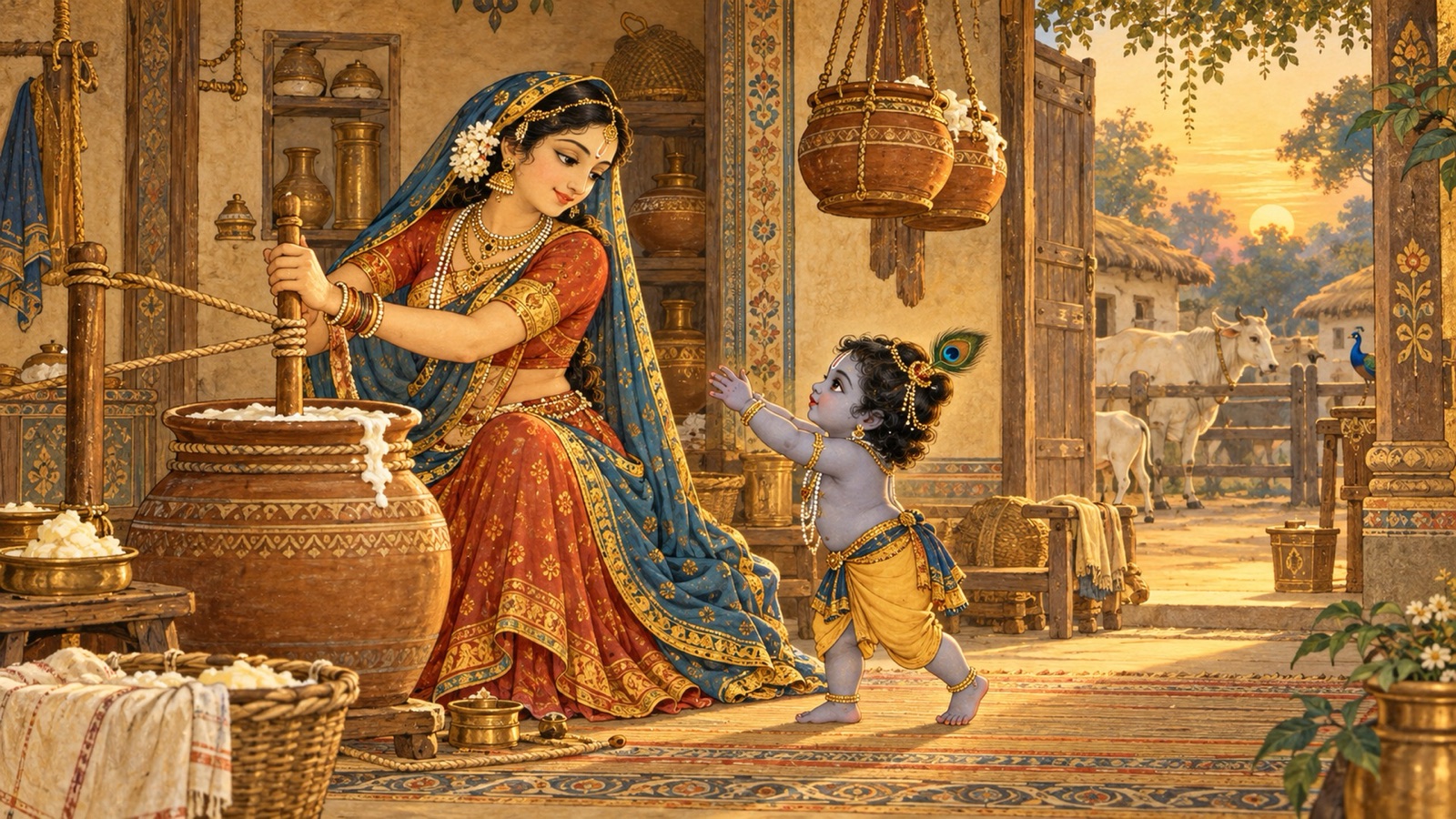
While she was thus absorbed, the infant Krishna, wishing to be nursed, came to His churning mother, and taking hold of the churning-rod with His little hands, He lovingly stopped her work — filling her heart with delight.
तां स्तन्यकाम आसाद्य मथ्नन्तीं जननीं हरि: ।
गृहीत्वा दधिमन्थानं न्यषेधत् प्रीतिमावहन् ॥ ४ ॥
tāṁ stanya-kāma āsādya mathnantīṁ jananīṁ hariḥ gṛhītvā dadhi-manthānaṁ nyaṣedhat prītim āvahan
Meaning: Wishing to be nursed, the child Hari approached His mother as she was churning, and taking hold of the churning-rod, He stopped her, bringing her great delight. (Canto 10, Chapter 9, verse 4)
The Broken Pot and the Stolen Butter
Yasoda lifted her son onto her lap and gave Him her breast, gazing with a smile upon His lovely face. But just then she noticed the milk on the stove boiling over, and setting the still-unsatisfied child down, she hurried away to attend to it. The little Lord, His desire interrupted, grew angry; His reddish lips quivered, and biting the curd-pot with His teeth, He broke it open with a stone. Then, shedding make-believe tears, He slipped quietly into an inner room and began to eat the freshly churned butter.
सञ्जातकोप: स्फुरितारुणाधरं
सन्दश्य दद्भिर्दधिमन्थभाजनम् ।
भित्त्वा मृषाश्रुर्दृषदश्मना रहो
जघास हैयङ्गवमन्तरं गत: ॥ ६ ॥
sañjāta-kopaḥ sphuritāruṇādharaṁ sandaśya dadbhir dadhi-mantha-bhājanam bhittvā mṛṣāśrur dṛṣad-aśmanā raho jaghāsa haiyaṅgavam antaraṁ gataḥ
Meaning: His anger roused and His reddish lips quivering, He bit the curd-pot with His teeth and broke it with a stone; then, shedding false tears, He slipped into a room and ate the freshly churned butter. (Canto 10, Chapter 9, verse 6)
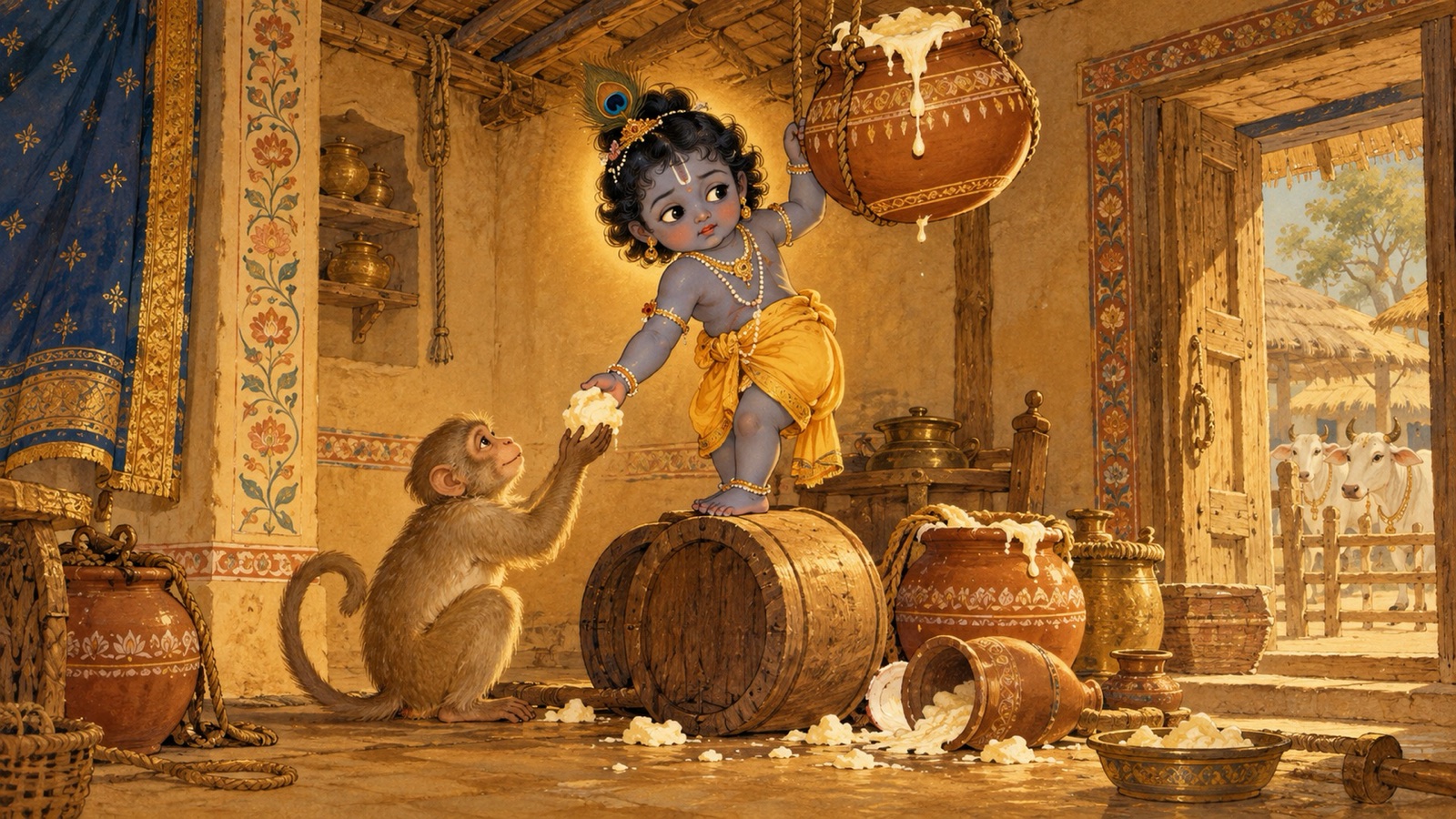
Having taken the boiled milk off the fire, Yasoda returned to find the curd-pot shattered. She understood at once that this was her son’s doing, and though she did not see Him anywhere, she could not help laughing at his mischief. Soon she found Him: He had climbed upon an upturned wooden mortar and was cheerfully handing out the butter from a hanging pot to a monkey, all the while glancing about with anxious eyes, as though fearful of being caught. Yasoda approached Him quietly from behind.
उलूखलाङ्घ्रेरुपरि व्यवस्थितं
मर्काय कामं ददतं शिचि स्थितम् ।
हैयङ्गवं चौर्यविशङ्कितेक्षणं
निरीक्ष्य पश्चात् सुतमागमच्छनै: ॥ ८ ॥
ulūkhalāṅghrer upari vyavasthitaṁ markāya kāmaṁ dadataṁ śici sthitam haiyaṅgavaṁ caurya-viśaṅkitekṣaṇaṁ nirīkṣya paścāt sutam āgamac chanaiḥ
Meaning: She saw her son standing upon an overturned mortar, freely handing the butter from a hanging pot to a monkey, his eyes darting about in fear of being caught for his theft; then she came up behind Him softly. (Canto 10, Chapter 9, verse 8)
The Loving Pursuit
The moment Krishna caught sight of His mother coming with a stick in her hand, He leapt down and fled as though truly afraid — He whom even great yogis, purified by long penance, cannot reach with their minds. Yasoda ran after her son. Slowed by her slender waist and the weight of her hips, her hair coming loose and the flowers falling from it, she at last caught hold of Him. Seeing the guilty little one weeping and rubbing his eyes with his hands — smearing the black collyrium across his face — and looking up at her with eyes bewildered by fear, she took Him by the hand and gently scolded Him, threatening Him only to correct His mischief.
Then, casting aside the stick and seeing how frightened her son had become, the affectionate mother — who did not know the true greatness of her child — decided instead to bind Him to the wooden grinding mortar, as one might tie down any ordinary restless child.
The Rope Ever Short by Two Fingers
Here the Bhagavatam pauses to remind us who this ‘ordinary child’ truly is. He has no inside and no outside, no beginning and no end; He is Himself the beginning and the end, the outside and the inside, of the whole world — indeed, He is the world itself. Thinking this very Lord, unmanifest and beyond the reach of the senses, to be simply her little son, Yasoda set out to tie Him with a rope.
न चान्तर्न बहिर्यस्य न पूर्वं नापि चापरम् ।
पूर्वापरं बहिश्चान्तर्जगतो यो जगच्च य: ॥ १३ ॥
तं मत्वात्मजमव्यक्तं मर्त्यलिङ्गमधोक्षजम् ।
गोपिकोलूखले दाम्ना बबन्ध प्राकृतं यथा ॥ १४ ॥
na cāntar na bahir yasya na pūrvaṁ nāpi cāparam pūrvāparaṁ bahiś cāntar jagato yo jagac ca yaḥ taṁ matvātmajam avyaktam martya-liṅgam adhokṣajam gopikolūkhale dāmnā babandha prākṛtaṁ yathā
Meaning: He who has no inside or outside, no before or after; who is Himself the before and after, the outside and inside, of the whole world, and who is the world itself — thinking that unmanifest, imperishable Lord, beyond the senses, to be her own son, the gopi bound Him to the grinding mortar with a rope, as one would bind an ordinary child. (Canto 10, Chapter 9, verses 13-14)
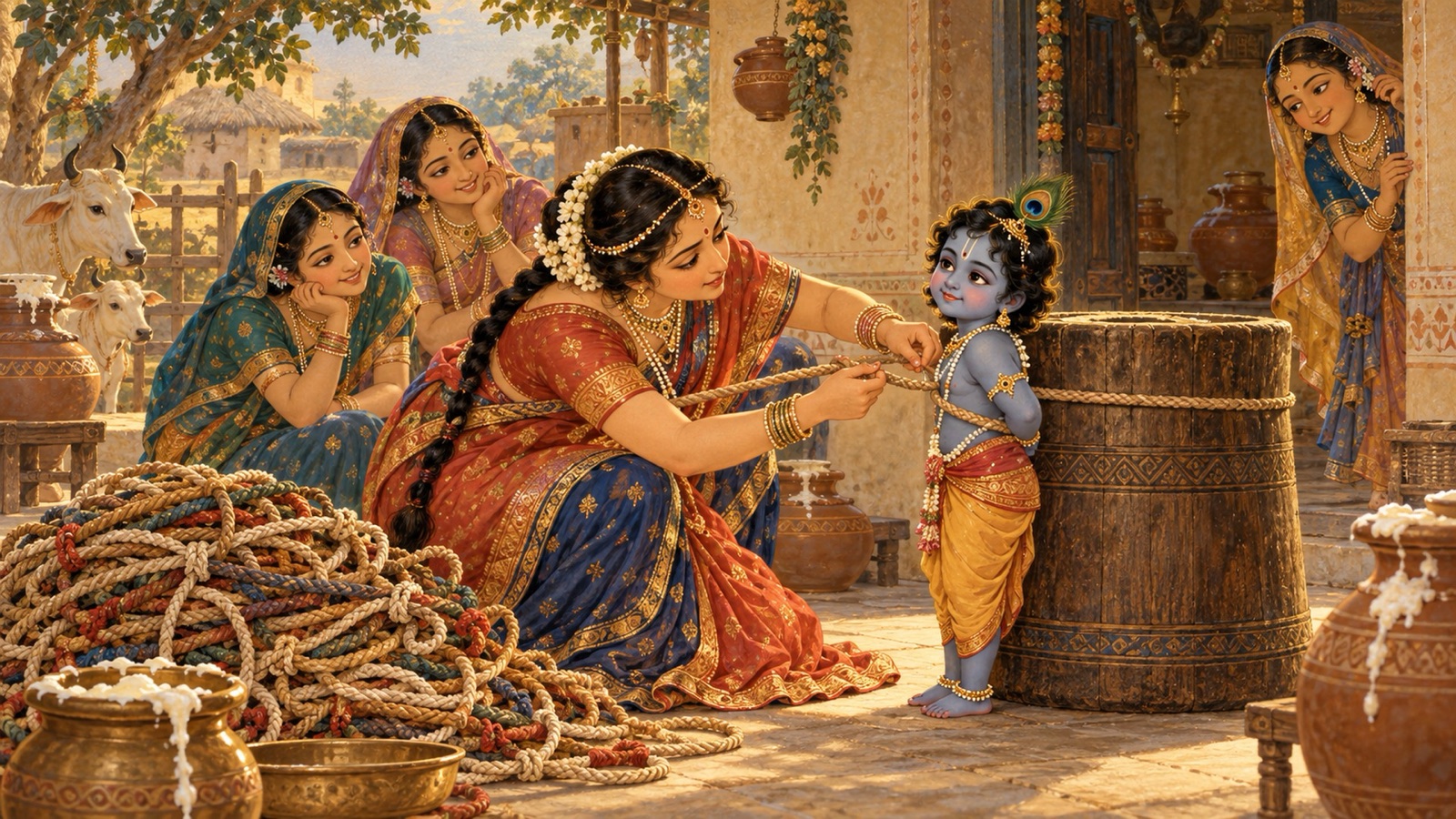
But when she tried to fasten the rope around her guilty little boy, it fell short by the width of two fingers. So she joined another rope to it — and that too was short by two fingers. She added another, and another, gathering together every rope in the house; yet however many she tied together, each time the rope was short by exactly two fingers. The gopis who had gathered to watch began to smile, and Yasoda herself, perspiring and with the garland fallen from her loosened hair, was filled with wonder.
तद् दाम बध्यमानस्य स्वार्भकस्य कृतागस: ।
द्व्यङ्गुलोनमभूत्तेन सन्दधेऽन्यच्च गोपिका ॥ १५ ॥
tad dāma badhyamānasya svārbhakasya kṛtāgasaḥ dvy-aṅgulonam abhūt tena sandadhe ’nyac ca gopikā
Meaning: But the rope she used to bind her guilty little son fell short by the width of two fingers, so the gopi joined another rope to it. (Canto 10, Chapter 9, verse 15)
The Lord Conquered by Love
At last, seeing His mother’s body bathed in perspiration, the flowers slipping from her hair, and all the weariness of her fruitless labour, the child Krishna took pity on her and, of His own free will, allowed Himself to be bound. In this the Lord revealed a great secret: He who holds within His control the entire universe, along with all its rulers, permits Himself to be controlled by the pure love of His devotees. He is conquered not by power, but by love alone.
स्वमातु: स्विन्नगात्राया विस्रस्तकबरस्रज: ।
दृष्ट्वा परिश्रमं कृष्ण: कृपयासीत् स्वबन्धने ॥ १८ ॥
sva-mātuḥ svinna-gātrāyā visrasta-kabara-srajaḥ dṛṣṭvā pariśramaṁ kṛṣṇaḥ kṛpayāsīt sva-bandhane
Meaning: Seeing His mother’s body bathed in perspiration, the garland slipping from her loosened hair, and all her weariness, Krishna out of compassion allowed Himself to be bound. (Canto 10, Chapter 9, verse 18)
Sukadeva marvels that neither Brahma the creator, nor Lord Shiva, nor even the goddess Lakshmi who ever rests upon the Lord’s chest, obtained the grace that this simple cowherd mother received from the giver of liberation. For the Supreme Lord, who had become the son of a gopi, is not so easily attained by those absorbed in the body, nor even by the wise and the self-realized, as He is by those whose hearts are full of loving devotion.
नायं सुखापो भगवान्देहिनां गोपिकासुत: ।
ज्ञानिनां चात्मभूतानां यथा भक्तिमतामिह ॥ २१ ॥
nāyaṁ sukhāpo bhagavān dehināṁ gopikā-sutaḥ jñānināṁ cātma-bhūtānāṁ yathā bhaktimatām iha
Meaning: This Supreme Lord, the son of the gopi, is not so easily attained by embodied souls, nor even by sages and the self-realized, as He is by those who are full of loving devotion. (Canto 10, Chapter 9, verse 21)
The Glance Toward the Two Trees
Bound to the mortar and left alone while His mother returned to her household chores, the Lord turned His gaze toward two great twin arjuna trees that stood close together in the courtyard. These trees, Sukadeva reveals, were no ordinary trees. They had once been Nalakuvara and Manigriva, the two opulent sons of Kubera, the treasurer of the gods; long ago, intoxicated with pride and wealth, they had been cursed by the sage Narada and turned into trees. Now the child bound by His mother’s love looked toward them — and in that quiet glance lay the promise of their deliverance, the story that the next chapter will unfold.
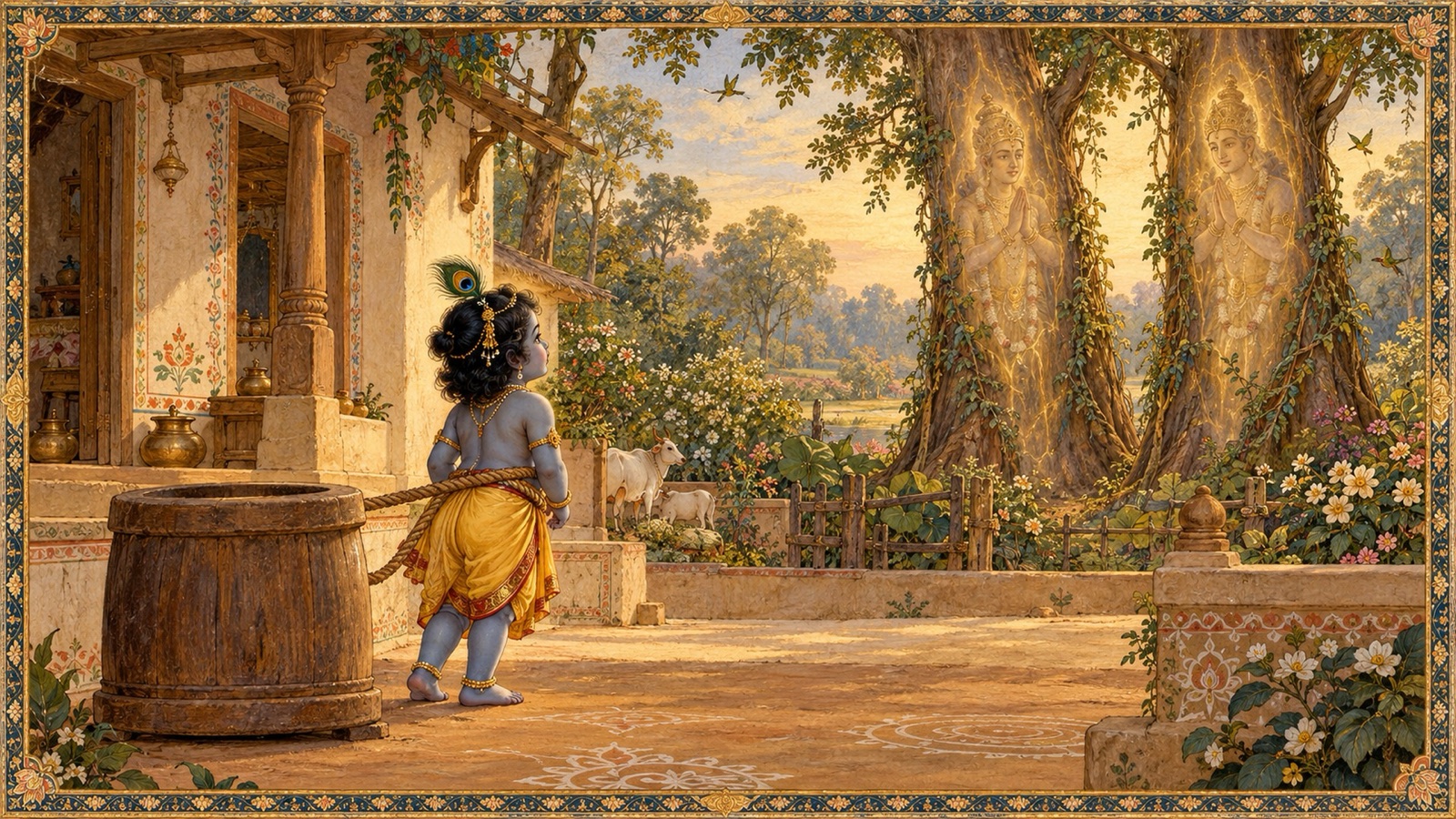
कृष्णस्तु गृहकृत्येषु व्यग्रायां मातरि प्रभु: ।
अद्राक्षीदर्जुनौ पूर्वं गुह्यकौ धनदात्मजौ ॥ २२ ॥
पुरा नारदशापेन वृक्षतां प्रापितौ मदात् ।
नलकूवरमणिग्रीवाविति ख्यातौ श्रियान्वितौ ॥ २३ ॥
kṛṣṇas tu gṛha-kṛtyeṣu vyagrāyāṁ mātari prabhuḥ adrākṣīd arjunau pūrvaṁ guhyakau dhanadātmajau purā nārada-śāpena vṛkṣatāṁ prāpitau madāt nalakūvara-maṇigrīvāv iti khyātau śriyānvitau
Meaning: While His mother was busy with household chores, the Lord Krishna caught sight of the two arjuna trees which had formerly been the two guhyakas, sons of Kubera the treasurer of the gods. Long ago, intoxicated with pride, they had by the curse of the sage Narada been made into trees; these two, endowed with great opulence, were known as Nalakuvara and Manigriva. (Canto 10, Chapter 9, verses 22-23)
Principal Teachings of This Chapter
1. The Infinite consents to be bound by love. He who has neither inside nor outside, who contains the whole world, allows a mother’s rope to hold Him (verses 13-18). The Lord cannot be seized by force or knowledge, but He surrenders willingly to pure affection.
2. The name Damodara is a name of grace. From dāma (rope) and udara (belly), Krishna becomes Damodara, the Lord bound about the waist. His most exalted names arise not from His conquests but from His sweet submission to His devotees’ love.
3. The rope short by two fingers. The rope that could never quite reach around Him (verses 15-16) teaches that our own effort always falls a little short; the Lord is bound only when our labour of love is joined with His answering grace.
4. Devotion surpasses even the greatest. Yasoda received what Brahma, Shiva, and Lakshmi did not (verses 20-21). Loving devotion draws the Lord nearer than power, austerity, or philosophical knowledge ever can.
5. Even the Lord’s mischief is mercy. The butter-theft, the false tears, the flight and the binding are all the Lord’s play, drawing His devotees into ever deeper intimacy and preparing, at the chapter’s close, the liberation of two fallen souls.
A Devotional Reflection
There is something almost unbearably tender in the sight of the Supreme Lord allowing Himself to be tied to a grinding mortar by a mother who does not fully know who He is. The rope that keeps falling short by two fingers is one of the most gentle teachings in all of scripture: our efforts, however sincere, can never quite encircle the Infinite; something is always missing — and that something is His grace, which He gives freely the moment He sees our loving exhaustion. Yasoda does not bind Krishna by the strength of her ropes; she binds Him by the sweat on her brow and the love in her heart, and He, seeing it, ties Himself. This is the whole secret of devotion. We are not asked to be strong enough or wise enough to capture God. We are only asked to love Him with everything we have, until He, moved by that love, lets Himself be caught. The Lord who cannot be reached by the austerities of yogis runs, laughing and afraid, into the arms of a mother who simply loves Him.
A Daily Devotional Practice
Today, meditate on the sweet name Damodara — the Lord who allowed Himself to be bound by love. As you go about your work, offer each small labour of your day, however humble, as Yasoda offered her churning: as an act of love for the Lord, trusting that where your strength falls short by two fingers, His grace will complete the binding. Begin by chanting gently: Om Namo Bhagavate Vasudevaya.
Conclusion
The ninth chapter of the Tenth Canto gives us the pastime that names the Lord Damodara and reveals the deepest law of His heart: that the Supreme Being, unreachable by force, austerity, or knowledge, is easily and joyfully conquered by pure love. Yasoda churns her butter and sings of her son; the child breaks the pot and steals the butter and runs; the mother pursues Him and, unable to bind Him with all the ropes of her house, binds Him at last only because He wills it. In her tired, loving hands the infinite Lord becomes a captive of affection, and Sukadeva declares that her fortune surpassed even that of Brahma, Shiva, and Lakshmi. As the chapter ends, the bound child looks toward two great trees, and we sense that His love is about to reach even two proud souls fallen under a sage’s curse. May we, hearing of the Lord who let Himself be bound, learn to hold Him fast with the one rope He can never resist — the rope of love.
May the divine wisdom of Srimad Bhagavatam awaken pure devotion within our hearts.
Om Namo Bhagavate Vasudevaya.
Jay Shree Madhav.
References and Attribution
- Primary edition: Gita Press, Śrīmad Bhāgavata Mahāpurāṇa (Sanskrit-Hindi, Volume 2), Book Ten (First Half), Discourse 9.
- Series: Srimad Bhagavatam Wisdom · Biswa Sanatan Dharma Seva Trust.
- Presented following the spiritual guidance and recommendation of Pandit Dr. Shri Kashinath Mishra.
This is an original, faithful retelling in the writer’s own words, with brief quoted verses shown in Devanāgarī and transliteration and their meanings given as summaries. It is not a reproduction of any single publisher’s continuous translation or commentary. No affiliation with or endorsement by any publisher is implied.
Jay Shree Madhav