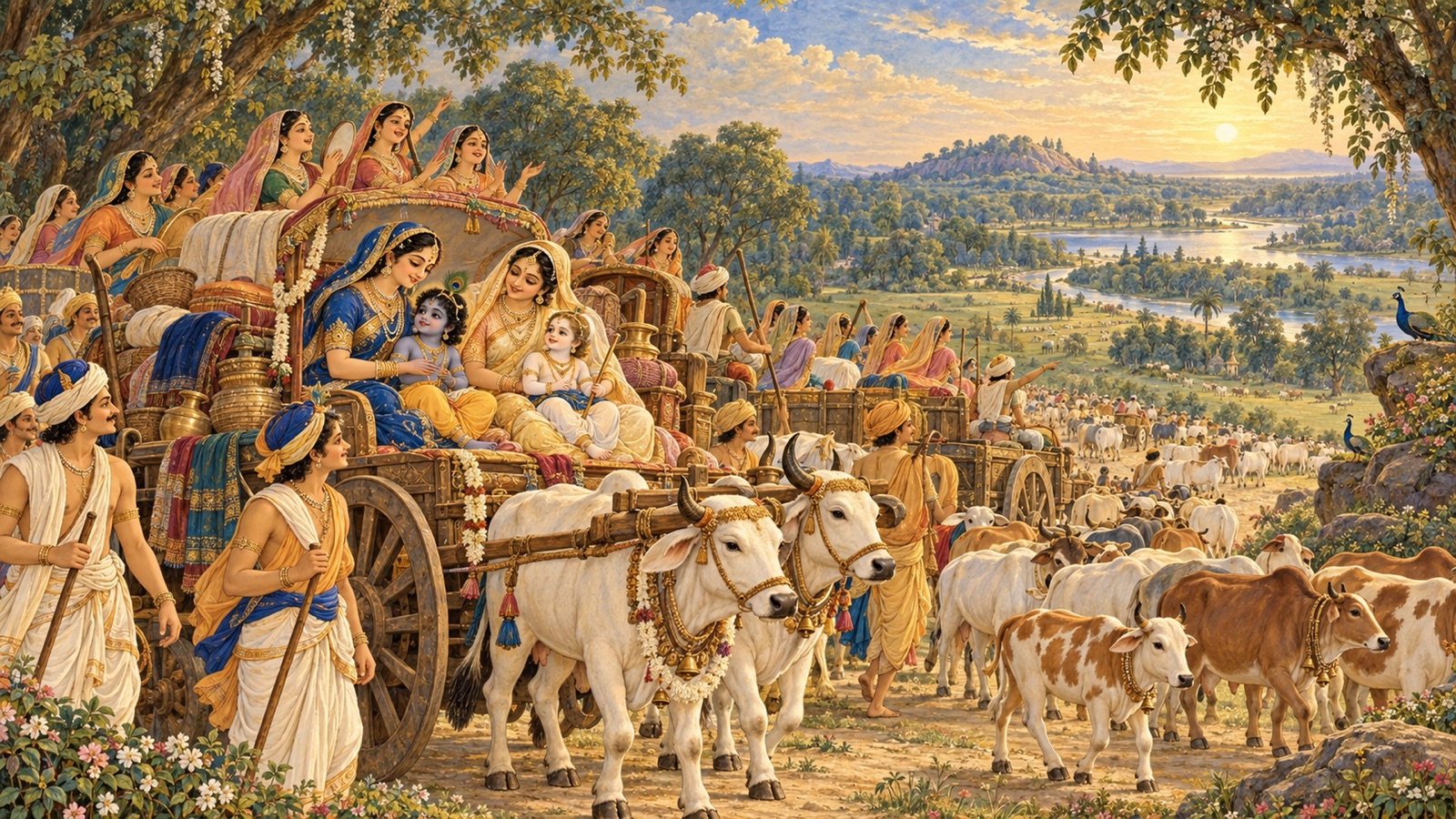
Seeking safety for their children, the cowherds of Vraja load their carts and journey to Vrindavana, the cattle going before them and the gopis singing of Krishna’s pastimes along the way.
Om Namo Bhagavate Vasudevaya.
Om Namo Bhagavate Vasudevaya.
Om Namo Bhagavate Vasudevaya.
Welcome back to Srimad Bhagavatam Wisdom, our devotional journey through the sacred histories and teachings of the Srimad Bhagavat Mahapurana. This eleventh chapter of the Tenth Canto gathers a garland of childhood pastimes. The cowherds, running to the sound of the falling trees, find the child bound to the mortar, and Nanda smilingly frees Him. Krishna plays like any little one, dancing and singing at the gopis’ bidding; a fruit-seller who fills His hands with fruit finds her basket brimming with jewels; and mother Yasoda calls her tired sons home. Then, alarmed by the many dangers that have beset the children in Gokula, the elders resolve to move the whole community to the fresh forest of Vrindavana. There the two Boys grow into calf-herds, and there Krishna delivers the demon Vatsasura, who came disguised as a calf, and Bakasura, the monstrous crane — until all of Vraja marvels that the words of the sage Garga have come true.
Chapter Information
- Scripture: Śrīmad Bhāgavata Mahāpurāṇa
- Canto: 10 (Book Ten, First Half)
- Chapter: 11 (Discourse 11)
- Chapter title: Childhood Pastimes and the Move to Vrindavana
- Principal speaker: Sukadeva Gosvami (narrating to King Parikshit)
- Principal listener: King Parikshit
- Main setting: Gokula and, thereafter, the forest of Vrindavana in Vraja
- Central subject: The freeing of Krishna from the mortar; His sweet childhood pastimes and the fruit-seller’s jewels; Yasoda’s calling of her sons; the community’s migration to Vrindavana; and the slaying of the demons Vatsasura and Bakasura
- Principal verse range: Canto 10, Chapter 11, verses 1–59
- Primary edition: Gita Press Śrīmad Bhāgavata Mahāpurāṇa (Sanskrit-Hindi, Volume 2)
Context From the Previous Chapter
In Chapter 10, the child Krishna, bound to a wooden mortar, crawled between the twin arjuna trees and uprooted them, liberating Nalakuvara and Manigriva, the two sons of Kubera cursed by Narada. This chapter opens with the cowherds rushing to the great crash, and follows Krishna’s childhood through the move to Vrindavana and the first of His demon-slaying pastimes.
The Fallen Trees and the Freeing of the Child
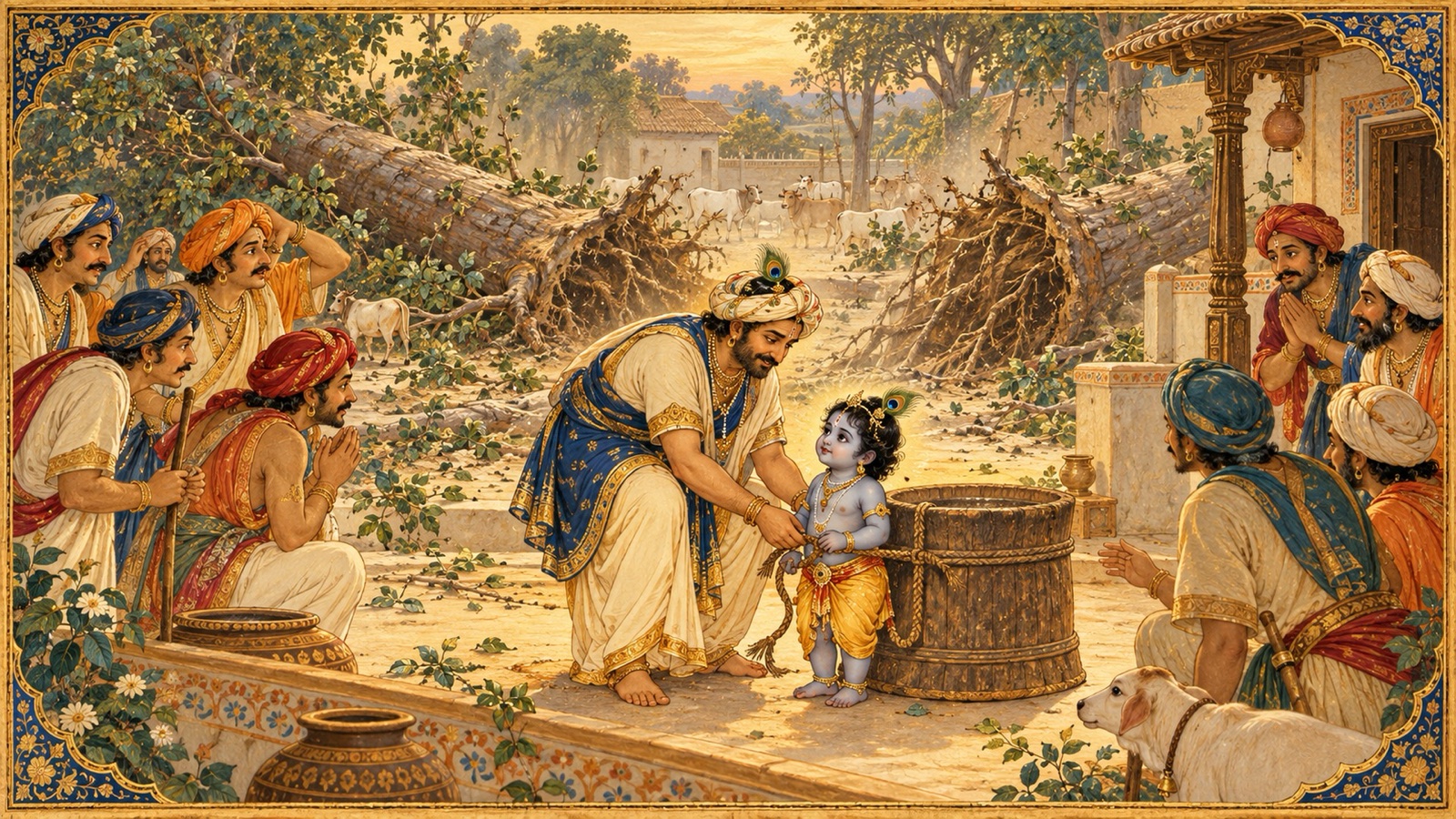
Hearing the thunderous crash of the falling trees, Nanda and the cowherds ran fearfully to the spot, thinking a lightning-bolt had struck. There they found the two great arjuna trees lying uprooted on the ground, yet could not make out the cause of their fall. The small children playing nearby told them the truth — that the little one, dragging the mortar tied to Him, had passed between the trees and pulled them down, and that two shining men had come forth. The elders, unable to believe that a mere infant could uproot such trees, stood doubtful and bewildered. Nanda, seeing his son still tied to the mortar, smiled with wonder and lovingly untied Him.
Sweet Pastimes and the Fruit-Seller’s Jewels
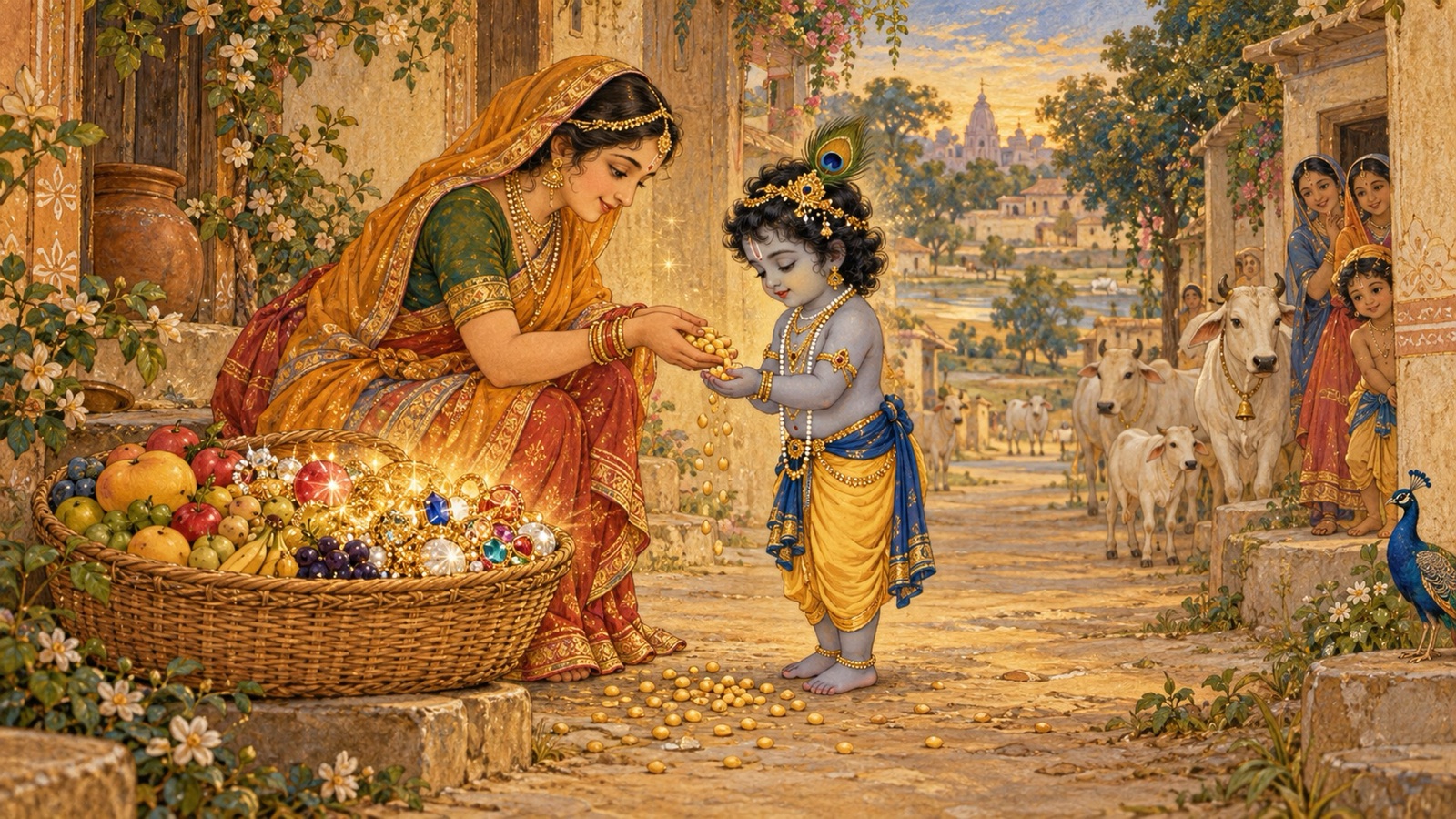
As Krishna grew, He delighted the whole of Vraja with His childish play. Coaxed by the gopis, He would dance, or suddenly sing, or carry a stool or measuring-pot when told, moving as though He were a little wooden puppet in their hands — the Supreme Lord revealing, to those who could understand, His sweet submission to His devotees. One day a fruit-seller woman came calling her wares. Hearing ‘Buy fruits!’, the infant Lord — who is Himself the giver of all fruits — eagerly gathered a few grains of corn in His tiny palms to barter and ran to her. Though most of the grains slipped through His little fingers on the way, the fruit-seller lovingly filled His hands with fruit; and in that moment her fruit-basket was filled to the brim with jewels.
फलविक्रयिणी तस्य च्युतधान्यकरद्वयम् ।
फलैरपूरयद् रत्नै: फलभाण्डमपूरि च ॥ ११ ॥
phala-vikrayiṇī tasya cyuta-dhānya-kara-dvayam phalair apūrayad ratnaiḥ phala-bhāṇḍam apūri ca
Meaning: The fruit-seller filled with fruit the two little hands of the Lord, from which the grains had mostly spilled; and her fruit-basket was filled with jewels. (Canto 10, Chapter 11, verse 11)
Yasoda Calls Her Sons Home
One day, when Krishna and Balarama were playing far too long with the other boys by the river, Rohini called them to come and eat; but the two, absorbed in their games, would not come. So Rohini sent Yasoda, whose love for her son was even deeper. Her breasts flowing with affection, Yasoda called out to Krishna with all the tenderness of a mother’s heart.
कृष्ण कृष्णारविन्दाक्ष तात एहि स्तनं पिब ।
अलं विहारै: क्षुत्क्षान्त: क्रीडाश्रान्तोऽसि पुत्रक ॥ १५ ॥
kṛṣṇa kṛṣṇāravindākṣa tāta ehi stanaṁ piba alaṁ vihāraiḥ kṣut-kṣāntaḥ krīḍā-śrānto ’si putraka
Meaning: Krishna, Krishna, lotus-eyed one! Dear child, come and drink at My breast. Enough of play — You are faint with hunger and tired from Your games, my little son. (Canto 10, Chapter 11, verse 15)
She reminded Him that it was the day of His birth-star, that He should bathe, give cows in charity to the brahmanas, and see how His well-groomed little friends were already bathed and adorned. Taking the crest-jewel of all beings simply for her own dear son, her mind bound by love, Yasoda led Krishna and Balarama home by the hand and saw to their bathing and adornment.
The Migration to Vrindavana
Meanwhile the elder cowherds, disturbed by the many great portents and dangers that had befallen the children in Gokula, gathered to take counsel for the welfare of Vraja. Among them the wise elder Upananda, learned in time and place and dear to Rama and Krishna, spoke. He recounted the perils the children had survived — the child-killing demoness, the overturned cart, the whirlwind-demon, and now the falling trees — and urged that, for the sake of the children, they should leave Gokula. He proposed a fresh and beautiful forest, rich in pasture and hills and herbs, fit for the cows and the cowherd folk: the forest called Vrindavana.
वनं वृन्दावनं नाम पशव्यं नवकाननम् ।
गोपगोपीगवां सेव्यं पुण्याद्रितृणवीरुधम् ॥ २८ ॥
vanaṁ vṛndāvanaṁ nāma paśavyaṁ nava-kānanam gopa-gopī-gavāṁ sevyaṁ puṇyādri-tṛṇa-vīrudham
Meaning: There is a forest named Vrindavana, a fresh woodland excellent for cattle, worthy to be enjoyed by the cowherd men, the cowherd women, and the cows, abounding in sacred hills, grass, and herbs. (Canto 10, Chapter 11, verse 28)
The cowherds agreed with one voice, and that very day they yoked their carts and set out. The cattle were driven ahead; the elders, children, women, and all their goods were loaded onto the carts; the herdsmen, bows in hand, surrounded them, and to the great blowing of horns and trumpets they journeyed forth with their family priests. The gopis, seated in the wagons and beautifully dressed, sang of Krishna’s pastimes with love; and Yasoda and Rohini rode together in one cart with Krishna and Balarama, eager to hear those very songs. Entering Vrindavana, ever pleasant in every season, they arranged their wagons in the form of a half-moon and made their new dwelling; and beholding Vrindavana, Govardhana Hill, and the sandy banks of the Yamuna, Rama and Krishna felt the greatest delight.
The Killing of Vatsasura
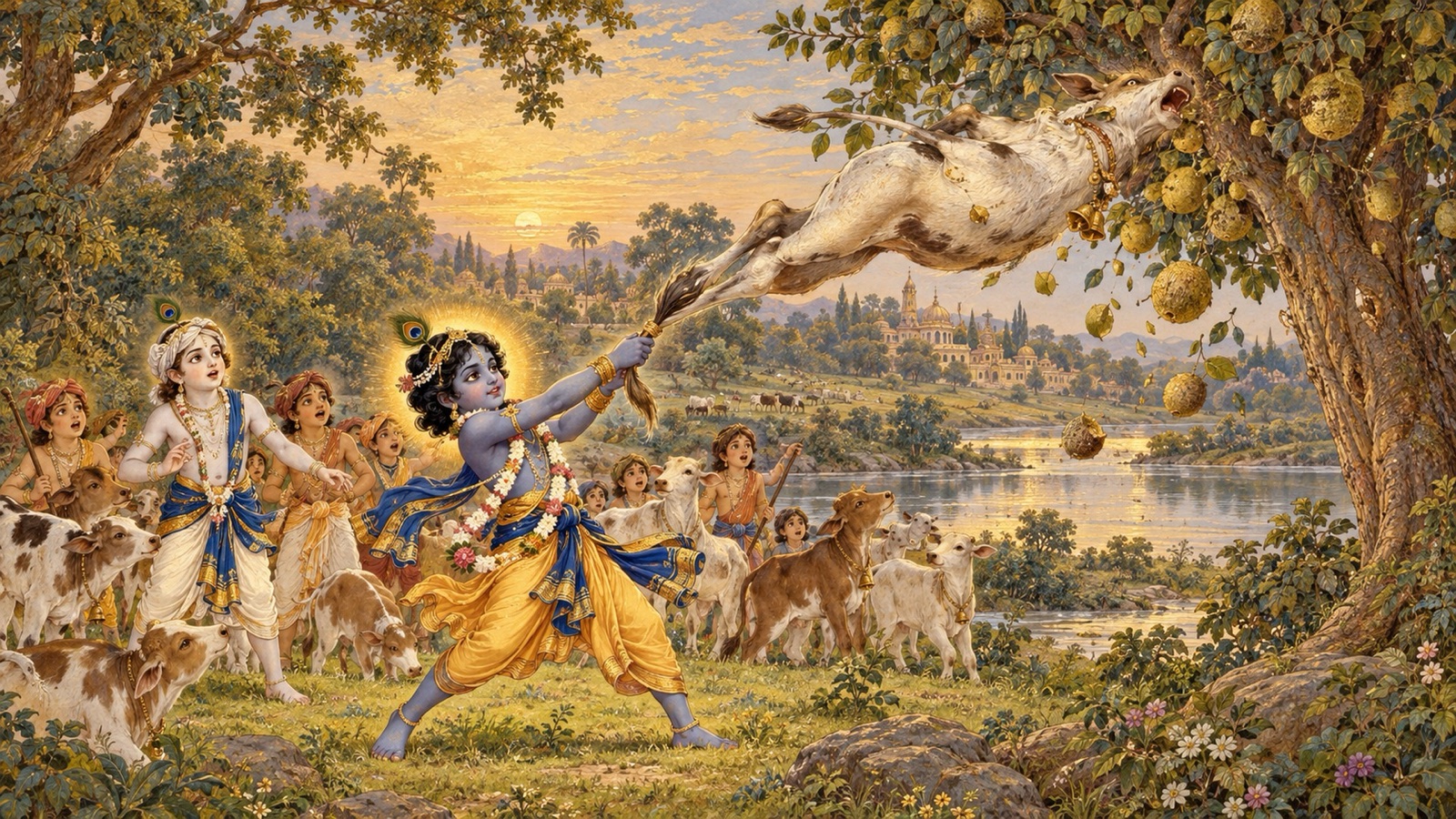
In time the two Boys became keepers of the calves, wandering not far from Vraja with the other cowherd boys, playing endless games — piping on the flute, flinging fruit with slings, tinkling the little bells on their feet, and imitating bulls and animals and birds, roaming as though they were quite ordinary children. One day, as they tended the calves by the Yamuna, a demon came, intent on killing Krishna, disguised as a calf and mingling with the herd. Krishna spotted him, quietly pointed him out to Balarama, and approached as if unsuspecting.
गृहीत्वापरपादाभ्यां सहलाङ्गूलमच्युत: ।
भ्रामयित्वा कपित्थाग्रे प्राहिणोद्गतजीवितम् ।
स कपित्थैर्महाकाय: पात्यमानै: पपात ह ॥ ४३ ॥
gṛhītvāpara-pādābhyāṁ saha-lāṅgūlam acyutaḥ bhrāmayitvā kapitthāgre prāhiṇod gata-jīvitam sa kapitthair mahā-kāyaḥ pātyamānaiḥ papāta ha
Meaning: Seizing the demon by the hind legs together with its tail, the infallible Lord whirled it around and flung it into the top of a wood-apple tree, taking its life; and the great body fell, bringing down the wood-apples with it. (Canto 10, Chapter 11, verse 43)
At this the astonished boys cried out ‘Well done! Well done!’, and the gods, well pleased, showered flowers upon the child who protects all the worlds.
The Killing of Bakasura
On another day the boys led their calves to a reservoir to drink, and after the calves had drunk they drank the water themselves. There they saw a huge creature, like a broken mountain-peak fallen to the earth, and were frightened. It was the mighty demon Bakasura in the form of a gigantic crane; rushing suddenly upon Krishna, it seized Him in its sharp beak and swallowed Him. Seeing Krishna swallowed by the great crane, Balarama and the other boys became senseless, like the senses bereft of the life-air. But Krishna scorched the demon’s throat like fire, so that the crane at once vomited Him out unharmed and, enraged, struck at Him again with its beak.
तमापतन्तं स निगृह्य तुण्डयो-
र्दोर्भ्यां बकं कंससखं सतां पति: ।
पश्यत्सु बालेषु ददार लीलया
मुदावहो वीरणवद् दिवौकसाम् ॥ ५१ ॥
tam āpatantaṁ sa nigṛhya tuṇḍayor dorbhyāṁ bakaṁ kaṁsa-sakhaṁ satāṁ patiḥ paśyatsu bāleṣu dadāra līlayā mudāvaho vīraṇavad divaukasām
Meaning: As the crane rushed upon Him again, the Lord of the saints seized it by the two halves of its beak, and before the watching boys split apart that friend of Kamsa as easily as a blade of grass, bringing joy to the dwellers of heaven. (Canto 10, Chapter 11, verse 51)
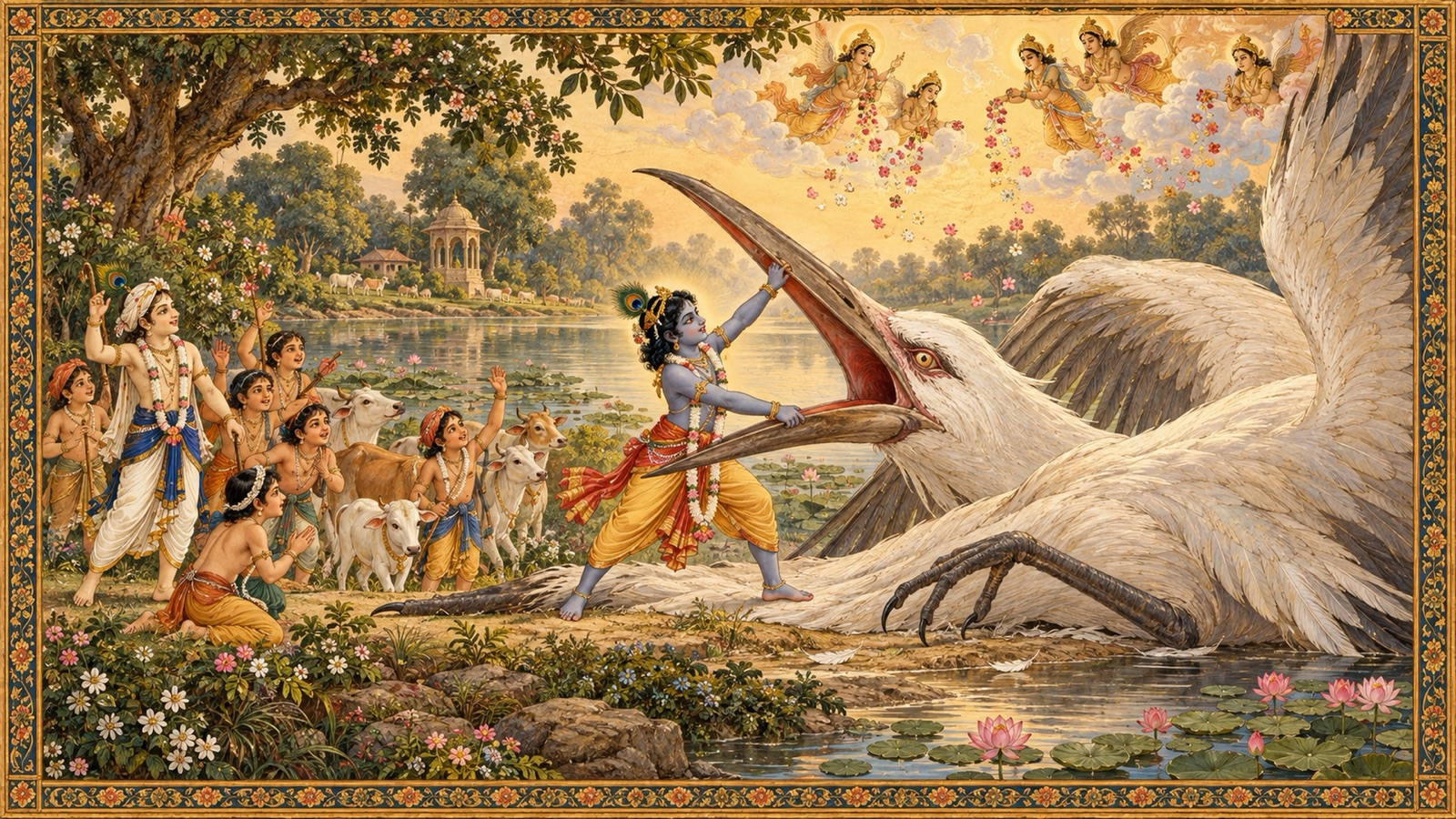
The residents of heaven scattered jasmine and other blossoms from the celestial garden upon the enemy of Baka, and praised Him with kettledrums, conches, and hymns; and the cowherd boys were filled with wonder. Recovering Krishna from the crane’s mouth as the senses recover the life-air, the boys embraced Him joyfully, gathered their calves, and returned to Vraja, singing of the deed.
The Wonder of Vraja
Hearing the story, the cowherds and gopis, filled with love, gazed upon Krishna with thirsting eyes, as though He had returned from the dead. They marvelled that so many deaths had come upon this one child, and wondered aloud what wrong they might once have done to deserve such fear; yet, they saw, the fearsome ones who came to kill Him only perished themselves, like moths falling into a flame. And they remembered the words of the sage Garga, and understood that they were coming true before their very eyes.
अहो ब्रह्मविदां वाचो नासत्या: सन्ति कर्हिचित् ।
गर्गो यदाह भगवानन्वभावि तथैव तत् ॥ ५७ ॥
aho brahma-vidāṁ vāco nāsatyāḥ santi karhicit gargo yad āha bhagavān anvabhāvi tathaiva tat
Meaning: Ah, the words of the knowers of Brahman are never untrue! Whatever the venerable Garga foretold has come to pass exactly so. (Canto 10, Chapter 11, verse 57)
Thus Nanda and the cowherds, joyfully telling and hearing the stories of Krishna and Balarama, felt none of the sorrows of worldly life; and so the two Boys passed the years of their childhood in Vraja, at play with hide-and-seek, bridge-building, monkey-leaping, and countless other games.
Principal Teachings of This Chapter
1. The Lord submits Himself to His devotees. Krishna dances and sings and fetches at the gopis’ word, like a puppet in loving hands (verses 7-9). His greatness is veiled so that intimate love may play with Him.
2. The giver of all fruits accepts our little offering. The fruit-seller offers fruit for a few spilled grains and receives a basket of jewels (verse 11). Whatever small thing we give the Lord, He returns beyond all measure.
3. A mother’s love holds the Lord of all. Yasoda calls the crest-jewel of all beings simply as her hungry, tired little son (verses 14-20). Pure affection binds Him more surely than any knowledge of His glory.
4. Wise counsel protects the community. The move to Vrindavana, urged by the thoughtful elder Upananda (verses 21-28), shows the value of prudent, selfless guidance for the good of all.
5. The Lord protects His own; evil destroys itself. Vatsasura and Bakasura come to kill and are themselves destroyed (verses 41-51). Those who rush at the Lord in enmity perish like moths in a flame, while His devotees are ever safe.
A Devotional Reflection
This chapter moves gently between the tender and the terrible, and in doing so it teaches us how to see our own lives. The same child who lets a fruit-seller fill His hands, who comes running when His mother calls Him to drink milk, is the one who whirls a demon into a tree and splits a monster’s beak like a blade of grass. Danger after danger falls upon Him, and each time the danger is the one destroyed. The cowherds’ bewildered question — what did we do to deserve such fear? — is one we all ask when trouble crowds in. The Bhagavatam’s quiet answer is that where the Lord is present, the fearsome things that come against His own only consume themselves, like moths in a lamp. Our task is not to escape every danger by our own cleverness, but, like Nanda and Yasoda, to keep telling and hearing the stories of the Lord until, as the verse says, we no longer feel the sorrows of this world at all.
A Daily Devotional Practice
Today, follow the example of the cowherds who felt no worldly sorrow because they were always speaking and hearing of the Lord. Set aside a few minutes to read or recall one of Krishna’s childhood pastimes from this chapter, and share it with someone dear to you, as the boys of Vraja ran home to tell what they had seen. And when fear or worry presses upon you, remember that the fearsome ones perished like moths in flame while the child of Vraja remained untouched. Begin by chanting gently: Om Namo Bhagavate Vasudevaya.
Conclusion
The eleventh chapter of the Tenth Canto carries us from the courtyard of Gokula to the fresh forest of Vrindavana, weaving together the sweetest and the most heroic of Krishna’s childhood deeds. He is freed from the mortar, dances at the gopis’ word, fills a fruit-seller’s basket with jewels, and comes home at His mother’s call; and when the elders, mindful of the children’s safety, lead all of Vraja to Vrindavana, He grows into a herder of calves and delivers the demons Vatsasura and Bakasura who come to destroy Him. Through it all, danger turns upon itself and the words of the sages prove true, while Nanda and the cowherds, immersed in His stories, taste a joy the world cannot give. May we too learn to dwell so fully in the remembrance of the Lord that the fears of this world lose their power over us, and every small thing we offer Him is returned as a basket of jewels.
May the divine wisdom of Srimad Bhagavatam awaken pure devotion within our hearts.
Om Namo Bhagavate Vasudevaya.
Jay Shree Madhav.
References and Attribution
- Primary edition: Gita Press, Śrīmad Bhāgavata Mahāpurāṇa (Sanskrit-Hindi, Volume 2), Book Ten (First Half), Discourse 11.
- Series: Srimad Bhagavatam Wisdom · Biswa Sanatan Dharma Seva Trust.
- Presented following the spiritual guidance and recommendation of Pandit Dr. Shri Kashinath Mishra.
This is an original, faithful retelling in the writer’s own words, with brief quoted verses shown in Devanāgarī and transliteration and their meanings given as summaries. It is not a reproduction of any single publisher’s continuous translation or commentary. No affiliation with or endorsement by any publisher is implied.
Jay Shree Madhav