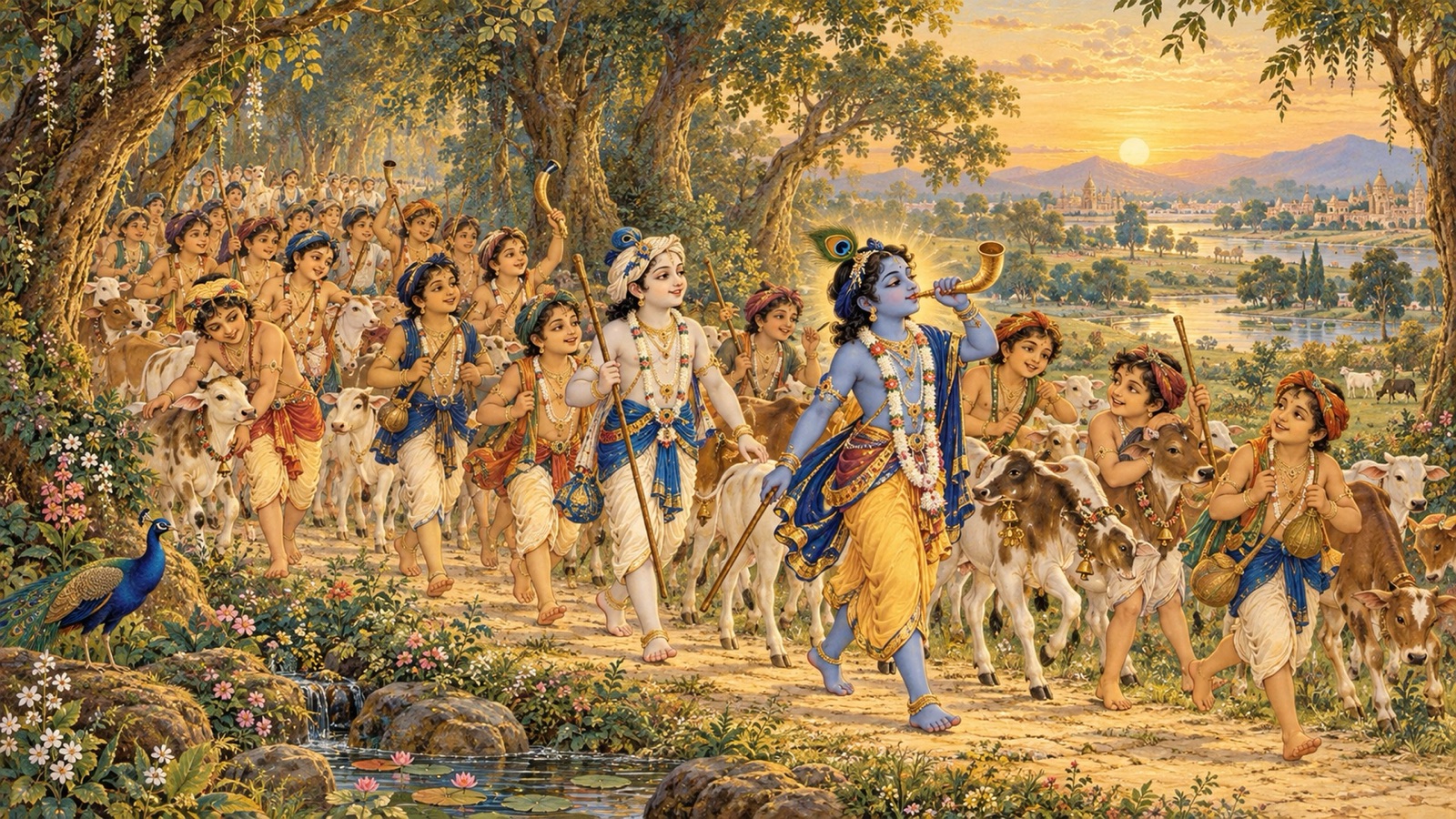
At dawn Krishna wakes His friends and calves with His horn and leads thousands of cowherd boys into the forest for a joyful picnic — the Lord whom yogis cannot reach, at play with the children of Vraja.
Om Namo Bhagavate Vasudevaya.
Om Namo Bhagavate Vasudevaya.
Om Namo Bhagavate Vasudevaya.
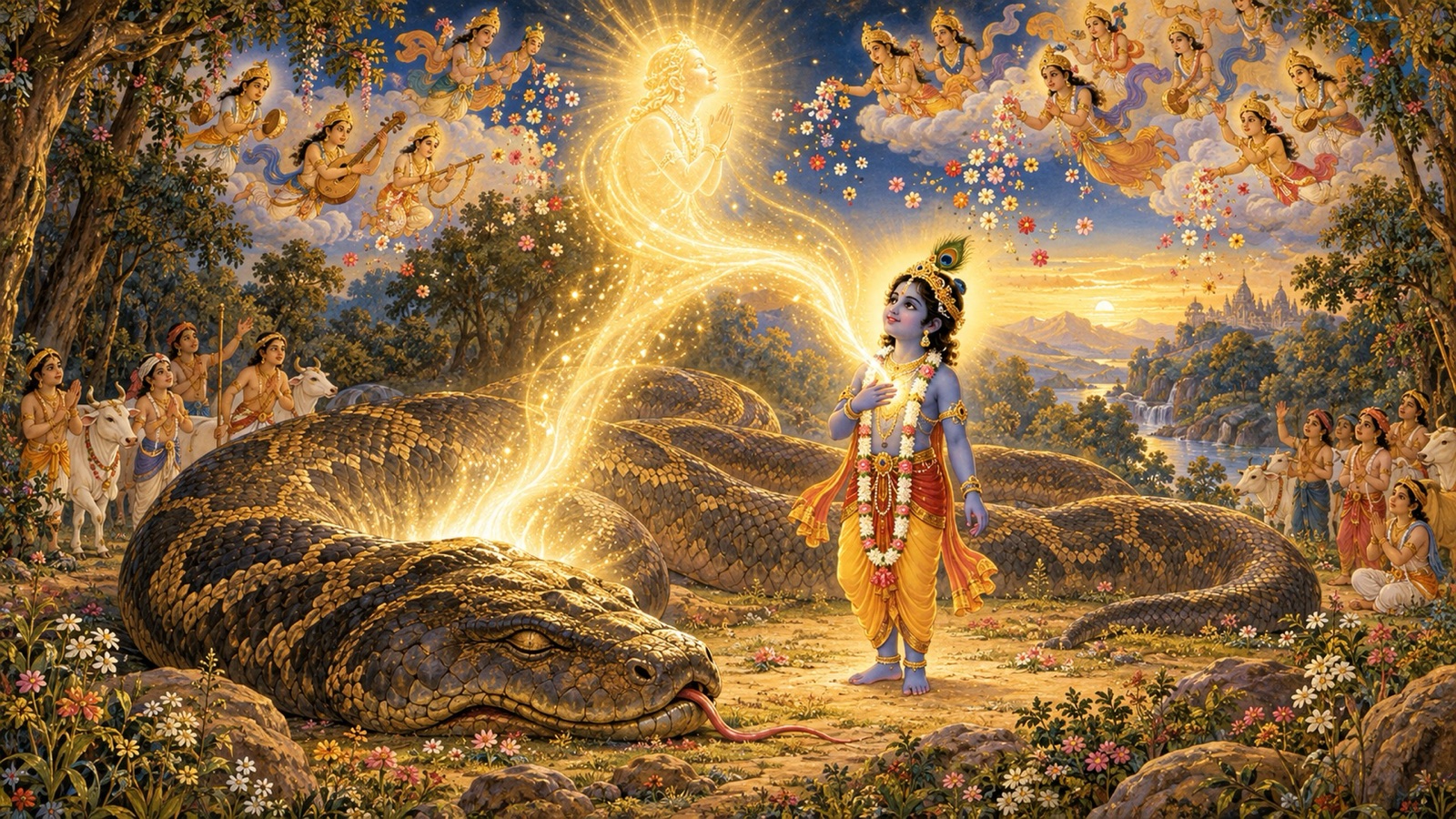
Welcome back to Srimad Bhagavatam Wisdom, our devotional journey through the sacred histories and teachings of the Srimad Bhagavat Mahapurana. This twelfth chapter of the Tenth Canto tells of a bright morning outing that turns into one of Krishna’s most astonishing pastimes. Rising at dawn, Krishna calls His cowherd friends and calves and leads thousands of boys into the forest for a picnic, filling the woods with music, games, and laughter. But the demon Aghasura — brother of the slain Putana and Bakasura and sent by Kamsa — takes the shape of a python a league long and lies across the path, his cave-like mouth agape to swallow them. Mistaking the mouth for a scenic cavern, the trusting boys walk in; and Krishna, dwelling in every heart, enters to save them, destroying the demon from within and leading all His friends safely out — while a wondrous light rises from the demon and merges into the Lord Himself.
Chapter Information
- Scripture: Śrīmad Bhāgavata Mahāpurāṇa
- Canto: 10 (Book Ten, First Half)
- Chapter: 12 (Discourse 12)
- Chapter title: The Killing of the Demon Aghasura
- Principal speaker: Sukadeva Gosvami (narrating to King Parikshit); related in turn by Suta Gosvami
- Principal listener: King Parikshit; the sages assembled at Naimisharanya
- Main setting: The forest and pastures of Vrindavana in Vraja
- Central subject: The dawn forest picnic of Krishna and the cowherd boys; the great fortune of the residents of Vraja; the demon Aghasura’s ambush as a python; the deliverance of the boys and calves; and the demon’s liberation by the Lord’s touch
- Principal verse range: Canto 10, Chapter 12, verses 1–44
- Primary edition: Gita Press Śrīmad Bhāgavata Mahāpurāṇa (Sanskrit-Hindi, Volume 2)
Context From the Previous Chapter
In Chapter 11, the community of Vraja moved to Vrindavana, where the two Boys became keepers of the calves, and Krishna slew the demons Vatsasura and Bakasura, brothers who came to destroy Him. This chapter continues those calf-herding days with a forest picnic and the coming of a third demon of that same family, Aghasura.
The Forest Picnic
One morning, wishing to picnic in the forest, Krishna rose at dawn and, blowing sweetly upon His horn, woke His cowherd friends and the calves. Thousands of boys came forth in delight, each driving his own calves before him, carrying his little bag and stick and horn and flute. Merging their countless calves into one great herd, the boys wandered here and there, playing childish games. Though already adorned with the fruits, flowers, peacock feathers, and coloured minerals of the forest, they decorated one another still more; they stole and hid each other’s lunch-bags and flung them far away, laughing, and gave them back; and whenever Krishna went ahead to look at the beauty of the woods, each boy vied to be the first to touch Him.
Sukadeva pauses in wonder at the fortune of these boys. The dust of the Lord’s feet, he says, cannot be attained even by great yogis who master themselves through the hardships of many births; yet that very Lord stood before the cowherd children as the visible object of their eyes and the companion of their play. How, he asks, can the destiny of the residents of Vraja even be described?
यत्पादपांसुर्बहुजन्मकृच्छ्रतो
धृतात्मभिर्योगिभिरप्यलभ्य: ।
स एव यद् दृग्विषय: स्वयं स्थित:
किं वर्ण्यते दिष्टमतो व्रजौकसाम् ॥ १२ ॥
yat-pāda-pāṁsur bahu-janma-kṛcchrato dhṛtātmabhir yogibhir apy alabhyaḥ sa eva yad-dṛg-viṣayaḥ svayaṁ sthitaḥ kiṁ varṇyate diṣṭam ato vrajaukasām
Meaning: That Lord, the dust of whose feet even great self-controlled yogis cannot attain after the hardships of many births, stood in person as the very object of the cowherd boys’ sight — how, then, can the good fortune of the residents of Vraja be described? (Canto 10, Chapter 12, verse 12)
Aghasura Lies in Wait
At that moment the great demon named Aghasura appeared, unable to bear the sight of the boys’ happy play. He was the younger brother of the demoness Putana and of Bakasura, and had been sent by Kamsa; and the immortal gods, ever anxious for their own lives, always dreaded him. Seeing the boys led by Krishna, Aghasura resolved to avenge his brother and sister by killing this child together with all his companions.
अथाघनामाभ्यपतन्महासुर-
स्तेषां सुखक्रीडनवीक्षणाक्षम: ।
नित्यं यदन्तर्निजजीवितेप्सुभि:
पीतामृतैरप्यमरै: प्रतीक्ष्यते ॥ १३ ॥
athāgha-nāmābhyapatan mahāsuras teṣāṁ sukha-krīḍana-vīkṣaṇākṣamaḥ nityaṁ yad-antar nija-jīvitepsubhiḥ pītāmṛtair apy amaraiḥ pratīkṣyate
Meaning: Then appeared the great demon named Agha, unable to bear the sight of the boys’ happy play — one whom even the immortals, though they had drunk the nectar of immortality, ever awaited with dread for their very lives. (Canto 10, Chapter 12, verse 13)
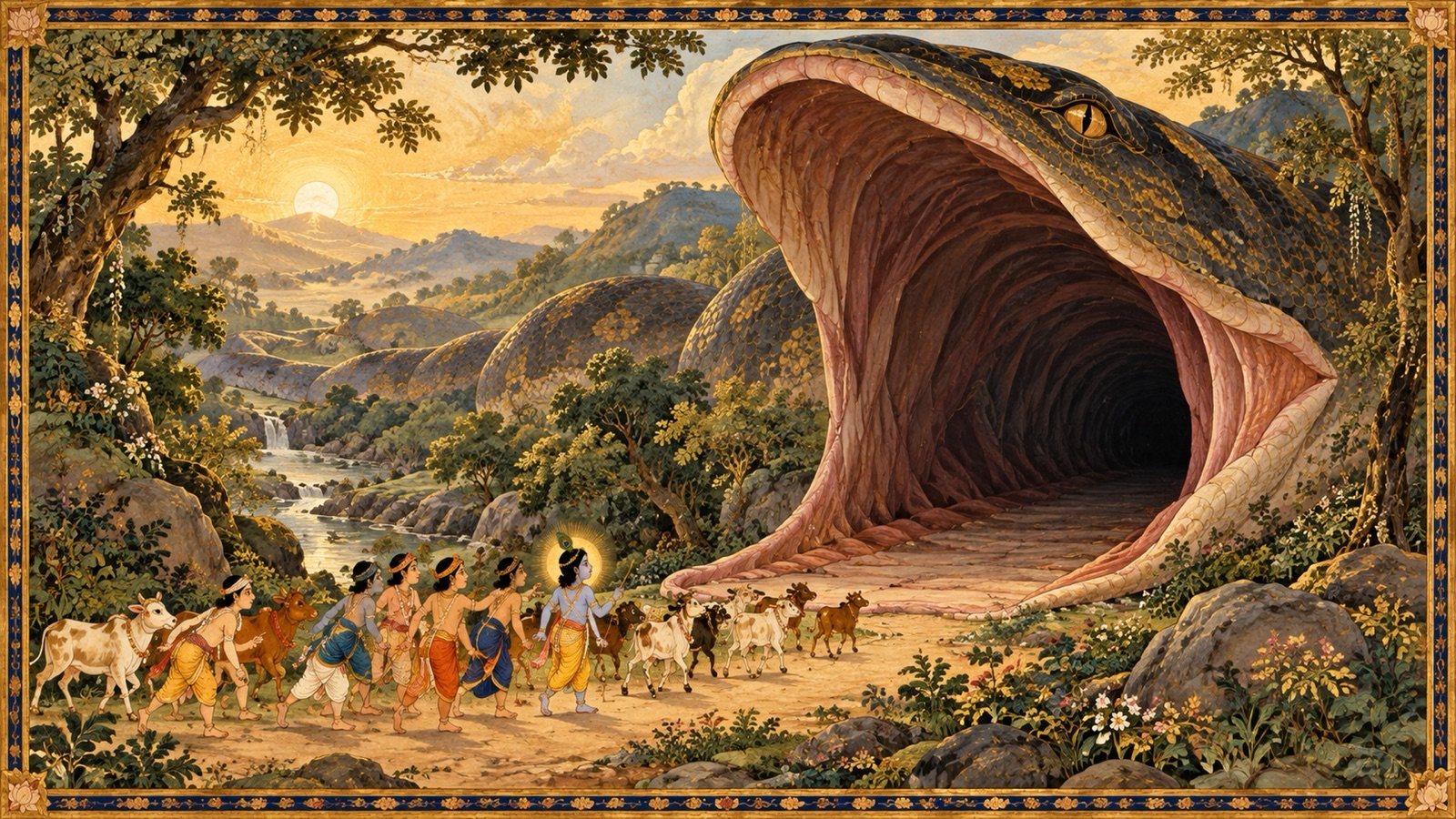
Reasoning that once these boys, dear as life to Krishna, were destroyed, all of Vraja would be as good as dead, the demon assumed a monstrous python’s body a full league in length, as huge as a great mountain. Holding his cave-like mouth wide open — his lower lip resting on the ground and his upper lip touching the clouds, his fangs like mountain-peaks and his breath like a hot forest wind — he lay across the path, hoping to swallow them all.
The Boys Enter the Mouth
Seeing the great open mouth, the innocent boys took it for a beautiful feature of Vrindavana and began to imagine playfully that it looked just like a python’s mouth. ‘Look, friends,’ they laughed, ‘is that not a creature’s snout, opened as if to swallow us? Surely, if it is a demon, it will be destroyed at once like Baka.’ And glancing toward the face of Krishna, the enemy of Baka, laughing and clapping their hands, they walked in fearlessly.
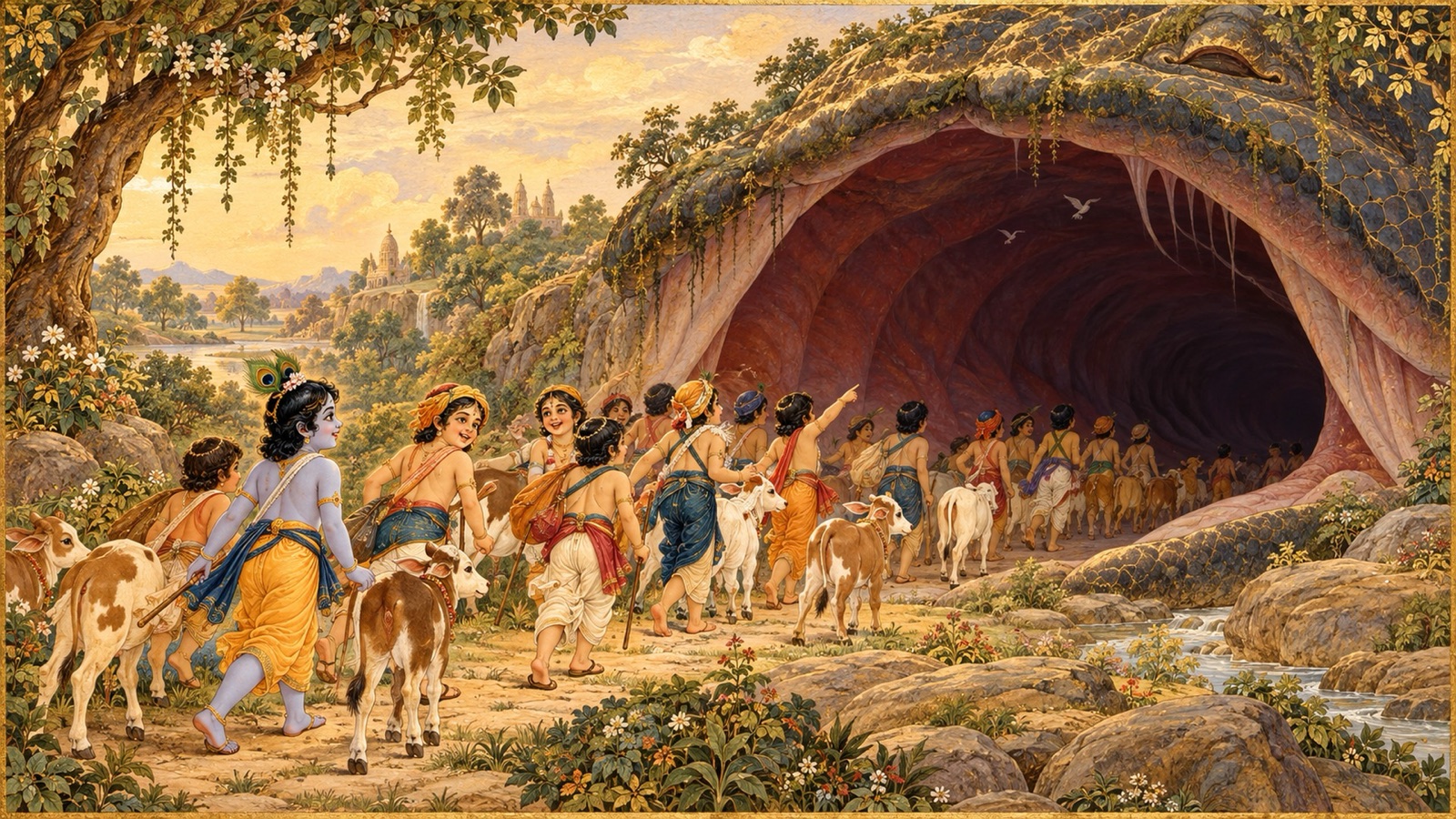
Knowing the truth — for He dwells within the hearts of all beings — Krishna wished to hold His friends back; but by then the boys and their calves had already entered the demon’s belly, and the demon waited only to close his jaws, remembering his slain kin. Seeing His helpless friends, who had no other protector, fallen from His hand as it were into the jaws of death, the Lord was moved with compassion and wondered how to accomplish two things at once — the death of the wicked demon and the rescue of the innocent boys.
कृत्यं किमत्रास्य खलस्य जीवनं
न वा अमीषां च सतां विहिंसनम् ।
द्वयं कथं स्यादिति संविचिन्त्य
ज्ञात्वाविशत्तुण्डमशेषदृग्घरि: ॥ २८ ॥
kṛtyaṁ kim atrāsya khalasya jīvanaṁ na vā amīṣāṁ ca satāṁ vihiṁsanam dvayaṁ kathaṁ syād iti saṁvicintya jñātvāviśat tuṇḍam aśeṣa-dṛg ghariḥ
Meaning: ‘What is to be done here — the slaying of this wicked one, or the saving of these innocent ones? How may both be accomplished at once?’ Thus reflecting, and knowing all, the all-seeing Lord Hari entered the demon’s mouth. (Canto 10, Chapter 12, verse 28)
The Deliverance and the Demon’s Fall
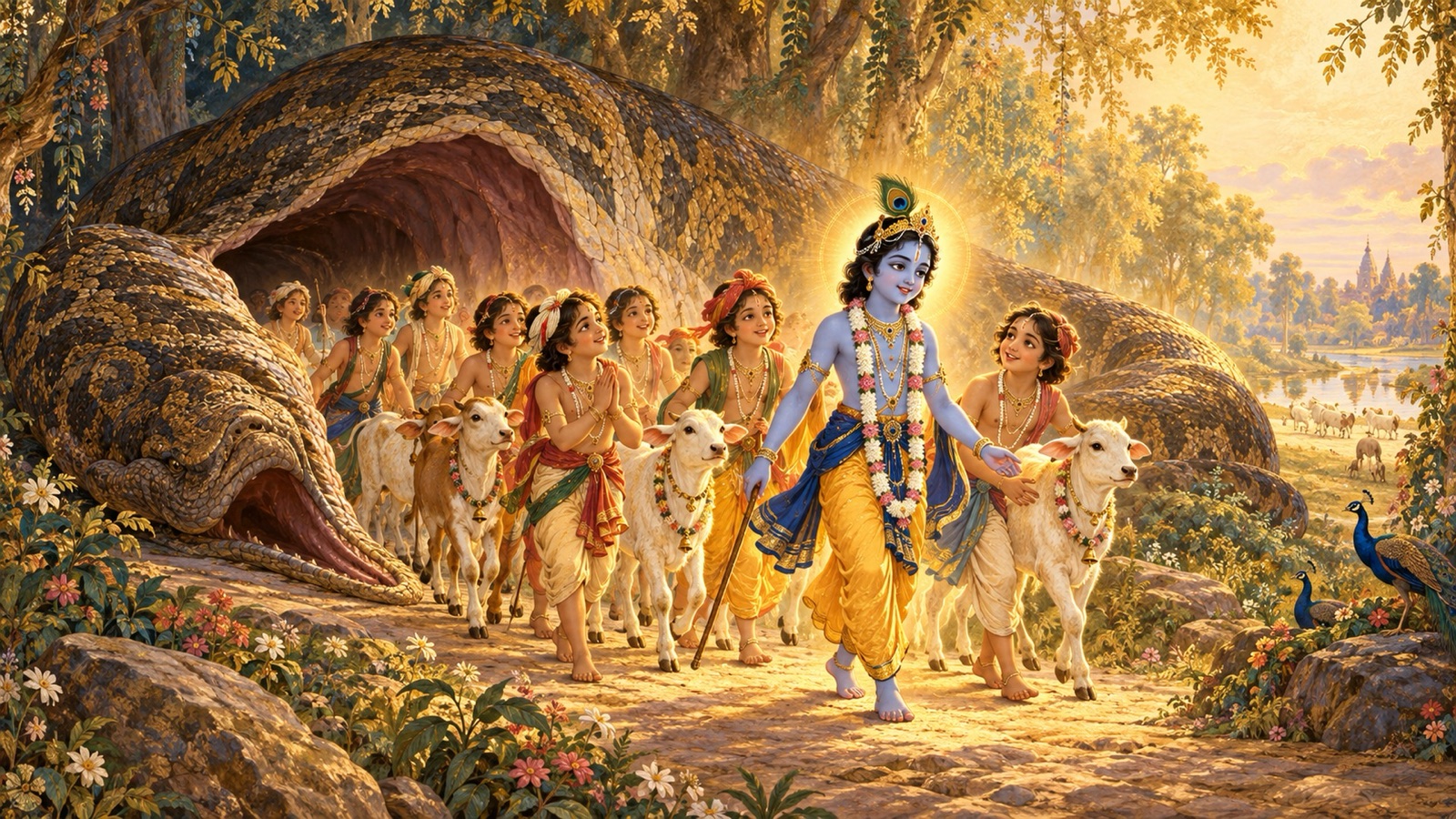
At this the gods, hidden behind the clouds, cried out ‘Alas! Alas!’ in fear, while Kamsa and the other demons, friends of Agha, rejoiced. Hearing them, the imperishable Lord Krishna, seeing that the demon meant to crush the boys and calves within, swiftly expanded Himself in the demon’s throat. The demon’s vast body, its passage blocked and its eyes bulging, thrashed about; his life-airs, unable to escape, at last burst out through the crown of his head. Then, reviving the dead calves and boys with His glance, Krishna led them all out of the demon’s mouth.
तेनैव सर्वेषु बहिर्गतेषु
प्राणेषु वत्सान् सुहृद: परेतान् ।
दृष्टया स्वयोत्थाप्य तदन्वित: पुन-
र्वक्त्रान्मुकुन्दो भगवान् विनिर्ययौ ॥ ३२ ॥
tenaiva sarveṣu bahir gateṣu prāṇeṣu vatsān suhṛdaḥ paretān dṛṣṭyā svayotthāpya tad-anvitaḥ punar vaktrān mukundo bhagavān viniryayau
Meaning: When the demon’s life-airs had all burst out, Lord Mukunda raised up the dead calves and His friends by His own glance, and together with them came forth again from the demon’s mouth. (Canto 10, Chapter 12, verse 32)
The Liberation of Aghasura
A wondrous great light then rose from the body of the python-demon, illuminating all ten directions with its own splendour; it waited in the sky until the Lord emerged, and then, before the eyes of the watching gods, merged into Krishna Himself. Overjoyed, the celestials showered flowers, the heavenly dancers danced, the gods sang, the musicians played, and the brahmanas offered prayers with cries of victory. Hearing the great festival of praise from nearby, even Brahma came and was struck with amazement at the deed. And the dried skin of the python, O king, remained for many days as a wondrous cave and playground for the residents of Vraja.
This pastime of childhood — Krishna’s own deliverance of Himself and His friends from the jaws of death — the boys, filled with wonder, related in Vraja only when they were older. Sukadeva marvels that it is no wonder the Supreme Creator should do such things; for even Aghasura, whose every sin was washed away by the mere touch of the Lord, attained that oneness of form with Him which is so rarely gained even by the pious.
नैतद् विचित्रं मनुजार्भमायिन:
परावराणां परमस्य वेधस: ।
अघोऽपि यत्स्पर्शनधौतपातक:
प्रापात्मसाम्यं त्वसतां सुदुर्लभम् ॥ ३८ ॥
naitad vicitraṁ manujārbha-māyinaḥ parāvarāṇāṁ paramasya vedhasaḥ agho ’pi yat-sparśana-dhauta-pātakaḥ prāpātma-sāmyaṁ tv asatāṁ sudurlabham
Meaning: This is no wonder in the Supreme Creator, higher than the highest, who plays as a human child; for even Agha, all his sins washed away by the Lord’s touch, attained that equality of form with the Lord which is exceedingly hard for the impious to gain. (Canto 10, Chapter 12, verse 38)
Parikshit’s Loving Question
Suta Gosvami told the sages of Naimisharanya how King Parikshit, hearing this wondrous history of his protector, was so charmed that he asked to hear more. How was it, he wondered, that a deed performed in Krishna’s early childhood was reported by the boys only a year later, when they were older? Surely, he said, this too must be the Lord’s own Maya. Declaring himself most fortunate to drink again and again the nectar of Krishna’s story from Sukadeva’s lips, he begged the sage to explain — and Sukadeva, his mind absorbed in the Lord, prepared to unfold the still more wondrous pastime that follows.
Principal Teachings of This Chapter
1. The Lord is nearest to the loving, not the learned. The dust of His feet, unreachable by yogis of many births, is the daily playmate of the cowherd boys (verse 12). Loving intimacy draws Him closer than long austerity.
2. Danger cannot touch those who trust Him. The boys walk fearlessly into the demon’s mouth because they trust Krishna; and He, dwelling in every heart, is already there to save them. Faith itself becomes their shelter.
3. The Lord shares our danger to deliver us. Rather than strike from afar, Krishna enters the very jaws of death with His friends (verse 28). He does not save us from a distance but comes into our peril with us.
4. Even an enemy is purified by His touch. Aghasura, who came only to kill, is cleansed of all sin and attains oneness of form with the Lord (verse 38). The Lord’s mercy is so vast that even contact in enmity can liberate.
5. His pastimes are beyond time and reason. That a childhood deed was told only a year later, and countless such wonders, are His Maya (verses 40-42). We are invited not to explain the Lord away but to drink the nectar of His story.
A Devotional Reflection
The most moving moment of this chapter is not the destruction of the demon but the pause before it, when Krishna sees His friends already fallen into the jaws of death and is ‘moved with compassion,’ wondering how to save them. He could have kept them from ever entering; He could have struck the demon down from outside. Instead He enters the darkness with them. This is the pattern of divine love throughout the Bhagavatam: the Lord does not rescue us from a safe distance but comes down into our very danger, into the belly of death itself, and brings us out with Him. The boys, for their part, do nothing clever; they simply trust, and walk in laughing, certain that their friend will not let them come to harm. Perhaps that childlike trust is the whole of the teaching. And there is a final tenderness here: the demon who came to devour Krishna is himself, by the Lord’s touch, carried into the light. If even Aghasura could be so purified, then no soul, however fallen, is beyond the reach of that mercy.
A Daily Devotional Practice
Today, cultivate the fearless trust of the cowherd boys. When you face a situation that frightens you, instead of relying only on your own cleverness, place it consciously in the Lord’s hands, remembering that He dwells within your heart and enters your danger with you. Read or recall the pastime of Aghasura, and let it assure you that no darkness can hold the one who belongs to Krishna. Begin by chanting gently: Om Namo Bhagavate Vasudevaya.
Conclusion
The twelfth chapter of the Tenth Canto sets the sweetest innocence beside the gravest danger. Krishna and His friends set out for a joyful forest picnic, and the demon Aghasura, last of Putana’s murderous family, lies in wait as a python to swallow them whole. The boys, trusting entirely in their friend, walk fearlessly into the jaws of death; and Krishna, dwelling in every heart, enters with them, destroys the demon from within, and revives and delivers all His companions — while the demon himself, cleansed by the Lord’s touch, is carried into liberation. Even Brahma is amazed, and the residents of Vraja taste a fortune the greatest yogis cannot reach. May we learn from the cowherd boys to trust the Lord fearlessly, and to remember that He does not save us from afar but comes down into our every darkness to lead us home.
May the divine wisdom of Srimad Bhagavatam awaken pure devotion within our hearts.
Om Namo Bhagavate Vasudevaya.
Jay Shree Madhav.
References and Attribution
- Primary edition: Gita Press, Śrīmad Bhāgavata Mahāpurāṇa (Sanskrit-Hindi, Volume 2), Book Ten (First Half), Discourse 12.
- Series: Srimad Bhagavatam Wisdom · Biswa Sanatan Dharma Seva Trust.
- Presented following the spiritual guidance and recommendation of Pandit Dr. Shri Kashinath Mishra.
This is an original, faithful retelling in the writer’s own words, with brief quoted verses shown in Devanāgarī and transliteration and their meanings given as summaries. It is not a reproduction of any single publisher’s continuous translation or commentary. No affiliation with or endorsement by any publisher is implied.
Jay Shree Madhav