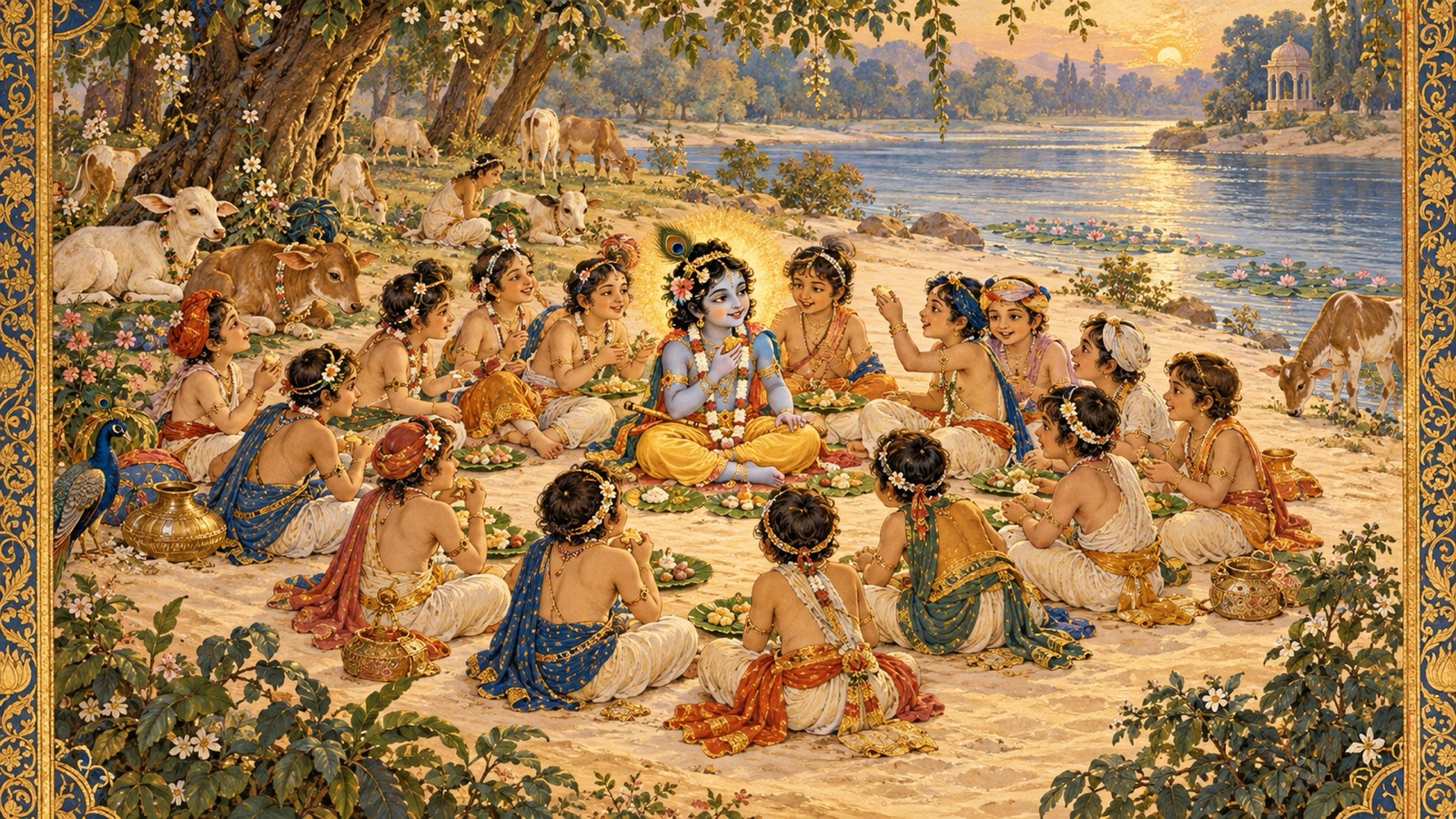
On the sandy bank of the Yamuna, Krishna sits at the centre of His cowherd friends, who are gathered around Him in circles like the petals about the whorl of a lotus, all sharing their forest lunch with joy.
Om Namo Bhagavate Vasudevaya.
Om Namo Bhagavate Vasudevaya.
Om Namo Bhagavate Vasudevaya.
Welcome back to Srimad Bhagavatam Wisdom, our devotional journey through the sacred histories and teachings of the Srimad Bhagavat Mahapurana. This thirteenth chapter of the Tenth Canto is one of the most profound in the whole book. After saving His friends from Aghasura, Krishna sits with them for a joyful lunch on the Yamuna’s bank. When the calves stray, He goes to fetch them; and in that moment Brahma, the creator himself, wishing to behold more of the child-Lord’s power, secretly carries away and hides all the boys and calves. Krishna’s answer is astonishing: He expands Himself into every one of the missing boys and calves, becoming their exact forms, and for a full year is Himself both the herd and the herders — so completely that even the mothers of Vraja notice nothing but an ever-deepening love. When Brahma returns after what to him was only a moment, he is confounded to find the boys still at play, and is granted a vision of countless four-armed Vishnu forms that humbles him utterly at the little cowherd’s feet.
Chapter Information
- Scripture: Śrīmad Bhāgavata Mahāpurāṇa
- Canto: 10 (Book Ten, First Half)
- Chapter: 13 (Discourse 13)
- Chapter title: Brahma Steals the Boys and Calves
- Principal speaker: Sukadeva Gosvami (narrating to King Parikshit)
- Principal listener: King Parikshit
- Main setting: The bank of the Yamuna and the pastures of Vrindavana in Vraja
- Central subject: The riverbank lunch; the straying of the calves; Brahma’s theft of the boys and calves; Krishna’s expansion into all of them for a year; Balarama’s discovery; Brahma’s bewilderment; the vision of countless Vishnus; and Brahma’s humbling at the Lord’s feet
- Principal verse range: Canto 10, Chapter 13, verses 1–64
- Primary edition: Gita Press Śrīmad Bhāgavata Mahāpurāṇa (Sanskrit-Hindi, Volume 2)
Context From the Previous Chapter
In Chapter 12, the demon Aghasura swallowed Krishna’s friends as a giant python, and the Lord entered his jaws, destroyed him from within, and delivered the boys and calves — while even the demon attained liberation. King Parikshit, charmed, asked to hear more; and this chapter, which Sukadeva calls a secret worthy of a devoted disciple, unfolds the wondrous pastime of Brahma’s bewilderment.
The Lunch on the Riverbank
Sukadeva began by praising Parikshit’s longing to hear ever more of the Lord, for the talk of Achyuta is ever-fresh to the hearts of the saints, and he promised to reveal a secret. Having saved the cowherd boys from Aghasura’s mouth, Krishna brought them to the sandy bank of the Yamuna and said, ‘How lovely is this spot, dear friends, with its soft clean sand and the humming of the bees drawn by the fragrance of the lotuses! Let us eat here; the day is advanced and we are hungry. Let the calves drink water and graze quietly nearby.’ So the boys let the calves loose on the tender grass, opened their lunch-bags, and ate together with the Lord in great delight.
They sat around Him in circles, their faces turned toward Him and their eyes wide with love, like the petals ranged around the whorl of a lotus. Some made plates of flowers, some of leaves or bark or stones, and all showed one another the delicacies they had brought, laughing and making others laugh. And in their very midst sat the enjoyer of all sacrifices, His flute tucked into His waist-cloth, His horn and stick under His arm, a morsel of food in His left hand — the Supreme Lord playing the part of a cowherd child while the dwellers of heaven looked on.
बिभ्रद् वेणुं जठरपटयो: शृङ्गवेत्रे च कक्षे
वामे पाणौ मसृणकवलं तत्फलान्यङ्गुलीषु ।
तिष्ठन् मध्ये स्वपरिसुहृदो हासयन् नर्मभि: स्वै:
स्वर्गे लोके मिषति बुभुजे यज्ञभुग् बालकेलि: ॥ ११ ॥
bibhrad veṇuṁ jaṭhara-paṭayoḥ śṛṅga-vetre ca kakṣe vāme pāṇau masṛṇa-kavalaṁ tat-phalāny aṅgulīṣu tiṣṭhan madhye sva-parisuhṛdo hāsayan narmabhiḥ svaiḥ svarge loke miṣati bubhuje yajña-bhug bāla-keliḥ
Meaning: With His flute tucked between His waist and His cloth, His horn and stick under His left arm, a morsel of food in His left hand and pieces of fruit between His fingers, He stood in the midst of His dear companions, making them laugh with His jokes; and thus the enjoyer of all sacrifices ate at play like a child, while the dwellers of heaven looked on. (Canto 10, Chapter 13, verse 11)
The Straying Calves and Brahma’s Theft
While the boys were absorbed in their meal, the calves, tempted by fresh grass, wandered far into the forest. Seeing His friends grow anxious, Krishna — the fear of fear itself — reassured them: ‘Do not stop eating, friends; I shall bring the calves back Myself.’ And holding His morsel of food still in His hand, the Lord set out to search for the calves through the hills, caves, and thickets.
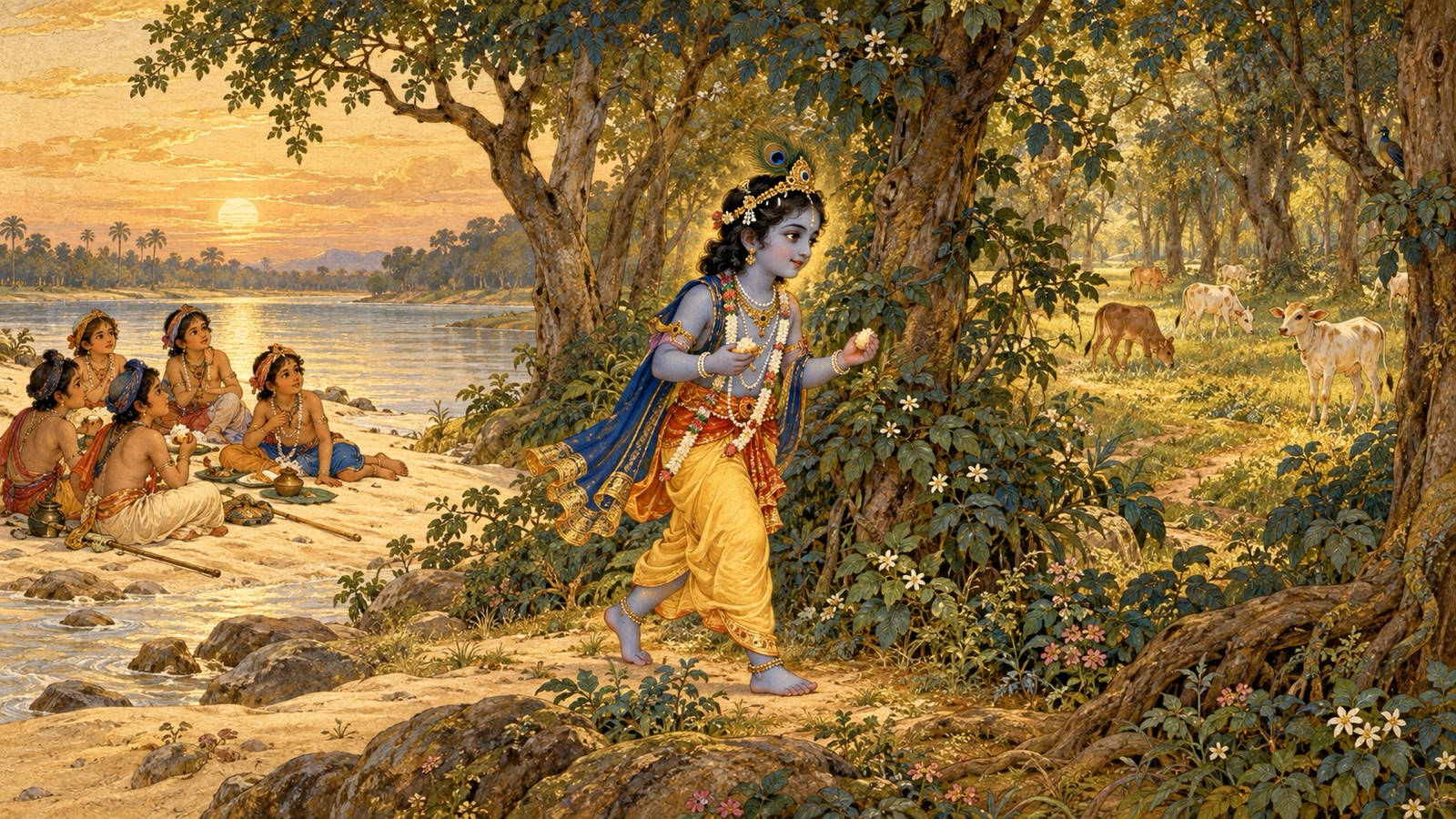
At that very time Brahma, the lotus-born creator, having earlier witnessed from the sky the liberation of Aghasura and been filled with amazement at the child’s power, wished to behold still more of that sweet glory. So he secretly carried off the calves, and then the boys as well, and hid them away, remaining himself in the sky to watch.
अम्भोजन्मजनिस्तदन्तरगतो मायार्भकस्येशितु-
र्द्रष्टुं मञ्जु महित्वमन्यदपि तद्वत्सानितो वत्सपान् ।
नीत्वान्यत्र कुरूद्वहान्तरदधात् खेऽवस्थितो य: पुरा
दृष्ट्वाघासुरमोक्षणं प्रभवत: प्राप्त: परं विस्मयम् ॥ १५ ॥
ambhojanma-janis tad-antara-gato māyārbhakasyeśitur draṣṭuṁ mañju mahitvam anyad api tad-vatsān ito vatsapān nītvānyatra kurūdvahāntaradadhāt khe ’vasthito yaḥ purā dṛṣṭvāghāsura-mokṣaṇaṁ prabhavataḥ prāptaḥ paraṁ vismayam
Meaning: The lotus-born Brahma, who had earlier stood in the sky and, seeing the deliverance of Aghasura by the almighty Lord, been struck with the greatest amazement, now — wishing to behold yet more of the sweet glory of the Lord who was playing as a child — carried the calves and the cowherd boys away elsewhere and concealed them. (Canto 10, Chapter 13, verse 15)
Returning and finding neither the calves nor, on the bank, the boys, Krishna searched the whole forest for both. Nowhere finding them, the knower of all understood at once that this was Brahma’s doing.
Krishna Becomes All the Boys and Calves
Then, to bring joy to the mothers of the missing boys and calves — and, in His play, to the bewildered creator — the Lord who fashions the universe made Himself into both the herd and the herders. He became, all at once, the exact bodies of every calf and every boy, down to their hands and feet, their sticks and horns and flutes and lunch-bags, their ornaments and clothes, their characters, qualities, names, forms, ages, and their very games. Everything became Vishnu; as the scriptures declare, the unborn Lord, who is the Self of all forms, shone forth as all of them.
यावद् वत्सपवत्सकाल्पकवपुर्यावत् कराङ्घ्र्यादिकं
यावद् यष्टिविषाणवेणुदलशिग् यावद् विभूषाम्बरम् ।
यावच्छीलगुणाभिधाकृतिवयो यावद् विहारादिकं
सर्वं विष्णुमयं गिरोऽङ्गवदज: सर्वस्वरूपो बभौ ॥ १९ ॥
yāvad vatsapa-vatsakālpaka-vapur yāvat karāṅghry-ādikaṁ yāvad yaṣṭi-viṣāṇa-veṇu-dala-śig yāvad vibhūṣāmbaram yāvac chīla-guṇābhidhākṛti-vayo yāvad vihārādikaṁ sarvaṁ viṣṇumayaṁ giro ’ṅga-vad ajaḥ sarva-svarūpo babhau
Meaning: Assuming the small forms of the calf-tending boys and the calves, complete in their hands and feet and every limb, their sticks, horns, flutes, and lunch-bags, their ornaments and dress, and even their character, qualities, names, forms, ages, and pastimes — everything became Vishnu; for the unborn Lord, who is the Self of all, shone forth, as the scriptures say, as the very form of them all. (Canto 10, Chapter 13, verse 19)
Leading each calf to its own shed and entering each boy’s own home in that boy’s own form, He was received by all. Hearing the sound of the flute, the mothers rose in haste, lifted their sons in their arms, embraced them tightly, and nursed them, taking the milk that flowed from their love to be the very nectar of Brahman — for that is what it was. In the same way the cows lavished redoubled affection upon their calves. And so the love of the people of Vraja for their children, and above all for Krishna, grew without limit day by day, though they knew not why. Thus, being Himself the calves, the boys, and their protector, the Lord sported for a whole year in the pastures and homes of Vraja.
Balarama’s Discovery
A little before the year was complete, one day as Krishna and Balarama were herding, the cows grazing high on Govardhana Hill caught sight of their calves far below and, overcome with love, came rushing down the steep paths with upraised heads and tails, lowing, their udders streaming, until cows and calves mingled together. The cowherds, ashamed and vexed that they could not hold the cows back, made their way down the difficult path — and there, seeing their own sons among the calves, they too were flooded with a love that swept away their annoyance, and they lifted the boys, embraced them, and smelled their heads in the greatest joy.
Balarama, noticing how the affection of all Vraja for the children was increasing every moment beyond all reason — a tenderness even greater than for their own infants at the breast — wondered at its cause. ‘What is this wonder,’ He thought, ‘that the love of Vraja, and My own, for these boys grows as never before, as it does for Vasudeva, the Self of all? Whose power is this?’ Reflecting, He saw by His own vision that all the boys and calves were none other than Krishna Himself, and, questioning Krishna, He learned that it was so.
Brahma’s Bewilderment
Meanwhile Brahma returned, after an interval that was, by his own vast measure of time, no more than a moment — though a full year had passed on earth. He saw Krishna playing exactly as before, surrounded by all the boys and calves. Astonished, he thought: ‘All the boys and calves of Gokula, whom I laid to rest upon the bed of my illusion, are still lying there and have not risen. Then whence have these come, who for a whole year have played here with Vishnu, untouched by my power?’ Long he pondered which were the real boys and which were not, and could not tell at all. Thus he who deludes the whole universe was himself deluded by his own illusion — as darkness is swallowed by night, or the spark of a firefly lost in the light of day, so the lesser power is undone before the greater.
एवं सम्मोहयन् विष्णुं विमोहं विश्वमोहनम् ।
स्वयैव माययाजोऽपि स्वयमेव विमोहित: ॥ ४४ ॥
evaṁ sammohayan viṣṇuṁ vimohaṁ viśva-mohanam svayaiva māyayājo ’pi svayam eva vimohitaḥ
Meaning: Thus, while seeking to bewilder Vishnu — the very bewilderment of the universe — the unborn Brahma was himself bewildered by his own illusory power. (Canto 10, Chapter 13, verse 44)
The Vision of Countless Vishnus
Then, as Brahma looked on, all the calf-tending boys at once appeared as forms of Vishnu — dark as rain-clouds, clothed in yellow silk, four-armed, bearing the conch, disc, mace, and lotus, crowned and adorned with earrings, garlands, and the mark of Srivatsa, wreathed from foot to crown in fresh and tender tulasi leaves. Smiling like moonlight, glancing with reddish eyes, they were worshipped on every side by all beings from Brahma down to a blade of grass, by the elements and the powers and the twenty-four principles of creation, by time and nature themselves — each in its own embodied form, offering songs and dances and homage. Forms of pure being, knowledge, infinity, and bliss, untouched by the world and beyond even the sight of the Upanishadic sages, Brahma beheld them all at once as the Supreme Brahman by whose light this whole moving and unmoving universe shines.
एवं सकृद् ददर्शाज: परब्रह्मात्मनोऽखिलान् ।
यस्य भासा सर्वमिदं विभाति सचराचरम् ॥ ५५ ॥
evaṁ sakṛd dadarśājaḥ para-brahmātmano ’khilān yasya bhāsā sarvam idaṁ vibhāti sa-carācaram
Meaning: Thus at a single glance the unborn Brahma beheld all of them as the Supreme Brahman itself — by whose light alone this whole universe, with all that moves and does not move, shines forth. (Canto 10, Chapter 13, verse 55)
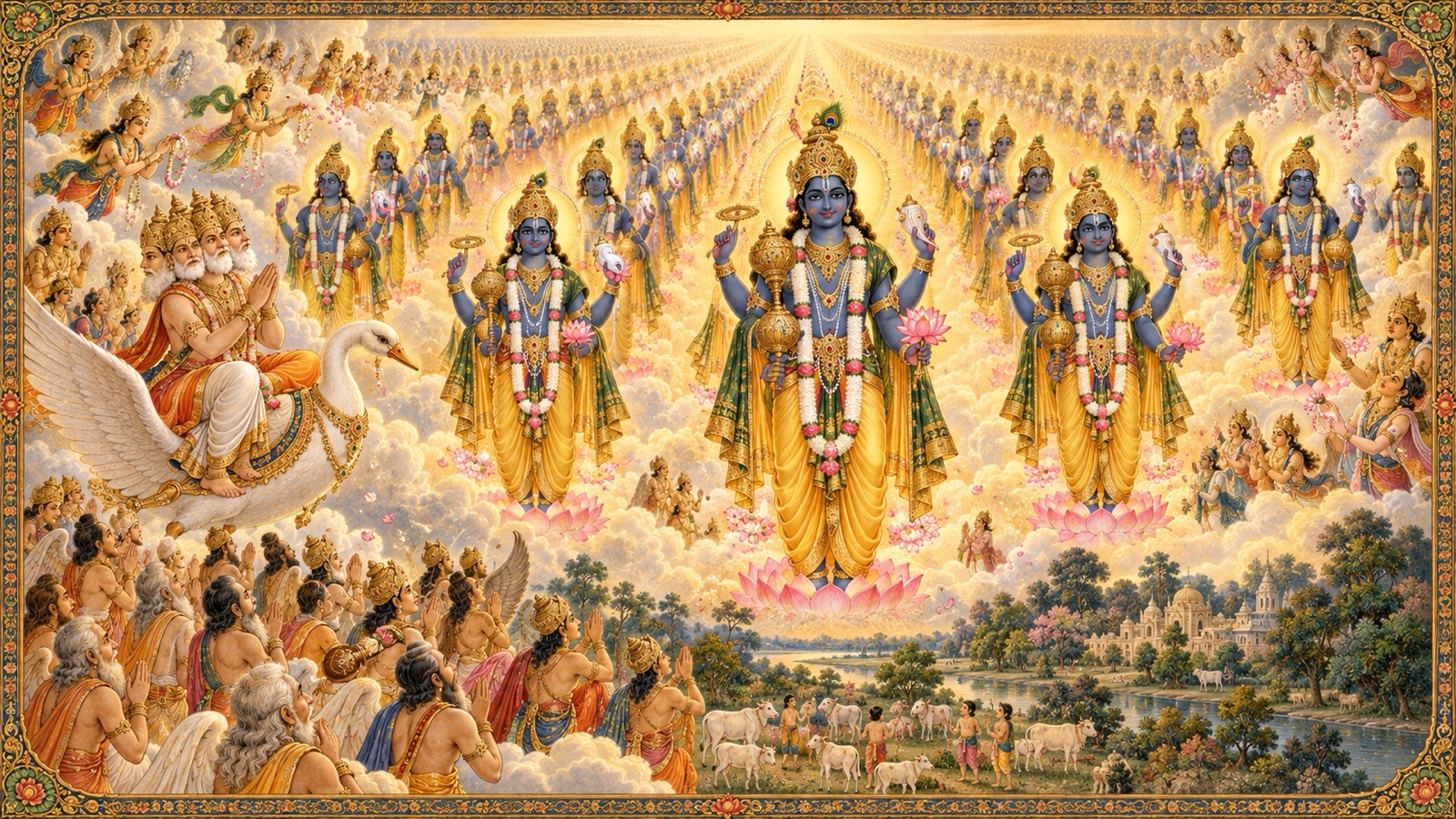
At this his eleven senses were stunned and stilled with wonder, and Brahma stood silent and motionless, like a little doll in the presence of the deity of a village. Then the Supreme Lord, knowing that Brahma had been rendered unable even to see, at once drew the curtain of His illusion. Brahma, regaining his senses like one risen from the dead, opened his eyes with difficulty and saw Vrindavana before him as before — and there again was the Supreme Brahman, non-dual and infinite, playing the part of a little cowherd, searching for His calves and friends with a morsel of food in His hand.
Brahma Humbled at Krishna’s Feet
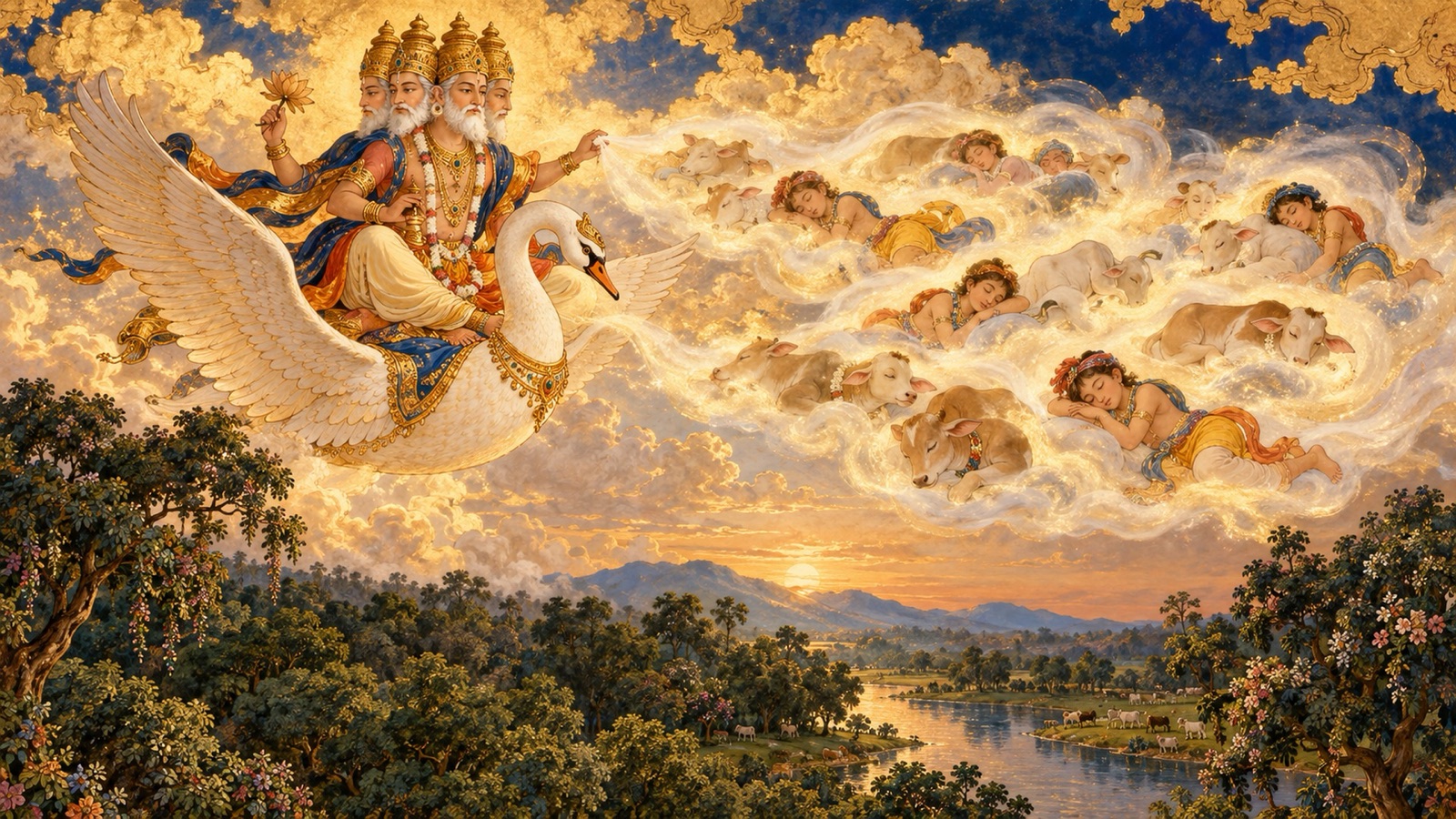
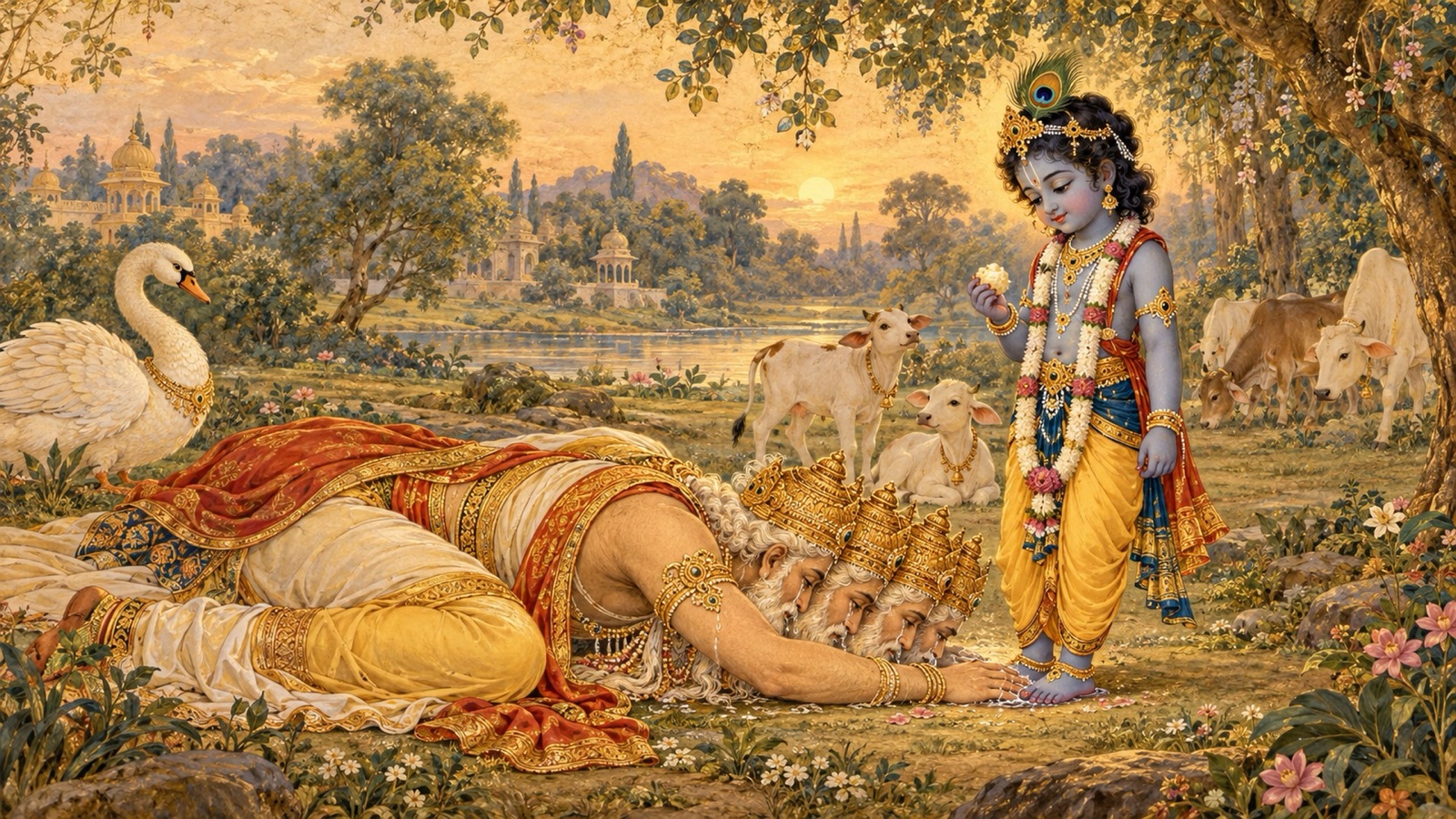
At once the creator abandoned every trace of pride. He climbed down from his swan-carrier, stretched his whole frame flat upon the ground as a gleaming rod of gold, and pressed his four crowned heads to the Lord’s feet, overcome, weeping without restraint. Again and again he rose and fell at Krishna’s feet, remembering over and over the glory he had just seen. At last, rising slowly and wiping his eyes, gazing up at Mukunda with bowed head, folded hands, and a voice trembling with emotion, the creator of the universe stood ready to offer the prayers that the next chapter records — the prayers of a humbled Brahma before the child of Vraja.
दृष्ट्वा त्वरेण निजधोरणतोऽवतीर्य
पृथ्व्यां वपु: कनकदण्डमिवाभिपात्य ।
स्पृष्ट्वा चतुर्मुकुटकोटिभिरङ्घ्रियुग्मं
नत्वा मुदश्रुसुजलैरकृताभिषेकम् ॥ ६२ ॥
dṛṣṭvā tvareṇa nija-dhoraṇato ’vatīrya pṛthvyāṁ vapuḥ kanaka-daṇḍam ivābhipātya spṛṣṭvā catur-mukuṭa-koṭibhir aṅghri-yugmaṁ natvā mud-aśru-sujalair akṛtābhiṣekam
Meaning: Beholding this, Brahma swiftly descended from his swan-carrier and cast his body upon the earth like a golden rod; touching the Lord’s two feet with the tips of his four crowns, he bowed and bathed them with the pure water of his tears of joy. (Canto 10, Chapter 13, verse 62)
Principal Teachings of This Chapter
1. The Lord is the Self of all beings. When Krishna becomes every boy and calf (verse 19), the Bhagavatam shows in a single stroke that He is not one being among many but the very Self shining as all. He is the reality behind every form.
2. Even the creator can be humbled. Brahma, mightiest of created beings, is bewildered by his own power (verse 44). Before the Supreme, all our pride in knowledge or position dissolves; humility is the only fitting response.
3. A mother’s love finds the truth without knowing it. The mothers of Vraja nurse Krishna Himself as their sons, tasting the very nectar of Brahman in their love. Pure affection touches the Lord directly, even where the intellect cannot follow.
4. The lesser power vanishes before the greater. As a firefly’s spark is lost in daylight, Brahma’s illusion is undone before Krishna’s (verse 44-45). No maya, however grand, can stand against the Lord who is its master.
5. The Supreme is both intimate and infinite. The same child who searches for stray calves with food in His hand is beheld as countless four-armed Vishnus worshipped by all creation (verses 46-55). His sweetness and His majesty are one.
A Devotional Reflection
This chapter holds two images side by side, and the whole of devotion lives in the space between them: a little boy walking into the forest with a lump of rice in his hand to look for some lost calves, and that same boy revealed as endless four-armed forms of God worshipped by all creation. Brahma, who came to test which of these was the real Krishna, learned the deepest secret of all — that there is no difference; the searching child and the Supreme Brahman are one and the same. We are often tempted, like Brahma, to test God, to demand a display of power before we will bow. But the Lord’s answer is not to overwhelm us; it is to keep being the little cowherd, holding His food, calling for His calves, letting Himself be loved. The vision of the many Vishnus lasts only a moment; the boy of Vraja remains. And perhaps that is the mercy: that the infinite has made Himself small enough to be embraced, so that even the creator of the universe may weep at His feet, and so may we.
A Daily Devotional Practice
Today, set down the impulse to test or measure God, and instead simply love Him as He has made Himself available to you — near, gentle, and small enough to hold in the heart. Recall the two images of this chapter, the searching cowherd child and the countless Vishnus, and let them remind you that the Lord you love intimately is the same Lord all creation worships. Where pride in your own understanding arises, bow it, as Brahma bowed, at the feet of the child of Vraja. Begin by chanting gently: Om Namo Bhagavate Vasudevaya.
Conclusion
The thirteenth chapter of the Tenth Canto carries us into the very heart of the Bhagavatam’s vision of God. Krishna feasts with His friends on the riverbank; the calves stray; and Brahma, curious to see more of the child’s power, steals away the boys and calves. In reply the Lord becomes them all, and for a year is Himself both the herd and its herders, unnoticed by all but the deepening love of Vraja. When Brahma returns and finds the boys still at play, he is confounded by his own illusion and granted a vision of countless Vishnus, before which his pride dissolves and he falls weeping at the little cowherd’s feet. In one chapter we behold the Lord as the intimate friend of children and as the Self of all that is. May this twofold vision awaken in us both the tender love of the gopas and the awe of the humbled creator, until we too are content simply to serve the child who is the shelter of all worlds.
May the divine wisdom of Srimad Bhagavatam awaken pure devotion within our hearts.
Om Namo Bhagavate Vasudevaya.
Jay Shree Madhav.
References and Attribution
- Primary edition: Gita Press, Śrīmad Bhāgavata Mahāpurāṇa (Sanskrit-Hindi, Volume 2), Book Ten (First Half), Discourse 13.
- Series: Srimad Bhagavatam Wisdom · Biswa Sanatan Dharma Seva Trust.
- Presented following the spiritual guidance and recommendation of Pandit Dr. Shri Kashinath Mishra.
This is an original, faithful retelling in the writer’s own words, with brief quoted verses shown in Devanāgarī and transliteration and their meanings given as summaries. It is not a reproduction of any single publisher’s continuous translation or commentary. No affiliation with or endorsement by any publisher is implied.
Jay Shree Madhav