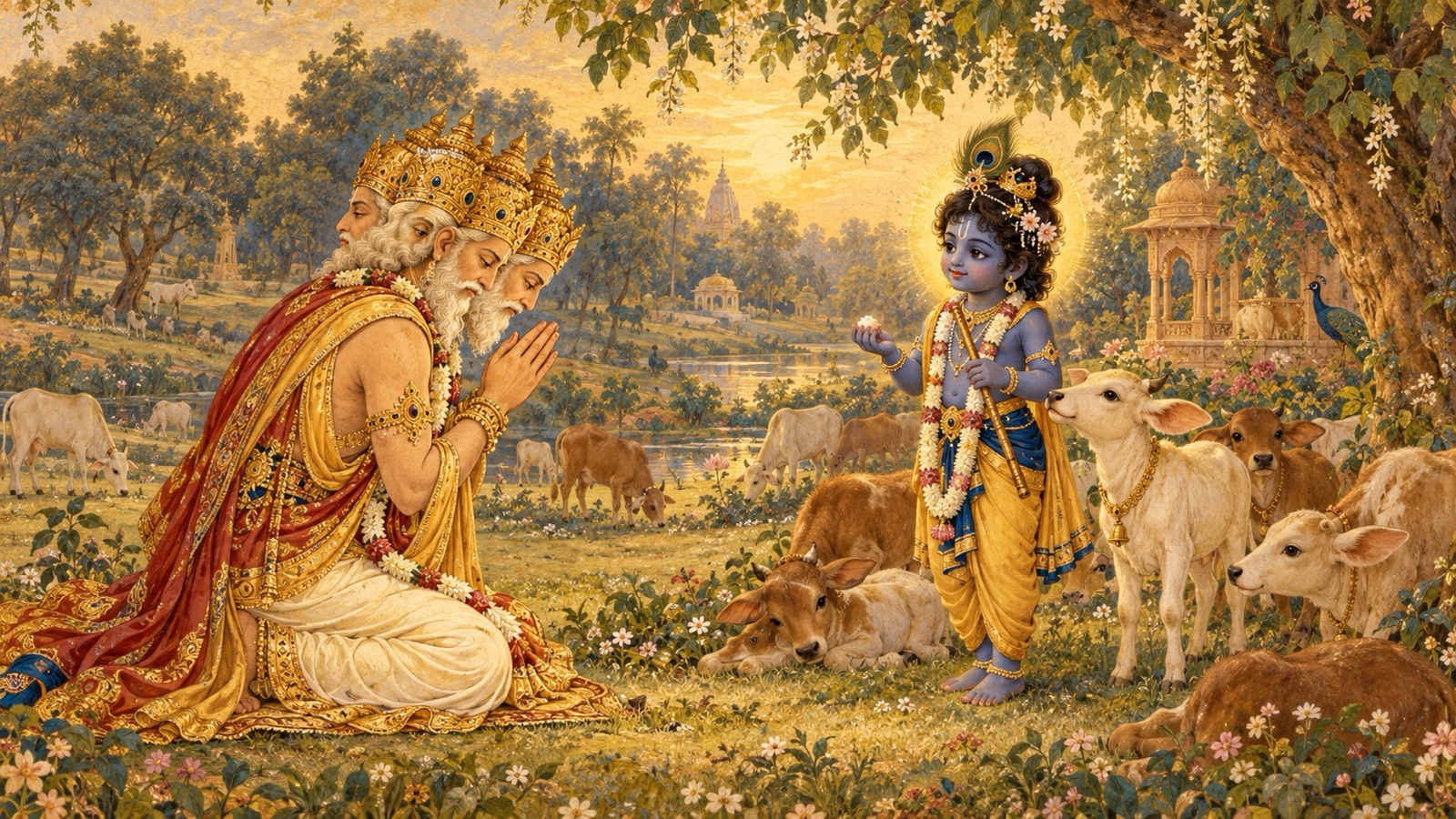
His pride dissolved, the four-headed Brahma stands with folded hands and offers a hymn of surrender to the little cowherd Krishna — the Supreme Brahman at play as the son of Nanda.
Om Namo Bhagavate Vasudevaya.
Om Namo Bhagavate Vasudevaya.
Om Namo Bhagavate Vasudevaya.
Welcome back to Srimad Bhagavatam Wisdom, our devotional journey through the sacred histories and teachings of the Srimad Bhagavat Mahapurana. This fourteenth chapter of the Tenth Canto is a garland of prayer. Humbled by the vision of countless Vishnus after his attempt to test the child-Lord, Brahma the creator pours out one of the most beloved hymns in all the scriptures. He confesses his folly, exalts loving devotion above dry knowledge, marvels at the fortune of the cowherds of Vraja whose friend is the Supreme Brahman, and begs only to be born, in any species whatever, among the devotees who serve the Lord’s feet. Having offered his prayers, Brahma departs; Krishna returns to His waiting friends, to whom the year seemed but half a moment; and Sukadeva closes by explaining why the people of Vraja loved this child, another’s son, even more than their own — because He is the very Self of all.
Chapter Information
- Scripture: Śrīmad Bhāgavata Mahāpurāṇa
- Canto: 10 (Book Ten, First Half)
- Chapter: 14 (Discourse 14)
- Chapter title: The Prayers of Brahma
- Principal speaker: Brahma (in his hymn); Sukadeva Gosvami (narrating to King Parikshit)
- Principal listener: Lord Krishna; King Parikshit
- Main setting: The pastures of Vrindavana and the bank of the Yamuna in Vraja
- Central subject: Brahma’s hymn of praise and surrender; the supremacy of loving devotion; the fortune of Vraja; Brahma’s departure; Krishna’s return to His friends; and the teaching on why Vraja loved Krishna as the Self of all
- Principal verse range: Canto 10, Chapter 14, verses 1–61
- Primary edition: Gita Press Śrīmad Bhāgavata Mahāpurāṇa (Sanskrit-Hindi, Volume 2)
Context From the Previous Chapter
In Chapter 13, Brahma stole the cowherd boys and calves to test Krishna’s power; the Lord became them all for a year, and when Brahma returned he was granted a vision of countless four-armed Vishnus that dissolved his pride and left him weeping at the little cowherd’s feet. This chapter records the prayers he then offered.
Brahma Begins His Hymn
Rising with folded hands and a trembling voice, Brahma began to praise the Lord before him — not as the mighty creator addressing a child, but as a servant fallen at the feet of his master. He bowed to the boy whose complexion was like a fresh rain-cloud, dressed in lightning-yellow, a peacock feather and gunja-berry ornament upon His head, a forest garland about His neck, a morsel of food in His hand, cane and horn and flute the marks of His beauty, His feet soft as new leaves — the son of a cowherd. This form, he said, is not made of matter but of the Lord’s own will, appearing to bless His devotee; and its glory cannot be fathomed even by the mind.
Then Brahma spoke the truth that stands at the very heart of the Bhagavatam — that the Lord, unconquerable by all the striving of the intellect, is conquered by those who simply give up the pride of speculation and live by humbly hearing and honouring His glories from the lips of the saints.
ज्ञाने प्रयासमुदपास्य नमन्त एव
जीवन्ति सन्मुखरितां भवदीयवार्ताम् ।
स्थाने स्थिता: श्रुतिगतां तनुवाङ्मनोभि-
र्ये प्रायशोऽजित जितोऽप्यसि तैस्त्रिलोक्याम् ॥ ३ ॥
jñāne prayāsam udapāsya namanta eva jīvanti san-mukharitāṁ bhavadīya-vārtām sthāne sthitāḥ śruti-gatāṁ tanu-vāṅ-manobhir ye prāyaśo ’jita jito ’py asi tais tri-lokyām
Meaning: Those who, casting aside the labour of trying to know You by speculation, live merely offering obeisance and hearing about You from realized souls with their body, words, and mind, remaining in their own proper place — by them, O unconquerable Lord, You are conquered, though You are unconquerable by all the three worlds. (Canto 10, Chapter 14, verse 3)
Devotion Above Dry Knowledge
Those who abandon the path of loving devotion and toil only for impersonal knowledge, Brahma said, gain nothing but their labour, like men who beat empty husks hoping for grain. But countless yogis, dedicating their every act to the Lord and receiving devotion through hearing His stories, have easily attained His supreme abode. His greatness cannot be measured; one might sooner count the atoms of the earth than reckon the qualities of the Lord who has descended for the good of all. And then Brahma gave the timeless definition of the true devotee — the one who patiently accepts whatever comes as the fruit of his own past deeds, keeps offering the Lord his heart, his words, and his body, and lives in the sure hope of the Lord’s mercy.
तत्तेऽनुकम्पां सुसमीक्षमाणो
भुञ्जान एवात्मकृतं विपाकम् ।
हृद्वाग्वपुर्भिर्विदधन्नमस्ते
जीवेत यो मुक्तिपदे स दायभाक् ॥ ८ ॥
tat te ’nukampāṁ su-samīkṣamāṇo bhuñjāna evātma-kṛtaṁ vipākam hṛd-vāg-vapurbhir vidadhan namas te jīveta yo mukti-pade sa dāya-bhāk
Meaning: One who, ever looking for Your mercy, patiently bears the reactions of his own past deeds, and offers You obeisance with his heart, his words, and his body, and so lives — he is the rightful heir to the abode of liberation. (Canto 10, Chapter 14, verse 8)
Brahma Confesses His Folly
Brahma then confessed his fault openly. ‘See my foolishness, O infinite Lord: that before You, the very master of illusion, I dared to spread my little illusion to behold Your power — like offering a spark to the fire from which it came. Forgive me, born of the mode of passion, ignorant, who fancied myself a separate lord.’ He marvelled at the smallness of his own being, seven spans of body within a single egg-shaped universe, before the greatness of the Lord through the pores of whose body countless universes pass like atoms. Recalling how he himself had been born from the lotus of the Lord’s navel, he understood that Krishna is none other than Narayana, the Self of all beings. And he acknowledged that the Lord had, that very day, revealed His Maya to him completely.
अद्यैव त्वदृतेऽस्य किं मम न ते मायात्वमादर्शित-
मेकोऽसि प्रथमं ततो व्रजसुहृद्वत्सा: समस्ता अपि ।
तावन्तोऽसि चतुर्भुजास्तदखिलै: साकं मयोपासिता-
स्तावन्त्येव जगन्त्यभूस्तदमितं ब्रह्माद्वयं शिष्यते ॥ १८ ॥
adyaiva tvad ṛte ’sya kiṁ mama na te māyātvam ādarśitam eko ’si prathamaṁ tato vraja-suhṛd-vatsāḥ samastā api tāvanto ’si catur-bhujās tad akhilaiḥ sākaṁ mayopāsitās tāvanty eva jaganty abhūs tad amitaṁ brahmādvayaṁ śiṣyate
Meaning: This very day You have shown me the power of Your Maya: first You alone were there; then You became all the cowherd friends and calves; then You became just as many four-armed forms, worshipped by me together with all beings; then You became just as many universes — and now again You alone remain, the immeasurable, non-dual Supreme Brahman. (Canto 10, Chapter 14, verse 18)
The Fortune of Vraja
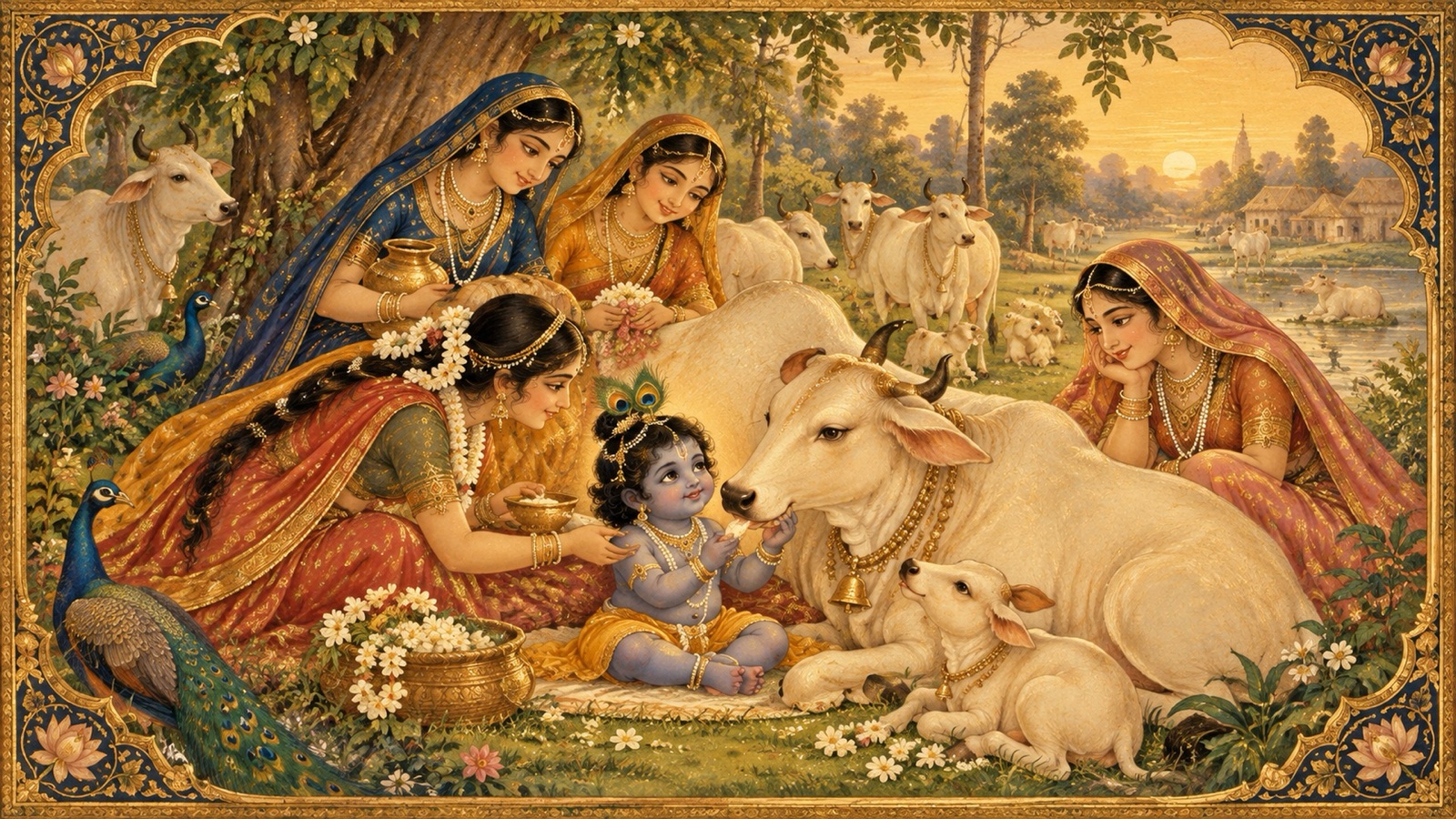
From confession Brahma turned to longing. He did not ask for power or position; his one prayer was to be counted, in any birth whatever — even as a bush or a beast in Gokula — among the devotees of the Lord, so that he might serve those tender lotus feet.
तदस्तु मे नाथ स भूरिभागो
भवेऽत्र वान्यत्र तु वा तिरश्चाम् ।
येनाहमेकोऽपि भवज्जनानां
भूत्वा निषेवे तव पादपल्लवम् ॥ ३० ॥
tad astu me nātha sa bhūri-bhāgo bhave ’tra vānyatra tu vā tiraścām yenāham eko ’pi bhavaj-janānāṁ bhūtvā niṣeve tava pāda-pallavam
Meaning: Therefore, O Lord, let this be my great fortune — in this life, or in any other, or even among the animals — that, becoming even one of Your devotees, I may serve Your tender lotus feet. (Canto 10, Chapter 14, verse 30)
He glorified the cows and cowherd women of Vraja, whose breast-milk the Lord drank with delight, and whose good fortune the greatest sacrifices could never equal. And then he uttered the verse that devotees have cherished ever since — the wonder of the fortune of Nanda and the people of Vraja, whose intimate friend is the eternal, all-blissful Supreme Brahman Himself.
अहो भाग्यमहो भाग्यं नन्दगोपव्रजौकसाम् ।
यन्मित्रं परमानन्दं पूर्णं ब्रह्म सनातनम् ॥ ३२ ॥
aho bhāgyam aho bhāgyaṁ nanda-gopa-vrajaukasām yan-mitraṁ paramānandaṁ pūrṇaṁ brahma sanātanam
Meaning: Oh, the great fortune! Oh, the great fortune of Nanda the cowherd and the people of Vraja, whose dear friend is the perfect, eternal Supreme Brahman, the reservoir of the highest bliss! (Canto 10, Chapter 14, verse 32)
Brahma’s Surrender and Departure
Brahma confessed that even he and the other presiding deities of the senses — indeed Shiva himself — repeatedly drink, through the cups of their senses, the nectar of the honey of the Lord’s lotus feet; and that to take birth even as a blade of grass in Gokula, sprinkled by the dust of the feet of these people whose whole life is Mukunda, would be the highest fortune. So long as people are not the Lord’s own, he said, the passions rob them like thieves, the home is a prison, and delusion is a shackle upon the feet. Declaring that his mind, body, and speech could never grasp the Lord’s greatness, Brahma asked leave: ‘You know all and see all; You are the Lord of the worlds, and this world is offered to You.’ Then, glorifying Krishna as the delight of the Yadus, the nourisher of the earth, the gods, the brahmanas, and the cattle, and the destroyer of irreligion, he offered his final obeisance.
समाश्रिता ये पदपल्लवप्लवं
महत्पदं पुण्ययशो मुरारे: ।
भवाम्बुधिर्वत्सपदं परं पदं
पदं पदं यद् विपदां न तेषाम् ॥ ५८ ॥
samāśritā ye pada-pallava-plavaṁ mahat-padaṁ puṇya-yaśo murāreḥ bhavāmbudhir vatsa-padaṁ paraṁ padaṁ padaṁ padaṁ yad vipadāṁ na teṣām
Meaning: For those who have taken shelter of the boat of the lotus feet of Murari — the feet that are the abode of all greatness and of sacred renown — the ocean of material existence becomes as small as the water in a calf’s hoofprint; they reach the supreme abode, where calamities are not found at every step. (Canto 10, Chapter 14, verse 58)
Krishna Returns to His Friends
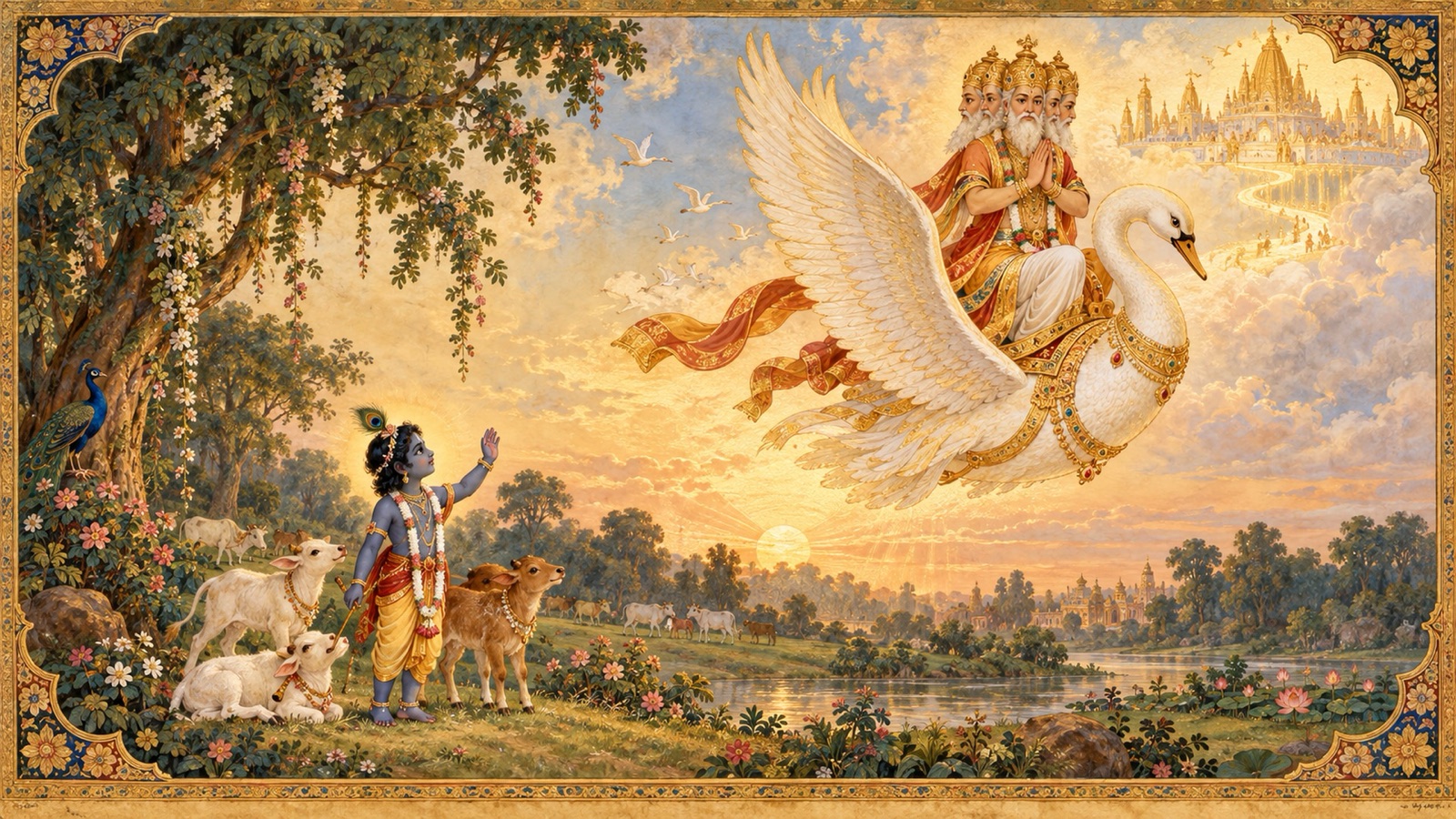
Having thus praised the Lord, Brahma circumambulated Him three times, bowed at His feet, and returned to his own abode. Krishna, taking leave of the creator, brought the calves back to the very spot on the riverbank where His friends were waiting. Though a whole year had passed, the boys, under the Lord’s Maya, believed only half a moment had gone by — for what will the maya-bewildered not forget, when the whole world under His spell is forever forgetting its own self?
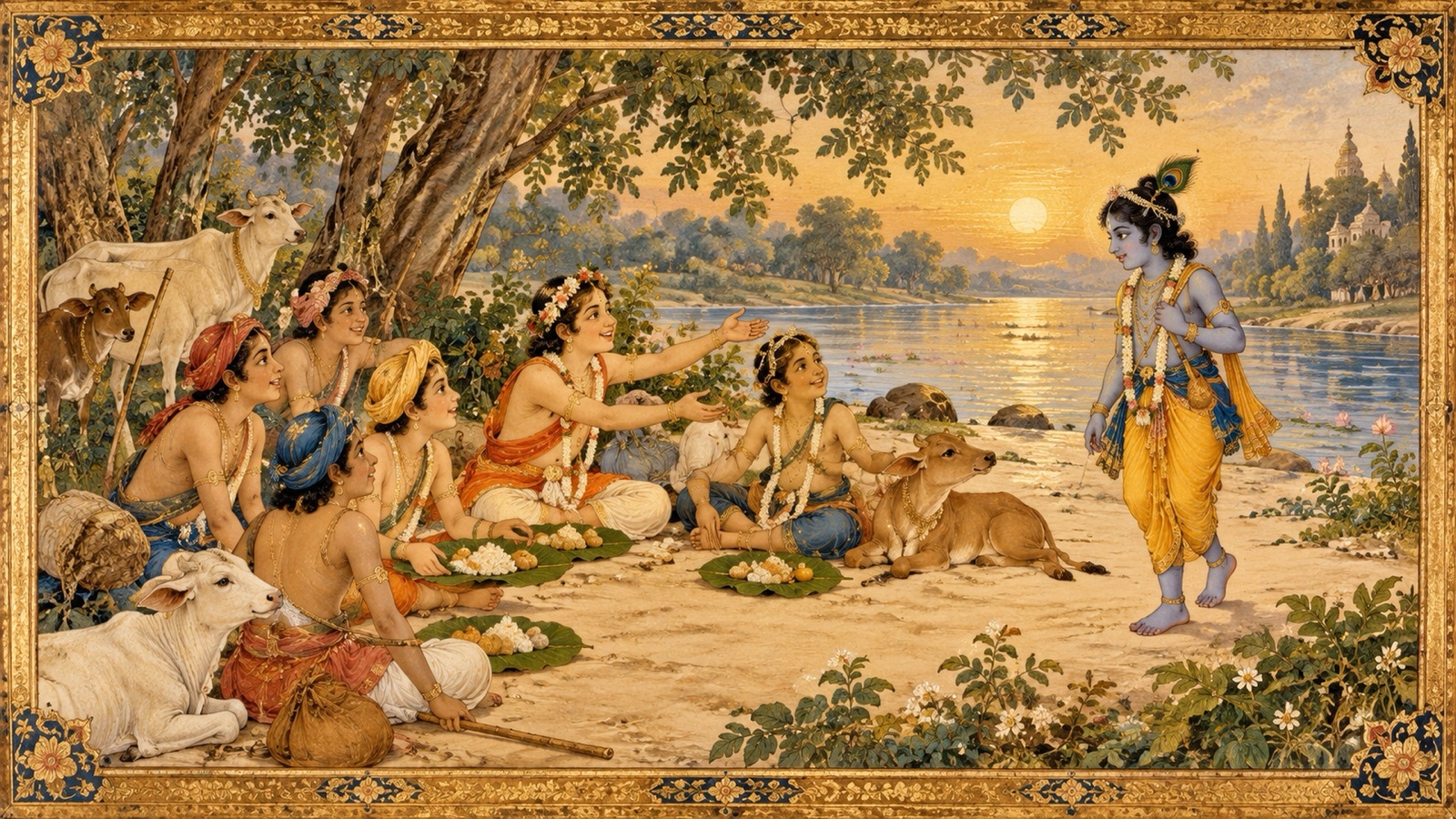
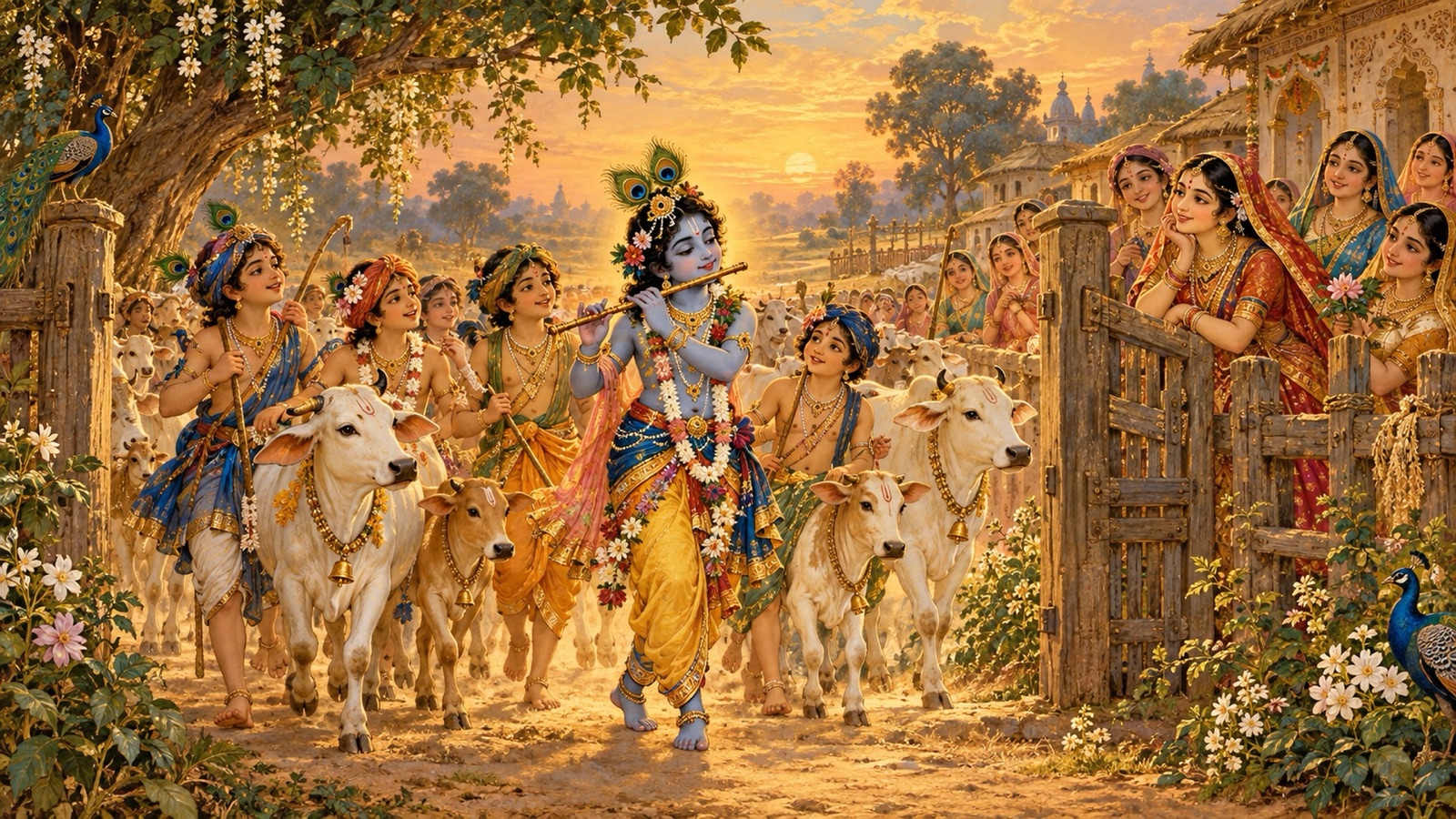
‘You have come back so quickly!’ the boys called to Him. ‘Not one of us has eaten a single morsel — come, let us all eat together.’ Smiling, Krishna ate with them, and then, showing them the dried skin of the python Aghasura on the way, He returned from the forest to Vraja. His body adorned with peacock feathers, forest flowers, and bright minerals, playing His flute while His companions sang His glory, He entered the cow-pen as a very festival for the eyes of the gopis; and the boys sang in Vraja of how their little friend had killed a great serpent.
Why Vraja Loved Krishna as Its Own Self
King Parikshit then asked how the people of Vraja could feel for Krishna — the son, as they thought, of another — a love even greater than for their own children. Sukadeva answered with a profound teaching. For every embodied being, he said, the dearest thing of all is one’s own self; children, wealth, and home are dear only for the sake of that self. But Krishna is the very Self of all selves; He appears here, by His Maya, as if He were an embodied being, for the good of the world. Therefore the love of Vraja flowed to Him more powerfully than to anything else, for in loving Him they were loving the innermost Self of their own hearts. To those who truly know, Sukadeva said, everything moving and unmoving is the form of the Lord, and nothing else exists apart from Him; Krishna is the essence and the goal of all that is. And for those who take shelter of His feet, the vast ocean of birth and death shrinks to a puddle easily crossed.
Principal Teachings of This Chapter
1. The Lord is won by devotion, not by argument. Brahma declares that the unconquerable Lord is conquered by those who give up speculation and simply hear and honour Him (verse 3). Humble hearing of His glories accomplishes what all the intellect cannot.
2. The true devotee accepts life as grace. One who bears his lot patiently as the fruit of his own deeds, and keeps offering the Lord his heart, words, and body, is the rightful heir to liberation (verse 8). Devotion is a way of living, not merely a feeling.
3. All our power is His, borrowed. Brahma’s attempt to test the Lord with his own maya was like offering a spark to a fire (verses 9-18). Before the Supreme, every creature’s power and pride dissolve.
4. The greatest fortune is His devotees’ company. Brahma prays to be born even as a beast in Gokula among the Lord’s devotees (verses 30-32). To be near those who love God is a higher fortune than any heaven.
5. The Lord is the Self of all we love. Vraja loves Krishna more than their own children because He is the very Self of all selves (verses 49-55). All love, rightly understood, is love for Him.
A Devotional Reflection
Brahma is the wisest and most powerful of all created beings, the very architect of the universe — and this chapter shows him weeping at the feet of a small boy holding a lump of rice, praying only to be born as a blade of grass where that boy is loved. There is no greater portrait of true humility in all of scripture. What broke Brahma’s pride was not a display of force but a glimpse of the truth: that the Lord he had tried to test is the Self of everything, the friend of cowherds, the object of every love. His prayer teaches us where real wisdom ends — not in mastering God through knowledge, but in surrendering to Him through love, and in longing above all for the company of those who love Him. If the creator of the universe considered it his highest fortune merely to serve at the edge of Vraja, then we, too, may set aside every ambition and ask for the one thing worth asking: a small place among the devotees, and the dust of the Lord’s feet upon our heads.
A Daily Devotional Practice
Today, make Brahma’s prayer your own. Instead of asking the Lord for success or relief, ask simply for devotion and for the company of His devotees — to be counted, however humbly, among those who love Him. When life brings hardship, receive it in the spirit of verse 8, as the fruit of your own past and an occasion to offer the Lord your heart, words, and body while awaiting His mercy. Begin by chanting gently: Om Namo Bhagavate Vasudevaya.
Conclusion
The fourteenth chapter of the Tenth Canto gives us the prayers of Brahma — a hymn in which the creator of the universe, humbled by the vision of the child-Lord’s glory, teaches us the whole science of devotion. He exalts loving surrender above dry knowledge, confesses that his own power is nothing before the Supreme, and prays only to serve at the feet of the Lord’s devotees, his heart undone at the thought of how blessed these simple herdsmen are to call the eternal Brahman their own dear companion. When he departs, Krishna returns to His waiting friends, for whom a year has passed as a moment, and re-enters Vraja to the delight of all. And Sukadeva reveals the secret of Vraja’s love: that Krishna is the very Self of all, so that to love Him is to love the innermost heart of everything. May we learn from the humbled creator to seek not mastery but surrender, and to treasure above all fortunes a small place among those who love the Lord.
May the divine wisdom of Srimad Bhagavatam awaken pure devotion within our hearts.
Om Namo Bhagavate Vasudevaya.
Jay Shree Madhav.
References and Attribution
- Primary edition: Gita Press, Śrīmad Bhāgavata Mahāpurāṇa (Sanskrit-Hindi, Volume 2), Book Ten (First Half), Discourse 14.
- Series: Srimad Bhagavatam Wisdom · Biswa Sanatan Dharma Seva Trust.
- Presented following the spiritual guidance and recommendation of Pandit Dr. Shri Kashinath Mishra.
This is an original, faithful retelling in the writer’s own words, with brief quoted verses shown in Devanāgarī and transliteration and their meanings given as summaries. It is not a reproduction of any single publisher’s continuous translation or commentary. No affiliation with or endorsement by any publisher is implied.
Jay Shree Madhav