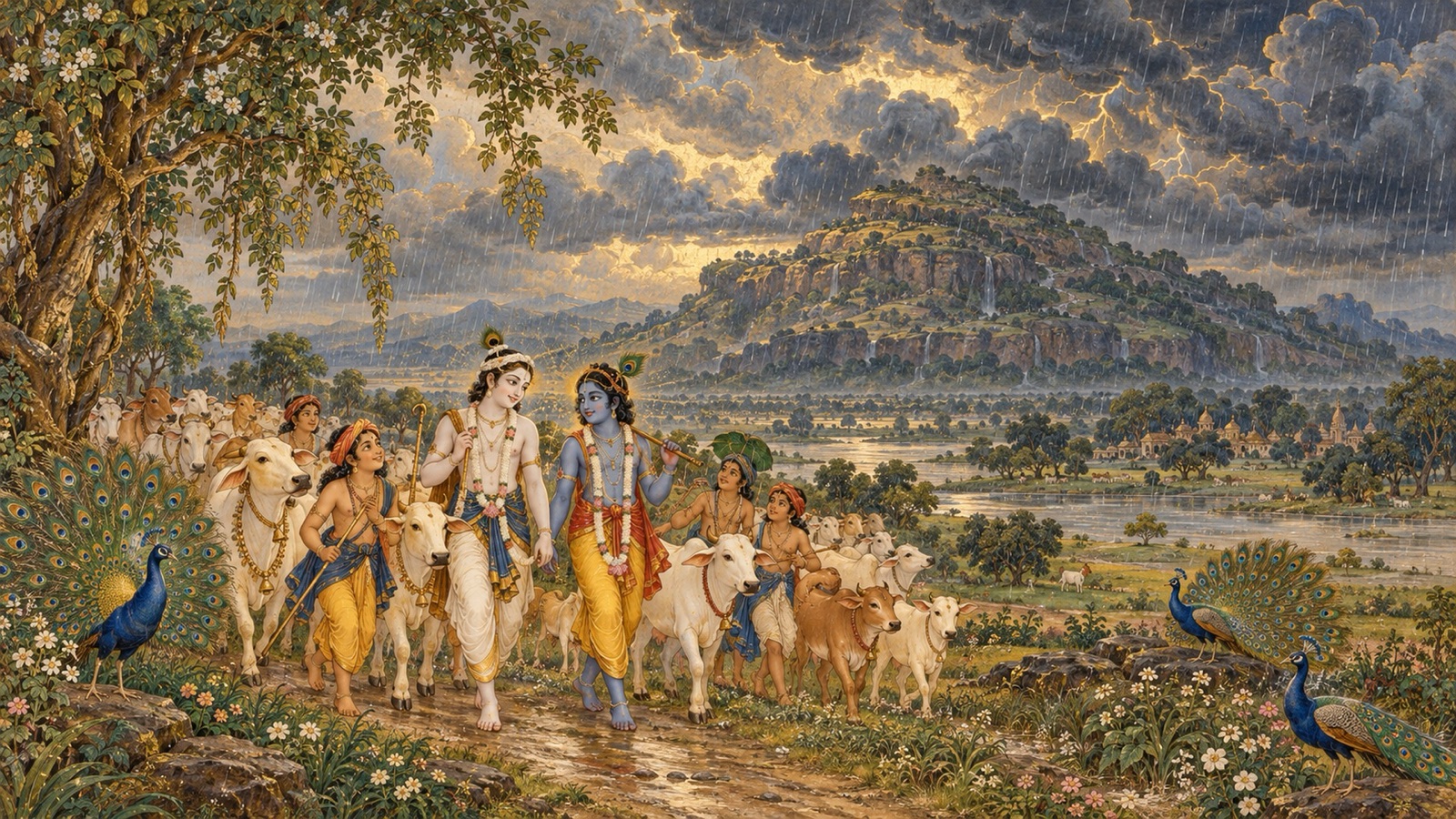
Beneath thunderclouds massed over Govardhana, Krishna walks with Balarama and the herds of Vraja, while every falling drop and dancing peacock becomes, for those with eyes to see, a word of the Lord’s own teaching.
Om Namo Bhagavate Vasudevaya.
Om Namo Bhagavate Vasudevaya.
Om Namo Bhagavate Vasudevaya.
Welcome back to Srimad Bhagavatam Wisdom, our devotional journey through the sacred histories and teachings of the Srimad Bhagavat Mahapurana. In this twentieth chapter of the Tenth Canto, Sukadeva Gosvami pauses the pastimes of Krishna to let two whole seasons pass before King Parikshit’s eyes — the drenching monsoon and the crystalline autumn that follows — while Krishna and Balarama walk through transformed Vrindavana with the herds and cowherd boys.
Chapter Information
- Scripture: Śrīmad Bhāgavata Mahāpurāṇa
- Canto: 10 (Book Ten, First Half)
- Chapter: 20 (Discourse 20)
- Chapter title: The Rainy Season and Autumn in Vrindavana
- Principal speaker: Sukadeva Gosvami (narrating to King Parikshit)
- Principal listener: King Parikshit
- Main setting: The forest of Vrindavana and the pastures of Vraja through the rainy season and the autumn that follows
- Central subject: The coming of the monsoon and of autumn in Vrindavana, each natural sign read as a teaching on devotion, detachment and the Lord’s glory, while Krishna and Balarama tend the herds through both seasons
- Principal verse range: Canto 10, Chapter 20, verses 1–49
- Primary edition: Gita Press Śrīmad Bhāgavata Mahāpurāṇa (English, Complete Edition)
Context From the Previous Chapter
In Chapter 19, a wildfire again threatened the sleeping cowherds, and Krishna swallowed it as before; in the same stretch of days, Pralamba, the demon who tried to carry off Balarama, met his end at Balarama’s hands. This chapter opens with the cowherd boys still marvelling over these twin deliverances as the rains begin.
The Cowherds Tell of the Fire and of Pralamba’s End
Sri Suka began again: returning home in wonder, the cowherd boys told the womenfolk of Vraja, at full length, of that rescue from the forest fire and of Pralamba’s destruction. Hearing it, the elder Gopas and the cowherd women could only conclude that Krishna and Balarama were two great gods who had, by great fortune, come down to dwell among them.
श्रीशुक उवाच
तयोस्तदद्भुतं कर्म दावाग्नेर्मोक्षमात्मन: ।
गोपा: स्त्रीभ्य: समाचख्यु: प्रलम्बवधमेव च ॥ १ ॥
śrī-śuka uvāca tayos tad adbhutaṁ karma dāvāgner mokṣam ātmanaḥ gopāḥ strībhyaḥ samācakhyuḥ pralamba-vadham eva ca
Meaning: Sri Suka said: The cowherd boys told their womenfolk in full that wondrous deed of the two brothers — their deliverance from the forest fire, and the slaying of Pralamba. (Canto 10, Chapter 20, verse 1)
The Clouds Gather Over Vraja
Then the rainy season set in — nourishing every creature, ringed with bright haloes about the sun and moon, resounding with thunder. Dense, lightning-charged clouds hid the heavenly lights, and the veiled sky resembled the pure soul whose wisdom is clouded by the play of the three gunas. The sun, who through eight months had drawn up the earth’s moisture, now released it as rain, like a righteous king returning to his people what is justly theirs; and the great rain-clouds poured down their life-giving water as the truly compassionate pour out their own strength to relieve another’s suffering. The parched earth, shrunken by summer, grew green and full again, as a body grows full once more when austerity bears its fruit.
Here Sukadeva offers a sharper teaching. At nightfall, under thick cloud, only the fireflies gleam, never the hidden planets; so too, in an age overrun by sin, empty doctrines flourish loudly while the Vedas themselves go unseen by those unwilling to look.
निशामुखेषु खद्योतास्तमसा भान्ति न ग्रहा: ।
यथा पापेन पाषण्डा न हि वेदा: कलौ युगे ॥ ८ ॥
niśā-mukheṣu khadyotās tamasā bhānti na grahāḥ yathā pāpena pāṣaṇḍā na hi vedāḥ kalau yuge
Meaning: At nightfall, under cover of darkness, it is the fireflies that shine, not the planets; just so, in the age of Kali, overrun by sin, empty doctrines flourish, not the Vedas themselves. (Canto 10, Chapter 20, verse 8)
Frogs long silent broke into croaking at the clouds’ roar, as a student breaks silence to recite the moment his teacher calls; and streams long dwindling suddenly overflowed, as an undisciplined man’s wealth runs into wrong channels once restraint is lost.
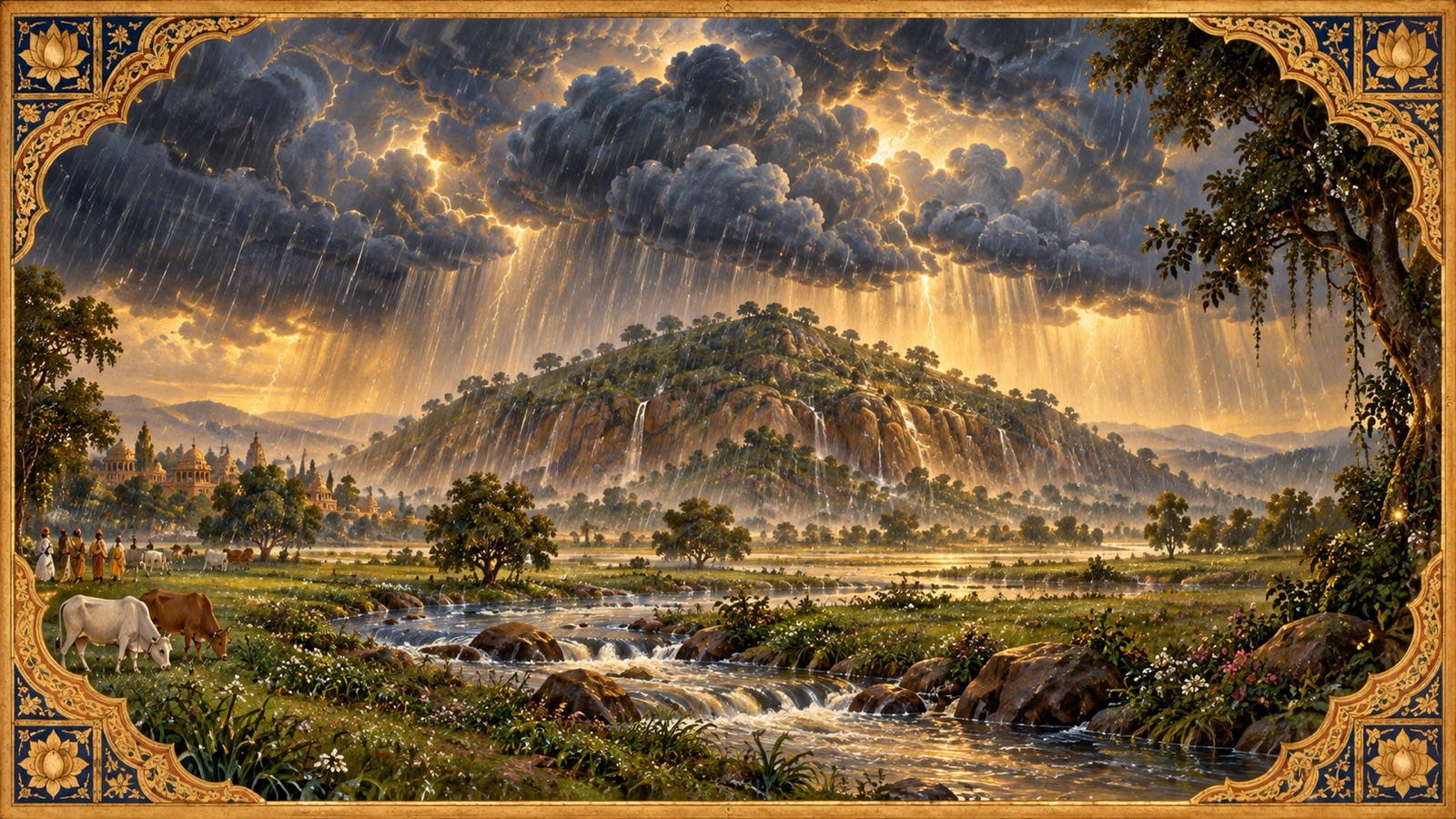
The Earth Rejoices in the Rain
The earth took on the colours of an army arrayed for battle — green with fresh grass, crimson with tiny red insects, white with mushrooms. The standing crops gladdened the farmers who sowed them even as they pained the wealthy, who envied this plenty without knowing abundance rests in Providence alone. Every creature of land and water took on a radiant new beauty through the fresh rainwater — as the soul, Sukadeva says, grows beautiful through the service of Sri Hari.
जलस्थलौकस: सर्वे नववारिनिषेवया ।
अबिभ्रन् रुचिरं रूपं यथा हरिनिषेवया ॥ १३ ॥
jala-sthalaukasaḥ sarve nava-vāri-niṣevayā abibhran ruciraṁ rūpaṁ yathā hari-niṣevayā
Meaning: All creatures of land and water took on a fresh beauty by resorting to the new rainwater — just as one grows beautiful by resorting to the worship of Sri Hari. (Canto 10, Chapter 20, verse 13)
The ocean, swollen by the rivers pouring into it, grew turbulent, as an unsteady mind is stirred by contact with the senses; but the mountains, battered without pause by rain, never trembled — as a heart fixed on the Lord stays unshaken under any calamity.
गिरयो वर्षधाराभिर्हन्यमाना न विव्यथु: ।
अभिभूयमाना व्यसनैर्यथाधोक्षजचेतस: ॥ १५ ॥
girayo varṣa-dhārābhir hanyamānā na vivyathuḥ abhibhūyamānā vyasanair yathādhokṣaja-cetasaḥ
Meaning: The mountains, struck again and again by torrents of rain, did not tremble — just as those whose minds are fixed on the transcendental Lord do not waver even when overwhelmed by calamities. (Canto 10, Chapter 20, verse 15)
Overgrown paths, long untrodden, grew hard to trace, Sukadeva adds, exactly as the true meaning of the Vedas fades among Brahmanas who neglect their study.
Further Wonders of the Monsoon
Sukadeva gathers a few more such signs together: fickle lightning that favours no one cloud for long, as an inconstant woman favours no single worthy man; the moon hidden by clouds shining with her own borrowed light, as the true Self goes unseen behind the shining ego; and peacocks dancing with joy at the first clouds, as a weary heart leaps at the arrival of one of Krishna’s own devotees. Trees withered by summer burst back into leaf and fruit, as ascetics grow strong once their discipline bears fruit; and as Indra’s showers breach dam after dam — as false doctrine breaches the dams of Vedic virtue in the age of Kali — the wind-driven clouds pour their nectar-like water on all beings, just as kings, guided by the learned, grant the boons their subjects long for.
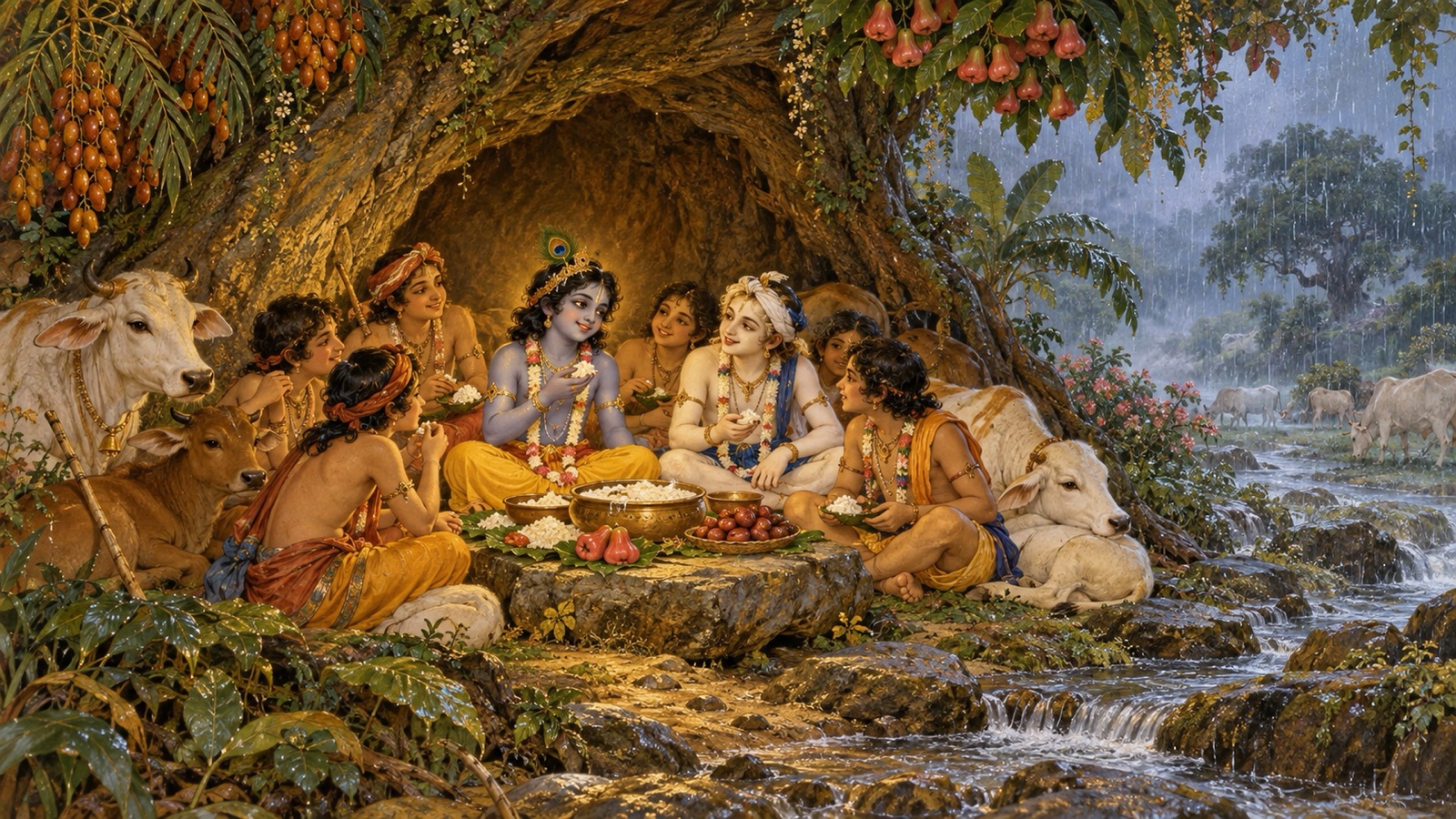
Krishna and Balarama Sport in the Rain-Drenched Forest
Through all this, Krishna, surrounded by the cows and cowherd boys and accompanied by Balarama, went deep into that same forest, heavy with ripe dates and rose-apples, simply to sport there. Called by His voice, the cows, slowed by their own milk-laden udders, quickened toward Him, their udders spilling milk from sheer tenderness. Moving through the drenched woods, the Lord watched the forest creatures rejoicing and the honey dripping from the trees; and when rain closed in on every side, He and His companions simply sheltered in a hollow tree or cave, content with wild roots and fruit, taking a simple meal with Balarama and the cowherd boys on a flat stone near the water. Watching the cows and calves resting on the meadows, fully content and chewing the cud with half-closed eyes, Krishna welcomed the whole rain-drenched splendour with evident delight.
Autumn Arrives in Vrindavana
So Krishna and Balarama dwelt in Vraja through those months; and then autumn fully arrived — cloudless, with crystal waters and a gentle, cooling breeze. Lotuses bloomed everywhere, and the waters regained their old transparency, as the mind of one who has strayed from yoga regains its clarity once practice is resumed. Here Sukadeva gives the clearest teaching of the whole chapter: as autumn drives the clouds from the sky, eases the crowding of creatures, dries the earth’s mire, and clears the waters, so devotion to Krishna removes every trace of inauspiciousness from a soul in any walk of life.
व्योम्नोऽब्भ्रं भूतशाबल्यं भुव: पङ्कमपां मलम् ।
शरज्जहाराश्रमिणां कृष्णे भक्तिर्यथाशुभम् ॥ ३४ ॥
vyomno ’bbhraṁ bhūta-śābalyaṁ bhuvaḥ paṅkam apāṁ malam śaraj jahārāśramiṇāṁ kṛṣṇe bhaktir yathāśubham
Meaning: Just as autumn took away the clouds of the sky, the overcrowded turbulence of creatures, the mire of the earth and the impurity of the waters, so does devotion to Krishna remove every trace of what is inauspicious from those who follow the orders of life. (Canto 10, Chapter 20, verse 34)
A few more autumn signs complete the picture: clouds once emptied of their water shine out white and clean, like ascetics who have shed every desire; mountains release their purest water in some places and withhold it in others, as the wise share their wisdom with the worthy only at the right time; and the ocean, lashed through the rains, grows calm with autumn’s coming, like a sage whose mind has at last found rest.
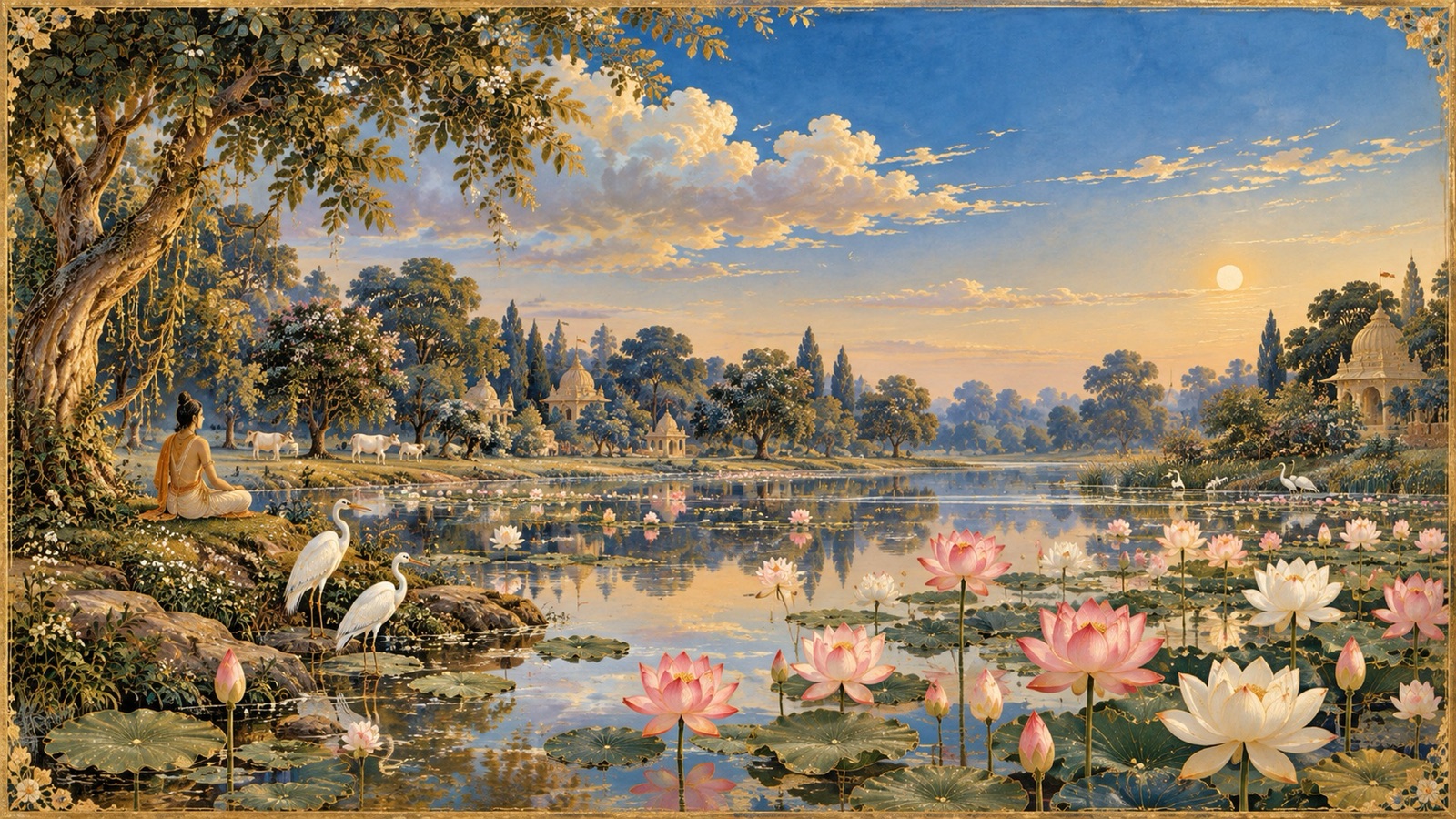
The Autumn Moon and the Shining Night
Farmers held back with firm embankments the water that might drain from their fields, as yogis guard the wisdom that would otherwise leak away through uncontrolled senses. The moon itself rose to relieve the world of a suffering the autumn sun’s rays had caused — as the dawning of true wisdom ends the suffering of mistaking the body for the self, and as Krishna alone could relieve the aching hearts of the gopis of Vraja, who suffered now from nothing but His own absence.
शरदर्कांशुजांस्तापान् भूतानामुडुपोऽहरत् ।
देहाभिमानजं बोधो मुकुन्दो व्रजयोषिताम् ॥ ४२ ॥
śarad-arkāṁśu-jāṁs tāpān bhūtānām uḍupo ’harat dehābhimāna-jaṁ bodho mukundo vraja-yoṣitām
Meaning: As the moon relieved all creatures of the suffering caused by the rays of the autumn sun, so does the dawning of true wisdom end the suffering born of identifying with the body — and so did Mukunda alone relieve the gopis of Vraja of the pain of separation from Him. (Canto 10, Chapter 20, verse 42)
The cloudless sky shone all the more beautifully by night with its scattering of stars, just as a mind ruled by goodness shines with the true import of scripture; and in that sky the full, unbroken moon blazed amid its stars exactly as, on this earth, Krishna, Lord of the Yadus, shone surrounded by the whole circle of the Vrishnis.
अखण्डमण्डलो व्योम्नि रराजोडुगणै: शशी ।
यथा यदुपति: कृष्णो वृष्णिचक्रावृतो भुवि ॥ ४४ ॥
akhaṇḍa-maṇḍalo vyomni rarājoḍu-gaṇaiḥ śaśī yathā yadu-patiḥ kṛṣṇo vṛṣṇi-cakrāvṛto bhuvi
Meaning: The unbroken orb of the moon shone in the sky surrounded by its host of stars, just as Krishna, the Lord of the Yadus, shone on this earth surrounded by the circle of the Vrishnis. (Canto 10, Chapter 20, verse 44)
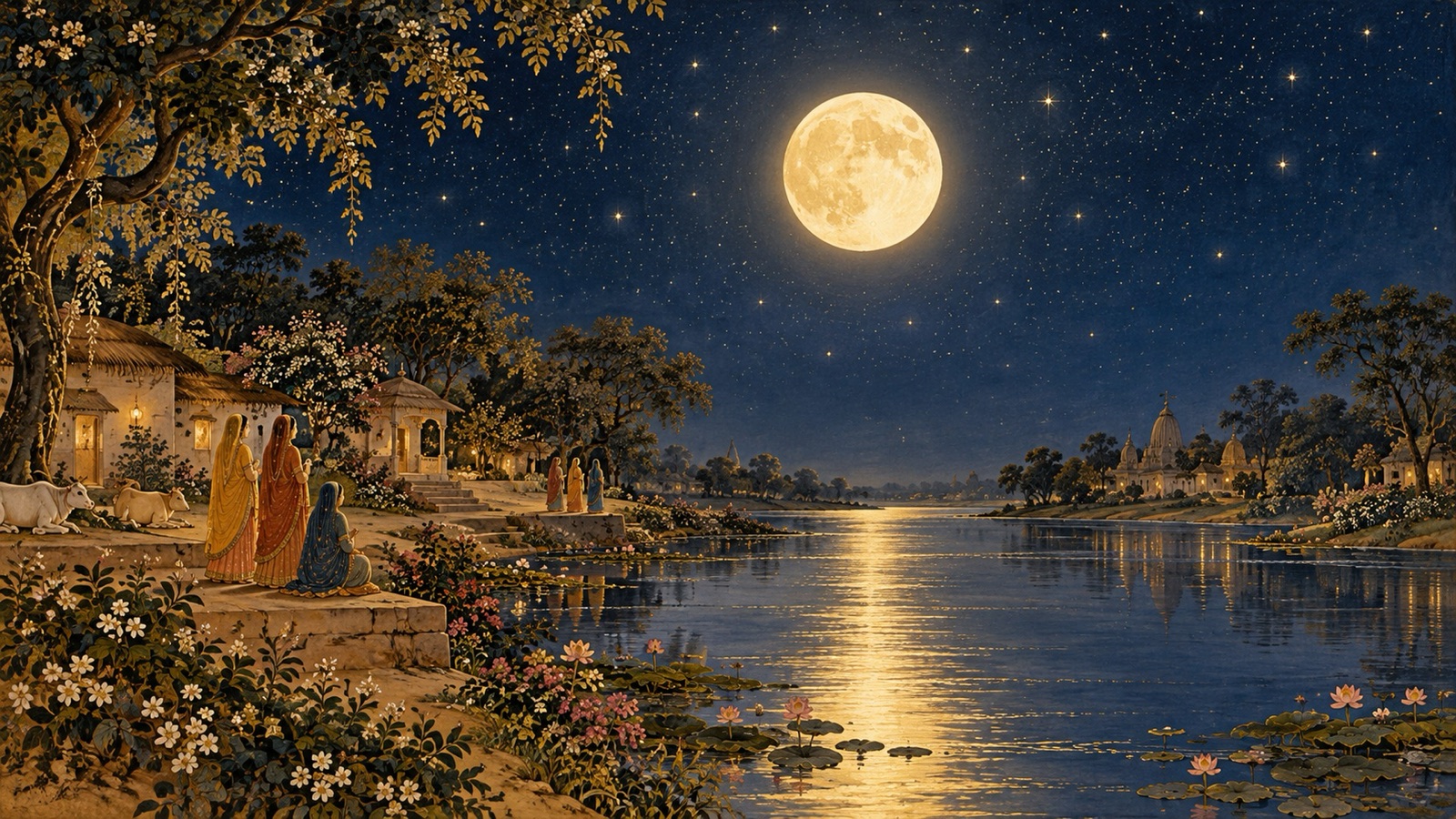
When the cool breeze drifted in from the flowering woods, people everywhere set aside summer’s lingering ache — all except the cowherd women, whose hearts Krishna alone had captured, for whom that same breeze only deepened their grief at His daytime absence. Creatures and women alike, sought by their mates in this season, conceived now exactly as actions offered to the Lord are bound, in their own time, to bear fruit; and at sunrise every flower of the waters opened except the water-lily, just as every subject feels fearless under a righteous king except the thief alone.
The Fullness of Autumn
With the earth rich in ripened grain, the land shone with Vedic sacrifices offered from the season’s first fruits, with village festivals, and — brightest of all — with Krishna and Balarama themselves among the people. At the rains’ end, the merchants, sages, kings and students held back by the monsoon set out and reached their destinations, as a soul perfected in yoga, freed at last from the body, attains the state it has long sought.
वणिङ्मुनिनृपस्नाता निर्गम्यार्थान् प्रपेदिरे ।
वर्षरुद्धा यथा सिद्धा: स्वपिण्डान् काल आगते ॥ ४९ ॥
vaṇiṅ-muni-nṛpa-snātā nirgamyārthān prapedire varṣa-ruddhā yathā siddhāḥ sva-piṇḍān kāla āgate
Meaning: The merchants, sages, kings and students, who had been held back by the rains, now went out and reached their desired ends — just as perfected souls, held back until their time, reach their own true state when the proper moment comes. (Canto 10, Chapter 20, verse 49)
Principal Teachings of This Chapter
1. All creation can become a teacher. Thunder, frogs, fireflies, mountains and moonlight all turn into living lessons (verses 4–24, 33–47). Nothing in the Lord’s world is too small to carry His instruction, for one who looks with devotion.
2. Devotion to Krishna cleanses what nothing else can. The chapter’s clearest teaching likens autumn’s clearing of cloud and mire to what bhakti does within the heart (verse 34): as autumn leaves the sky, earth and waters pure, so does loving service to Krishna wash away whatever is unclean in a soul, on any path of life. This is the key the sage hands us for reading everything else here — every downpour and quiet mountain finally points back to this one purifying power of bhakti.
3. Service to the Lord gives the soul its true beauty. Just as every creature took on a fresh radiance through the rain, the soul that resorts to the worship of Sri Hari takes on a beauty no outward adornment can give (verse 13).
4. A heart fixed on the Lord cannot be shaken. The mountains, pounded endlessly by rain, remain motionless, as does a mind anchored in the Lord, however hard calamity strikes (verse 15).
5. Even the Lord’s seeming absence serves His devotees. The moon relieves a heat it did not cause, and Krishna alone relieves the gopis of the pain His own absence brought (verse 42) — the remedy for separation from the Lord is found only in the Lord.
A Devotional Reflection
There is something tender in watching Sukadeva slow the great story of Krishna to the pace of a single rainy season. No demon is slain here, no serpent subdued — yet every falling drop and unmoved mountain is made to speak of the soul and its Lord. It is as though the sage wants Parikshit, and us with him, to learn that the whole world is already saying these things quietly, and devotion is simply what allows us to finally hear it. The monsoon that darkens and swells everything, only for autumn to settle and clarify it again, feels like the movement of a heart in surrender — first the flood of longing, and only then, by Krishna’s grace, the quiet, moonlit clearness that remains.
A Daily Devotional Practice
Today, let one ordinary sight from nature — a cloud, falling rain, moonlight on still water — become for a quiet moment your teacher, as the rains and the autumn taught King Parikshit. Ask simply what it would say of the soul and the Lord, and offer a silent word of gratitude to Krishna for placing His own lessons so freely around us. Begin with a gentle chant: Om Namo Bhagavate Vasudevaya.
Conclusion
In this twentieth chapter of the Tenth Canto, Sukadeva lets two seasons pass over Vraja — the monsoon that swells and darkens, and the autumn that clears and calms — while Krishna and Balarama walk through both with the herds and their cowherd friends. In cloud, frog, mountain and moonbeam the sage finds a quiet lesson, gathered beneath the one teaching that matters most: devotion to Krishna cleanses the heart exactly as autumn cleanses the world. May we carry this gentle wisdom with us the next time rain darkens our own sky, trusting the clearing that follows as Krishna’s own promise to every heart that turns to Him.
May the divine wisdom of Srimad Bhagavatam awaken pure devotion within our hearts.
Om Namo Bhagavate Vasudevaya.
Jay Shree Madhav.
References and Attribution
- Primary edition: Gita Press, Śrīmad Bhāgavata Mahāpurāṇa (English, Complete Edition), Book Ten (First Half), Discourse 20.
- Series: Srimad Bhagavatam Wisdom · Biswa Sanatan Dharma Seva Trust.
- Presented following the spiritual guidance and recommendation of Pandit Dr. Shri Kashinath Mishra.
This is an original, faithful retelling in the writer’s own words, with brief quoted verses shown in Devanāgarī and transliteration and their meanings given as summaries. It is not a reproduction of any single publisher’s continuous translation or commentary. No affiliation with or endorsement by any publisher is implied.
Jay Shree Madhav