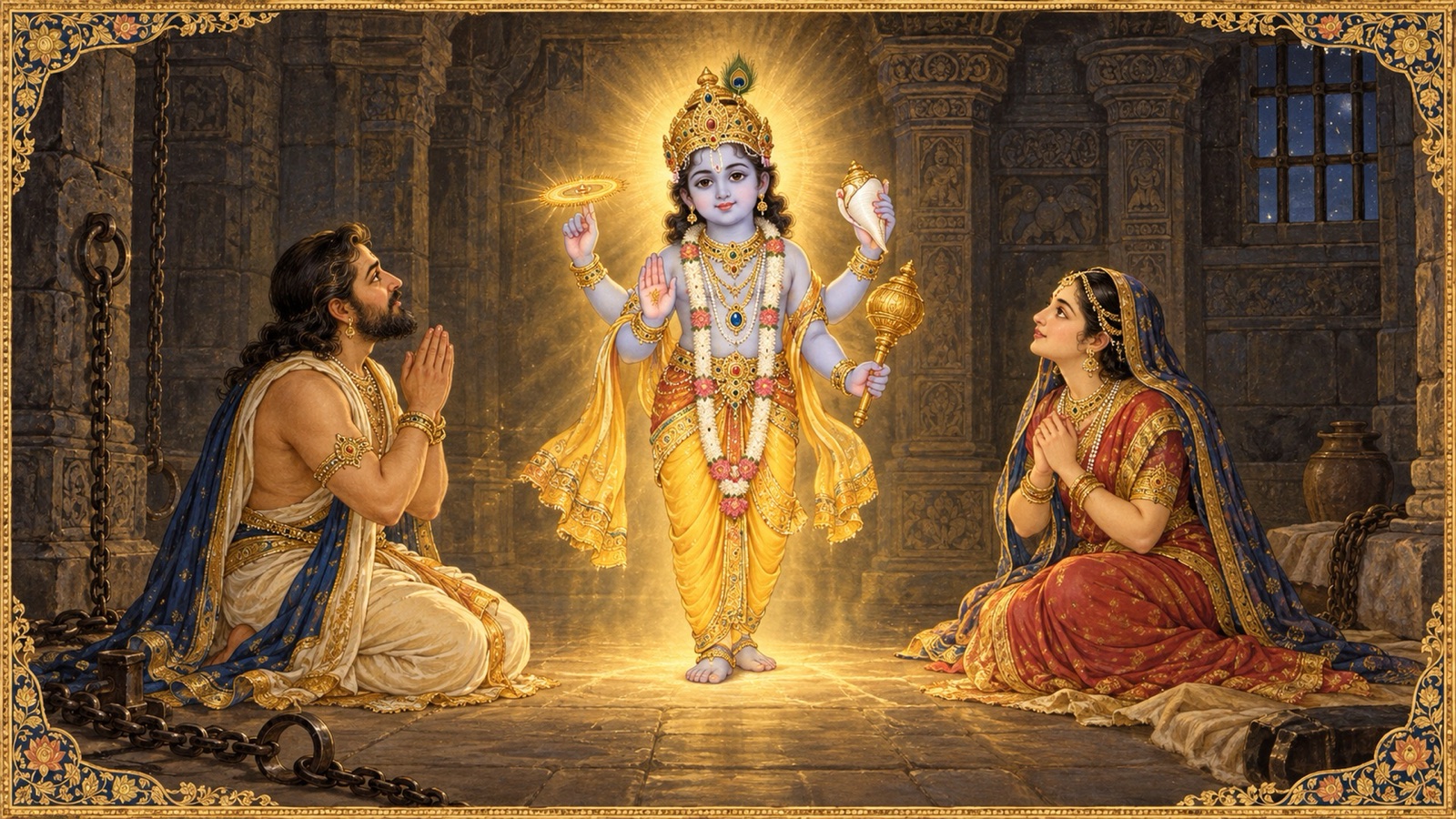
At the darkest hour of midnight, in a prison cell, the Supreme Lord appears before Vasudeva and Devaki — four-armed and radiant — and the long-awaited advent of Sri Krishna at last comes to pass.
Om Namo Bhagavate Vasudevaya.
Om Namo Bhagavate Vasudevaya.
Om Namo Bhagavate Vasudevaya.
Welcome back to Srimad Bhagavatam Wisdom, our devotional journey through the sacred histories and teachings of the Srimad Bhagavat Mahapurana. In the previous chapter, the Supreme Lord entered the womb of Devaki, her prison-cell filled with an unearthly radiance, and the gods descended to sing the Garbha-stuti, the eulogy of the Lord within the womb. Now comes the moment toward which the whole canto has been building. In this third chapter the whole of creation grows still and beautiful at the hour of midnight; the Supreme Lord manifests before Vasudeva and Devaki in His four-armed form; both parents glorify Him with wonder and love; the Lord recalls His former descents and instructs them; and, transforming Himself into an ordinary infant, He is carried across the swollen Yamuna to Gokula while all the guards sleep. This is the chapter of the divine advent — Sri Krishna Janma.
Chapter Information
- Scripture: Śrīmad Bhāgavata Mahāpurāṇa
- Canto: 10 (Book Ten, First Half)
- Chapter: 3 (Discourse 3)
- Chapter title: The Birth of Lord Krishna
- Principal speaker: Sukadeva Gosvami (narrating to King Parikshit); related in turn by Suta Gosvami to the sages at Naimisharanya
- Principal listener: King Parikshit (within Sukadeva’s narration); the sages assembled at Naimisharanya
- Main setting: The prison-palace of Kamsa in Mathura; the flooded river Yamuna at night; and the cowherd village of Gokula in Vraja
- Central subject: The advent of the Supreme Lord Sri Krishna; the prayers of Vasudeva and Devaki; the Lord’s recollection of His former descents; and His nighttime journey to Gokula
- Principal verse range: Canto 10, Chapter 3, verses 1–53
- Primary edition: Gita Press Śrīmad Bhāgavata Mahāpurāṇa
Context From the Previous Chapter
In Chapter 2, the Lord’s part-manifestation Ananta was transferred from Devaki’s womb to that of Rohini, to be known as Balarama, and the Supreme Lord Himself entered the womb of Devaki. Her radiance so alarmed Kamsa that he kept a grim, sleepless watch. The gods, led by Brahma and Shiva, gathered at the prison and offered the Garbha-stuti, taking refuge in the Lord as truth itself and comforting Devaki that her son would be the protector of the Yadus. This chapter carries that promise to its fulfilment.
The Auspicious Hour of the Advent
Sukadeva describes how the entire cosmos prepared itself for the descent. The most delightful hour arrived, fraught with every blessing, when the asterism Rohini was at the ascendant and all the planets and stars bore a gentle, benign aspect. The quarters grew clear and serene, as though autumn had come though the rainy season had not yet ended, and the sky shone unobscured with multitudes of stars. The earth, with its towns, villages, cowherd stations, and mines, seemed alive with festivity.
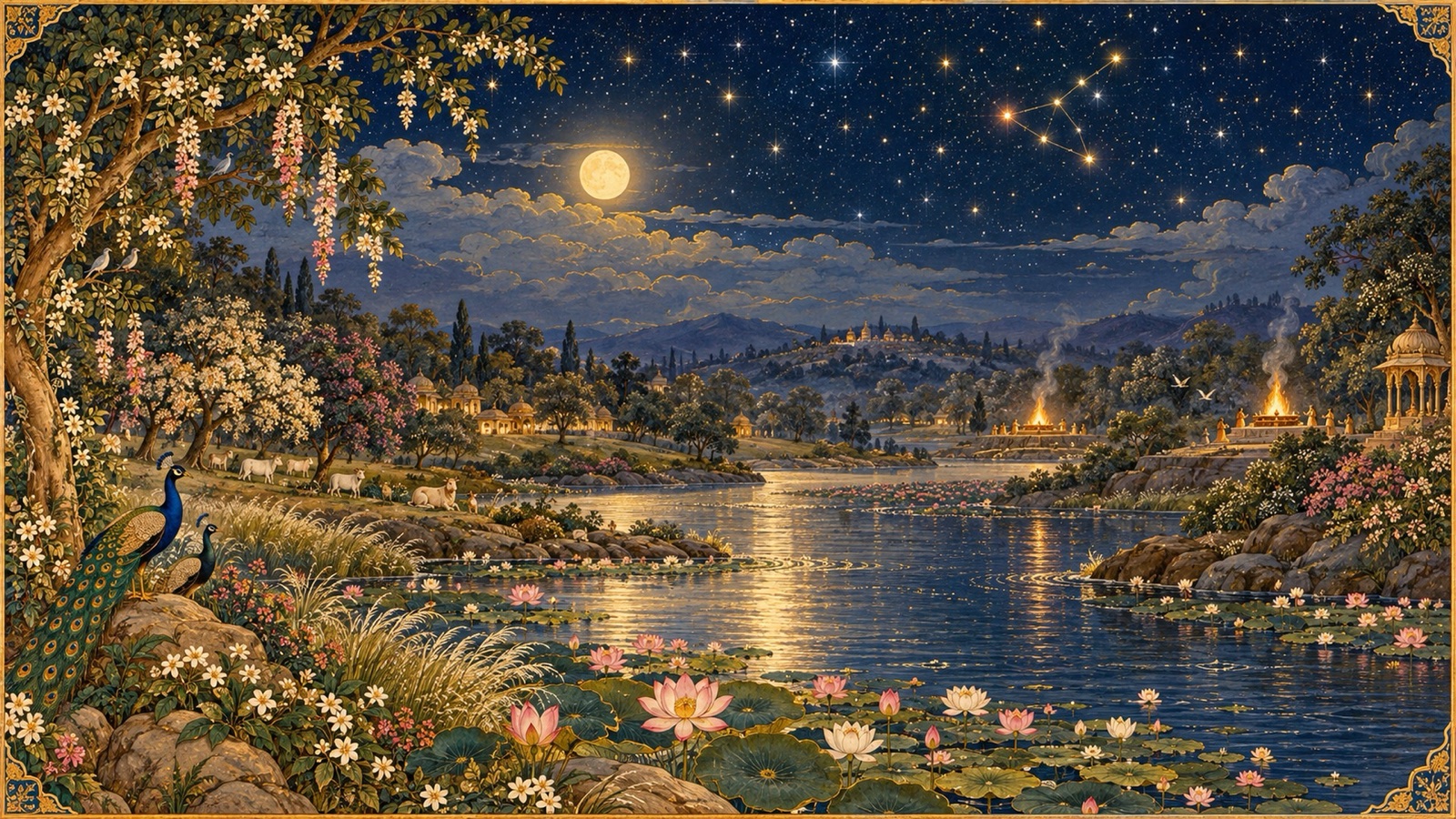
The rivers ran limpid and clear; ponds bloomed with lotuses; rows of flowering forest trees rang with the sweet notes of birds and the humming of bees. A hallowed breeze, carrying a sweet fragrance from the direction of the holy Yamuna, blew delightful to the touch. The sacred fires of the twice-born, extinguished during Kamsa’s persecution, burst into flame of their own accord. The minds of the righteous, long oppressed, grew serene. As the birthless Lord was about to be born, kettledrums sounded of themselves in heaven, Kinnaras and Gandharvas sang, Siddhas and Caranas uttered praises, and celestial women danced while sages and gods showered down flowers and gentle clouds rumbled softly like the sea.
The Supreme Lord Appears
Then, at the deepest hour of midnight, wrapped in darkness, and as the prayers of the world rose for His descent, Lord Vishnu — the Indweller of every heart — manifested in His fullness through Devaki, who bore a form resembling a goddess, even as the full moon rises upon the eastern horizon.
निशीथे तमउद्भूते जायमाने जनार्दने । देवक्यां देवरूपिण्यां विष्णु: सर्वगुहाशय: । आविरासीद् यथा प्राच्यां दिशीन्दुरिव पुष्कल: ॥ ८ ॥
niśīthe tama-udbhūte jāyamāne janārdane devakyāṁ deva-rūpiṇyāṁ viṣṇuḥ sarva-guhā-śayaḥ āvirāsīd yathā prācyāṁ diśīndur iva puṣkalaḥ
Meaning: At the dead of midnight, in the thickest darkness, as the Lord Janardana took birth, Vishnu, who dwells hidden within all hearts, appeared through the goddess-like Devaki, just as the full moon rises in the eastern sky. (Canto 10, Chapter 3, verse 8)
Vasudeva Beholds the Four-Armed Lord
Vasudeva gazed upon the wondrous child with lotus-like eyes. He beheld the Lord endowed with four arms, bearing the conch, mace, and discus; adorned with the mark of Srivatsa upon His chest and the Kaustubha gem glowing at His neck; clad in yellow silk and beautiful as a rain-laden cloud; His abundant locks bathed in the splendour of a jewelled crown and cat’s-eye earrings; resplendent with an exquisite girdle, armlets, and bangles.
तमद्भुतं बालकमम्बुजेक्षणं चतुर्भुजं शङ्खगदाद्युदायुधम् । श्रीवत्सलक्ष्मं गलशोभिकौस्तुभं पीताम्बरं सान्द्रपयोदसौभगम् ॥ ९ ॥
tam adbhutaṁ bālakam ambujekṣaṇaṁ catur-bhujaṁ śaṅkha-gadādy-udāyudham śrīvatsa-lakṣmaṁ gala-śobhi-kaustubhaṁ pītāmbaraṁ sāndra-payoda-saubhagam
Meaning: Vasudeva beheld that wondrous child with lotus eyes, bearing four arms armed with conch, mace, and other emblems, marked with the Srivatsa, the Kaustubha gem shining at His throat, clad in yellow and lovely as a dense raincloud. (Canto 10, Chapter 3, verses 9-10)
Plunged in joy to behold Sri Hari as his own son, and his eyes wide with wonder, Vasudeva in his heart gave away ten thousand cows to the brahmanas to celebrate the descent of the Lord. Recognising the child illuminating the birth-chamber to be Lord Vishnu Himself, and with his fear now wholly gone, he began to glorify Him with folded palms and a body bent low in humility.
The Prayer of Vasudeva
Vasudeva prayed that he had come to know the child directly as the Supreme Person, existing beyond material nature, consisting of pure and conscious bliss, the witness of every mind.
श्रीवसुदेव उवाच विदितोऽसि भवान् साक्षात्पुरुष: प्रकृते: पर: । केवलानुभवानन्दस्वरूप: सर्वबुद्धिदृक् ॥ १३ ॥
śrī-vasudeva uvāca vidito ’si bhavān sākṣāt puruṣaḥ prakṛteḥ paraḥ kevalānubhavānanda- svarūpaḥ sarva-buddhi-dṛk
Meaning: Sri Vasudeva said: You are directly known to me as the Supreme Person, beyond material nature, whose very form is unalloyed conscious bliss, the seer of all intelligence. (Canto 10, Chapter 3, verse 13)
He contemplated aloud the mystery that the Lord, though appearing to have entered creation and now the womb of Devaki, has in truth never entered anything, for He is all-pervading and dwells everywhere as the cause of all. Just as the great material principles seem to enter the cosmos they produce though they were present within it all along, so the Lord only appears to be contained. Vasudeva praised the three complexions the Lord assumes by His own creative will — white for the maintenance of the worlds, red for their creation, and dark for their dissolution — and rejoiced that this same Lord had now descended in his own house to protect the universe.
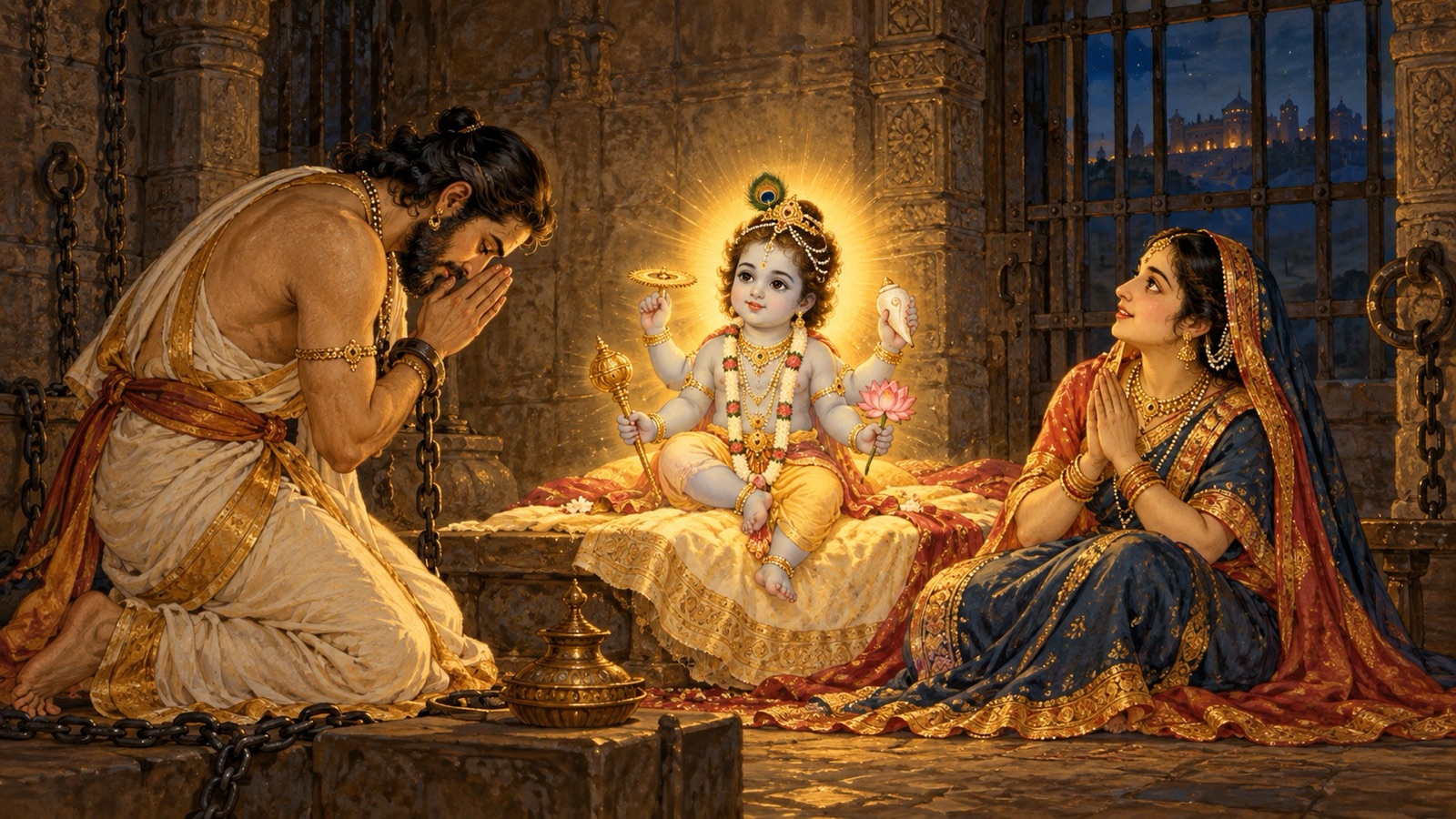
त्वमस्य लोकस्य विभो रिरक्षिषु- र्गृहेऽवतीर्णोऽसि ममाखिलेश्वर । राजन्यसंज्ञासुरकोटियूथपै- र्निर्व्यूह्यमाना निहनिष्यसे चमू: ॥ २१ ॥
tvam asya lokasya vibho rirakṣiṣur gṛhe ’vatīrṇo ’si mamākhileśvara rājanya-saṁjñāsura-koṭi-yūthapair nirvyūhyamānā nihaniṣyase camūḥ
Meaning: O all-pervading Lord of all, desiring to protect this world You have descended in my house; and You shall destroy the armies marshalled by countless demon chieftains who pass under the name of royal princes. (Canto 10, Chapter 3, verse 21)
Yet even in his rapture, Vasudeva was seized with dread for the child, knowing that Kamsa, who had slain the Lord’s elder brothers, would rush with uplifted weapons the moment he learned of the birth.
The Prayer of Devaki
Seeing her son bearing the marks of Lord Vishnu, Devaki — until now afraid of Kamsa — smiled brightly and offered her own prayer. She glorified the child as none other than Lord Vishnu, the self-luminous Reality, the unmanifest and changeless cause that the Vedas describe as beyond the three modes of nature.
श्रीदेवक्युवाच रूपं यत् तत् प्राहुरव्यक्तमाद्यं ब्रह्म ज्योतिर्निर्गुणं निर्विकारम् । सत्तामात्रं निर्विशेषं निरीहं स त्वं साक्षाद् विष्णुरध्यात्मदीप: ॥ २४ ॥
śrī-devaky uvāca rūpaṁ yat tat prāhur avyaktam ādyaṁ brahma jyotir nirguṇaṁ nirvikāram sattā-mātraṁ nirviśeṣaṁ nirīhaṁ sa tvaṁ sākṣād viṣṇur adhyātma-dīpaḥ
Meaning: Sri Devaki said: That primeval form which the sages call the unmanifest, the effulgent Brahman, beyond the modes, changeless, pure existence, without distinction and without striving — that very Lord are You, Vishnu Himself, the lamp of the inner self. (Canto 10, Chapter 3, verse 24)
Devaki took refuge in Him as the master of Time, at whose impulse the worlds run their cyclic course and in whom, at the great dissolution, all things merge until He alone remains, called Shesha, the residue. She prayed that He protect His devotees from the terrible Kamsa. Then, moved by a mother’s fear, she begged Him to withdraw His four-armed, weapon-bearing form and not to reveal His divinity to the cruel king — lest Kamsa learn of His birth — and marvelled that He who holds the whole universe within His body at the end of time should have chosen to appear as her own small child.
The Lord Reveals His Former Advents
In reply, the Lord comforted Devaki by unveiling the long history of their bond. In a former age, during the Svayambhuva Manvantara, she had been Prsni and Vasudeva had been the blameless sage Sutapa. Commanded by Brahma to beget offspring, the couple undertook the most severe austerities — enduring rain and storm and sun and snow, subsisting on withered leaves and on air alone, their minds purified through breath-control — for twelve thousand celestial years, worshipping the Lord with steadfast devotion.
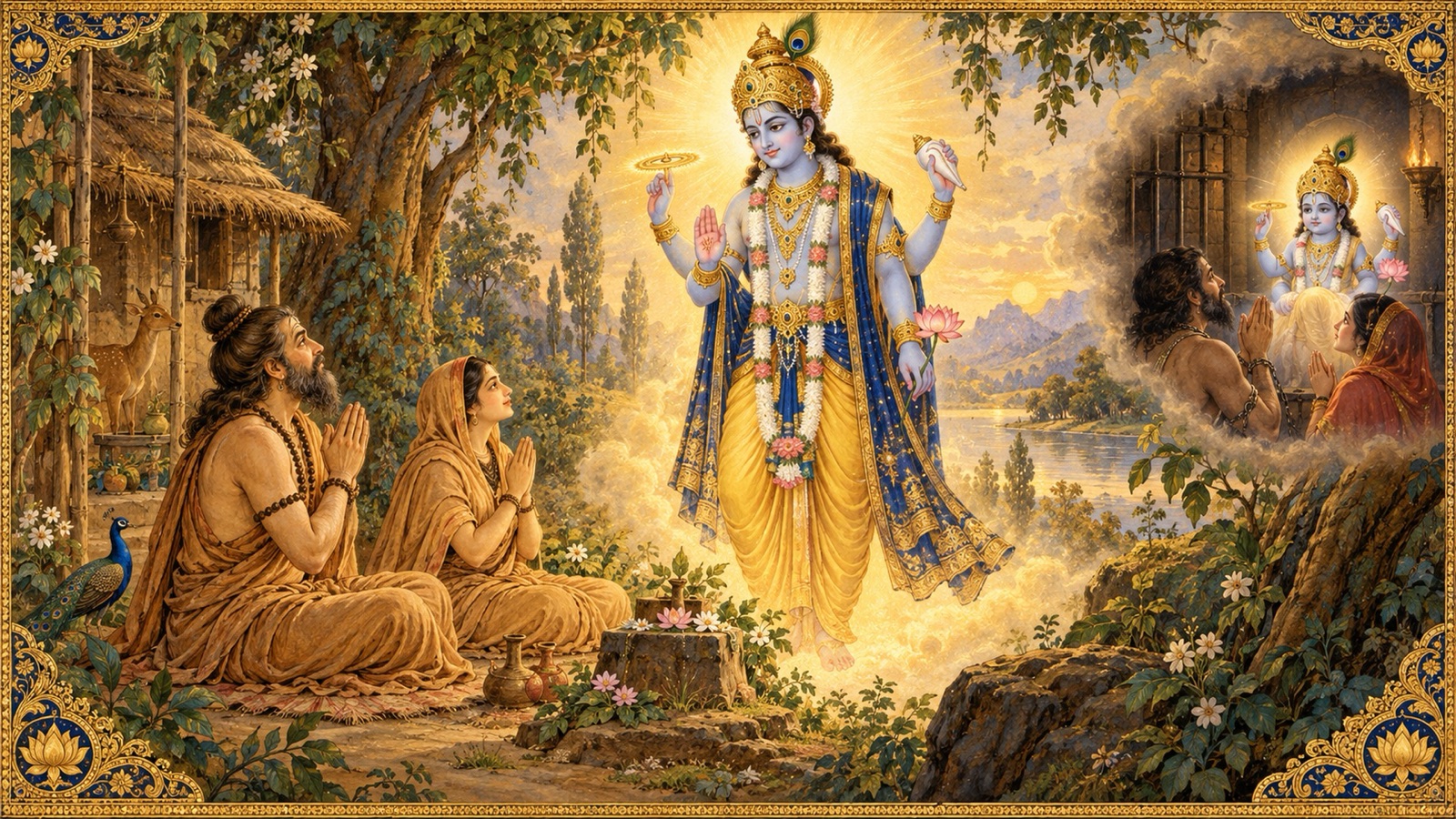
Pleased, the Lord had appeared and offered them any boon, and they, still bound by His Maya and untasting of liberation, had asked only for a son like Himself. Finding none in all the world equal to Himself, the Lord became their son, known as Prsnigarbha. In a later age He was born again to the same pair — now as Aditi and the sage Kasyapa — as the divine dwarf Vamana, also called Upendra. And now, for a third time, He had come to them once more in the same form, that His word might prove true.
तृतीयेऽस्मिन् भवेऽहं वै तेनैव वपुषाथ वाम् । जातो भूयस्तयोरेव सत्यं मे व्याहृतं सति ॥ ४३ ॥
tṛtīye ’smin bhave ’haṁ vai tenaiva vapuṣātha vām jāto bhūyas tayor eva satyaṁ me vyāhṛtaṁ sati
Meaning: In this third birth I have again been born to you both in that very form; My word is ever true, O virtuous lady. (Canto 10, Chapter 3, verse 43)
He explained that He had shown this four-armed form to remind them of His former descents, for His true identity could not be known through an ordinary human semblance; and He promised that by constantly thinking of Him with love, both as their son and as the all-pervading Lord, they would attain the highest union with Him.
The Lord Becomes an Ordinary Infant
Having spoken thus, the Lord fell silent, and at once, before the very eyes of His parents, by His own inconceivable power He assumed the form of an ordinary human infant.
श्रीशुक उवाच इत्युक्त्वासीद्धरिस्तूष्णीं भगवानात्ममायया । पित्रो: सम्पश्यतो: सद्यो बभूव प्राकृत: शिशु: ॥ ४६ ॥
śrī-śuka uvāca ity uktvāsīd dharis tūṣṇīṁ bhagavān ātma-māyayā pitroḥ sampaśyatoḥ sadyo babhūva prākṛtaḥ śiśuḥ
Meaning: Sri Suka said: Having spoken thus, the Lord Sri Hari fell silent, and by His own divine power, in the very sight of His parents, at once became an ordinary infant. (Canto 10, Chapter 3, verse 46)
At that same hour, at Gokula, Yogamaya — the Lord’s mystic energy, herself called Aja, the birthless — took birth as the daughter of Nanda’s wife.
The Journey to Gokula
Now, by Yogamaya’s power, the palace guards were robbed of their awareness and the citizens sank into deep sleep, and every gate, though bolted with mighty doors and bound with iron chains, swung open of its own accord. Vasudeva lifted the child and carried Him out into the stormy night. As he went, Ananta Shesha followed behind, spreading his hoods above the Lord like an umbrella to ward off the falling rain, while Indra sent showers to shield the journey from prying eyes. When Vasudeva reached the flooded Yamuna, the river subsided and gave him passage, as once the ocean had made way for Sri Rama.
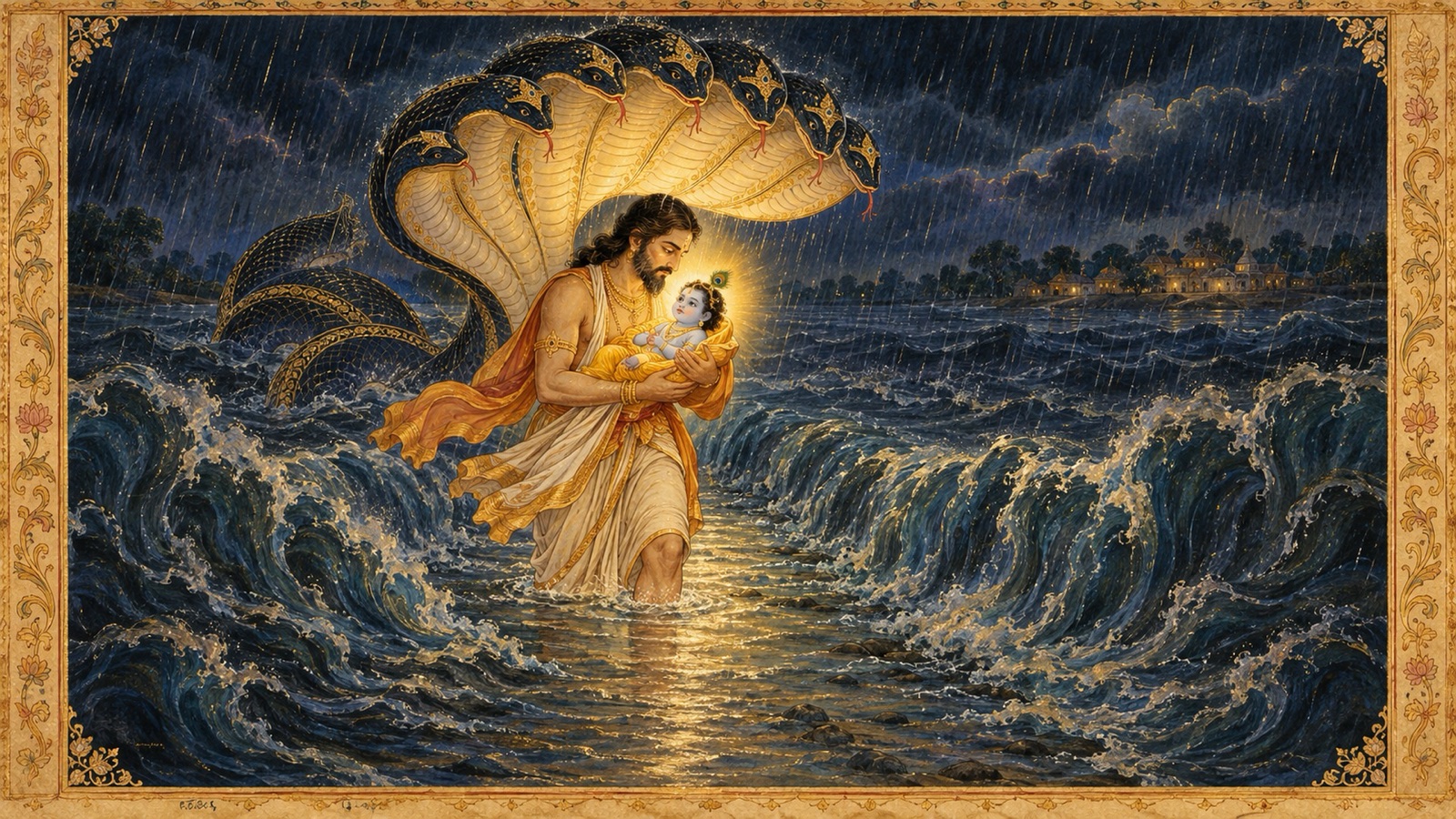
Reaching the cowherd village of Nanda in Vraja, Vasudeva found all the herdsmen deep in the sleep of Yogamaya. He laid his son gently on the bed of Yasoda, took up in exchange her newborn daughter, and returned to the prison.
नन्दव्रजं शौरिरुपेत्य तत्र तान् गोपान् प्रसुप्तानुपलभ्य निद्रया । सुतं यशोदाशयने निधाय त- त्सुतामुपादाय पुनर्गृहानगात् ॥ ५१ ॥
nanda-vrajaṁ śaurir upetya tatra tān gopān prasuptān upalabhya nidrayā sutaṁ yaśodā-śayane nidhāya tat- sutām upādāya punar gṛhān agāt
Meaning: Reaching Nanda’s Vraja and finding the cowherds there fast asleep, Vasudeva placed his son on the bed of Yasoda, took up her daughter in exchange, and returned to his own quarters. (Canto 10, Chapter 3, verse 51)
Laying the divine girl upon Devaki’s bed and fastening the chains once more about his own feet, Vasudeva stood confined as before. Yasoda, meanwhile, exhausted by childbirth and overcome by Yogamaya, knew only that a child had been born to her, and remembered nothing of the night’s great exchange.
Principal Teachings of This Chapter
1. The whole of creation rejoices at the coming of the Lord. The clear skies, blooming lotuses, fragrant breeze, and self-kindling sacred fires show that when the Lord descends, all of nature is quietly renewed and made serene (verses 1-7).
2. God appears in the darkest hour. The Lord manifests precisely at deepest midnight, in a prison. His advent teaches that grace enters exactly where the darkness is thickest and hope seems most confined (verse 8).
3. Devotion transforms fear into praise. Both Vasudeva and Devaki move from terror of Kamsa to wonder and adoration the moment they truly behold the Lord. Recognising Him dissolves fear and awakens praise (verses 12-31).
4. The Lord is faithful to His devotees across lifetimes. By recalling Prsni and Sutapa, the Lord shows that a sincere longing for Him, held through austerity and love, is never forgotten — He returns again and again to those who seek Him (verses 32-45).
5. The Lord’s protection works through unseen means. Sleeping guards, opening gates, the sheltering hoods of Shesha, and the parting Yamuna reveal that when the Lord acts, every obstacle quietly yields (verses 46-53).
A Devotional Reflection
There is something deeply moving in the way the Lord of all the worlds, having revealed His four-armed majesty, willingly folds Himself into the helpless form of a newborn. The same hands that hold the discus and the conch become the small hands of an infant that must be carried through the rain. Divinity does not overwhelm the parents; it entrusts itself to their love. This is the tenderness at the heart of the whole tenth canto: the Supreme reveals His power only long enough to be recognised, and then sets it aside to be loved as a child. Perhaps this is how He still comes to us — showing us just enough of His greatness to awaken our faith, and then asking, gently, only to be held close and cherished. The night of Krishna’s birth invites us to receive Him not with fear but with the quiet, wondering joy of Vasudeva and Devaki.
A Daily Devotional Practice
Tonight, before you sleep, recall that the Lord chose the darkest hour of midnight for His advent. Take a single quiet moment in the dark — set aside worry and distraction — and offer a short prayer welcoming the Lord into your heart, as Devaki welcomed Him into the world. Let the stillness of that moment become your own small Gokula. Before you begin, chant: “Om Namo Bhagavate Vasudevaya.”
Conclusion
The third chapter of the Tenth Canto brings the long-promised advent to its fulfilment. Creation itself grows radiant and serene; at the stroke of midnight the Supreme Lord appears before Vasudeva and Devaki in His four-armed glory; both parents, their fear dissolved, glorify Him; the Lord recalls the devotion of their former lives and assures them of union with Him; and then, becoming a simple infant, He is borne through the parting Yamuna to Gokula, sheltered by the hoods of Shesha, while the guards sleep and the gates open of themselves. In a single night, the burden of the earth begins to lift and the joy of Vraja is set in motion. In the chapters to come, the child of Gokula will begin the incomparable pastimes that have delighted devotees for all time.
May the divine wisdom of Srimad Bhagavatam awaken pure devotion within our hearts.
Om Namo Bhagavate Vasudevaya.
Jay Shree Madhav.
References and Attribution
- Primary edition: Gita Press, Śrīmad Bhāgavata Mahāpurāṇa (English, complete), Book Ten (First Half), Discourse 3.
- Series: Srimad Bhagavatam Wisdom · Biswa Sanatan Dharma Seva Trust.
- Presented following the spiritual guidance and recommendation of Pandit Dr. Shri Kashinath Mishra.
This is an original, faithful retelling in the writer’s own words, with brief quoted verses shown in Devanāgarī and transliteration and their meanings given as summaries. It is not a reproduction of any single publisher’s continuous translation or commentary. No affiliation with or endorsement by any publisher is implied.
Jay Shree Madhav