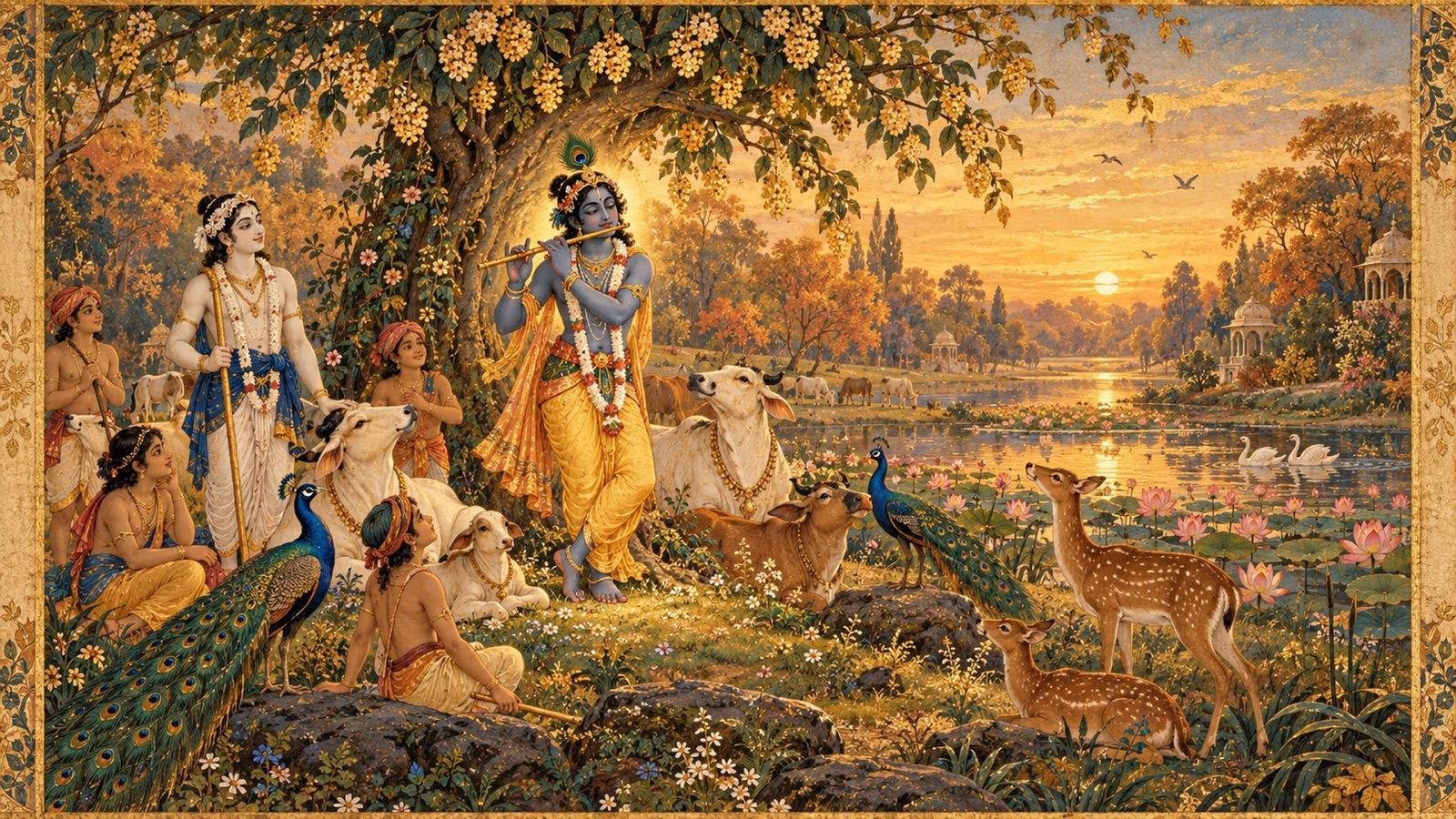
As Krishna’s flute sounds through the autumn forest of Vrindavana, every creature that hears it — the deer, the peacocks, the rivers, the very cows at pasture — forgets itself in love, and the gopis gather to sing of a melody their own hearts cannot fully describe.
Om Namo Bhagavate Vasudevaya.
Om Namo Bhagavate Vasudevaya.
Om Namo Bhagavate Vasudevaya.
Welcome back to Srimad Bhagavatam Wisdom, our devotional journey through the sacred histories and teachings of the Srimad Bhagavat Mahapurana. The twenty-first chapter of the Tenth Canto turns for a while from action to wonder: Krishna walks into the autumn forest with Balarama and the cowherd boys and simply plays His flute, and that single sound becomes the whole subject of the chapter. Sukadeva tells King Parikshit how the women of Vraja, catching that music from a distance, gathered among themselves to praise it to their companions — and found their own words overtaken by what they were trying to describe. What follows is their song, in which deer and rivers, cows and sages, a passing cloud and the great hill of Govardhana are all shown adoring the same flute-call that has stolen the gopis’ hearts.
Chapter Information
- Scripture: Śrīmad Bhāgavata Mahāpurāṇa
- Canto: 10 (Book Ten, First Half)
- Chapter: 21 (Discourse 21)
- Chapter title: The Gopis Glorify the Song of Krishna’s Flute
- Principal speaker: Sukadeva Gosvami (narrating to King Parikshit); within the chapter, the Gopis of Vraja themselves sing the hymn
- Principal listener: King Parikshit
- Main setting: The autumn forest of Vrindavana beside the river Yamuna, in Vraja
- Central subject: Krishna sounding His flute while pasturing the cows with Balarama, and the gopis’ ecstatic hymn on how that music moves the deer, the peacocks, the rivers, the cows, the celestial women, the forest sages and Govardhana Hill
- Principal verse range: Canto 10, Chapter 21, verses 1–20
- Primary edition: Gita Press Śrīmad Bhāgavata Mahāpurāṇa (English, Complete Edition)
Context From the Previous Chapter
In Chapter 20, Sukadeva described how, after the rains, autumn settled over Vraja — clear skies, transparent waters, blooming lotuses — comparing each sign of the season to the clarity that devotion brings to a soul. That chapter closed with the earth made beautiful by both the season and the presence of Krishna and Balarama among the cowherds. This chapter opens in that very forest, now fully arrayed in its autumn glory.
Krishna Sounds His Flute in the Autumn Forest
Sukadeva began again. Accompanied by the cows and the cowherd boys, Krishna entered deep into that forest, its waters made clear by autumn and the air carrying the fragrance of blossoming lotus-beds (verse 1). Passing among lakes and hills that echoed with the warbling of birds and the humming of bees drawn to groves in full flower, the Lord of Madhu pastured the cows in the company of Balarama and His friends — and there, amid that beauty, He sounded His flute.
कुसुमितवनराजिशुष्मिभृङ्गद्विजकुलघुष्टसर:सरिन्महीध्रम् ।
मधुपतिरवगाह्य चारयन् गा: सहपशुपालबलश्चुकूज वेणुम् ॥ २ ॥
kusumita-vanarāji-śuṣmi-bhṛṅga-dvija-kula-ghuṣṭa-saraḥ-sarin-mahīdhram madhupatir avagāhya cārayan gāḥ saha-paśu-pāla-balaś cukūja veṇum
Meaning: Entering that forest of flowering groves — its lakes, streams and hills resounding with birds and bees drunk on blossom — the Lord of Madhu, pasturing the cows with Balarama and His cowherd friends, sounded His flute. (Canto 10, Chapter 21, verse 2)
The Women of Vraja Try to Describe the Music
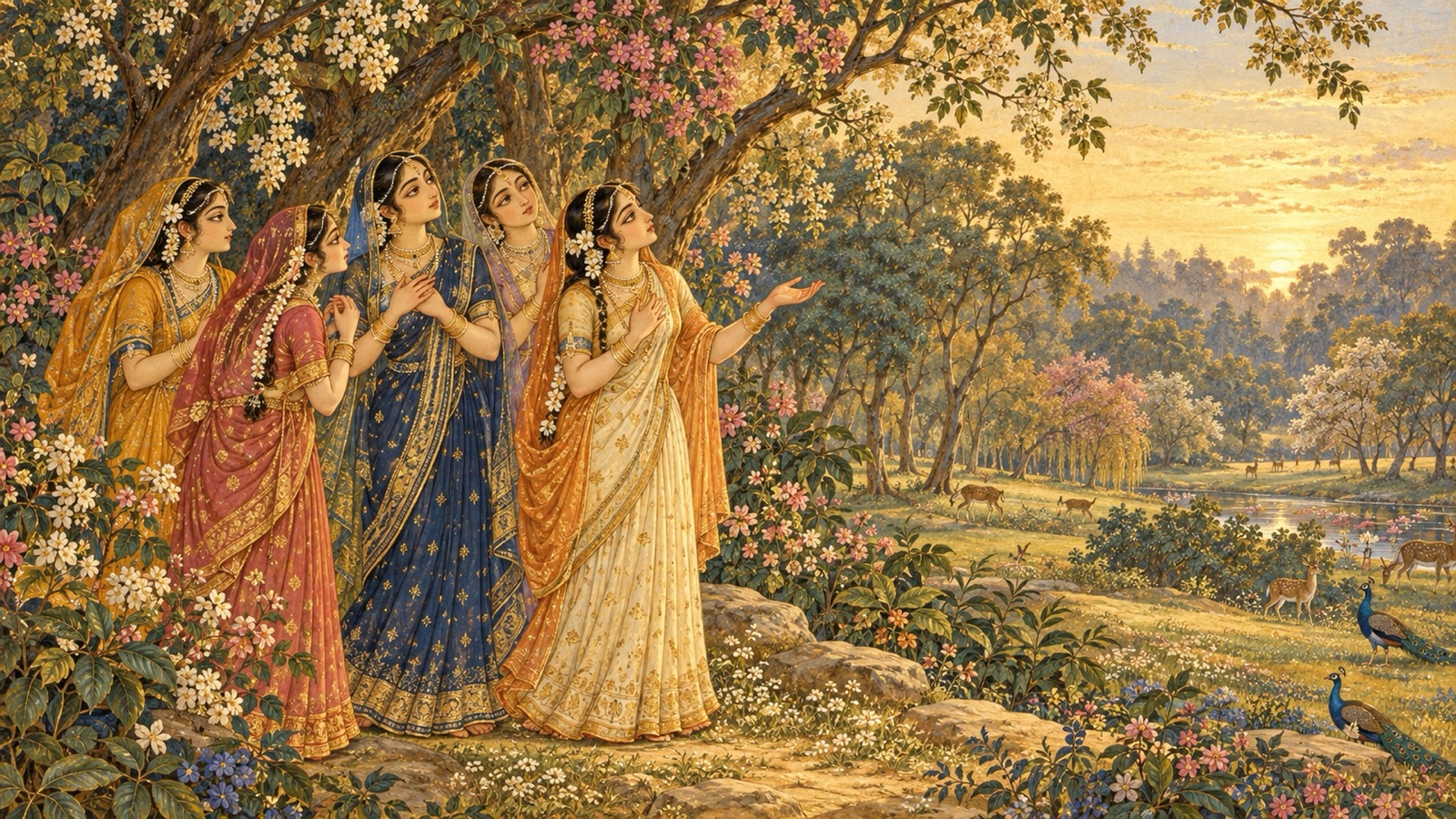
That music of Krishna’s flute kindled love the instant it was heard. Some of the women of Vraja, hearing it from where they stood, went to their companions, out of Krishna’s sight, to speak of what they had heard. They began to describe His gestures while He played — but their minds, overwhelmed by the force of that love, could not complete the telling (verses 3–4). Even to picture Him was to lose themselves: an unmatched form, they said, crowned with a peacock feather, karnikara blossoms at His ears, a garland of five-coloured flowers about His neck and a cloth bright as gold at His waist, filling the holes of His flute as though with the very nectar of His lips, entering Vrindavana with His footprints gracing every step, His glory already being sung by the cowherd boys who walked beside Him (verse 5). Hearing that flute-song, which enchants every living heart, all the women of Vraja, even as they tried to describe it, embraced the Lord within their minds.
इति वेणुरवं राजन् सर्वभूतमनोहरम् ।
श्रुत्वा व्रजस्त्रिय: सर्वा वर्णयन्त्योऽभिरेभिरे ॥ ६ ॥
iti veṇu-ravaṁ rājan sarva-bhūta-manoharam śrutvā vraja-striyaḥ sarvā varṇayantyo ’bhirebhire
Meaning: Hearing, O King, that music of His flute, which captivates the minds of all living beings, all the women of Vraja, even while trying to describe it, embraced the Lord in their hearts. (Canto 10, Chapter 21, verse 6)
The Gopis’ Song: The Prize of Having Eyes
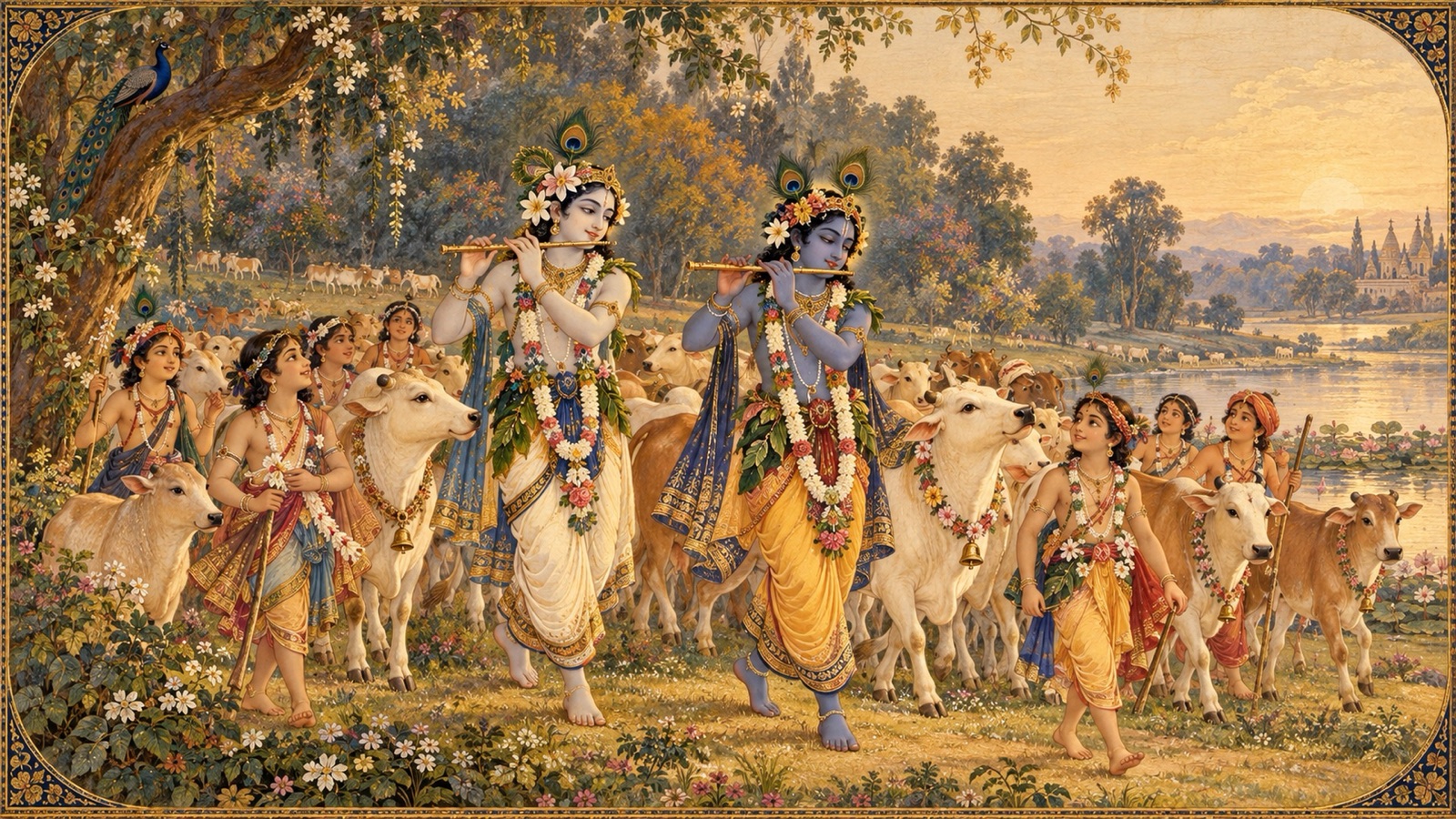
What the gopis could not fully speak to one another, they now poured out as song, and Sukadeva repeats their very words to Parikshit. This is the one reward of having eyes, they sang; they knew of no greater prize than that won by those whose gaze has drunk in the faces of the two sons of Nanda — playing their flutes and casting loving glances all about — as They lead the cattle among their playmates (verse 7). Clad in forest garlands of mango shoots, peacock feathers and flowers, a lotus in hand and lilies at the ear, the two Brothers shone among the cowherds and the cattle like the finest of actors upon a stage, singing as they walked (verse 8). What good fortune, they wondered, has this simple flute earned, that it alone tastes without end the sweetness flowing from Krishna’s lips — sweetness that is, by every right, the Gopis’ own (verse 9).
श्रीगोप्य ऊचु:
अक्षण्वतां फलमिदं न परं विदाम: सख्य: पशूननु विवेशयतोर्वयस्यै: ।
वक्त्रं व्रजेशसुतयोरनवेणु जुष्टं यैर्वा निपीतमनुरक्तकटाक्षमोक्षम् ॥ ७ ॥
śrī-gopya ūcuḥ akṣaṇvatāṁ phalam idaṁ na paraṁ vidāmaḥ sakhyaḥ paśūn anuviveśayator vayasyaiḥ vaktraṁ vrajeśa-sutayor anaveṇu-juṣṭaṁ yair vā nipītam anurakta-kaṭākṣa-mokṣam
Meaning: The Gopis sang: Friends, this is the one reward of having eyes — we know of no greater — than that enjoyed by those who have drunk, with their gaze, the loving glances cast from the flute-graced faces of the two sons of the lord of Vraja, as They lead the cattle in the company of Their playmates. (Canto 10, Chapter 21, verse 7)
Vrindavana’s Glory and the Entranced Creatures of Govardhana
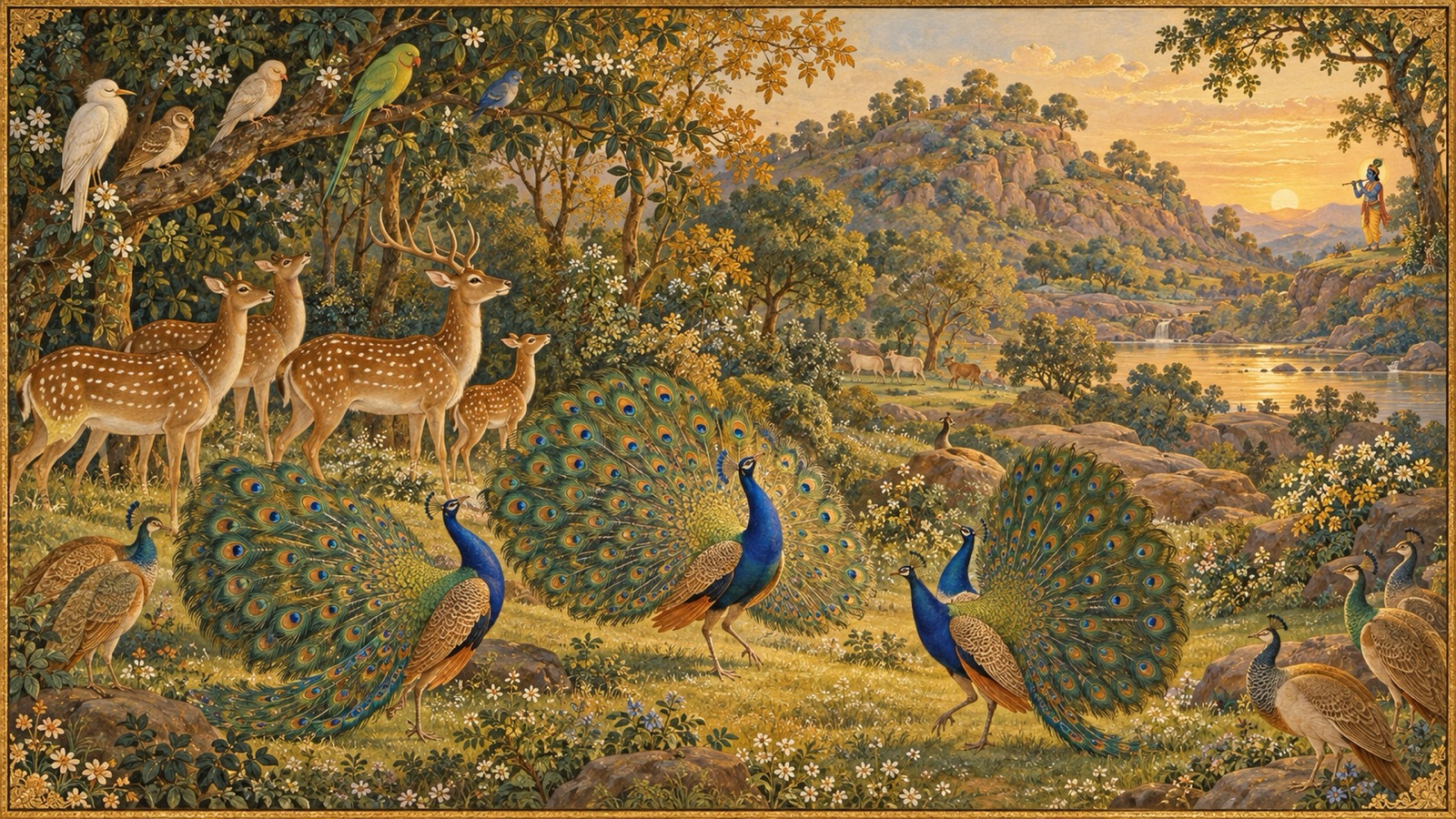
From the flute itself the gopis turned to the very ground on which it is heard. Vrindavana, they sang, spreads the glory of the earth beyond even the heavens, for its soil has won the fortune of being touched by Krishna’s lotus feet; and watching the peacocks dance in rapture at Govinda’s flute, every other creature upon the slopes of Govardhana falls still (verse 10). Blessed indeed, they continued, are the female deer, simple-minded though they are, who stand beside their mates and offer worship through their loving, unwavering glances to the darling of Nanda in His wondrous forest dress (verse 11). Even in the heavens this music is felt: celestial women travelling in their aerial cars, hearing those strange sweet notes and beholding His beauty, lose themselves entirely, flowers falling loose from their hair, their garments coming undone (verse 12). On the earth, the cows and their calves stand rooted to the spot, drinking that nectar-like music with the cups of their ears, holding Govinda within their hearts as it enters through their eyes, tears standing in them, the milk still flowing from their mothers’ udders left untouched, for they have no strength left even to swallow (verse 13). And the birds of this forest, the gopis sang, must surely be sages: perched on branches heavy with fresh leaves, their eyes closed, every other sound forgotten, they do nothing but listen (verse 14).
The Rivers Embrace His Feet, and a Cloud Becomes His Umbrella
Even the rivers, the gopis sang, are not beyond this love. Hearing that music of Mukunda, their swift currents broke and turned to eddies, as though love itself had checked their flow; and with the arms of their waves the rivers folded themselves about His two feet in an embrace, offering lotuses as their gift (verse 15).
नद्यस्तदा तदुपधार्य मुकुन्दगीतमावर्तलक्षितमनोभवभग्नवेगा: ।
आलिङ्गनस्थगितमूर्मिभुजैर्मुरारेर्गृह्णन्ति पादयुगलं कमलोपहारा: ॥ १५ ॥
nadyas tadā tad upadhārya mukunda-gītam āvarta-lakṣita-manobhava-bhagna-vegāḥ āliṅgana-sthagitam ūrmi-bhujair murārer gṛhṇanti pāda-yugalaṁ kamalopahārāḥ
Meaning: Hearing that music of Mukunda, the rivers’ swift flow was broken into eddies, as if love itself had checked it; and with the arms of their waves they clasped the two feet of Murari in an embrace, offering lotuses. (Canto 10, Chapter 21, verse 15)
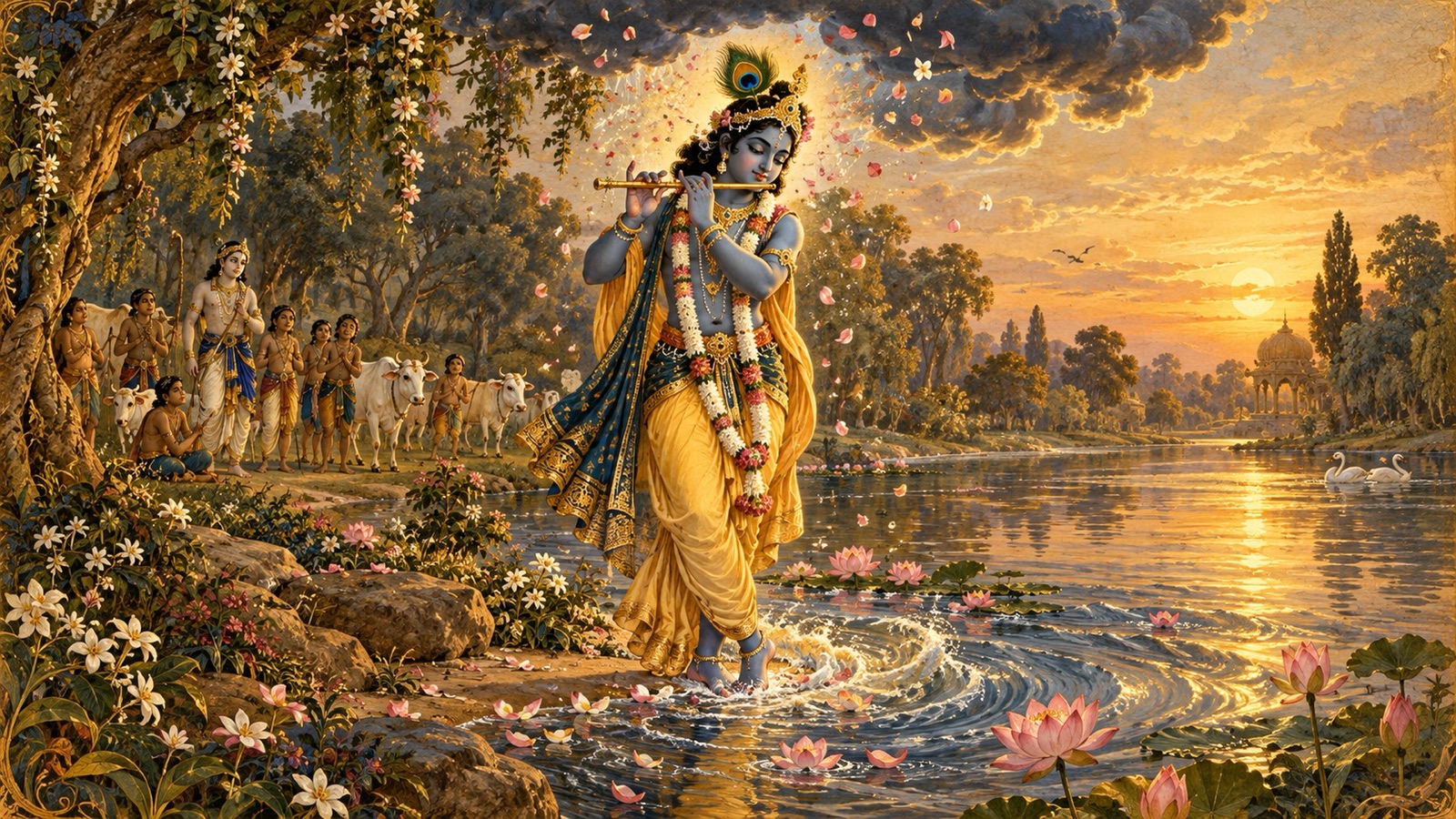
Watching Krishna pasture the cattle in the hot sun with Balarama and the cowherd boys, playing His flute as He followed behind the herd, a cloud swelled with love and placed itself above Him as an umbrella, sheltering its Friend with its own body and showering Him, at the same time, with flowers (verse 16).
The Bhil Women and the Grace of Govardhana Hill
Even the simple forest-dwelling women of these hills find their love-pangs soothed, the gopis sang, by the fragrant red dust of this ground, touched already by the feet of Balarama and Krishna (verse 17). And Govardhana Hill itself, they declared, is foremost among all the Lord’s servants: it rejoices in the mere touch of the two Brothers’ feet, its happiness showing in the fresh grass that springs up wherever They walk, and it offers its purest water, its sweetest pasture, its sheltering caves, and its own bulbs and roots freely to Them and to Their cows and companions (verse 18).
All Creation Stilled, All Creation Rejoicing
It is a wonder past telling, the gopis sang, that the same low, sweet notes of the two Brothers’ flutes — as They lead the cows from forest to forest with Their companions, the cord for tying the cows’ hind legs twined about Their heads and the rope for the unruly ones laid across Their shoulders — should bring every moving creature, even the running rivers, to a standstill, while a thrill of joy runs through the trees that cannot move at all (verse 19).
The Gopis Absorbed in the Lord’s Pastimes
So the women of Vraja sang on, recounting among themselves these many pastimes of the Lord who wanders through Vrindavana, until, in the very telling, they themselves were drawn wholly into what they described.
एवंविधा भगवतो या वृन्दावनचारिण: ।
वर्णयन्त्यो मिथो गोप्य: क्रीडास्तन्मयतां ययु: ॥ २० ॥
evaṁ-vidhā bhagavato yā vṛndāvana-cāriṇaḥ varṇayantyo mitho gopyaḥ krīḍās tan-mayatāṁ yayuḥ
Meaning: Thus describing among themselves such pastimes of the Lord who wanders in Vrindavana, the Gopis, in the very act of describing them, became wholly absorbed in them. (Canto 10, Chapter 21, verse 20)
Principal Teachings of This Chapter
1. Remembrance of the Lord overwhelms calculation. When the gopis try to narrate Krishna’s flute-song, the force of their love leaves their own words unfinished (verses 3–4). True remembrance of the Lord is not a tidy description but an experience that exceeds whatever we set out to say.
2. Bhakti is the natural language of all creation. Deer, rivers, cows, clouds and even the unmoving trees respond to the flute with longing and joy (verses 10–16, 19). Love for the Lord is not foreign to any being; it is simply what every heart, however humble, is already capable of.
3. The goal of renunciation is to behold the Lord. The gopis imagine the forest birds as sages who have climbed the branches purely to see Krishna and to hear His flute, unmoved by any other sound (verse 14). Austerity finds its purpose only when it leads, in the end, to His presence.
4. Selfless service, however small, is treasured by the Lord. Govardhana Hill offers nothing grand — only water, pasture, shelter and roots — yet the gopis call it the foremost of Hari’s servants (verse 18). What pleases Him is the spirit of the offering, not its size.
5. To speak of the Lord’s pastimes is already to enter them. The gopis set out only to describe what they had heard, and in describing it became lost in it (verse 20). Hearing and telling Krishna’s glories is not mere preparation for devotion; it is itself the path into His presence.
A Devotional Reflection
What stays with us from this chapter is not a single event but a mood — the gopis trying, and failing, to put Krishna’s flute into words, and finding that the failure itself became their song. We often assume devotion must first be understood before it can be felt, that the right words must come before the heart is allowed to move. This chapter turns that order around. The women of Vraja never finish their description; they are undone by love before a single sentence is complete, and what pours out instead is praise of everything the flute has touched — the deer, the rivers, the hill, even the sages hidden as birds. Perhaps this is what it means to glorify the Lord: not to master a subject, but to be so moved by it that our own voice joins its telling. We may never stand where the gopis stood, beside the Yamuna in that autumn forest, but their unfinished song offers a model for our own prayer — one that does not wait to be eloquent before it begins to love.
A Daily Devotional Practice
Today, instead of waiting until you have the right words, let a single remembered image of Krishna — His flute, His form, a line from this very chapter — rise in your mind, and simply dwell there without trying to explain it fully. Let your heart respond the way the gopis’, the deer’s, the very rivers’ did: with quiet attention rather than analysis. Close with the same prayer that opened this telling: Om Namo Bhagavate Vasudevaya.
Conclusion
This telling of Krishna’s flute is, from first verse to last, one unbroken offering of praise. Krishna enters the autumn forest and sounds His flute; the women of Vraja, unable to finish describing it to one another, sing instead, declaring the sight of His face the one true reward of having eyes, and tracing that single melody into the dancing peacocks of Govardhana, the motionless deer, the enchanted women of the heavens, the weeping cows, the sage-like birds, the river that embraces His feet, the cloud that shields Him, and the hill that serves Him with water and shade. By the end, the gopis who set out only to speak of Krishna’s pastimes have themselves been carried into them, their telling and their love no longer two things but one. May we, who have only heard of that flute-song, carry something of the same absorption into our own remembrance of Him, letting His glories move us before we ever manage to explain them.
May the divine wisdom of Srimad Bhagavatam awaken pure devotion within our hearts.
Om Namo Bhagavate Vasudevaya.
Jay Shree Madhav.
References and Attribution
- Primary edition: Gita Press, Śrīmad Bhāgavata Mahāpurāṇa (English, Complete Edition), Book Ten (First Half), Discourse 21.
- Series: Srimad Bhagavatam Wisdom · Biswa Sanatan Dharma Seva Trust.
- Presented following the spiritual guidance and recommendation of Pandit Dr. Shri Kashinath Mishra.
This is an original, faithful retelling in the writer’s own words, with brief quoted verses shown in Devanāgarī and transliteration and their meanings given as summaries. It is not a reproduction of any single publisher’s continuous translation or commentary. No affiliation with or endorsement by any publisher is implied.
Jay Shree Madhav