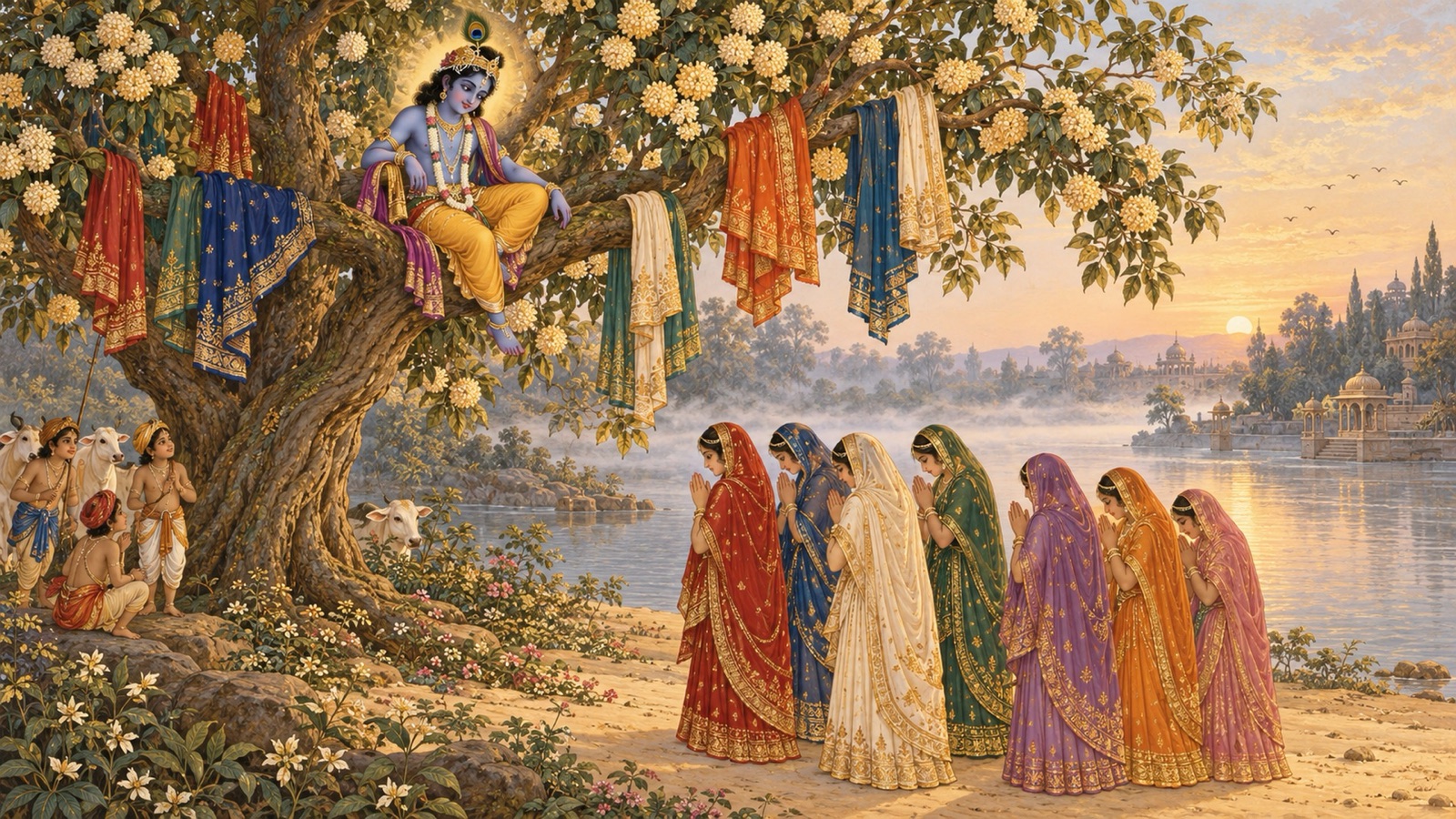
For a winter month the maidens of Vraja worship Goddess Katyayani on the Yamuna bank with one prayer — and on the day their vow is complete, the Lord they prayed for climbs a kadamba tree with their garments and turns their longing into a promise.
Om Namo Bhagavate Vasudevaya.
Om Namo Bhagavate Vasudevaya.
Om Namo Bhagavate Vasudevaya.
Welcome back to Srimad Bhagavatam Wisdom, our devotional journey through the sacred histories and teachings of the Srimad Bhagavat Mahapurana. In this twenty-second chapter of the Tenth Canto, Sukadeva tells King Parikshit of the maidens’ month-long vow to Goddess Katyayani, of Krishna crowning that vow in His own playful way, and of His summer lesson to the cowherd boys on the trees that live for others.
Chapter Information
- Scripture: Śrīmad Bhāgavata Mahāpurāṇa
- Canto: 10 (Book Ten, First Half)
- Chapter: 22 (Discourse 22)
- Chapter title: Krishna Steals the Garments of the Unmarried Gopis
- Principal speaker: Sukadeva Gosvami (narrating to King Parikshit); within it, Sri Krishna addresses the gopis and the cowherd boys
- Principal listener: King Parikshit
- Main setting: The bank of the Kālindī (Yamunā) in Vraja; later, the summer forest beyond Vṛndāvana
- Central subject: The Katyayani vow; the garments taken and returned; the Lord’s blessing; the teaching of the trees
- Principal verse range: Canto 10, Chapter 22, verses 1–38
- Primary edition: Gita Press Śrīmad Bhāgavata Mahāpurāṇa (English edition, Book Ten, First Half)
Context From the Previous Chapter
In Chapter 21, as autumn settled over Vrindavana, Krishna played His flute in the forest, and the gopis sang of all that song had blessed — the does, the rivers held still by love, the cloud that shaded Him, the trees, and Govardhana. Their hearts were already His; now the youngest among them seek Him through a sacred vow.
The Vow to Goddess Katyayani
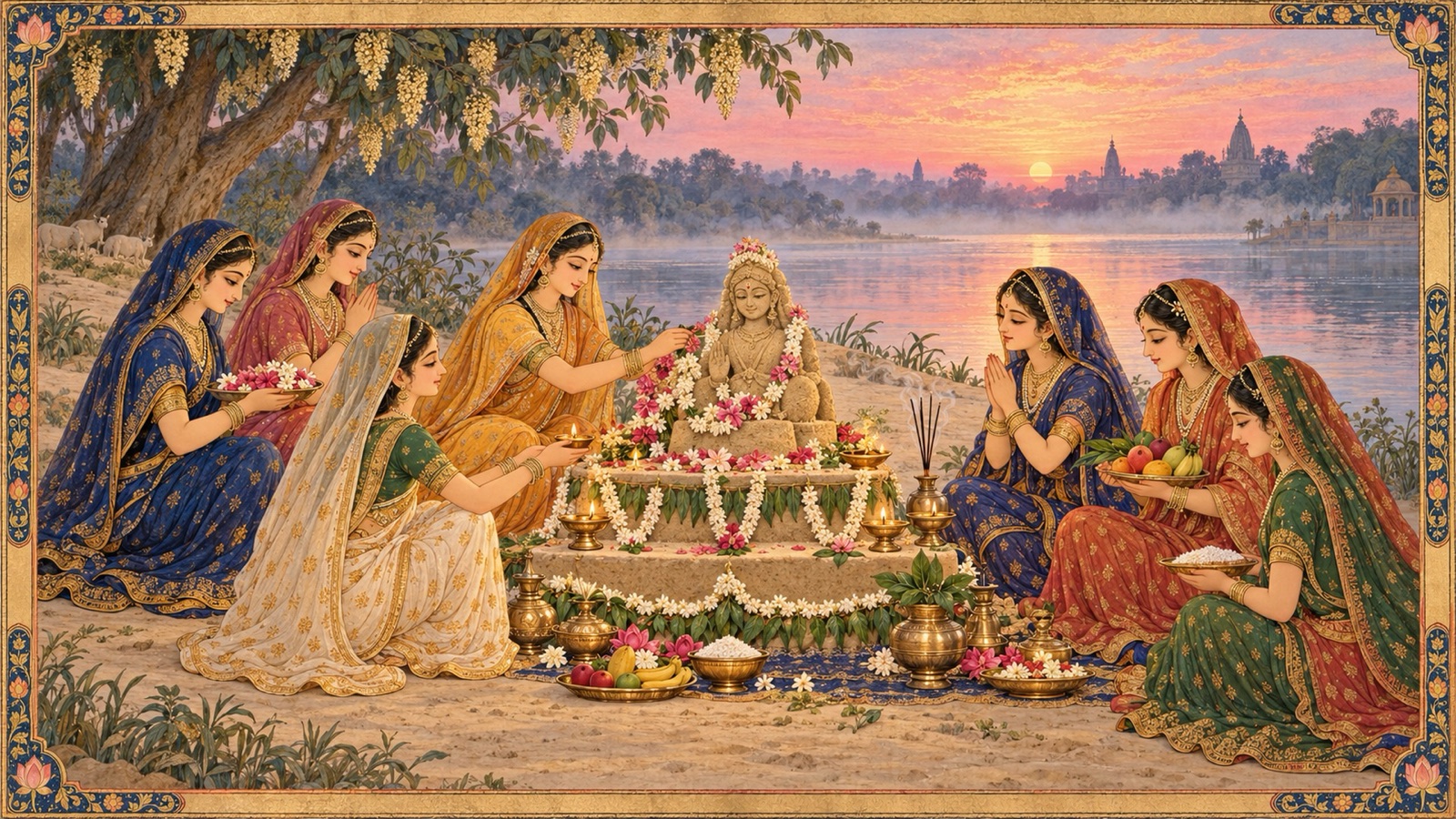
Sukadeva began again. In Margashirsha, the first month of the Hemanta season, the unmarried girls of Nanda’s Vraja took up a vow of worship to Goddess Katyayani, eating only food fit to be offered into the sacred fire. Each day at daybreak they bathed in the Kalindi and shaped an image of the Goddess from the sand of the bank, worshipping her with sandal paste, fragrant flowers and garlands, oblations, incense and lamps, gifts great and small, and tender leaves, fruits and unbroken rice.
As they worshipped, each maiden softly repeated the same prayer, for all carried one wish in their hearts.
कात्यायनि महामाये महायोगिन्यधीश्वरि ।
नन्दगोपसुतं देवि पतिं मे कुरु ते नम: ।
इति मन्त्रं जपन्त्यस्ता: पूजां चक्रु: कुमारिका: ॥ ४ ॥
kātyāyani mahā-māye mahā-yoginy adhīśvari nanda-gopa-sutaṁ devi patiṁ me kuru te namaḥ iti mantraṁ japantyas tāḥ pūjāṁ cakruḥ kumārikāḥ
Meaning: “O Goddess Katyayani, great deluding potency of the Lord, possessor of boundless yogic power, supreme Ruler — O Devi, make the son of Nanda the cowherd my husband. Obeisance to You.” Repeating this mantra, the maidens performed their worship. (Canto 10, Chapter 22, verse 4)
With minds fixed on Krishna, the girls kept the vow for a whole month, honouring Goddess Bhadrakali and praying, “May the son of Nanda be our husband.” Rising before dawn, calling one another by name and linking arms, they walked daily to the Kalindi to bathe, singing of Krishna aloud.
The Lord Comes to Fulfil Their Vow
On one such day the maidens came to the river, left their garments on the bank as always, and played joyfully in the water, singing the glories of Krishna. The Lord knew their hearts. The Master of all masters of Yoga went there with His young companions — not to disturb their worship, but to bring it to its fruit.
भगवांस्तदभिप्रेत्य कृष्णो योगेश्वरेश्वर: ।
वयस्यैरावृतस्तत्र गतस्तत्कर्मसिद्धये ॥ ८ ॥
bhagavāṁs tad abhipretya kṛṣno yogeśvareśvaraḥ vayasyair āvṛtas tatra gatas tat-karma-siddhaye
Meaning: Understanding their purpose, the Lord Sri Krishna, Master of the masters of Yoga, surrounded by His companions, went there in order to bring their act of worship to fulfilment. (Canto 10, Chapter 22, verse 8)
Gathering their garments, He quickly climbed a nearby kadamba tree and, amid the boys’ laughter, called out playfully: “Come here, girls, and each of you take your own garment as you please. I am telling you the truth; this is no joke, for you are worn thin by your vow. I have never spoken a lie before, and these boys know it. Come one at a time, or all together, O slender-waisted ones.”
The Maidens’ Plea From the Water
Seeing the Lord’s jest, the gopis were flooded with love. Abashed, they glanced at one another and smiled, but would not come out. Sunk to their necks in the cold water, trembling, their hearts stolen by His teasing, they answered: “Do not be unfair to us, dear Krishna. We know you as the beloved son of Nanda, honoured in all of Vraja; give us our garments, for we are shivering. O Shyamasundara, we are your servants and will do whatever you say — but return our clothes, O knower of dharma, or else we shall tell the king.”
The Lord Speaks on the Sanctity of the Vow
The Lord replied: “If you are truly My servants and will do as I say, then come here with bright smiles and receive your garments.” Shivering with cold and shrinking with shame, the girls came out of the water, covering themselves with their hands. Seeing them so overcome by modesty that they seemed scarcely alive, and pleased by their pure hearts, the Lord laid the garments across His shoulder and spoke with an affectionate smile.
यूयं विवस्त्रा यदपो धृतव्रता
व्यगाहतैतत्तदु देवहेलनम् ।
बद्ध्वाञ्जलिं मूर्ध्न्यपनुत्तयेऽहस:
कृत्वा नमोऽधोवसनं प्रगृह्यताम् ॥ १९ ॥
yūyaṁ vivastrā yad apo dhṛta-vratā vyagāhataitat tad u deva-helanam baddhvāñjaliṁ mūrdhny apanuttaye ’ṁhasaḥ kṛtvā namo ’dho-vasanaṁ pragṛhyatām
Meaning: “Since you entered the water without your garments while bound by a sacred vow, that was a slight to the god of the waters. To wash away that fault, join your palms upon your heads, bow down, and then take your lower garments.” (Canto 10, Chapter 22, verse 19)
Hearing Acyuta’s words, the daughters of Vraja understood that bathing unclothed had been a lapse in their vow. Longing for it to be made whole, they bowed before Him — for He is Himself the fruit of that vow and of every sacred act, and He removes every fault. Seeing them bent low and gladdened by their salutation, the compassionate son of Devaki gave back their garments.
No Fault, Only the Joy of His Company
Now see the heart of the gopis. Tricked, made to lose their modesty, teased and treated like playthings, their clothes carried off — yet not a trace of resentment arose in them.
दृढं प्रलब्धास्त्रपया च हापिता:
प्रस्तोभिता: क्रीडनवच्च कारिता: ।
वस्त्राणि चैवापहृतान्यथाप्यमुं
ता नाभ्यसूयन् प्रियसङ्गनिर्वृता: ॥ २२ ॥
dṛḍhaṁ pralabdhās trapayā ca hāpitāḥ prastobhitāḥ krīḍana-vac ca kāritāḥ vastrāṇi caivāpahṛtāny athāpy amuṁ tā nābhyasūyan priya-saṅga-nirvṛtāḥ
Meaning: Though they had been thoroughly deceived, robbed of their bashfulness, made fun of and used as toys, and though their garments had been stolen away, they did not find fault with Him, so delighted were they by the company of their Beloved. (Canto 10, Chapter 22, verse 22)
Dressed again, they still could not move; their shy glances rested on Krishna, their hearts captured, the joy of meeting their dearest one holding them where they stood.
The Blessing of Damodara
The Lord knew the resolve behind their vow: the longing to touch His feet. He who had once let His mother bind Him at the waist — Damodara, bound by love — now spoke: “Your resolve to worship Me is known to Me, O virtuous girls, and I approve of it. Therefore it deserves to come true.”
न मय्यावेशितधियां काम: कामाय कल्पते ।
भर्जिता क्वथिता धाना: प्रायो बीजाय नेशते ॥ २६ ॥
na mayy āveśita-dhiyāṁ kāmaḥ kāmāya kalpate bharjitā kvathitā dhānāḥ prāyo bījāya neśate
Meaning: “The desire of those whose minds are absorbed in Me does not give rise to further worldly desire, just as grains that have been fried or boiled are, as a rule, no longer able to sprout as seed.” (Canto 10, Chapter 22, verse 26)
“Go back to Vraja, girls,” He said. “Your purpose is accomplished. In the coming nights you will enjoy My company, for it was for this that you, pure in heart, undertook this vow of worship to the Goddess.” Sukadeva continued: so instructed by the Lord, their desire granted, the maidens turned toward Vraja, their minds dwelling on His lotus feet — and only with great difficulty could they tear themselves away.
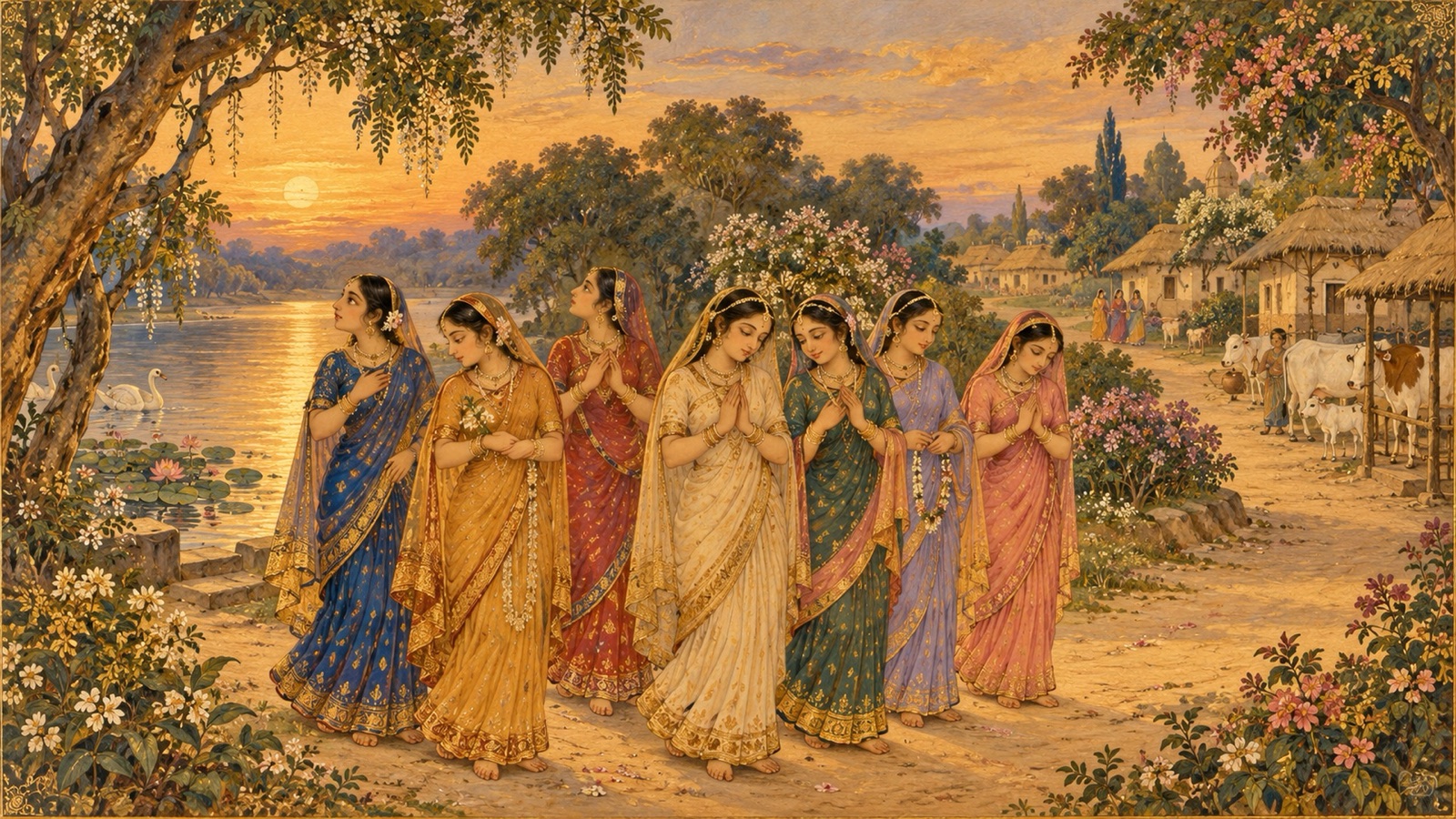
Why did the Lord arrange this strange and tender pastime? He came for the completion of their worship, and what completed it was not the sand image or the offerings but surrender itself: palms joined above the head, the body bowed, every covering of pride set aside before Him. Their vow had asked for Krishna as a husband; the Lord accepted the wish, approved it, and revealed its true nature. Desire poured into Him is roasted grain — it can no longer sprout into the endless harvest of worldly craving. Their shame before Him was a purification, and their refusal to blame Him the sign that bhakti, not mere longing, had ripened in them.
The Trees That Live for Others
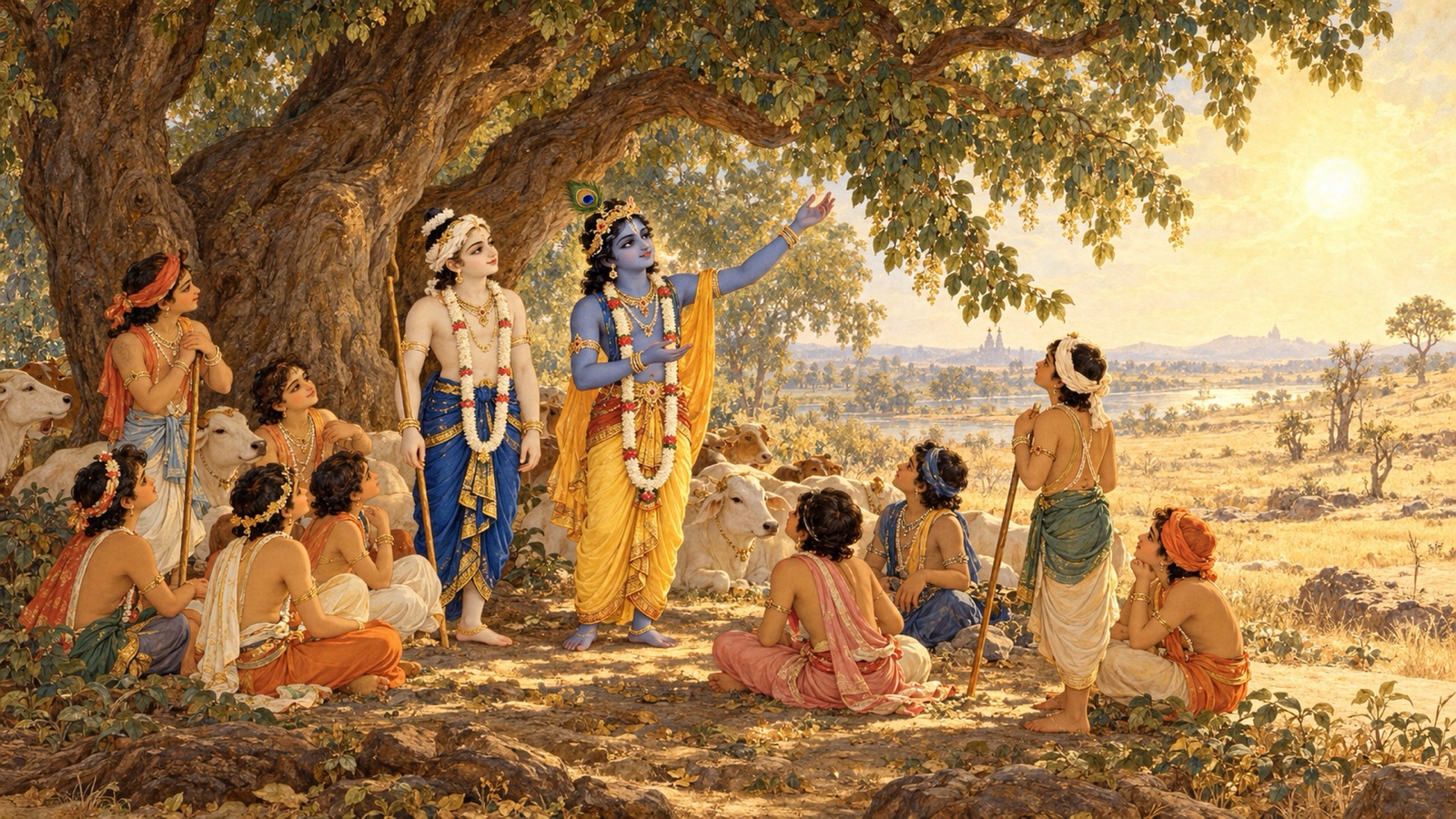
Sukadeva then carried the king forward to a day in the hot season, when Krishna, with Balarama and the cowherd boys, had taken the cows far from Vrindavana. Under the fierce summer sun He noticed the trees holding their shade over Him like umbrellas, and He turned to His friends — Stokakrishna, Amshu, Shridama, Subala, Arjuna, Vishala, Rishabha, Tejasvi, Devaprastha and Varuthapa — and said: “Look at these greatly blessed beings. They live only for the sake of others. Bearing wind, rain, heat and frost themselves, they keep all of it away from us.”
अहो एषां वरं जन्म सर्वप्राण्युपजीवनम् ।
सुजनस्येव येषां वै विमुखा यान्ति नार्थिन: ॥ ३३ ॥
aho eṣāṁ varaṁ janma sarva-prāṇy-upajīvanam su-janasyeva yeṣāṁ vai vimukhā yānti nārthinaḥ
Meaning: “How excellent is the birth of these trees, which sustain the life of every creature. No one who comes to them in need goes away disappointed, just as none returns empty-handed from a good and generous man.” (Canto 10, Chapter 22, verse 33)
With leaves, flowers and fruits, He went on, with shade, roots, bark and wood, with fragrance, sap, ashes, charcoal and tender shoots, the trees fulfil the wants of all. Then He gave His friends the lesson the trees embody.
एतावज्जन्मसाफल्यं देहिनामिह देहिषु ।
प्राणैरर्थैर्धिया वाचा श्रेयआचरणं सदा ॥ ३५ ॥
etāvaj janma-sāphalyaṁ dehinām iha dehiṣu prāṇair arthair dhiyā vācā śreya-ācaraṇaṁ sadā
Meaning: “This alone is the fruitfulness of the birth of embodied beings in this world: that with their life, their wealth, their intelligence and their speech they always act for the good of other living beings.” (Canto 10, Chapter 22, verse 35)
At the Waters of the Yamuna
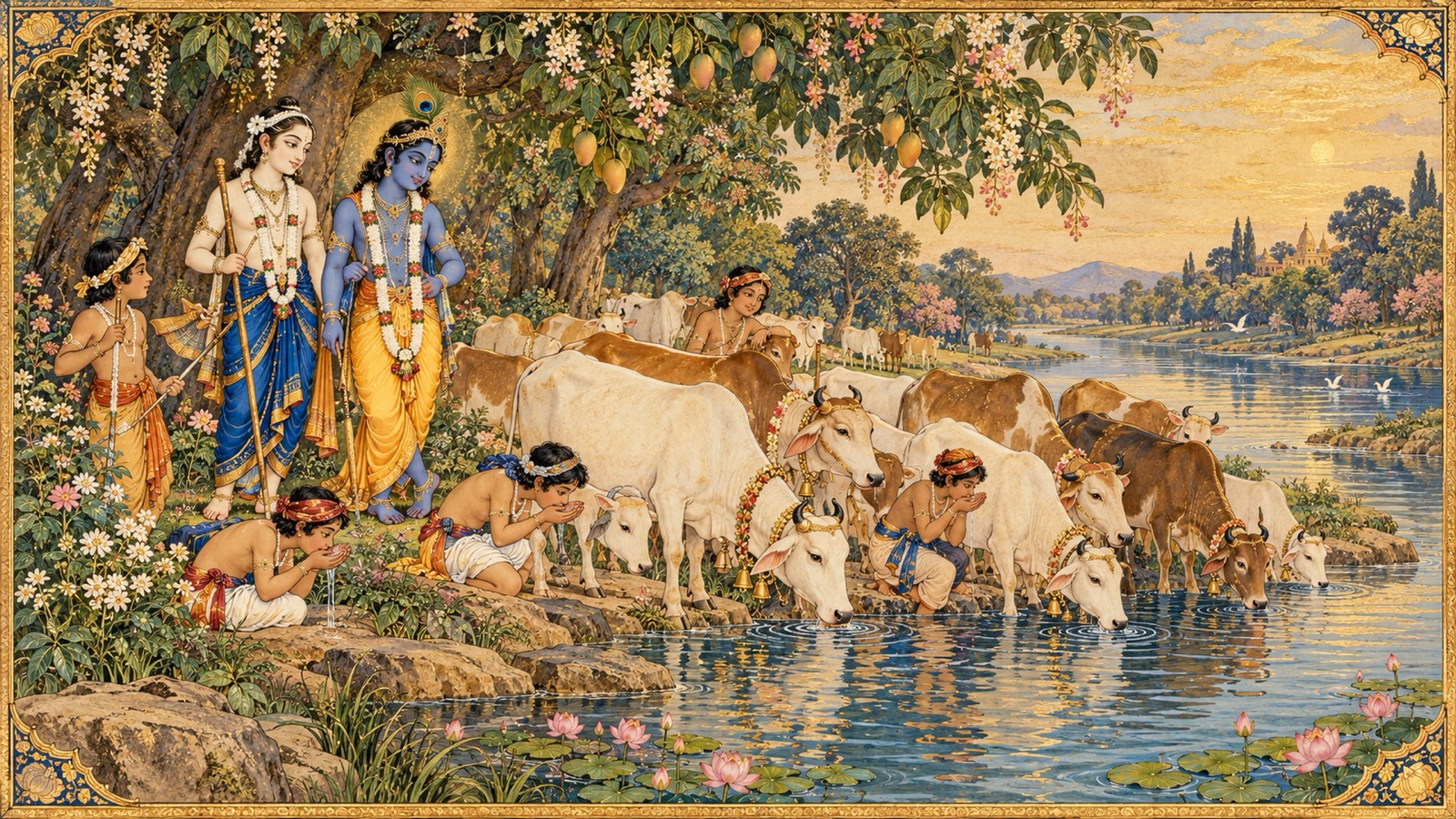
Speaking thus, the Lord passed between rows of trees whose branches bowed low with young leaves, fruits and blossoms, and came to the Yamuna. The cows were led to drink its sweet, cool and wholesome water, and then the cowherd boys drank their fill. They let the cattle graze freely in the grove along the bank, and then, pinched with hunger, came to Krishna and Balarama and spoke — words with which the next chapter opens.
Principal Teachings of This Chapter
1. A vow offered to the Lord is heard by the Lord. The maidens prayed to Katyayani for the son of Nanda (verse 4), and Krishna Himself came to complete their worship (verse 8). Sincere devotion reaches Him by whatever sacred door it enters.
2. He asks for surrender, and gives back more than He took. The gesture He requested — folded palms upon the head and a bow (verse 19) — is the posture of complete surrender. He took garments; He returned garments, a blessing, and Himself.
3. The devotee finds no fault with the Beloved. Teased and tricked, the gopis did not resent Him (verse 22). Love that cannot be offended by the Lord’s play belongs entirely to Him.
4. Desire fixed on Krishna loses its power to bind. Like roasted grain that cannot sprout, longing absorbed in the Lord does not multiply into worldly craving (verse 26). Bhakti does not suppress the heart; it turns it toward Him.
5. Life bears fruit only in service to others. The trees endure heat and storm so others may be sheltered (verse 33), and the Lord names this the fulfilment of embodied life: life, wealth, mind and speech given for the good of all (verse 35).
A Devotional Reflection
A winter dawn where girls shape a goddess out of sand; a summer noon where a boy points at the trees — one truth shines in both scenes. The gopis gave the Lord everything, and He asked for the one thing still held back: their pride, their last covering before Him. The trees give everything too, leaf and fruit and shade and even their ashes, and the Lord calls their birth excellent. What He praises in the forest He draws out on the riverbank: a love that keeps nothing for itself. We often come to Him as the maidens did, with a wish shaped by our small understanding. He does not scorn it. He receives it, purifies it, and gives back more than we knew to ask for. And when we shrink from how much He asks us to lay down, we may remember the garments on His shoulder, and the smile with which He handed them back.
A Daily Devotional Practice
Today, perform one act of quiet service in which you keep nothing for yourself — a kindness, a gift, a gentle word — and offer it inwardly to the Lord as the trees offer their shade. Before you begin, bow with folded palms raised above your head, as the maidens of Vraja did, praying that every desire still in your heart may turn toward Him alone. Then chant gently: Om Namo Bhagavate Vasudevaya.
Conclusion
The twenty-second chapter of the Tenth Canto gathers a month of prayer, a morning of holy mischief and a summer sermon under the trees into a single teaching: the Lord completes the worship of those who come to Him with pure hearts, and a life given wholly for others is the only life that truly bears fruit. The daughters of Vraja bowed and received their garments and His promise; the cowherd boys looked up at the branches and received a lesson for all time. May we too hold back nothing from Him.
May the divine wisdom of Srimad Bhagavatam awaken pure devotion within our hearts.
Om Namo Bhagavate Vasudevaya.
Jay Shree Madhav.
References and Attribution
- Primary edition: Gita Press, Śrīmad Bhāgavata Mahāpurāṇa (English), Book Ten (First Half), Discourse 22.
- Series: Srimad Bhagavatam Wisdom · Biswa Sanatan Dharma Seva Trust.
- Presented following the spiritual guidance and recommendation of Pandit Dr. Shri Kashinath Mishra.
This is an original, faithful retelling in the writer’s own words, with brief quoted verses shown in Devanāgarī and transliteration and their meanings given as summaries. It is not a reproduction of any single publisher’s continuous translation or commentary. No affiliation with or endorsement by any publisher is implied.
Jay Shree Madhav