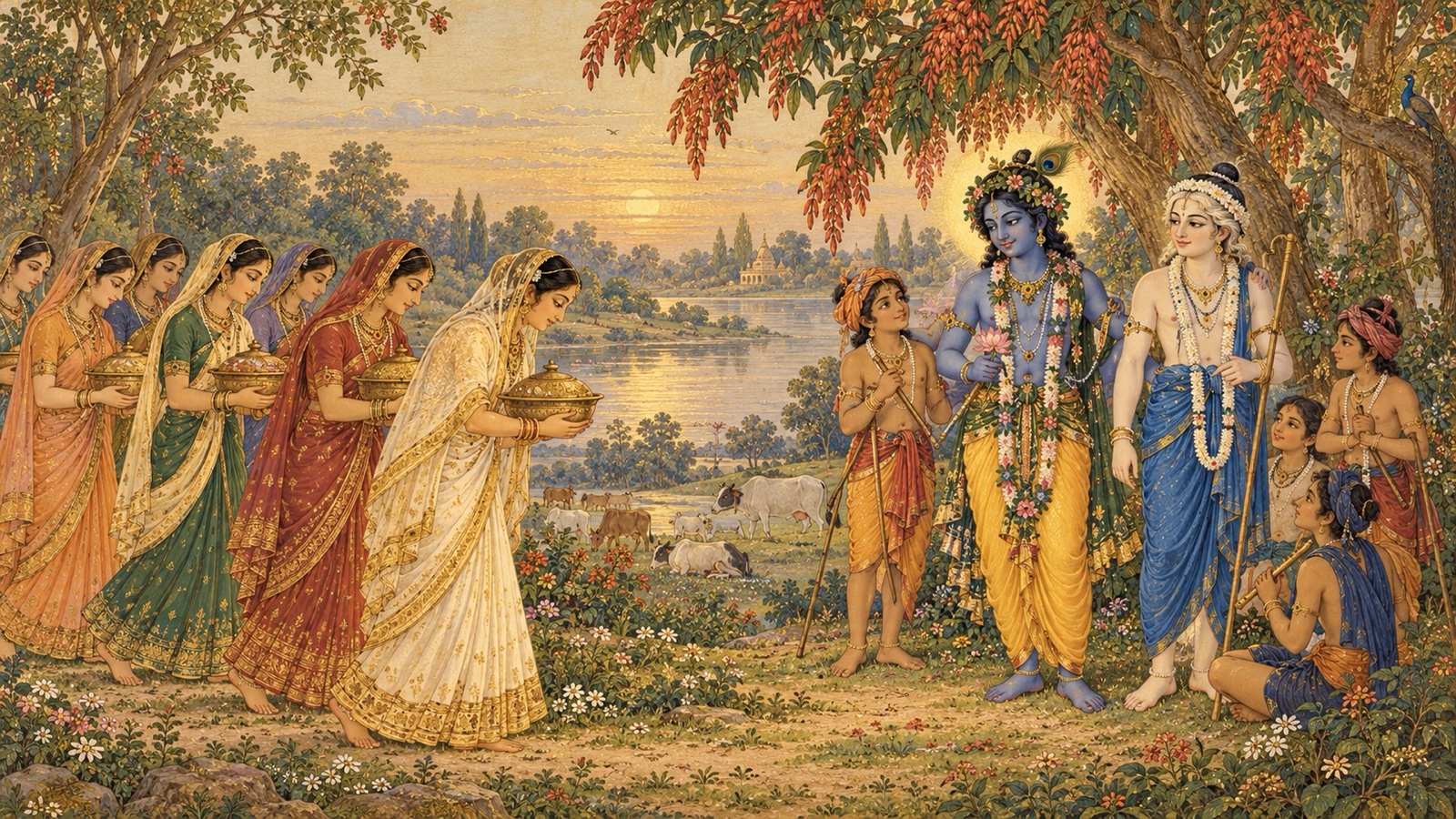
Brahmanas intent on a sacrifice for heaven turn away the Lord who begs a little rice at their door; their wives, who have only heard of Him, carry vessels of food to Him and are received by Krishna as His own.
Om Namo Bhagavate Vasudevaya.
Om Namo Bhagavate Vasudevaya.
Om Namo Bhagavate Vasudevaya.
Welcome back to Srimad Bhagavatam Wisdom, our devotional journey through the sacred histories and teachings of the Srimad Bhagavat Mahapurana. This twenty-third chapter of the Tenth Canto begins with something very small, the hunger of the cowherd boys, and from it the Lord draws out a lesson about who truly recognizes Him.
Chapter Information
- Scripture: Śrīmad Bhāgavata Mahāpurāṇa
- Canto: 10 (Book Ten, First Half)
- Chapter: 23 (Discourse 23)
- Chapter title: The Brahmanas’ Wives Blessed
- Principal speaker: Sukadeva Gosvami (narrating to King Parikshit)
- Principal listener: King Parikshit
- Main setting: The Yamuna groves near Vrindavana and the nearby sacrificial arena of the brahmanas
- Central subject: Brahmanas refuse the Lord’s request for food; their wives feed Krishna and Balarama out of love; His teaching on devotion; the brahmanas’ remorse
- Principal verse range: Canto 10, Chapter 23, verses 1–52
- Primary edition: Gita Press Śrīmad Bhāgavata Mahāpurāṇa
Context From the Previous Chapter
In Chapter 22, after the pastime of the gopis’ garments, Krishna wandered far from Vrindavana with Balarama and the cowherd boys in the summer heat, praised the trees that live for others, and led the herd to the Yamuna, where the boys came to the two brothers pinched with hunger.
The Hunger of the Cowherd Boys
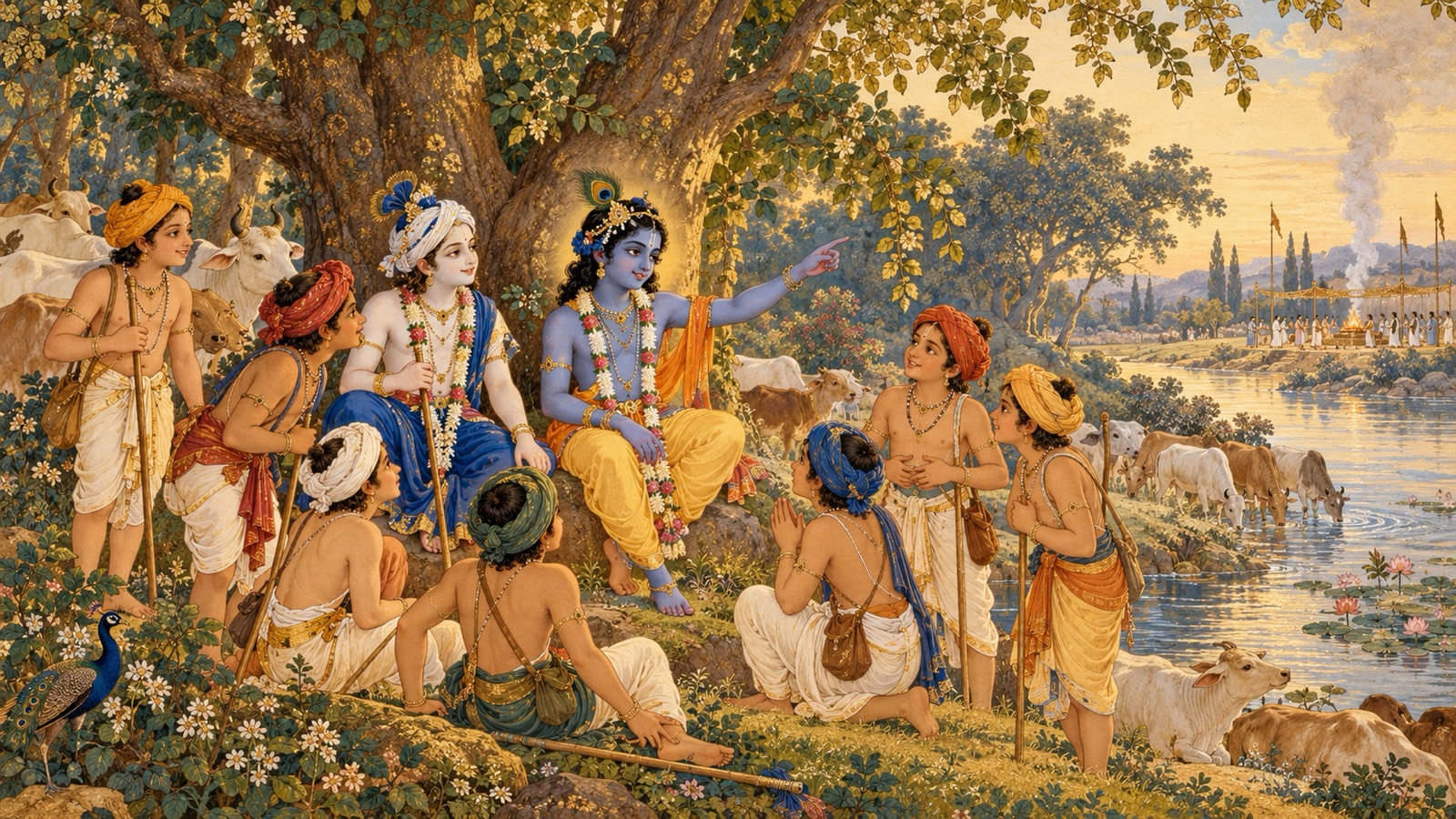
The cowherd boys came before Balarama and Krishna and spoke plainly: ‘O Rama, O Rama of great valour, O Krishna, destroyer of the wicked, this hunger is troubling us. Be pleased to relieve it.’
The Lord, the son of Devaki, wishing to shower His grace upon certain brahmana women devoted to Him, gave an unexpected answer: ‘Go to the sacrificial arena where brahmanas learned in the Vedas are performing a sacrifice named Āṅgirasa, desiring heaven. Speak the name of My revered elder brother and My own, and ask them for cooked rice.’
The Brahmanas Who Would Not Hear
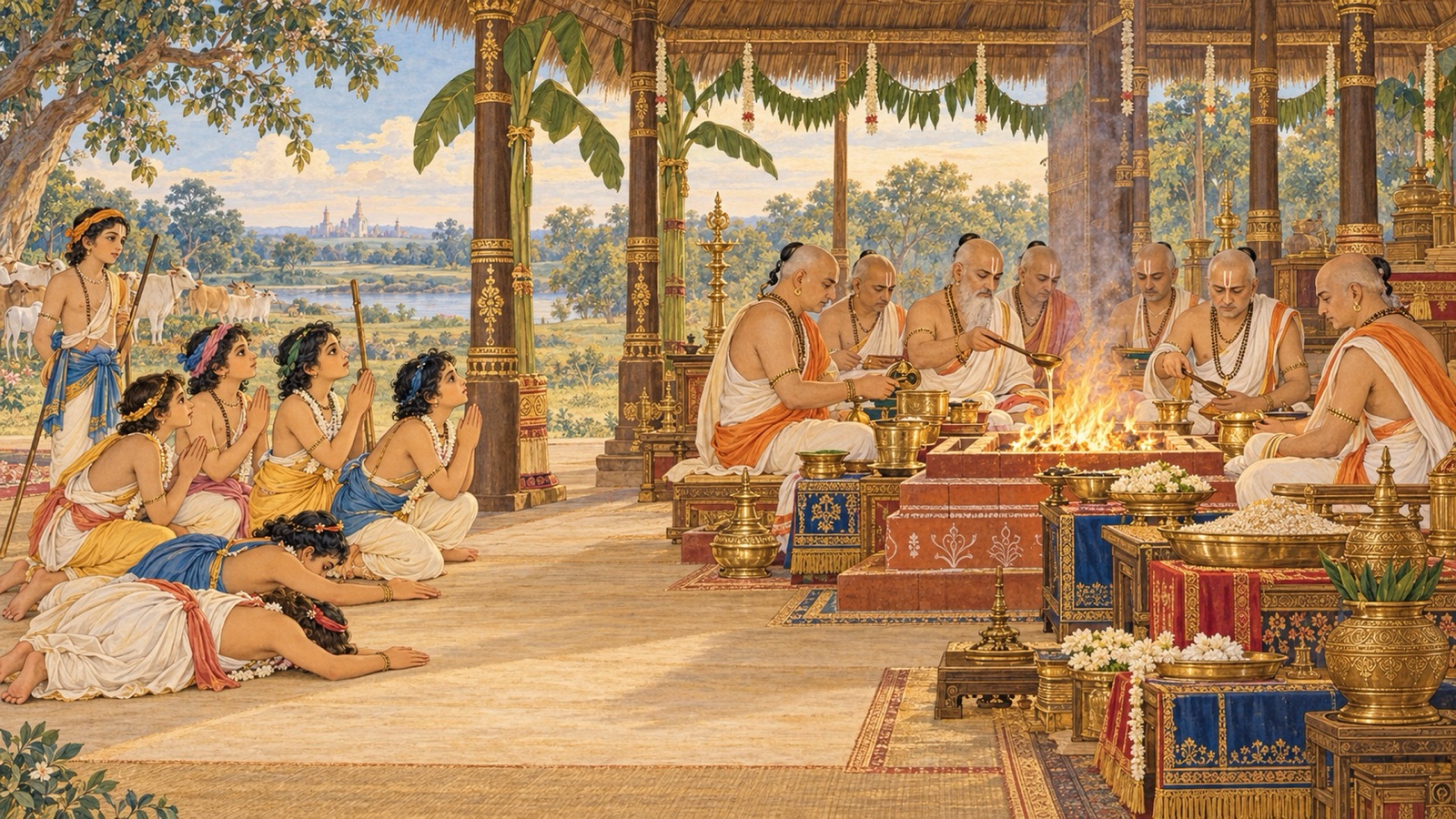
With palms joined, the boys fell flat on the ground before the brahmanas and spoke humbly: ‘O gods upon the earth, hear us. We are cowherd boys carrying out Krishna’s command, sent here by Balarama. Balarama and Krishna, the infallible Lord, are grazing the cows not far away and are hungry. They desire cooked rice; if you have it, and if you have faith in them, give it, O best among the knowers of dharma.’ They even reminded them of the rule that, except at an animal sacrifice or the Sautrāmaṇi, one who eats the food of a householder consecrated for a sacrifice is not defiled.
इति ते भगवद्याच्ञां शृण्वन्तोऽपि न शुश्रुवु: ।
क्षुद्राशा भूरिकर्माणो बालिशा वृद्धमानिन: ॥ ९ ॥
iti te bhagavad-yācñāṁ śṛṇvanto ’pi na śuśruvuḥ kṣudrāśā bhūri-karmāṇo bāliśā vṛddha-māninaḥ
Meaning: Though they heard this request of the Lord, the brahmanas paid no heed to it; cherishing petty hopes while engaged in elaborate rites, they were childish, though they thought themselves advanced. (Canto 10, Chapter 23, verse 9)
Sukadeva lays bare the root of their failure. The place and time of a sacrifice, its ingredients, mantras and rituals, its priests, fires and deities, the sacrificer, the act itself and its merit — all of these are the Lord. That Supreme Brahman, Adhokshaja, beyond the reach of the senses, had sent His request to their door; but these men, mistaking the mortal body for the self, saw only a human boy. They said neither yes nor no, and the boys returned disappointed to tell Krishna and Balarama.
The Lord Laughs and Sends Them to the Wives
Hearing this, the Lord of the universe laughed aloud and spoke to the boys again, showing them the way of the world, where a petitioner refused once does not lose heart. ‘Tell their wives,’ He said, ‘that I have come here with Sankarshana. Affectionate as they are, and dwelling in Me with their minds, they will give you all the food you desire.’
In the quarters set apart for the sacrificers’ wives the boys found the chaste brahmana ladies seated, finely adorned. Bowing, they said: ‘Obeisance to you, wives of the brahmanas. Krishna, wandering not far from here, has sent us. He has come a long way grazing the cows with Balarama and the cowherd boys. Let food be given to Him and His hungry companions.’
Like Rivers to the Ocean
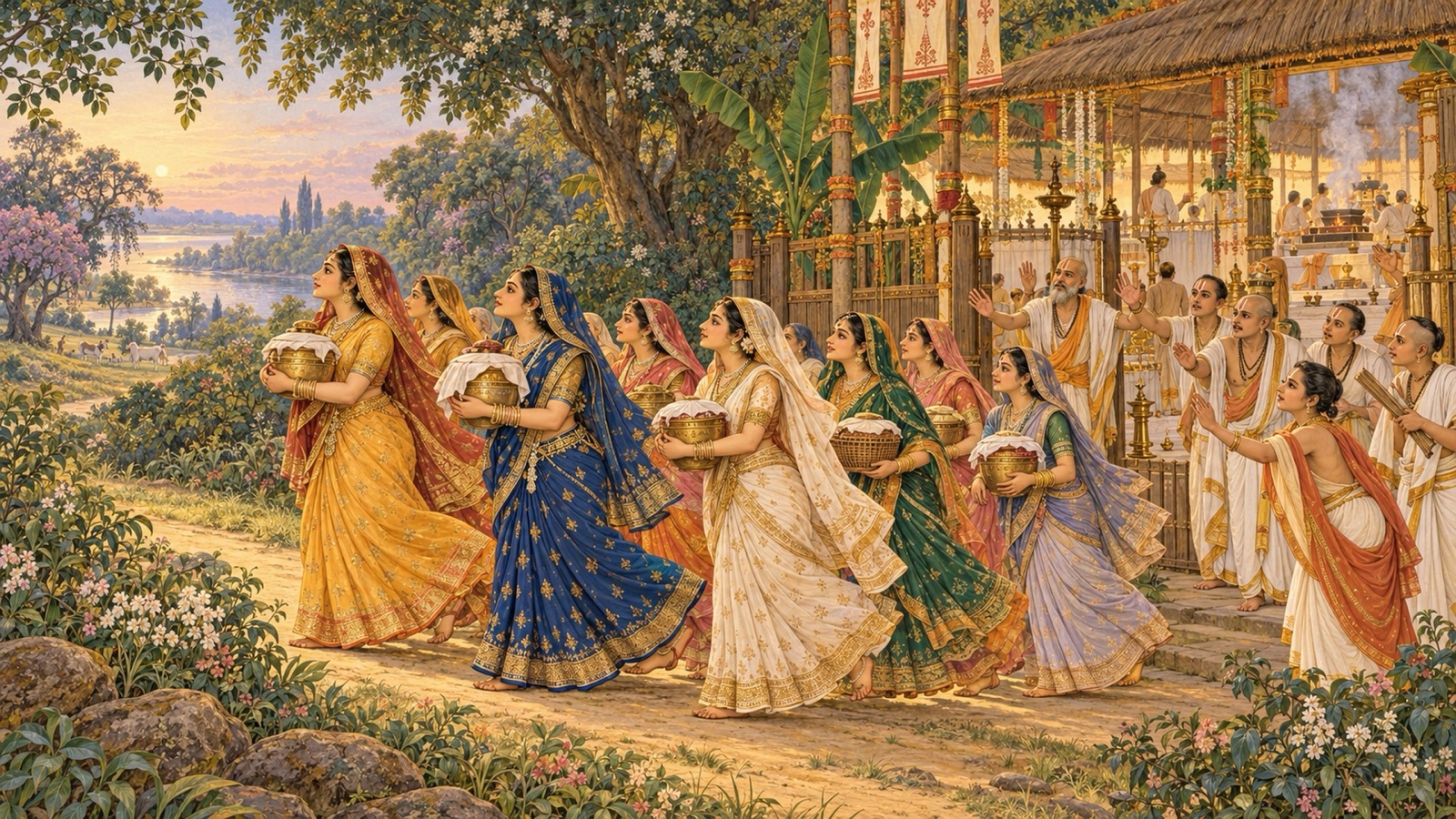
Hearing that Acyuta, the infallible Lord, had come so near, the women were thrown into a flutter of joy; they had long yearned to see Him, their minds captured by the stories of Him they had heard.
चतुर्विधं बहुगुणमन्नमादाय भाजनै: ।
अभिसस्रु: प्रियं सर्वा: समुद्रमिव निम्नगा: ॥ १९ ॥
catur-vidhaṁ bahu-guṇam annam ādāya bhājanaiḥ abhisasruḥ priyaṁ sarvāḥ samudram iva nimnagāḥ
Meaning: Taking excellent food of four kinds in vessels, they all hurried toward their Beloved, as rivers flow to the sea. (Canto 10, Chapter 23, verse 19)
Husbands, brothers, kinsmen and sons tried to hold them back in vain, for their hearts had long been fixed on Uttamaśloka, the Lord of excellent fame, through all they had heard of Him.
In a grove by the Yamuna, bright with the fresh shoots of Aśoka trees, they saw Him at last, strolling with His elder brother amid the cowherd boys. Dark-hued, a golden cloth about His waist, garlanded with forest flowers, peacock feathers and tender leaves and painted with coloured minerals like a dancer on a stage, He rested one hand on a friend’s shoulder and twirled a lotus with the other, water-lilies at His ears, curls on His cheeks, a smile on His lotus face. Through the gateways of their eyes the women took into their hearts the One whose glories had so long adorned their ears, and embracing Him within, they were freed of the pain of separation, as those bound by ego are freed of anguish upon embracing an enlightened soul.
The Lord Welcomes Them and Speaks of Devotion
Krishna, the witness of every heart, knew that they had come solely to see Him, defying their relatives and giving up every hope of return. Smiling, He addressed them: ‘Welcome, highly blessed ladies. Please be seated. What may We do for you? It is fitting that you have come here longing to see Me.’
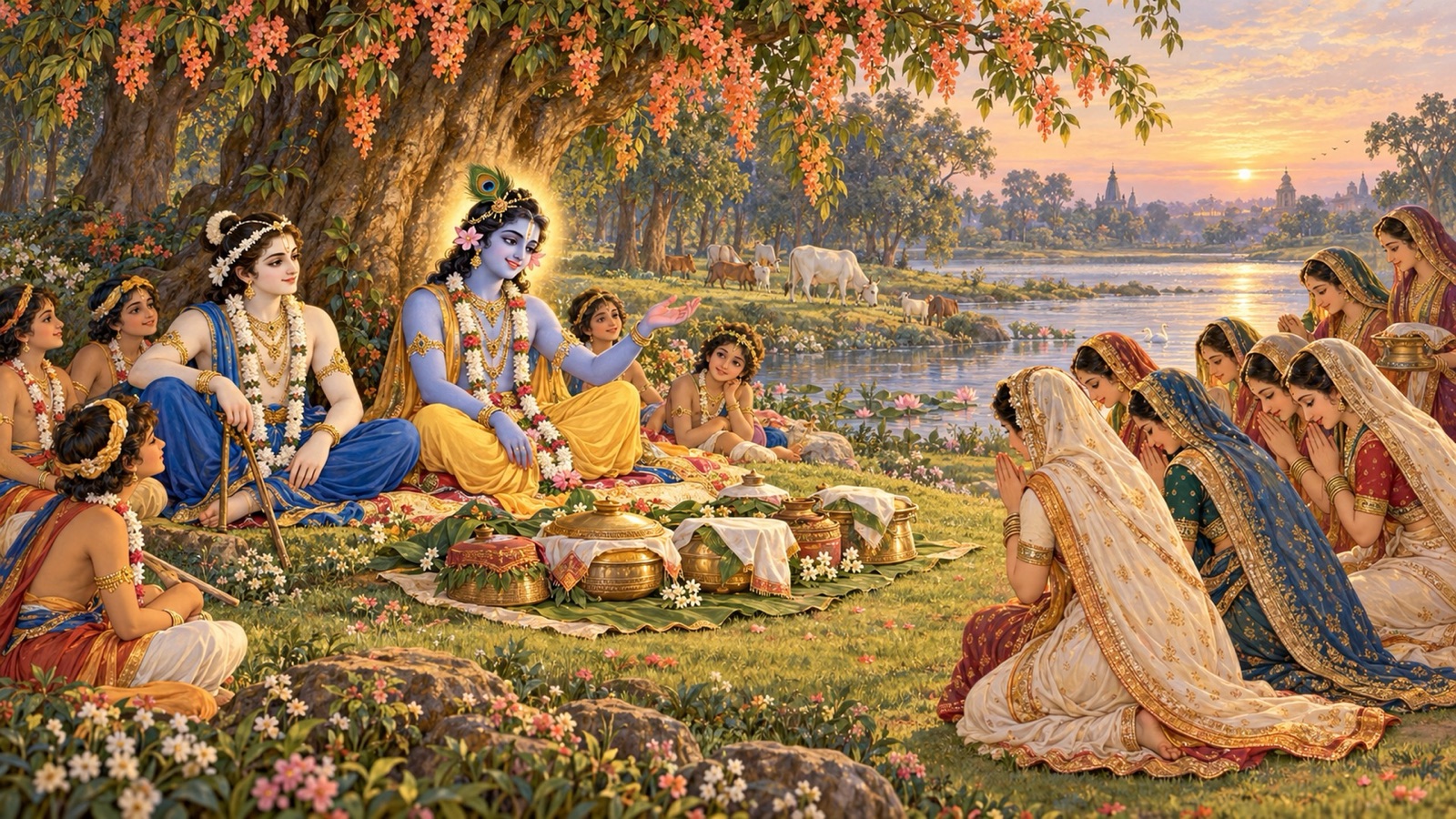
Then He spoke of the devotion they had lived.
नन्वद्धा मयि कुर्वन्ति कुशला: स्वार्थदर्शिन: ।
अहैतुक्यव्यवहितां भक्तिमात्मप्रिये यथा ॥ २६ ॥
nanv addhā mayi kurvanti kuśalāḥ svārtha-darśinaḥ ahaituky avyavahitāṁ bhaktim ātma-priye yathā
Meaning: Surely the wise, who see their true interest, practise unmotivated and uninterrupted devotion directly to Me, who am their own beloved Self. (Canto 10, Chapter 23, verse 26)
Who, He asked, could be dearer than one’s own self, through which alone life, intellect, mind, body, kinsfolk, wife, children and wealth become dear? Then He said: ‘Return now to the sacrificial arena. Your husbands, brahmana householders, will complete their sacrifice with your help.’
The Wives’ Plea and the Lord’s Assurance
The women answered: ‘O almighty Lord, it is not fitting for You to speak such harsh words. Make true the declaration of the Vedas that one who comes to You does not return. Setting aside all our relatives, we have come to the soles of Your feet to wear upon our hair the tulasi garland that falls from them. Our husbands will not take us back, nor our parents, sons, brothers, kinsmen or friends; how then could strangers receive us? Ordain, O subduer of foes, that for us who have fallen at Your feet there be no other refuge.’
The Lord’s reply was tender and firm. ‘Your husbands, parents, brothers, sons and all the rest will feel no resentment toward you, for you have been favoured by Me; even the gods approve.’
न प्रीतयेऽनुरागाय ह्यङ्गसङ्गो नृणामिह ।
तन्मनो मयि युञ्जाना अचिरान्मामवाप्स्यथ ॥ ३२ ॥
na prītaye ’nurāgāya hy aṅga-saṅgo nṛṇām iha tan mano mayi yuñjānā acirān mām avāpsyatha
Meaning: Bodily contact with Me does not bring people in this world delight or deepen their love. Therefore fix your minds on Me, and before long you will attain Me. (Canto 10, Chapter 23, verse 32)
The Return, and the Meal in the Forest
Thus instructed, the brahmanas’ wives went back, and their husbands, finding no fault with them, completed the sacrifice in their company. One lady alone had been forcibly held back by her husband; embracing the Lord within her heart exactly as she had heard of Him, she cast off the body her past karma had fashioned.
Then Lord Govinda, though complete in every power, fed the cowherd boys with the four kinds of food the women had brought, and only afterwards ate Himself. So the Lord, in a human-like form assumed for His pastimes, moved among people as one of them, delighting the cows, cowherd men and cowherd women of Vraja by His beauty, words and deeds.
The Brahmanas’ Remorse
Only afterwards did the brahmanas come to their senses: they had refused the plea of Balarama and Krishna, the Lords of the universe playing the part of men. Seeing in their own wives a devotion not of this world and finding themselves empty of it, they condemned themselves bitterly. ‘Fie upon our threefold birth, our learning, our vow, our wide knowledge, our lineage and our skill in ritual,’ they cried, ‘when we have turned our faces from Adhokshaja. Truly the Lord’s Maya deludes even great yogis; that is how we, teachers of men, lost sight of our own real good.’
अहो पश्यत नारीणामपि कृष्णे जगद्गुरौ ।
दुरन्तभावं योऽविध्यन्मृत्युपाशान् गृहाभिधान् ॥ ४२ ॥
aho paśyata nārīṇām api kṛṣṇe jagad-gurau duranta-bhāvaṁ yo ’vidhyan mṛtyu-pāśān gṛhābhidhān
Meaning: Ah, behold the boundless devotion of even these women to Krishna, the teacher of the universe — a devotion that has cut asunder the snares of death that go by the name of household life. (Canto 10, Chapter 23, verse 42)
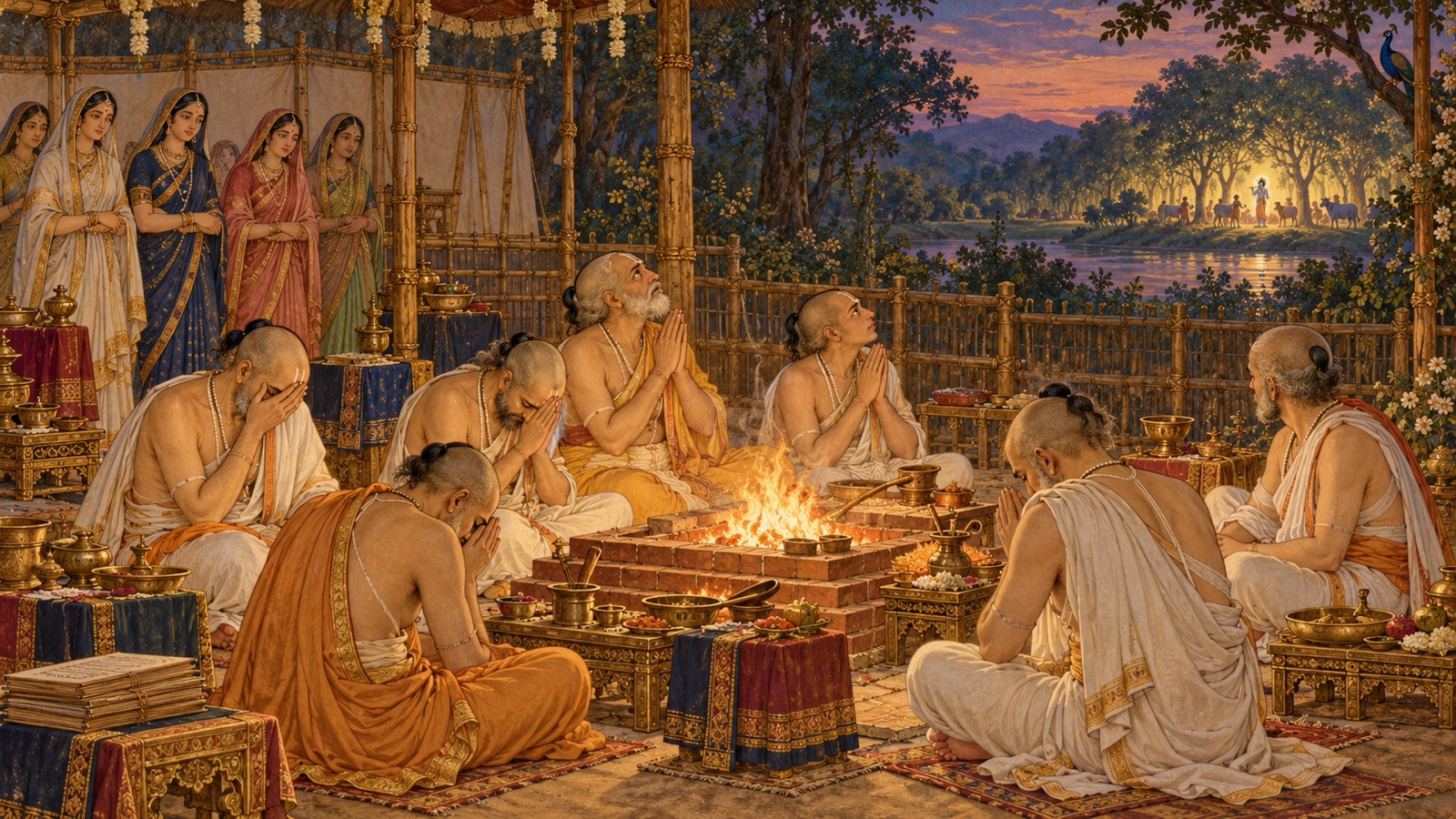
These women had received no sacred thread, never lived in a teacher’s house, performed no austerities, self-inquiry, purifications or pious works; yet firm devotion to Krishna, Lord of the masters of yoga, stood in them and was nowhere in the brahmanas, who held every such qualification. ‘How merciful,’ they said, ‘that the Lord, refuge of the saintly, used the words of cowherd boys to awaken us, lost in household affairs and blind to our own good. What could He, who is complete and grants even liberation, want from us? His begging was pure pretence. Lakshmi herself waits upon Him for the touch of His feet; that such a Lord should ask for rice bewilders the world.’
Now they saw what they had missed: the Lord who is Himself every element of sacrifice and its reward — that very Lord Vishnu had taken birth among the Yadus, as they had heard; and still, fools that they were, they had not recognized Him. They called themselves most blessed to have such wives, through whose devotion their minds were now fixed upon Hari. Bowing to Lord Krishna of unobstructed intelligence, they confessed that by His Maya their judgment had been clouded and they had wandered the paths of karma, and they prayed: ‘May that primeval Person forgive the transgression of us who, deluded by His own Maya, did not know His greatness.’
Recalling their offence again and again, the brahmanas who had slighted Krishna longed to go to Vraja and see the two brothers; yet, afraid of Kamsa, they did not stir.
Principal Teachings of This Chapter
1. Ritual without recognition of the Lord is empty. Expert in the Vedas, the brahmanas still ignored the Lord’s request (verse 9) because they saw only a boy; a rite that does not recognize Him, who is every element of sacrifice, misses its goal.
2. The Lord seeks out those who hold Him in their hearts. Krishna sends the boys to the wives knowing they will give, for their minds already dwell in Him. What we have heard of the Lord with love becomes the place where He comes to receive us.
3. True devotion flows past every obstacle. The wives ran to Krishna like rivers to the sea (verse 19), undeterred by husbands and kin.
4. The Lord is the dearest Self, and nearness of mind reaches Him. The discerning offer Him unmotivated, unbroken devotion as their own beloved Self (verse 26), and the mind fixed on Him, not bodily closeness, brings one to Him (verse 32).
5. Devotion, not qualification, cuts the snares of death. The wives, without a single ritual credential, severed the bonds of household life through bhakti (verse 42). Sincere love outweighs birth, learning and ceremony.
A Devotional Reflection
How gently the Lord arranges everything here. He is not hungry in any way that food can satisfy; He is the sacrifice itself. Yet He lets a plea for rice carry His name to a sacrificial enclosure, so that women who had loved Him through hearing might stand before Him, and their learned husbands might discover, through shame, what their learning had left out. The Lord condemns no one: the wives are blessed, the brahmanas awakened, and even the lady held back at home embraces Him within. We are sometimes the women, carrying our offering past every voice that says no, and sometimes the brahmanas, so busy doing things correctly that we miss the Lord at the door. May we hold what we have heard of Krishna until it becomes love strong enough to walk toward Him, and when we find we have turned Him away, fall at His feet in honest remorse.
A Daily Devotional Practice
Today, before you eat, pause and offer the meal to the Lord in your heart with a few words of love, remembering the women who carried their vessels through the forest to feed Krishna and Balarama; and if someone asks you for help, treat the request as though it carried His name. Begin and end by chanting: Om Namo Bhagavate Vasudevaya.
Conclusion
The twenty-third chapter of the Tenth Canto sets one lesson before us through two groups: brahmanas rich in learning who let the Lord’s request pass, and their wives, poor in qualification, who gave up everything for Him. Krishna receives the women, teaches them that the mind fixed on Him attains Him, and sends them home honoured; the brahmanas, awakened by their wives’ love, confess their delusion and pray for forgiveness. May we let what we hear of the Lord ripen into love, and recognize Him in whatever form He comes asking.
May the divine wisdom of Srimad Bhagavatam awaken pure devotion within our hearts.
Om Namo Bhagavate Vasudevaya.
Jay Shree Madhav.
References and Attribution
- Primary edition: Gita Press, Śrīmad Bhāgavata Mahāpurāṇa (English, complete), Book Ten (First Half), Discourse 23.
- Series: Srimad Bhagavatam Wisdom · Biswa Sanatan Dharma Seva Trust.
- Presented following the spiritual guidance and recommendation of Pandit Dr. Shri Kashinath Mishra.
This is an original, faithful retelling in the writer’s own words, with brief quoted verses shown in Devanāgarī and transliteration and their meanings given as summaries. It is not a reproduction of any single publisher’s continuous translation or commentary. No affiliation with or endorsement by any publisher is implied.
Jay Shree Madhav