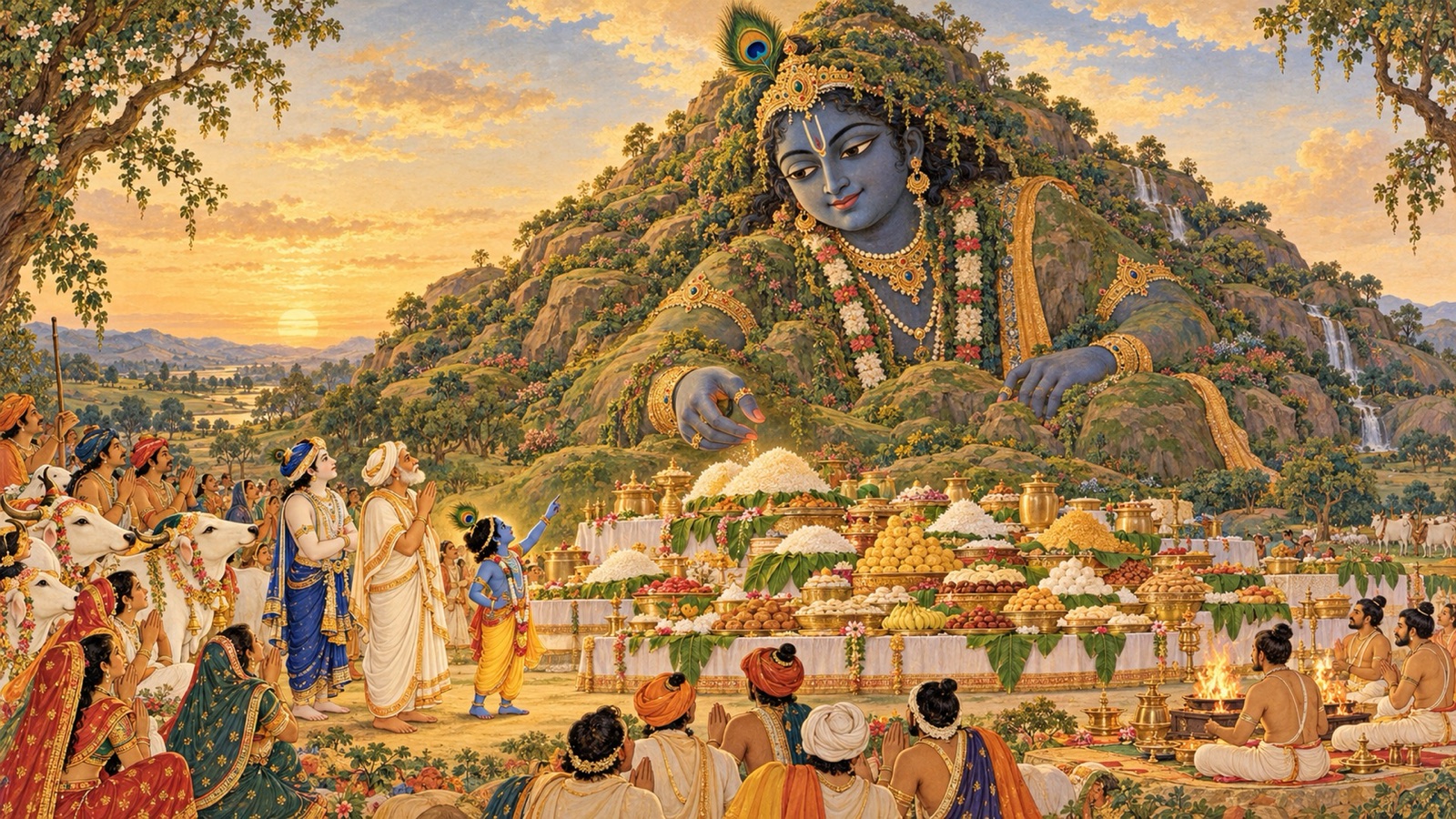
As the cowherds of Vraja ready their yearly offering to Indra, the boy Krishna bows before His father with a question, turns the whole festival toward the cows, the brahmanas and Govardhana Hill, and then, in a towering form, receives it Himself: “I am the mountain!”
Om Namo Bhagavate Vasudevaya.
Om Namo Bhagavate Vasudevaya.
Om Namo Bhagavate Vasudevaya.
Welcome back to Srimad Bhagavatam Wisdom, our devotional journey through the sacred histories and teachings of the Srimad Bhagavat Mahapurana. The twenty-fourth chapter of the Tenth Canto brings us to the foot of Govardhana, where a child’s question to his father becomes a lesson for all Vraja on what truly sustains a life and who deserves our worship.
Chapter Information
- Scripture: Śrīmad Bhāgavata Mahāpurāṇa
- Canto: 10 (Book Ten, First Half)
- Chapter: 24 (Discourse 24)
- Chapter title: Worshiping Govardhana Hill
- Principal speaker: Sukadeva Gosvami (narrating to King Parikshit); within the narration, Sri Krishna and Nanda
- Principal listener: King Parikshit; within the narration, Nanda and the elders of Vraja
- Main setting: Vraja (Vṛndāvana), at the foot of Govardhana Hill
- Central subject: Krishna questions the sacrifice to Indra, teaches on karma and one’s own nature, redirects the offering to the cows, the brahmanas and Govardhana, and accepts it Himself as the Hill
- Principal verse range: Canto 10, Chapter 24, verses 1–38
- Primary edition: Gita Press Śrīmad Bhāgavata Mahāpurāṇa (English, Book Ten, Discourse 24)
Context From the Previous Chapter
In Chapter 23 the hungry cowherd boys, sent by Krishna, begged food from brahmanas absorbed in a sacrifice. The brahmanas ignored them, but their wives ran to the Lord with every delicacy and gave Him their hearts. Realizing their offence, the brahmanas condemned their own pride, marvelled at their wives’ devotion and prayed for forgiveness — yet, fearing Kamsa, they did not go to see the two Brothers.
Krishna Notices the Preparations for Indra’s Sacrifice
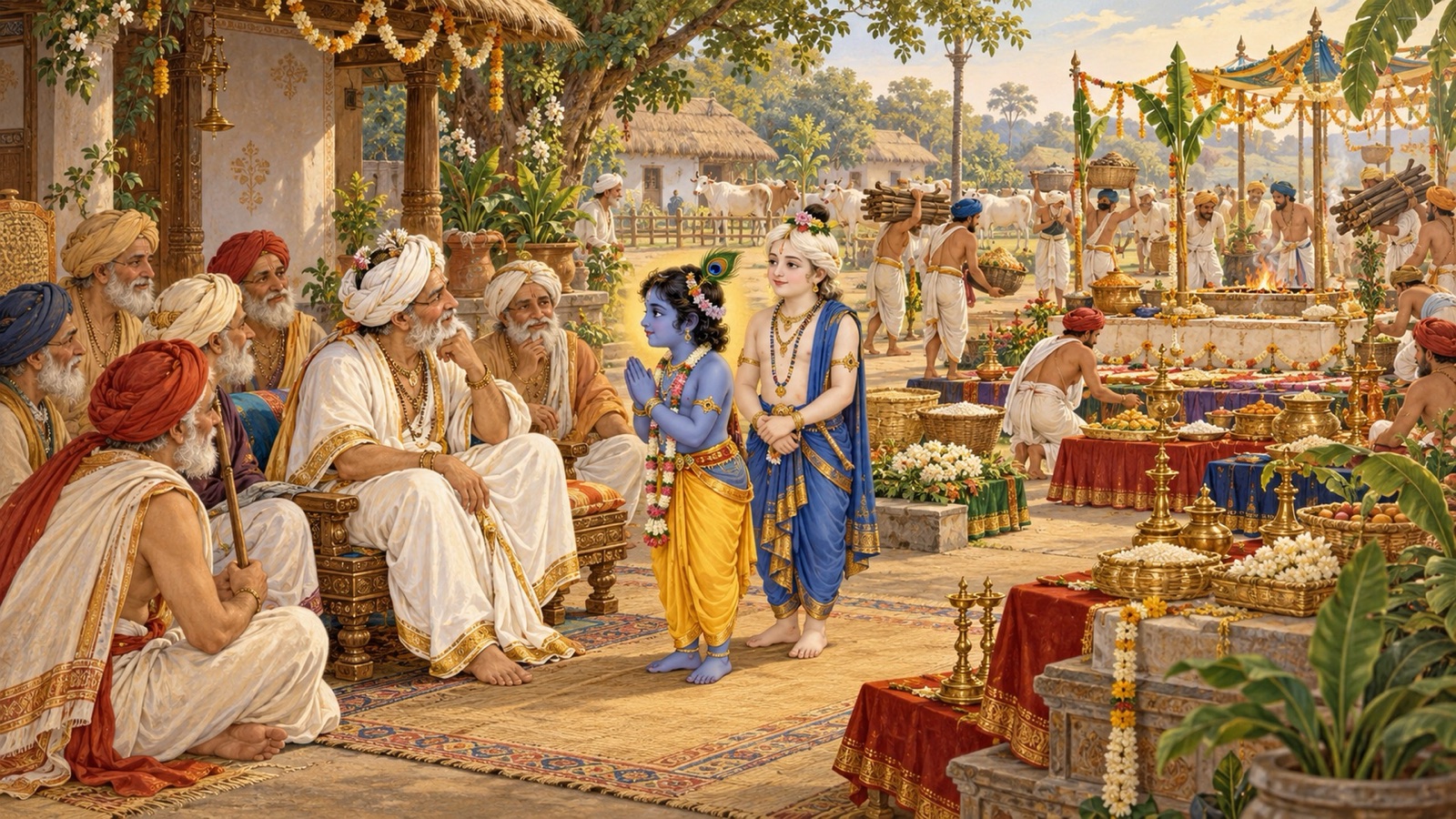
Sukadeva resumed. Living in Vraja with Baladeva, the Lord saw the cowherds busily gathering materials for a great sacrifice to Indra, the god of rain. He knew perfectly well what was afoot — He is the Self within every heart and sees all things — yet, bending low with a child’s courtesy before his elders, He questioned the senior men of Vraja, with Nanda at their head.
कथ्यतां मे पित: कोऽयं सम्भ्रमो व उपागत: ।
किं फलं कस्य वोद्देश: केन वा साध्यते मख: ॥ ३ ॥
kathyatāṁ me pitaḥ ko ’yaṁ sambhramo va upāgataḥ kiṁ phalaṁ kasya voddeśaḥ kena vā sādhyate makhaḥ
Meaning: Please tell Me, father: what is this great flurry of activity that has come upon you? What fruit will it bring, for whom is it meant, and by whom and with what materials is this sacrifice to be accomplished? (Canto 10, Chapter 24, verse 3)
“Tell Me, father,” He went on, “for I long to hear it. Saintly souls who see everyone as their own self, who count none as their own or a stranger, and who have neither friend, neutral nor enemy, keep nothing hidden; where such vision is lacking, a neutral is to be shunned like an enemy, while a friend is as dear as one’s own self.” Then He added: people act with understanding or without it, and success crowns only the one who understands. “So is this ritual of yours something you have examined, or is it simply the way of the world? Explain it to Me well, for I truly wish to know.”
Nanda Explains the Worship of Indra
Nanda answered his son with the faith of generations.
श्रीनन्द उवाच
पर्जन्यो भगवानिन्द्रो मेघास्तस्यात्ममूर्तय: ।
तेऽभिवर्षन्ति भूतानां प्रीणनं जीवनं पय: ॥ ८ ॥
śrī-nanda uvāca parjanyo bhagavān indro meghās tasyātma-mūrtayaḥ te ’bhivarṣanti bhūtānāṁ prīṇanaṁ jīvanaṁ payaḥ
Meaning: Nanda said: The mighty Indra is the lord of rain, and the clouds are his own forms, dear to him as his very self; they shower down water, which is the nourishment and the very life of living beings. (Canto 10, Chapter 24, verse 8)
“We and other men, dear child,” Nanda continued, “worship this ruler of the clouds with sacrifices made from the grain his rain produces, and we live on what remains, seeking the threefold reward of religious merit, enjoyment and prosperity. It is Indra who makes men’s labour bear fruit.” And he closed with a warning rooted in tradition: whoever abandons a religious practice handed down through the generations — from desire, hatred, fear or greed — comes to no good.
Krishna’s Teaching on Karma and One’s Own Nature
Sukadeva then revealed the Lord’s hidden purpose: having heard the reply of Nanda and the other people of Vraja, Keshava spoke to His father in order to arouse the anger of Indra.
श्रीभगवानुवाच
कर्मणा जायते जन्तु: कर्मणैव प्रलीयते ।
सुखं दु:खं भयं क्षेमं कर्मणैवाभिपद्यते ॥ १३ ॥
śrī-bhagavān uvāca karmaṇā jāyate jantuḥ karmaṇaiva pralīyate sukhaṁ duḥkhaṁ bhayaṁ kṣemaṁ karmaṇaivābhipadyate
Meaning: The Lord said: By karma a living being is born, and by karma alone it dies; happiness and sorrow, fear and security all come to it by karma alone. (Canto 10, Chapter 24, verse 13)
If some supreme ruler hands out the fruits of others’ actions, Krishna argued, even he must deal with the doer, for he has no power over one who does nothing. What, then, have living beings — each following its own deeds — to do with Indra, who cannot alter what a person’s nature has ordained? Every creature is bound to its nature and follows it; the whole creation, gods, demons and humans alike, rests upon nature.
देहानुच्चावचाञ्जन्तु: प्राप्योत्सृजति कर्मणा ।
शत्रुर्मित्रमुदासीन: कर्मैव गुरुरीश्वर: ॥ १७ ॥
dehān uccāvacāñ jantuḥ prāpyotsṛjati karmaṇā śatrur mitram udāsīnaḥ karmaiva gurur īśvaraḥ
Meaning: By karma a being takes up bodies high and low and gives them up again; karma alone appears as enemy, friend or neutral party, and karma alone is one’s teacher and one’s lord. (Canto 10, Chapter 24, verse 17)
Therefore, the Lord concluded, a person should keep to the station and stage of life fixed by his nature, do his own duty and honour karma itself; for that by which one lives in comfort is truly one’s deity. One who lives by one thing but worships another gains nothing from it, any more than an unfaithful wife gains from her paramour.
He then set out how each order of society lives: the brahmana by the Vedas, the kshatriya by protecting the earth, the vaishya by vārtā, the shudra by serving the twice-born. Vārtā is of four kinds — agriculture, trade, cow-protection and money-lending — “and of these, we have always lived by the cow.” Widening the view, He explained that sattva, rajas and tamas cause the world’s maintenance, creation and dissolution; through rajas the varied universe is born of mutual union, and rajas drives the clouds to pour rain on every side. By that water living beings prosper. “What, then, will the great Indra do?”
“Let the Cows, the Brahmanas and the Hill Be Worshipped”
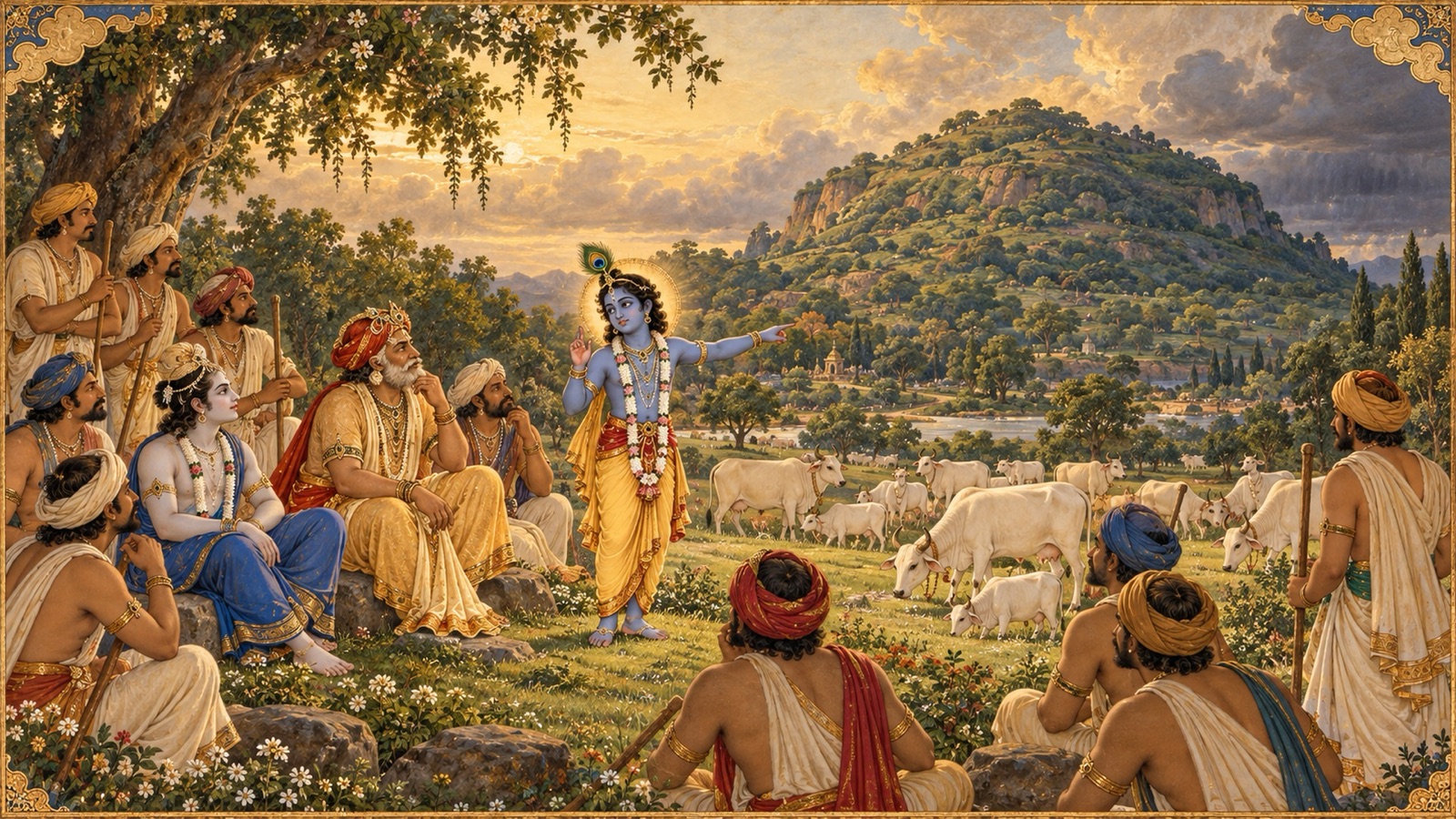
From principle Krishna turned to practice. “We possess no cities, no provinces, no villages, no houses,” He reminded them. “We are forest-dwellers, father, who have always made our home among woodlands and hills.”
तस्माद् गवां ब्राह्मणानामद्रेश्चारभ्यतां मख: ।
य इन्द्रयागसम्भारास्तैरयं साध्यतां मख: ॥ २५ ॥
tasmād gavāṁ brāhmaṇānām adreś cārabhyatāṁ makhaḥ ya indra-yāga-sambhārās tair ayaṁ sādhyatāṁ makhaḥ
Meaning: Therefore let a sacrifice be begun in honour of the cows, the brahmanas and the hill; and let it be accomplished with the very materials that have been gathered for the sacrifice to Indra. (Canto 10, Chapter 24, verse 25)
Then, with a householder’s care for detail, the Lord described the festival. Let many kinds of food be cooked — from sweet milk-rice down to soups of pulses, with saṁyāva porridge, cakes and fried delicacies — and let all the milk of Vraja be collected. Let Vedic brahmanas feed the sacred fires with oblations and be honoured with rich food, cows and dakṣiṇā. Let food be given to all others as is fitting, down to the dogs, the outcastes and the fallen; let grass be given to the cows; then let the offering be presented to the mountain. Afterwards, fed, anointed with sandal-paste and finely dressed, “walk in reverence around the cows, the brahmanas, the sacred fires and the hill, keeping them to your right.” He ended as a son, not a commander: “This is My opinion, father; carry it out if it pleases you. Such a sacrifice will be dear to the cows, the brahmanas and the mountain — and to Me.”
The Offering at the Foot of Govardhana
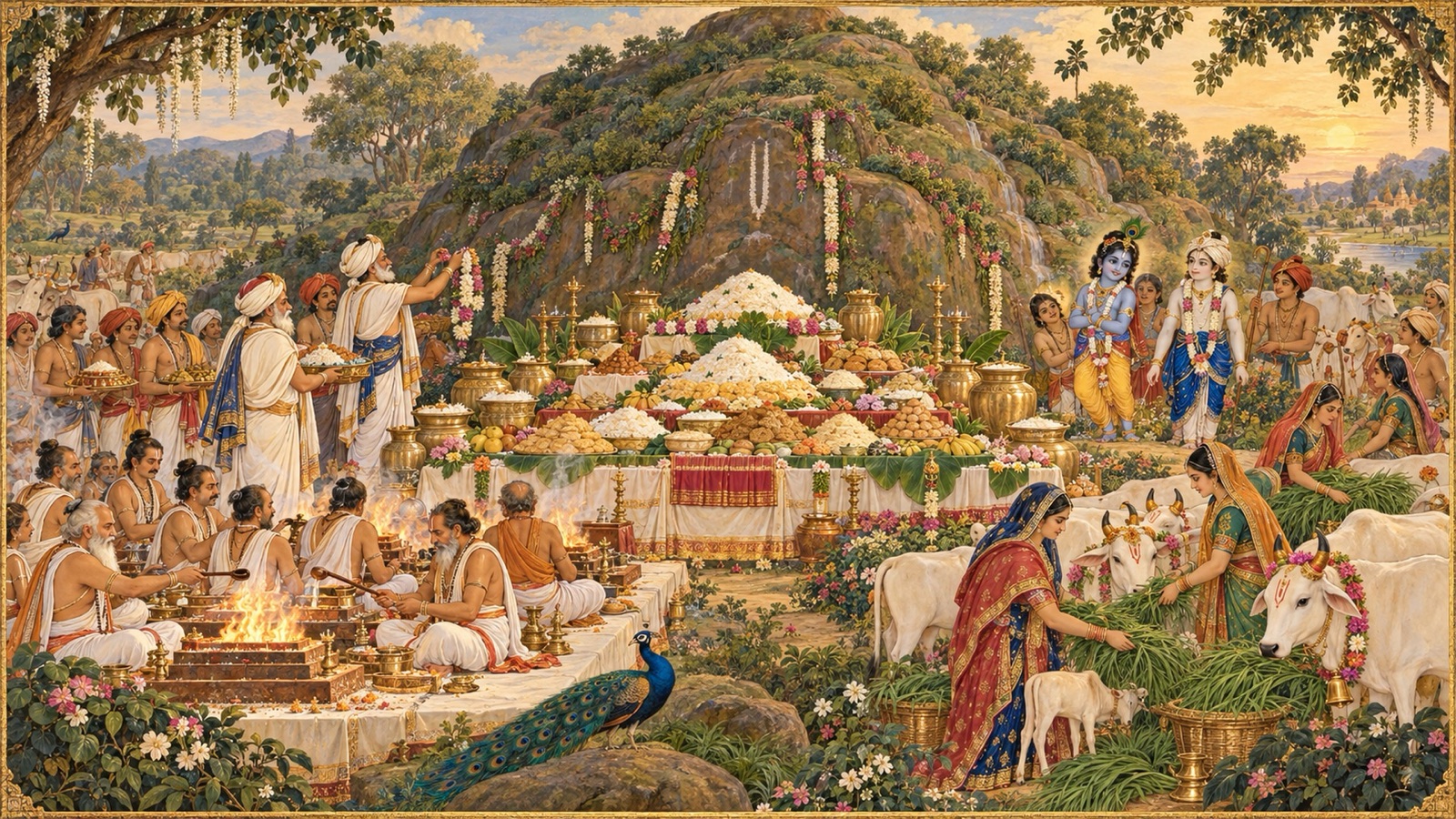
Sukadeva disclosed once more what lay behind the words: the Lord, as the very Spirit of Time, had spoken to shatter Indra’s pride. Nanda and the elders received His counsel gladly and did everything exactly as Madhusudana had said. They had the brahmanas recite benedictions; with the materials gathered for Indra they reverently presented the offerings to the hill and the brahmanas; and they gave fresh grass to the cows.
Circling the Hill with Song
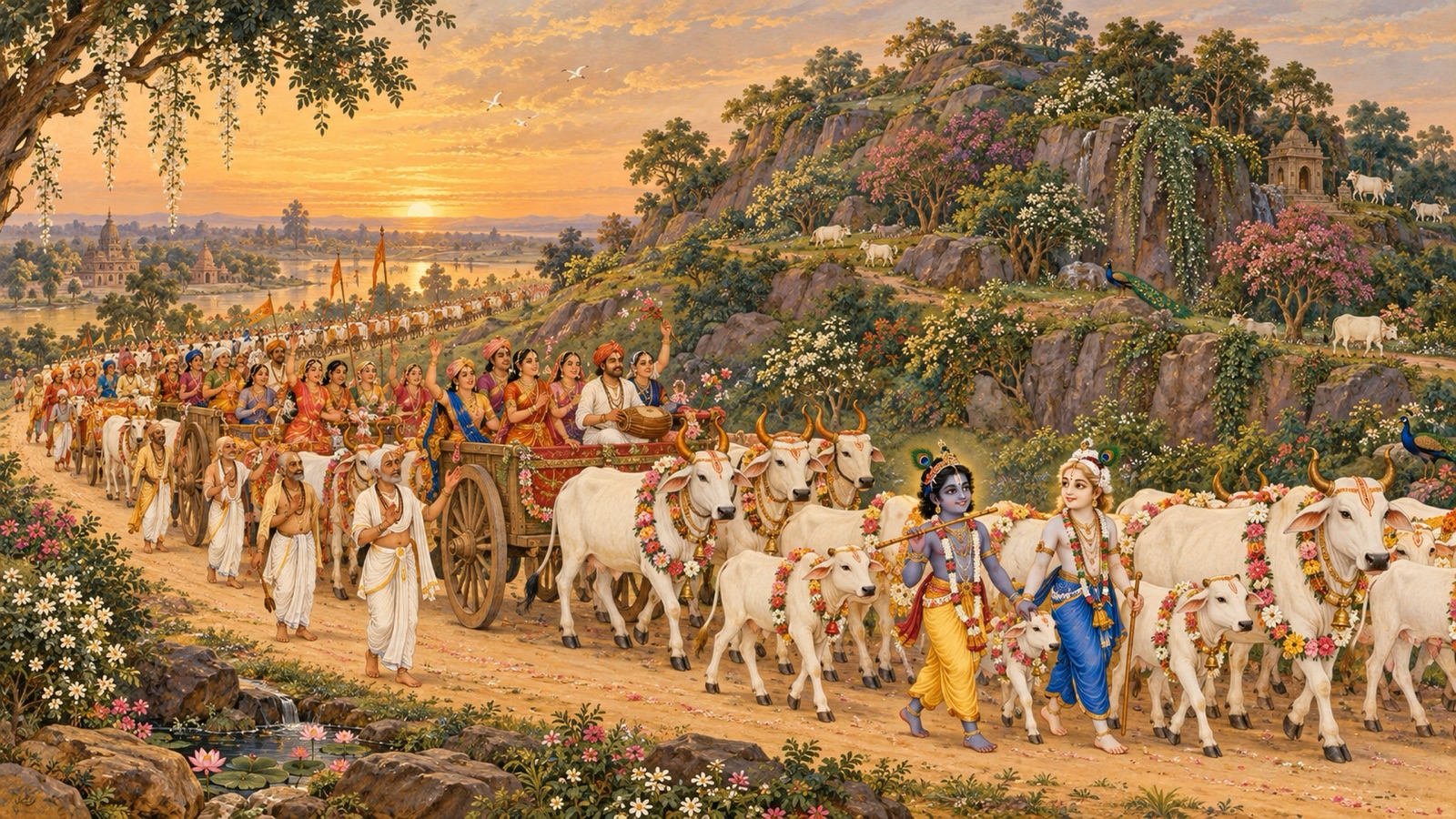
Then, placing their cattle-wealth before them, the people of Vraja circumambulated Govardhana. The cowherd men, finely adorned, rode in carts yoked with bullocks, and the gopis rode with them, singing the heroic deeds of Krishna, while the brahmanas pronounced their blessings over the procession.
“I Am the Mountain!”
And now came the wonder that no one in Vraja had expected.
कृष्णस्त्वन्यतमं रूपं गोपविश्रम्भणं गत: ।
शैलोऽस्मीति ब्रुवन् भूरि बलिमादद् बृहद्वपु: ॥ ३५ ॥
kṛṣṇas tv anyatamaṁ rūpaṁ gopa-viśrambhaṇaṁ gataḥ śailo ’smīti bruvan bhūri balim ādad bṛhad-vapuḥ
Meaning: But Krishna, assuming another form in order to inspire the cowherds’ faith, declared, “I am the mountain!” and with a gigantic body consumed the abundant offering. (Canto 10, Chapter 24, verse 35)
तस्मै नमो व्रजजनै: सह चक्र आत्मनात्मने ।
अहो पश्यत शैलोऽसौ रूपी नोऽनुग्रहं व्यधात् ॥ ३६ ॥
tasmai namo vraja-janaiḥ saha cakra ātmanātmane aho paśyata śailo ’sau rūpī no ’nugrahaṁ vyadhāt
Meaning: Together with the people of Vraja, Krishna Himself bowed to that form — His own Self honouring His own Self — saying, “Behold! This hill has appeared before us in visible form and has shown us his grace.” (Canto 10, Chapter 24, verse 36)
Standing among the cowherds, the Lord pointed to His own colossal form and spoke as one of them: “Taking any form he pleases, this deity slays forest-dwelling mortals who treat him with contempt. For our own welfare and that of our cows, let us bow to him.” Having thus completed with full ceremony the worship of Govardhana, the cows and the brahmanas, as the Son of Vasudeva had directed, the cowherds returned to Vraja with Krishna in their midst.
Here the chapter quietly reveals why the Lord arranged all this. The discourse on karma was never meant to leave Vraja worshipping a bare law of nature: Sukadeva says plainly that Krishna spoke to arouse Indra’s anger and shatter his pride, and the Lord slipped the offering’s real destination into His proposal — “dear to Me” — before receiving it as the Hill (verse 35). Indra had been honoured from fear and for rain; Govardhana, the cows and the brahmanas were honoured from gratitude for what actually sustained Vraja — and behind them stood the Lord of Vraja, taking with love what was offered. Worship thus moves from bargaining with the heavens to the devotion of the heart.
Principal Teachings of This Chapter
1. Understanding should guide what we do. Krishna’s first lesson is a question: is this ritual understood, or merely inherited? Success belongs to the one who acts with knowledge. Devotion, too, deepens when we know why we do what we do.
2. Karma and nature shape every life. Birth and death, joy and sorrow, fear and safety come by one’s own karma (verse 13); every being follows the nature it is given, and even the gods rest upon that nature. Begging the heavens cannot change what our own actions have sown.
3. Honour what sustains you. That by which one lives is one’s deity, and one who lives by one thing while courting another gains nothing. The cowherds lived by cows, forests and hills; gratitude belonged there first.
4. Offerings reach their true Owner. The Lord proposed the sacrifice (verse 25), called it dear to Himself, and accepted it as the Hill (verse 35). Whatever is given in reverence to His creation and His devotees is received by Him.
5. The Lord teaches by example. Krishna bowed with the cowherds to His own form (verse 36). The Supreme Person Himself models reverence, so that reverence may take root in us.
A Devotional Reflection
What moves the heart in this chapter is not the argument but the posture. The Lord of the universe stands before His father bent in humility and asks to be taught. He whom Brahma and Shiva worship proposes a village festival for cows and a hill, and then, among his friends, folds his hands before a mountain. At every turn Krishna lowers Himself so that Vraja may be lifted — from fearful bargaining with the sky toward gratitude for the grass under the cows’ feet, the brahmanas’ blessings and the quiet Hill that has always sheltered them. And when the offering is complete, He eats it Himself, in a vast form the cowherds can trust, so that their simple love reaches its true destination without their knowing. Perhaps this is how He deals with each of us: receiving as Himself the kindness we show His cows, His servants and His earth, while we imagine we are only doing our duty.
A Daily Devotional Practice
Today, before you eat, name three things that actually sustain your life — the earth that grew your food, the hands that prepared it, the breath you did not earn — and offer thanks for each, remembering that the Lord receives such gratitude as the Hill received Vraja’s offering. Then show one living creature in your care deliberate kindness. Begin by chanting gently: Om Namo Bhagavate Vasudevaya.
Conclusion
The twenty-fourth chapter of the Tenth Canto turns a festival for Indra into the first worship of Govardhana. Through a son’s respectful inquiry and a teacher’s clear reasoning, Krishna leads Vraja to honour the cows, the brahmanas and the Hill that sustain them, then receives the offering Himself in a form vast enough to inspire their faith. One point gathers the whole chapter: worship rooted in fear and reward gives way to worship rooted in gratitude, and all such gratitude flows to the Lord who stands unseen behind everything that keeps us alive. May we learn from the cowherds to give thanks where our life is truly held.
May the divine wisdom of Srimad Bhagavatam awaken pure devotion within our hearts.
Om Namo Bhagavate Vasudevaya.
Jay Shree Madhav.
References and Attribution
- Primary edition: Gita Press, Śrīmad Bhāgavata Mahāpurāṇa (English), Book Ten (First Half), Discourse 24.
- Series: Srimad Bhagavatam Wisdom · Biswa Sanatan Dharma Seva Trust.
- Presented following the spiritual guidance and recommendation of Pandit Dr. Shri Kashinath Mishra.
This is an original, faithful retelling in the writer’s own words, with brief quoted verses shown in Devanāgarī and transliteration and their meanings given as summaries. It is not a reproduction of any single publisher’s continuous translation or commentary. No affiliation with or endorsement by any publisher is implied.
Jay Shree Madhav