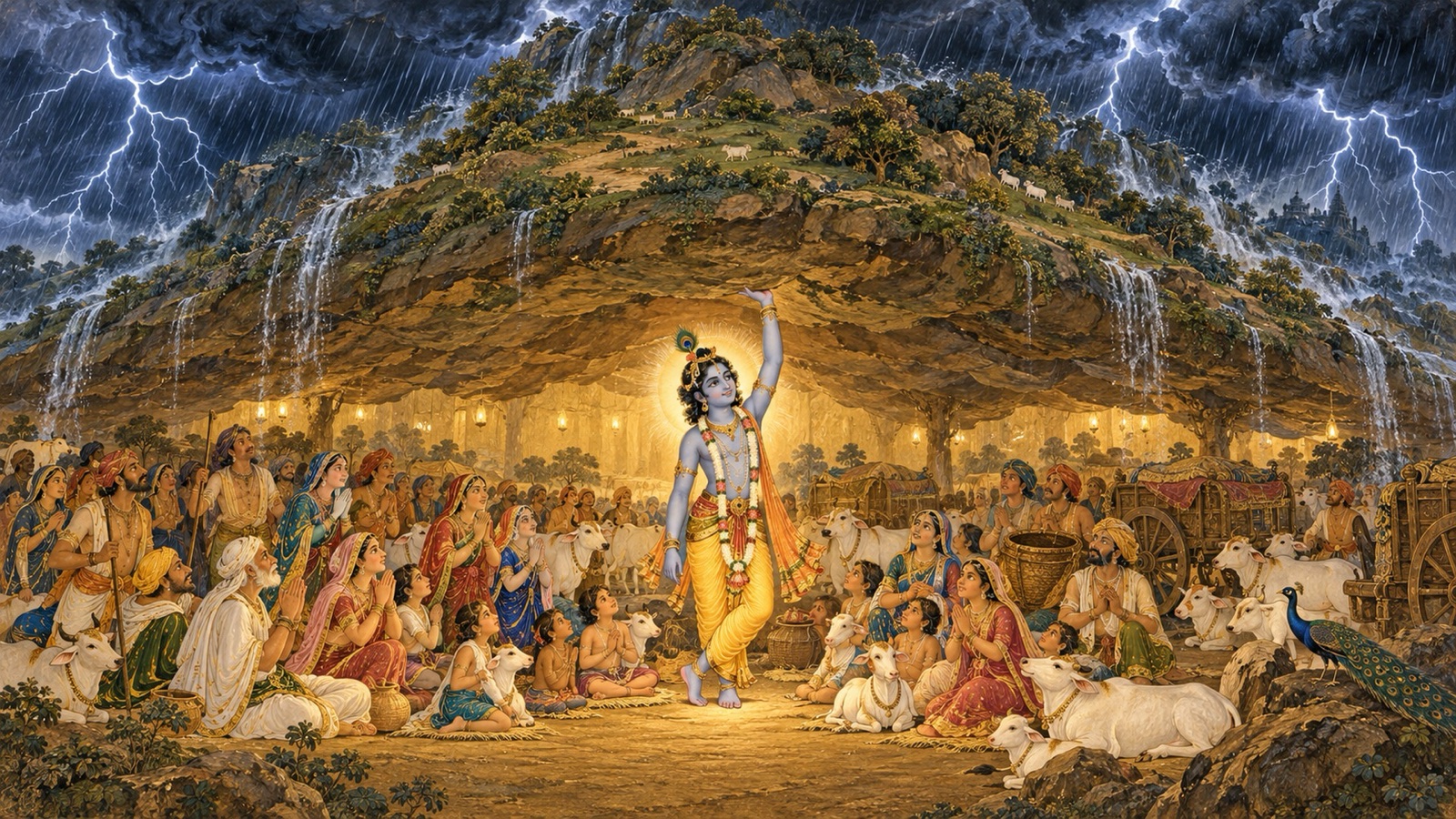
Stung in his pride, Indra looses the clouds of universal dissolution upon Vraja — and the Lord raises Mount Govardhana on a single hand, standing unmoved for seven days over every cowherd, child and cow who has run to Him for shelter.
Om Namo Bhagavate Vasudevaya.
Om Namo Bhagavate Vasudevaya.
Om Namo Bhagavate Vasudevaya.
Welcome back to Srimad Bhagavatam Wisdom, our devotional journey through the sacred histories and teachings of the Srimad Bhagavat Mahapurana. In this twenty-fifth chapter of the Tenth Canto, the king of heaven, furious that his sacrifice has been set aside, commands the Samvartaka clouds to drown Nanda’s Vraja; the shivering cowherds take refuge at Krishna’s feet; and the Lord lifts the great hill as lightly as a child plucks a mushroom, holding it over His people until Indra’s pride is gone and the sun shines again.
Chapter Information
- Scripture: Śrīmad Bhāgavata Mahāpurāṇa
- Canto: 10 (Book Ten, First Half)
- Chapter: 25 (Discourse 25)
- Chapter title: Lord Krishna Lifts Govardhana Hill
- Principal speaker: Sukadeva Gosvami (narrating to King Parikshit); within the narration, Indra and Sri Krishna speak
- Principal listener: King Parikshit
- Main setting: Nanda’s Vraja (Gokula) and Mount Govardhana in Vrindavana
- Central subject: Indra’s anger at the loss of his worship; the storm of the Samvartaka clouds; Vraja’s surrender to Krishna; the lifting of Govardhana and the seven days beneath it; the humbling of Indra; the rejoicing of Vraja and the gods
- Principal verse range: Canto 10, Chapter 25, verses 1–33
- Primary edition: Gita Press Śrīmad Bhāgavata Mahāpurāṇa (English, Book Ten)
Context From the Previous Chapter
In Chapter 24, Krishna gently persuaded Nanda and the cowherds to set aside their yearly sacrifice to Indra and to worship instead Mount Govardhana, the cows and the brahmanas. Receiving their offerings in a vast and wondrous form, He Himself declared, “I am the mountain,” and the people of Vraja went home having bowed to the hill. What Indra did when he learned of this is the story of the present chapter.
Indra’s Wounded Pride
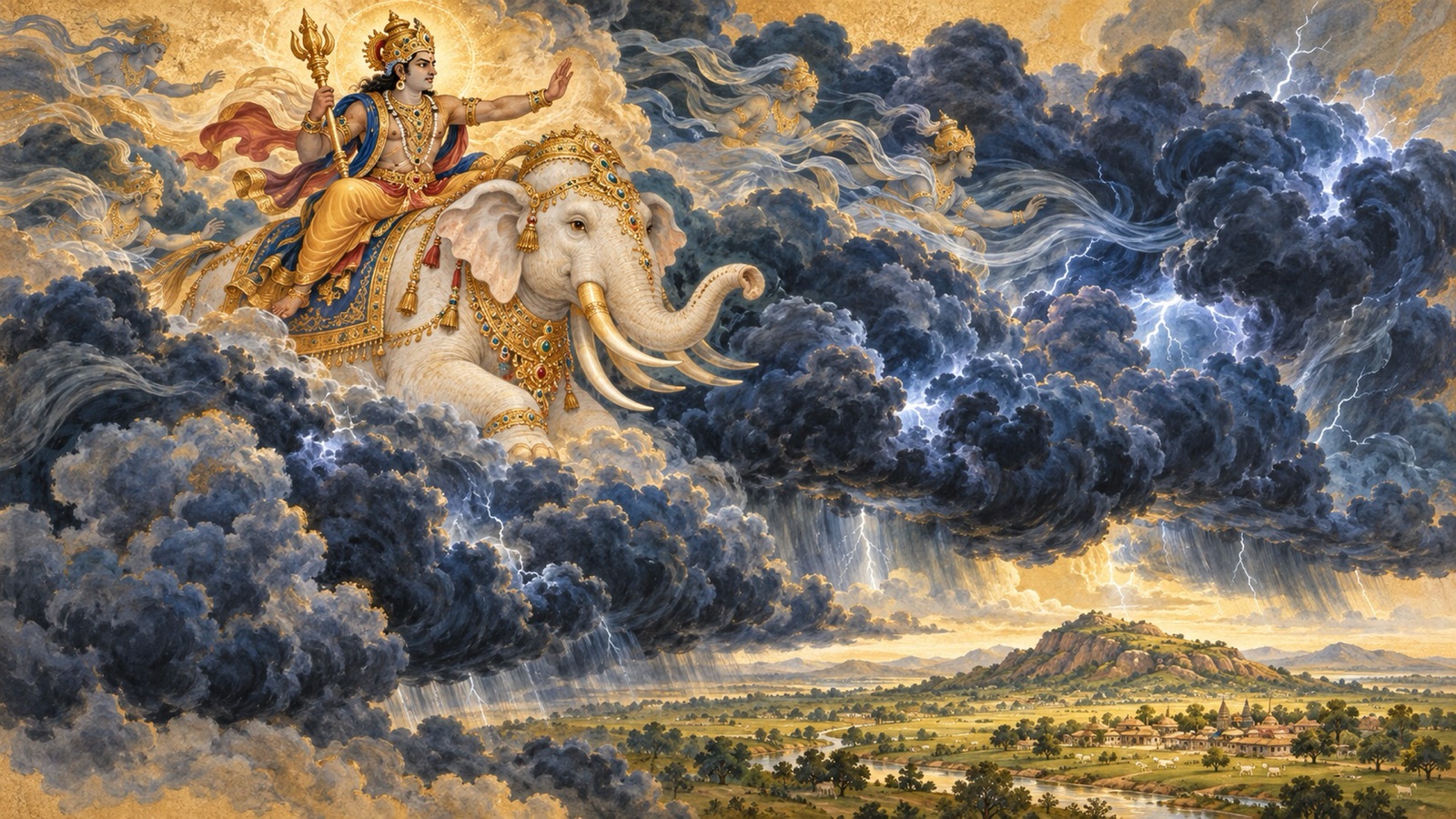
Sukadeva continued his narration. When Indra came to know that his worship had been stopped, he burned with anger against Nanda and the other cowherds, who looked upon Krishna as their protector. Regarding himself as the supreme ruler of all, the indignant king of heaven summoned the host of clouds called Samvartaka — the clouds that bring about the dissolution of the universe and are otherwise held in check until the end of an age — and gave them his command. His first words were not of strategy but of contempt.
अहो श्रीमदमाहात्म्यं गोपानां काननौकसाम् ।
कृष्णं मर्त्यमुपाश्रित्य ये चक्रुर्देवहेलनम् ॥ ३ ॥
aho śrī-mada-māhātmyaṁ gopānāṁ kānanaukasām kṛṣṇaṁ martyam upāśritya ye cakrur deva-helanam
Meaning: “Oh, how great is the pride born of wealth among these forest-dwelling cowherds! Relying on Krishna, a mere mortal, they have dared to offend a god.” (Canto 10, Chapter 25, verse 3)
“Like men wedded to ritual,” Indra went on, “who abandon the knowledge of the Self and try to cross the ocean of worldly existence in sacrifices that are boats in name alone, these cowherds have given offence to me by taking shelter of Krishna — a talkative, childish, arrogant and ignorant mortal who fancies himself a great scholar. Shake the stiff pride of wealth out of these Gopas, swollen with prosperity and puffed up by Krishna, and drive their cattle to destruction. I myself will ride my elephant Airavata and follow close behind you to Vraja with the mighty wind-gods, intent on wiping out Nanda’s cowherd settlement.” (verses 4–7)
The Deluge Over Vraja
So commanded, and loosed from the bonds that had restrained them until the end of the world, the clouds fell upon Nanda’s Gokula and tormented it with driving rain of terrible force. Blazing with lightning, roaring with thunder and whipped onward by furious winds, they poured down hailstones. The torrents fell as thick as pillars, without pause, until the earth lay so flooded that no one could tell high ground from low. (verses 8–10)
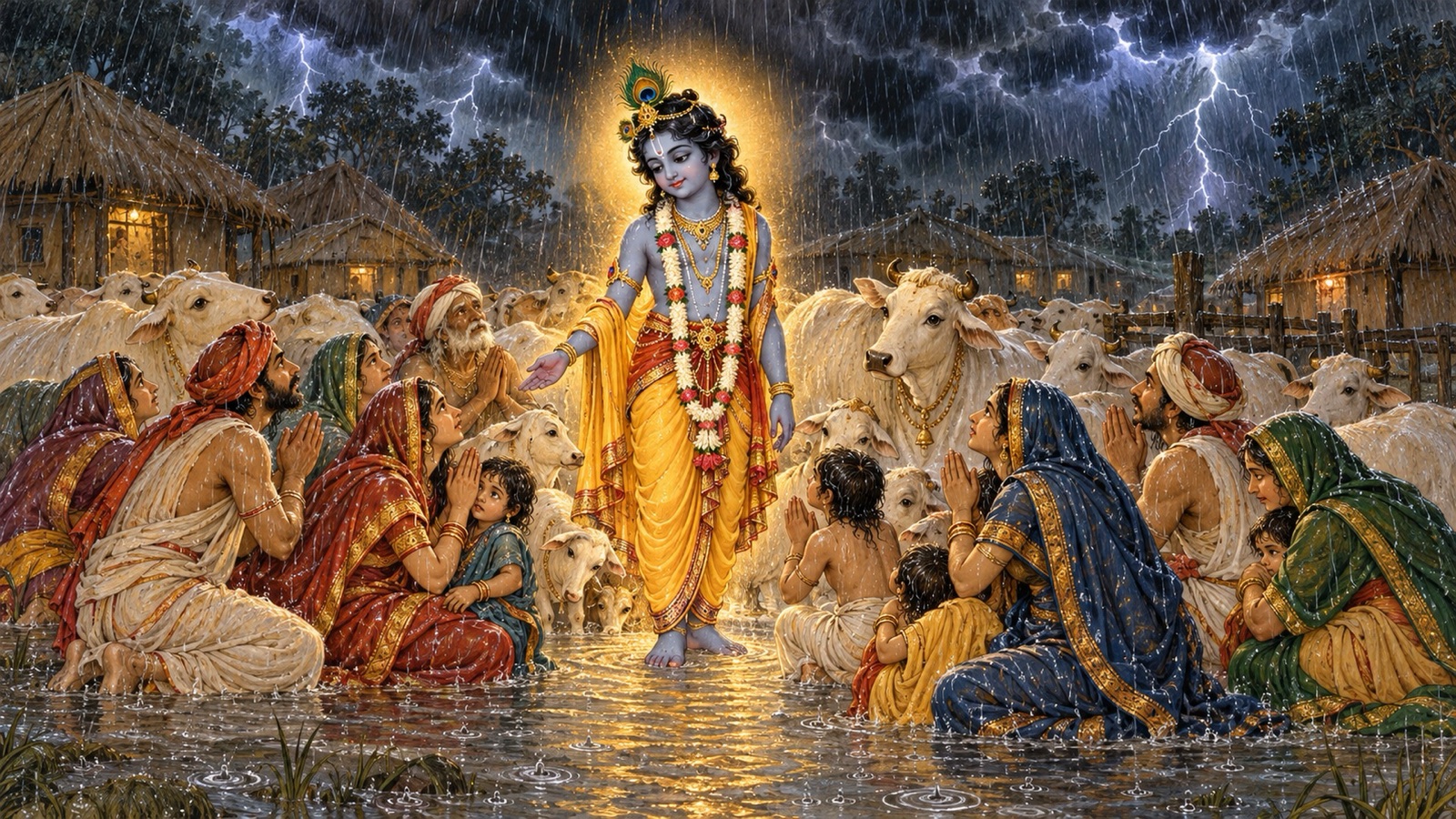
Shivering under the ceaseless rain and gale and stricken with cold, the cows, the cowherd men and the cowherd women had nowhere left to turn — and so they turned to Govinda, the protector of cows, and made Him their refuge. Covering their heads and their children with their own bodies against the downpour, trembling, they came to the soles of the Lord’s feet and prayed. (verses 11–12)
कृष्ण कृष्ण महाभाग त्वन्नाथं गोकुलं प्रभो ।
त्रातुमर्हसि देवान्न: कुपिताद् भक्तवत्सल ॥ १३ ॥
kṛṣṇa kṛṣṇa mahā-bhāga tvan-nāthaṁ gokulaṁ prabho trātum arhasi devān naḥ kupitād bhakta-vatsala
Meaning: “O Krishna, Krishna, greatly blessed Lord! O You who are so tender toward Your devotees — Gokula has no master but You; be pleased to save the cows and ourselves from the wrath of the angered god.” (Canto 10, Chapter 25, verse 13)
The Lord’s Resolve
Seeing the animals beaten senseless by the hail and the storm, Sri Hari understood that this was the doing of the angry Indra. “Because we have obstructed his sacrifice,” He reflected, “Indra is sending this most violent, unseasonal storm of hail and wind for our destruction. I shall answer it fully by My own divine power, and I shall dispel the darkness of wealth-pride in these gods who, out of delusion, imagine themselves the lords of the world.” (verses 14–16)
न हि सद्भावयुक्तानां सुराणामीशविस्मय: ।
मत्तोऽसतां मानभङ्ग: प्रशमायोपकल्पते ॥ १७ ॥
na hi sad-bhāva-yuktānāṁ surāṇām īśa-vismayaḥ matto ’satāṁ māna-bhaṅgaḥ praśamāyopakalpate
Meaning: “Surely the conceit of being the supreme ruler has no place in the gods, who are endowed with goodness; and when the pride of the wicked is broken by Me, it leads to their peace.” (Canto 10, Chapter 25, verse 17)
तस्मान्मच्छरणं गोष्ठं मन्नाथं मत्परिग्रहम् ।
गोपाये स्वात्मयोगेन सोऽयं मे व्रत आहित: ॥ १८ ॥
tasmān mac-charaṇaṁ goṣṭhaṁ man-nāthaṁ mat-parigraham gopāye svātma-yogena so ’yaṁ me vrata āhitaḥ
Meaning: “Therefore, by My own divine power I shall protect this cowherd community, which has taken refuge in Me, which regards Me as its master and which is My own family — for this is the vow I have taken upon Myself.” (Canto 10, Chapter 25, verse 18)
Why did the Lord stop Indra’s sacrifice in the first place, and why does He now choose to meet the storm Himself rather than simply calm the sky? Indra and the gods are beings of goodness; the conceit of lordship has no rightful home in them, and the pride that worship and wealth have bred in Indra is a darkness that must be lifted for his own sake. The humbling that comes from the Lord’s hand is not vengeance but medicine, and He says plainly that it brings the proud to peace. On the other side stand the people of Vraja, who have no shelter but Him, who look to Him as their master, and whom He calls His own household. To break the arrogance of the mighty and to honour His promise to the surrendered are, for Krishna, one undivided act of grace — the same hand that is about to hold the mountain chastens Indra and shields the cowherds in a single gesture.
Govardhana Lifted
इत्युक्त्वैकेन हस्तेन कृत्वा गोवर्धनाचलम् ।
दधार लीलया विष्णुश्छत्राकमिव बालक: ॥ १९ ॥
ity uktvaikena hastena kṛtvā govardhanācalam dadhāra līlayā viṣṇuś chatrākam iva bālakaḥ
Meaning: Having spoken thus, the Lord uprooted Mount Govardhana with one hand and held it aloft in play, as easily as a small child holds up a mushroom. (Canto 10, Chapter 25, verse 19)
Then the Lord called to the cowherds, “O mother, O father, O people of Vraja! Come and settle yourselves comfortably in the hollow beneath this mountain, together with your cows. Have no fear that the hill will fall from My hand; and let there be an end to your dread of wind and rain, for your protection has already been arranged.” Their hearts reassured by Krishna’s words, they entered the cavern with their cattle, their carts and all their dependants, each finding a place as the space allowed. (verses 20–22)
Seven Days Beneath the Hill
क्षुत्तृड्व्यथां सुखापेक्षां हित्वा तैर्व्रजवासिभि: ।
वीक्ष्यमाणो दधाराद्रिं सप्ताहं नाचलत् पदात् ॥ २३ ॥
kṣut-tṛḍ-vyathāṁ sukhāpekṣāṁ hitvā tair vraja-vāsibhiḥ vīkṣyamāṇo dadhārādriṁ saptāhaṁ nācalat padāt
Meaning: Gazed upon by the people of Vraja, who had set aside the pangs of hunger and thirst and every thought of their own comfort, He held up the mountain for seven days and did not stir from where He stood. (Canto 10, Chapter 25, verse 23)
Those were days of a strange sweetness: the rain roared outside, yet beneath the hill no one remembered hunger or thirst, for every eye rested on the boy who held the mountain. Far above, Indra too was watching — and what he saw undid him.
कृष्णयोगानुभावं तं निशम्येन्द्रोऽतिविस्मित: ।
निस्तम्भो भ्रष्टसङ्कल्प: स्वान्मेघान् सन्न्यवारयत् ॥ २४ ॥
kṛṣṇa-yogānubhāvaṁ taṁ niśamyendro ’ti-vismitaḥ nistambho bhraṣṭa-saṅkalpaḥ svān meghān sannyavārayat
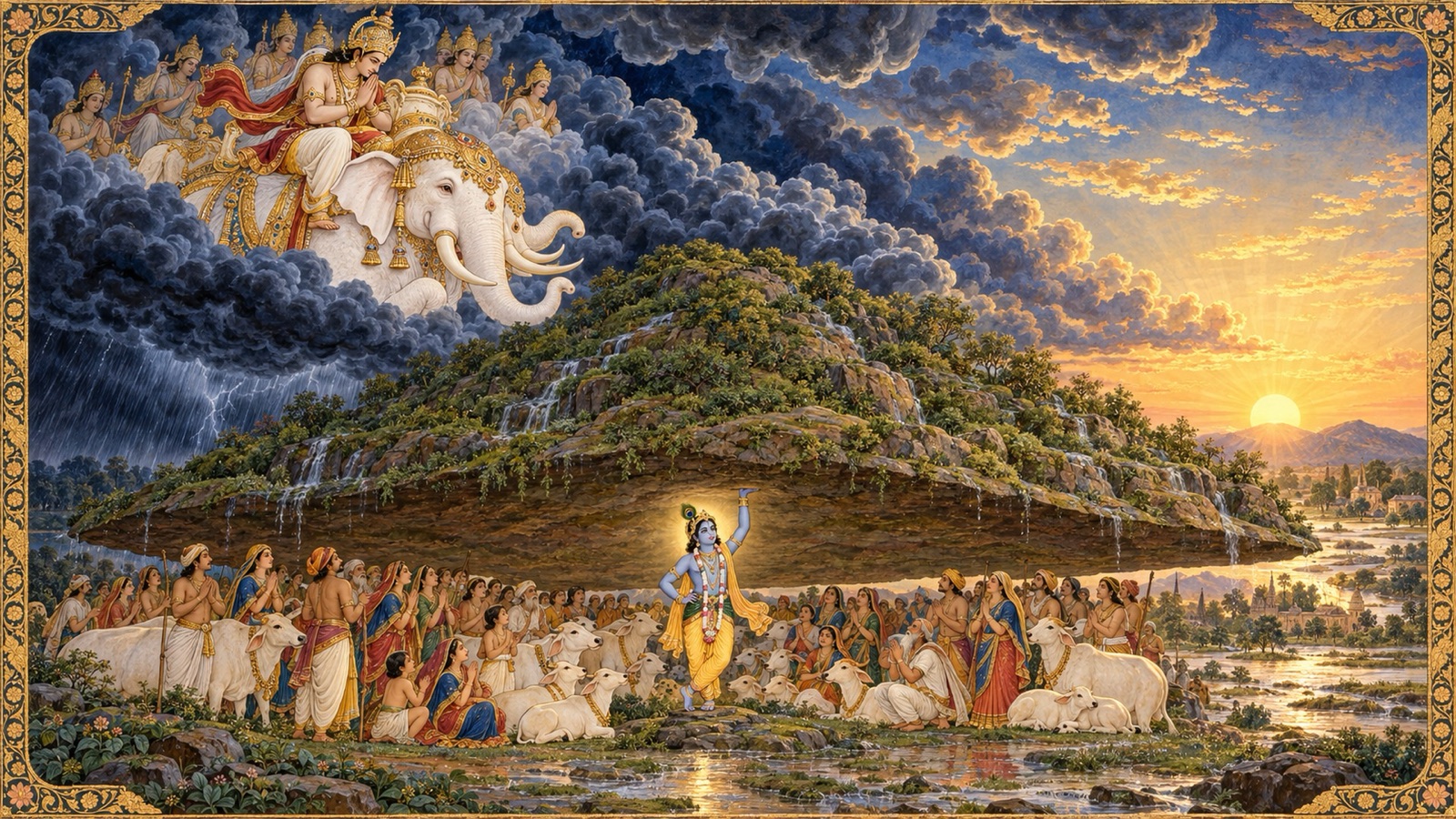
Meaning: Witnessing that manifestation of Krishna’s divine power, Indra was utterly astonished; shorn of his pride and thwarted in his design, he restrained his clouds. (Canto 10, Chapter 25, verse 24)
The Sky Clears and the Hill Is Set Down
Seeing the sky free of clouds, the sun risen, and the fierce wind and rain at an end, the bearer of Govardhana spoke to the cowherds: “Go out now, O Gopas, and cast off your fear, with your women, your wealth and your children. The storm has ceased, and the rivers have nearly returned to their beds.” Slowly the cowherds came forth, each gathering his own cattle, their goods loaded on their carts, the women, children and elders among them. And the almighty Lord, while every creature looked on in wonder, playfully set the mountain down in its own place, exactly as it had stood before. (verses 25–28)
The Love of Vraja and the Praise of the Gods
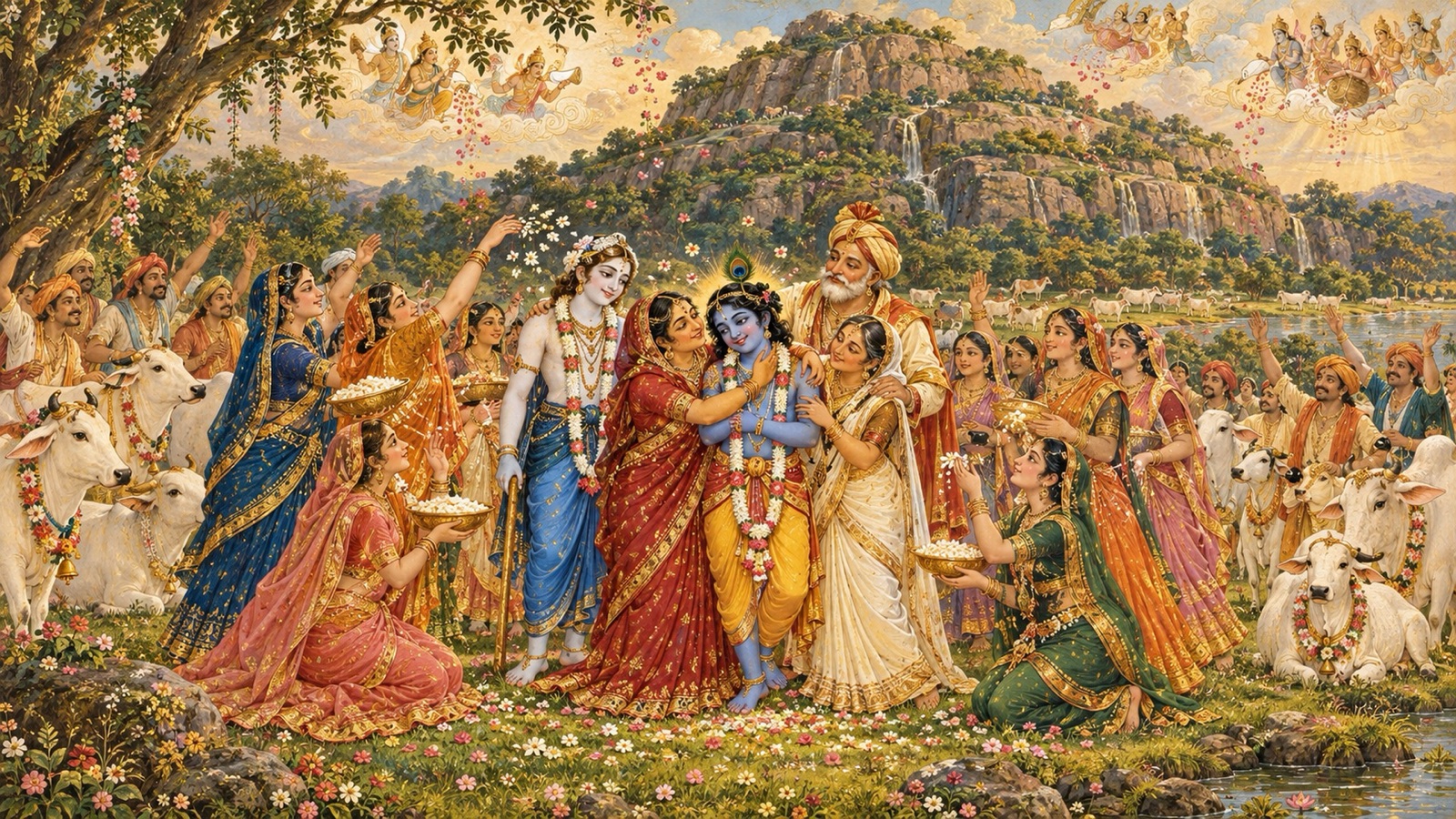
Then love overflowed its banks. The people of Vraja rushed to Him and embraced Him with every tender gesture of affection; the gopis, their hearts brimming, worshipped Him with sprinklings of curd and unbroken rice and poured out their choicest blessings upon Him. Yasoda, Rohini, Nanda and Balarama, the foremost of the strong, held Krishna close and blessed Him, undone by love. In the heavens the hosts of gods, the Siddhas, the Sadhyas, the Gandharvas and the Charanas glorified Him and rained down flowers; conchs and kettledrums resounded at the gods’ bidding, and the chief Gandharvas, led by Tumburu, sang. Then, O king, surrounded by His devoted cowherds and accompanied by Balarama, Sri Hari returned to Vraja, while the gopis went home full of joy, singing of these deeds of His that had captured their hearts. (verses 29–33)
Principal Teachings of This Chapter
1. Pride can blind even the gods. Indra, a god of goodness, looks at the Lord of the universe and sees only “a mere mortal” (verse 3). Wealth and honour, when they breed conceit, cloud even the vision of the highest beings.
2. In distress, the devotee runs to the Lord. The cowherds do not curse Indra or scheme to appease him; they shield their children with their bodies and go to Krishna’s feet (verse 13). Surrender is the devotee’s first response to danger, not the last.
3. The Lord’s chastisement is His mercy. Krishna declares that breaking the pride of the arrogant leads to their peace (verse 17). When the Lord humbles us, He is not punishing us but healing us of the delusion that we are the rulers of our world.
4. He protects those who have made Him their only shelter. The Lord calls Vraja His refuge-seekers, His dependants and His own family, and names their protection His solemn vow (verse 18). No one who leans on Him alone is ever abandoned.
5. The mightiest deeds of God are play. The hill rises as a child lifts a mushroom (verse 19), and it is set down again just as lightly. What is impossible for us is effortless lila for Him; our part is simply to trust.
6. Love forgets itself. For seven days the people of Vraja forgot hunger, thirst and comfort while they gazed on Krishna (verse 23). Where the heart is fixed on the Lord, the body’s demands fall silent.
A Devotional Reflection
What moves us most in this chapter is not the size of the mountain but the smallness of the hand beneath it. A boy of Vraja, barefoot in the mud, holds up a hill while the sky empties itself upon the world — and does so not with strain but with a smile, as a child shows off a mushroom he has found. Indra’s rage is answered not with a counter-blow but with shelter. The gods’ delusion is cured not by humiliation before a crowd but by a quiet week of rain in which a proud king slowly understands whom he has been fighting. And the cowherds, who could have fled or bargained, do the one thing that makes the whole miracle possible: they come to His feet. We too live beneath skies we cannot control, and Govardhana reminds us that the question is never whether the rain will come, but where we will stand when it does. Beneath His hand, hunger and thirst are forgotten, and even the storm becomes a reason to look at Him a little longer.
A Daily Devotional Practice
Today, whenever anxiety rises — about money, health or the opinion of others — pause and picture the hollow beneath Govardhana. Place yourself there with your family and your cares, and look up at the hand that holds the hill. Say inwardly the cowherds’ prayer: “Gokula has no master but You.” Let the worry remain if it must, but let it remain under His shelter rather than over your head. Close the moment by chanting gently: Om Namo Bhagavate Vasudevaya.
Conclusion
The twenty-fifth chapter of the Tenth Canto sets side by side the pride of heaven and the surrender of Vraja, and shows the Lord answering both with a single gesture. Indra’s dissolution-clouds are stilled not by force but by the sight of a hill held aloft for a week; the cowherds who sought Krishna’s feet are kept dry beneath it; and the god who called Him a mortal is left wondering and humbled, his conceit washed away for his own good. May we learn from the people of Vraja to make the Lord’s shelter our first thought in every storm, and from Indra to let Him gently break whatever pride stands between us and peace.
May the divine wisdom of Srimad Bhagavatam awaken pure devotion within our hearts.
Om Namo Bhagavate Vasudevaya.
Jay Shree Madhav.
References and Attribution
- Primary edition: Gita Press, Śrīmad Bhāgavata Mahāpurāṇa (English), Book Ten (First Half), Discourse 25.
- Series: Srimad Bhagavatam Wisdom · Biswa Sanatan Dharma Seva Trust.
- Presented following the spiritual guidance and recommendation of Pandit Dr. Shri Kashinath Mishra.
This is an original, faithful retelling in the writer’s own words, with brief quoted verses shown in Devanāgarī and transliteration and their meanings given as summaries. It is not a reproduction of any single publisher’s continuous translation or commentary. No affiliation with or endorsement by any publisher is implied.
Jay Shree Madhav