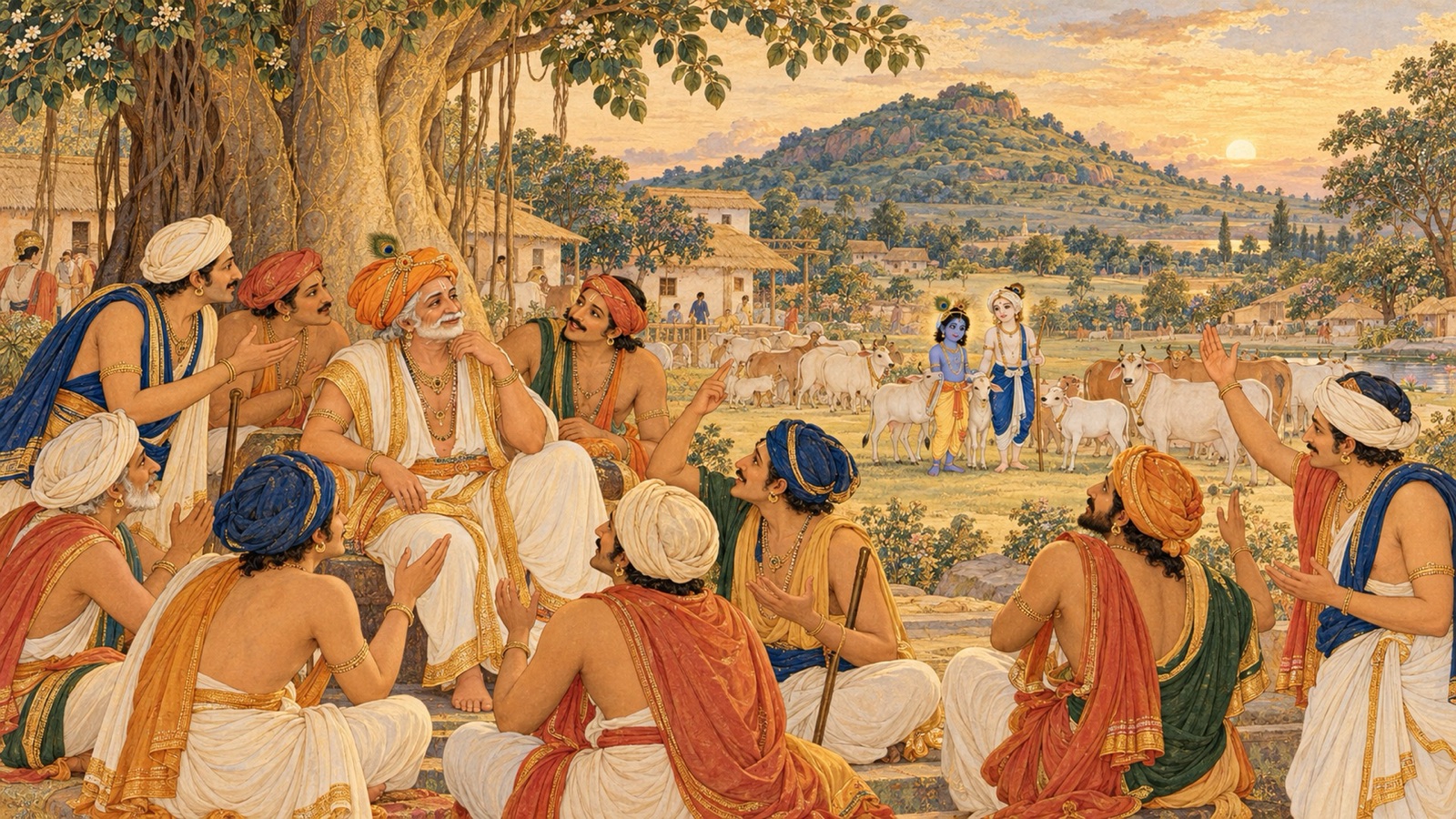
Still dazed from watching a seven-year-old hold up Govardhana for a week, the cowherd men of Vraja gather around Nanda and count his son’s wonders one by one — until Nanda repeats what the sage Garga once told him, and their bewilderment melts into joyful worship.
Om Namo Bhagavate Vasudevaya.
Om Namo Bhagavate Vasudevaya.
Om Namo Bhagavate Vasudevaya.
Welcome back to Srimad Bhagavatam Wisdom, our devotional journey through the sacred histories and teachings of the Srimad Bhagavat Mahapurana. The twenty-sixth chapter of the Tenth Canto is the quiet hour after the storm: the mountain rests again in its place, and the herdsmen of Vraja sit together to make sense of the boy who grew up in their lanes. Their question is answered not by guesswork but by the words of a sage, remembered by Nanda at the very moment they were needed.
Chapter Information
- Scripture: Śrīmad Bhāgavata Mahāpurāṇa
- Canto: 10 (Book Ten, First Half)
- Chapter: 26 (Discourse 26)
- Chapter title: Wonderful Krishna
- Principal speaker: Sukadeva Gosvami (narrating to King Parikshit); within the chapter, the cowherds of Vraja and Nanda Maharaja
- Principal listener: King Parikshit; within the chapter, Nanda and the cowherds
- Main setting: Vraja (Gokula), near Govardhana, in the days after the lifting of the mountain
- Central subject: The cowherds’ amazement at Krishna’s deeds, Nanda’s recollection of Garga’s prophecy, and the turning of astonishment into worship
- Principal verse range: Canto 10, Chapter 26, verses 1–25
- Primary edition: Gita Press Śrīmad Bhāgavata Mahāpurāṇa (English, Part II)
Context From the Previous Chapter
In Chapter 25, Indra, furious that his worship had been set aside, loosed the clouds of dissolution upon Vraja. Krishna lifted Govardhana with one hand and held it for seven days, sheltering every person and animal until the humbled Indra called off the storm. The people of Vraja embraced Him with overflowing affection, the gods rained flowers, and Krishna walked home with Balarama and the cowherds.
The Cowherds Gather in Wonder
Sukadeva continued his narration to King Parikshit. The cowherds had seen deed after deed from Krishna that no human child could perform, yet they knew nothing of His real power. Astonished, they came together and began to talk. If the acts of this mere boy were so utterly beyond nature, they asked, how could he deserve a birth among plain village folk like themselves — a birth that seemed so far beneath him? A child of seven had held up a great mountain on a single hand for a whole week, as easily as a lordly elephant lifts a lotus in its trunk.
य: सप्तहायनो बाल: करेणैकेन लीलया ।
कथं बिभ्रद् गिरिवरं पुष्करं गजराडिव ॥ ३ ॥
yaḥ sapta-hāyano bālaḥ kareṇaikena līlayā kathaṁ bibhrad giri-varaṁ puṣkaraṁ gaja-rāḍ iva
Meaning: How could a boy of seven years hold up the best of mountains with one hand, in play, as a lordly elephant holds a lotus? (Canto 10, Chapter 26, verse 3)
The Deeds They Remembered
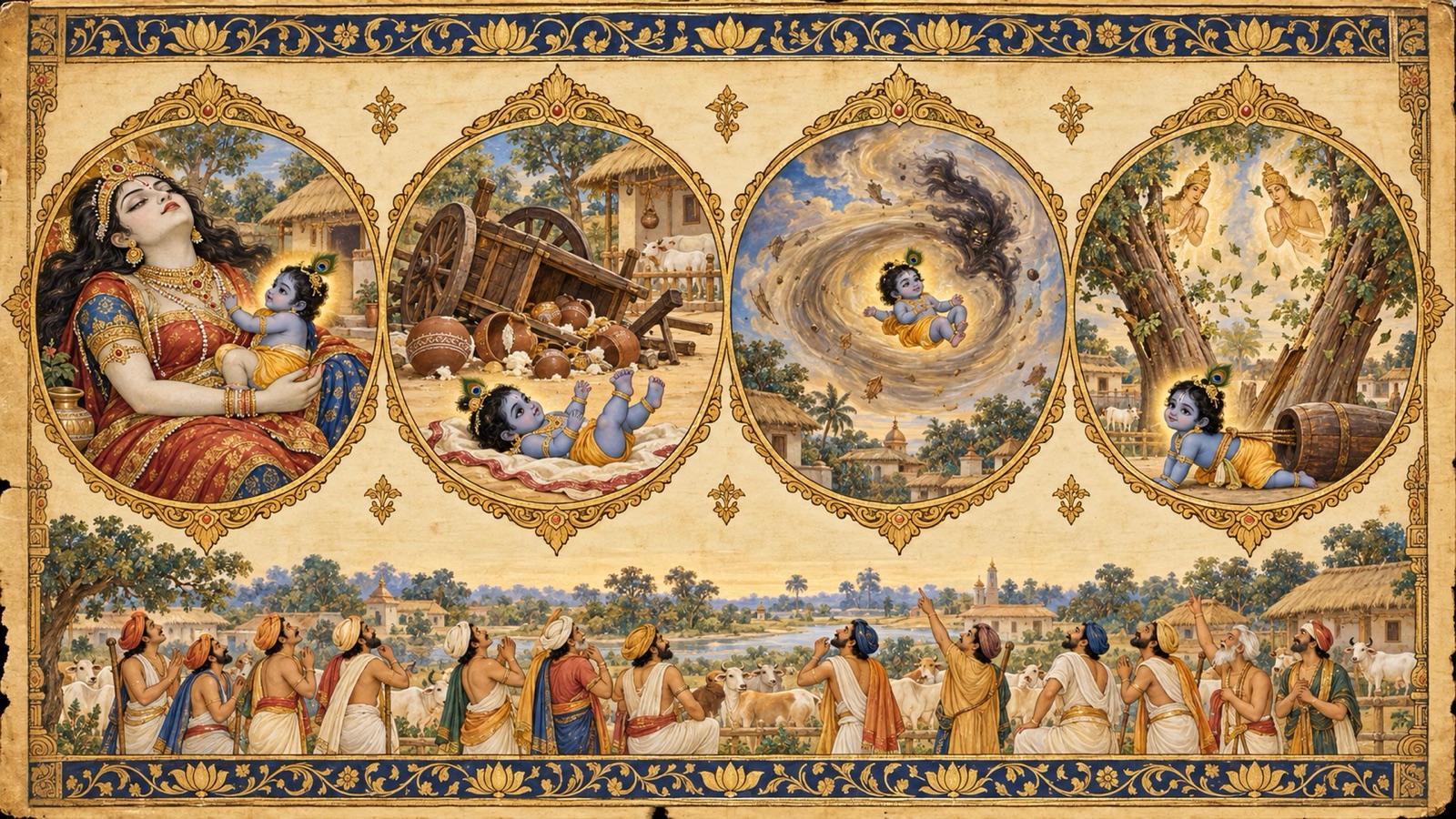
Their minds went back over everything they had witnessed. When He was a tiny babe with eyes half closed, the mighty Putana had put Him to her breast, and He had drawn out her very life along with the milk, as Time silently swallows the lifespan of every creature. At three months old, lying beneath a cart and crying, He had struck it with His kicking feet and sent it toppling over. At one year, seated on the ground, He had been carried off through the sky by the demon Trinavarta, and had killed him while the demon choked in the grip at his throat. And once, tied by His mother to a mortar for stealing butter, He had crawled between the two Arjuna trees and brought both crashing down with the strength of His arms.
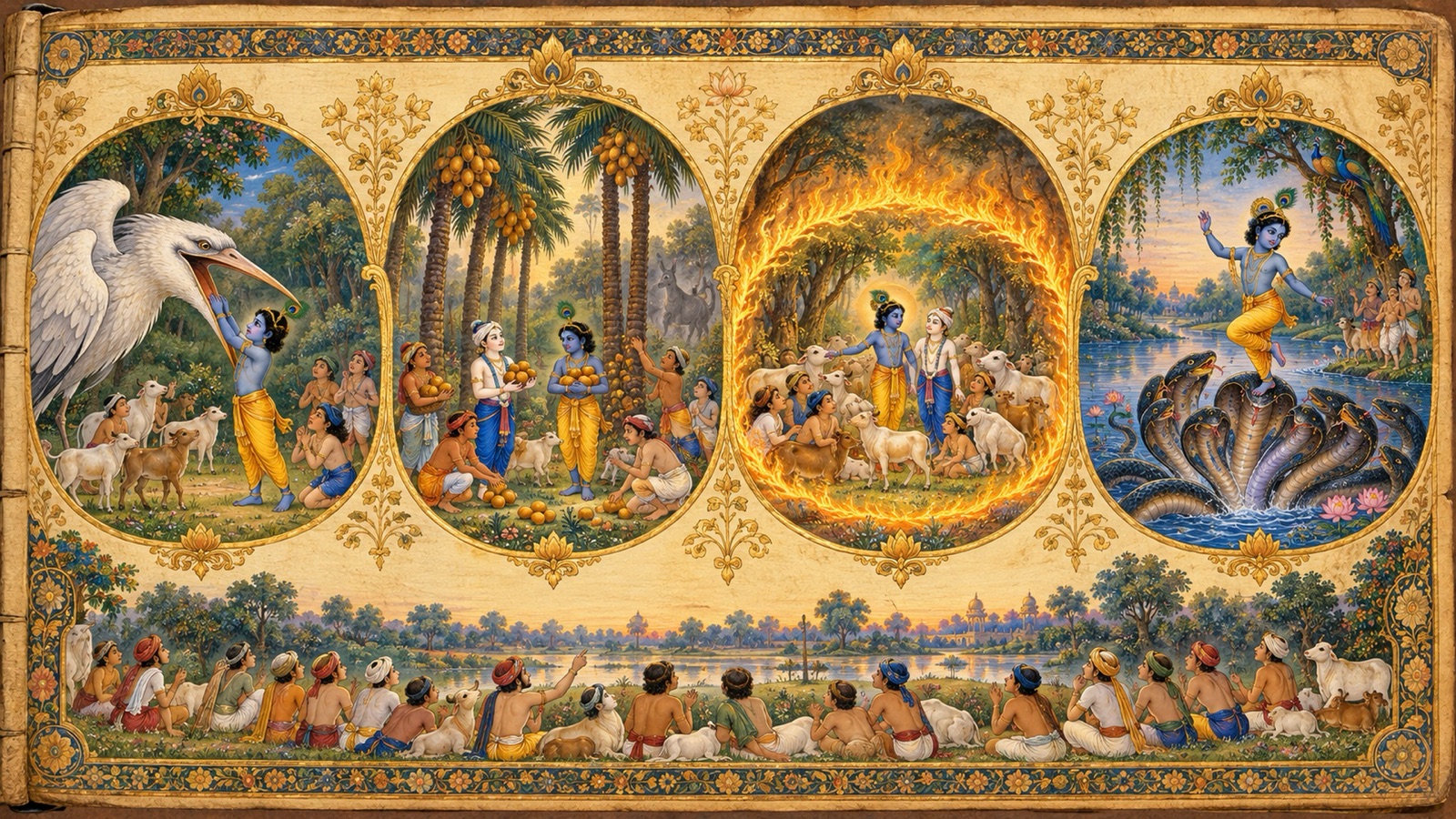
Nor had the marvels ended with infancy. Grazing the calves in the forest with Balarama and the other boys, He had torn apart by the beak the heron Baka, who came intending to kill Him. When another demon crept among the calves in the shape of a calf with the same intent, He had slain it and, in sport, used its body to knock down the Kapittha trees. With Balarama at His side He had destroyed the donkey-demon Dhenuka and all his kin and made the palm forest, heavy with ripe fruit, safe for everyone. He had the terrible Pralamba killed by the mighty Balarama, and had freed the cattle and herdsmen of Vraja from a forest fire. And He had subdued Kaliya, the most venomous of serpent-kings, stripped him of his arrogance, driven him from his pool, and left the waters of the Yamuna free of poison.
“How Can This Be?”
Then the cowherds turned to Nanda with the question beneath all the others. It was not only the deeds that puzzled them; it was the love. Every one of them, they said, felt an affection for this boy that could not be given up even if they tried, and the boy’s own fondness for them was just as natural, as though born with him. How could such a bond exist between a village of herdsmen and a child who did such things?
दुस्त्यजश्चानुरागोऽस्मिन् सर्वेषां नो व्रजौकसाम् ।
नन्द ते तनयेऽस्मासु तस्याप्यौत्पत्तिक: कथम् ॥ १३ ॥
dustyajaś cānurāgo ’smin sarveṣāṁ no vrajaukasām nanda te tanaye ’smāsu tasyāpy autpattikaḥ katham
Meaning: O Nanda, the love of all of us who dwell in Vraja for this son of yours cannot be given up, and his love for us too is natural and spontaneous — how can this be? (Canto 10, Chapter 26, verse 13)
A boy of seven on one side, they said, and the holding up of a mighty hill on the other — the two would not fit together in the mind. For this reason, they confessed to the lord of Vraja, a suspicion had arisen in them about his son: perhaps this child was not what he appeared to be.
Nanda Recalls the Words of Garga
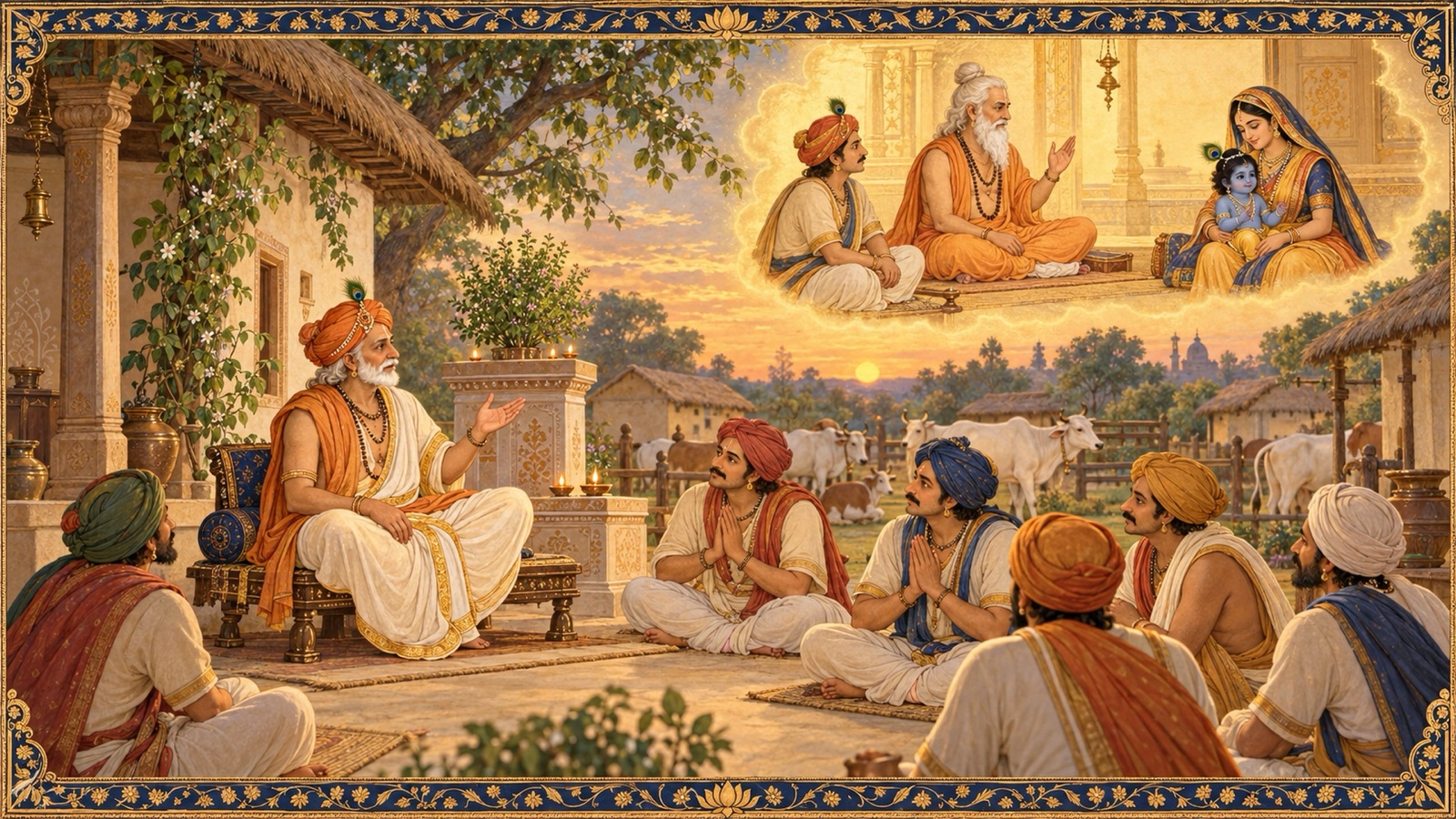
Nanda did not answer from his own imagination. “Hear my words, O cowherds,” he said, “and let your doubt about the child be gone. I will tell you exactly what the sage Garga said to me about this boy.”
Garga had told him that this child takes a body in every age, and in doing so had already shown three colours — white, red and yellow — and had in the present age taken on a dark complexion.
वर्णास्त्रय: किलास्यासन् गृह्णतोऽनुयुगं तनू: ।
शुक्लो रक्तस्तथा पीत इदानीं कृष्णतां गत: ॥ १६ ॥
varṇās trayaḥ kilāsyāsan gṛhṇato ’nu-yugaṁ tanūḥ śuklo raktas tathā pīta idānīṁ kṛṣṇatāṁ gataḥ
Meaning: Assuming bodies age after age, this child has indeed borne three colours — white, red and yellow; now he has taken on a dark hue. (Canto 10, Chapter 26, verse 16)
Garga had also said that in a former time this son of Nanda had been born in the house of Vasudeva, and that the wise who knew this truth would rightly call him the glorious Vāsudeva. The boy’s names and forms were many, the sage had said, each answering to his qualities and deeds; Garga himself knew them, while ordinary people did not.
The Promise of Protection
Then came the sage’s assurance for Vraja itself. This boy, Garga had said, is the delight of the cowherds and of all Gokula, and he will bring you lasting good; with his help you will cross every difficulty with ease. In an earlier age, O lord of Vraja, when there was no king and good people were harassed by robbers, it was he who protected and strengthened them until they prevailed. And whoever gives love to this boy, the sage had promised, stands under a shelter no enemy can breach.
य एतस्मिन् महाभागे प्रीतिं कुर्वन्ति मानवा: ।
नारयोऽभिभवन्त्येतान् विष्णुपक्षानिवासुरा: ॥ २१ ॥
ya etasmin mahā-bhāge prītiṁ kurvanti mānavāḥ nārayo ’bhibhavanty etān viṣṇu-pakṣān ivāsurāḥ
Meaning: Those blessed people who offer their love to this most fortunate boy are never overcome by enemies, just as demons cannot prevail against those on the side of Lord Vishnu. (Canto 10, Chapter 26, verse 21)
Garga had closed with the sentence that answered in advance every question the cowherds would one day ask: this son of yours, O Nanda, stands equal to Lord Narayana in excellences, in splendour, in fame and in glory — so let nothing he does surprise you.
तस्मान्नन्द कुमारोऽयं नारायणसमो गुणै: ।
श्रिया कीर्त्यानुभावेन तत्कर्मसु न विस्मय: ॥ २२ ॥
tasmān nanda kumāro ’yaṁ nārāyaṇa-samo guṇaiḥ śriyā kīrtyānubhāvena tat-karmasu na vismayaḥ
Meaning: Therefore, O Nanda, this child is the equal of Lord Narayana in qualities, splendour, fame and glory; there is nothing to wonder at in his deeds. (Canto 10, Chapter 26, verse 22)
Nanda’s Own Faith
Having passed on Garga’s words, Nanda added his own settled conviction. From the day the sage instructed him so plainly and went back to his hermitage, Nanda said, he had held Krishna, who again and again had lifted trouble from their heads, to be a part manifestation of Lord Narayana Himself.
इत्यद्धा मां समादिश्य गर्गे च स्वगृहं गते ।
मन्ये नारायणस्यांशं कृष्णमक्लिष्टकारिणम् ॥ २३ ॥
ity addhā māṁ samādiśya garge ca sva-gṛhaṁ gate manye nārāyaṇasyāṁśaṁ kṛṣṇam akliṣṭa-kāriṇam
Meaning: Having instructed me plainly in this way, Garga returned to his own home; and I regard Krishna, who frees us from every affliction, as a part manifestation of Lord Narayana. (Canto 10, Chapter 26, verse 23)
Wonder Turns to Worship
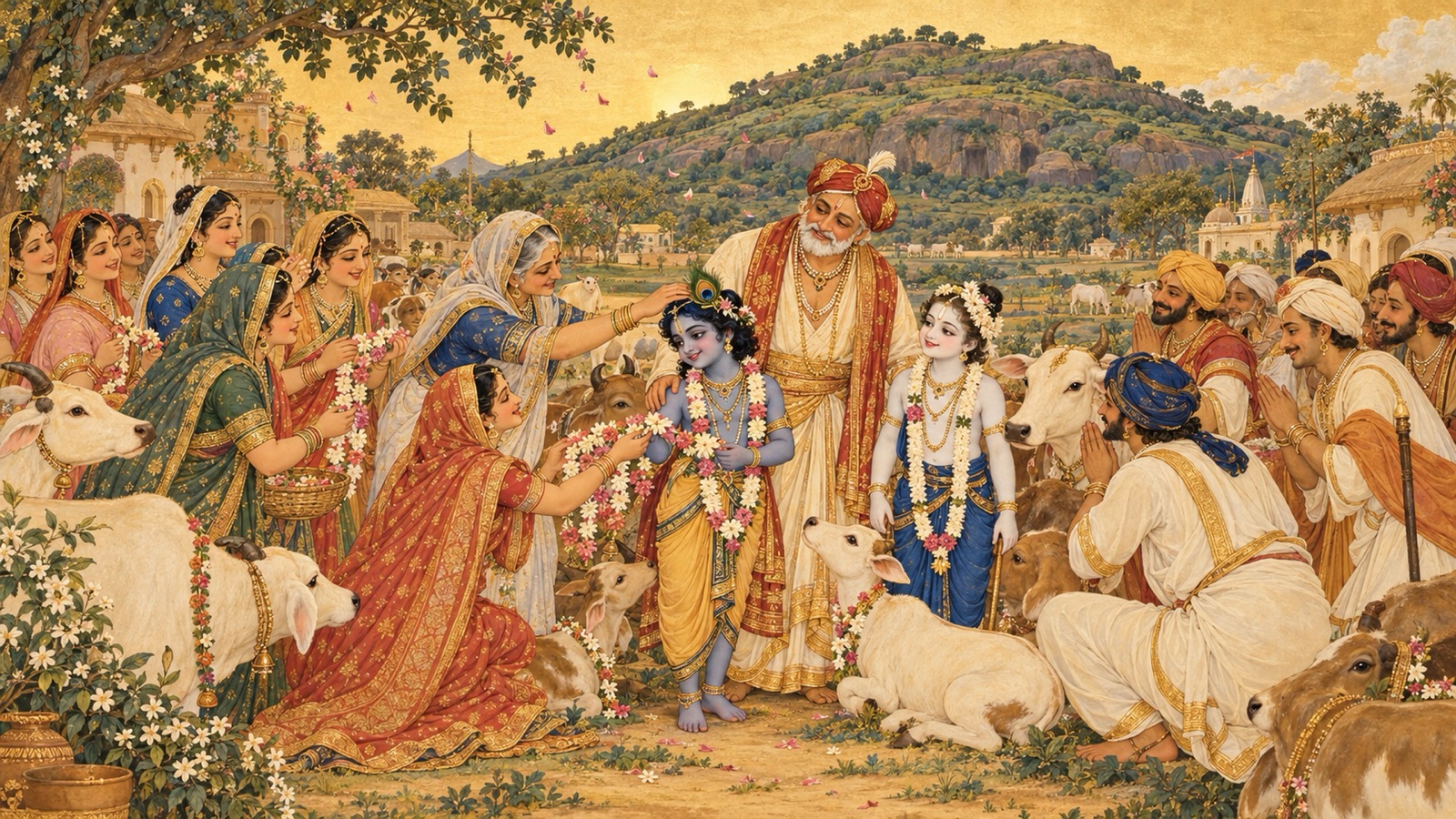
The people of Vraja had seen the glory of Krishna, whose energy has no limit, with their own eyes and had heard of it from others; now they heard Nanda repeat Garga’s song about Him. Their astonishment left them. Filled with joy, they honoured Nanda and they honoured Krishna, no longer as a riddle but as the treasure of Vraja whose greatness had at last been named for them.
The Closing Prayer to the Lifter of Govardhana
Sukadeva sealed the chapter with a benediction that gathers up the whole Govardhana pastime in a single breath of praise.
देवे वर्षति यज्ञविप्लवरुषा वज्राश्मवर्षानिलै:
सीदत्पालपशुस्त्रियात्मशरणं दृष्ट्वानुकम्प्युत्स्मयन् ।
उत्पाट्यैककरेण शैलमबलो लीलोच्छिलीन्ध्रं यथा
बिभ्रद् गोष्ठमपान्महेन्द्रमदभित् प्रीयान्न इन्द्रो गवाम् ॥ २५ ॥
deve varṣati yajña-viplava-ruṣā vajrāsma-varṣānilaiḥ sīdat-pāla-paśu-striy ātma-śaraṇaṁ dṛṣṭvānukampy utsmayan utpāṭyaika-kareṇa śailam abalo līlocchilīndhraṁ yathā bibhrad goṣṭham apān mahendra-mada-bhit prīyān na indro gavām
Meaning: When Indra, enraged at the disruption of his worship, poured down rain with thunderbolts, hail and fierce winds, Krishna saw the cowherds, the cattle and the women of Vraja in distress, depending on Him alone; moved with pity and smiling, He uprooted the mountain with one hand as a child pulls up a mushroom, held it high and protected the cowherd settlement, crushing the pride of mighty Indra. May that Krishna, the Lord of the cows, be pleased with us. (Canto 10, Chapter 26, verse 25)
Principal Teachings of This Chapter
1. Once we know who He is, His deeds cease to astonish. Garga’s conclusion (verse 22) is the heart of the chapter: a mountain on a child’s finger is unthinkable only while the child is taken for an ordinary boy. The cowherds’ amazement arose because they did not know His power, and it vanished the moment His identity was named. This is why the Lord arranged for the sage’s words to be spoken long before they were needed and remembered on the very day the herdsmen’s hearts could no longer hold their wonder. He wanted their love free of fear, yet without losing the intimacy of treating Him as Nanda’s son; so the answer came gently, through a trusted elder, and left their affection intact.
2. Doubt is settled by the words of the wise. Nanda does not reason out an answer; he repeats what he was told and adds what he himself has come to believe (verse 23). Hearing from a realized guide, and testing it against our own experience of the Lord’s protection, is how faith matures.
3. The love of Vraja is natural, not purchased by miracles. The herdsmen are as puzzled by their own affection as by the mountain (verse 13). Such devotion is spontaneous and impossible to abandon — a pointer toward the soul’s native relationship with Him.
4. Those who love Him are never defeated. Garga’s promise (verse 21) does not say that devotees will face no enemies; it says enemies will not overpower them. Shelter in the Lord guarantees final victory, not a life without trial.
5. The mountain was lifted by compassion. The closing prayer (verse 25) names the motive: He saw His people in distress and depending on Him alone, and He acted with pity and a smile. Divine power in the Bhagavatam always moves at the call of love.
A Devotional Reflection
There is something tender in a whole village sitting down to wonder about a child they had all carried on their shoulders. They had scolded Him for stealing butter and tied Him to a mortar; now they had watched Him hold up a hill. What moves us is that their puzzlement never turned into distance. They did not step back from Krishna; they drew closer to Nanda and asked, and when the answer came they honoured father and son together. The Lord allowed Himself to be loved as a neighbour’s boy, and allowed that love to be told, at the right moment, whose boy He really was. Perhaps this is how He deals with each of us: we live with Him for years as a familiar presence, half noticing His quiet rescues, until some Garga-like word reaches us and we realise who has been holding the mountain over our heads all along. May our discovery end as theirs did: astonishment gone, and worship begun.
A Daily Devotional Practice
Today, sit for a few minutes and count, as the cowherds did, the moments when you were quietly protected — the dangers that passed, the burdens lifted before you understood how. After each one, say softly, as Garga told Nanda, that there is nothing to wonder at in His deeds; then offer the day’s work into His hands. Begin by chanting gently: Om Namo Bhagavate Vasudevaya.
Conclusion
In this twenty-sixth chapter the people of Vraja move from bewilderment to faith. Their list of Krishna’s wonders ends in a question about love itself, and Nanda answers with Garga’s prophecy: this boy has appeared age after age, bears many names and forms, protects all who love him, and is equal to Narayana in every excellence. Their wonder dissolves into worship, and Sukadeva closes with a prayer to the compassionate Lifter of Govardhana. May we too learn that His mercies are no accident, and rest in Him without fear.
May the divine wisdom of Srimad Bhagavatam awaken pure devotion within our hearts.
Om Namo Bhagavate Vasudevaya.
Jay Shree Madhav.
References and Attribution
- Primary edition: Gita Press, Śrīmad Bhāgavata Mahāpurāṇa (English, Part II), Book Ten (First Half), Discourse 26, pages 215–217.
- Series: Srimad Bhagavatam Wisdom · Biswa Sanatan Dharma Seva Trust.
- Presented following the spiritual guidance and recommendation of Pandit Dr. Shri Kashinath Mishra.
This is an original, faithful retelling in the writer’s own words, with brief quoted verses shown in Devanāgarī and transliteration and their meanings given as summaries. It is not a reproduction of any single publisher’s continuous translation or commentary. No affiliation with or endorsement by any publisher is implied.
Jay Shree Madhav