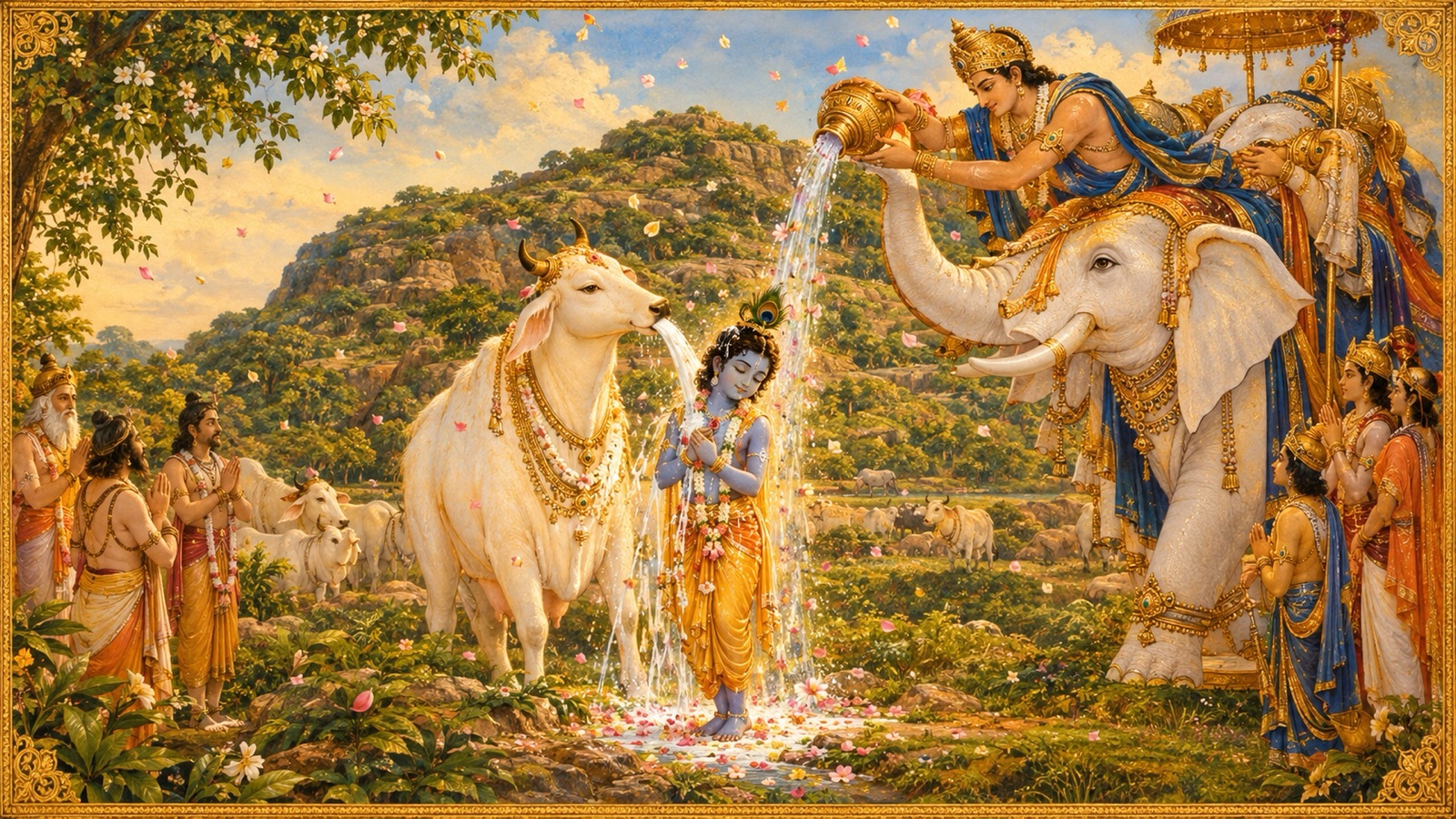
Bathed in the milk of the celestial cow of plenty and in Ganga water lifted from heaven by Airavata’s trunk, the cowherd boy of Vraja receives His dearest name.
Om Namo Bhagavate Vasudevaya.
Om Namo Bhagavate Vasudevaya.
Om Namo Bhagavate Vasudevaya.
Welcome back to Srimad Bhagavatam Wisdom, our devotional journey through the sacred histories and teachings of the Srimad Bhagavat Mahapurana. The storm over Govardhana has spent itself, and in this twenty-seventh chapter of the Tenth Canto two visitors come quietly to the boy who held up the hill — Indra, the humbled king of heaven, and Surabhi, the mother of cows.
Chapter Information
- Scripture: Śrīmad Bhāgavata Mahāpurāṇa
- Canto: 10 (Book Ten, First Half)
- Chapter: 27 (Discourse 27)
- Chapter title: Lord Indra and Mother Surabhi Offer Prayers
- Principal speaker: Sukadeva Gosvami (narrating to King Parikshit)
- Principal listener: King Parikshit
- Main setting: A secluded place near Mount Govardhana in Vraja
- Central subject: Indra’s repentance; the Lord’s teaching that He withdraws riches from one He wishes to bless; Surabhi’s prayer and the consecration of Krishna as Govinda
- Principal verse range: Canto 10, Chapter 27, verses 1–28
- Primary edition: Gita Press Śrīmad Bhāgavata Mahāpurāṇa (English)
Context From the Previous Chapter
In the previous discourse the cowherds of Vraja, astonished by what the child had done, asked Nanda who his son really was, and Nanda repeated the words the sage Garga had spoken long before — that this boy stands equal to Narayana in excellence and fame. Their bewilderment turned to worship. Now the god whose pride was crushed by that lifted hill comes to speak for himself.
Two Visitors Come Down to Govardhana
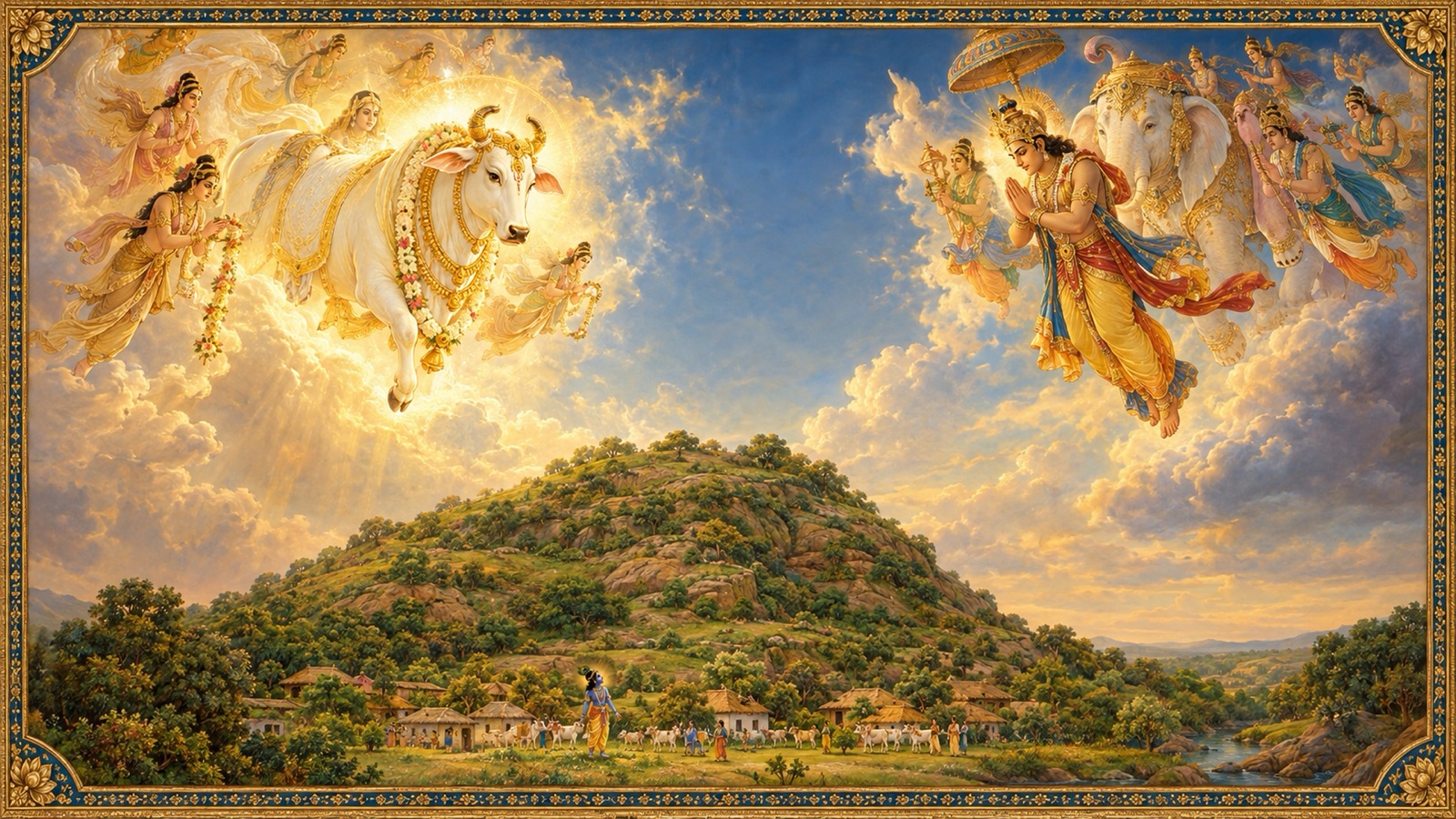
Sukadeva Gosvami took up the thread again for King Parikshit. The mountain had been held aloft, the downpour had failed, and Vraja stood unharmed beneath a clearing sky. Then two seekers set out toward one small boy from two different worlds: Surabhi, the celestial cow of plenty, came to Krishna from Goloka, the heavenly home of cows, and from his paradise came Indra, lord of rain (Canto 10, Chapter 27, verse 1).
The King of Heaven Lays His Crown at Krishna’s Feet
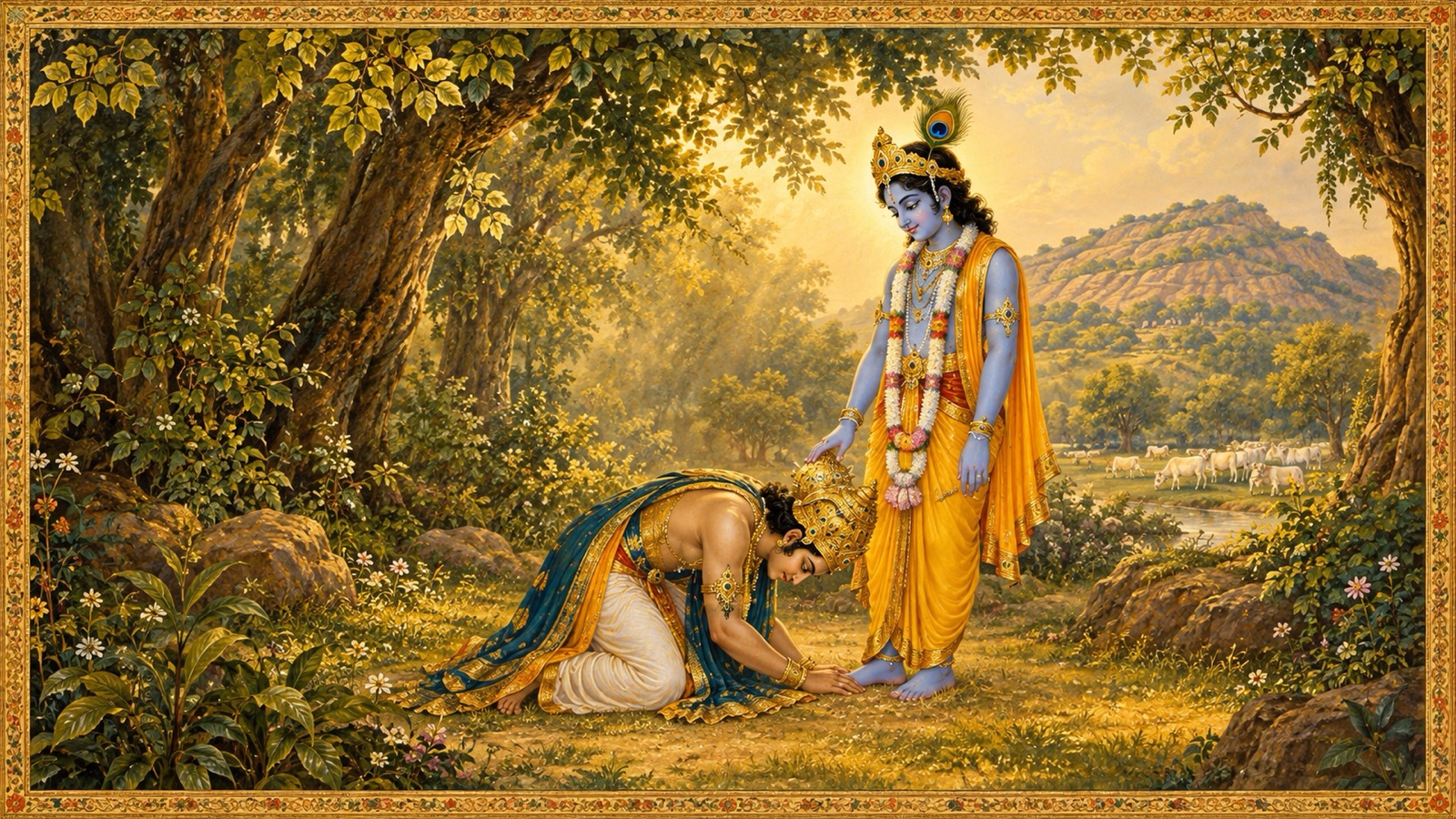
Indra did not arrive in state, with thunder and retinue. He arrived ashamed. He had treated the Lord with contempt and knew it, so he sought a solitary spot where none would see what he had come to do, and there he bent and touched Krishna’s feet with his diadem.
विविक्त उपसङ्गम्य व्रीडीत: कृतहेलन: ।
पस्पर्श पादयोरेनं किरीटेनार्कवर्चसा ॥ २ ॥
vivikta upasaṅgamya vrīḍītaḥ kṛta-helanaḥ pasparśa pādayor enaṁ kirīṭenārka-varcasā
Meaning: Ashamed of the slight he had offered, he approached the Lord in a place apart and touched His feet with his diadem, which shone with the splendour of the sun. (Canto 10, Chapter 27, verse 2)
He had heard of the greatness of this boy of measureless power, and now he had seen it. The conceit of ruling three worlds was gone from him, and with joined palms he began to speak (Canto 10, Chapter 27, verse 3).
Indra’s Prayer
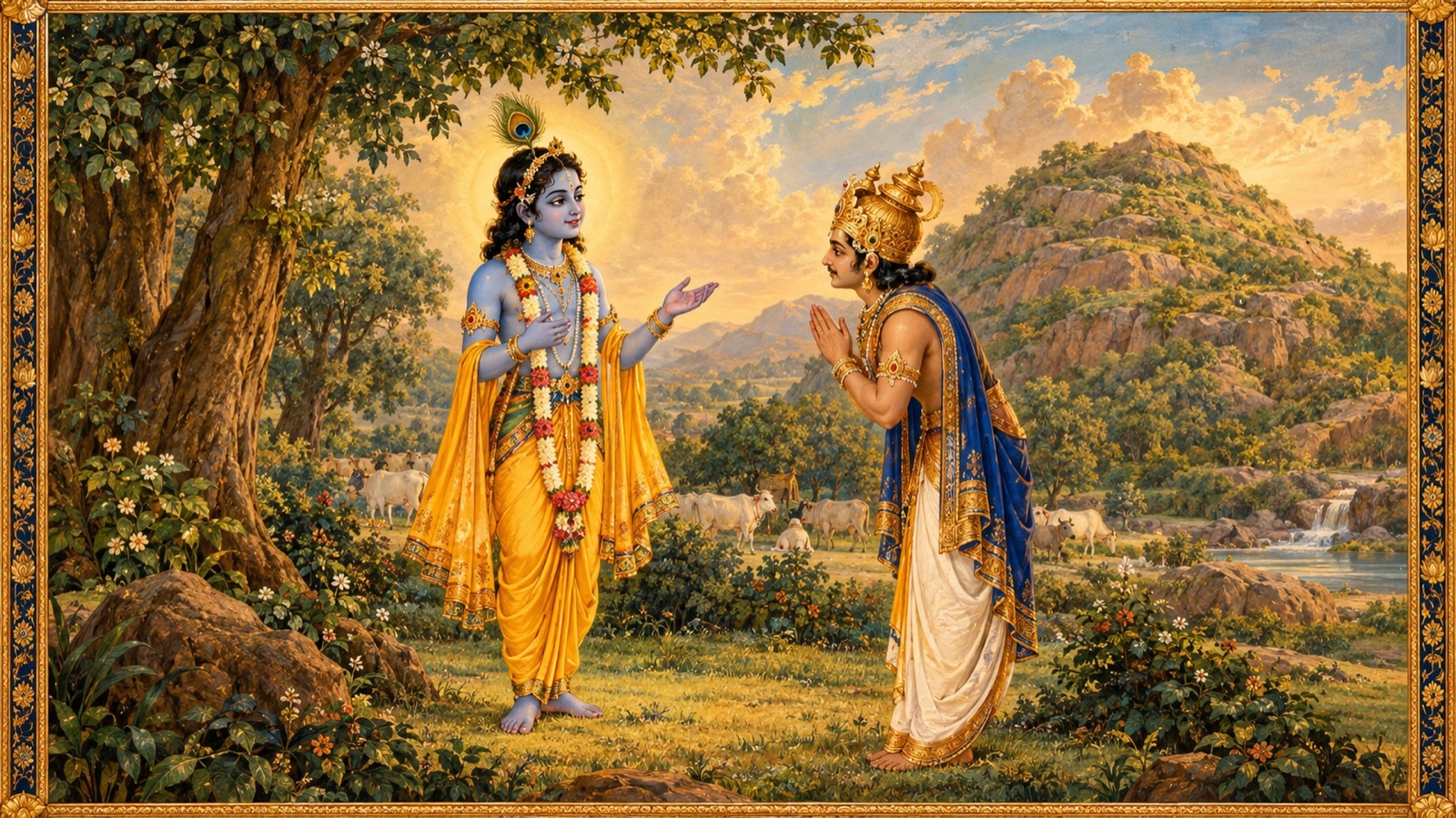
What the god of rain offers is not an excuse but a confession carried inside a hymn, and he begins where a chastened heart begins — with the nature of the One he has wronged. Your own being, he says, is unalloyed goodness, serene and luminous, with the restlessness of rajas and the dullness of tamas burnt away; this streaming world fashioned by maya, which lasts only so long as ignorance lasts, finds no foothold in You. How then could greed and its companions — marks of the unwise, born of taking the body for the self — be found in You? And yet the Lord does take up the rod of correction, to guard righteousness and hold the cruel in check (Canto 10, Chapter 27, verses 4–5).
You are the father of the worlds, Indra continues, their teacher and their sovereign; You are Time itself, whom none can overstep, Time with the staff of chastisement in hand. When You assume bodies at Your own pleasure, it is for the good of all — shaking the conceit out of those who fancy that they govern creation. Unknowing men like me behold You standing unafraid in the hour of terror, and our arrogance drops away; we take instead to the road the noble walk. Even for the wicked, what You do is instruction (Canto 10, Chapter 27, verses 6–7).
Then comes the plea. Drowned in the pride of lordship, blind to Your greatness, I have sinned against You; be pleased to pardon me, and let my mind never again be set so wickedly. And Indra names the purpose of the descent he has witnessed: the Lord has come to end the careers of those army commanders who burden this earth and breed yet more burdens, and to bless all who walk after His feet (Canto 10, Chapter 27, verses 8–9).
Twice over he bows: salutation to the Supreme Person, the great Soul, Vasudeva, Krishna, Lord of the Satvatas; salutation to Him who wears a body of His own choosing, whose form is untainted knowledge, who is the seed of everything and the Self seated in every being (Canto 10, Chapter 27, verses 10–11). Then he says plainly what he did: when my worship was interrupted, swollen with self-importance and burning with rage, I tried to destroy the cowherd settlement with torrents and gales (Canto 10, Chapter 27, verse 12). There, at the bottom of his own confession, his prayer finds its resting place.
त्वयेशानुगृहीतोऽस्मि ध्वस्तस्तम्भो वृथोद्यम: ।
ईश्वरं गुरुमात्मानं त्वामहं शरणं गत: ॥ १३ ॥
tvayeśānugṛhīto ’smi dhvasta-stambho vṛthodyamaḥ īśvaraṁ gurum ātmānaṁ tvām ahaṁ śaraṇaṁ gataḥ
Meaning: My stiffness is shattered and my exertion has come to nothing, and in this, O Lord, You have shown me favour. I have come for shelter to You, who are the supreme Ruler, the preceptor, and my own very Self. (Canto 10, Chapter 27, verse 13)
The Lord’s Answer — a Grace That Looked Like Loss
So glorified, Krishna laughed aloud with delight and answered heaven’s king in a voice deep as the rumbling of rain-clouds (Canto 10, Chapter 27, verse 14).
श्रीभगवानुवाच
मया तेऽकारि मघवन् मखभङ्गोऽनुगृह्णता ।
मदनुस्मृतये नित्यं मत्तस्येन्द्र श्रिया भृशम् ॥ १५ ॥
śrī-bhagavān uvāca mayā te ’kāri maghavan makha-bhaṅgo ’nugṛhṇatā mad-anusmṛtaye nityaṁ mattasyendra-śriyā bhṛśam
Meaning: It was I who brought about the stopping of your sacrifice, O Maghavan, and I did it out of kindness to you — so that you, deeply drunk on the fortune of Indra, might hold Me in mind without ceasing. (Canto 10, Chapter 27, verse 15)
मामैश्वर्यश्रीमदान्धो दण्डपाणिं न पश्यति ।
तं भ्रंशयामि सम्पद्भ्यो यस्य चेच्छाम्यनुग्रहम् ॥ १६ ॥
mām aiśvarya-śrī-madāndho daṇḍa pāṇiṁ na paśyati taṁ bhraṁśayāmi sampadbhyo yasya cecchāmy anugraham
Meaning: One whom the intoxication of power and riches has blinded does not notice Me standing with the rod in My hand. Whomever I desire to bless, him I bring down from his affluence. (Canto 10, Chapter 27, verse 16)
Here lies the heart of this chapter, and a teaching that reaches well past Indra. The ruin of the sacrifice was never punishment; the Lord Himself calls it an act of favour. Position and plenty had swelled so large in the eyes of heaven’s king that the One who stands before every creature with the rod of correction had become invisible to him — and whoever cannot see the Lord cannot remember Him either. So He took away the very thing that was blinding him. That is why Krishna says He strips of affluence the one He means to bless: the collapse that looks like disaster is the doorway through which remembrance walks back in.
Then He sent him home blessed: Go now, Indra, and may it be well with you; let My word be carried out; stay within the office that is yours, attentive to your work and empty of arrogance (Canto 10, Chapter 27, verse 17). The throne is not taken away. It is handed back, washed clean.
Mother Surabhi’s Prayer
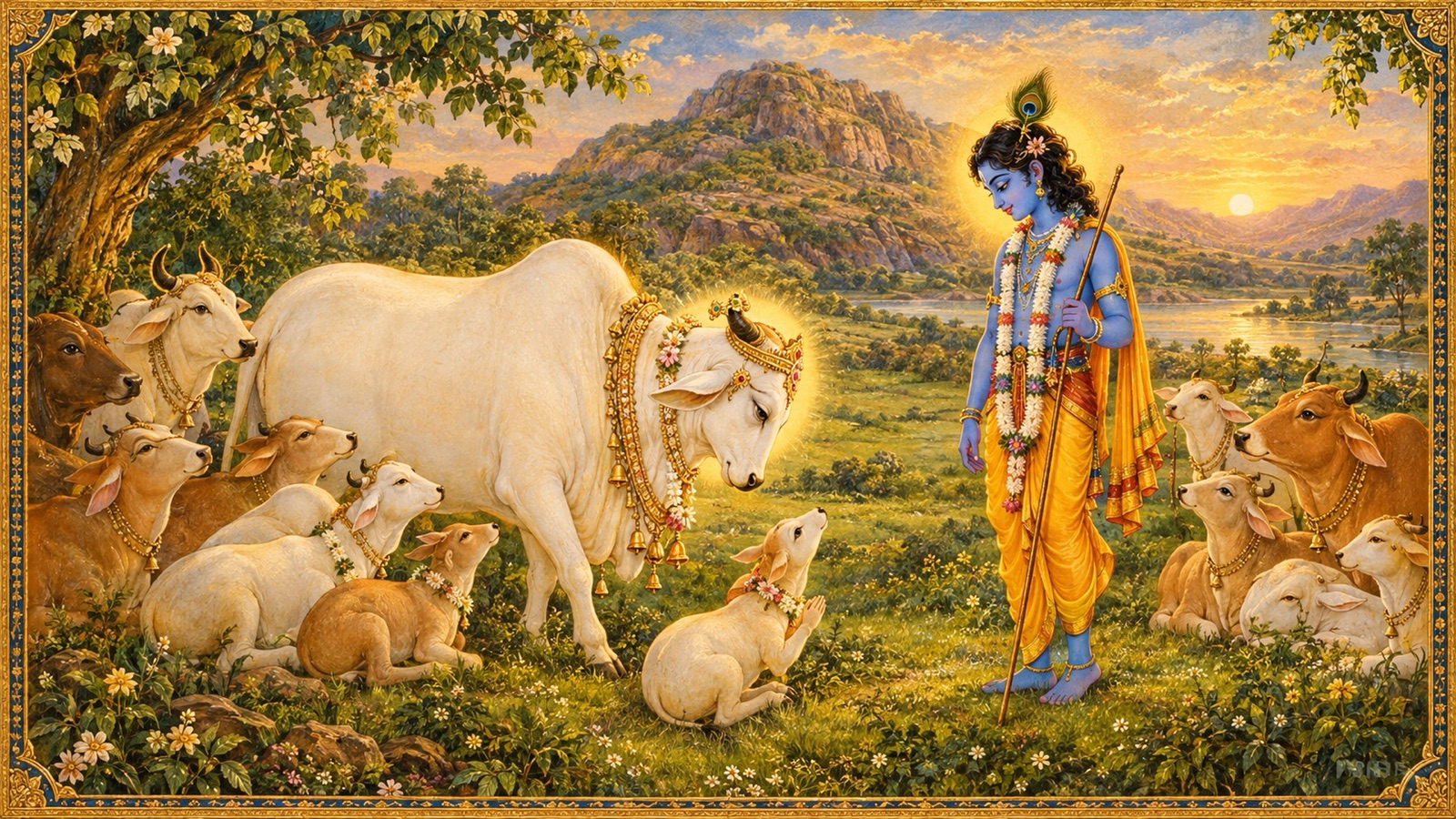
Now the noble-minded cow of plenty bowed before Krishna and, with her offspring about her, addressed the Ruler of all who stood there in the guise of a herd-boy (Canto 10, Chapter 27, verse 18). Krishna, Krishna, she said, great master of yoga, Soul of the universe and its origin — in You, guardian of the worlds, we who had no protector have found our own, O Achyuta (Canto 10, Chapter 27, verse 19).
त्वं न: परमकं दैवं त्वं न इन्द्रो जगत्पते ।
भवाय भव गोविप्रदेवानां ये च साधव: ॥ २० ॥
tvaṁ naḥ paramakaṁ daivaṁ tvaṁ na indro jagat-pate bhavāya bhava go-vipra devānāṁ ye ca sādhavaḥ
Meaning: You are our highest divinity; You, O Master of the universe, are our Indra. Be the well-being of the cows, the brahmanas, the gods, and of all those who are good. (Canto 10, Chapter 27, verse 20)
Then she asks for the thing that gives this discourse its name. Instructed by Brahma, she says, we have come to anoint You as our Indra, for You have descended, O Self of all, to lighten the load this earth has carried (Canto 10, Chapter 27, verse 21). The cows beg for neither rain nor pasture. They want the Lord Himself for their king.
Milk, Heavenly Water, and the Name Govinda
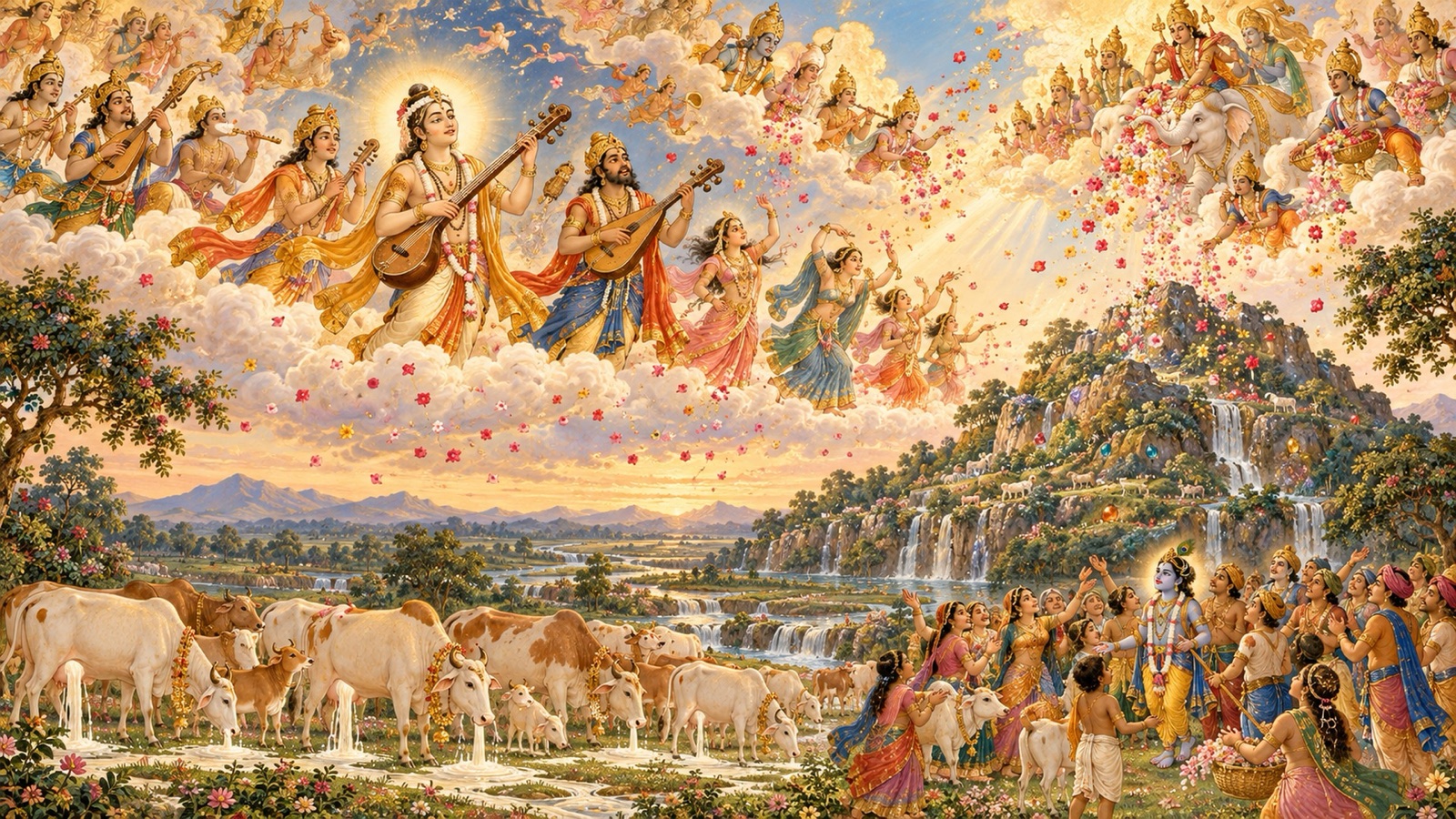
Having made her appeal, Surabhi bathed Him with the milk of her own udders. Indra too, urged on by Aditi and the other mothers of the gods and attended by the sages of heaven, bathed the scion of Dasharha with water of the sky-borne Ganga, raised up in the trunk of his elephant Airavata — and he gave Him a name.
एवं कृष्णमुपामन्त्र्य सुरभि: पयसात्मन: । जलैराकाशगङ्गाया ऐरावतकरोद्धृतै: ॥ २२ ॥
इन्द्र: सुरर्षिभि: साकं चोदितो देवमातृभि: । अभ्यसिञ्चत दाशार्हं गोविन्द इति चाभ्यधात् ॥ २३ ॥
evaṁ kṛṣṇam upāmantrya surabhiḥ payasātmanaḥ jalair ākāśa-gaṅgāyā airāvata-karoddhṛtaiḥ indraḥ surarṣibhiḥ sākaṁ codito deva-mātṛbhiḥ abhyasiñcata dāśārhaṁ govinda iti cābhyadhāt
Meaning: Having thus entreated Krishna, Surabhi anointed Him with her own milk; and Indra, prompted by the mothers of the gods and accompanied by celestial seers, anointed the descendant of Dasharha with heavenly Ganga water borne up in Airavata’s trunk, and addressed Him as Govinda. (Canto 10, Chapter 27, verses 22–23)
Heaven and Earth Rejoice
Tumburu, Narada and the others assembled there — gandharvas, vidyadharas, siddhas and charanas — sang the glory of Sri Hari that washes the stain from the worlds, while the women of heaven danced in delight. The foremost gods extolled Him and poured down showers of wonderful blossoms. All three worlds were filled with gladness, and the cows let their milk run until the ground was soaked (Canto 10, Chapter 27, verses 24–25).
The earth answered in kind. Rivers ran with sweet juices, trees dripped honey, herbs ripened where no plough had opened the soil, and the hills carried gems upon their slopes. And once Krishna was consecrated, Sukadeva told his listener, even beasts savage by nature laid their hostility down (Canto 10, Chapter 27, verses 26–27).
So the crowning was finished, and he who had come in shame went home in peace.
इति गोगोकुलपतिं गोविन्दमभिषिच्य स: ।
अनुज्ञातो ययौ शक्रो वृतो देवादिभिर्दिवम् ॥ २८ ॥
iti go-gokula-patiṁ govindam abhiṣicya saḥ anujñāto yayau śakro vṛto devādibhir divam
Meaning: Having in this way consecrated Govinda as master of the cows and of Gokula, and having obtained His leave, Indra went up to the celestial realm surrounded by the gods and the rest. (Canto 10, Chapter 27, verse 28)
Principal Teachings of This Chapter
1. True repentance moves the body, not only the tongue. Heaven’s king sends no messenger and composes no defence; he comes himself, and the first thing he sets down is his crown (verse 2). Where sorrow for a fault is real, it bends.
2. A broken pride is the beginning of shelter. Indra calls his own shattered stiffness a mercy, and takes refuge in the Lord as ruler, teacher and inmost Self (verse 13). What humbles us is not our undoing; it is our invitation.
3. What the Lord withdraws, He withdraws in kindness. He claims the stopping of the worship as His own gift, given so that remembrance of Him would become constant (verse 15).
4. Prosperity can hide the Lord from the one who enjoys it. Riches dazzle the eye until the One standing nearest is no longer seen (verse 16). Fortune is safe only in hands that remember whose it is.
5. The highest petition asks for the Giver. Surabhi could have sought abundance for her herds; instead she begs that He Himself become their sovereign (verse 20). Prayer reaches its summit when it stops asking for things.
6. The Lord treasures the love of the simplest creatures. Of all the titles heaven might have conferred, He keeps the one won at a cow’s bathing (verses 22–23), given by those with nothing to offer but milk.
A Devotional Reflection
There is something tender in the way this chapter arranges its two petitioners. One has everything — the three worlds, the rain, the thunderbolt — and must lose his sacrifice before he can see. The other has nothing to give but milk, and sees from the first. Between them stands a small boy with mud still on His feet, receiving both. We are usually more like Indra than like Surabhi. Our small sovereignties — competence, savings, good name — settle over the eyes so gently that we never notice the dimming. Then something is taken, we are frightened, and we call it misfortune. May we learn to recognize His mercy even when it arrives wearing the face of loss.
A Daily Devotional Practice
Today, bring to mind one thing you have lost — a position, a plan, a certainty — and rather than grieve over it, offer it at the Lord’s feet with the words Indra used: I have come for shelter to You. Then spend a few quiet minutes tending some living creature, remembering those whose love gave Him the name Govinda. Chant gently as you go: Om Namo Bhagavate Vasudevaya.
Conclusion
The twenty-seventh discourse of the Tenth Canto gathers up the Govardhana pastime and seals it with mercy. Heaven’s king, stripped of his conceit, lays his shining crown on a cowherd’s feet and learns that his humiliation was a blessing in disguise; the mother of cows, asking nothing for herself, begs that the Lord be her Indra. From her bathing of Him comes the sweetest of His names. May we hold fast to the lesson at its centre: whatever the Lord removes from our hands, He removes only to make room for Himself.
May the divine wisdom of Srimad Bhagavatam awaken pure devotion within our hearts.
Om Namo Bhagavate Vasudevaya.
Jay Shree Madhav.
References and Attribution
- Primary edition: Gita Press, Śrīmad Bhāgavata Mahāpurāṇa (English), Book Ten (First Half), Discourse 27.
- Series: Srimad Bhagavatam Wisdom · Biswa Sanatan Dharma Seva Trust.
- Presented following the spiritual guidance and recommendation of Pandit Dr. Shri Kashinath Mishra.
This is an original, faithful retelling in the writer’s own words, with brief quoted verses shown in Devanāgarī and transliteration and their meanings given as summaries. It is not a reproduction of any single publisher’s continuous translation or commentary. No affiliation with or endorsement by any publisher is implied.
Jay Shree Madhav