A father’s quiet vow on an Ekadashi night draws the Lord down beneath the waters — and what begins as a rescue ends with simple cowherds gazing upon the eternal realm that lies past all darkness.
Om Namo Bhagavate Vasudevaya.
Om Namo Bhagavate Vasudevaya.
Om Namo Bhagavate Vasudevaya.
Welcome back to Srimad Bhagavatam Wisdom, our devotional journey through the sacred histories and teachings of the Srimad Bhagavat Mahapurana. In this twenty-eighth chapter of the Tenth Canto, Sukadeva Gosvami tells King Parikshit how a servant of the lord of the waters seized Nanda during his sacred observance, and how Krishna Himself went down into that kingdom to bring His father home. A rescue then opens into a revelation, for the Lord grants the herdsmen of Vraja a vision that sages win only after long stillness.
Chapter Information
- Scripture: Śrīmad Bhāgavata Mahāpurāṇa
- Canto: 10 (Book Ten, First Half)
- Chapter: 28 (Discourse 28)
- Chapter title: Krishna Rescues Nanda Maharaja from the Abode of Varuna
- Principal speaker: Sukadeva Gosvami (narrating to King Parikshit)
- Principal listener: King Parikshit
- Main setting: The Kalindi (Yamuna) at Vraja, and the realm of Varuṇa beneath the waters
- Central subject: Nanda’s Ekadashi observance and his seizure by a servant of Varuṇa; Varuṇa’s worship of the Lord and his plea for pardon; and the revelation of the Lord’s own eternal realm to the cowherds
- Principal verse range: Canto 10, Chapter 28, verses 1–17
- Primary edition: Gita Press Śrīmad Bhāgavata Mahāpurāṇa (English)
Context From the Previous Chapter
In the twenty-seventh discourse, Indra came down humbled to Govardhana with the cow Surabhi; she bathed the Lord with her own milk and Indra with water of the celestial Ganga, and they crowned Him Govinda, ruler of the cows. Now the scene returns to the quiet riverside life of Vraja, where an old cowherd keeps a sacred vow in the dark hours before dawn.
A Father’s Vow on the Night of Ekadashi
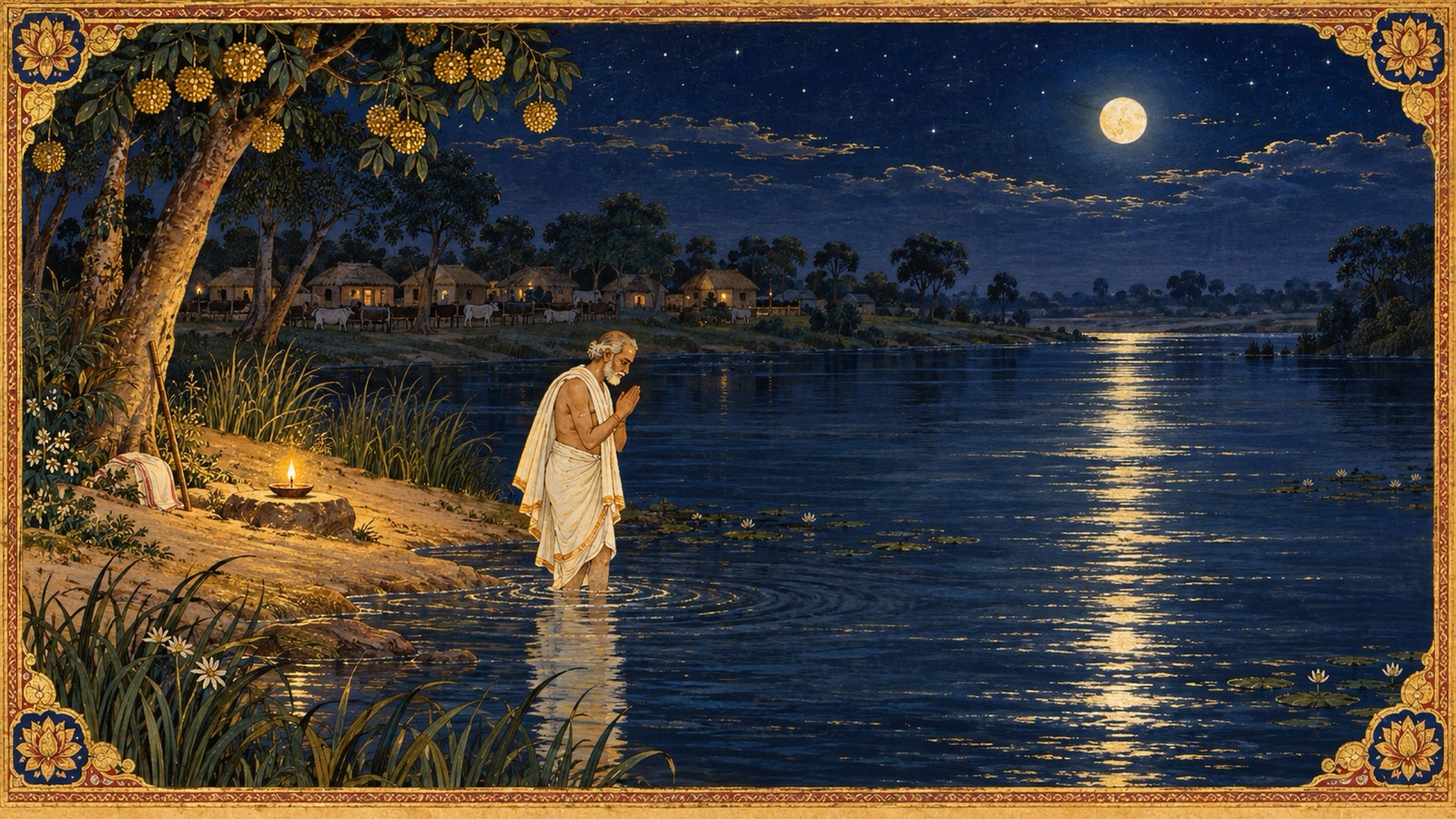
Nanda, the gentle chief of the cowherds, had passed the Ekadashi without food and had worshipped Lord Janardana, the Deity who presides over that sacred day. The twelfth day was approaching, and the vow had to be completed with a bath taken within its appointed hours. So in the last watch of that night, while Vraja slept, Nanda walked down to the Kalindi and stepped into her dark water.
एकादश्यां निराहार: समभ्यर्च्य जनार्दनम् ।
स्नातुं नन्दस्तु कालिन्द्यां द्वादश्यां जलमाविशत् ॥ १ ॥
ekādaśyāṁ nirāhāraḥ samabhyarcya janārdanam snātuṁ nandas tu kālindyāṁ dvādaśyāṁ jalam āviśat
Meaning: Having fasted on the Ekadashi and duly worshipped Lord Janardana, Nanda entered the water of the Kalindi in order to bathe within the hours of the Dwadashi. (Canto 10, Chapter 28, verse 1)
Carried Away to the Lord of the Waters
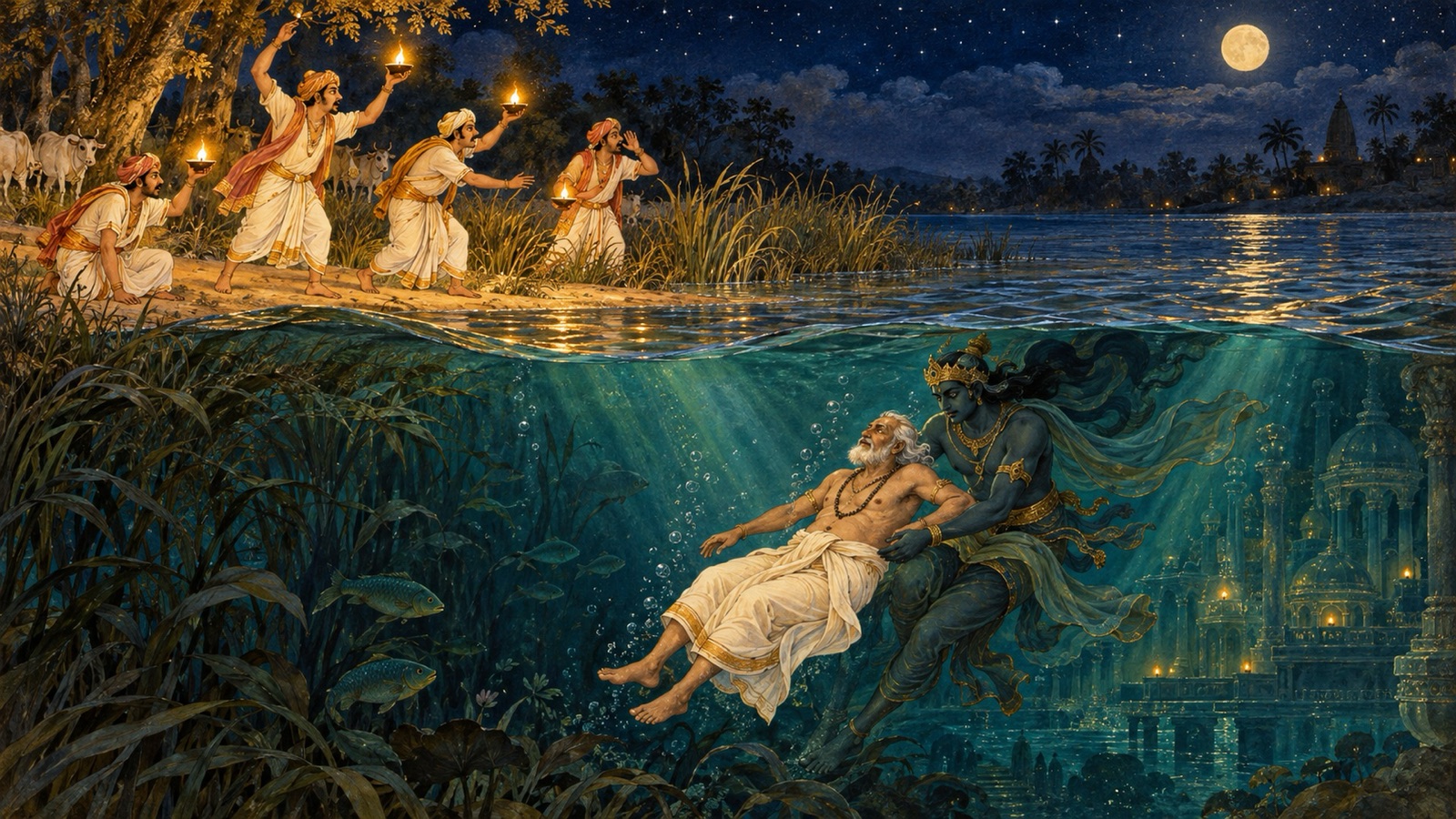
The night hours, however, are reserved for the movements of the demons, and a demon in the service of Varuṇa was watching. Taking the unwitting cowherd’s entry into the river as a trespass upon that hour, he laid hold of Nanda and bore him away to the presence of his own master beneath the waters.
On the bank the herdsmen searched and could not find him. Then their one cry went up into the dark — ‘O Rama! O Krishna!’ The Lord heard that call, and knowing at once that His father had been carried off to Varuṇa’s realm, He who gives fearlessness to His own went down to that door Himself.
Varuṇa Worships the Lord of the Senses
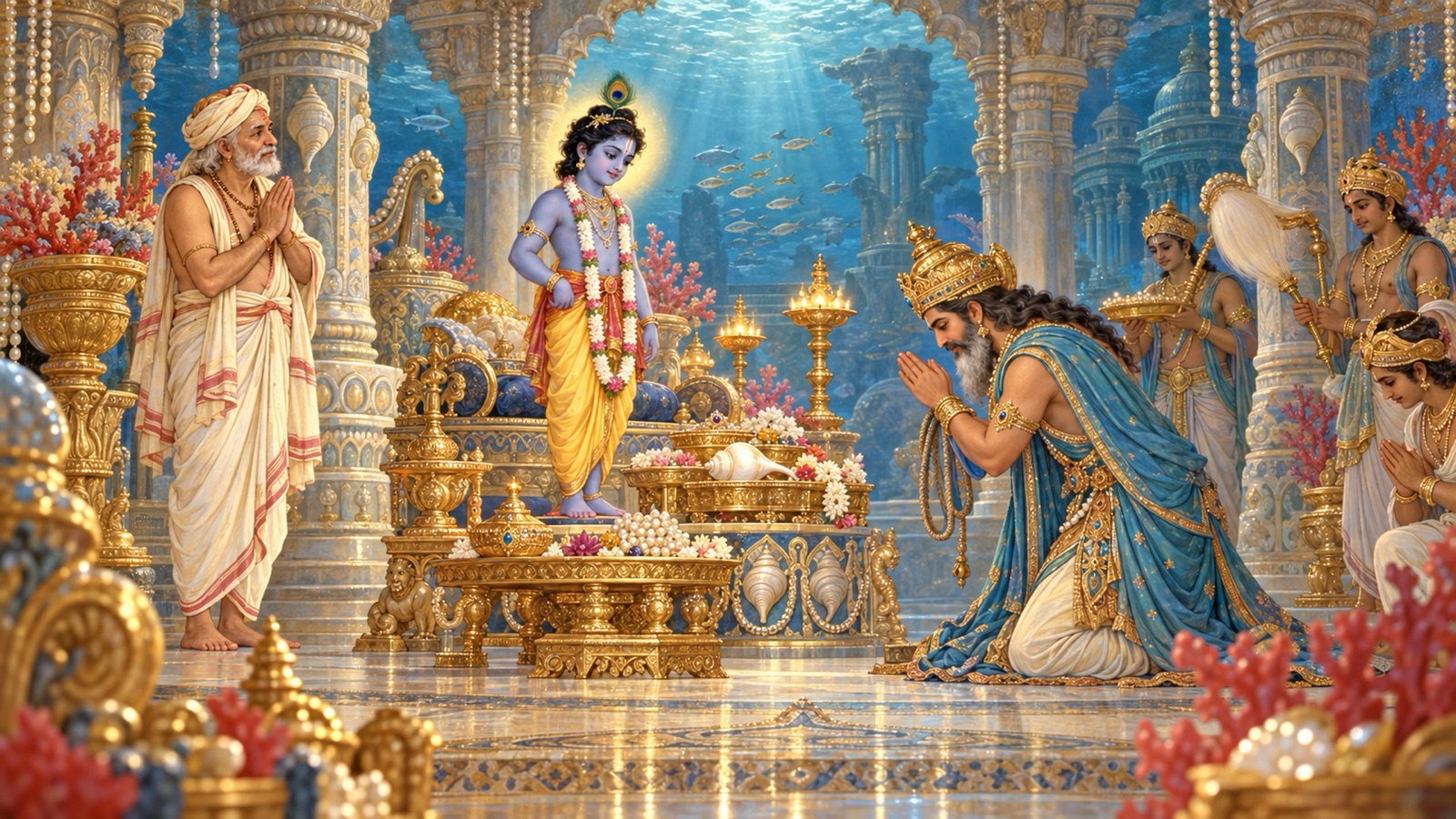
When Varuṇa, guardian of one quarter of the worlds, saw Hrishikesha standing before him, that sight was itself a great festival for him. Overjoyed, he worshipped the Lord with lavish offerings and spoke words shining with gratitude rather than fear.
अद्य मे निभृतो देहोऽद्यैवार्थोऽधिगत: प्रभो ।
त्वत्पादभाजो भगवन्नवापु: पारमध्वन: ॥ ५ ॥
adya me nibhṛto deho ’dyaivārtho ’dhigataḥ prabho tvat-pāda-bhājo bhagavann avāpuḥ pāram adhvanaḥ
Meaning: Today my body has found its rest, and this very day my purpose has been attained, O Master; those who hold to Your feet, O Lord, have crossed to the far shore of the long road of worldly existence. (Canto 10, Chapter 28, verse 5)
He bowed next to the Lord as the Supreme Spirit, perfect and all-pervading, in whom the Maya that fashions world after world is not so much as heard of. Then he came to the matter at hand with a candour that is beautiful to read. The man standing there, he said, had been brought by a servant of his own — a foolish and ignorant creature who did not know his duty — and for that fault he asked the Lord’s pardon. He did not excuse himself by blaming the servant alone; he took the offence upon his own head.
ममाप्यनुग्रहं कृष्ण कर्तुमर्हस्यशेषदृक् ।
गोविन्द नीयतामेष पिता ते पितृवत्सल ॥ ८ ॥
mamāpy anugrahaṁ kṛṣṇa kartum arhasy aśeṣa-dṛk govinda nīyatām eṣa pitā te pitṛ-vatsala
Meaning: Be pleased to show Your grace to me also, O Krishna, O all-seeing One; O Govinda, let this father of Yours be taken back, for You are tender towards Your parents. (Canto 10, Chapter 28, verse 8)
The Return to Vraja and a Wonder Retold
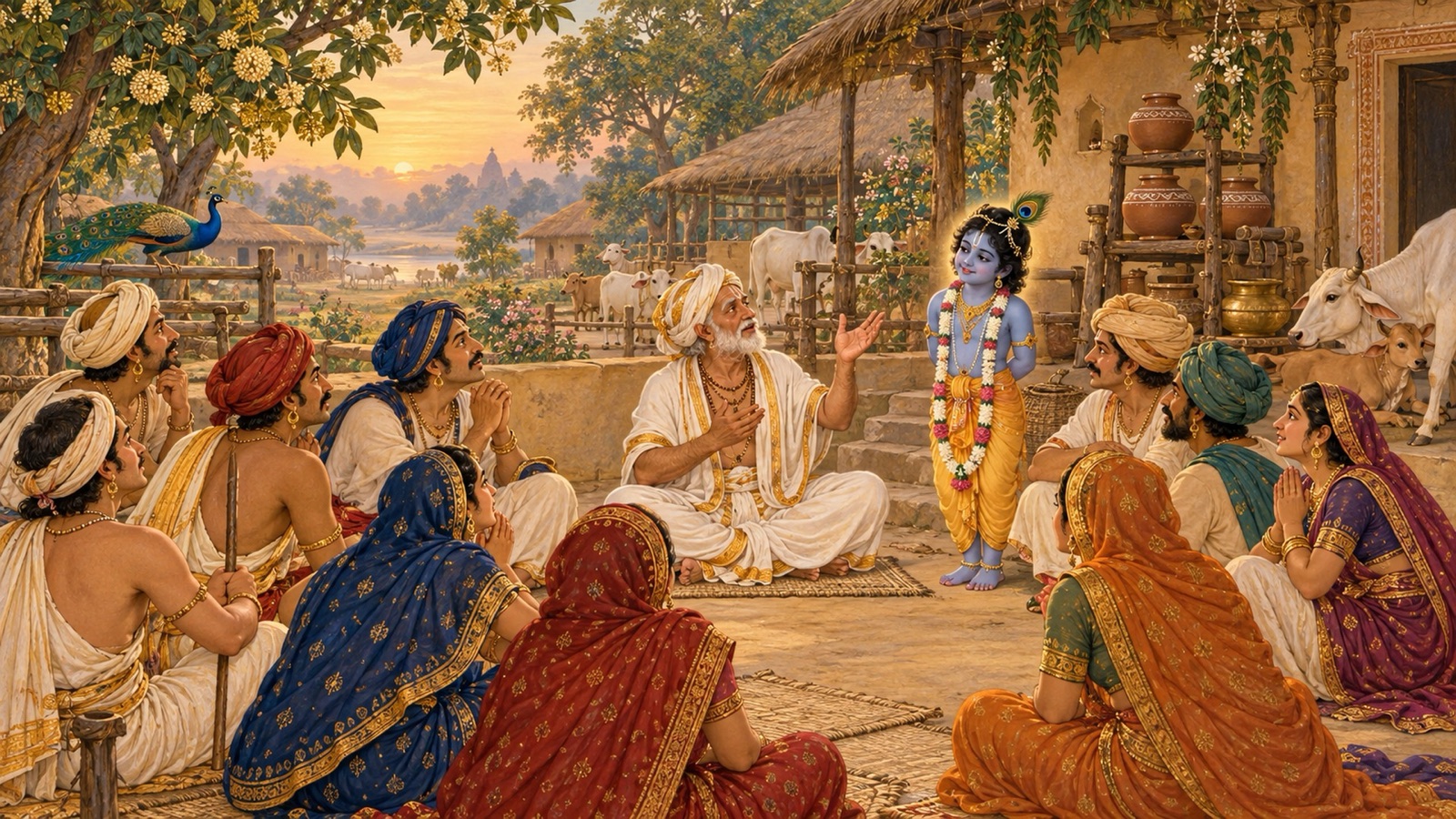
So propitiated, the Lord of all lords took His father and came back, and the joy of their kinsfolk at that homecoming can be imagined. But Nanda returned carrying something else as well: astonishment. He had looked upon a splendour beyond the reach of the senses, a magnificence of that world-guardian such as he had never once seen; and he had watched the whole of that kingdom bow low before his own boy. Full of wonder, he told his relatives everything he had witnessed.
The Longing the Cowherds Could Not Speak
The herdsmen listened, and their minds grew eager. Taking Him now to be the Supreme Lord indeed, a hope rose silently among them: would the Master of all also bestow on them His own destination, that subtle state which belongs to Him? They did not voice the prayer. But the all-seeing Lord knew the wish of His own people from within, and out of compassion He considered how their desire might be fulfilled, reflecting on the condition in which every embodied soul is caught.
जनो वै लोक एतस्मिन्नविद्याकामकर्मभि: ।
उच्चावचासु गतिषु न वेद स्वां गतिं भ्रमन् ॥ १३ ॥
jano vai loka etasminn avidyā-kāma-karmabhiḥ uccāvacāsu gatiṣu na veda svāṁ gatiṁ bhraman
Meaning: In this world a person, impelled by ignorance, desire and action, revolves among high and low states of being and does not know his own true destination. (Canto 10, Chapter 28, verse 13)
Here lies the heart of the whole pastime. The Lord did not go down to the waters merely to recover a father, nor did He let the matter end with Vraja marvelling at an underwater palace. Nanda’s brush with that realm had lifted the herdsmen’s eyes above the grazing grounds — yet celestial grandeur, however dazzling, is still a station within the wheel of ignorance, desire and action described in this verse, a high condition among the high and low through which the soul keeps turning without ever recognising its own home. So the Lord took the wonder newly awakened in them and carried it past every created splendour to the one destination that does not revolve. And He gave this not to ascetics seasoned in austerity, but to cowherds whose only wealth was love for Him.
The Realm Beyond Darkness
इति सञ्चिन्त्य भगवान् महाकारुणिको हरि: ।
दर्शयामास लोकं स्वं गोपानां तमस: परम् ॥ १४ ॥
सत्यं ज्ञानमनन्तं यद् ब्रह्मज्योति: सनातनम् ।
यद्धि पश्यन्ति मुनयो गुणापाये समाहिता: ॥ १५ ॥
iti sañcintya bhagavān mahā-kāruṇiko hariḥ darśayām āsa lokaṁ svaṁ gopānāṁ tamasaḥ param satyaṁ jñānam anantaṁ yad brahma-jyotiḥ sanātanam yad dhi paśyanti munayo guṇāpāye samāhitāḥ
Meaning: Having thought in this way, Lord Hari, who is greatly merciful, showed the cowherds His own realm, which lies beyond darkness — truth, knowledge, the infinite and eternal effulgence of Brahman, which sages behold only when the modes of nature have fallen away and they are perfectly composed. (Canto 10, Chapter 28, verses 14–15)
He led them to the Brahma-hrada, where they sank into that all-absorbing Brahman and were steeped in it, until He Himself drew them up again as one is roused out of a trance. Their eyes then opened upon a country no herdsman had ever hoped to see — the same abode that Akrura also, by this very Lord’s grace, was once permitted to behold.
ते तु ब्रह्मह्रदं नीता मग्ना: कृष्णेन चोद्धृता: ।
ददृशुर्ब्रह्मणो लोकं यत्राक्रूरोऽध्यगात् पुरा ॥ १६ ॥
te tu brahma-hradam nītā magnāḥ kṛṣṇena coddhṛtāḥ dadṛśur brahmaṇo lokaṁ yatrākrūro ’dhyagāt purā
Meaning: Carried to the Brahma-hrada and immersed there, and then raised up by Krishna, they saw the realm of Brahman — that which Akrura too had seen. (Canto 10, Chapter 28, verse 16)
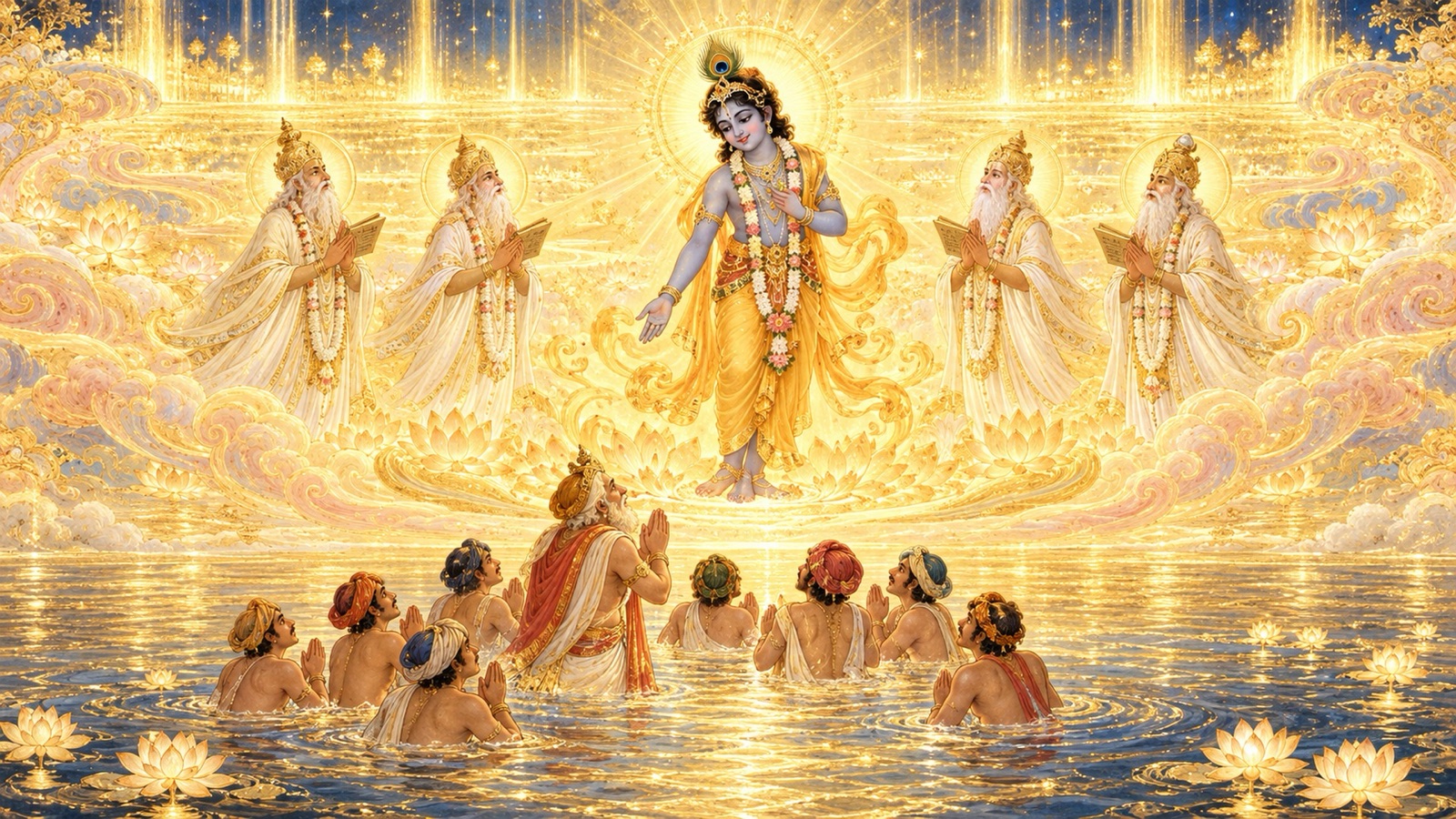
Krishna Praised There by the Vedas
What the cowherds saw in that shining country completed everything. Krishna was standing within it, and the Vedas in their own living forms were singing His praises. The herdsmen who had looked for Him by the riverbank now found Him glorified at the centre of eternity — and then found Him once more beside them, their own boy, exactly as before.
नन्दादयस्तु तं दृष्ट्वा परमानन्दनिवृता: ।
कृष्णं च तत्रच्छन्दोभि: स्तूयमानं सुविस्मिता: ॥ १७ ॥
nandādayas tu taṁ dṛṣṭvā paramānanda-nivṛtāḥ kṛṣṇaṁ ca tatra cchandobhiḥ stūyamānaṁ su-vismitāḥ
Meaning: Beholding that realm, and seeing Krishna there being praised by the Vedas, Nanda and the others were overwhelmed with supreme bliss and filled with wonder. (Canto 10, Chapter 28, verse 17)
Principal Teachings of This Chapter
1. A vow kept in secret is never unattended. Nanda’s fast and his pre-dawn bath (verse 1) were known to no one but the Lord — and it was the Lord who came for him when the observance went awry. Sincerity in worship is its own protection.
2. Darshan is the true treasure. Varuṇa holds every jewel of the ocean, yet he declares that only on this day has his purpose been gained (verse 5). The wealthiest of the world-guardians measures his fortune by a single sight of the Lord.
3. Humility accepts the fault it did not commit. Rather than disown his servant, Varuṇa takes responsibility, asks pardon, and restores Nanda, calling the Lord tender towards His parents (verse 8). A devotee’s greatness shows in how quickly he bows.
4. The soul forgets its own destination. Ignorance, desire and action keep the embodied being circling through higher and lower births, blind to where it truly belongs (verse 13). This is the condition the Lord’s mercy addresses.
5. He answers the prayer we never managed to utter. The cowherds only wished in silence; the Lord read their hearts and revealed the realm beyond darkness that contemplatives reach only in deep absorption (verses 14–15). Love draws from Him what effort alone cannot.
A Devotional Reflection
There is something tender in the smallness of how this chapter opens. No battle is fought, no demon rages through Vraja. An elderly cowherd simply wants to finish his vow properly, and he walks into a cold river before daylight because that is when the scriptures say the bath must fall. It is for this — for an old man’s carefulness about a sacred duty — that the Lord of all worlds goes down beneath the waters. We often imagine that God attends to the large matters and leaves the small ones to us. Here the small matter is exactly what He attends to, and the whole of Vraja is enriched because one devotee was particular about a fast. And notice what Vraja asks for afterwards: not safety, not prosperity, not even an explanation. Having seen a king of the waters bow to their boy, they want only to be where He is. That silent wanting is the most fruitful prayer in the chapter, and it is the one He answers first.
A Daily Devotional Practice
Today, keep one small spiritual commitment with complete care — a fixed number of rounds of the holy name, a lamp lit at the proper hour, a verse read before you sleep — and keep it even if no one knows you have kept it. Let the chapter’s quiet promise rest in your mind as you do: the Lord notices what is done for Him alone. Then, before you rise, offer the wish the cowherds could not speak, asking simply for a place near His feet, and chant gently: Om Namo Bhagavate Vasudevaya.
Conclusion
Nanda’s observance of Ekadashi, interrupted by a servant of the waters, becomes in the Lord’s hands the doorway to the greatest of gifts. Varuṇa worships Him and returns the father with folded hands; Vraja marvels at a splendour it had never imagined; and the Lord, reading the unspoken longing of His people, lifts them past every created wonder to the eternal realm where the Vedas sing His glories. The single truth the chapter leaves with us is this: the Supreme Lord does not merely rescue His devotees from difficulty — He uses the difficulty to draw them home. May we also learn to want only Him, and to trust Him with the rest.
May the divine wisdom of Srimad Bhagavatam awaken pure devotion within our hearts.
Om Namo Bhagavate Vasudevaya.
Jay Shree Madhav.
References and Attribution
- Primary edition: Gita Press, Śrīmad Bhāgavata Mahāpurāṇa (English), Book Ten (First Half), Discourse 28.
- Series: Srimad Bhagavatam Wisdom · Biswa Sanatan Dharma Seva Trust.
- Presented following the spiritual guidance and recommendation of Pandit Dr. Shri Kashinath Mishra.
This is an original, faithful retelling in the writer’s own words, with brief quoted verses shown in Devanāgarī and transliteration and their meanings given as summaries. It is not a reproduction of any single publisher’s continuous translation or commentary. No affiliation with or endorsement by any publisher is implied.
Jay Shree Madhav