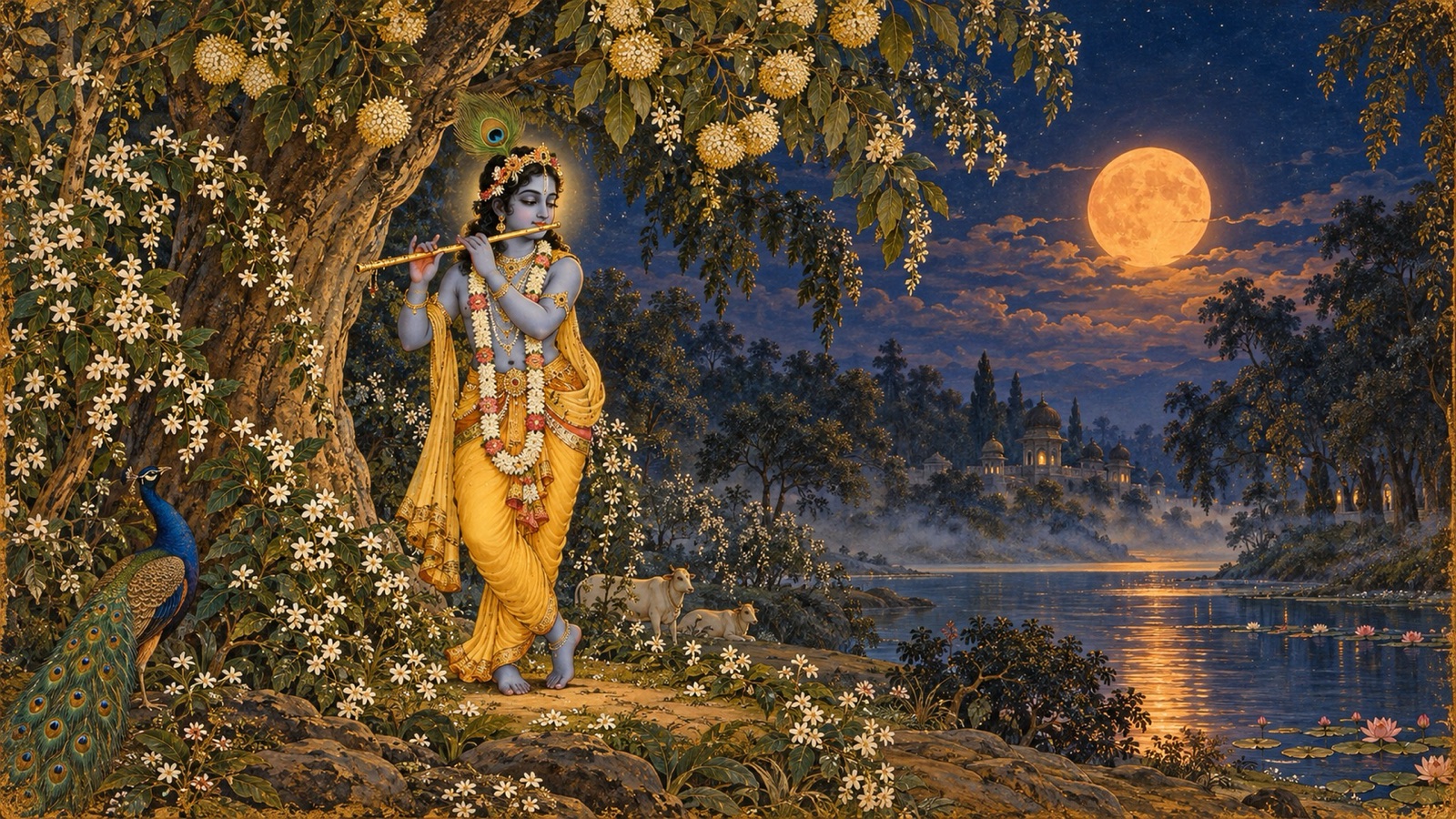
Under the full moon of autumn, with jasmine opening in every thicket and the woods of Vrindavana washed in soft light, the Lord takes up His flute — and a music is heard in Vraja that no loving heart can resist.
Om Namo Bhagavate Vasudevaya.
Om Namo Bhagavate Vasudevaya.
Om Namo Bhagavate Vasudevaya.
Welcome back to Srimad Bhagavatam Wisdom, our devotional journey through the sacred histories and teachings of the Srimad Bhagavat Mahapurana. With this twenty-ninth chapter of the Tenth Canto the most celebrated of the pastimes of Vraja begins. Sukadeva Gosvami tells how the Lord, resting upon His own Yogamaya, resolved upon the divine play; how His flute drew the cowherd women out at night; how He turned them back with the plain words of duty and heard their answer; and how He vanished at last to take away the pride in their joy.
Chapter Information
- Scripture: Śrīmad Bhāgavata Mahāpurāṇa
- Canto: 10 (Book Ten, First Half)
- Chapter: 29 (Discourse 29)
- Chapter title: Krishna and the Gopis Meet for the Rasa Dance
- Principal speaker: Sukadeva Gosvami (narrating to King Parikshit)
- Principal listener: King Parikshit
- Main setting: The moonlit forest of Vrindavana and the bank of the Yamuna in Vraja
- Central subject: The call of the flute; the gopis’ renunciation; Krishna’s instruction on dharma and their reply; His compassion and His vanishing
- Principal verse range: Canto 10, Chapter 29, verses 1–48
- Primary edition: Gita Press Śrīmad Bhāgavata Mahāpurāṇa (English, Book Ten, First Half)
Context From the Previous Chapter
In Chapter 28 the Lord brought Nanda back from the abode of Varuna and showed the cowherds His own eternal realm beyond Prakriti. With that wonder still fresh in Vraja, the nights of autumn arrive.
The Autumn Night and the Song of the Flute
Sukadeva Gosvami took up the thread again. The season had turned; the nights of Vraja were clear and jasmine was opening in full bloom. Seeing those nights, the Lord — complete in Himself, with no desire left to fulfil — set His heart upon the divine play, resorting to His Yogamaya.
भगवानपि ता रात्री: शारदोत्फुल्लमल्लिका: ।
वीक्ष्य रन्तुं मनश्चक्रे योगमायामुपाश्रित: ॥ १ ॥
bhagavān api tā rātrīḥ śāradotphulla-mallikāḥ vīkṣya rantuṁ manaś cakre yoga-māyām upāśritaḥ
Meaning: Beholding those autumn nights adorned with blossoming jasmine, the Lord too resolved to enjoy the divine play, taking recourse to His Yogamaya. (Canto 10, Chapter 29, verse 1)
Then the moon rose, painting the east with soothing red rays as a husband long absent gladdens his beloved on returning, and wiping away the distress of the day’s heat. Beholding that unbroken orb, red as fresh saffron and radiant as Lakshmi’s face, and the woodland coloured by its tender light, Krishna played sweetly upon His flute — and that music carried away the minds of the fair-eyed gopis.
The Women of Vraja Set Out Into the Night
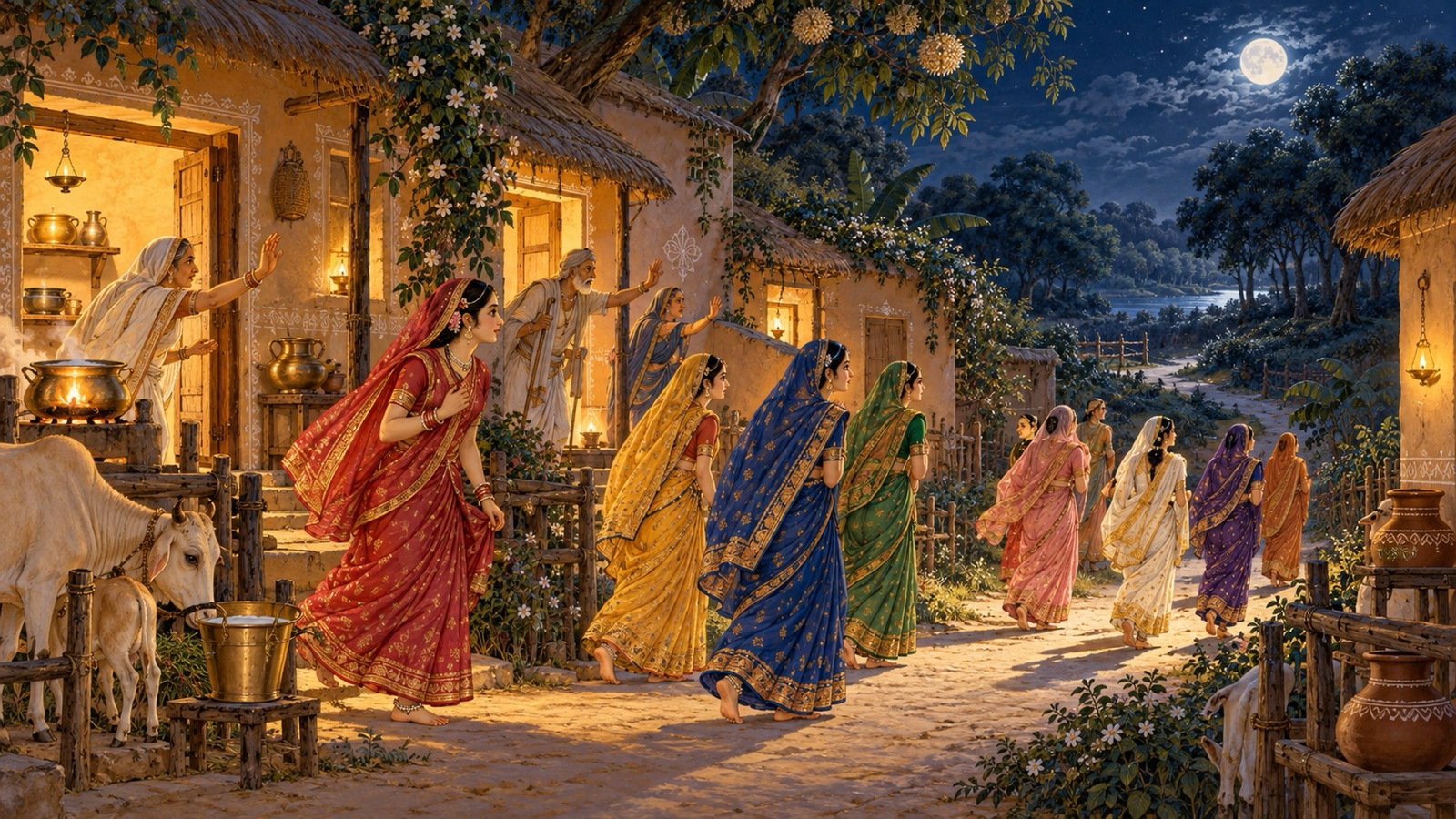
That song went out over houses and pastures, and the women who heard it could not stay where they were. Their minds had long been held by Krishna; now each set out by her own path toward Him, so swiftly that none noticed the hurry of the others, their earrings swinging as they went.
What they left behind is itself an instruction. One ran from her milking, leaving the pail; one did not wait for the milk to boil; one left the porridge on the hearth. One walked away from the food she was serving, one laid down the infant she was feeding, one turned from attending her husband, one rose from her unfinished meal; some left sandal paste half spread and eyes half painted, and some came with ornaments awry. Relatives tried to hold them back, but they did not turn homeward, their hearts already taken by the Protector of cows. And some, shut indoors with no way out, closed their eyes and held Him within their minds with a longing that left room for nothing else.
The Bonds of Karma Fall Away
Of those who could not come, Sukadeva says something astonishing. The unbearable agony of separation burned away everything inauspicious in them, and the ecstasy of embracing the immortal Lord within meditation exhausted even their merit; with both bonds cut, they gave up their bodies made of the modes and were united with that same Supreme Self — though they had known Him only as the one their hearts loved.
King Parikshit’s Question
Here the king put in a question any listener might ask. These women knew Krishna as their dearest one, not as Brahman, the Infinite; how could the stream of birth and death stop for them, whose minds were moved by the three modes?
Sukadeva recalled Shishupala, who hated Krishna and nevertheless attained oneness with Him; what wonder, then, if the gopis, who held Him as most beloved, should do the same? The appearance of the Lord — imperishable, immeasurable, beyond the modes and yet their master — has one purpose: the final good of human beings.
कामं क्रोधं भयं स्नेहमैक्यं सौहृदमेव च ।
नित्यं हरौ विदधतो यान्ति तन्मयतां हि ते ॥ १५ ॥
kāmaṁ krodhaṁ bhayaṁ sneham aikyaṁ sauhṛdam eva ca nityaṁ harau vidadhato yānti tan-mayatāṁ hi te
Meaning: Those who constantly fix upon Sri Hari their desire, anger, fear, affection, sense of oneness or friendship surely attain absorption in Him. (Canto 10, Chapter 29, verse 15)
Here lies the reason the Lord arranged this play at all. He does not descend to be admired from a distance; He descends for the liberation of those who cannot yet conceive of Him as the Infinite, and so accepts whatever a heart can give — even the helpless attachment of one who knows Him only as dearest. Because He is the Supreme Self and not a perishable thing, what is given to Him does not bind the giver but frees her. Wonder no more, said Sukadeva, at the Lord by whose grace this creation is freed.
Krishna Tells Them to Return
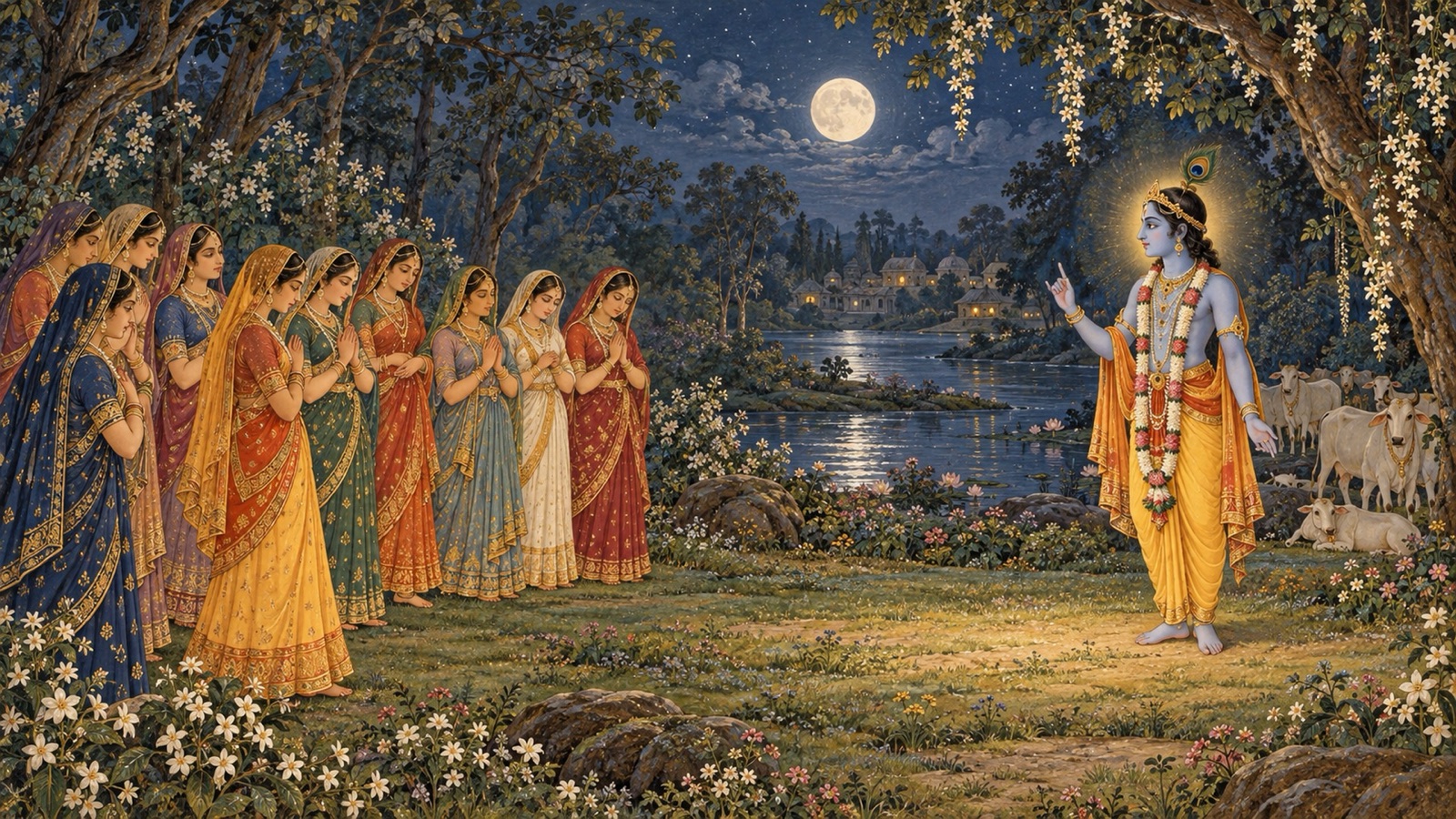
When the women of Vraja stood before Him, Krishna, foremost of all who know how to speak, greeted them with words that bewildered them. Welcome, O most fortunate ones; how may I serve you? Is all well in Vraja? Tell Me why you have come. Then He spoke as a guardian speaks: this night is fearful and haunted by frightful creatures, so go back; your parents, sons, brothers and husbands will be searching, and you should not give them anxiety. You have seen the flowering forest lit by the full moon; return now and attend upon your husbands, for the calves and the children are crying with hunger. Or perhaps your minds are bound to Me by affection; if so it is only fitting, for every creature finds delight in Me.
Then, as the knower of dharma, He set the plain duty before them: the highest duty of women is guileless service to husband and his family and the nourishing of children; a husband is not to be abandoned by a woman who hopes for the higher worlds, be he poor, ailing, ageing or dull, unless he has altogether fallen; and for a woman of good family attachment to another man bars heaven and brings disgrace and fear. Then He gave them the key to it all.
श्रवणाद् दर्शनाद्ध्यानान्मयि भावोऽनुकीर्तनात् ।
न तथा सन्निकर्षेण प्रतियात ततो गृहान् ॥ २७ ॥
śravaṇād darśanād dhyānān mayi bhāvo ’nukīrtanāt na tathā sannikarṣeṇa pratiyāta tato gṛhān
Meaning: Love for Me is developed by hearing of Me, seeing Me, meditating upon Me and singing My glories, and not so much by physical proximity; therefore return to your homes. (Canto 10, Chapter 29, verse 27)
He who had drawn them with His flute now told them that bodily nearness is not what makes devotion grow: hearing, remembrance and song are open to every devotee in every age.
Standing Silent in the Moonlight
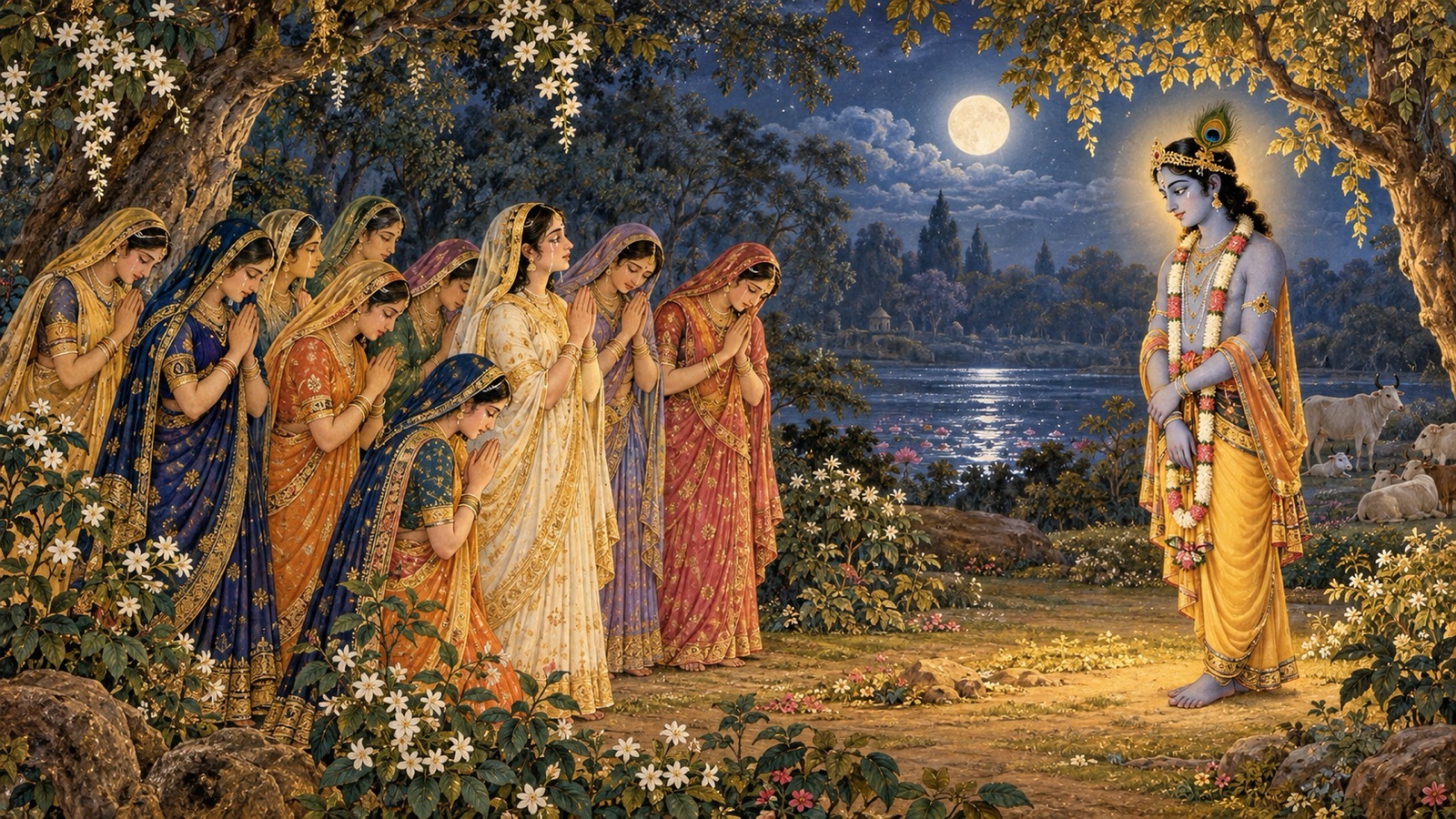
His speech was bitter to them. Their hope frustrated, the gopis sank into a grief they could not throw off: faces cast down, lips parched by hot breaths of sorrow, toes scratching the ground, tears washing away the saffron they wore. Then, wiping their eyes, they who had given up every other longing for His sake answered Him in voices choked with gentle reproach.
The Answer of the Gopis
मैवं विभोऽर्हति भवान् गदितुं नृशंसं सन्त्यज्य सर्वविषयांस्तव पादमूलम् ।
भक्ता भजस्व दुरवग्रह मा त्यजास्मान् देवो यथादिपुरुषो भजते मुमुक्षून् ॥ ३१ ॥
maivaṁ vibho ’rhati bhavān gadituṁ nṛ-śaṁsaṁ santyajya sarva-viṣayāṁs tava pāda-mūlam bhaktā bhajasva duravagraha mā tyajāsmān devo yathādi-puruṣo bhajate mumukṣūn
Meaning: O Lord, You should not speak so harshly. Having renounced all else we have come to the soles of Your feet; accept us as Your devotees, as the Primeval Person accepts those who seek liberation. (Canto 10, Chapter 29, verse 31)
They met His teaching with His own words. You, the knower of dharma, have said that a woman’s duty is to serve husband, children and family; let that service be rendered to You — for You are the dearest friend and the very Self of every embodied being, and what is offered to You reaches all, as water poured at the root nourishes every branch. The wise delight in You alone, their eternally dear Self; what is gained from husband and children, who are sources of pain? Be gracious, O lotus-eyed Lord, and do not cut off the hope we have cherished in You so long. Our minds, once at home in the house, have been stolen by You; our hands have lost their power for its work; our feet will not move one step from Your feet. How shall we return to Vraja, and what shall we do there?
Quench, they prayed, the fire Your smiles and glances and music have kindled in us; and if You will not, then with our bodies consumed by separation we shall come by meditation alone to the path of Your feet. Even Sri, who has a place upon Your bosom, vies with Tulasi for the dust of those feet; that dust is all we seek. We have left our homes only to wait upon You — grant us Your service, and lay Your lotus hand upon Your maidservants.
The Lord’s Compassion on the Sands of the Yamuna
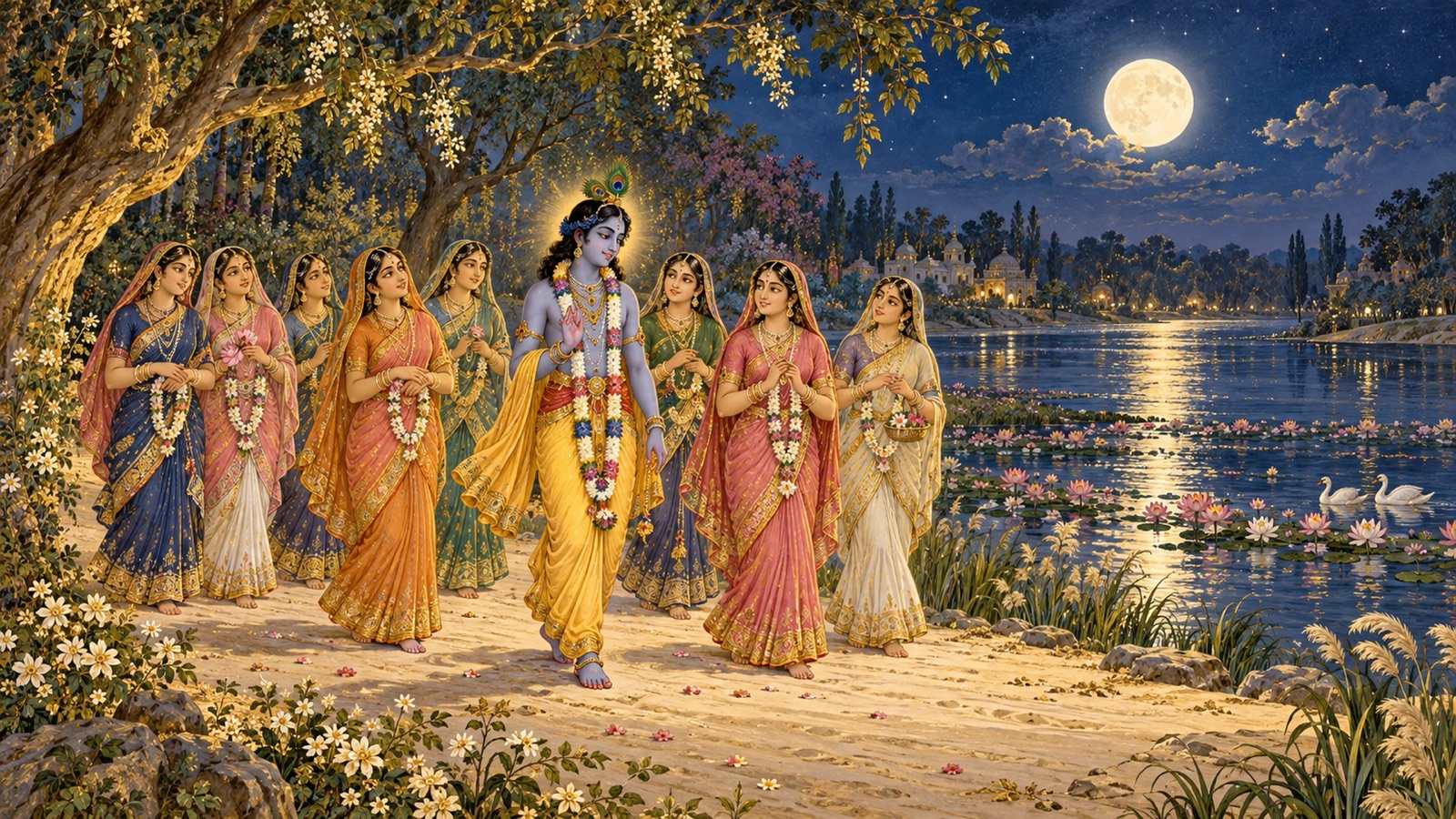
Hearing that helpless plea, the Lord of all masters of yoga laughed softly and, out of compassion, satisfied them, though He takes His pleasure in Himself alone. Surrounded by those whose faces had blossomed at the sight of Him, His smile bright as jasmine, He shone like the moon among stars. Praised in their songs and singing aloud Himself, wearing His Vaijayanti garland, He graced the forest and came with them to the river bank, where the sand lay cool under the breeze and the air was fragrant with water-lilies. There He gave them the joy of His nearness and delighted their hearts.
Pride, and the Vanishing
Having received such regard from the great-souled Lord, the gopis grew proud, thinking themselves the most fortunate women on earth. And He saw it.
तासां तत् सौभगमदं वीक्ष्य मानं च केशव: ।
प्रशमाय प्रसादाय तत्रैवान्तरधीयत ॥ ४८ ॥
tāsāṁ tat-saubhaga-madaṁ vīkṣya mānaṁ ca keśavaḥ praśamāya prasādāya tatraivāntaradhīyata
Meaning: Observing their intoxication with their good fortune and their pride, Keshava disappeared from that very spot, in order to quiet that pride and in order to bestow His grace upon them. (Canto 10, Chapter 29, verse 48)
So the discourse closes, not with a withdrawal of love but with its deepest act. The One who had called them with the flute hid Himself, and the hiding was mercy — for pride is the one thing that stands between a devotee and the Beloved.
Principal Teachings of This Chapter
1. The divine play rests upon Yogamaya. Before this pastime the Lord, complete and wanting nothing, took recourse to His own spiritual potency (verse 1). What follows is no event of this world, and must not be measured by worldly standards.
2. Whatever is fixed wholly upon Him becomes the road to Him. Desire, anger, fear, affection, kinship, friendship — any of these, held constantly toward Sri Hari, ends in absorption in Him (verse 15).
3. Devotion grows by hearing, remembrance and song. The Lord Himself teaches that bodily nearness is not the measure of love for Him (verse 27) — the consolation of every devotee not born in Vrindavana.
4. Service offered to the Self of all fulfils every duty. The gopis never deny the dharma Krishna teaches; they ask that the same service be given to the Lord, the Self of all beings (verse 31) — for what is offered at the root reaches every branch.
5. Even His disappearance is His grace. Pride born of His own favour is still pride, and He removes it by removing Himself from sight (verse 48). When He seems to withdraw, He is working most closely for us.
A Devotional Reflection
What stays with us is not only the flute in the moonlight but the strange severity of the Lord’s reply. The gopis have left everything — the milk on the fire, the child at the breast, the half-painted eye — and His first word to them is: go home. He praises the very duties they abandoned, and tells them He can be loved as truly in the kitchen as in the forest. Only afterwards does He accept them. Perhaps this is the order of grace itself: He will not let our love rest upon circumstances — a beautiful night, a holy place, a passing mood — but tests whether it stands when He seems to push it away. Their answer is that of a soul with nothing left to protect.
A Daily Devotional Practice
Today, offer your ordinary duty to the Lord instead of leaving it. Before beginning your next piece of work, say within yourself: this service is for You. Then, while the hands are busy, keep ear and tongue with Him — hear a verse, remember His moonlit form, sing His name softly as you work. Begin with the chant: Om Namo Bhagavate Vasudevaya.
Conclusion
This twenty-ninth discourse opens the rasa pastime with an autumn night, a flute, and a love that let go of everything to answer it. Krishna sends the women of Vraja homeward with the plainest teaching of duty and the deepest teaching of bhakti; they reply that every service belongs to Him, the Self of all; and He, laughing with compassion, grants them His nearness, then vanishes to heal their pride. One truth holds it together: a heart given wholly to Hari is carried to Him. May we give Him ours as completely.
May the divine wisdom of Srimad Bhagavatam awaken pure devotion within our hearts.
Om Namo Bhagavate Vasudevaya.
Jay Shree Madhav.
References and Attribution
- Primary edition: Gita Press, Śrīmad Bhāgavata Mahāpurāṇa (English, complete), Book Ten (First Half), Discourse 29.
- Series: Srimad Bhagavatam Wisdom · Biswa Sanatan Dharma Seva Trust.
- Presented following the spiritual guidance and recommendation of Pandit Dr. Shri Kashinath Mishra.
This is an original, faithful retelling in the writer’s own words, with brief quoted verses shown in Devanāgarī and transliteration and their meanings given as summaries. It is not a reproduction of any single publisher’s continuous translation or commentary. No affiliation with or endorsement by any publisher is implied.
Jay Shree Madhav