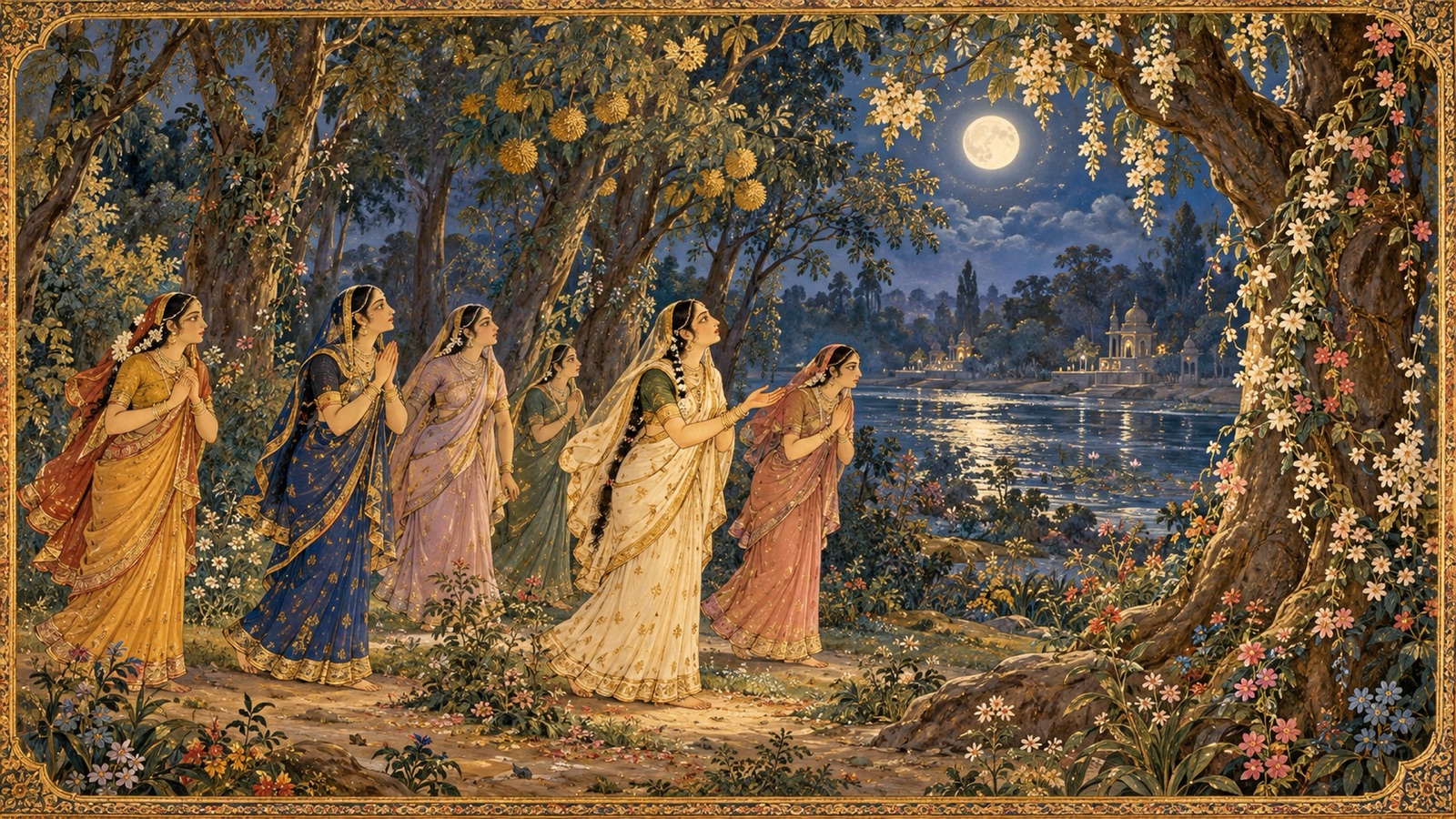
Bereft of their Lord in the moonlit woods of Vrindavana, the cowherd women question every tree and vine, become Krishna Himself in their longing, and find His sacred footprints in the forest soil.
Om Namo Bhagavate Vasudevaya.
Om Namo Bhagavate Vasudevaya.
Om Namo Bhagavate Vasudevaya.
Welcome back to Srimad Bhagavatam Wisdom, our devotional journey through the sacred histories and teachings of the Srimad Bhagavat Mahapurana. In this thirtieth chapter of the Tenth Canto, Sukadeva Gosvami tells King Parikshit what the women of Vraja did when Krishna was suddenly no longer among them: how their grief turned not inward but outward — into song, question, imitation, and a search that lasted until the moonlight failed.
Chapter Information
- Scripture: Śrīmad Bhāgavata Mahāpurāṇa
- Canto: 10 (Book Ten, First Half)
- Chapter: 30 (Discourse 30)
- Chapter title: The Gopis Search for Krishna
- Principal speaker: Sukadeva Gosvami
- Principal listener: King Parikshit
- Main setting: The forest of Vrindavana and the bank of the Kalindi (Yamuna)
- Central subject: The cowherd women’s anguish at the Lord’s disappearance, their search through the forest, and the humbling of the gopi He had taken apart
- Principal verse range: Canto 10, Chapter 30, verses 1–44
- Primary edition: Gita Press Śrīmad Bhāgavata Mahāpurāṇa (English), Book Ten (First Half)
Context From the Previous Chapter
In the previous discourse the Lord drew the women of Vraja to the moonlit forest by His flute, accepted their love, and began the great circle dance. When that rare good fortune bred a touch of pride in them, He withdrew in an instant — not to abandon them, but to deepen them.
The Lord Vanishes in a Moment
When the Lord vanished all at once, the women of Vraja burned with anguish.
श्रीशुक उवाच
अन्तर्हिते भगवति सहसैव व्रजाङ्गना: ।
अतप्यंस्तमचक्षाणा: करिण्य इव यूथपम् ॥ १ ॥
śrī-śuka uvāca antarhite bhagavati sahasaiva vrajāṅganāḥ atapyaṁs tam acakṣāṇāḥ kariṇya iva yūthapam
Meaning: Sukadeva said: When the Lord had disappeared all of a sudden, the women of Vraja were tormented at not seeing Him, like she-elephants that have lost sight of their herd-leader. (Canto 10, Chapter 30, verse 1)
Their minds had long been carried away by His walk, His loving smiles and playful glances, His charming speech and graceful sport; now, with nothing of Him left outside them, they found Him within by becoming Him. Their bodies took on His gait, His smile, His look, His way of speaking, until each darling of the Lord declared, “Indeed, I am Krishna!”
Questions to the Trees and the Creepers
Singing His glories aloud in chorus and moving from grove to grove like women out of their senses, they asked the trees about Him who dwells within all beings and outside them, like the sky. “O aśvattha, O plakṣa, O nyagrodha — has the son of Nanda passed this way, who stole our minds with His loving smiles? O kurabaka, aśoka, nāga, punnāga, campaka — did the younger brother of Balarama go by, whose smile takes away the pride of proud women? O auspicious Tulasi, so dear to Govinda’s feet, have you seen your beloved Acyuta pass, bearing you with His bees? O mālatī, mallikā, jātī and yūthikā — did Mādhava gladden you with the touch of His hand?” Then they begged the trees along the river:
चूतप्रियालपनसासनकोविदार-
जम्ब्वर्कबिल्वबकुलाम्रकदम्बनीपा: ।
येऽन्ये परार्थभवका यमुनोपकूला:
शंसन्तु कृष्णपदवीं रहितात्मनां न: ॥ ९ ॥
cūta-priyāla-panasāsana-kovidāra- jambv-arka-bilva-bakulāmra-kadamba-nīpāḥ ye ’nye parārtha-bhavakā yamunopakūlāḥ śaṁsantu kṛṣṇa-padavīṁ rahitātmanāṁ naḥ
Meaning: O cūta, priyāla, panasa, āsana, kovidāra, jambu, arka, bilva, bakula, āmra, kadamba and nīpa trees, and all you others on the Yamuna’s bank who live for the good of others — show the way to Krishna to us, whose selves have been taken from us. (Canto 10, Chapter 30, verse 9)
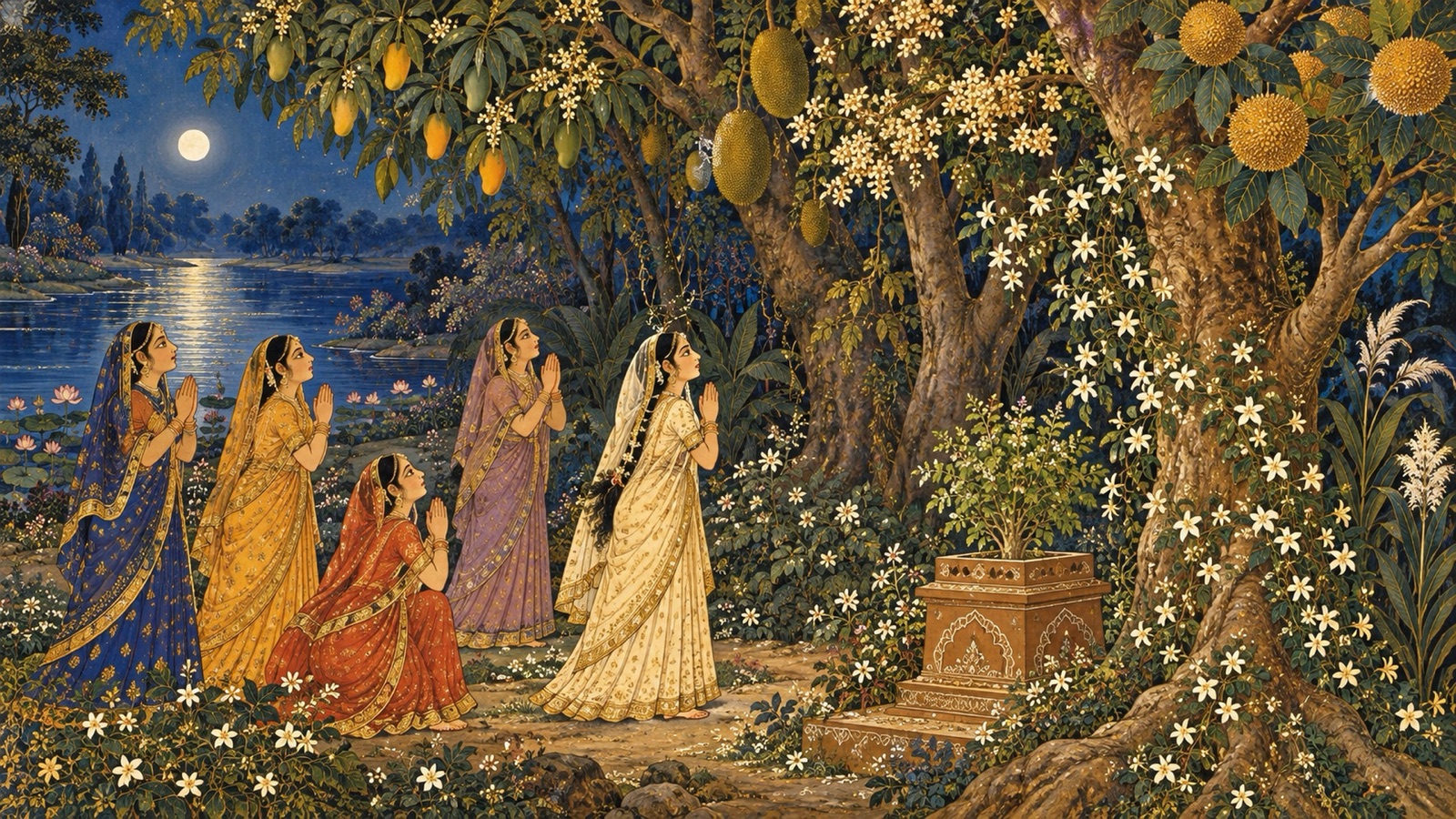
They asked the earth what austerity she had performed, that her grasses stood thrilled with joy — was it Kesava’s feet just now, the strides of Vamana, or the embrace of Varaha long ago? They asked a doe whether Acyuta had passed with His beloved, for the scent of His jasmine garland still hung on the air. They asked the trees whether He had answered their bowing with loving looks, a lotus in His hand and His arm on His dear one’s shoulder. “Ask these creepers too — though they clasp the arms of their lord the tree, they wear a thrill of fresh buds; surely His fingernails have touched them.”
“Indeed, I Am Krishna”
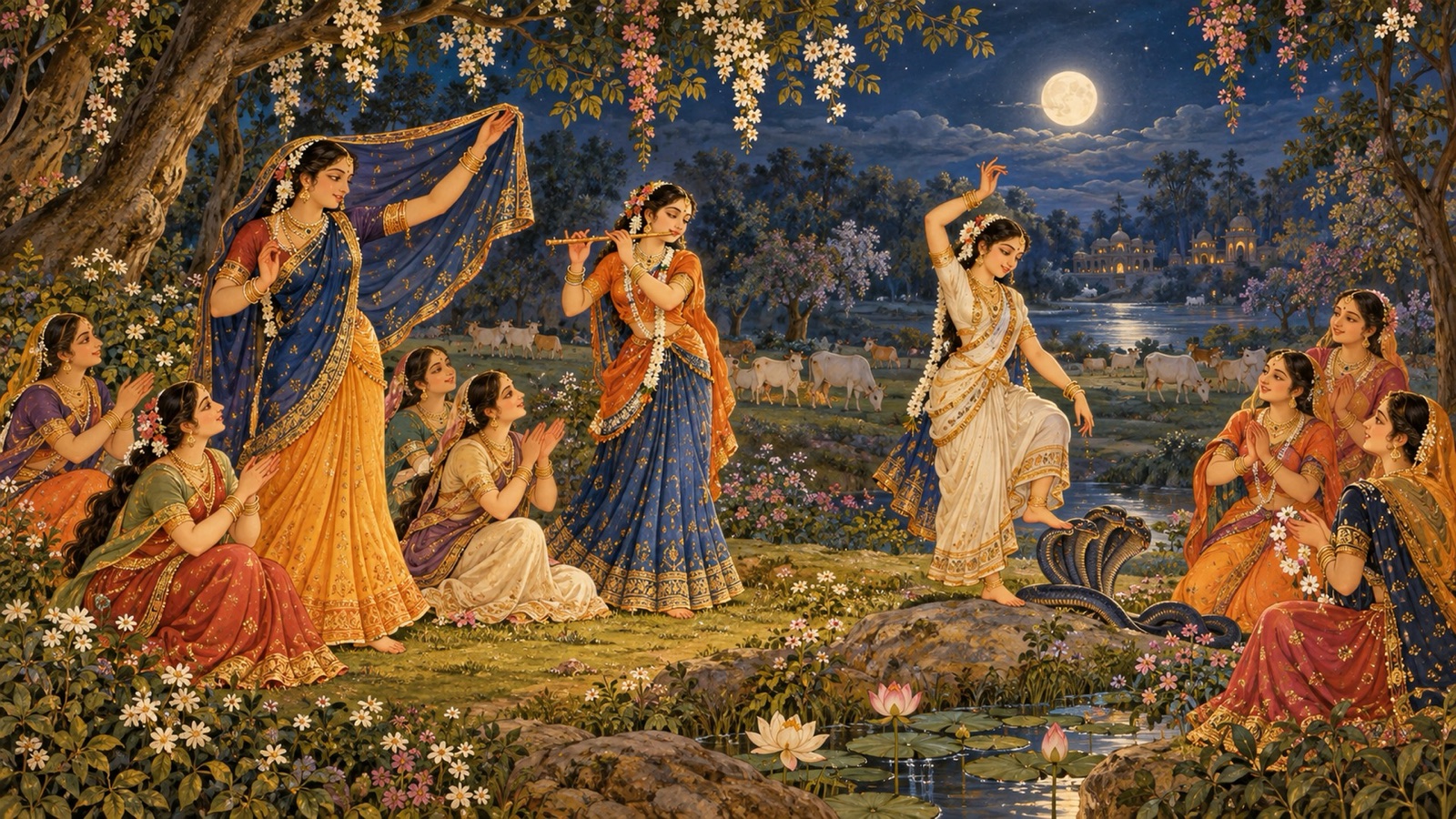
Speaking thus like women bereft of reason and utterly identified with Him, the gopis began to act out the Lord’s own pastimes. One became Putana and another the infant who drank her life away at the breast; one cried like a babe and kicked over a friend who lay as the cart. One carried off a companion as the whirlwind demon did; another crawled on hands and knees, her anklets jingling. Two took the parts of Krishna and Balarama while others became cowherd boys, and the calf-demon and the crane-demon were struck down once more. One called the distant cows home as He calls them, sounded a flute, and the rest cried, “Well done!” Another laid her arm on a friend’s shoulder: “Look at my graceful step — I am Krishna!” One lifted her upper cloth with a single hand, with a show of great effort: “Fear neither wind nor rain; I have made your shelter.” One set her foot upon another’s head: “Away, wicked serpent! I am born as the chastiser of the wicked.” One cried out as though to cowherds, “Look at this forest fire! Shut your eyes and I shall carry you through.” And one slender girl, tied to a mortar by a friend playing His mother, hid her face in a charming show of fear.
The Footprints of the Supreme Self
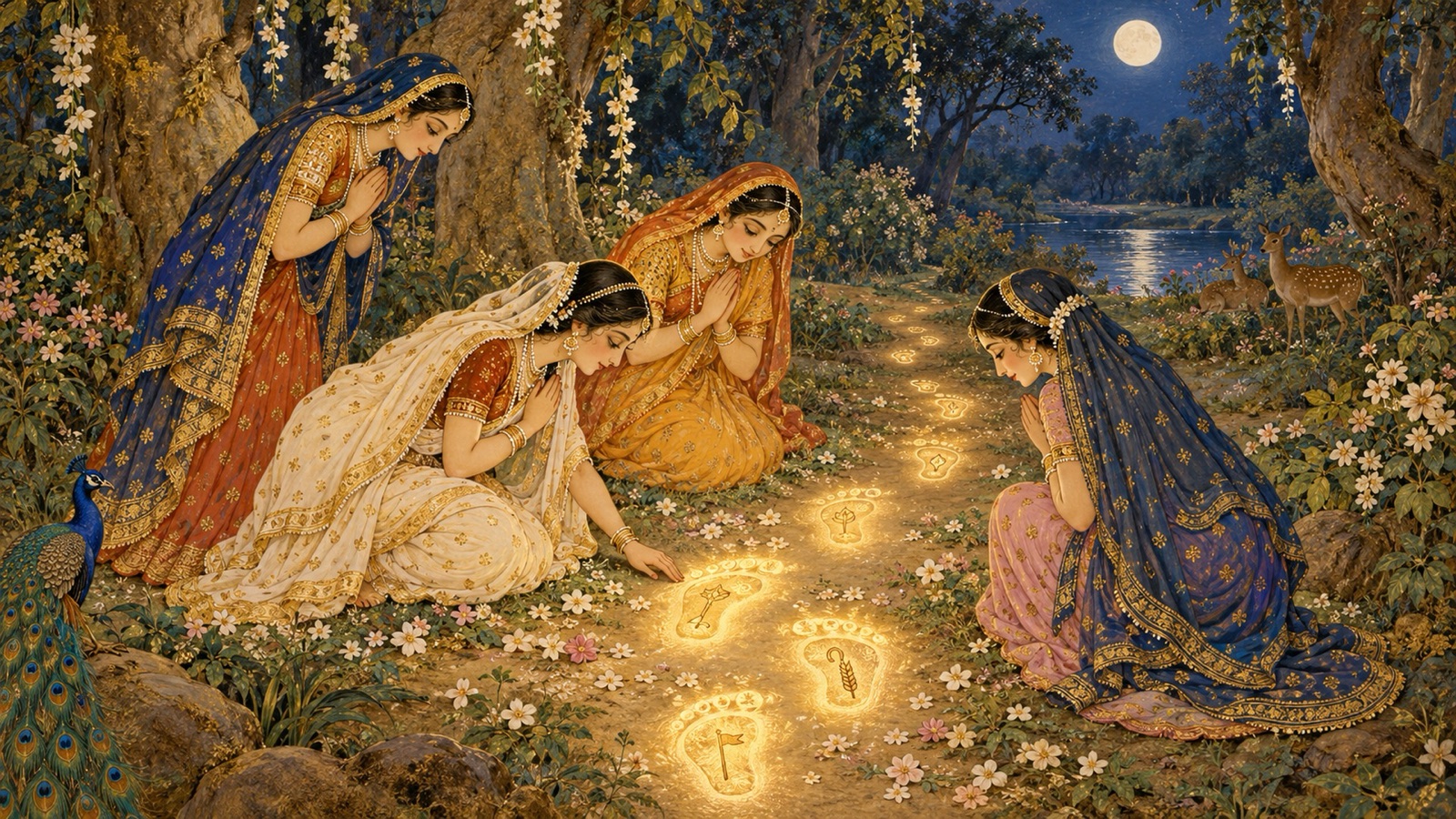
Still asking the creepers and trees about Him, the cowherd women came to a part of the forest where the ground itself answered.
एवं कृष्णं पृच्छमाना वृन्दावनलतास्तरून् ।
व्यचक्षत वनोद्देशे पदानि परमात्मन: ॥ २४ ॥
evaṁ kṛṣṇaṁ pṛcchamānā vṛndāvana-latās tarūn vyacakṣata vanoddeśe padāni paramātmanaḥ
Meaning: Thus questioning the creepers and trees of Vrindavana about Krishna, in one part of the forest they beheld the footprints of the Supreme Self. (Canto 10, Chapter 30, verse 24)
“These are plainly the feet of the great-souled son of Nanda,” they said, “for here is the flag, the lotus, the thunderbolt, the goad, the barley grain.” Tracing that path eagerly, the poor women came upon a second line of prints beside His — a woman’s — and their hearts sank. “Who has gone this way with Nanda’s darling, His forearm on her shoulder, like a she-elephant beside her lord? Surely she has worshipped the almighty Lord Hari to perfection, that Govinda should leave us all and lead her away in solitude.”
Yet even in that ache their love did not turn bitter, but rose into praise of the dust those feet had touched.
धन्या अहो अमी आल्यो गोविन्दाङ्घ्र्यब्जरेणव: ।
यान् ब्रह्मेशौ रमा देवी दधुर्मूर्ध्न्यघनुत्तये ॥ २९ ॥
dhanyā aho amī ālyo govindāṅghry-abja-reṇavaḥ yān brahmeśau ramā devī dadhur mūrdhny agha-nuttaye
Meaning: Blessed indeed, O friends, are these particles of dust from the lotus feet of Govinda, which Brahma and Lord Siva and the goddess Rama bear upon their heads to drive away their agony. (Canto 10, Chapter 30, verse 29)
Still the prints beside His troubled them: “She who has carried off the Lord and enjoys in secret the nectar of His lips — these marks of hers shake our hearts.” Moving on they said, “Her footprints end here; surely the Beloved lifted her up, whose tender soles the grass was hurting. See how much deeper His prints are sunk, weighed down by the one He bore. Here He set her down for flowers; here He gathered them — only the forepart of His feet has pressed the ground. And here He dressed her hair, and here sat to bind the blossoms into her braid.”
The Lord Who Delights in Himself
Why would the Lord, who wants nothing from anyone, act in this way at all? Sukadeva gives the reason plainly.
रेमे तया चात्मरत आत्मारामोऽप्यखण्डित: ।
कामिनां दर्शयन् दैन्यं स्त्रीणां चैव दुरात्मताम् ॥ ३४ ॥
reme tayā cātma-rata ātmārāmo ’py akhaṇḍitaḥ kāmināṁ darśayan dainyaṁ strīṇāṁ caiva durātmatām
Meaning: Though He delights in His own Self and is never diminished, He sported with that lady in order to show the wretched plight of those overcome by desire and the ill-mindedness that can arise in a woman’s heart. (Canto 10, Chapter 30, verse 34)
Here lies the heart of the chapter. The Lord is ātmārāma: He rejoices in Himself, is whole and undivided, and nothing any creature does can add to or diminish that fullness. So when He walks apart with one gopi, carries her over the grass and binds flowers into her braid, He is not being completed by her — He is showing what we could not otherwise see: how abject longing makes those it rules, and how quickly a heart singled out for honour begins to hold the Lord as its private possession. What follows is the proof. The one so favoured is lifted up by pride, and He who seemed entirely hers is gone in an instant. His vanishing is not punishment; it is the exact medicine for the single disease that can grow in the soil of His own grace.
The Gopi Who Was Left Alone
Meanwhile that gopi whom Krishna had led away had come to think herself the finest of all women: “Leaving the gopis who love Him, my beloved enjoys my company alone.” Reaching a certain part of the forest she said proudly to Kesava, “I cannot walk any further. Carry me wherever your heart desires.” “Then climb upon my shoulder,” the Lord answered — and as she reached for it, Krishna disappeared, and she was left to her sorrow.
हा नाथ रमण प्रेष्ठ क्वासि क्वासि महाभुज ।
दास्यास्ते कृपणाया मे सखे दर्शय सन्निधिम् ॥ ३९ ॥
hā nātha ramaṇa preṣṭha kvāsi kvāsi mahā-bhuja dāsyās te kṛpaṇāyā me sakhe darśaya sannidhim
Meaning: O my lord! O my beloved, O dearest one, where are you, where are you, O mighty-armed one? O friend, show your nearness to me, your wretched maidservant. (Canto 10, Chapter 30, verse 39)
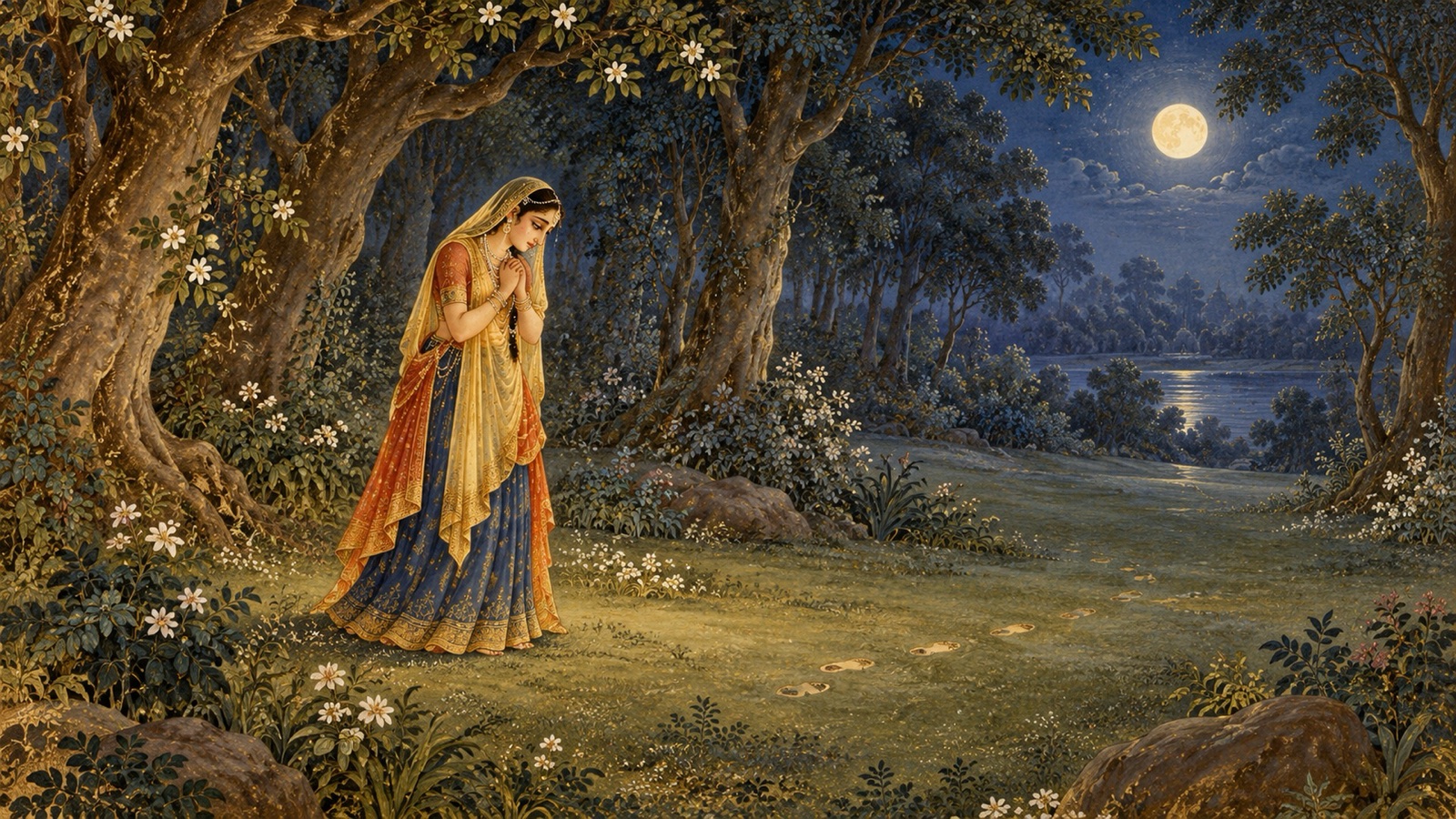
Hear how her words have changed. A moment ago she asked to be carried; now she asks only to be shown His presence, and calls herself His servant. Pride had made her His mistress; loss has made her His own.
The Search in the Moonlight
Following His path further, the cowherd women found their companion not far off, dazed and grieving at separation from her beloved. She told them everything — the honour she had received from Mādhava, and how by her own ill-mindedness she had met with His disregard — and they listened in the greatest wonder. Then they entered the forest once more, as far as the moonlight could show them the way; and seeing darkness set in, they turned back from that point.
तन्मनस्कास्तदालापास्तद्विचेष्टास्तदात्मिका: ।
तद्गुणानेव गायन्त्यो नात्मगाराणि सस्मरु: ॥ ४३ ॥
tan-manaskās tad-alāpās tad-viceṣṭās tad-ātmikāḥ tad-guṇān eva gāyantyo nātmagārāṇi sasmaruḥ
Meaning: With their minds fixed on Him, their talk of Him, their gestures His, identified with Him and singing of His qualities alone, they did not remember their own bodies, much less their homes. (Canto 10, Chapter 30, verse 43)
Coming back at last to the sandy bank of the Kalindi, longing for His return, they gathered and began to sing of Him — the song the next discourse preserves.
Principal Teachings of This Chapter
1. Separation is itself a form of His mercy. He withdraws from those who already love Him (verse 1), and their torment becomes the fire in which remembrance is purified.
2. The whole creation bears witness to Him. Trees, creepers, the earth and the deer are addressed as living beings who know Him and live for others (verse 9). A devotee cannot see the world as dead matter.
3. Remembrance makes the soul resemble the remembered. Absorbed in Him, the gopis forget their own bodies and homes (verse 43) — the fruit of unbroken loving attention, not a manufactured feat.
4. The dust of His feet is the treasure of the highest beings. Brahma, Siva and the goddess Rama hold that dust upon their heads (verse 29). Nothing this world offers stands beside what lies freely on His path.
5. Pride is the one thing His grace cannot carry. He who delights in Himself exposes what possessiveness does to the heart (verse 34). The moment we call Him ours alone, He steps out of sight, so that we may learn to call ourselves His.
A Devotional Reflection
There is something here that makes us lower our eyes. The cowherd women have lost the Lord, and they neither accuse Him nor sit down in despair nor console themselves with philosophy. They go out into the dark and ask the trees. They ask a basil plant, a vine, a doe, in perfect seriousness, because love has made the whole forest His family and they cannot believe that one who has seen Him could forget Him. When the questions give out, they do the only other thing love knows: they become Him, until they hardly know where He ends and they begin. We measure devotion by how steadily we hold a practice; they measure nothing and cannot stop. Then comes the pain of the second footprints — and even there their first instinct is to bless the dust.
A Daily Devotional Practice
Today, let your remembrance of the Lord be carried by the things around you rather than confined to one hour. When you water a Tulasi plant, when you pass a tree, when a breeze brings you some fragrance, let it ask you the gopis’ question — has He come this way? Speak one of His names aloud at that moment. If the day brings you loss or silence from Him, do not hurry to fill it; offer it with longing rather than complaint. Begin by chanting gently: Om Namo Bhagavate Vasudevaya.
Conclusion
This chapter teaches that the Lord’s hiding is as full of love as His appearing. Searching, singing, imitating, the women of Vraja show a love that forgets its own body and home; and the gopi carried apart shows the one thing such love must never keep — the thought that He is mine alone. He who takes His joy in Himself needs none of it, and accepts it all in order to make us His. May we seek Him as they sought Him, and hold Him as she finally held Him, in humility.
May the divine wisdom of Srimad Bhagavatam awaken pure devotion within our hearts.
Om Namo Bhagavate Vasudevaya.
Jay Shree Madhav.
References and Attribution
- Primary edition: Gita Press, Śrīmad Bhāgavata Mahāpurāṇa (English), Book Ten (First Half), Discourse 30.
- Series: Srimad Bhagavatam Wisdom · Biswa Sanatan Dharma Seva Trust.
- Presented following the spiritual guidance and recommendation of Pandit Dr. Shri Kashinath Mishra.
This is an original, faithful retelling in the writer’s own words, with brief quoted verses shown in Devanāgarī and transliteration and their meanings given as summaries. It is not a reproduction of any single publisher’s continuous translation or commentary. No affiliation with or endorsement by any publisher is implied.
Jay Shree Madhav