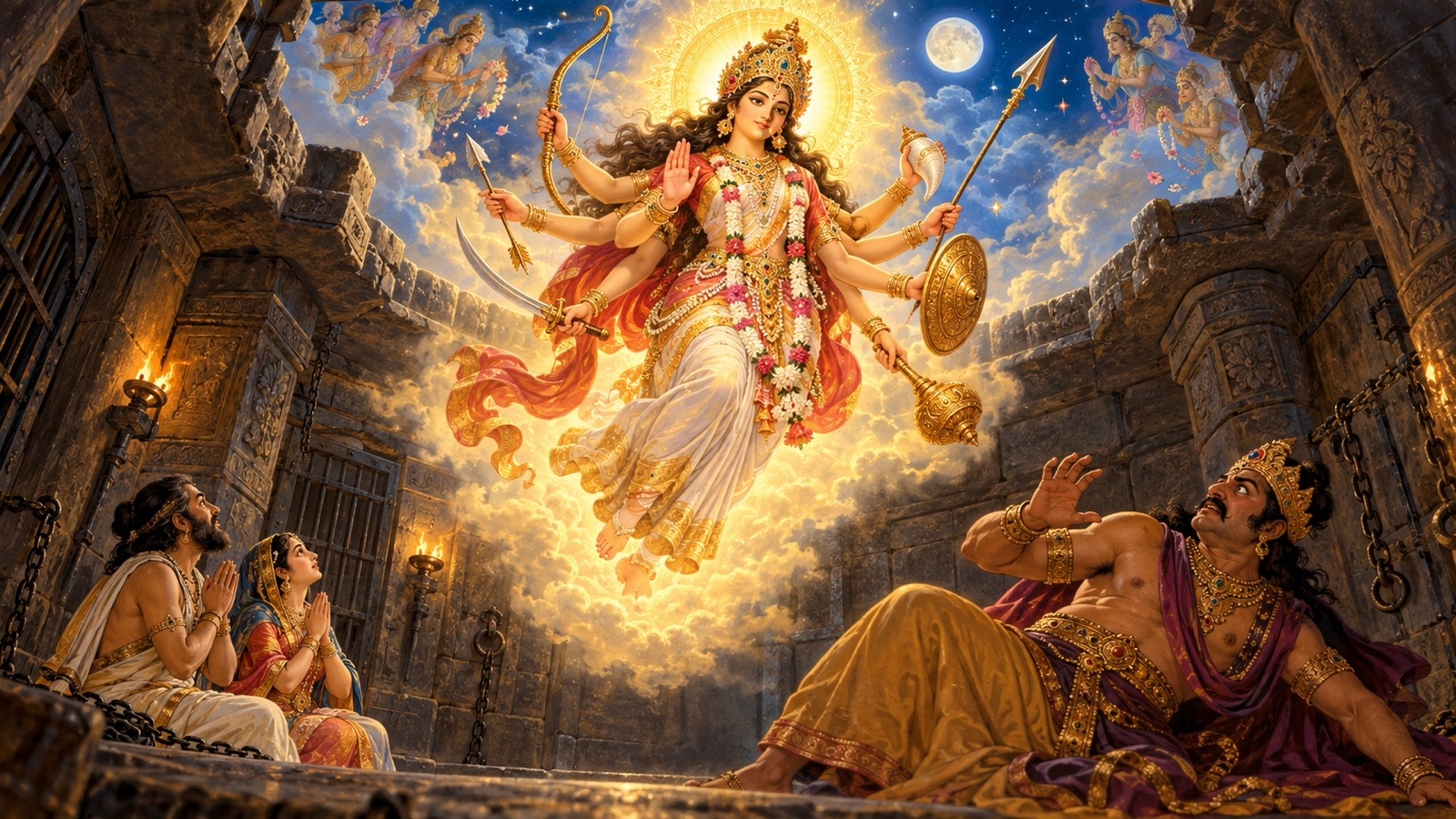
Slipping from the tyrant’s grasp, the Lord’s mystic energy rises into the heavens as an eight-armed goddess and announces that the destroyer of Kamsa has already been born — and the whole course of the tenth canto turns upon her words.
Om Namo Bhagavate Vasudevaya.
Om Namo Bhagavate Vasudevaya.
Om Namo Bhagavate Vasudevaya.
Welcome back to Srimad Bhagavatam Wisdom, our devotional journey through the sacred histories and teachings of the Srimad Bhagavat Mahapurana. In the previous chapter, the Supreme Lord appeared at midnight in the four-armed form, was glorified by Vasudeva and Devaki, and was then carried across the parting Yamuna to Gokula, where Vasudeva laid Him beside Yasoda and returned with the newborn girl. This fourth chapter opens the moment Vasudeva’s chains fasten again. The guards wake at the infant’s cry; Kamsa rushes to the prison; Devaki pleads in vain for the little girl; and, at the very instant the tyrant tries to destroy her, the child slips from his hands, rises into the sky as an eight-armed goddess, and proclaims that his slayer is already born. What follows is stranger still: Kamsa, struck with remorse, frees his prisoners and speaks words of repentance and wisdom — only to be talked back into cruelty by his demon counsellors, who resolve to persecute the saintly and the innocent throughout the land.
Chapter Information
- Scripture: Śrīmad Bhāgavata Mahāpurāṇa
- Canto: 10 (Book Ten, First Half)
- Chapter: 4 (Discourse 4)
- Chapter title: The Atrocities of King Kamsa
- Principal speaker: Sukadeva Gosvami (narrating to King Parikshit); related in turn by Suta Gosvami to the sages at Naimisharanya
- Principal listener: King Parikshit (within Sukadeva’s narration); the sages assembled at Naimisharanya
- Main setting: The prison-palace of Kamsa in Mathura; the open sky above; and Kamsa’s council chamber
- Central subject: The escape of Yogamaya as an eight-armed goddess and her prophecy; Kamsa’s momentary remorse and his teaching on the eternal self; and the demons’ resolve to persecute the righteous
- Principal verse range: Canto 10, Chapter 4, verses 1–46
- Primary edition: Gita Press Śrīmad Bhāgavata Mahāpurāṇa
Context From the Previous Chapter
In Chapter 3 the Supreme Lord manifested at midnight before Vasudeva and Devaki in His four-armed glory, received their prayers, recalled His former descents, and then became an ordinary infant. Under Yogamaya’s spell the guards slept and the gates opened of themselves; Vasudeva carried the child across the flooded Yamuna, sheltered by the hoods of Shesha, laid Him on Yasoda’s bed in Gokula, and returned with Yasoda’s newborn daughter, whom he placed on Devaki’s bed before binding his own chains once more. This chapter takes up the story at that very hour.
The Guards Awake and Devaki Pleads
Once Vasudeva had returned, the outer gates and those of the inner apartments closed as before. Then the cry of a newborn was heard, and the palace guards started wide awake. Hastening to Kamsa, they reported the birth of Devaki’s child — the eighth childbirth he had so anxiously awaited. Rising in alarm from his bed and thinking this baby to be his own death, the king rushed to the birth-chamber with tottering steps and dishevelled hair.
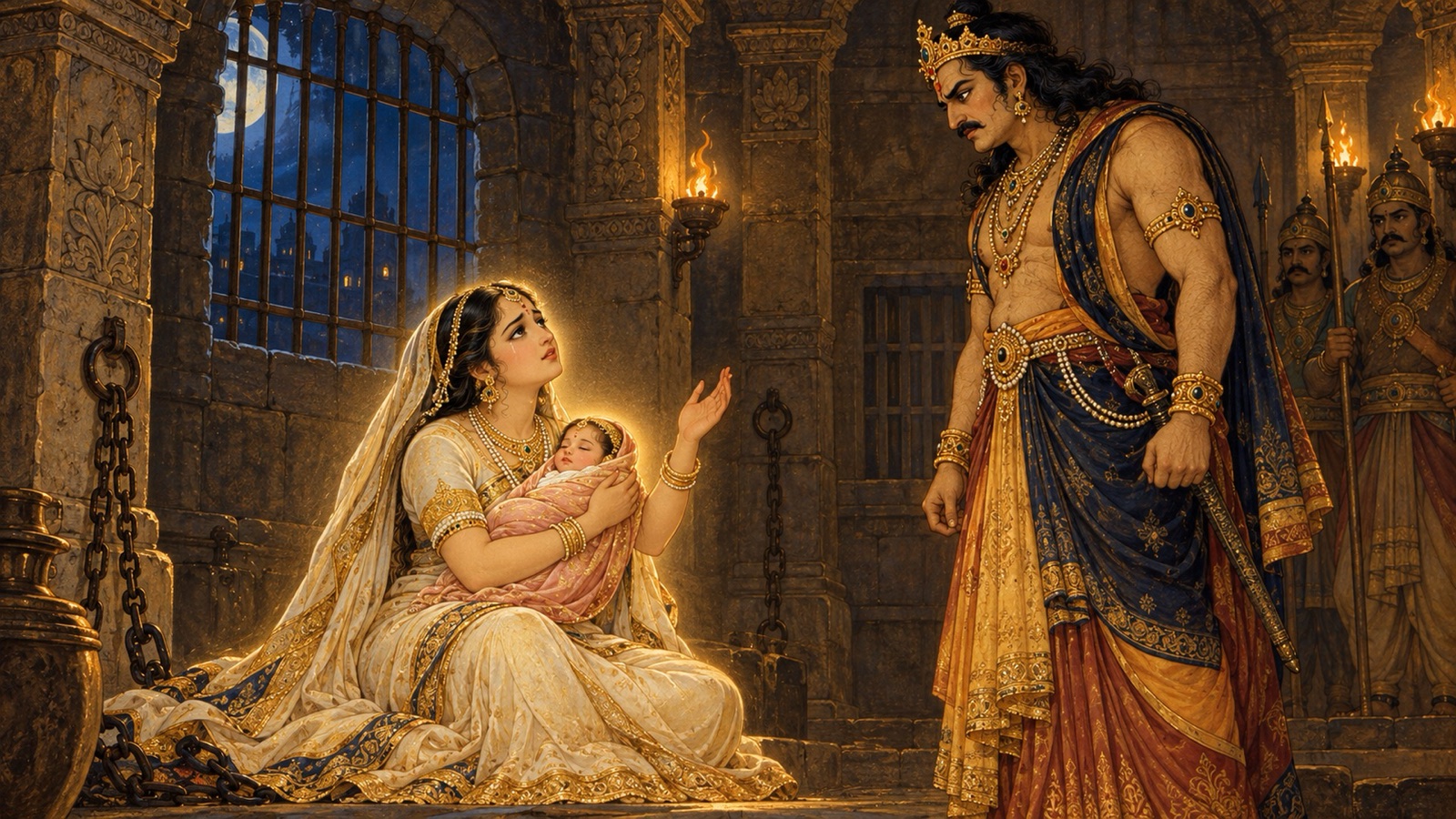
There the wretched but shining Devaki appealed to her cousin most piteously. This child, she said, was as a daughter-in-law to him, and it was not right to kill a female infant. He had already slain many babes bright as fire, driven by the force of destiny; let this one solitary, helpless girl be given to her. She was his own younger cousin, her sons already killed and she therefore miserable; he ought, she begged, to grant her this last child.
Yogamaya Escapes and Utters Her Prophecy
Weeping like the most helpless of women and hugging her daughter, Devaki entreated the king; but the wicked one rebuked her harshly and snatched the baby from her hands. Yet the moment he sought to strike her against the stone, the child slipped from his grasp — for this was no ordinary infant, but the Lord’s own mystic energy — and rose at once into the heavens.
सा तद्धस्तात् समुत्पत्य सद्यो देव्यम्बरं गता । अदृश्यतानुजा विष्णो: सायुधाष्टमहाभुजा ॥ ९ ॥
sā tad-dhastāt samutpatya sadyo devy ambaraṁ gatā adṛśyatānujā viṣṇoḥ sāyudhāṣṭa-mahābhujā
Meaning: Slipping from his hand, she at once rose into the sky and appeared there as the younger sister of Vishnu — a goddess with eight mighty arms, each bearing a weapon. (Canto 10, Chapter 4, verse 9)
There she stood revealed, adorned with celestial garlands, garments, sandal-paste, and jewelled ornaments, wielding a bow, a pike, an arrow, a shield, a sword, a conch, a discus, and a mace in her eight hands. Hymned by Siddhas, Caranas, Gandharvas, Apsaras, Kinnaras, and Nagas, who offered her worship, she spoke to the astonished king.
किं मया हतया मन्द जात: खलु तवान्तकृत् । यत्र क्व वा पूर्वशत्रुर्मा हिंसी: कृपणान् वृथा ॥ १२ ॥
kiṁ mayā hatayā manda jātaḥ khalu tavānta-kṛt yatra kva vā pūrva-śatrur mā hiṁsīḥ kṛpaṇān vṛthā
Meaning: What will you gain by slaying me, O foolish one? He who will bring about your end — your enemy of former lives — has already taken birth somewhere. Do not needlessly kill other helpless children. (Canto 10, Chapter 4, verse 12)
Having warned him thus, the divine Maya of the Lord departed and took her place upon the earth, worshipped ever after in shrines of many names under many names of her own.
इति प्रभाष्य तं देवी माया भगवती भुवि । बहुनामनिकेतेषु बहुनामा बभूव ह ॥ १३ ॥
iti prabhāṣya taṁ devī māyā bhagavatī bhuvi bahu-nāma-niketeṣu bahu-nāmā babhūva ha
Meaning: Having spoken thus to him, the divine goddess Maya became present upon the earth, worshipped by many names in temples of many names. (Canto 10, Chapter 4, verse 13)
Kamsa’s Remorse and the Wisdom of the Self
Amazed by the goddess’s words, Kamsa at once released Vasudeva and Devaki from their chains and spoke to them with unexpected humility. He confessed that, like an ogre devouring its own young, he had killed so many of their sons, sinner that he was; that having cast off compassion and disowned his own kin, he was as good as dead though still breathing, and could only fall into the darkest regions like a slayer of brahmanas. He had trusted the words of gods and men, he lamented, and for that faith had murdered innocent babes.
Then, remarkably, the repentant king consoled the grieving parents with a teaching on the eternal soul. They should not lament their sons, he said, for every living being reaps only what it has sown, and none abides forever or in one place, all being under the sway of destiny. As earthen pots appear upon the earth and pass away while the earth itself is unchanged, so bodies come and go while the Self within remains untouched.
भुवि भौमानि भूतानि यथा यान्त्यपयान्ति च । नायमात्मा तथैतेषु विपर्येति यथैव भू: ॥ १९ ॥
bhuvi bhaumāni bhūtāni yathā yānty apayānti ca nāyam ātmā tathaiteṣu viparyeti yathaiva bhūḥ
Meaning: As earthly things made of clay come into being and pass away upon the earth, so bodies appear and vanish; yet the Self within them does not change, just as the earth itself does not. (Canto 10, Chapter 4, verse 19)
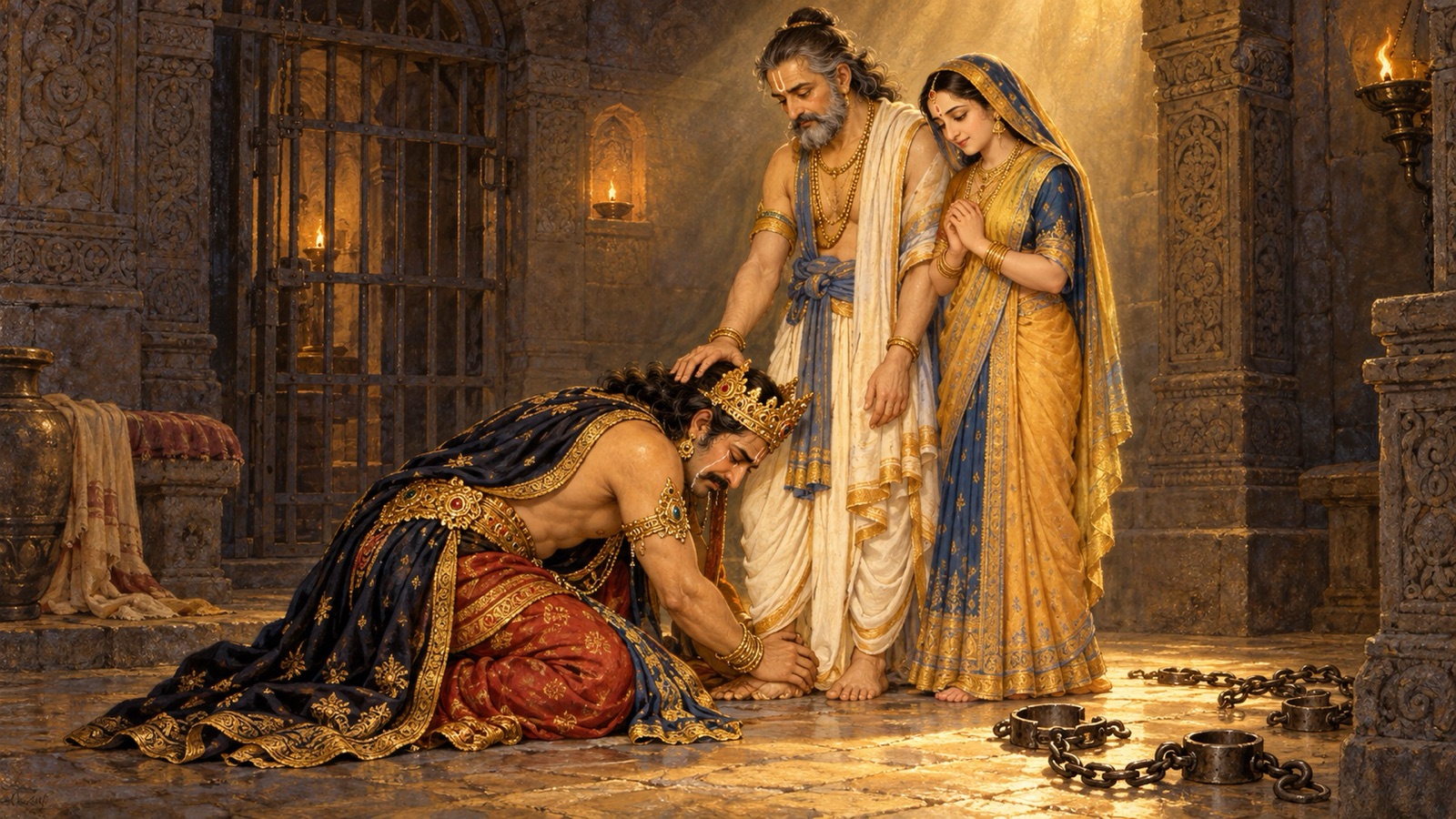
Kamsa explained that only through ignorance does one identify the self with the body, and from that error springs the sense of “mine” and “not mine,” of union and separation, keeping the soul bound to rebirth. He begged Devaki and Vasudeva to forgive his wickedness, for the pious are ever kind to the afflicted; and with tears streaming down his face he clasped their feet. Reassured by the goddess’s prophecy, he set them free. Devaki forgave her repentant cousin and let go of her anger, and Vasudeva, smiling, agreed that the notion “I am this body” is born of ignorance, and that those clouded by grief, fear, greed, and pride cannot see that it is the Lord, as the spirit of Time, who moves beings against beings.
The Demons’ Sinister Counsel
Thus appeased and given leave, Kamsa withdrew to his palace. But when the night had passed, he summoned his counsellors and told them all that Yogamaya had revealed. Hearing their master, the demons — sworn enemies of the gods, resentful and far from wise — urged a monstrous plan: they would kill every infant in the towns, villages, and cowherd stations, whether ten days old or younger. They mocked the gods as cowards, scorned the power of Vishnu, Shiva, Indra, and Brahma, and pressed Kamsa to let them destroy Vishnu wherever He might be hidden as a child. An enemy left unchecked, they warned, grows impossible to uproot, like a disease ignored until it takes hold.
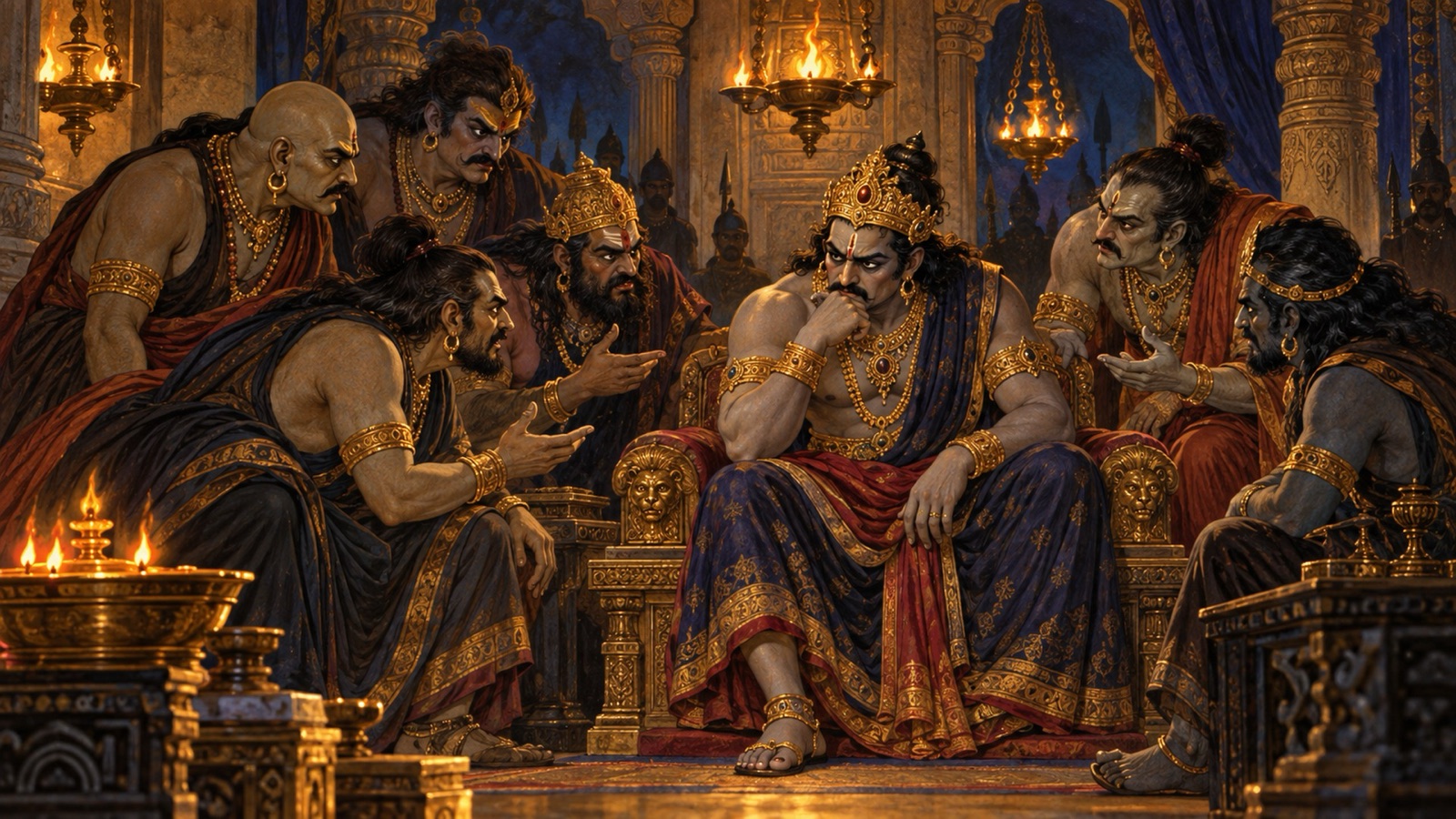
Their counsel then turned to a darker logic. Vishnu, they said, is the very root of the gods, and He abides wherever the eternal religion is upheld — sustained by the Veda, the cow, the brahmana, austerity, and sacrifice. To strike at these, they reasoned, was to strike at the Lord Himself.
विप्रा गावश्च वेदाश्च तप: सत्यं दम: शम: । श्रद्धा दया तितिक्षा च क्रतवश्च हरेस्तनू: ॥ ४१ ॥
viprā gāvaś ca vedāś ca tapaḥ satyaṁ damaḥ śamaḥ śraddhā dayā titikṣā ca kratavaś ca hares tanūḥ
Meaning: The brahmanas and the cows, the Vedas, austerity, truthfulness, control of the senses and of the mind, faith, compassion, forbearance, and sacrifice — all these are the very limbs, the embodied forms, of Lord Hari. (Canto 10, Chapter 4, verse 41)
Since the Lord is the master of all the gods, the enemy of the demons, and the indweller of every heart — the source from whom even Shiva and Brahma arise — the demons concluded that to extirpate the sages was the surest way to strike at Vishnu.
Kamsa Commands the Persecution
Having taken counsel with these wicked advisers, the evil-minded king, already caught fast in the snare of death, judged the destruction of the brahmanas to be for his own good. He commanded the demons — who could take any form they pleased and delighted in tormenting others — to oppress the righteous in every quarter, and then retired into his palace. Ruled by passion and darkness, their doom drawing near, the demons set about their cruelty against the virtuous.
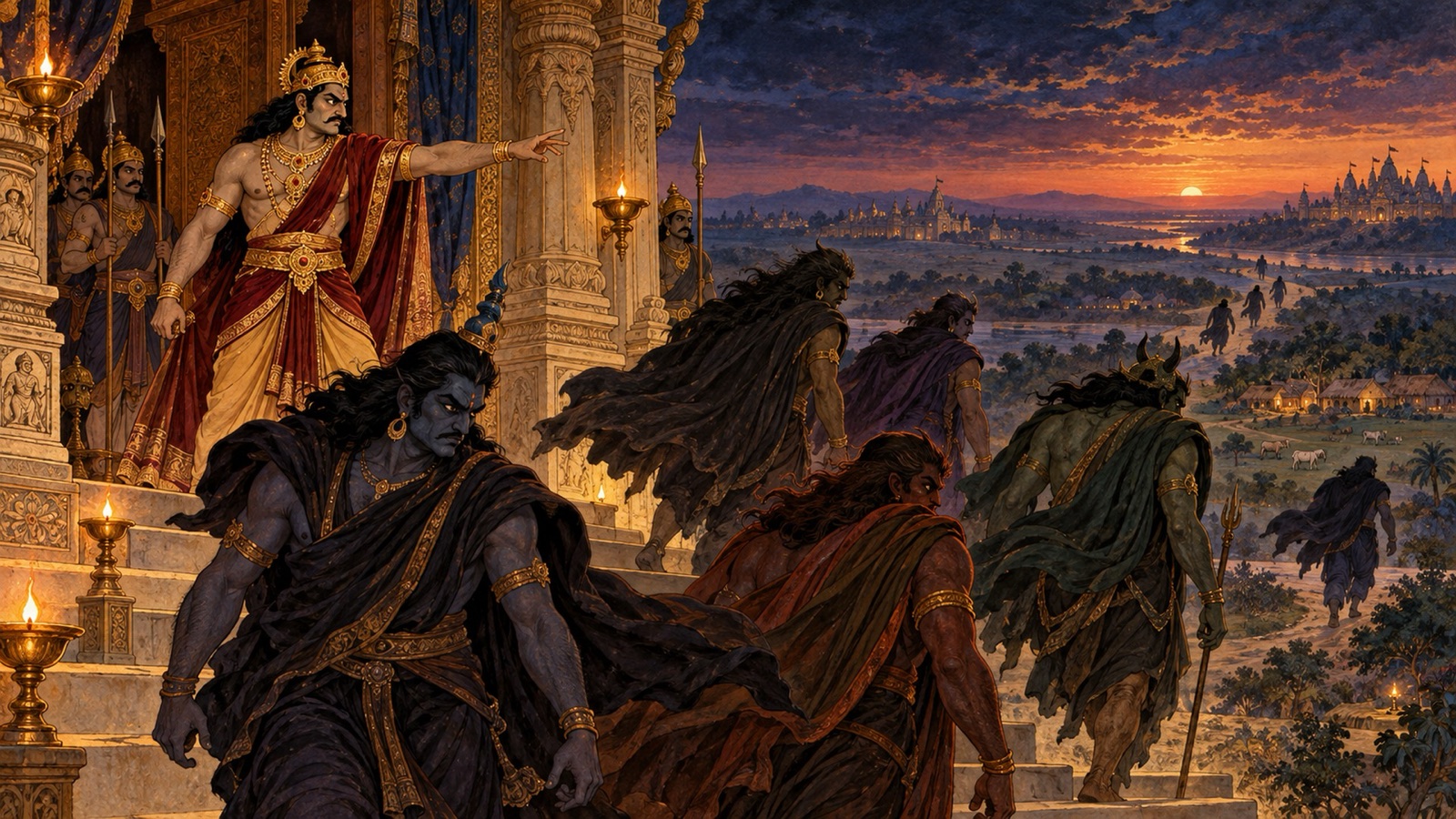
Sukadeva closes the chapter with a solemn warning, true for every age: an offence against an exalted soul consumes everything a person holds dear.
आयु: श्रियं यशो धर्मं लोकानाशिष एव च । हन्ति श्रेयांसि सर्वाणि पुंसो महदतिक्रम: ॥ ४६ ॥
āyuḥ śriyaṁ yaśo dharmaṁ lokān āśiṣa eva ca hanti śreyāṁsi sarvāṇi puṁso mahad-atikramaḥ
Meaning: An outrage committed against a great soul destroys a person’s very life, prosperity, fame, and merit, his claim to the higher worlds and his cherished aims — indeed, every one of his blessings. (Canto 10, Chapter 4, verse 46)
Principal Teachings of This Chapter
1. The Lord’s power cannot be seized by force. The moment Kamsa lays hold of the divine child, she slips away and rises beyond his reach. No tyrant can grasp or destroy the energy of the Lord; violence against the divine only reveals its own helplessness (verses 7-9).
2. Providence announces what no force can prevent. Yogamaya’s prophecy — that the destroyer is already born — shows that the divine plan unfolds on its own terms; the frightened efforts of the wicked cannot forestall it (verses 12-13).
3. The self is untouched by the death of the body. Even from the mouth of Kamsa comes the great teaching that the soul, like the unchanging earth beneath its passing pots, is never truly slain. Grief for the departed softens in the light of this truth (verses 18-22).
4. Remorse without steadiness does not last. Kamsa weeps, frees his prisoners, and speaks like a sage — yet a single night of evil counsel undoes it all. Genuine change must be guarded, or bad company will quickly reclaim the heart (verses 23-30).
5. Dharma lives in the brahmanas, cows, Veda, and sacrifice. Even the demons recognise that the Lord dwells wherever these are honoured. What they plot to destroy, the devotee is called to cherish and protect (verses 39-41).
A Devotional Reflection
There is a strange mercy hidden in this dark chapter. For one trembling hour, even Kamsa becomes a teacher of the truth — freeing his captives, weeping at their feet, speaking of the deathless self. It is a glimpse of what he might have been. And then the counsellors arrive, and the light goes out. The contrast is a mirror held up to our own hearts: how often we too are moved to sincerity, resolve to be gentler and truer, and then let a stray voice, a familiar temptation, talk us back into our old ways. The chapter quietly asks us to guard the tender moments when grace touches us, to keep the company that steadies our better resolves, and to remember that what the wicked seek to destroy — the sages, the scriptures, the innocent, all that is holy — is precisely what the devotee is meant to shelter and love.
A Daily Devotional Practice
Today, recall a moment when your heart was softened toward the good — a resolve to be kinder, more honest, more devoted. Instead of letting it fade, write it down or speak it aloud, and choose one small act to honour it before the day ends. Guard that resolve from the “counsellors” of doubt and habit. As you begin, chant: “Om Namo Bhagavate Vasudevaya.”
Conclusion
The fourth chapter of the Tenth Canto turns on a single, luminous instant: the child that Kamsa means to destroy slips from his hands and rises as an eight-armed goddess, declaring that his end is already born. In that instant the whole terror of the tyrant is exposed as powerless. For a moment even Kamsa is transformed, freeing his prisoners and teaching the imperishable self; but his demon counsellors soon draw him back into cruelty, and he sets loose a persecution of the righteous across the land. The chapter ends with a warning that echoes down the ages — that violence against the holy consumes the wrongdoer’s every blessing. Even so, the Lord Himself now rests safely in Gokula, and the joy of Vraja is about to begin. In the chapters to come, the child of the cowherds will start the pastimes that turn all this darkness to light.
May the divine wisdom of Srimad Bhagavatam awaken pure devotion within our hearts.
Om Namo Bhagavate Vasudevaya.
Jay Shree Madhav.
References and Attribution
- Primary edition: Gita Press, Śrīmad Bhāgavata Mahāpurāṇa (English, complete), Book Ten (First Half), Discourse 4.
- Series: Srimad Bhagavatam Wisdom · Biswa Sanatan Dharma Seva Trust.
- Presented following the spiritual guidance and recommendation of Pandit Dr. Shri Kashinath Mishra.
This is an original, faithful retelling in the writer’s own words, with brief quoted verses shown in Devanāgarī and transliteration and their meanings given as summaries. It is not a reproduction of any single publisher’s continuous translation or commentary. No affiliation with or endorsement by any publisher is implied.
Jay Shree Madhav