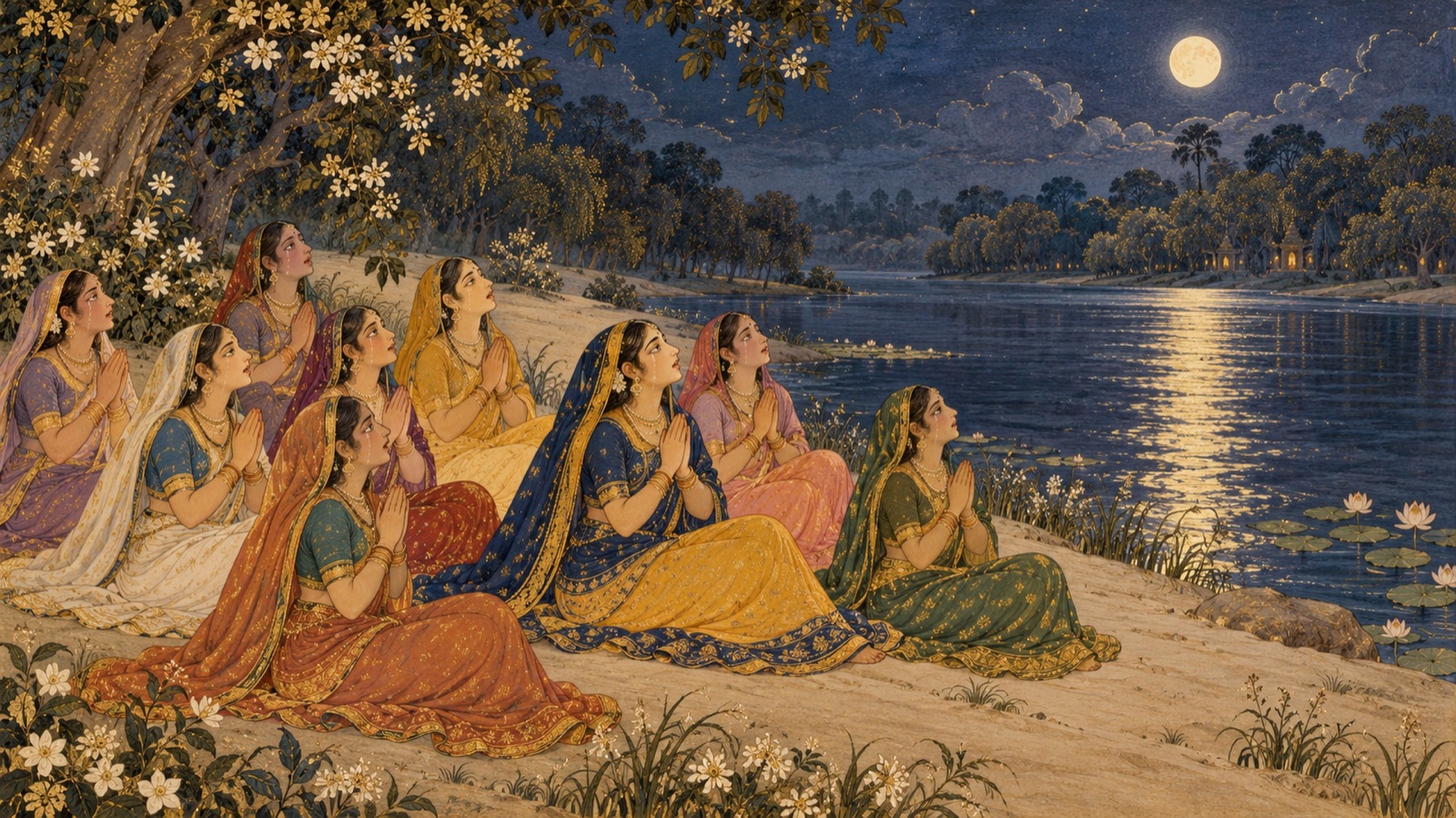
On the moonlit sand of the Yamuna, the cowherd women of Vraja, their Beloved gone from their midst, pour out a song that asks for nothing but Him.
Om Namo Bhagavate Vasudevaya.
Om Namo Bhagavate Vasudevaya.
Om Namo Bhagavate Vasudevaya.
Welcome back to Srimad Bhagavatam Wisdom, our devotional journey through the sacred histories and teachings of the Srimad Bhagavat Mahapurana. From first word to last, the thirty-first chapter of the Tenth Canto is one unbroken song, raised by the cowherd women of Vraja on the bank of the Kalindi after Sri Krishna withdrew from their sight. Devotees know these nineteen verses by the name the Sanskrit colophon gives them — the Gopi-gita.
Chapter Information
- Scripture: Śrīmad Bhāgavata Mahāpurāṇa
- Canto: 10 (Book Ten, First Half)
- Chapter: 31 (Discourse 31)
- Chapter title: The Gopis’ Songs of Separation (Gopī-gīta)
- Principal speaker: The gopis of Vraja, as recounted by Sukadeva Gosvami
- Principal listener: Sri Krishna, whom they address throughout; King Parikshit hears the account
- Main setting: The sandy bank of the Kalindi (Yamuna) in Vrindavana, by moonlight
- Central subject: The song of the cowherd women of Vraja in separation from Sri Krishna
- Principal verse range: Canto 10, Chapter 31, verses 1–19
- Primary edition: Gita Press Śrīmad Bhāgavata Mahāpurāṇa (English, complete edition)
Context From the Previous Chapter
When Krishna vanished from the rasa dance, the gopis wandered the groves, questioned the trees and creepers, traced His footprints and searched until the moonlight failed. Returning to the sandy bank of the Kalindi, absorbed in Him and longing for His return, they sang of Him in chorus.
The Song Rises on the Bank of the Kalindi
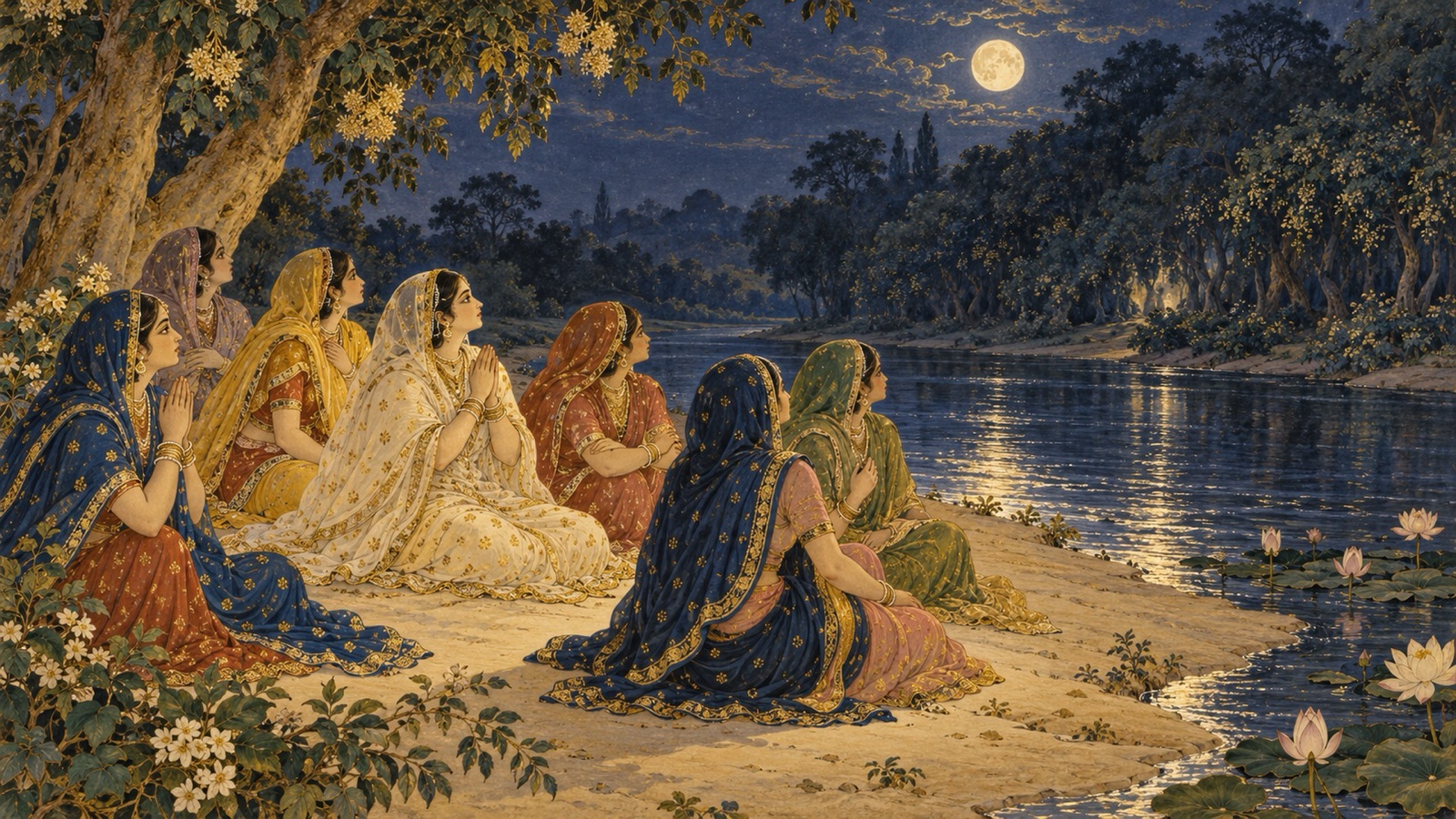
On the cool sand, moonlight lying broken upon the water, they turned toward the dark forest and sang — not to one another but to Him, as though He stood near enough to hear. Their opening words are praise, not complaint: this small cowherd settlement shines brighter than anywhere in creation because He consented to be born here, and since that hour the goddess of fortune has never agreed to leave it.
गोप्य ऊचु:
जयति तेऽधिकं जन्मना व्रज:
श्रयत इन्दिरा शश्वदत्र हि ।
दयित दृश्यतां दिक्षु तावका-
स्त्वयि धृतासवस्त्वां विचिन्वते ॥ १ ॥
gopya ūcuḥ jayati te ’dhikaṁ janmanā vrajaḥ śrayata indirā śaśvad atra hi dayita dṛśyatāṁ dikṣu tāvakās tvayi dhṛtāsavas tvāṁ vicinvate
Meaning: Vraja is glorified beyond measure by Your birth here, for Indira, the goddess of fortune, dwells within it unceasingly. O Beloved, look about You in every direction: these women of Yours, who have placed their very life in You, are searching everywhere for You. (Canto 10, Chapter 31, verse 1)
Only after honouring the land that received Him do they mention themselves. Those eyes of His, they sing, stealing the splendour of a lotus newly opened in an autumn pond, are striking down the very women who serve Him without wage; is this not slaughter, they ask Him plainly — a boldness belonging to love alone.
Remembering How Often He Has Saved Them
From pain the song turns, as devotion does, to remembrance. Over and over, they recall, He has drawn all Vraja out of the mouth of death: from water made deadly by poison, from the coils of a demon disguised as a serpent, from a punishing downpour and a tearing wind, from the fire of lightning, from a demon who stood among the herd in the body of a calf, and from the demon son of Maya.
विषजलाप्ययाद् व्यालराक्षसाद्
वर्षमारुताद् वैद्युतानलात् ।
वृषमयात्मजाद् विश्वतो भया-
दृषभ ते वयं रक्षिता मुहु: ॥ ३ ॥
viṣa-jalāpyayād vyāla-rākṣasād varṣa-mārutād vaidyutānalāt vṛṣa-mayātmajād viśvato bhayād ṛṣabha te vayaṁ rakṣitā muhuḥ
Meaning: From poisoned water, from the serpent-demon, from the rain and the storm-wind, from the fire of lightning, from the demon in the form of a calf and from the son of Maya, and from every fear in the world, we have been protected over and over by You, O best among men. (Canto 10, Chapter 31, verse 3)
The memory carries an unspoken question: if He has drawn them out of every peril, will He now let them perish of His absence?
He Is Not the Son of a Cowherd Woman Alone
Then the song lifts clear out of Vraja. These village women, who have never left their pasture lands, declare whom they weep for.
न खलु गोपीकानन्दनो भवान्
अखिलदेहिनामन्तरात्मदृक् ।
विखनसार्थितो विश्वगुप्तये
सख उदेयिवान् सात्वतां कुले ॥ ४ ॥
na khalu gopīkā-nandano bhavān akhila-dehinām antarātma-dṛk vikhanasārthito viśva-guptaye sakha udeyivān sātvatāṁ kule
Meaning: You are certainly not merely the son of a cowherd woman; You are the witness dwelling within the inner self of every embodied being. O friend, entreated by Brahma, You have appeared in the dynasty of the Satvatas for the protection of the universe. (Canto 10, Chapter 31, verse 4)

Theirs is no village fondness for a charming local boy. It is offered with open eyes to the Supreme Person who sees from within every heart and came down at the creator’s entreaty to shelter the worlds. Knowing that, they still call Him dearest — the wonder of Vraja, where highest truth and closest affection rest in one breath.
Their Prayer for His Hand, His Face and His Feet
Having said who He is, they beg for what He alone can give. Lay that lotus palm upon our heads, they sing — the hand that grants fearlessness to all who approach His feet dreading birth and death, that fulfils whatever is asked of it, that clasped the hand of Sri. O remover of Vraja’s sorrows, whose smile crushes the pride of His own people, accept these servants and show them that beautiful lotus face again. Then they ask for His feet: feet that wash away the sins of all who bow, that follow patiently behind grass-eating cattle, that are the dwelling place of fortune, that were set fearlessly upon the hoods of the serpent in this very river. Place them upon our bosoms, they pray, and cut away the longing pent up within us.
The Nectar of His Speech and the Gift of His Story
Their next prayer is for His voice. They are ready to do whatever He bids, they say, and are left bewildered by that melodious speech with its charming turns of phrase, which delights even the learned; let the lotus-eyed Lord revive them with the nectar of His lips. Then, amid grief, the song does something unforgettable: it stops asking for anything and blesses the world instead.
तव कथामृतं तप्तजीवनं
कविभिरीडितं कल्मषापहम् ।
श्रवणमङ्गलं श्रीमदाततं
भुवि गृणन्ति ये भूरिदा जना: ॥ ९ ॥
tava kathāmṛtaṁ tapta-jīvanaṁ kavibhir īḍitaṁ kalmaṣāpaham śravaṇa-maṅgalaṁ śrīmad ātataṁ bhuvi gṛṇanti ye bhūri-dā janāḥ
Meaning: Your nectarean story is life itself to those who suffer; it is sung by the wise, it washes away sin, it is auspicious merely to hear, and it is rich with all good. Those who spread it abroad upon this earth are the most munificent of givers. (Canto 10, Chapter 31, verse 9)
Even in such separation they remember that what they taste can be shared. Telling and hearing His glories is medicine for every afflicted heart, and those who carry that telling across the earth give the greatest gift there is.

Memories That Will Not Let the Heart Rest
Then memory returns and will not be quieted: His hearty laughter, His loving sidelong glance, His pastimes that bless whoever contemplates them, the playful words spoken in confidence that went straight into the heart. All of it stirs their minds unbearably now, and they call Him, half in reproach and wholly in helplessness, a deceiver.
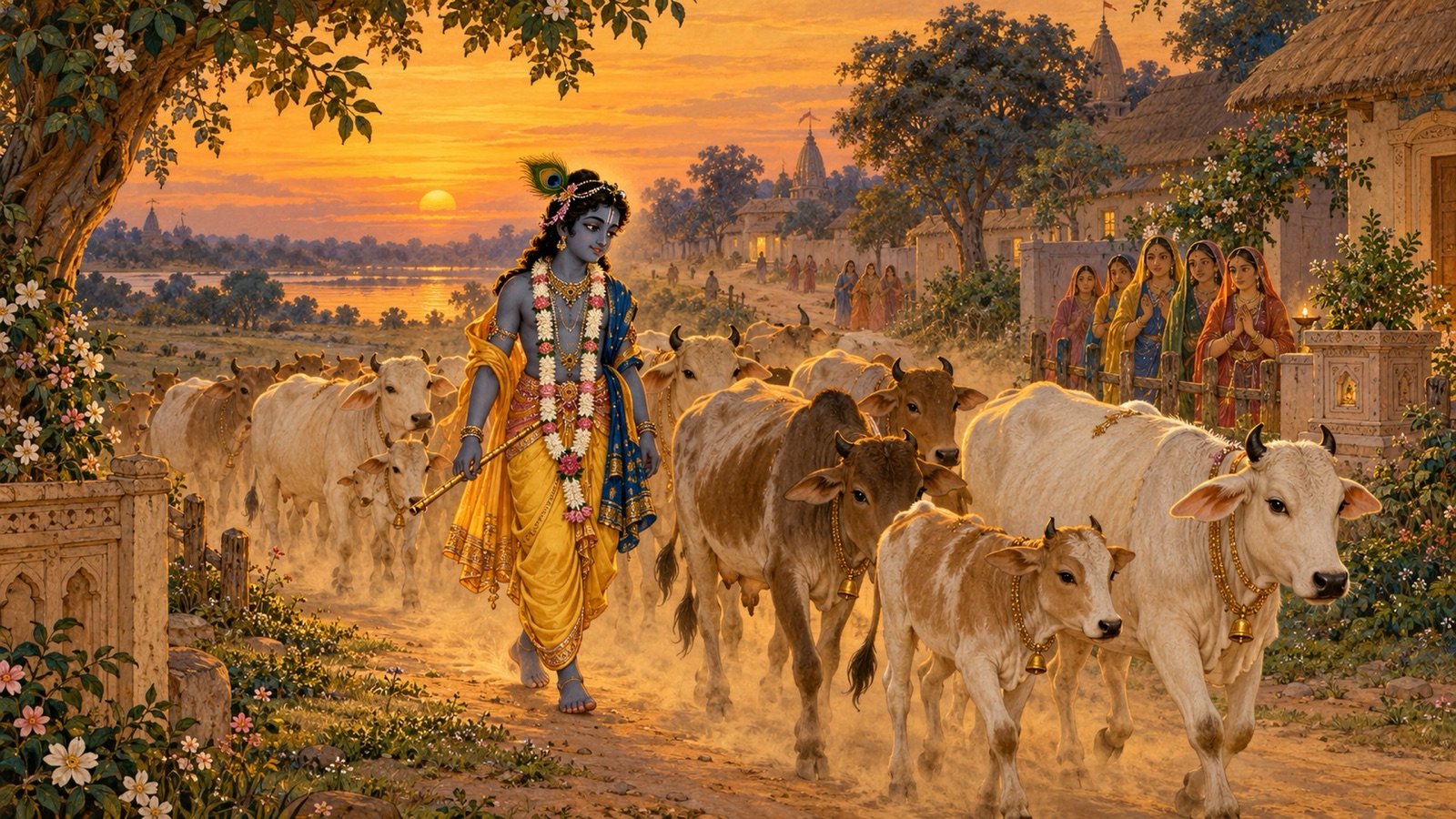
The next memory is not of their joy but of their fear for Him. Each morning He walks out of Vraja behind the cattle, and all day they are uneasy that feet delicate as a lotus must press upon sharp grass, husks of grain and hard sprouts. Each evening He returns, His face framed in dark curly locks and greyed with the dust the cows raise, and shows Himself to them — and that sight kindles their love afresh.
When a Fraction of a Moment Becomes an Age
Once more the song returns to His feet and cannot say enough of them: they grant the desires of all who bow low, they are worshipped by the lotus-born Brahma, they ornament the earth, they are the refuge to meditate upon in calamity. Set them on our bosoms, the gopis beg, and relieve this agony. Give us too the nectar of Your lips, which heightens joy and destroys grief, which the flute drinks fully whenever You sound it, and which makes one forget every other attachment. Then, in one astonishing line, they measure what His absence does to time.
अटति यद् भवानह्नि काननं
त्रुटि युगायते त्वामपश्यताम् ।
कुटिलकुन्तलं श्रीमुखं च ते
जड उदीक्षतां पक्ष्मकृद् दृशाम् ॥ १५ ॥
aṭati yad bhavān ahni kānanaṁ truṭi yugāyate tvām apaśyatām kuṭila-kuntalaṁ śrī-mukhaṁ ca te jaḍa udīkṣatāṁ pakṣma-kṛd dṛśām
Meaning: When You go off to the woods by day, a fraction of a second becomes an age for us who cannot see You. And how dull-witted is the one who fashioned eyelids for the eyes that gaze upon Your lovely face with its curling locks. (Canto 10, Chapter 31, verse 15)
All Else Left Behind for His Sake
Now they remind Him what this love has cost. Husbands, children, kinsmen and brothers were all stepped over and left behind on the night when, enchanted by the shrill note of His flute and knowing His ways well, they came out to Him. What man but a trickster, they ask, abandons helpless women at such an hour? His secret words, the love rising in their hearts, His smiling countenance, His affectionate look, His broad chest where Sri resides — all of it returns and overwhelms them. Then they state the plain truth of His advent: His appearance has ended the sorrow of all who dwell in the forests of Vraja and is wholly auspicious for the universe; let Him unreservedly give a little of that remedy which cures the heart-disease of His own people.
Their Last Prayer
In the closing verse the gopis forget themselves altogether.
यत्ते सुजातचरणाम्बुरुहं स्तनेषु
भीता: शनै: प्रिय दधीमहि कर्कशेषु ।
तेनाटवीमटसि तद् व्यथते न किंस्वित्
कूर्पादिभिर्भ्रमति धीर्भवदायुषां न: ॥ १९ ॥
yat te sujāta-caraṇāmburuhaṁ staneṣu bhītāḥ śanaiḥ priya dadhīmahi karkaśeṣu tenāṭavīm aṭasi tad vyathate na kiṁ svit kūrpādibhir bhramati dhīr bhavad-āyuṣāṁ naḥ
Meaning: Those tender lotus feet of Yours, O Beloved, which we place slowly and fearfully upon our hard bosoms — with those very feet You wander the forest paths. Are they not hurt by the pebbles and the rough ground? Our minds reel at the thought, for You are our very life. (Canto 10, Chapter 31, verse 19)
Here the song reveals what it has moved toward from the first. Those who began by saying His glance was killing them end with no word of their own pain, troubled only that gravel on a forest path might bruise His feet. Love still turned partly upon itself asks to be relieved of its wound; love that separation has purified forgets the wound and aches only for the Beloved’s comfort. And since they have already declared Him the witness within every heart, descended for the protection of the worlds (verse 4), this is not sentiment but the highest worship scripture knows. Separation borne in love does not weaken devotion; it burns away whatever in devotion was still about oneself.

Principal Teachings of This Chapter
1. Wherever He is received becomes glorious. Vraja shines above all places because He was born there and the goddess of fortune would not afterwards leave it (verse 1).
2. Remembrance is the medicine of separation. The gopis meet grief by recounting every rescue He has worked (verse 3). When the Lord seems distant, recalling what He has already done steadies the soul.
3. He is the witness seated within every heart. The cowherd women themselves declare Him not a village child but the inner witness of all beings, descended at Brahma’s entreaty (verse 4). Closeness to Him never requires thinking Him small.
4. Spreading His story is the greatest charity. Those who recite His nectarean glories widely are named the most munificent of givers, for what they distribute is life to the afflicted (verse 9).
5. Longing changes the measure of time. For one who cannot see Him, an instant stretches into an age (verse 15) — not weakness, but the mark of a heart that has found its only treasure.
6. Perfected love forgets itself. Their final prayer asks nothing for themselves, fearing only that His feet may be hurt (verse 19) — the summit toward which all devotion climbs.
A Devotional Reflection
Most of us learn to pray when something is missing. We begin by telling the Lord what His absence is doing to us — and there is nothing wrong in such a beginning; the Bhagavata puts it in the mouths of the purest lovers of God who ever lived. What this song shows is where such a prayer can travel if we let it run its course: from our own ache to His glory, from glory to gratitude for perils already survived in His care, from gratitude to the recognition of who He truly is, and from there to the wish that the whole world might taste the same nectar. By the last verse, the one praying has stopped speaking of herself. We cannot manufacture such love; we can let our prayers move in its direction — beginning honestly, refusing to stop there, ending in Him alone.
A Daily Devotional Practice
Today choose one verse of the Gopi-gita — their remembrance of His protection, their blessing upon all who speak of Him, or their last prayer for His feet — and carry it through your work. When the mind grows restless, turn from ache to remembrance: recall one way the Lord has protected you, and thank Him aloud. Then tell His story to one person, even in a sentence, and chant gently: Om Namo Bhagavate Vasudevaya.
Conclusion
Outwardly nothing happens here; inwardly everything is disclosed. On the sand of the Kalindi, in the fading moonlight, the cowherd women sing to a Lord they cannot see, and their song carries them from the wound of absence to praise, to gratitude, to the declaration that He is the witness within all hearts, and at last to a prayer that keeps nothing back for itself. May the Gopi-gita teach us to love Him so — honest in grief, bold in asking, and finally thinking only of Him.
May the divine wisdom of Srimad Bhagavatam awaken pure devotion within our hearts.
Om Namo Bhagavate Vasudevaya.
Jay Shree Madhav.
References and Attribution
- Primary edition: Gita Press, Śrīmad Bhāgavata Mahāpurāṇa (English, complete edition), Book Ten (First Half), Discourse 31.
- Series: Srimad Bhagavatam Wisdom · Biswa Sanatan Dharma Seva Trust.
- Presented following the spiritual guidance and recommendation of Pandit Dr. Shri Kashinath Mishra.
This is an original, faithful retelling in the writer’s own words, with brief quoted verses shown in Devanāgarī and transliteration and their meanings given as summaries. It is not a reproduction of any single publisher’s continuous translation or commentary. No affiliation with or endorsement by any publisher is implied.
Jay Shree Madhav